




Abstract
Public policy shapes the lives of individuals, and even more so if they depend on state support. In the case of unemployment, the financial situation is largely determined by cash transfers and daily routines depend on the involvement in active labour market policy measures. To what extent, however, can subjective well-being differences of European unemployed be traced back to the national design and generosity of labour market policy? This article applies multilevel and panel estimation techniques to identify the moderating effect of unemployment benefit generosity and active labour market policy on life satisfaction of the unemployed. While unemployment has strong negative life satisfaction effects in all 21 European countries under study, the generosity of passive labour market policy moderates this effect to a surprisingly large extent: the adverse effect of unemployment is almost doubled if unemployment benefits are meagre. This moderating effect can be explained both by a resource as well as a non-pecuniary mechanism. The positive moderating effect of active labour market policy is less robust across model specifications.
Keywords
Introduction
Public policy shapes various aspects of our lives, and this statement holds even more for groups whose everyday life depends heavily on state support. Indisputably, the life of the unemployed is affected more by welfare state design than the life of the average employee, with labour market policy having the largest impact. The level of unemployment benefits largely determines the financial situation of the unemployed. Furthermore, strict eligibility rules and short benefit durations may translate into dependence on means-tested social assistance benefits or family transfers and an increased risk that unemployment be stigmatic (Gallie and Paugam, 2000: 4). In addition to these monetary transfers that affect the unemployed, active labour market policy (ALMP) plays an increasingly important role in most European countries. How do these different kinds of labour market policies affect the subjective well-being of the unemployed?
Policy evaluations have analysed the effects of both active and passive labour market policy intensely, but this research is narrowly focused on objective outcomes such as employment, unemployment and wages. The effect of labour market policy on subjective well-being has only recently gained attention (Di Tella et al., 2003; Helliwell and Huang, 2011; Ochsen and Welsch, 2012), despite the vast literature proving the harmful life satisfaction effects of unemployment. Especially comparative research covering both active and passive labour market policies has been entirely missing up until this article. Given that many scholars demand that subjective well-being substitute or complement pecuniary indicators in the measurement of social welfare (e.g. Easterlin, 1974; Layard, 2011; Ng, 1997; Oswald, 1997), this lack of policy evaluation comes as a surprise. For policymakers, the well-being of the unemployed matters for two distinct reasons: first, the drop and consequently low level of subjective well-being among the unemployed are likely to affect job-search behaviour. While Mavridis (2010; see also Clark, 2003) finds that individuals who suffer from larger drops in life satisfaction after job loss have shorter unemployment durations, Anderson (2009: 348; see also Korpi, 1997; Waters and Moore, 2002) argues that low life satisfaction may translate into ‘discouragement, lower levels of skill acquisition, inferior performance in job interviews, and eventually a lower probability of job offers and successful job searches’. Second, improving the well-being of the socially disadvantaged in society is a core task of the welfare state. Accordingly, the EU has stressed the importance of social cohesion and inclusion in their growth strategy for the coming decade, Europe2020. 1
This article improves our understanding of the effects of labour market policy by jointly analysing the moderating effects of active as well as passive labour market policies on subjective well-being across a large European country sample. Furthermore, multilevel as well as panel data methods are applied to check whether the effect of changes in policies within countries differs from cross-sectional results. Survey data from four waves of the European Social Survey (ESS) are assembled for 21 European countries to be able to analyse and control for individual characteristics of respondents. These micro data are merged with macro-level data concerning labour market policy indicators. It is tested whether the design and generosity of the welfare state interact with the effect of unemployment on life satisfaction. Specifically, this article focuses on the question whether unemployment benefit generosity and a country’s commitment to ALMP mitigate the life satisfaction effect of unemployment. The empirical analysis shows that generous passive labour market policy moderates the negative life satisfaction effect of unemployment to an impressive extent, while the positive effects of ALMP turn out to be less robust. These relationships can be found both within countries over time as well as between countries in a cross-sectional analysis. I argue that the generosity of unemployment benefits affects life satisfaction of the unemployed through two mechanisms: in addition to an obvious resource mechanism, labour market policy also affects life satisfaction through a non-pecuniary mechanism that is linked to stigmatization and the position of the unemployed in society.
The article is structured as follows: first, the recent developments of European labour market policy are portrayed. The following section provides an overview of the effect of unemployment on well-being, with a special focus on the intervening effect of labour market policy. After the description of methodology and data with the depiction of descriptive statistics, the results of the multivariate analyses are presented and discussed. Finally, the conclusion completes the article.
Labour market policy, unemployment and life satisfaction
The ‘activation turn’ in European labour market policy
As a reaction to recurrent waves of mass unemployment and the disturbing expansion of long-term unemployment in Europe, criticism concerning inflexible labour markets and discouraging welfare state design has risen since the 1990s. Generous unemployment insurance schemes have been accused of raising the reservation wage of the unemployed and thus disincentivizing job search and employment. Even though cross-national comparisons analysing the connection between unemployment benefits and national unemployment rates are contradictory in their findings (see Sjöberg et al., 2010: 429–30), the positive effect of unemployment benefit generosity on unemployment duration is indeed one of the most evident findings in the microeconometric literature (see Tatsiramos and Van Ours, 2012). European policymakers have reformed their labour market policy design heavily over the past decades, with activation becoming a central component of modern welfare states. Broadly speaking, this ‘activation turn’ is composed of at least two components: first, active labour market policy has gained in importance, with many countries expanding on training measures, job-search assistance and employment subsidies. Second, reforms have tended to be restrictive concerning passive labour market policy: ‘Eligibility criteria have been tightened, benefit levels have been reduced, benefits have been made conditional on employment, and the duration of receipt has been shortened’ (Kenworthy, 2010: 438). Furthermore, different tiers of unemployment benefits have been homogenized in order to avoid disincentive effects of high replacement rates (Clasen and Clegg, 2011: 7). While the specific pattern of policy change differs quite considerably between European welfare states, it is fair to speak of a general shift from passive towards active (and activating) labour market policy.
The effects of this policy shift have been analysed with respect to outcomes such as employment, unemployment and income, with micro-level studies being somewhat more optimistic than macro-level evaluations (Bonoli, 2010: 450). This discrepancy between micro-level and macro-level analyses might well be due to substitution effects between participants and non-participants of, for example, training schemes, yet proving these effects is methodologically more than challenging.
Well-being effects of unemployment and the intervening effect of labour market policy
Evaluations of labour market policies generally ignore the fact that unemployment is connected to more than strictly financial consequences, although the multidimensional ‘negative effects are cumulative, and they act individually and jointly to undermine and subvert personal and social life’ (Sen, 1997: 160). The psychosocial effects of unemployment were first described by Jahoda et al. (1933). In her deprivation theory, Jahoda (1982: 59) argues that the unemployed are deprived of five essential experience categories of work: (1) imposition of a time structure, (2) social contacts, (3) participation in a collective purpose, (4) status and identity and (5) required regular activity. Accordingly, the disintegration of social networks that comprise ties between individuals and society is a core aspect in the social exclusion literature with respect to unemployment (e.g. Gallie and Paugam, 2000; Hammer, 2003; Room, 1995). Furthermore, Fryer (1986) stresses the importance of agency and control in the connection between unemployment and well-being, as unemployment prevents the individual from being economically self-sufficient and restricts control over the own life course.
As suggested by these psychosocial factors, a detrimental life satisfaction effect of unemployment has consistently been found across countries, time and research designs (e.g. Carroll, 2007; Clark and Oswald, 1994; Gerlach and Stephan, 1996; Khattab and Fenton, 2009; Van Praag and Ferrer-i-Carbonell, 2002; Winkelmann and Winkelmann, 1998). Even after controlling for income, time-consistent personality traits and other socioeconomic preconditions, the lack of paid employment causes a considerable drop in the well-being of affected individuals. Furthermore, financial hardship among the unemployed is connected to high psychological distress (Gallie and Russell, 1998: 269), so that both non-pecuniary and pecuniary factors cause life satisfaction to fall.
Several scholars have called for governments to take well-being effects into account in their policy design (e.g. Carroll, 2007; Clark and Oswald, 1994; Layard, 2011; Sen, 1997). To do so, the intervening effect of policies needs to be understood first. Yet, the extensive literature on well-being effects of unemployment, on the one hand, and labour market policy evaluation, on the other hand, has largely ignored the call to connect both research areas. The few studies that analyse the intervening effect of labour market policy reach contradictory conclusions. Di Tella et al. (2003) find a positive effect of unemployment benefit replacement rates on average life satisfaction in 12 European nations between 1975 and 1992, while they do not find evidence for an interaction effect between benefit generosity and individual unemployment. These results are in line with the findings of Gallie and Russell (1998). Helliwell and Huang (2011) even show a slightly negative interaction effect of unemployment benefit replacement rates and unemployment in US states. They explain this counterintuitive result with potential endogeneity in policymaking: states in which unemployment is perceived to be especially harsh may be more generous in their benefits. In contrast to these results, Ochsen and Welsch (2012) find quite pronounced effects of labour market institutions such as employment protection legislation on the life satisfaction of average citizens and a particularly strong effect of benefit generosity on the unemployed in 10 European countries between 1975 and 2002, accounting for both level and duration of unemployment benefits. In general, the effect of unemployment benefit generosity on subjective well-being seems to be larger in studies that analyse European data rather than US data and use a more comprehensive measure of generosity than merely average replacement rates, covering additional features such as the duration of benefit entitlement. Most studies, however, only focus on the effect of replacement rates and disregard ALMP altogether.
The hypotheses in this article expect labour market policy to have a considerable impact on the well-being of the unemployed, as their living standards are highly dependent on state support. I argue that the generosity of the passive labour market policy may affect the unemployed through two mechanisms. The first mechanism is strictly tied to the resource dimension of financial hardship, that is, generous unemployment benefits enable the unemployed to consume goods that yield utility. The second factor is closely connected to the statement that policymakers implicitly or explicitly make about the status and identity of the unemployed in society by implementing a certain labour market policy. For instance, low generosity of insurance-based unemployment benefits and a higher reliance on means-tested social assistance benefits increase the risk that unemployment will be stigmatic (Gallie and Paugam, 2000: 4). Also, short durations and higher conditionality of benefits can be expected to be connected to high levels of psychological stress that go beyond the lack of financial resources that it might imply.
I expect both the pecuniary and the non-pecuniary aspects of passive labour market policy to lead to a moderating effect of unemployment benefit generosity on the life satisfaction of the unemployed. Hypothesis 1 thus expects the unemployed in a country with generous passive labour market policy to experience a smaller drop in well-being than the unemployed in in countries with meagre benefits and short benefit duration.
The influence of labour market policy on the lives of the unemployed is not limited to monetary transfers, though. The everyday lives of European unemployed are shaped by job-search assistance, training measures, work creation schemes and other ALMP measures that are likely to have an impact on well-being. Micro-level studies in Sweden, Germany and the United Kingdom have indeed pointed towards an increase in the well-being of unemployed who are currently participating in certain active labour market schemes (Andersen, 2008; Strandh, 2001; Wulfgramm, 2011). Moreover, Anderson (2009) conducted a multilevel analysis on the impact of ALMP on social ties in Europe and shows that labour market outsiders in countries with higher spending on ALMP tend to have a higher sense of social inclusion and report more frequent social interaction. There are, however, no comparative studies on the effect of ALMP on life satisfaction.
Applying Jahoda’s deprivation theory to ALMP measures, I argue that government training and occupational schemes can fulfil certain psychosocial functions of work and should thus have a positive effect on the life satisfaction of the unemployed. ALMP schemes offer opportunities for social contacts, are subject to a clear time structure and may even convey the feeling of participating in a useful collective purpose. Moreover, skill acquisition should enhance the feeling of control over one’s life. It should be kept in mind that not all ALMP spending is alike in its design and intentions, though. For instance, work creation schemes can have a strong enforcing character (Dingeldey, 2007) and participation may not be voluntary.
Hypothesis 2 expects ALMP to have a positive moderating effect on the life satisfaction of unemployment. The two core hypotheses of this article will be tested by applying multilevel and panel methods to survey data as well as macro-level data, as described in the following sections.
Methodology and model specification
As data are sampled from both the micro- and the macro level for four time periods, the regression analysis needs to account for the specificity of such a clustered design. In a nested data structure, that is, individual survey responses (level 1) are nested within country-waves (level 2) that are nested in countries (level 3), the influence of the contextual variables would be greatly biased towards high significance levels if the analysis treats all lower level observations as independent (see Hox, 2010: 3). To avoid spuriously significant results, the biased error terms need to be adjusted for the dependence of lower level observations within clusters. Both multilevel models and fixed effects estimations with clustered standard errors are applied in this study. While the first technique allows differences between countries to be exploited, the latter concentrates on within-country variations of policies and policy responses over time.
Multilevel models adjust biased standard errors by introducing random intercepts into the empirical analysis. This accounts for the high intra-cluster correlation (ICC = 0.13 in the null-model) in life satisfaction of respondents from the same country. Therefore, the models tested in this article have the following general design:

The endogenous variable life satisfaction
The main level 1 variable of interest is current unemployment of the respondent, as compared to employment, retirement, military or civil service, housework, being permanently sick or disabled and being a student as the main activity during the last 7 days. In addition, vector X consists of control variables at the individual level. These include gender, living with a partner, subjective health, 3 age, age squared, years of formal education and household income. 4 Vector Z contains macro variables concerning social and labour market policy. As the main exogenous variables, unemployment benefit generosity and expenditure on active labour market policy per unemployed as a percentage of GDP (gross domestic product) per capita are analysed. In addition, control variables at the country-wave level are included in the models. These level 2 control variables are the natural logarithm of GDP per capita, public social expenditure as a percentage of GDP as well as the unemployment rate. As the research question and core hypotheses suggest, two interaction effects are of special interest for this article. First, the moderating influence of passive labour market policy on the life satisfaction effect of unemployment is tested with the interaction term unemployment × unemployment benefit generosity. The second moderating influence of interest is the interaction term unemployment × ALMP expenditure per unemployed as a percentage of GDP per capita.
As this article relies on comparisons in life satisfaction responses across countries, criticism may arise concerning cultural or linguistic biases in the answering of well-being surveys. Despite studies that have suggested these general concerns to be exaggerated by comparing life satisfaction evaluations of hypothetical situations between countries (Bolle and Kemp, 2009), it might still be argued that life satisfaction differences are mainly driven by country-specific constant characteristics and that these characteristics are correlated to policy differences between countries. This might lead to endogeneity problems. Therefore, models that include country-fixed effects are estimated, with clustered standard errors at the country level. Thus, changes in the severity of the life satisfaction effect of unemployment can be traced back to policy changes within countries across time. It should be noted that most of the variance occurs between countries rather than within countries, though. This becomes especially obvious in the benefit generosity indicator, with an average within-country standard deviation of 2 as compared to an overall standard deviation of 19.1 (see Table 2). However, models with country-fixed effects may serve as a robustness test: If the moderating effect of labour market policy shows both between and within countries, the empirical evidence is quite strong. One further concern might be the argument that the life satisfaction scale from 0–10 is actually an ordinal representation of an underlying latent variable, implying an ordered logistic or probit estimation. This concern, however, has been proven to be mainly of a theoretical nature with few empirical implications (Ferrer-i-Carbonell and Frijters, 2004), while it inhibits the intuitive interpretation of coefficients, especially in case of interaction effects (Ai and Norton, 2003). In line with the findings of Ferrer-i-Carbonell and Frijters (2004), I refrain from treating the dependent variable as being ordinal.
Data: Merging macro-data with the European Social Survey
To test the hypotheses in the multilevel framework of this article, both micro-level and macro-level data are merged. Table 1 summarizes the main features of the micro-level dataset as well as macro-level control variables, while Table 2 shows descriptive statistics of the explanatory macro-level variables by country.
Descriptive statistics.
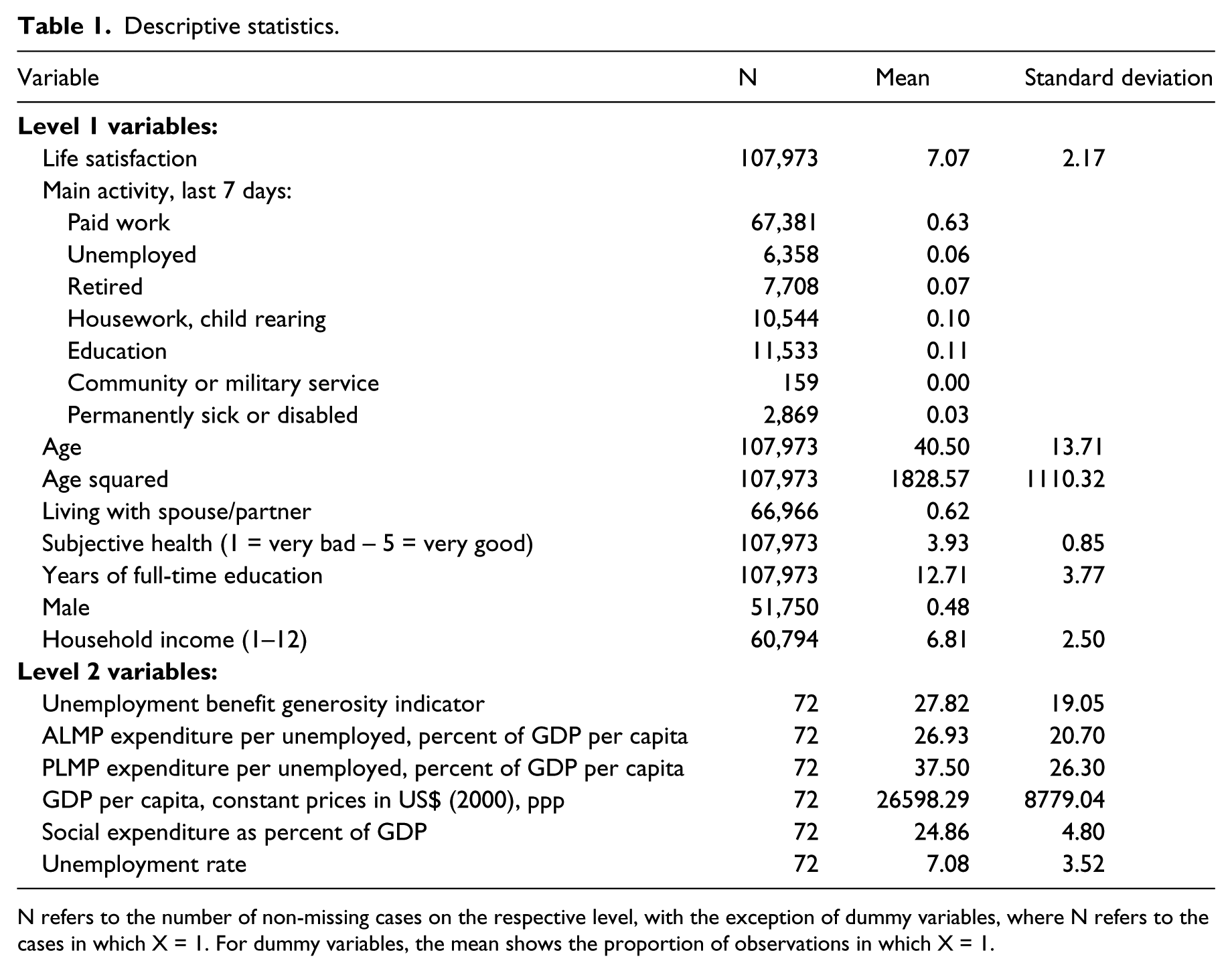
N refers to the number of non-missing cases on the respective level, with the exception of dummy variables, where N refers to the cases in which X = 1. For dummy variables, the mean shows the proportion of observations in which X = 1.
Labour market policy by country.

AT: Austria; BE: Belgium; CH: Switzerland; CZ: Czech Republic; DE: Germany; DK: Denmark; EE: Estonia; ES: Spain; FI: Finland; FR: France; GB: United Kingdom; HU: Hungary; IE: Ireland; IT: Italy; LU: Luxembourg; NL: the Netherlands; NO: Norway; PL: Poland; PT: Portugal; SE: Sweden; SK: Slovakia.
In percent of 48 months; for durations > 48 months, the indicator is set equal to 100.
On the micro-level, survey data from the ESS cover the dependent variable life satisfaction as well as exogenous variables that provide information about individual characteristics of respondents.
The data for this study are compiled of the first four waves of the survey for a total of 21 countries, with 16 to 20 countries that are included in the integrated dataset per wave: Austria, Belgium, Czech Republic, Denmark, Estonia, Finland, France, Germany, Hungary, Ireland, Italy, Luxembourg, the Netherlands, Norway, Poland, Portugal, Slovakia, Spain, Sweden, Switzerland and the United Kingdom. The respective interview periods of waves 1–4 are 2002/2003, 2004/2005, 2006/2007 and 2008/2009, respectively. As research questions aim at analysing the effect of unemployment and labour market policy on the unemployed, the focus is limited to respondents of working age. Therefore, only respondents aged 15 to 64 remain in the dataset. Given this selection of cases, between 863 and 2309 respondents per country and wave are included, yielding a total of 107,973 level 1 observations.
To measure the dependent variable in this article, that is, life satisfaction, the following question was asked in the respective local language:
All things considered, how satisfied are you with your life as a whole nowadays? Please answer using this card, where 0 means extremely dissatisfied and 10 means extremely satisfied.
Merging data from different waves of the ESS poses problems concerning the availability of micro-level variables. While most questions of interest have been asked identically in all waves of the ESS, the measurement of household income differs between waves. In waves 1–3, the income variable codes all countries according to the same 12 income categories. In contrast, the income variable in wave 4 is based on country-specific income deciles. Thus, while waves 1–3 give information about the absolute income, wave 4 gives information on the relative income. An integration of both income measures would be highly misleading, so that no income variable can be inserted into models that use the full data sample.
On the macro-level, aggregated country data covering economic conditions and welfare state as well as labour market policy indicators are assembled. To measure the intensity of active labour market policy that the unemployed encounter, expenditure on ALMP per unemployed expressed as a percentage of GDP per capita is calculated from the Organisation for Economic Co-operation and Development (OECD) data. The operationalization of the generosity of unemployment benefit systems is more ambiguous. Most studies simply use the average net replacement rate of short-term unemployment benefits. These replacement rates by the OECD do not, however, account for other relevant aspects, that is, how long these benefits are paid and under what conditions. In fact, countries differ even more in the duration of unemployment benefits than in their level. Therefore, Hasselpflug (2005) and Allard (2005) argue that indicators for the duration and the conditionality of unemployment benefits should be added to construct a so-called ‘net reservation wage’. As the inclusion of conditionality hardly changes the generosity indicator as specified below (correlation coefficient of 0.97) and data availability on conditionality is limited, models are estimated without the inclusion of a conditionality adjustment. 5
Net replacement rates for unemployed persons (up to 1 year of unemployment) are taken from the OECD (2010). The replacement rates were averaged over the three family types and three income levels provided. To account for the duration of unemployment benefits, an indicator that ranges between 0 (no benefit) and 100 (unlimited duration or duration longer than 48 months) is inserted into the equation. Information was taken from the OECD ‘Benefits and Wages’ country-specific files. 6 Replacement rates and durations are available for a comparatively large country sample, and thus the main variable to measure benefit generosity is

The indicator theoretically ranges between 0 (no benefits) and 100 (full-income replacement for at least 48 months).
As a further operationalization of unemployment benefit generosity, OECD expenditure data on unemployment benefits per unemployed as a percentage of GDP per capita are used. In contrast to the unemployment benefit generosity indicator, this operationalization also accounts for the coverage of unemploy-ment benefits, including realized conditionality and eligibility criteria. From simple correlations with this passive labour market policy (PLMP) expenditure indicator, it becomes obvious that replacement levels miss important aspects of the generosity of unemployment benefit systems: average net replacement rates only show a correlation coefficient of 0.28, while unemployment benefit generosity that accounts for the duration of benefits correlates with the PLMP expenditure data by 0.68. Table 2 shows descriptive statistics for all labour market policy variables by country. In addition to the labour market policy indicators, total social expenditure as a percentage of GDP as well as the unemployment rate (ILO) and GDP per capita (in US$, constant prices adjusted for purchasing power parity, OECD) were added as control variables at the macro level.
Regression results and interpretation
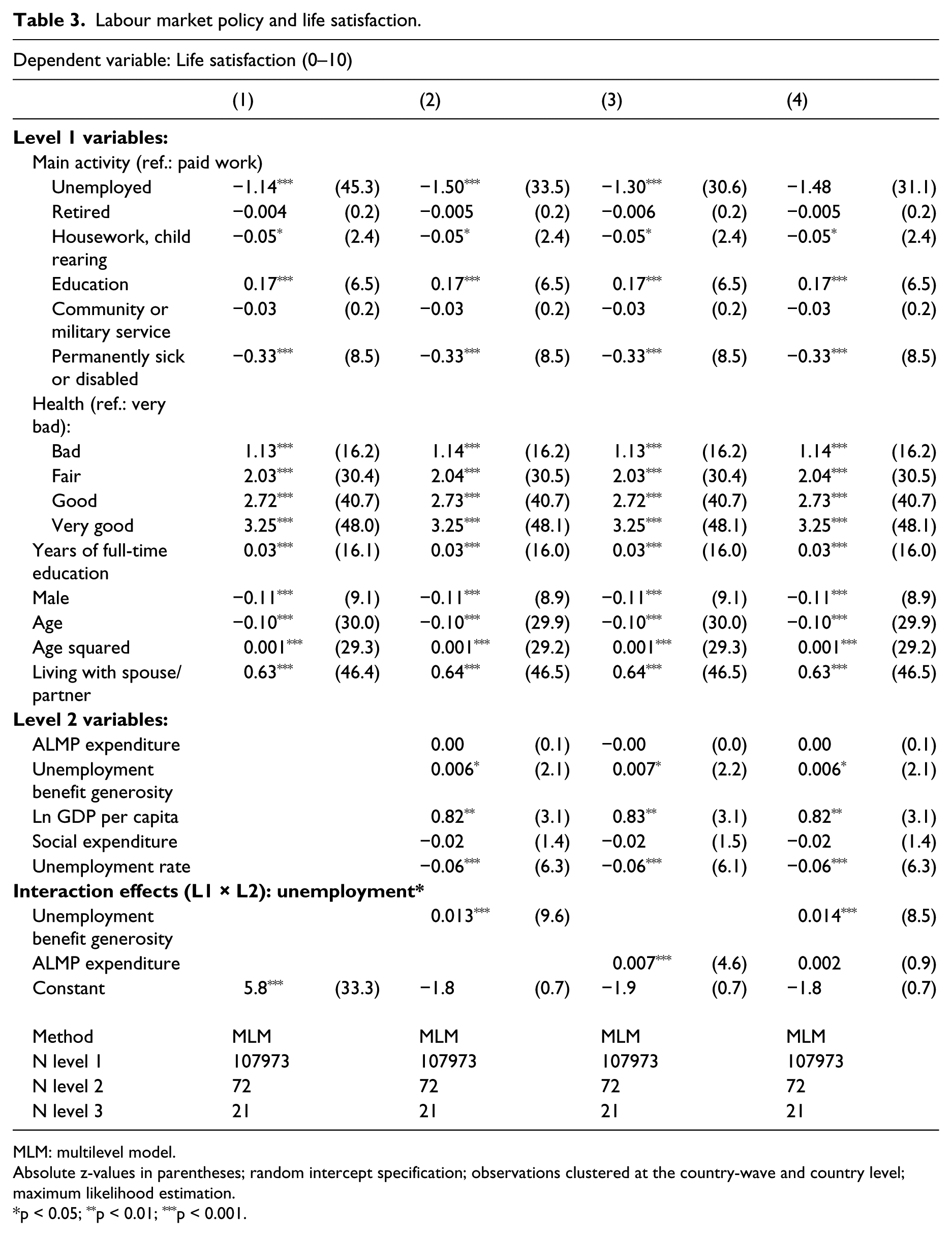
The empirical analysis shows that national labour market policy has a major moderating influence on the life satisfaction effect of unemployment. In line with all previous literature, unemployment has a negative effect on life satisfaction in all countries in the sample. On average, unemployment decreases life satisfaction by more than a full point on the 0–10 scale even after controlling for other personal characteristics (model (1)). However, active and passive labour market policies play a non-negligible role in determining the severity of this effect.
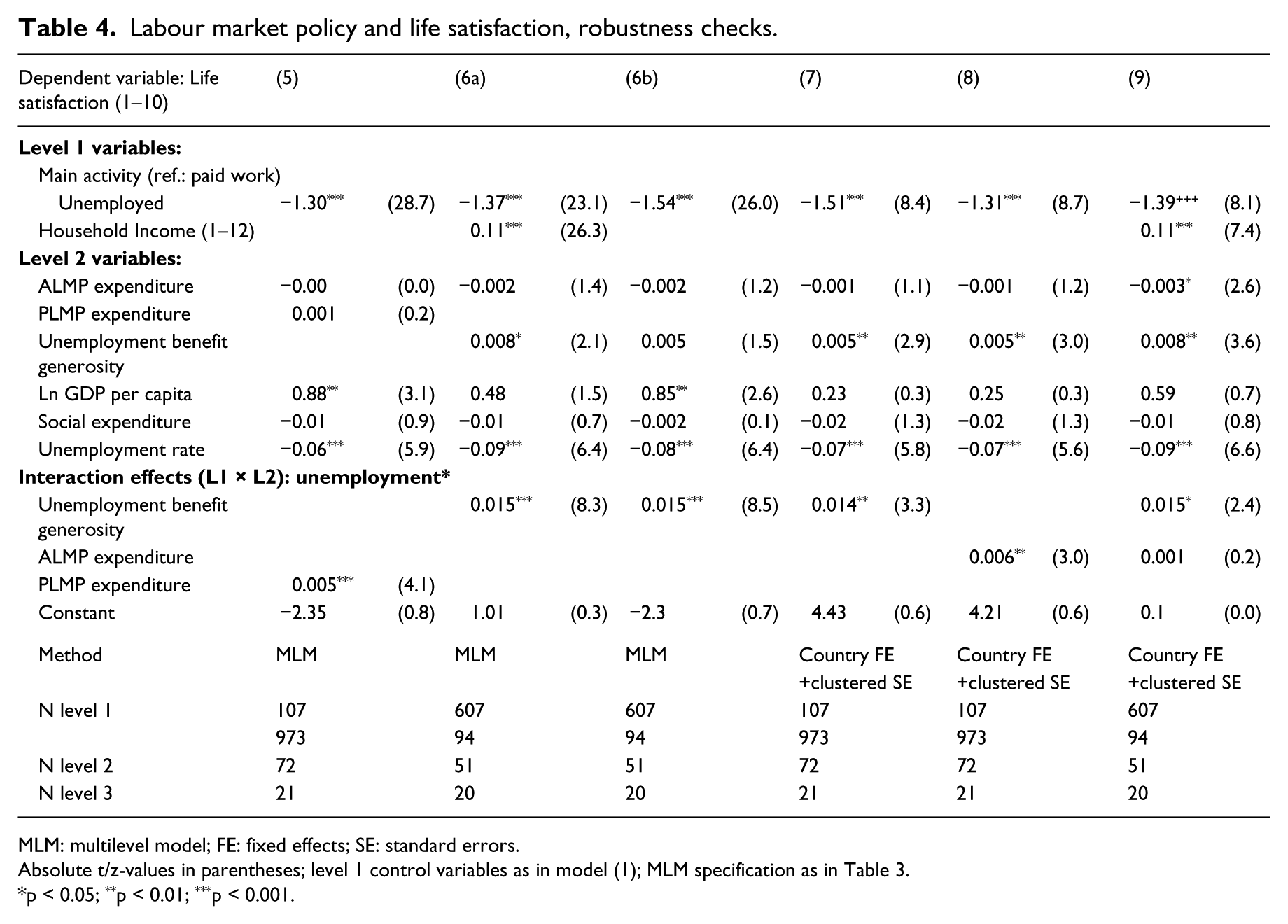
Tables 3 and 4 report the regression results for the determinants of life satisfaction with the focus on labour market policy effects. Models (2) to (4) in Table 3 show the interaction effects of unemployment with ALMP expenditure and unemployment benefit generosity for the full data sample using random intercept models (MLM), while Table 4 shows alternative model specifications and fixed effects estimations as robustness tests.
Labour market policy and life satisfaction.
MLM: multilevel model.
Absolute z-values in parentheses; random intercept specification; observations clustered at the country-wave and country level; maximum likelihood estimation.
p < 0.05; **p < 0.01; ***p < 0.001.
Labour market policy and life satisfaction, robustness checks.
MLM: multilevel model; FE: fixed effects; SE: standard errors.
Absolute t/z-values in parentheses; level 1 control variables as in model (1); MLM specification as in Table 3.
p < 0.05; **p < 0.01; ***p < 0.001.
The inclusion of all four waves yields a fair amount of level 2 information concerning macro-level labour market policy, that is, the macro-level number of observations is 72. Using survey data from ESS round 4, however, inhibits the insertion of an income variable, as the survey question on household income deviates too drastically from former waves. As income has been shown to have a considerable influence on life satisfaction, results in Table 3 might be accused of suffering from a serious omitted variable bias, especially in the interplay with benefit generosity. Therefore, models (6a) and (9) show the results of virtually the same model specification as model (2), but include the household income of respondents. Model (6b) replicates model (2) using the limited sample of model (6a) to provide direct comparability of models with and without the income variable. As a result of dropping data from ESS round 4, the number of level 2 observations shrinks to 51. Next to pragmatic considerations of sample size and the prevention of an omitted variable bias, the comparison between models with and without household income variable may also offer additional information regarding the content of a moderating effect of passive labour market policy.
Furthermore, models (7) to (9) insert country-fixed effects with clustered standard errors at the country level to check whether changes in policies over time within countries have similar effects as cross-country differences in policy designs. Finally, model (5) changes the operationalization of unemployment benefit generosity analysing the effect of PLMP expenditure and its interaction with unemployment.
The moderating effect of unemployment benefit generosity
Results show that the severity of the life satisfaction effect of unemployment depends greatly on the generosity of the unemployment benefit system in a country. Hypothesis 1 that predicts a positive moderating influence of unemployment benefit generosity on the effect of unemployment on life satisfaction is strongly supported. The coefficient for the interaction term between unemployment and benefit generosity ranges between 0.013 and 0.015 in all model specifications. This effect is significant at the 0.1 percent level in all random intercept specifications and proves to be robust in the longitudinal fixed effects specifications at the 5 percent or even 1 percent significance level (models (7) and (9)). As a further robustness test, the same models have been estimated for each wave of the ESS separately. The results prove to be robust across individual waves: in a specification corresponding to model (4), the interaction effect between unemployment and benefit generosity was positive and significant at least at the 5 percent level in each ESS round (not shown, but available from the author).
To be clear, respondents living in a country with high replacement rates and long benefit receipt are still experiencing a remarkable drop in their subjective well-being in case of job loss, but the loss of life satisfaction is not nearly as dramatic as it is for an unemployed individual living in a country with low unemployment benefit generosity. For instance, a person becoming unemployed in a country with a benefit generosity indicator of 1 standard deviation above the mean experiences a drop in life satisfaction of −0.81 points on the 0–10 scale. Given the same personal characteristics, a respective respondent in a rather ungenerous country in terms of unemployment benefits (unemployment benefit generosity indicator of one standard deviation below the mean) faces a considerably larger drop in life satisfaction of −1.35. 7
In model (5), benefit generosity is operationalized by expenditure data for passive labour market policy per unemployed. The positive and significant interaction effect with unemployment confirms the moderating effect of monetary transfers on the life satisfaction drop associated with unemployment. The social rights approach of the unemployment benefit generosity indicator appears, however, to be even more influential than the expenditure data as suggested by the somewhat lower z-value.
As mentioned above, the comparison between models that control for household income and models that lack an income variable can be a first step in understanding the mechanisms of a moderating effect of labour market policy. If labour market policy lost its influence once income was controlled for, the moderating effect of benefit generosity would have to be interpreted in a strict resource framework. An interaction effect that is unaffected by the inclusion of the income variable, however, suggests that a passive labour market policy may affect the life satisfaction of the unemployed through mechanisms that are not strictly pecuniary. Without knowing the exact composition of the moderating effect, the estimation results in models (6a) and (9) suggest that next to the resource dimension, labour market policy affects the unemployed in a non-pecuniary way. The unemployed in a country with encompassing unemployment benefits may suffer from a less severe stigmatization and thus loss of self-confidence and life satisfaction than the unemployed in a country with extremely low generosity scores. This argument is in line with previous research that hints towards negative psychosocial effects of means-tested social assistance benefit receipt compared to unemployment insurance benefits in Germany (Wulfgramm, 2011: 495).
The moderating effect of active labour market policy
The moderating effect of active labour market policy with respect to unemployment and life satisfaction appears less robust than the effect of passive labour market policy. If an interaction effect of unemployment × ALPM expenditure per unemployed is added to the model specification, a moderating effect of active labour market policy shows (model (3)) and proves to be robust in a fixed effects estimation (model (8)). These results suggest that the life satisfaction effect of unemployment in a country with low activation effort (one standard deviation below the mean) is −1.26, while it is only −0.97 in a more generous country, but the addition of the interaction effect of unemployment × benefit generosity offsets this positive interaction effect. ALMP expenditure and benefit generosity have a correlation coefficient of 0.54, which explains the difference between models. In general, countries with a generous unemployment insurance system tend to invest more into ALMP, possibly to offset the disincentive effects of unemployment benefits. Consequently, it is hard to disentangle the effects of the two kinds of labour market policies. If passive labour market policy is controlled for, active labour market policy loses its significance in the determination of life satisfaction of the unemployed. Hence, despite positive interaction effects, Hypothesis 2 cannot be confirmed robustly.
The control variables on the micro-level behave in a rather predictable fashion and are in line with most happiness literature. Among the main occupations, being a student sticks out as having a more positive effect than working, while being permanently sick or disabled is associated with a significantly lower level of life satisfaction. For age, the well-known u-curve emerges, with the lowest level of life satisfaction at the age of 42. Moreover, being educated and healthy as well as living with a partner increases life satisfaction, while being male affects well-being negatively.
The comparison of the positive impact of the income variable on the micro-level and the level of GDP in the between-country estimation of the MLM specification with the non-existent influence of changes in national wealth of a country as estimated in the fixed effects model complies very well with the Easterlin paradox (see Easterlin, 2001): while earning and owning more than others satisfies individuals, economic development does not alter the average life satisfaction within a country once a certain threshold is reached.
While the large negative impact of the unemployment rate conforms to general expectations and previous research on contextual effects of unemployment (e.g. Faas, 2010), the effects of the three welfare state variables are less intuitive. Both coefficients of ALMP expenditure as well as social expenditure show slightly negative tendencies, while unemployment benefit generosity has a somewhat positive effect on life satisfaction. Significance levels remain modest and tend to be highly sensitive to the model specification, though.
Conclusion
European welfare states differ widely in their approaches to alleviate the situation of the unemployed, yet the general trend of the past two decades has shown an ‘activation turn’ in European labour market policy. This paradigm shift has led to an increasingly high commitment towards active labour market policy, while unemployment benefits tend to have developed in a restrictive fashion with respect to their level, duration and conditionality. Both these enabling and enforcing elements of labour market activation are supposed to increase the reemployment of the unemployed. Yet, such changes in public policies generally entail more than just the objective labour market effects. I argue that the lives of individuals that are highly dependent on welfare state support are affected by public policies in ways that go beyond the economic effects that are generally studied in policy analyses. When it comes to life satisfaction effects, little is known about the interaction between adverse life events such as unemployment and the welfare state pillars that are supposed to cover these risks.
As the life of the unemployed is largely framed by national design and generosity of unemployment benefits as well as active labour market policy, the core hypotheses predicted positive moderating effects of generous labour market policies on life satisfaction of the unemployed. Indeed, this article has shown that the well-being of the unemployed is to a surprisingly large extent determined by labour market policy. The effect of unemployment on life satisfaction differs considerably between European countries as well as within countries over time and depends strongly on the generosity of unemployment benefits. Restrictive benefit systems with short benefit durations and low benefit levels increase the psychosocial burden of unemployment and are thus connected to a far larger drop in life satisfaction than the respective negative effect of unemployment in countries with comparatively generous passive labour market policy. It is shown that this effect remains strong even after the individual income of respondents is controlled for. Therefore, I argue that this moderating effect of unemployment benefit generosity acts through both a resource and a non-pecuniary mechanism, where the latter is due to the fact that labour market policy may contribute to the stigmatization of unemployment.
Conclusions regarding the moderating effect of ALMP need to be somewhat more careful. The positive moderating effect strongly shows both between and within countries, but this connection disappears once unemployment benefit generosity is controlled for. As countries with generous monetary transfers also tend to invest strongly in ALMP, disentangling the differential effects of labour market policy proves to be difficult. A further cause for the unstable link may be the simplified assumption that ALMP always has an enabling character, while different types of active measures may actually have very different well-being implications. The aggregation of ALMP spending may thus blur the effect of specific policies. Future research should therefore investigate whether the type of ALMP efforts affects the well-being of the unemployed. Furthermore, more light should be shed on the interplay between active and passive labour market policy in the determination of the life satisfaction effect of unemployment.
A final word needs to be said about the importance of incorporating well-being effects into the evaluation of labour market policy. It might be argued that a focus on the effect of labour market policy on reemployment already covers well-being aspects, as reemployment has been shown to be connected to a sharp rise in life satisfaction. While the reintegration into paid employment is most certainly the major aim of activation, this kind of argumentation ignores the reality of European labour markets with unemployment rates of up to 20 percent. As long as activation fails to combat unemployment successfully, a concern for the quality of life of the unemployed touches upon the core function of the welfare state, that is, inclusion and support of the worst-off.
Footnotes
Funding
This research received no specific grant from any funding agency in the public, commercial or not-for-profit sectors.