



Abstract
This article deals with families’ risk of entering poverty as a consequence of childbirth in four European Union (EU) welfare clusters. Poverty risks around childbirth are institutionally stratified according to specific characteristics of national welfare systems and the value they assign to family policies as well as the kind of labour market deregulation. While southern European countries are known for having welfare systems that make few provisions for ‘the future generations of citizens’, conservative and social-democratic countries differ significantly in the amount of their investments in family policies. We compare households’ risks of entering poverty at childbirth between Southern Europe and the rest of Europe using pooled longitudinal European Union Statistics on Income and Living Conditions (EU-SILC) data and applying panel models and propensity score matching. We show that childbirth is very poverty inducing only in southern Europe, especially for the less ‘labour market–attached’ households (precarious worker families, the unemployed) and traditional single-earner families, thereby pointing out the under-protectiveness of the Southern European systems of family and social policies. This situation is exacerbating additional inequality as families’ well-being largely depends on the previous unequal social stratification of resources.
Introduction
This study investigates the interaction between childbirth – interpreted as a specific ‘triggering event’ for economic poverty – and households’ labour market conditions across different welfare contexts, by adopting a longitudinal approach. Although some of the early, ground-breaking research examined cross-national differences in poverty risks (Duncan et al., 1993) embracing a longitudinal perspective, the vast majority of the literature has mostly been cross-sectional, thus emphasising poverty situations rather than poverty dynamics. Furthermore, the few comparative studies focusing on poverty transitions and poverty spells often fail to establish whether the same event produces the same effect within different institutional contexts and work–family arrangements (Duncan et al., 1993; Fouarge and Layte, 2005; Layte and Whelan, 2003; Vandecasteele, 2010). This article addresses some of these shortcomings by investigating the risk of a specific life event, such as childbirth, becoming a real poverty-triggering situation in different macro-institutional settings and for various types of work–family arrangements, thereby combining micro (individuals and families) and macro (social policy systems and their structural features) determinants of poverty entry.
Although European nations face similar risks, needs and trade-offs connected to post-industrial challenges, their ability to cope with the ‘new’ social risks affecting individuals and families is, in fact, highly heterogeneous (Cantillon, 2011; Dewilde, 2003; Esping-Andersen, 2002; Ferrera, 2005; Fouarge and Layte, 2005; Western et al., 2012). At the household level, income dynamics are influenced by specific events connected to the employment situation within the household and to changes in the household’s composition (DiPrete, 2002). Growing levels of economic uncertainty and labour market instability have increased the proportion of families that experience weak labour market positions (e.g. flexible jobs and unemployment events), as well as (further) highlighted the relevance of female employment for the household’s economic security. At the same time, lower stability of employment and families (in terms of increasing divorce rates and so on) alters the household’s ability to compensate for income fluctuations connected to family events.
The extent to which work and family events may lead to poverty varies considerably across welfare systems. On one hand, countries differ in the distribution of so-called triggering events leading to specific social risks. These differences are related to institutional factors such as job mobility, unemployment and other labour market characteristics. On the other hand, welfare systems differ in the type and level of support they provide for families and career circumstances and thus influence the (economic) consequences that certain family events may involve (Dewilde, 2003; DiPrete and McManus, 2000; Fouarge and Layte, 2005; Saraceno et al., 2012; Western et al., 2012). In terms of poverty rates, the frequency and duration of poverty spells vary systematically across countries (Duncan et al., 1993; Fouarge and Layte, 2005; Nolan et al., 2006) and welfare systems (Nolan and Whelan, 2011, 2014; Pintelon et al., 2013). The liberal and Southern European countries have much higher poverty rates (with longer durations) than the social-democratic and conservative countries (Brady, 2005; Brady et al., 2006; Cantillon, 2011; Kangas and Palme, 2000; Layte and Whelan, 2003; Misra et al., 2007, 2012).
Childbirth represents a poverty-triggering event because it destabilises both the household’s level of need and the family/work balance (Callens and Croux, 2009; McKernan and Ratcliffe, 2005; Organisation for Economic Co-operation and Development (OECD), 2008; Vandecasteele, 2010). A rise in the number of children is generally linked to a decrease in a family’s disposable income (Misra et al., 2007; Nolan et al., 2006; OECD, 2011a; Rigg and Sefton, 2006), although an income reduction does not necessarily lead to a transition to poverty (Layte and Whelan, 2003; OECD, 2008). Rigg and Sefton (2006) show that although childbirth among English families is accompanied by an income reduction, this event rarely leads to poverty. Other studies highlight the fact that the effect of childbirth on households’ poverty risks is moderated by the parents’ previous economic situation. In other words, childbirth heightens the already-existing inequalities by affecting the weakest social groups, such as single-parent households and the long-term unemployed/inactive (Barbieri et al., 2012; Chzhen and Bradshaw, 2012; Layte and Whelan, 2003; Vandecasteele, 2010).
Exactly how these effects vary across welfare systems, family types and labour market arrangements still remains unclear. Several comparative studies have demonstrated that state support for parents’ employment as well as generous benefits and social allowances for families with children reduces families’ poverty risk (Brady, 2006; Misra et al., 2007, 2012). However, as already stated, these studies often lack a clear focus on households’ dynamics in different macro-contexts and do not help disentangle the effect of an event, such as childbirth, from the effect of other risk factors, such as the parents’ former socio-economic situation. These shortcomings lead to a tendency to underestimate the impact of a family’s previous economic situation on their current situation (Layte and Whelan, 2003). Without engaging in the debate about the causes and origins of new/old social risks and whether they have to be understood in terms of events or in terms of attributes (i.e. structural determinants), our contribution is meant to shed light on the household (interpreted as a key social unit) and the interplay between household members’ employment situations and childbirth in order to emphasise the importance of the interaction between events and stable attributes of both individuals and households and the way in which they are combined across different macro-contexts. 1 As shown in the literature (Cantillon et al., 2013; Pintelon et al., 2013; Russell et al., 2013), a wide range of socio-economic attributes and circumstances, including employment, play a relevant role in shaping economic vulnerability. By the same token, the way in which a potential triggering event unfolds is shaped by broader socio-economic dynamic and traditional stratification cleavages (Pintelon et al., 2013). Focusing on triggering events such as childbirth does not in any way undermine the importance of the social structuring phenomena influencing a household’s economic vulnerability – including the household’s employment situation and the macro-institutional asset, with its risk pooling effect via social policies and transfers.
Background discussion
Labour market restructuring and households’ employment situations
During recent decades, poverty and economic vulnerability trends across European Union (EU) countries have increased (Cantillon et al., 2013), particularly among young people, single parents and single-earner families with children (Gornick, and Jäntti, 2012 OECD, 2008, 2011b; Russell et al., 2013; Scherer and Grotti, 2014). Despite the average growth in family income, work–family economic conditions are now even more exposed to unemployment, precariousness and carousel careers due to an increase in dual-earner families and the rise in women’s/mothers’ labour market participation (Keck and Saraceno, 2013). Recent trends towards higher rates of in-work poverty indicate that employment quality is becoming an issue for a growing number of workers (Cantillon et al., 2013; OECD, 2011a; Marx et al., 2012).
Changes in the organisation of the labour market and the consequences for earnings distribution help to explain the variations in poverty risks. The rise in non-standard employment, such as temporary and contingent jobs in the majority of OECD countries, has contributed to increasing the dispersion of individual earnings among employees (OECD, 2008, 2011, 2012) and plays a crucial role in the recent rise of income inequality also in present Europe (Gash and McGinnity, 2007; Hoeller et al., 2012; Koske et al., 2012; Piketty, 2014; Rani, 2008; Salverda et al., 2014). Non-standard jobs are often linked to higher employment instability as well as to lower wages and long-term income penalties. These kinds of jobs also have the disadvantage of not coming with any additional benefits or the entitlement to basic social and pension rights or other unemployment protections (OECD, 2008).
Among young adult households, higher employment instability increases the risk of experiencing unexpected losses of income (Blossfeld et al., 2005; Bradbury et al., 2001; Dewilde, 2003; Esping-Andersen, 2007a). In fact, household economic volatility and insecurity in the 2000s are considered to have been even higher than it was during the 1970s (Gangl, 2005; Western et al., 2012), 2 a scenario that has been further exacerbated by the 2008 economic crisis (Jenkins et al., 2012).
However, the negative consequences of labour market deregulation for individual careers and earnings over the life course vary considerably across different institutional settings and social groups. Certain groups experience higher level of risks under specific circumstances. Southern European countries, for example, have implemented strong partial and targeted labour market deregulation policies, which have created a particularly risky insider/outsider scenario (Barbieri, 2009, 2011; Barbieri and Scherer, 2008, 2009; Blossfeld et al., 2008; Häusermann and Schwander, 2012; Lindbeck and Snower, 2001). In these contexts, there are remarkable risks to remaining trapped in precarious, poorly protected and low-paid jobs, especially for poorly educated people, youths and women (Barbieri and Cutuli, 2010; Esping-Andersen, 2007; Lucifora et al., 2005). In contrast, where the state supports a ‘non-targeted’ labour market deregulation, as in Anglo-Saxon countries, the relative deterioration of employment for workers in non-standard positions has been relatively limited when compared with the working population as a whole (Esping-Andersen and Regini, 2000; Gash, 2008; OECD, 2008). Finally, in Nordic countries, the availability of reconciliation policies and childcare services has reduced the work–family trade-off over the life course and has supported the demand for female labour.
Despite these institutional differences, the consequences of the changing nature of labour market arrangements for household economic conditions depend on the way different labour market positions are combined within the same household (OECD, 2008; Western et al., 2012). Higher levels of employment and income instability raise the risk of an accumulation of unstable work positions within the same household (Scherer and Grotti, 2014; Ultee et al., 1988). This consideration helps demonstrate the relevance of having a dual-earner household and, consequently, the importance of women’s labour market participation for fostering families’ economic conditions and a more stable work–family balance (Esping-Andersen et al., 2013). If we look at families as informal risk pooling organisations that protect against adverse events, the role of women’s market labour is crucial in compensating for unexpected economic hardships afflicting men – and vice versa (Kollmeyer, 2013; Oppenheimer et al., 1997; Western et al., 2012). However, the diffusion of dual-earner families strongly depends on the welfare system and the extent to which it facilitates – or hinders – female employment through reconciliation policies and care provisions. At the micro-level, living in a dual-earner family is socially stratified and thus depends on individuals’ social origin and educational endowments, as well as their educational homogamy. More highly educated individuals will often choose partners with a similar level of education, which may contribute to potential polarisation across families (Cantillon, 2011; Esping-Andersen, 2009).
Households with a weaker labour market attachment, such as families in which both partners have precarious jobs or are unemployed, are less able to absorb adverse labour market events, such as unemployment, reductions in wages or working hours or fixed-term contract expiration. These families thereby face higher risks of economic deprivation, which may translate to poverty depending on the degree of support offered by the institutional context (Fouarge and Layte, 2005; Gornick and Jäntti, 2012; McKernan and Ratcliffe, 2005; Misra et al., 2012; Oppenheimer et al., 1997; Western et al., 2012).
Poverty risks are also influenced by changes in the household structure that alter earnings and the level of needs. The arrival of a new child implies a rearrangement of the work–family balance to meet new responsibilities, needs and constraints presented by childrearing. Indeed, the household income usually decreases around childbirth. The baby often becomes an additional financial burden that may not be adequately compensated for by family-related benefits (Fouarge and Layte, 2005; Layte and Whelan, 2003; McKernan and Ratcliffe, 2005). The greatest reduction in household income occurs in the period between birth and the age of 4: a critical period for child development, as well as for parental career development (OECD, 2011).
The presence of social policies able to provide income support – in the form of child and family allowances – as well as greater opportunities to reconcile family duties and work (e.g. paid leave or childcare support) is crucial to limit income loss and the rise of needs connected to childbirth. In general, the better supported the employment of mothers, the lower the poverty risks and earnings penalties posed by childbirth (Misra et al., 2007). Along with the dual-earner work–family arrangement, child and family allowances are considered to be among the most effective anti-poverty policy tools, especially for households with children under the age of 18 (Misra et al., 2007; OECD, 2011; Thévenon, 2011).
Social and family-related policies
Within EU countries, significant variations in the amount of public spending on child and family benefits and the ways in which different policies are structured and balanced continue to persist. 3 These variations are often explained by the different norms about the role of women in society, namely, the balance between working and caregiving responsibilities (Esping-Andersen, 2007b; Gornick and Meyers, 2004; Misra et al., 2007; Thévenon, 2011). More precisely, Southern European welfare systems are characterised by a ‘deficit’ of family- and child-related policies (OECD, 2011) and a persistent reliance on family support (González, 2006). Saraceno (2002) describes this as a situation of ‘enforced familism’. 4 De-commodifying social-democratic welfare states stand in opposition to the Southern European states, as they actively support dual-earner household arrangements, especially in families with young children or babies (Gauthier, 2002). In conservative welfare systems, family policies help to secure time for caregiving and support family economic stability, even if a consistent variability within this cluster in terms of work–family arrangements can be observed, ranging from the traditional male breadwinner model to the ‘one-and-a-half earner’ family model and the dual-earner household model (Misra et al., 2007, 2012; Thévenon, 2011). In countries such as Germany and the Netherlands, the setup remains closer to the ‘male breadwinner–female caregiver’ model, supported by high family allowances and with a notable role of part-time work that is strongly female segregated. France and Belgium, on the other hand, follow a mixed strategy in which women are valued and rewarded for providing care but also encouraged to engage in (short) full-time employment. In these cases, the welfare state provides substantial support to women’s work–family reconciliation with long and well-paid parental leave, particularly when the children are young (Del Boca et al., 2009; Misra et al., 2007).
Finally, liberal welfare states actively seek to sponsor market solutions encouraging women’s/mothers’ employment (mainly part-time) and private welfare provision, thus limiting public responsibilities to acute market failures and focusing mainly on single mothers (Esping-Andersen, 2002; Thévenon, 2011). However, unlike in Southern European countries, the overall public spending on family benefits (cash benefits, in-kind benefits and tax breaks for social purposes) as a percentage of gross domestic product (GDP) in the United Kingdom and Ireland is consistently above the OECD average (OECD, 2011).
Research questions and hypotheses
We ask under which conditions childbirth increases families’ risks of becoming poor across different welfare systems. In the context of growing employment instability, household economic conditions should be increasingly linked to parents’ ability to balance employment and parenting. As welfare systems differ substantially in the way they support the various work–family arrangements, poverty risks in connection to childbirth should vary systematically across different welfare systems and among household work arrangements within each context.
We first investigate whether and to what extent childbirth influences families’ poverty risks in different welfare systems. We expect that families will be less capable of assuring the economic welfare of their children in institutional settings in which family policies are neglected and dual-earner households are less supported, as in Southern European countries.
Second, we ask whether poverty risks associated with childbirth within a specific welfare system are homogeneous, that is, typical to all families, or whether they are connected to the specific type of work arrangement found in the household. Since poverty risks are strictly connected to the ‘work-attachment’ of a family (the number of earners and the kind of contract), we expect the financial impact of childbirth to be heterogeneous among household work arrangements. More explicitly, childbirth should increase the risk of entering poverty for households with a weaker labour market attachment and/or an unstable work arrangement.
Data and methods
The analyses are based on a pooled European Union Statistics on Income and Living Conditions (EU-SILC) longitudinal database from 2007, 2008 and 2009. 5 The EU-SILC data have the major advantage of providing internationally comparative information on European incomes and living conditions. However, it provides rather limited sample sizes and rather short longitudinal information. In fact, units are followed for 4 years at most. The information on income ranges from 2004 to 2008. We consider only those households containing at least one woman aged between 19 and 49. 6 We group countries into four welfare systems assuming (relative) homogeneity of the key features of their socio-economic institutions and policies within groups (Barbieri and Cutuli, 2013; Maître et al., 2005). Each welfare group/cluster contains at least two countries. Italy and Spain represent the Southern European cluster; France, Belgium and Austria represent the conservative welfare systems; the United Kingdom and Ireland represent the liberal systems; and Norway, Sweden and Finland represent the social-democratic systems.
Figure 1 summarises the strategies of analyses adopted in this work. Following the standard approach, poverty is defined as having a disposable household income below 60 percent of the (national) median equivalent household disposable income 7 using the ‘modified OECD’ equivalence scale. The equivalised household income is attributed to each of its members, assuming equal distribution of resources within households. In the first and second parts of this work, entry into poverty is defined as the risk of being poor at time t conditional on not being poor 1 year earlier, at time t-1 (OECD, 2011) (Figure 1(a)). This selection allows us to rule out situations of genuine state dependence – for example, due to poverty traps (Biewen, 2003; Fouarge and Layte, 2005; Jenkins and Cappellari, 2004). Moreover, we include controls for the previous poverty experiences of the family at t-2 and t-3. Since the poverty condition at t is based on the income gained in the previous year, control variables on individual and household characteristics are measured at t-1, that is, before the income reference period (Heuberger, 2003). This choice implies that for each individual, we need information on at least two time points (years t and t-1), which causes a loss of almost a quarter of all the available observations since the EU-SILC is a 4-year rotating panel and since issues on non-response rates and attrition rates incidental to panel data occur 8 (Figure 1(a)). Due to the limited number of observations, we unfortunately need to abandon a precise measure of the ‘trigger event’ of childbirth and have to adopt an ‘enlarged’ definition focusing on the presence of children aged 0–2 at t (those born between t-2 and t). This raises concerns about endogeneity in the analyses as we deal with co-occurring events (Figure 1(a)) rather than a detailed sequencing. The birth reference period overlaps with the income reference period. In the last paragraph, however, we provide robustness checks of our results by implementing a more restrictive analytical strategy that, requiring information on at least 3 years for each household, almost halves our sample (Figure 1(b)).

Designs of analysis: (a) design of analysis and (b) ‘time-adjusted’ design of analysis.
Poverty risks depend on how sources of income are pooled within the family. We identify a typology of household work arrangements that combines the presence of a partner with the individual’s labour market situation (at t-1) defined by the type of contract (fixed term/open-ended contracts), episodes of unemployment (between t-2 and t-1) and being out of the labour market. Combining this information, we identify five working family types:
Dual-earner couples, in which both individuals are employed, regardless of the type of contract;
Single breadwinner couples, in which the couple combines the stable employment of one partner (permanently or self-employed) with the non-employment (out of work/job-seeking/unemployed) of the other;
Precarious households, including single-earner couples with unstable contracts, or one or both partners being unemployed;
Single women in any form of employment (full-time/part-time, permanent/temporary or self-employed);
Single jobless women.
This classification is the outcome of extensive tests with more detailed definitions and allows us to combine sufficiently large numbers of observations within categories and with relatively little loss of information (in Appendix 1, we provide the frequency distribution of these household types).
We estimate random-effects probit models on the risks of entering poverty 9 separately for each welfare cluster, controlling for (a) interactions between childbirth and country to test whether childbirth effects vary among single countries within the same cluster and (b) different interactions between the presence of a child/children aged 0–2 and the type of household work arrangements 10 to test whether the presence of a child/children 0–2 is a poverty-triggering event per se or whether its effect is moderated by the labour market attachment of the household at t-1.
All models control for women’s individual information (age, three International Standard Classification of Education (ISCED) educational levels and part-time work) and the households’ characteristics (household work arrangement at t-1, families’ economic position measured by International Socio-Economic Index (ISEI) score using a dominance approach – the highest in the couple at t-1 – the presence of pensioner(s) in the household at t-1 and the number of children older than 2 at t-2).
In the second part of our analyses, we correct for selection into childbirth (families with and without children aged 0–2) based on observables by using propensity score matching procedures. In fact, the probability of having a child is not randomly distributed, but varies according to individual characteristics (age, level of education, preferences, attitudes, health status), family traits (family–work arrangement, the presence of a partner, household economic conditions, the presence of other children, previous experience of poverty and deprivation) and the availability of institutional support (Dewilde, 2003; McLanahan and Percheski, 2008; Rigg and Sefton, 2006). As documented in the literature, the economic situation of the household influences fertility decisions. The probability of having children is, for example, somewhat lower in households dependent on a single salary from the secondary labour market. 11 Moreover, the size of this negative effect is supposed to vary across welfare systems because of the different labour market regulations and family support provisions of the welfare state. To take these selection issues into account, we run propensity score estimations that balance observed relevant characteristics of women with and without children aged 0–2. We assess separate estimations for each household type within each welfare arrangement since the chances of having children are strongly shaped by these two factors. The propensity score matching estimator is simply the mean difference in the risks of entering poverty over the common support (appropriately weighted by the propensity score distribution of women with and without children aged 0–2) within each sample selection (Caliendo and Kopening, 2005). Propensity scores are computed on the basis of the following relevant household and individual variables measured at t-1: the number of children at t-2, the number of male children at t-2, ISEI (the highest in the couple), more than two incomes in the household, the presence of pensioner(s) in the household, previous poverty and deprivation episodes at t-2 and t-3, home ownership, the woman’s age, the woman’s level of education, the woman’s civil status (separated, cohabiting), the woman’s working hours – part-time (<40 hours), the woman’s health status (dummy) and the woman’s partner’s educational homogamy. 12
Poverty entry around childbirth in different institutional settings
Table 1 shows the results from panel random-effects probit models analysing the risks of entering poverty for each welfare cluster. Overall, the presence of a child below the age of 2 increases the risk of becoming poor in all but the Nordic countries (Table 1, Model 1; note that results are conditional on the family not having been poor at t-1). Estimated parameters highlight that within each cluster, there are differences in terms of the average risks of entering poverty (after social transfers) across countries, but the interaction with the presence of a small child does not (further) increase these relative distances. The exception is Sweden (and Norway, even if n.s.), where families with small children face even lower risks of poverty. The results further confirm that poverty risks are strictly connected to household types and more precisely to the number of earners. The role of household types in stratifying poverty reveals a universal pattern observable in all countries. Poverty risks are highest for single-earner families with unstable employment contracts (fixed-term) and for single employed women. In addition, the effects of the other factors related to poverty are rather similar across welfare systems: a low level of education and previous poverty experiences increase a household’s poverty risk, while the economic position of the family is negatively correlated to poverty entry – as shown in previous research (Russell et al., 2013). More interestingly, differences between clusters emerge with regard to the effect of the number of children. While having (additional) children (older than 2) in the social-democratic welfare systems entails lower incidences of poverty, it increases poverty risks in all other contexts.
Poverty entry (not poor at t-1) – random-effects probit models.

Source: European Union Statistics on Income and Living Conditions (EU-SILC).
Ref.: reference category; ISEI: International Socio-Economic Index; LL: log-likelihood; AIC: Akaike Information Criterion; BIC: Bayesian Information Criterion.
Models are estimated separately for each welfare cluster.
AIC and BIC are defined as AIC = −2*ln(likelihood) + 2*k; BIC = −2*ln(likelihood) + ln(N)*k where k = number of parameters estimated and N = number of observations. Given that two models fit on the same data, the model with the smaller value of the information criterion is preferred.
p < 0.1; **p < 0.05; ***p < 0.01.
To see whether poverty risks associated with having young children vary according to the household work arrangement, we introduce interaction terms (Table 1, Model 2). This leads to an improvement of the model fit in the Southern European and social-democratic cluster. In Southern Europe in particular, childbirth acts as a poverty-triggering event for all kinds of single-earner families. Thus, the second income does protect families from poverty in the event of childbirth. In the Nordic countries, conversely, childbirth is only associated with a growth of poverty risks among single, unemployed mothers. Finally, the interactions point out a null effect for the conservative and liberal clusters. Figure 2 summarises the findings reporting the predicted probabilities of entering poverty. In almost all welfare systems, couples in precarious employment situations (‘precarious households’, that is, single-earner couples on fixed-term contracts or couples in which both partners are unemployed) face the highest risk of becoming poor, followed by single, unemployed women. This pattern is far more pronounced in Southern European and conservative countries, which are characterised by a strongly segmented labour market and have higher (also economic) penalties for ‘outsiders’ (Barbieri, 2011). In liberal and Nordic countries, poverty risks are highest among single mothers.

Predicted probabilities of entering poverty (not being poor at t-1) by household arrangements with/without children aged 0–2 (random-effects probit model, M2 in Table 1).
Concerning our research question regarding the poverty-triggering effect of childbirth in different work–family arrangements within different welfare systems, Figure 2 clearly shows how the presence of a small child significantly increases the household’s risk of entering poverty only in Southern Europe. This effect is particularly strong for ‘precarious couples’ and single-breadwinner families. The average marginal effects range from 7 percent for traditional breadwinner families to 12 percent for households with unstable employment situations. In the remaining countries, small children do not show the same effect.
As previously mentioned, childbirth is not a random process but might vary systematically according to individual, household and institutional traits (McLanahan and Percheski, 2008; Rigg and Sefton, 2004). We use propensity score matching to reduce the effects of self-selection and improve common support when comparing families with or without small children. We have produced separate propensity score estimation for each working family type within each welfare cluster. The underlying idea is that the selection process on having or not having a child or children aged 0–2 in the household works differently not only between working family types but also for each working family arrangement in different welfare clusters.
Our results (Table 2) confirm the proposed interpretation. Only in Southern Europe does the presence of small children increase the household’s poverty risks. As to be expected, the estimated effects based on propensity score matching appear slightly smaller when compared with the average marginal effects of the random-effects probit models. For the Southern European cluster, however, we still register an average significant increase of poverty entry risks of 4.5 percent for traditional breadwinner families and 7.5 percent for precarious single-earner families.
Propensity score matching estimates of the effects of 0–2 children in the household on the risk of entering poverty, by welfare cluster and household arrangement (not being poor at t-1).
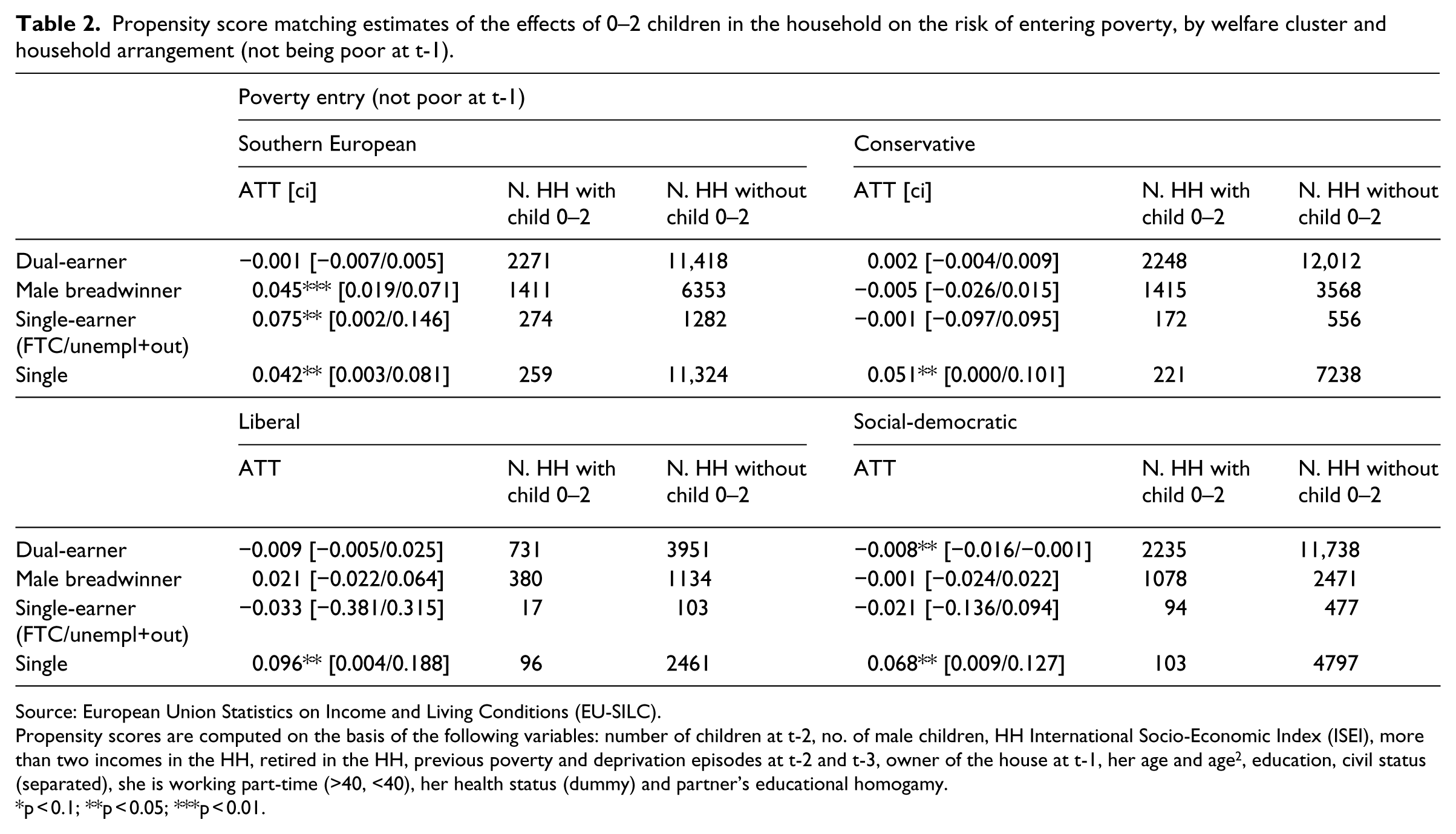
Source: European Union Statistics on Income and Living Conditions (EU-SILC).
Propensity scores are computed on the basis of the following variables: number of children at t-2, no. of male children, HH International Socio-Economic Index (ISEI), more than two incomes in the HH, retired in the HH, previous poverty and deprivation episodes at t-2 and t-3, owner of the house at t-1, her age and age2, education, civil status (separated), she is working part-time (>40, <40), her health status (dummy) and partner’s educational homogamy.
p < 0.1; **p < 0.05; ***p < 0.01.
Consistent with the literature on the social exclusion of single mothers (Misra et al., 2007, 2012), these results confirm that single mothers have a significantly increased risk of poverty, regardless of the institutional setting.
The role of social transfers: poverty risks around childbirth before/after family and child-related transfers
The effects of living in precarious working conditions in Southern Europe meet our expectations and are consistent with previous studies that show the specific vulnerability connected to fixed-term and atypical contracts in this context, both in terms of welfare support and wage differentials (Barbieri, 2011; Barbieri and Cutuli, 2010).
Furthermore, the general weakness identified in the case of traditional breadwinner families suggests that inadequate social welfare policies available in Southern Europe fail to also support the ‘insider’ workers’ financial situation.
Moreover, our results support the thesis that more generous social transfers lower the risk of poverty (Chzhen and Bradshaw, 2012). After comparing the risks of entering poverty based on the total disposable household income before and after welfare transfers, the central role played by social transfers (e.g. paid leave, family- and child-related allowances) in supporting family incomes and wealth at childbirth is indeed very compelling. This exercise clearly reveals how effective redistributive social and family policies can be in preventing household poverty. Households’ disposable income before family- and child-related allowances is computed as the disposable income minus the sum of the family and child-related allowances. 13 Mimicking the Eurostat indications to estimate poverty risks before social transfers, we compute the household’s poverty risk before family and child transfers as the share of people having an equivalised disposable income before family and child allowances that is below the poverty threshold calculated on the household’s disposable income after social transfers. This indicator can be considered a proxy of the poverty risks under the hypothetical non-existence of social policies to relieve individuals and families of the burden of family- and child-related risks or needs.
Despite the fact that subtracting benefits from income represents the standard approach when dealing with the impact of welfare transfers, this simulation might suffer from endogeneity problems due to its implicit assumption that the type and level of transfers and taxes do not influence the level of pre-transfer poverty. Pre-transfer poverty is compared with post-transfer poverty – all else being equal, that is, assuming unchanged household and labour market structures and disregarding any possible behavioural changes that the absence or the presence of social transfers might produce (Caminada and Goudswaard, 2009; Danziger et al., 1981; Kim, 2000). 14
That said, Figure 3 compares the predicted probabilities of entering poverty for families with and without a small child/children, computed on households’ disposable income before/after family- and child-related allowances. As expected, poverty risks in all welfare clusters for families with a small child/children are significantly higher before welfare intervention than are the risks of families with no children. Having a baby is generally associated with a decline in the household’s economic condition; moreover, this holds true in households with weak labour market attachments, be they single-earner families, precarious or unemployed couples, or single mothers. However, when considering households’ poverty risks computed on the total disposable household income after social transfers, it becomes clear that, in Europe, social policies do make the difference when it comes to families’ well-being and wealth – particularly in Central and Northern Europe, where household poverty risks associated with childbirth are significantly reduced by family social transfers.
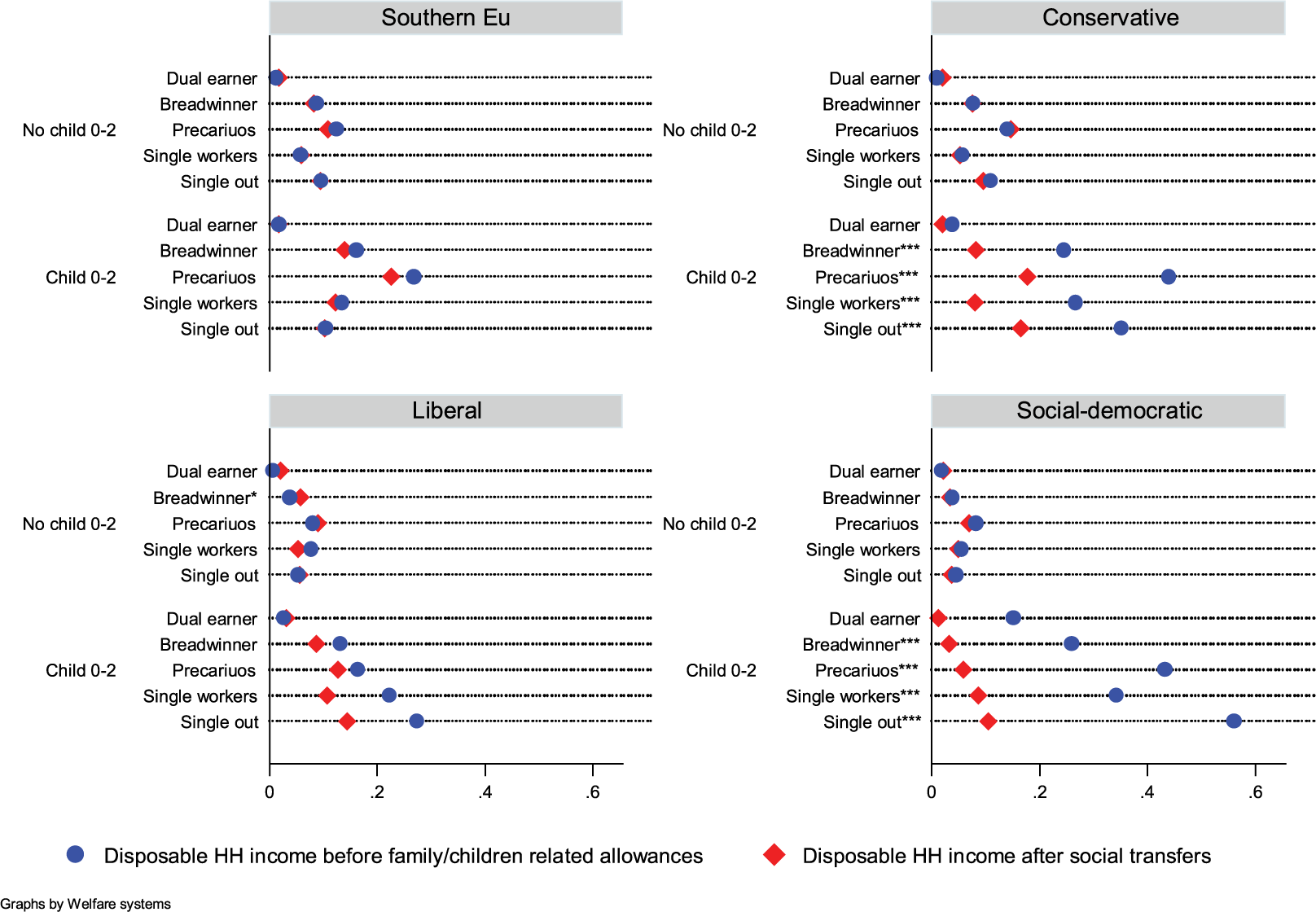
Predicted probabilities of entering poverty (not being poor at t-1) before/after family-/child-related allowances, by household work arrangements and with/without 0–2 children.
Poverty risk-reduction is particularly effective in Scandinavian countries where – thanks to social transfers – childbirth does not represent a social risk, which reconfirms our previous results. Liberal and, to a larger extent, Southern European countries represent the worst contexts. Not only is having a child accompanied by higher poverty risks, but the household’s work arrangement further increases such risks. Single mothers, precarious couples and single-income families are definitely those most exposed to poverty risks, both in general and as a consequence of childbirth in Southern Europe, where the effectiveness of public family transfers is entirely negligible.
By contrast, more than two-thirds of all women with small children at risk of entering poverty (before family-related allowances) in the social-democratic cluster moved above the threshold after welfare intervention. This is also the case in the conservative welfare systems, even if the effects of family- and child-related transfers are somewhat limited (compared with the Scandinavian cluster) and their impact is more unequally distributed among different family–work arrangements.
Poverty risks after childbirth: a sensitivity check
Up to this point, we have maximised the available information to reach a sufficient number of observations for families with young children. However, this choice implies that we analyse co-occurring events. To overcome possible endogeneity issues, we need to improve the sequencing of our control variables and look at the risks of entering poverty at time t conditional on not being poor at t-2 (Figure 1(b)). Thus, we adopt a more restrictive definition of the dependent variable, correctly situating childbirth before the income reference period on which we estimate households’ poverty risks. More precisely, while childbirths are situated between t-2 and t-1, the income reference period ranges from t-1 and t. All control variables are measured accordingly at t-2. This ‘time-adjusted’ analysis, while unravelling possible endogeneity issues, unfortunately requires information for at least three time points (t-2, t-1, and t) for each woman, which involves a significant reduction in the households used in the analyses – indeed, it almost halves our observations. For this sensitivity check, we make use of a standard procedure of statistical matching. Table 3 summarises the estimates of the effects of childbirth on household poverty risks by welfare cluster and household work arrangements.
Propensity score matching estimates of the effects of childbirth on poverty risks at time t, by welfare cluster and household arrangement.
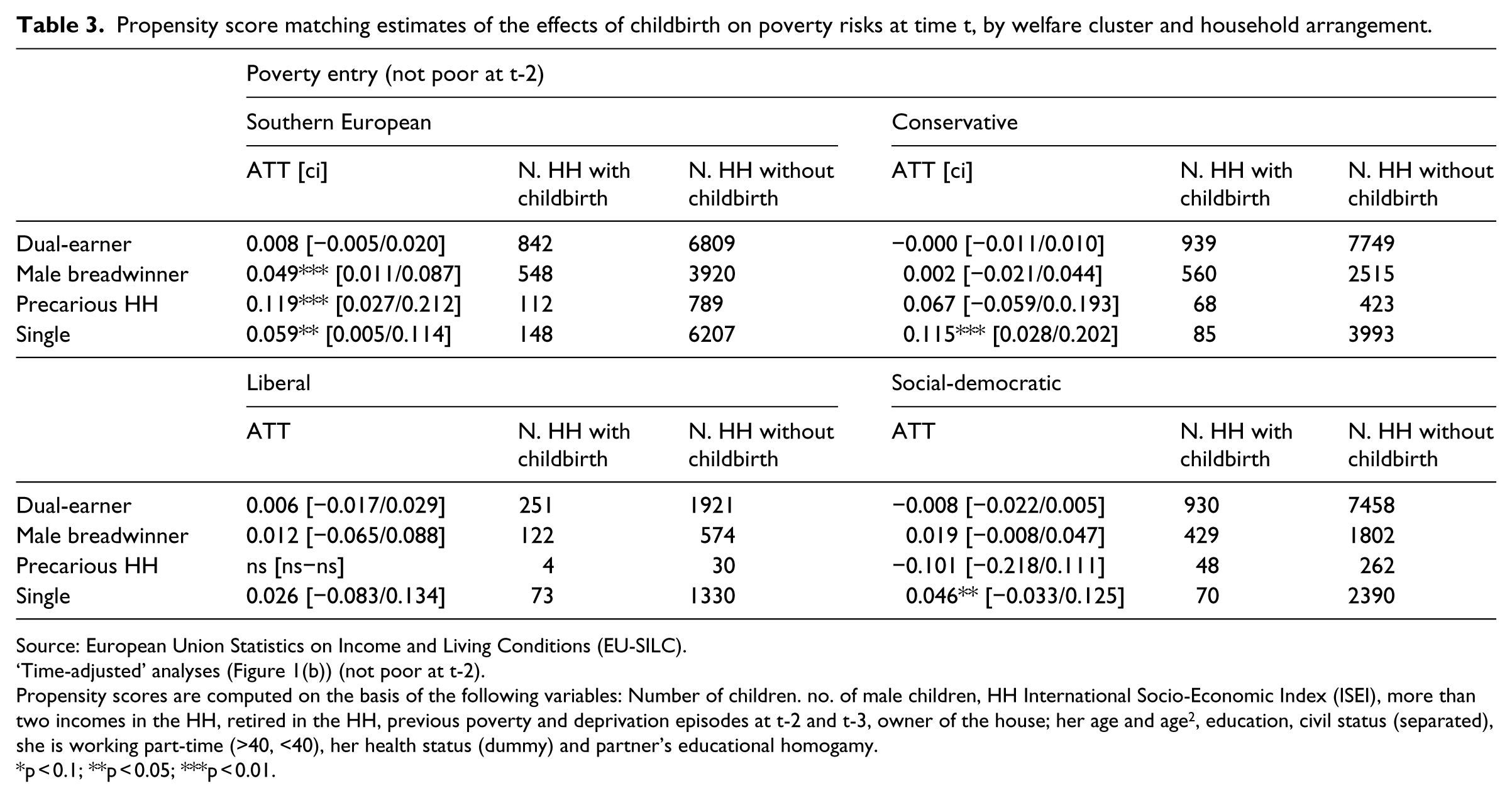
Source: European Union Statistics on Income and Living Conditions (EU-SILC).
‘Time-adjusted’ analyses (Figure 1(b)) (not poor at t-2).
Propensity scores are computed on the basis of the following variables: Number of children. no. of male children, HH International Socio-Economic Index (ISEI), more than two incomes in the HH, retired in the HH, previous poverty and deprivation episodes at t-2 and t-3, owner of the house; her age and age2, education, civil status (separated), she is working part-time (>40, <40), her health status (dummy) and partner’s educational homogamy.
p < 0.1; **p < 0.05; ***p < 0.01.
A more rigorous analytical strategy validates our main result on the peculiarity of the Southern European countries, in which the interaction between households’ employment situation and childbirth plays the expected (negative) role in determining the families’ risk of poverty. Precarious-worker couples are most at risk of entering poverty (+11.9%), even if their social vulnerability is shared (at lower levels) by single-income households (+4.9%) and single mothers (+5.9%). Southern Europe is thus confirmed as the setting in which childbirth significantly raises families’ poverty risks. Conversely, both in Central and in Northern Europe, childbirth represents a poverty-triggering event only for single women.
Conclusion
This article has aimed to compare the impact of childbirth on the risk of falling into poverty across different family–work arrangements and welfare states in Europe by adopting a dynamic approach. We have shown that events and stable attributes combine in defining the outcomes of a potential triggering episode, such as childbirth, in different institutional scenarios. From this perspective, we have looked at the interaction between stable characteristics and resources of families (namely, their employment situations, which derive from the kind of labour market deregulation implemented in Europe during the last decades), the different welfare systems’ ability to support families’ needs and childbirth, which we consider the ‘triggering event’ from which the household’s risk exposure originates.
We contend that focusing on the combination of the childbirth–poverty link with the family–work situation, within different welfare scenarios, other than innovative as a research perspective for its combination of micro- and macro-determinants of poverty, is of particular sociological relevance when looking at childbirth as a serious economic challenge for the family, potentially affecting the life chances of the new-born. Additionally, we contend that the blend of panel models and quasi-experimental tools implemented represents a highly valuable complement to the existing literature and offers clear improvements and robustness to policy-relevant results.
We have shown how childbirth, as a predictor of poverty entry, does not have the same impact for all family–work arrangements within different welfare systems and for different measures (before/after transfers) of households’ disposable income. At the micro-level, double-income households clearly emerge from our analyses as the best ‘protectors’ against poverty risks in poor welfare and strongly insider–outsider countries.
At the macro-level, our results have some clear – and relevant – policy implications that bring charges against Southern European countries due to these countries’ perverse combination of sub-protective welfare and a labour market deregulated only ‘at the margins’ and which therefore concentrates on young people and newly formed families’ employment insecurity and precariousness while leaving them with scarce – if not inexistent – welfare guarantees.
Our results single out the need for ‘universalistic’ labour market and welfare reforms in Southern European countries in order to reduce the labour market insider–outsider disease and to provide the young generations with a set of social policies capable of sheltering them against the ‘new’ social risks too often fully neglected by the ‘old’ insurance-based welfare schemas. The combination of institutionally originated determinants of social exclusion in fact (re)produces additional inequality since the possibility for families to act as welfare institutions largely depends on the previous, unequal stratification of social resources.
Footnotes
Appendix 1
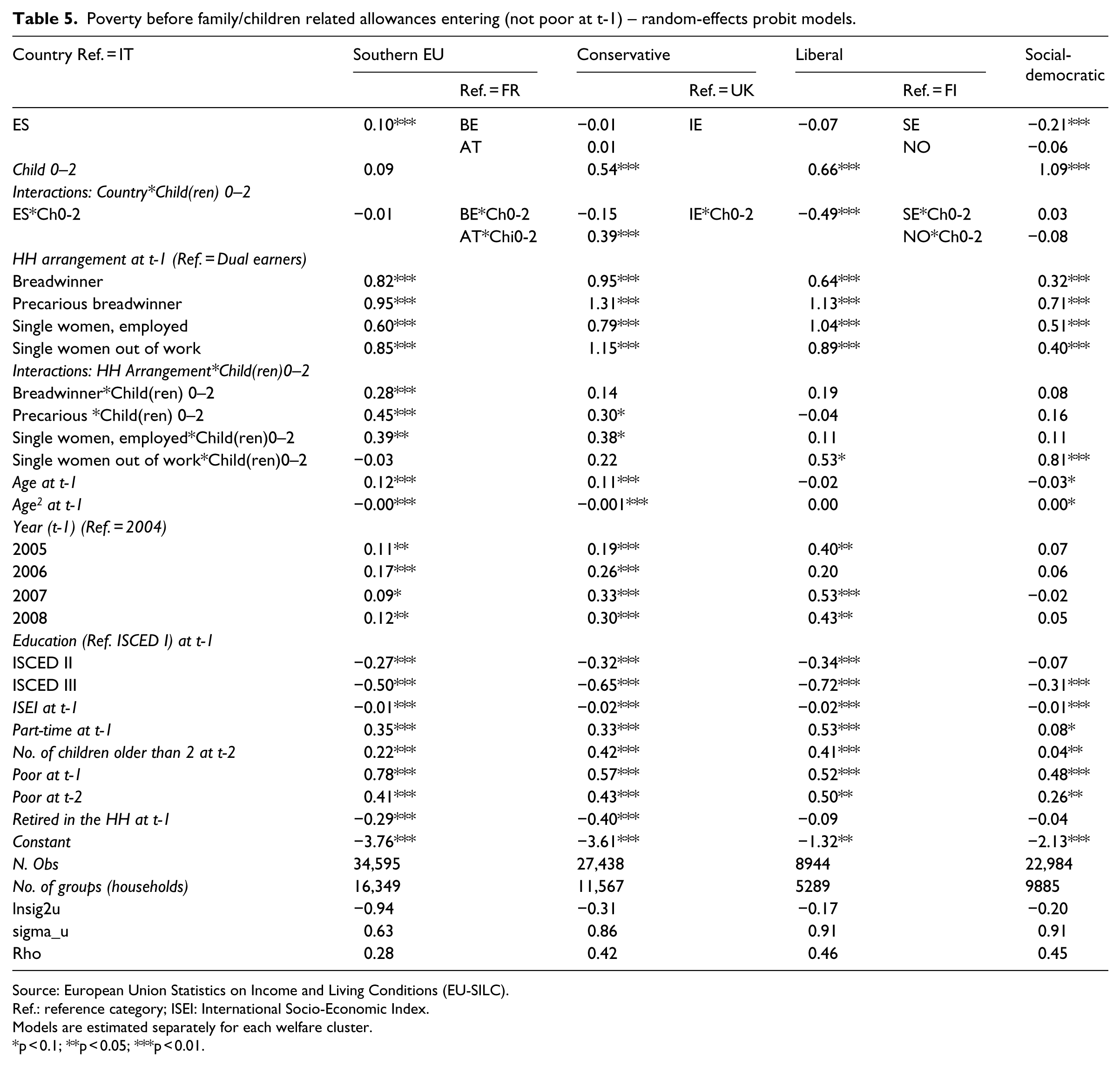
Poverty before family/children related allowances entering (not poor at t-1) – random-effects probit models.
| Country Ref. = IT | Southern EU |
Conservative |
Liberal |
Social-democratic | |||
|---|---|---|---|---|---|---|---|
| Ref. = FR | Ref. = UK | Ref. = FI | |||||
| ES | 0.10*** | BE | −0.01 | IE | −0.07 | SE | −0.21*** |
| AT | 0.01 | NO | −0.06 | ||||
| Child 0–2 | 0.09 | 0.54*** | 0.66*** | 1.09*** | |||
| Interactions: Country*Child(ren) 0–2 | |||||||
| ES*Ch0-2 | −0.01 | BE*Ch0-2 | −0.15 | IE*Ch0-2 | −0.49*** | SE*Ch0-2 | 0.03 |
| AT*Chi0-2 | 0.39*** | NO*Ch0-2 | −0.08 | ||||
| HH arrangement at t-1 (Ref. = Dual earners) | |||||||
| Breadwinner | 0.82*** | 0.95*** | 0.64*** | 0.32*** | |||
| Precarious breadwinner | 0.95*** | 1.31*** | 1.13*** | 0.71*** | |||
| Single women, employed | 0.60*** | 0.79*** | 1.04*** | 0.51*** | |||
| Single women out of work | 0.85*** | 1.15*** | 0.89*** | 0.40*** | |||
| Interactions: HH Arrangement*Child(ren)0–2 | |||||||
| Breadwinner*Child(ren) 0–2 | 0.28*** | 0.14 | 0.19 | 0.08 | |||
| Precarious *Child(ren) 0–2 | 0.45*** | 0.30* | −0.04 | 0.16 | |||
| Single women, employed*Child(ren)0–2 | 0.39** | 0.38* | 0.11 | 0.11 | |||
| Single women out of work*Child(ren)0–2 | −0.03 | 0.22 | 0.53* | 0.81*** | |||
| Age at t-1 | 0.12*** | 0.11*** | −0.02 | −0.03* | |||
| Age2 at t-1 | −0.00*** | −0.001*** | 0.00 | 0.00* | |||
| Year (t-1) (Ref. = 2004) | |||||||
| 2005 | 0.11** | 0.19*** | 0.40** | 0.07 | |||
| 2006 | 0.17*** | 0.26*** | 0.20 | 0.06 | |||
| 2007 | 0.09* | 0.33*** | 0.53*** | −0.02 | |||
| 2008 | 0.12** | 0.30*** | 0.43** | 0.05 | |||
| Education (Ref. ISCED I) at t-1 | |||||||
| ISCED II | −0.27*** | −0.32*** | −0.34*** | −0.07 | |||
| ISCED III | −0.50*** | −0.65*** | −0.72*** | −0.31*** | |||
| ISEI at t-1 | −0.01*** | −0.02*** | −0.02*** | −0.01*** | |||
| Part-time at t-1 | 0.35*** | 0.33*** | 0.53*** | 0.08* | |||
| No. of children older than 2 at t-2 | 0.22*** | 0.42*** | 0.41*** | 0.04** | |||
| Poor at t-1 | 0.78*** | 0.57*** | 0.52*** | 0.48*** | |||
| Poor at t-2 | 0.41*** | 0.43*** | 0.50** | 0.26** | |||
| Retired in the HH at t-1 | −0.29*** | −0.40*** | −0.09 | −0.04 | |||
| Constant | −3.76*** | −3.61*** | −1.32** | −2.13*** | |||
| N. Obs | 34,595 | 27,438 | 8944 | 22,984 | |||
| No. of groups (households) | 16,349 | 11,567 | 5289 | 9885 | |||
| lnsig2u | −0.94 | −0.31 | −0.17 | −0.20 | |||
| sigma_u | 0.63 | 0.86 | 0.91 | 0.91 | |||
| Rho | 0.28 | 0.42 | 0.46 | 0.45 | |||
Source: European Union Statistics on Income and Living Conditions (EU-SILC).
Ref.: reference category; ISEI: International Socio-Economic Index.
Models are estimated separately for each welfare cluster.
p < 0.1; **p < 0.05; ***p < 0.01.
Acknowledgements
The authors wish to thank Marco Albertini, Stefani Scherer and an anonymous JESP reviewer for their helpful comments and suggestions. Usual disclaimers apply.
Funding
This work was supported by the European Research Council under the European ERC Grant Agreement no. StG-263183 (Families of Inequalities – FamIne).