



Abstract
This article focuses on the relationship between employment protection legislation (EPL) and skill-specific unemployment risks. As a consequence of skill-biased technological progress, low- and high-skilled workers are expected to be affected differently. Moreover, the level of technological progress should moderate the relation between EPL and skill-specific unemployment risks. The analyses are based on data from the Labour Force Survey from the year 2008 and concentrate on the civilian labour force aged between 25 and 49 years in 20 European countries. The results show that stricter EPL strengthens unemployment risks between skill groups only when the level of technological progress is very advanced. In other countries, stricter EPL is related to less inequality in unemployment risks. However, there are two sides to a coin. While stricter EPL is related to lower unemployment risks for the low skilled in most countries, it leads to higher unemployment rates for the highly skilled at the same time.
Introduction
A lack of flexibility in the hiring and firing decisions of employers is generally regarded as a main reason for high and persistent unemployment rates in many European countries (Addison and Teixeira, 2001; Organisation for Economic Co-operation and Development (OECD), 2004; Skedinger, 2010; Walwei, 1996, 2002).
The relaxation of employment protection legislation (EPL) is believed to improve employment chances, particularly for people who are disadvantaged in the labour market, for example, the low skilled, who often appear to be losers to technological progress. Due to structural change, jobs offered in the primary and secondary sectors have decreased. Achieved knowledge in these fields has become obsolete. At the same time, new skills are needed to fulfil the requirements of the service sector and newly established branches. These new jobs mainly demand rather higher levels of qualification (Iversen and Cusack, 2000). In this context, the design of EPL has become of high political relevance. The enhancement of labour market flexibility – particularly by facilitating the use of temporary employment – has been one of the main targets of the European Union’s current and future employment strategies (Council of Europe, 2005; European Commission, 2012), which aim to reduce the degree of social exclusion and improve social cohesion. The easing of dismissal rules is expected to simplify access to the labour market by retrenching employment barriers. However, the demand for more labour market flexibility is transferred to all member countries without taking their specific economic conditions into account.
Empirically, however, there is no clear evidence of a relationship between the relaxation of EPL and a reduction in the unemployment rate in general (for an overview, see Addison and Teixeira, 2001; Skedinger, 2010). However, previous studies have shown that the effects of EPL can be moderated by other factors. De Beer and Schils (2009) demonstrated, for instance, that the effect of EPL on unemployment depends on the generosity of unemployment benefits. It is significantly stronger, the more generous unemployment benefits are. Nickell and Layard (1999) and Blanchard and Wolfers (2000) identified a relation with the level of coordination, although the direction of the estimated effects partly deviates from each other.
Moreover, specific effects of EPL on different skill groups have only been of minor interest in the past. There are only a few studies dealing with the within-country effects of EPL on skill-specific unemployment risks: both the OECD (1999) and Oesch (2010) concentrated on the effects that EPL has on the low-skilled unemployment rate, but were unable to show any significant relation. Esping-Andersen (2000) identified a significant and positive relationship between the long-term unemployment rate of less-educated workers and EPL, but again not with the low-skilled unemployment rate in general. Gebel and Giesecke (2011) provided the first insights into skill-specific labour market outcomes for differently educated workers. The authors concentrated on the relative differences between skill groups in temporary employment and unemployment. Their results show that deregulating restrictions on temporary employment increases the relative share of low-skilled workers in temporary employment in comparison with better-skilled workers; however, there was no effect concerning the distribution of unemployment risks. In their study, the easing of dismissal rules for regular employment decreased the relative unemployment risks for the low skilled. Bennett (2012) could only confirm these results relating to differences between individuals with medium and high levels of qualification, while also facilitating the possibility that employing workers on a temporary contract has no influence on the distribution of unemployment risks at all. However, it was shown that an increase in the level of EPL leads to bigger differences in the employment rates between the low and the high skilled, whereas differences in employment rates between the medium and the high skilled are strengthened only by an increase in the regulation of temporary employment.
The following analysis aims to provide more insights into the interplay between EPL and skill-specific unemployment risks. In contrast to previous studies, it does not concentrate on changes in EPL, but on the level of EPL that is implemented at a specific point in time. By taking a cross-sectional perspective, the existing differences between countries concerning the currently implemented levels of dismissal rules and their relation to individual unemployment risks are highlighted. Furthermore, this article contributes to the literature by taking technological progress into account. The article tries to answer the question of whether the relation between EPL and unemployment risks for different skill groups might be moderated by the level of technical progress observable in a country. Since technological advancements are considered to be skill-biased (as will be outlined later), they might produce different flexibility requirements for varying skill groups. However, this article does not try to explain why countries differ according to their current levels of technological progress. 1
The analyses are based on data from the Labour Force Survey (LFS) (wave 2008) and captures 20 European countries. For the analyses, fixed effects models with cross-level interaction effects have been applied.
The article is structured as follows: the second section deals with skill-specific unemployment risks that are related to skill-biased technological progress and different levels of EPL, and the section after that describes the data, variables and methods that have been used. In the fourth section, the descriptive, bivariate and multivariate results are presented. The article ends with a discussion of the results.
Skill-specific unemployment risks
Skill-biased technological progress
One important reason for differences in unemployment risks refers to skill-biased technological progress. Technological progress has changed productivity levels of low- and high-skilled workers. It has also led to changes in the organisation of labour within companies.
There are two reasons for this development. One is the increase in the proportion of skilled workers in the labour force in the past (Acemoglu, 1999, 2002; Autor et al., 1998). The expansion of higher education is a worldwide phenomenon. The number of students per 10,000 capita has changed from around 40 to more than 165 students worldwide in 2000 (Schofer and Meyer, 2005).
Increases in skilled labour usually lead to decreases in the wage premium for investments in education. However, if a certain threshold is reached, it becomes more beneficial for employers to create jobs targeted specifically at highly qualified workers; this also results in higher returns to education. Between 1979 and 1995, for example, the wages for college graduates relative to the wages of high-school graduates increased in the United States by more than 25 percent (Acemoglu, 1999). Thus, the key determinant of skill-biased technological change has been the market size of skilled labour. The second reason is that increases in skill supply have been accompanied by technological progress, thereby reducing the optimal amount of labour by increasing factor productivity at the same time. Technological change has resulted in a qualitative change in the composition of jobs. It has been associated with changes in production techniques, but also with organisational changes and capital deepening (Autor et al., 1998). The developments observable in the labour market confirm the existence of skill-biased technological change and the formation of two separate job markets for skilled and unskilled workers (Acemoglu, 1999). Furthermore, the highly skilled are encouraged to match with other high-skilled workers through positive wage effects, rather than working as managers in companies employing mostly low-skilled workers. The positive wage effects result from increases in productivity that can be realised in this context (Acemoglu, 2002). The diffusion of computers and telecommunication technologies in the 1980s and early 1990s has largely contributed to this development. For both the manufacturing and non-manufacturing sector, the increase in demand for high-skilled individuals has been greatest in the most computer-intensive industries. In particular, the simple and repetitive tasks of white-collar workers have been rationalised by computerisation rather than complex and specific tasks. Many production processes have also been substituted. While many clerical and production jobs have been displaced from the labour market, workers with managerial and professional jobs have benefited from computerisation by utilising their manpower more effectively (Autor et al., 1998; Mortensen and Pissarides, 1999).
Skill-biased technological change has also led to changes in the organisational structure of companies. For instance, the use of computer technology has increased the ability of firms to monitor work (Acemoglu, 1999, 2002; Autor et al., 1998). Moreover, it was stated, High wage firms are more selective in hiring than they were two decades ago, the distribution of physical capital to labor ratios across industries has become more unequal, workers appear to be better matched to their jobs, the distribution of on-the-job training across education groups has become more unequal, and some of the jobs in industries and occupations that typically pay close to the median of the wage distribution have been replaced by jobs from the more extreme parts of the quality distribution of jobs. (Acemoglu, 1999: 1260–1)
However, later Autor et al. (2003) claim that the low skilled are only little affected by technological progress, since routine labour is often done by medium-skilled workers. In a more current article, Autor (2010) confirms a decrease in middle-wage, middle-skilled white-collar and blue-collar jobs within the United States and Europe. Manning (2004) argues, however, that ‘employment of the less-skilled is increasingly dependent on physical proximity to the more-skilled and may also be vulnerable in the long-run to further technological developments’ (p. 581).
EPL and skill-specific unemployment risks
Acemoglu (2002) found some evidence that labour market institutions and skill-biased technological change interact with each other. Employment protection rules have turned out to play a prominent role in this context.
Generally, EPL can be described as ‘restrictions placed on the ability of the employer to utilize labor’ (Addison and Teixeira, 2001: 2), or according to the OECD, as ‘rules governing the hiring and firing process’ (OECD, 2004: 64). It is expected to reduce companies’ numerical flexibility. Numerical flexibility is a quantitative measure referring to the amount of labour a firm uses. To be differentiated from this is the concept of functional flexibility, which is related to the possibility of re-deploying workers from one task to another, but without changing the amount of labour input (Kalleberg, 2001). Actually, EPL is the sum of rather complex systems of rules that vary from country to country.
From an economic perspective, the strictness of EPL is determined by the costs related to the dismissal of an employee. One can distinguish between costs directly associated with a lay-off – that is, quantifiable and already known before the employment relation starts, for example, severance payments – and indirect costs arising from procedural inconveniences and difficulties to enforce a dismissal. Given that the flexibility of wages is somehow restricted, the literature argues that strict EPL has both negative and positive employment effects that determine the probability of unemployment (Addison and Teixeira, 2001; Skedinger, 2010). Negative employment effects might result from high labour costs and restrictions on the flexibility of entrepreneurial activity. Dismissal regulations increase separation costs, for example, by severance payments, and delay the optimal moment of a dismissal in a company. As neoclassical employment theory states, high labour costs are generally related to a reduction in labour demand so as to reach an optimal amount of labour. Furthermore, by limiting the freedom of action, appropriate responses to economic changes are constrained. Compared to labour markets with low requirements on firing rules, employers in strictly regulated markets are restricted in their competitiveness. Rigid EPL might, thus, result in recruitment freezes or shifts in foreign markets. When creating employment barriers, strict dismissal rules are specifically expected to increase the probability of being long-term unemployed.
Hiring and firing decisions depend, however, on the employer’s expectation of the extent to which additional labour costs will be compensated for in the future (OECD, 2004). In this regard, EPL is expected to work differently for low- and high-skilled workers. Firms might, therefore, have different flexibility requirements on their employees varying with the level of qualifications that have been acquired.
Redundancies often result from a decrease in demand (Nolte, 2001). In this regard, labour demand for simple activities is more price-elastic. According to Davis and Reeve (1997), the more easily input factors are substitutable, the more they respond to price fluctuations (here, in terms of decreasing marginal labour productivity). In the case of high-skilled workers, the elasticity of labour demand is, therefore, rather low. Future replacement of high-skilled workers in times of increasing demand is expensive. Moreover, high-skilled employees can even become indispensable as important service providers for the production process of the company. For the highly skilled, there is generally a greater need for functional flexibility. These workers often participate in decision-making, work in teams and their wages are often determined by the organisational performance of the company. Therefore, layoffs due to declines in consumer demand affect, at least in the short run, mainly low-skilled workers.
The literature, however, also gives some reason to suspect that there are positive employment effects resulting from strict dismissal rules (see, in particular, Belot et al., 2002; Storm, 2007). First of all, those being employed profit from a high level of job protection, and consequently the frequency of becoming unemployed should be lowered. Through the establishment of specific dismissal laws, long contract negotiations at the beginning of the employment relationship can be avoided and thus reduce transaction costs. Moreover, job security afforded by EPL increases the extent of human capital investments by workers. Increases in productivity could compensate for high labour costs. In order to obtain investment incentives, workers have to be provided with an appropriate employment guarantee, which protects them against the opportunistic behaviour of an employer so that, at the very least, the investment costs can be amortised (OECD, 2004). Because productivity rates increase in relation with the skill level acquired, dismissal risks – for the same seniority – decrease more for high-skilled workers than for low-skilled workers (Layte et al., 2002; Nolte, 2001). Strict EPL also tends to improve the extent of cooperation by increasing job security. According to Walwei (1996), it promotes the identification with operational objectives, in-house mobility and the acceptance of technological progress. A lack of EPL might, in contrast, result in more frequent strikes, a reduced willingness to make concessions by workers’ representatives and an increased amount of shirking (Walwei, 1996).
The added value for the company resulting from an increased level of cooperation, however, depends on how important cooperation in the production process is. The more ambiguous and unstructured the task is and the higher the required skill levels are, the more difficult the monitoring of performance is (Jones, 1984). Productivity benefits from strict firing rules, therefore, derive especially for high-skilled workers.
In general, it is unclear whether the detrimental or beneficial effects prevail. Unemployment risks are determined by both the frequency of unemployment periods and their duration. On one hand, strict EPL can mutate into an employment barrier for those searching for a job by reducing hiring incentives to high labour costs; on the other hand, workers who are already employed profit from low dismissal risks because they are protected by legislation. Both effects might compensate for each other, so that the net effect is zero.
Since, however, the actual employment effects depend on employers’ expectations as to what extent labour costs will be compensated for and which productivity gains will be met in the future (OECD, 2004), the negative effects should generally decrease with the skill levels acquired:
H1. Differences in skill-specific unemployment risks are expected to increase with the level of EPL.
As outlined before, however, the organisational structure within a company and the productivity levels of different skill groups are influenced by the degree of technological progress. This aspect has been largely ignored in the literature dealing with skill-specific unemployment effects related to the level of EPL, although technological advances and the introduction of innovations vary a lot between countries.
Following the theoretical considerations concerning the development of skill-biased technological change, the relation between EPL and skill-specific unemployment risks should be moderated by the level of technological progress. In countries with a high level of skill-biased technological change, differences between skill groups should be most pronounced because the expected differences in productivity levels between skill groups and the organisational structure are biggest. The highly skilled should be less harmed by strict EPL because they are more able to profit from the positive employment effects that are related to rigorous EPL in comparison with the low skilled.
Conversely, in countries with less technological progress, differences in labour organisation and productivity levels should be less severe. High-, medium- and low-skilled workers partly compete for the same jobs. This also means that flexibility requirements for different skill groups are more similar. Therefore, the relationship between EPL and individual unemployment risks should differ less.
H2. The relation between skill-specific unemployment risks and EPL are expected to be positively moderated by the level of technological progress.
Data, variables and methods
Data
Micro-level data are based on the European LFS from 2008. The LFS collects information on demographic, social and economic characteristics of numerous European countries (German Federal Statistical Office, 2012). 2 Due to restrictions in the availability of macro-level data, this study includes 20 countries: Austria, Belgium, Czech Republic, Germany, Denmark, Estonia, Spain, Finland, France, Greece, Hungary, Ireland, Italy, the Netherlands, Norway, Poland, Portugal, Sweden, Slovenia, and the United Kingdom. 3 In total, these constitute about 850,000 respondents. Only the working population is included, that is, unemployed and employed people but without self-employed and family workers. 4 The study further focuses on middle-aged respondents aged between 25 and 49 years old. This limitation allows for ignoring the specific problems that young and old people face on the labour market. 5
Individual-level variables
Employment status is at the focus of the analysis. The analysis differentiates between being unemployed and being employed; all other groups are excluded. The variable is coded 1 if the individual is unemployed and 0 if the individual is employed. Several socio-demographic attributes are taken into account as control variables. These are gender, age, marital status and nationality. The binary variable ‘foreign nationality’ is coded 1 for respondents not having the citizenship of their residence and 0 for the opposite situation. Marital status is 1 for individuals being married and 0 otherwise. On the individual level, the reference month respondents refer to is also controlled for. In most countries, surveys were equally spread over the whole year, while some were concentrated only on specific time periods. Individual unemployment risks, however, could vary over time. However, despite the economic crises, most of the countries in the sample still showed decreasing unemployment rates in 2008. Increases in unemployment can mainly be observed for 2009. Only in some countries did unemployment increase in 2008. However, by controlling for the reference month in terms of a metric control variable, 6 unemployment risks that are related to the time the survey was undertaken are taken into account.
Skills are classified on the basis of the International Standard Classification of Education 1997 (ISCED-97) scheme (UNESCO, 2010). It captures seven different levels and includes information on formal, general or vocational education. In the following, skills are classified as low (from pre-primary until lower secondary stage of basic education), medium ((upper) secondary and post-secondary stage of education) or high (first or second stage of tertiary education). 7
Country-level variables 8
The level of EPL is measured by an EPL index provided by the OECD for the year 2008, Version 3 (OECD, 2012). It captures legislation, court rulings, collectively bargained conditions of employment and customary practices. The index includes three sub-indicators representing (1) dismissal rules for regular employment, (2) additional regulation for collective dismissals and (3) restrictions on the use of temporary employment. It consists, inter alia, of information on procedural processes, compensation payments, notice periods and the difficulty of enforcing a dismissal. It also captures information on the requirements and restrictions of using temporary employment, that is, fixed-term or temporary work agency employment (for detailed information, see Venn, 2009). While the sub-indicators for dismissals, rules for regular employment and restrictions on the use of temporary employment are of equal importance, the sub-index for regulation on collective dismissals is attributed only 40 percent of the weight assigned to the other two sub-indicators.
The strictness of EPL is valued on a scale from 0 to 6, with larger numbers meaning stricter regulation. Data refer to the year 2008. With a value of 1.09, EPL is the most flexible in the United Kingdom. Ireland (1.39) and Denmark (1.91) also have relatively liberal dismissal rules. In contrast, France (3.00), Portugal (3.05) and Spain (3.11) show comparatively strict employment protection regulations. The average value of the EPL index over all countries is 2.40.
Besides differences in the overall index, countries also vary concerning the interaction between regulation for regular and temporary employment. In the past, countries like Sweden, the Netherlands, Germany and the Czech Republic created, for example, the so-called two-tier systems with relatively strict regulations for dismissal from regular employment on one side and a flexible market for temporary employment on the other side, while other countries implemented rather balanced regulations for both employment sectors.
In order to represent the level of technological progress that has taken place within countries, and which is reflected in the labour market, the share of employment in innovative sectors as a percentage of the total workforce is taken into account. 9 Information is taken from the European Innovation Scoreboard (EIS) and refers to the year 2008 (PRO INNO Europe, 2009). The EIS has been developed at the initiative of the European Commission in order to compare the innovation performance of its member states, including the level of technological progress. It differentiates various input and output dimensions. The share of employment in innovative sectors is considered to represent the corresponding economic outcomes that have been achieved within the countries in the sample. Innovative sectors capture both the (medium-) high-tech manufacturing and the knowledge-intensive service sector. Knowledge-intensive service includes the following branches: water transport, air transport, post and telecommunications, financial intermediation, insurance and pension funding, activities auxiliary to financial intermediation, real estate activities, renting of machinery and equipment, computer and related activities, research and development and other business activities. The medium-high and high-tech manufacturing sector captures chemicals, machinery, office equipment, electrical equipment, telecommunications and related equipment, precision instruments, automobiles as well as aerospace and other transports (Hollanders and Van Cruysen, 2008). It is expected that the proportion of employment in innovative sectors corresponds to the level of technological progress that has been achieved.
Portugal (13.1%), Greece (13.4%) and Estonia (14.9%) bring up the rear with less than 15 percent employment in (medium-) high-tech manufacturing and knowledge-intensive services in sum. Germany has a total share of 26.3 percent at the top of the league, followed by Sweden (24.7%) and the United Kingdom (24.0%). The average is 20.4 percent.
Methods
The analysis starts with some descriptive and bivariate findings, providing insights into the relationship between individual unemployment risks and country-level determinants. All data are weighted at the individual level by the design weight provided with the LFS in order to account for potential selection biases. To analyse the relation between skill-specific unemployment risks at the individual level and the strictness of EPL and the level of technological progress at the country level, I apply different logistic regression models. Since the data structure is hierarchical – individuals are nested in countries – multi-level methods have to be used. However, due to the small number of cases, the conventional random effects regression models, allowing for estimations of variations at various levels at the same time (Raudenbush and Bryk, 2002), have some severe drawbacks. Only a very small number of country variables can be controlled for simultaneously (Maas and Hox, 2004). This limitation can lead to omitted variable bias or spurious correlation effects. Moreover, models are often not very robust.
As an alternative in this case, Allison (2009) and Möhring (2012) recommend the application of fixed effects models. Due to the inclusion of N−1 country dummies, the models automatically control for country-level heterogeneity. However, this also means that all the variance at the country level is already explained, that is, no additional country-level variables can be included. Fixed effects models therefore do not allow, for example, for estimating the main effect of EPL (or other country-level variables) on the individual unemployment risks of different skill groups.
Instead of modelling the main effects, however, cross-level interaction effects can be estimated, which is a common practice from panel data analyses. Since the interaction effects of individual and macro-level variables vary between and within countries, they can be estimated simultaneously with the N−1 country dummies in the model. So, the impact of macro-level variables can be measured at least indirectly. With regard to the hypotheses of this article, one can analyse, for example, whether the relation between education and individual unemployment risks on the individual level is moderated by the level of EPL or the level of technological progress on the macro level, respectively. It also enables an assessment of the extent to which inequalities between skill groups are strengthened or diminished by the selected country variables.
Coefficients in logistic regression models (logits or odds ratios) are not – in contrast to linear regression estimates – comparable across groups or samples. Coefficients always capture the degree of unobserved heterogeneity, that is, they are affected by omitted variable bias. Mood (2010) therefore recommends, among other things, calculating average marginal effects (AMEs). In this study, the AME express the average effect of the selected variables on the probability of being unemployed over all observations. Another possibility is to calculate conditional probabilities, for example, at the mean values of the selected variables (see Figure 2).
Results
Figure 1 displays individual unemployment rates for the low, medium, and highly skilled in each country based on data from the LFS. Countries are sorted according to their level of EPL. As the descriptive results show, there seems to be no general trend between the level of EPL and country-specific unemployment risks. However, in countries where EPL is very rigorous (Greece, France, Portugal, Spain), the unemployment rates of the medium and highly skilled tend to be rather high.
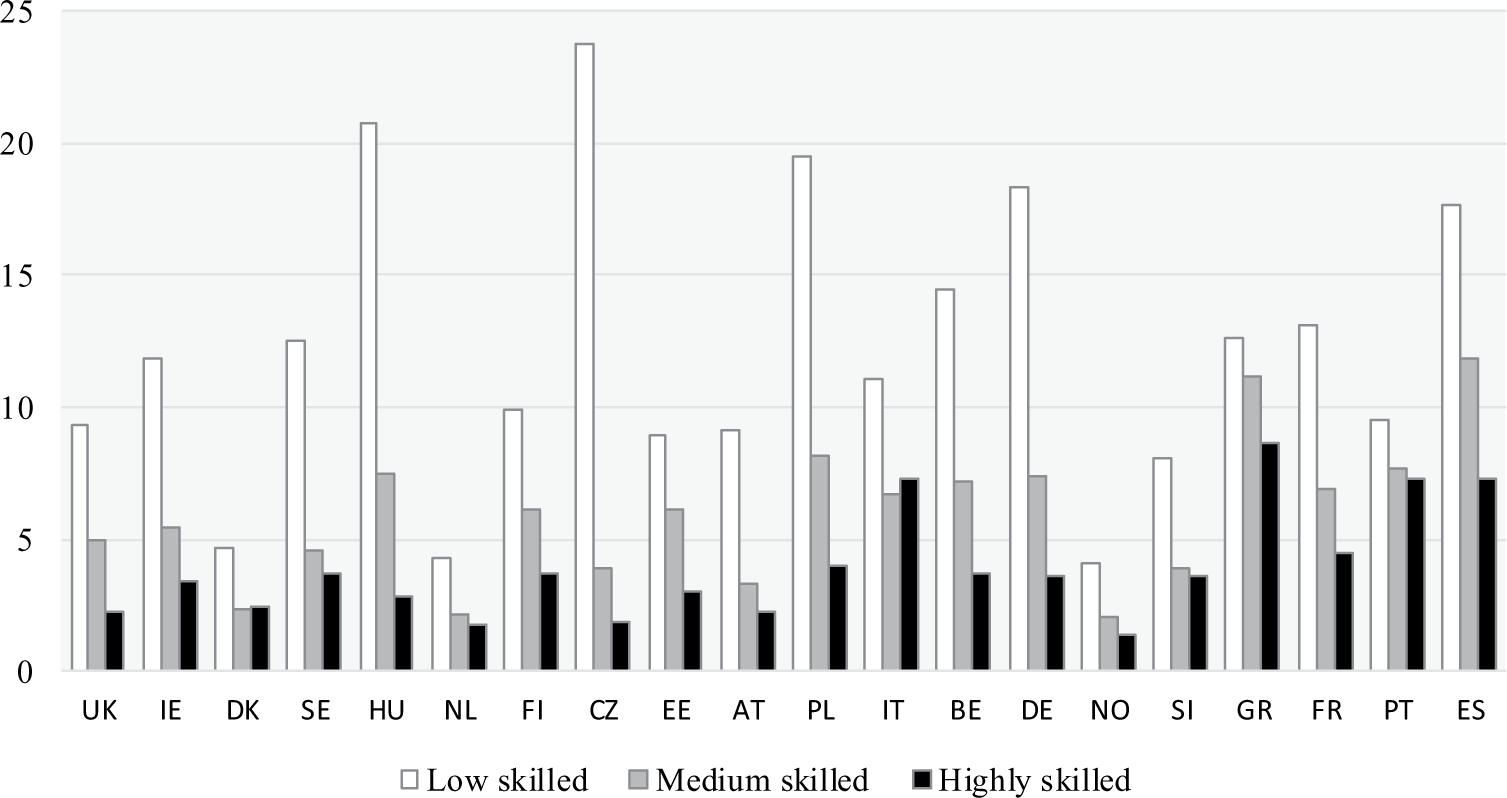
Skill-specific unemployment rates of the civilian labour force (25–49 years) assorted according to the level of EPL from minimum to maximum, 2008 (in %).
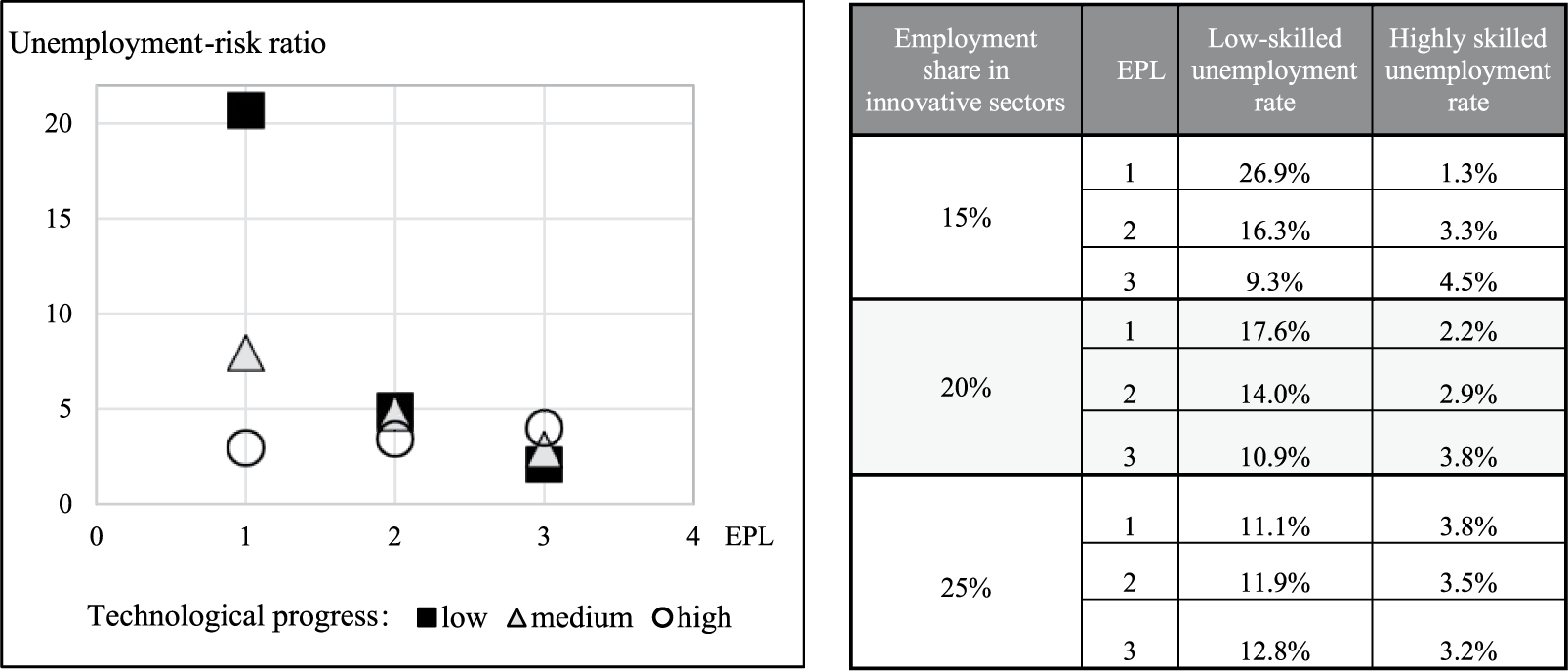
Unemployment-risk ratio between the low and highly skilled for different EPL levels and employment shares in innovative sectors.
Moreover, Figure 1 also shows that there is much more variation between countries in the unemployment rates of the low skilled than in the other two groups. The low-skilled unemployment rates range from 4.1 percent in Norway to 23.8 percent in the Czech Republic. The unemployment rates for medium-skilled individuals vary from 2.1 percent in Norway to 11.8 percent in Spain; meanwhile, the high-skilled rates range from 1.4 percent in Norway to 8.7 percent in Greece. For the latter two groups, unemployment is particularly high in Southern European countries. Differences between the low and highly skilled are particularly pronounced in Poland (16 percentage points), Hungary (18 percentage points) and the Czech Republic (22 percentage points). In Italy and Denmark, unemployment rates of the highly skilled are slightly higher when compared to the unemployment rates of the medium-skilled labour force.
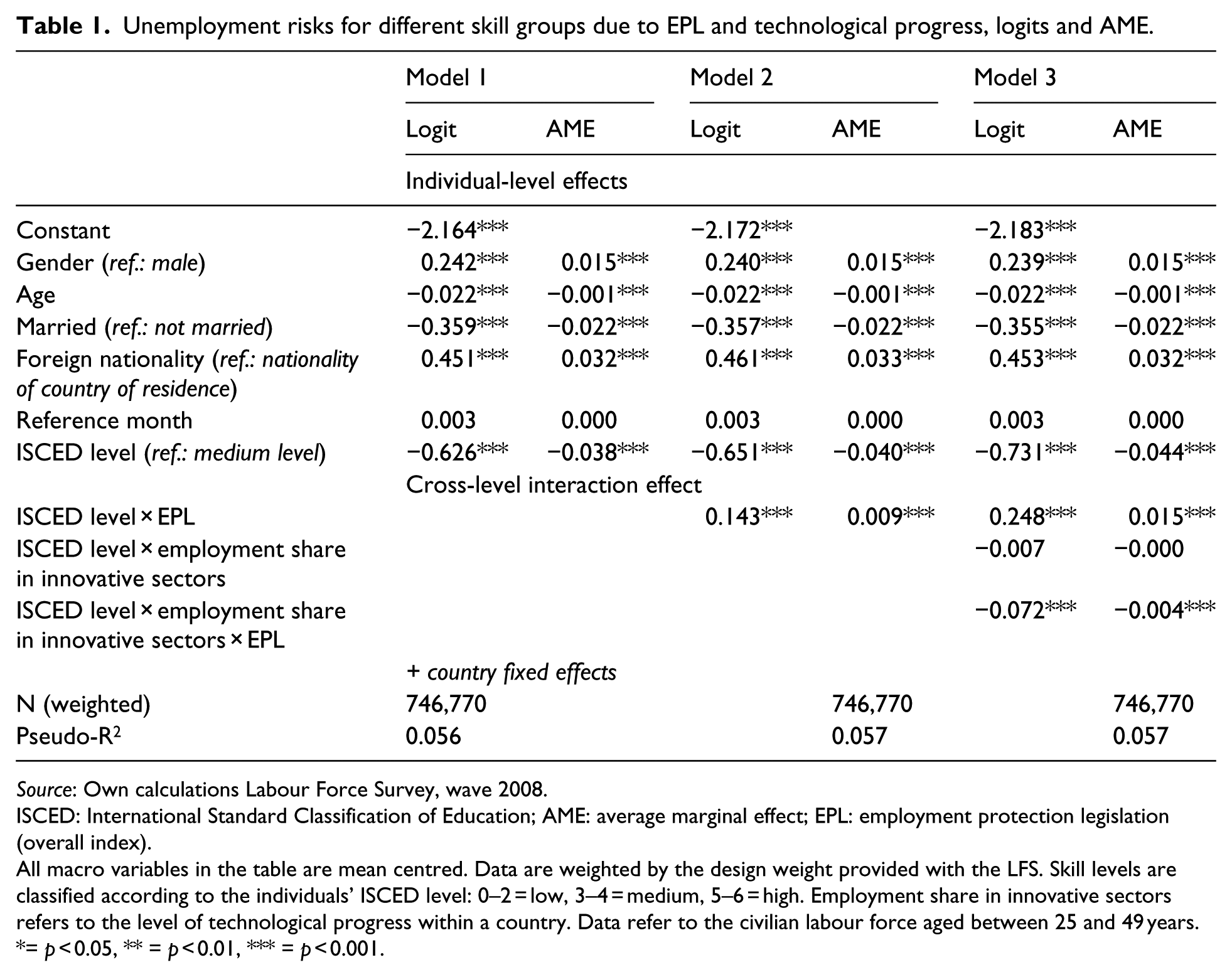
Table 1 presents the results (logits and AMEs) of the fixed effects logistic regression models. In the first model, only individual-level variables are included. The second model also captures the cross-national interaction effect between EPL and the individual skill level. The third model includes two additional interaction effects: the interaction between skills and the share of employment in innovative sectors as well as a three-way interaction effect between skills, EPL and the share of employment in innovative sectors. All macro variables are centred around their mean.
Unemployment risks for different skill groups due to EPL and technological progress, logits and AME.
Source: Own calculations Labour Force Survey, wave 2008.
ISCED: International Standard Classification of Education; AME: average marginal effect; EPL: employment protection legislation (overall index).
All macro variables in the table are mean centred. Data are weighted by the design weight provided with the LFS. Skill levels are classified according to the individuals’ ISCED level: 0–2 = low, 3–4 = medium, 5–6 = high. Employment share in innovative sectors refers to the level of technological progress within a country. Data refer to the civilian labour force aged between 25 and 49 years.
= p < 0.05, ** = p < 0.01, *** = p < 0.001.
As expected, Table 1 shows that skills, represented by International Standard Classification of Education (ISCED) levels, are positively related to individual unemployment risks. Without considering cross-national interaction effects (Model 1), the probability of being unemployed decreases by 2.3 percent on average if ISCED levels increase by one unit compared to someone with an ISCED level of zero (‘skill-effect’). 10 Moreover, unemployment risks are higher for women and foreigners within the selected sample. They decrease with age and are lower for married people. The date of the interview (reference month) is not relevant.
The results of Model 2 illustrate the effect of skills by controlling for the level of EPL. The positive interaction effect (ISCED level × EPL) demonstrates that the skill-effect is smaller the stricter EPL is. Hypothesis 1, therefore, has to be neglected. Differences in skill-specific unemployment risks decrease with more rigid EPL. However, this result does not mean that unemployment risks of the highly skilled are positively related to EPL, and unemployment risks of the low skilled are negatively related. It only indicates that the relative differences in unemployment risks become smaller between skill groups the stricter EPL is. In other words, the highly skilled seem to be more affected by rigorous EPL with regard to their unemployment risks compared to the low skilled.
Model 3 introduces the level of technological progress by considering the share of employment in innovative sectors. The results illustrate that the two-way interaction effect between EPL and technological progress is not significant. However, the three-way interaction effect (ISCED-level × EPL × employment share in innovative sectors) indicates that the relation between EPL and the skill-effect can be compensated for by high levels of technological progress. That means that if strict EPL appears jointly with a high share of employment in innovative sectors, the differences in unemployment risks due to the individual skill level acquired are more pronounced than in countries with strict EPL and low technological progress. 11 On the other hand, in countries where only little technological progress has happened so far, rigid EPL is related to small differences in unemployment risks. Hypothesis 2 can, therefore, be confirmed. 12
To illustrate the three-way cross-level interaction effect in Model 3, I predicted individual unemployment risks conditional on different values of EPL and employment in innovative sectors in order to illustrate the unemployment-risk ratio of the low and highly skilled. All other predictors are set to their means.
The unemployment-risk ratio corresponds to the ratio between the estimated unemployment rates of the low and the highly skilled. As Figure 2 demonstrates, relative differences are most pronounced in countries with flexible EPL (=1%) and a low employment share in innovative sectors (=15%). There, unemployment rates of the low skilled are 20.7 times higher compared to the highly skilled. In contrast, inequalities are smallest in countries with very rigid EPL (=3%) and a low employment share in innovative sectors (=15%). In these cases, unemployment rates of the low skilled are only 2.1 times higher compared to the highly skilled. Thus, EPL has very strong effects on the distribution of unemployment risks between skill groups in countries with low technological progress.
In contrast, as expected from the theoretical considerations, stricter levels of EPL are related to bigger inequalities between skill groups in countries that are technologically very advanced (=25%). However, differences due to the level of EPL are rather small.
By looking at the estimated unemployment probabilities, we can also observe that unemployment risks decrease for the low skilled the stricter EPL is on condition that the employment share is – with regard to the sample considered – either low (15%) or medium (20%). In countries with relatively high employment shares in innovative sectors (25%), unemployment rates for the low skilled are higher the more flexible EPL is. For the highly skilled, we can observe the reverse effects.
In order to specify the relation between EPL and skill-specific unemployment risks, I replicated the models in Table 1 by using the two sub-indicators capturing regulation on temporary employment (EPT) and dismissal rules for regular employment (EPR) separately instead of the overall EPL index. 13 The results show that the positive interaction effect between skills and EPL goes back to EPT. In contrast, the interaction effect between skills and EPR is negative. However, this effect is strongly moderated by the level of technological progress. High employment shares in innovative sectors strengthen the effect of EPR. It might even dominate the effect of EPT for which we can also observe a significant and negative three-way interaction effect between skills and technological progress, but which, concerning the size of its influence, is somewhat smaller.
In other words, rigid regulation of temporary employment is related to smaller differences in skill-specific unemployment risks, in particular, in countries that are not technologically very advanced. However, the level of technological progress seems to play only a minor role. In countries where EPT is flexible, inequalities between skill groups are expected to be more pronounced. In contrast, very rigid EPR is related to big differences between low- and high-skilled individuals, especially when the share of employment in innovative sectors is very high. Inequalities are smallest when EPR is flexible and the level of technological progress low.
Thus, in countries with high employment shares in innovative sectors, differences in unemployment risks between skill groups are expected to be most pronounced when EPT is flexible and EPR rigid, that is, in countries that have implemented two-tier systems.
Discussion
The purpose of this analysis was to shed some light on the interplay between EPL and skill-specific unemployment risks by taking the level of technological progress into account. Technological progress is considered to have been skill-biased, which has led to changes in the productivity levels of low- and high-skilled workers and the organisation of labour. It was expected that this development has influenced the flexibility requirements of the company and, therewith, the relation between EPL and skill-specific unemployment risks.
Since the results of the study are cross-sectional, they do not allow for causal explanations. However, they illustrate the general relation between EPL and individual labour market outcomes, from which at least presumptions concerning the effects of EPL reforms can be derived.
The multivariate analyses show, as expected, that individuals with higher skill levels generally face lower unemployment risks. However, in contrast to the hypothesis, differences in skill-specific unemployment risks become smaller the stricter EPL is. Thus, the highly skilled seem to be more negatively affected compared to the low skilled. Since separation costs are related to current earnings, increases in productivity levels of the highly skilled due to more rigid EPL are probably less able to compensate for additional costs, in particular, with respect to severance payments. As the results demonstrate, this effect goes back to the regulation on temporary employment instead of dismissal rules for regular employment.
The analyses also show, however, that the relation between EPL and skill-specific unemployment risks is moderated by the level of technological progress. In countries with a very high level of technological advancement, the relation changes its direction, that is, that skill-specific unemployment risks are strengthened, the stricter EPL is. In these countries, additional productivity gains by the highly skilled must be stronger compared to countries with low technological progress so that the additional labour costs resulting from strict EPL can be compensated for. On the other hand, strict EPL seems to turn into employment barriers for the low skilled. Thus, the analyses have confirmed that companies’ flexibility requirements change with the level of technological progress. Employers seem to be more interested in long-lasting and stable job relationships with high-skilled workers and a high degree of numerical flexibility with respect to the employment of less-skilled workers in countries that are technologically very advanced in contrast to countries that have achieved only a low level of technological progress.
Differences due to the level of EPL are, however, only marginal in countries with high levels of technological progress. In contrast, effects are particularly strong in countries where progress has been very low. The results also show that differences in skill-specific unemployment risks are most pronounced in countries with high levels of technological advancements that have implemented two-tier systems.
As the predicted probabilities in Figure 2 demonstrate, however, there are two sides to a coin. While the low-skilled unemployment rate increases in countries with low or medium levels of technological progress the stricter EPL is, unemployment rates increase due to less flexible EPL for the highly skilled in countries with high levels of technological progress.
One striking result of this article is that EPL is no panacea to solve labour market problems, particularly with respect to inequalities in unemployment risks between skill groups. EPL is, furthermore, not associated with higher unemployment risks per se. The effects of EPL depend on the countries’ economic performances. Therefore, the general demand for more flexible dismissal rules within the member states of the European Union has to be regarded critically.
The results do not refer to the quality of employment, however. Decreases in unemployment risks might be related to an increase in atypical employment, for example, low-wage jobs or fixed-term employment. Moreover, the relation between unemployment, skills, EPL and technological progress might also depend on additional factors like, for instance, the generosity of unemployment benefits, for which in previous studies, positive moderator effects between EPL and aggregated unemployment rates have been detected (De Beer and Schils, 2009).
Footnotes
Acknowledgements
I would like to thank the members of the research training school GK SOCLIFE for all their helpful comments and the Wissenschaftszentrum Berlin für Sozialforschung for its support during my research stay.
Funding
The author(s) disclosed receipt of the following financial support for the research, authorship, and/or publication of this article: Research for this study was funded by the Deutsche Forschungsgemeinschaft (GRK 1461).