



Abstract
The article contributes to the growing literature on framing of deservingness as an alternative to ‘blame avoidance’ strategies in the politics of welfare retrenchment. In particular, the article focuses on the interplay between political framing and media framing. Based on an analysis of two major welfare reforms involving reductions of social benefits in Denmark in 2005 and 2013, the article analyses the frames used by politicians supporting and opposing reform, as well as the frames used by the media. The article shows, first, that political reforms reducing social benefits are followed by increased framing of recipients as undeserving. The article finds a strong correlation between the political objective of reducing benefits and the reliance on frames that position recipients as undeserving. Second, the article shows that media framing remains significantly different from political framing in both years. However, the results also show that the media become less critical and more prone to frame recipients as undeserving along with the changes in political framing. Third, the article shows that media coverage of retrenchment reforms will be more critical under conditions of political conflict than in the case of political consensus. However, this result is also qualified by the observation that the media increasingly seek outside sources in order to find alternative voices under conditions approximating political consensus.
Introduction
Although the ‘new politics’ of welfare retrenchment is not exactly new anymore, it remains an open and vital question how exactly such politics are exercised. Since Pierson (1996) advanced his influential analysis, the prevalent answer has revolved around the idea of ‘blame avoidance’. Cautious political strategies based on the need to obscure responsibility for reform due to fear of electoral punishment have thus been seen as a major factor behind the combination of institutional resilience of the welfare state and individual social policy reforms involving significant or even drastic cost containment, recalibration and/or recommodification in recent decades (Pierson, 2001; Starke, 2006; Vis and Van Kersbergen, 2007; Wenzelburger, 2014).
Recent studies, however, have suggested that there is an alternative political strategy at work in the politics of welfare retrenchment: framing of recipients as less deserving of welfare benefits. Rather than trying to avoid blame for reforms assumed to be risky or unpopular, governments and political coalitions may seek proactively to change the public perception of particular groups of welfare recipients as more or less deserving, potentially turning welfare retrenchment, using a particularly astute statement of this point, into a ‘vote winner’ (Elmelund-Præstekær and Emmenegger, 2012). More generally, strategic framing of deservingness can be said to suggest a less conservative tendency in the politics of welfare retrenchment and a possible explanation for reforms that can even be seen as ‘path-breaking’ (Green-Pedersen and Haverland, 2002: 47).
Against this background, the article explores two questions: first, whether political parties behind welfare retrenchment reforms frame recipients of benefits as undeserving and, second, whether the media follow such political framing or assume a different stance towards welfare retrenchment reforms. In order to answer these questions, the article presents the results of a study of the two most intensely debated reforms of compensation schemes in Denmark in recent years: the ‘cap’ on baseline social benefits for citizens incapable of being self-sustaining due to unemployment and other social circumstances introduced in 2004 and the general overhaul of the same system of benefits coming into effect in 2013.
The fact that welfare and social policy is underpinned by perceptions and classifications of citizens is not in itself new. In their innovative combination of historical analysis and content analysis, Golding and Middleton (1982) show how contemporary ‘welfare images’ about the ‘morality’ of work ethic and self-sufficiency, the ‘pathology’ of individual inadequacy as the cause of poverty and the ‘efficiency’ of the labour market and the economy can be traced back to concepts of idleness, pauperism and moral vices found in the earliest poor laws in Britain (p. 48). Other classical studies have examined the underlying images, perceptions and classifications of welfare in the United States (Cook, 1979; Handler and Hasenfeld, 1991). The main idea behind current studies, however, is that such welfare images and classifications are less a matter of deep-seated beliefs and ideological convictions subject to slow incremental changes than an object of swift strategic manipulation in the new reality of what has been referred to as mediatized politics and professionalized political communication (Blumler and Kavanagh, 1999).
Drawing on insights from the political communication literature, we define political attempts to strategically alter public perceptions of deservingness as framing (Chong and Druckman, 2007b). Referring to the concept of ‘framing effects’, existing studies provide evidence that strategic framing can indeed lead to changes in public perception of deservingness (Petersen et al., 2010; Slothuus, 2007). Other empirical studies of deservingness have found public support for social benefits to be highly contingent upon the perceived deservingness of the particular groups receiving benefits (Van Oorschot, 2000, 2006). Deservingness criteria, in the words of a key contribution, shape individual judgements and public perceptions about ‘who should get what, and why’ in the field of welfare benefits and social policy in a wider sense (Van Oorschot, 2000).
In contrast to the study of framing effects and changes in the public perception of deservingness, however, we focus on so-called ‘frames in communication’ used by politicians and the media. Such political framing and media framing are, with the support of existing studies, assumed to influence public perceptions of deservingness. In this sense, the media–politics relationship should of course be seen as part of a triangle in which the public constitutes the third point. However, we do not track changes in public perceptions empirically, but rather compare political framing with media framing, the reason being that the role of the media in welfare retrenchment reforms is a more important lacuna in current research than framing effects on public opinion and public perceptions of deservingness.
Although the importance of the media in relation to political framing and public perceptions of deservingness is consistently acknowledged in the available literature on deservingness, studies including the media are in short supply. Correspondingly, our analysis links political framing and media framing. This approach, in turn, requires a combination of existing assumptions about political framing of deservingness with assumptions about the media–politics relationship drawn from media sociology and journalism studies. Before we turn to the methodology and results of the study, the following sections therefore specify the assumptions drawn from these two diverse strands of literature.
Political framing of deservingness
The core claim behind the notion of a ‘new’ politics of the welfare state is that the transition from a long phase of welfare expansion to an era of welfare retrenchment ‘dictates’ a new set of blame avoidance strategies (Pierson, 1996: 147). Whereas the prevalent strategy under welfare expansion is ‘political credit claiming’, the inherently unpopular nature of welfare retrenchment requires strategies that will be able to deflect a likely loss of electoral or political support for governments cutting costs or launching recommodification reforms. Strategies of blame avoidance include, inter alia, finding scapegoats, passing the buck, including the opposition in unpopular reforms, offering compensation to politically crucial groups and submitting government spending to external control (Vis and Van Kersbergen, 2007; Weaver, 1986).
Strategic framing of deservingness provides an alternative to such strategies. The claim that welfare retrenchment is inherently unpopular and punished at the ballot box has been questioned elsewhere (Wenzelburger, 2014). Studies of deservingness add to this observation by drawing attention to how governments and political coalitions may attempt to shape the legitimacy of reform, thus attacking the assumed unpopularity of reform proactively. Indeed, strategic framing creates a way out of the apparent political deadlock of inherently unpopular reforms: ‘Our point is quite simple: The unpopularity of reform is a function of its political content as well as its framing’ (Elmelund-Præstekær and Emmenegger, 2012: 24; italics in original).
It should be noted that there is a certain degree of overlap between theories of blame avoidance and framing. A poignant example is the attempt to frame retrenchment as necessary adaptation to financial crisis and increased global competition (Elmelund-Præstekær and Emmenegger, 2012; Green-Pedersen and Haverland, 2002). For proponents of the blame avoidance theory, ‘changing the issue’ in this way can be seen as a form of blame avoidance. However, the limits of this approach also become apparent in the claim that ‘no government will ever present reform policies of popular social programmes as explicitly aiming at reducing the level of protection from the market … Instead harsh retrenchment policies will be presented as necessary efficiency measures’ (Vis and Van Kersbergen, 2007: 166).
This argument assumes that framing is still restricted to the defensive and reactive nature of blame avoidance due to the inherent unpopularity of reform. Framing welfare recipients as less deserving, however, aims to change the popularity of reform proactively through the deservingness heuristic guiding public support for benefits and solidarity with particular groups of recipients. Correspondingly, strategic framing of recipients as undeserving is, albeit depending on the specific frame, quite likely to present retrenchment exactly as a matter of reducing protection from the market. In order to test whether framing of deservingness can indeed be seen as a political strategy related to welfare retrenchment, we propose the following hypothesis:
H1. Political parties will frame recipients as undeserving when launching reforms involving a reduction of social benefits.
Our use of the term framing refers to ‘frames in communication’, that is, the ‘words, images, phrases, and presentation styles that a speaker (for example, a politician, a media outlet) uses when relying information about an issue or event to an audience’ (Chong and Druckman, 2007a: 100), as distinct from the ‘frames in thought’ found at the individual level of cognitive processes. This distinction, which can also be understood to separate frames as ‘macroconstructs’ from frames as ‘microconstructs’, is essential to framing studies (Scheufele and Tewksbury, 2007). Whereas studies of ‘framing effects’ focus on the relation between these two types of frames, sometimes referred to as ‘frame setting’, and corresponding changes in individual attitudes, our focus is the process of ‘frame building’ in societal communication about issues (Scheufele, 1999).
In contrast to other communicative strategies that primarily seek to influence whether audiences think about particular issues, that is, agenda-setting and priming, framing is particular in its effort to suggest how audiences should think about particular issues (Scheufele and Tewksbury, 2007: 14). In order to provide a more operational definition of framing, we use Entman’s (1993) seminal distinction between four frame dimensions: To frame is to select some aspects of perceived reality and make them more salient in a communicating text, in such a way as to promote a particular problem definition, causal interpretation, moral evaluation and/or treatment recommendation for the item described. (p. 53; italics in original)
Table 1 presents an overview of the studied frames on these four dimensions.
Applied frames and frame dimensions: deserving and undeserving.
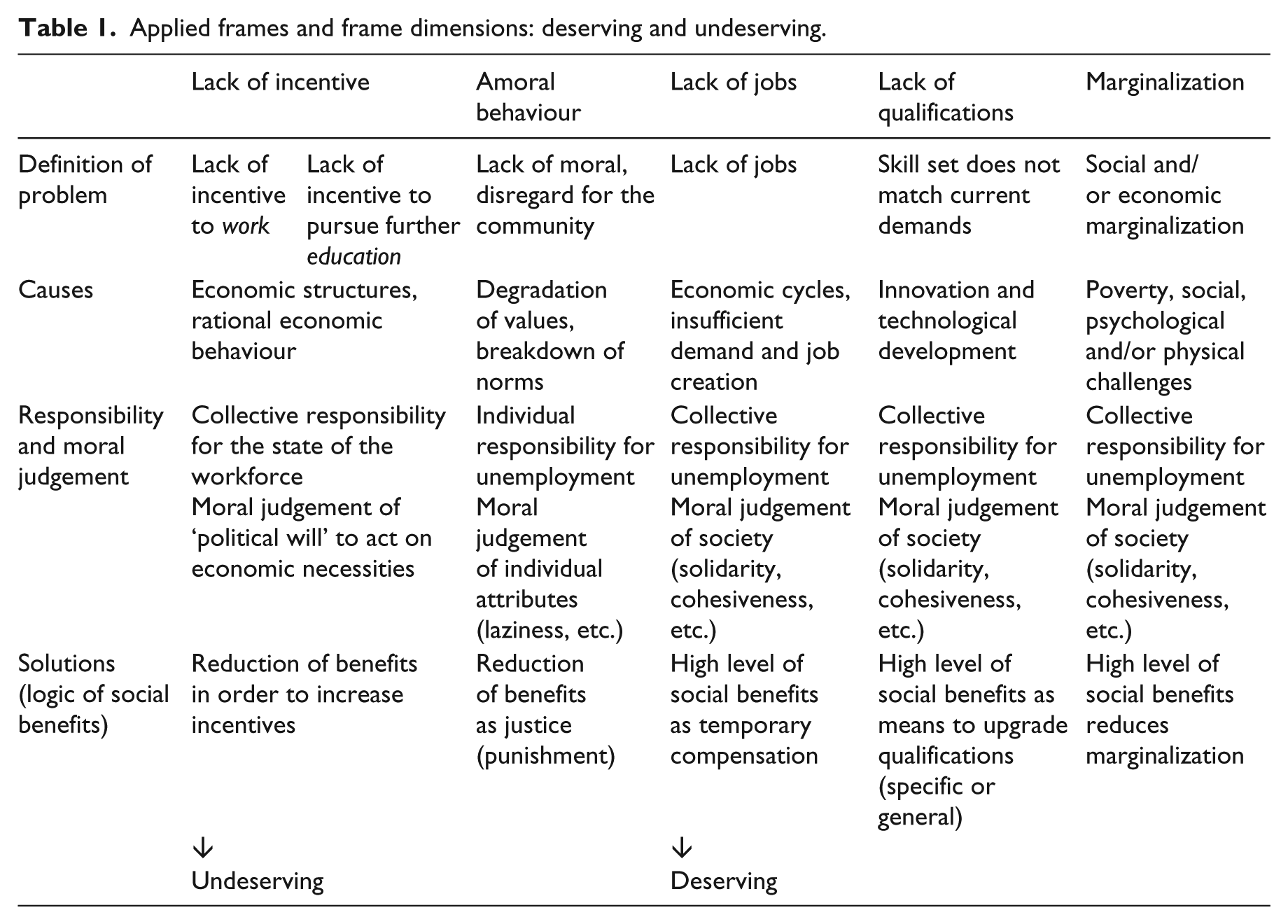
This inventory of frames is based on the following considerations. First, framing of deservingness is ultimately binary insofar as it depicts groups of recipients as either deserving or undeserving welfare benefits. Second, however, there can be a number of frames at work on either side of this dichotomy. In competitive democracies, frame building is defined by a significant degree of ‘frame competition’ (Chong and Druckman, 2007b). A comprehensive analysis thus requires an inclusive approach to competing frames and the different reasons they provide for deservingness, or lack thereof. Third, we extrapolated potential frames from existing studies of deservingness and broader studies of welfare reform (Cox, 2001; Green-Pedersen and Haverland, 2002; Torfing, 2004).
This approach can be contrasted with the inference of frames from ideologically (and geographically) distinct welfare regimes, according to which the Social-Democratic and Danish (Nordic) emphasis on universal coverage and social rights offers ‘few programmatic cleavages along which “deserving” recipients may be separated from “undeserving” ones’ (Ross, 2000: 178). Such ‘top-down’ inference of frames from the institutional and ideological domain of welfare regimes potentially negates the actual frame competition taking place at the level of policy debate and reform. Correspondingly, we identify frames ‘bottom-up’ by focusing on the particular mixes of economic, social and moral arguments found in frames specific to deservingness. We return to the operationalization and coding of these frames in the methodology section.
Media framing
Whereas existing studies of deservingness provide us with relatively firm claims about political framing, framing by the media remains largely uncharted. The images and stereotypes of poverty and the poor found in the media have of course been an object of research for a long time (Golding and Middleton, 1982). A recent example of this approach is Larsen and Dejgaard’s (2013) study of the images of the poor and welfare recipients in the news, inspired by Gilens’ (1996) classical study of racial bias. Our focus on possible media responses to political framing of deservingness, however, requires firmer assumptions about the media–politics relationship. Although this relation is the subject of a vast literature in its own right, we proceed from the rather concrete and resilient theory of source dependency in political journalism.
The basic claim of the source-dependency theory is that the journalistic dependence on politicians and spokespeople as sources of news stories is the defining feature of the media–politics relationship. Access to and use of elected politicians and their spokespeople as sources remain the sine qua non of most political news stories (Bennett, 1990: 103; Lawrence, 2010: 269). Political journalists prefer official and authoritative sources ‘in a position to know’, which gives politicians and spokespeople a strong position to influence the flow of political communication (Althaus, 2003: 383). Indeed, it can even be said that the political news story is less about what happened than what authoritative sources claim has happened (Zaller and Chiu, 1996: 386).
The general theory of source dependency can be found in various, more or less formal versions. Entman’s (2004) ‘cascading activation model’ suggests that the initial step in the news flow where ‘journalists canvass their networks of legitimate and customary sources’ means that government has the ‘highest probability’ of making their ideas and frames ‘become part of the general circulation of ideas’ and the ‘most power’ to push ideas to the media and further on the public (p. 9). A particularly strong variant of the source-dependency theory is Bennett’s indexing hypothesis, which suggests a correspondence between the political spectrum of debate around a particular issue and the spectrum of positions (or index) presented in media coverage. This correspondence includes not only attitudes and stances towards a particular issue but also the frames applied to an issue (Bennett, 1990). Thus, our second hypothesis is as follows:
H2. Media framing of welfare reform involving a reduction of social benefits will reflect the political framing of recipients as deserving or undeserving.
However, indexing theory adds the qualification that the level of political conflict will affect the degree of correspondence between the political debate and media coverage. This argument finds a parallel in the distinction between one-sided and two-sided information flows in studies of public opinion (Zaller, 1992: 185). In the realm of the media–politics relationship, the claim is that the media stance towards reform depends on the level of political conflict about the issue at hand. Briefly put, journalists ‘are attack dogs when covering political contests, but they are lapdogs, a handout press, when covering policy monopoly’ (Lawrence, 2010: 267).
The ‘attack dog’ is often assumed to the core journalistic role, invoking the idea of the critical watchdog and the media as a fourth estate (Norris, 2000: 24). Moreover, the importance of conflict as a journalistic news criterion and commitment to pluralism in the media suggest that journalists will strive to find conflict and pursue other viewpoints and voices than those presented by the most dominant political actors (Entman, 2004: 18). According to the indexing hypothesis, however, the inclusion of alternative viewpoints in the media is premised on the existence of conflict in the political spectrum of opinions (Bennett, 1990: 110). In other words, the journalistic emphasis on news criteria and the critical role of the media is constrained by the need to find the available and authoritative sources presenting alternative viewpoints. This leads to our third hypothesis:
H3. Media framing of welfare reform involving a reduction of social benefits will be more critical under conditions of political conflict than in the case of political consensus.
Design of the study
Case selection
The hypotheses have been tested through a study of political framing and media framing of two Danish reforms in 2005 and 2013. In terms of content, both reforms are examples of recommodification, that is, reforms that ‘restrict the alternatives to participation in the labour market, either by tightening eligibility or cutting benefits’ (Pierson, 2001: 422). The goal of both reforms was a more restrictive system of basic social security for the uninsured (‘kontanthjælpen’), implemented through a combination of reduction and changes in eligibility. The first reform, coming into effect in 2004, introduced a limit of 6 months for full benefits and subsequent reductions, de facto targeting extended families and married couples. Key aspects of the second reform from 2013 include the mutual obligation of support for non-married couples, work for benefits (‘nyttejob’) and reduced benefits for people under the age of 30.
Whereas the substance of the two reforms can be considered constant in terms of recommodification, the context of reform varies with respect to (1) the political left/right composition of the government behind the reform and (2) the degree of political conflict about the reform. In 2004, the reform was launched by a liberal–conservative government, backed by the right-wing Danish People’s Party. The reform was uniformly opposed by the opposition, thus constituting a clear split between the two sides of the political spectrum. In 2013, the reform was launched by a government coalition consisting of the Social Democrats, the Social-Liberals and the Socialist People’s Party, backed by all remaining parties except for the left-wing Red–Green Alliance.
Moreover, the two reforms differ in terms of (3) economic conditions and the general emphasis on cost containment and austerity. In 2004, economic conditions were considered favourable, whereas 2013 was still defined by the prolonged economic crisis beginning in 2008. However, our focus is not on cost containment as an element of reform in itself, but rather on whether the change in context is reflected in the framing of deservingness. On one hand, economic crisis can be seen to provide additional space for downgrading deservingness. However, economic crisis can also be strongly associated with a tight job market and insufficient availability of jobs, thus providing fertile conditions for framing of recipients as deserving.
Sampling
The study is based on quantitative content analysis of all media content pertaining to the two reforms in three major Danish newspapers: the two major national dailies, the centre-left Politiken and the centre-right Berlingske Tidende, as well as Ekstra Bladet, one of two major tabloids and usually categorized as moderately centre-left. The choice of newspapers as source material for the analysis is based on the fact that the absence of public service requirements increases the potential for variation and critical stances in newspapers, vis-à-vis broadcasting, in particular in the Danish media system where public TV and radio are dominant. The study includes all regular news articles covering the relevant reforms for 2 years, excluding opinion pieces, editorials, reviews and periodicals. 1 The distribution of articles is reported in Table 2.
Distribution of articles: 2005 and 2013 (nominal) (N = 322).
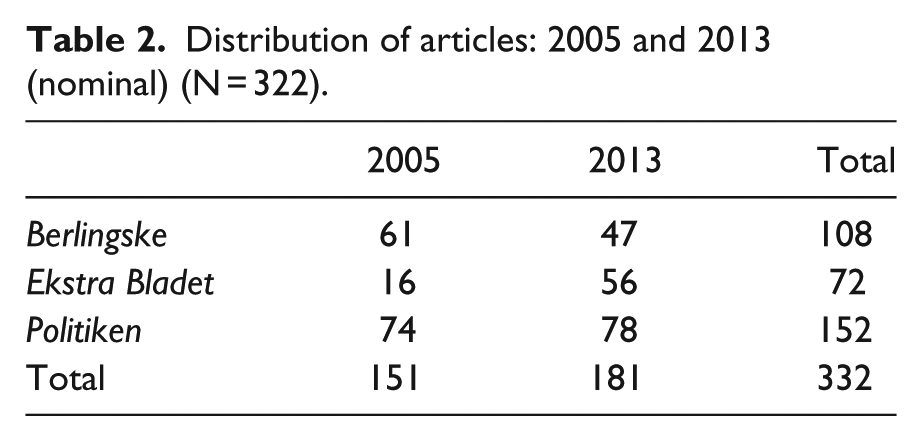
The choice of sampling years is based on a general mapping of coverage between 2000 and 2014, showing that 2005 is the most intensive year of debate in the period between 2000 and 2010; 2013 has seen the most intensive debate on the issue yet. These intensive periods of debate are crucial to the development of the frames that define the debate as such (Elmelund-Præstekær and Wien, 2008). This emphasis placed on the intensity of debate does mean, however, that the debate in 2005 follows 1 year after the reform (introduced January 2004), whereas the debate in 2013 takes place immediately following the introduction (January of that year).
Data coding
Quantitative content analysis is generally recognized as the default method to achieve objective and systematic knowledge about news content and message characteristics (Neuendorf, 2002). Rather than coding for manifest frames, that is, coding that defines particular words and sentences as framing attributes, we have chosen to code for latent meta-frames. Although coding of manifest frames ensures a high degree of replicability, the strategy can also be said to run the risk of reducing the complex structure of frames in political news too much. Thus, coding of meta-frames allows an interpretive step in the coding process guided by a codebook defining the type of statements related to a particular frame more broadly (Chong and Druckman, 2011: 255). In our case, the coding was guided by the previously specified inventory of frames and frame dimensions (see Table 1). The reliability of the coding done based on these guidelines has been ensured through a test of inter-coder reliability. 2
The ‘lack of incentive’ frame, also called a ‘job frame’ in earlier studies (Slothuus, 2007), includes statements reflecting a concern for ‘incentivization’ rather than protection or compensation. Moreover, we included the application of this logic to education as a distinct variation. The ‘laziness’ frame taken up by earlier studies (Petersen et al., 2010), by contrast, involves statements that question the moral fabric of recipients and society at large. On the side of deservingness, statements portraying benefits as means to battle poverty and social exclusion were coded as belonging to the ‘marginalization’ frame, also referred to as a ‘poor’ frame in previous studies (Slothuus, 2007). The ‘lack of jobs’ frame, by contrast, involves statements highlighting unemployment and compensation for market fluctuations. The ‘lack of qualifications’ frame highlights structural aspects of the economy and a corresponding notion of protection as continuous upgrading of competences.
Following Entman’s definition, we considered the presence of statements on some rather than all frame dimensions sufficient to merit coding of a frame. More specifically, the problem dimension and the presence of solutions and/or recommendations were taken as the baseline criterion for coding of a frame. Observed problem–solution constellations remained consistent with the relations proposed in Table 1. Causation was also present in all but a few articles and remained consistent with the general categorization. Assignment of responsibility proved the least distinctive dimension, partly due to the absence of this dimension in a number of articles and partly due to the theoretical focus on individual vis-à-vis collective responsibility.
Although an article can be a carrier of multiple frames, coding was restricted to the most prevalent political frame and the most prevalent media frame, based on criteria of frame strength (Chong and Druckman, 2011: 251). This approach deviates from studies of framing effects, where frames found in political news are rather interpreted generically as being political and journalistic at one and the same time. Drawing our inspiration from the ‘claims-making’ approach, we consider political news articles containers of claims by political speakers as well as claims where the journalist is the ‘claimant’, both directly and indirectly (Koopmans and Statham, 2010). Although we do not code claims as such (which involves categories based on the internal structure of a claim), the claims-making approach provides guidelines for a more systematic distinction between political and journalistic statements within each individual article.
More specifically, political frames are coded on the basis of statements made by political actors quoted in the article. The use of political news for this purpose provides an established alternative to coding political statements made outside the media in party programmes or other political manifestos (Chong and Druckman, 2011: 241). Media frames, for their part, are defined as the frames used specifically by the journalist to convey information about the issue at hand in the always substantial parts of a news article that involve no direct or indirect reference to sources. Compared with the editorial, which is perhaps the more conventionally used source of media framing, political news is both more abundant and likely to reach a broader audience, at least in a Danish context where the editorial is of little relevance. In addition to the dominant frame, the articles have been coded for tone towards recipients as well as the reforms themselves, explicit journalistic critique and sources used. 3
Results
Political framing: a change of heart?
Looking first at the political framing in the two reforms included in the analysis, Table 3 displays a more or less equal distribution between framing of recipients as undeserving and framing of recipients as deserving in 2005, whereas framing of recipients as undeserving outweighs deservingness 2:1 in 2013. Both years are, however, characterized by stark differences between parties in favour of lower social benefits and those opposed. Of the dominant frames advanced by the party representatives in favour of lower social benefits, including the liberal and conservative government partners as well as the Danish People’s Party, 84 percent positioned recipients as undeserving in 2005. For parties opposed to lower social benefits, the distribution is inverted. In 2013, the broad majority behind reduction of social benefits, including all parties in parliament except for the Red–Green Alliance, framed recipients as undeserving in 83 percent of the cases. Members of the Red–Green alliance abstain from framing recipients as undeserving altogether.
Framing in political statements: 2005 and 2013 (%) (N = 311).
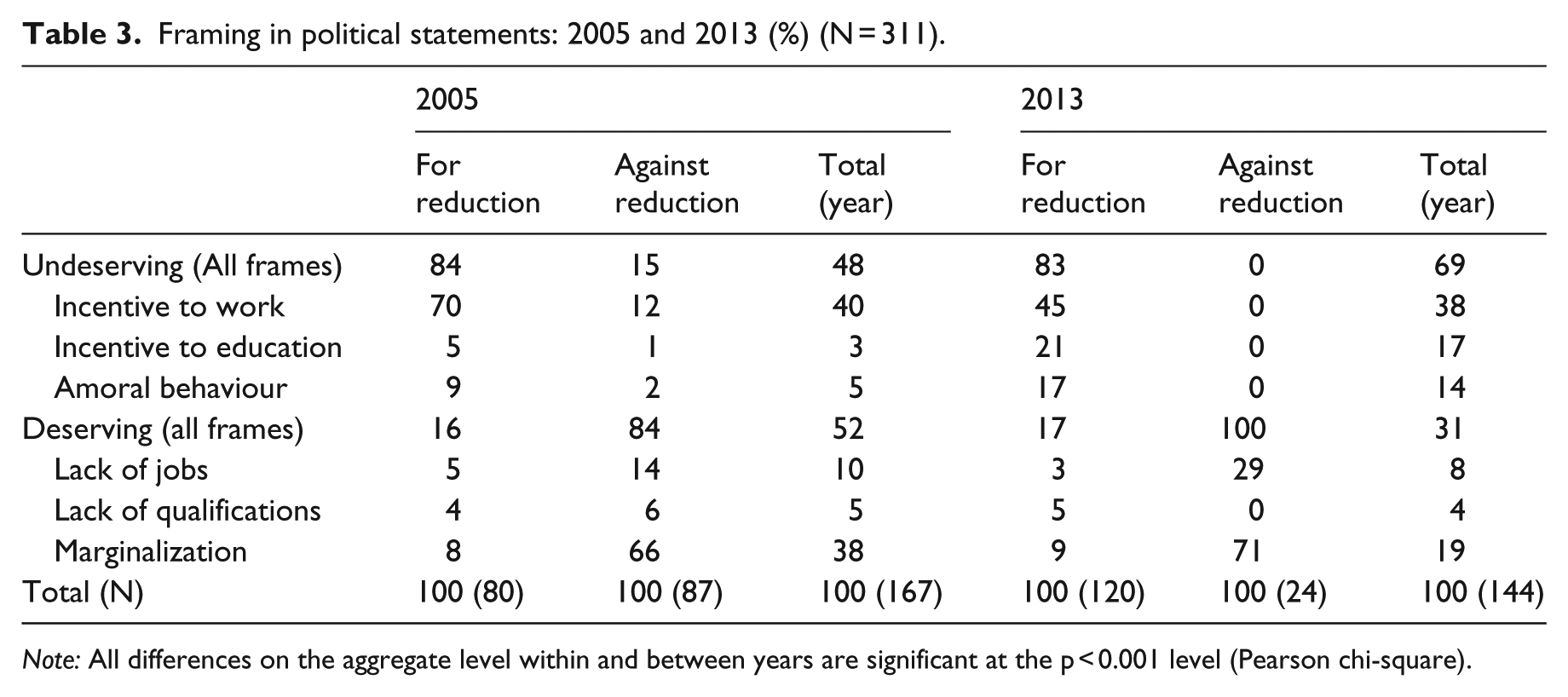
Note: All differences on the aggregate level within and between years are significant at the p < 0.001 level (Pearson chi-square).
Table 3 provides a first indication of the strong support for H1 found in the analysis. Before reaching the firm conclusion on the first hypothesis, however, a few comments on the distribution between individual frames should be made. In 2005, the debate can be said to display a clear polarization between the job frame and the marginalization frame. Insufficient incentives to work is the single most applied frame and the preferred frame of parties in favour of lower benefits in 70 percent of the cases, whereas the marginalization frame is the second most applied frame, used 66 percent of the time by parties opposing lower benefits.
The marginalization frame identifies recipients of benefits as people struck by unfortunate circumstances and in need of help and poverty relief. The picture is more diverse in 2013. For one, the framing of reform according to logic of incentivization is broadened to include insufficient incentives to seek further education in addition to the work focus of the job frame. This result largely reflects the emphasis on providing better incentives for young people to enrol in educational programmes by reducing benefits relative to educational support for people under the age of 30 in 2013. This dimension of the reform was referred to as ‘help to educate’.
Moreover, framing of recipients as amoral becomes noteworthy in 2013. In 2005, amoral behaviour accounted for only 5 percent of the total number of frames, compared to 14 percent in 2013. This development is potentially associated with the case of ‘Lazy Robert’, a citizen who became the focal point of an extensive debate after openly refusing to accept routine jobs and defending his claim to prolonged social benefits on TV. However, 2012 also saw the emergence of the ‘Carina’ story, in which a recipient of benefits originally cast by a member of the Socialists as a case story for poverty was found to fare better economically than certain low income families, thus becoming a stereotype for the incentive to work frame much as lazy Robert embodies the amoral behaviour frame. However, the incentive to work frame is less prominent in 2013. Moreover, experimental research suggests that the influence of the two cases was moderate, albeit in the realm of public opinion (Hedegaard, 2014).
A further substantiation of H1 is possible, if we focus specifically on the group of parties changing political position on the issue of lower benefits between 2005 and 2013. To this end, Figure 1 distinguishes between three groups: The Red–Green Alliance (Ø) must be considered a group in its own right, being the only party that remains against lower social benefits in 2005 as well as 2013. The Liberals (V), the Conservatives (C) and the Danish People’s Party (DF) constitute a second group of parties assuming a positive stance towards reduction of benefits in both years. In 2013, the group is supplemented with the neoliberal party ‘Liberal Alliance’ (LA) that was not represented in parliament in 2005. Finally, the Socialists (SF), the Social Democrats (S) and the Social-Liberals (R) constitute a crucial group adverse to the reduction of benefits in 2005, but forming the governmental coalition behind the reform in 2013.
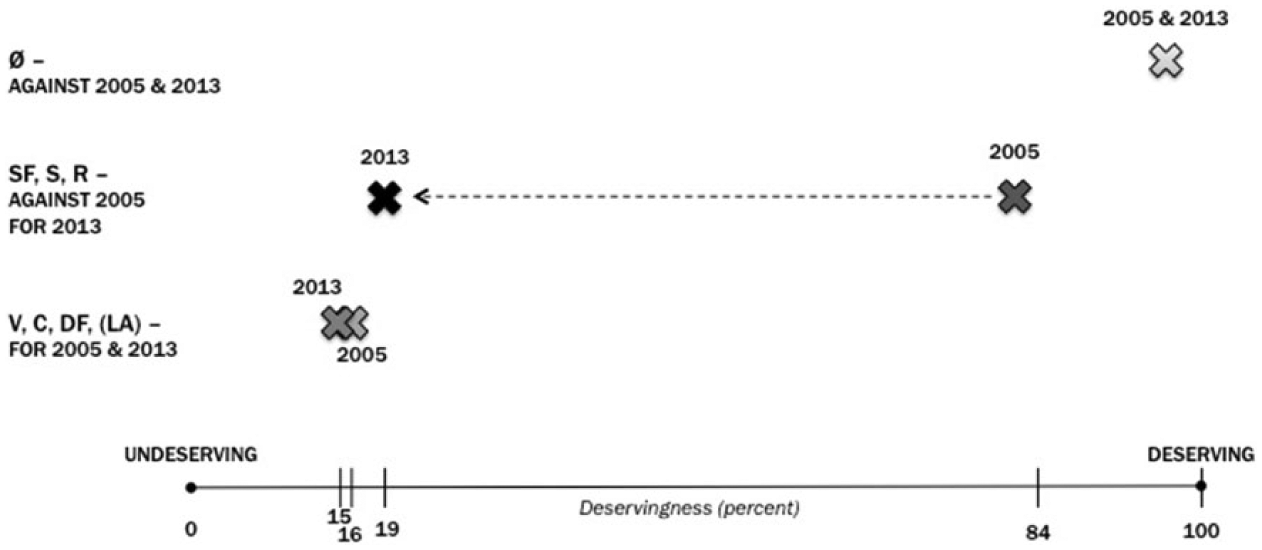
Changes in framing. Individual parties: 2005 and 2013 (%) (N = 311).
The shift in balance between deservingness and undeservingness in the political framing of recipients between 2005 and 2013 is largely the result of a change in framing by the group of parties changing political position between the 2 years. The results for this third group of centre-left parties are rather remarkable: whereas the balance between framing of recipients as deserving vis-à-vis undeserving is 85/15 percent in 2005 where the group is opposed to the reduction of benefits, the balance is almost completely inverted to 19/81 percent in 2013, on par with the centre-right group of parties. Although differences at the level of specific frames are noteworthy, the overall image conveyed by the results is clear: parties that remain consistent in their political position also remain consistent in their framing, whereas the group of parties changing political position also changes framing radically. Indeed, the balance between deservingness and undeservingness is practically inverted.
H1 is thus supported by the results. Parties frame recipients as undeserving when launching and backing reforms involving a reduction of social benefits. Parties in favour of a reduction rely heavily on frames that position recipients as undeserving and vice versa. This result is further substantiated by the radical change in framing between the 2 years for the group of parties changing position between the 2 years. Although the design of the study does not allow for an assessment of the relative weight of different strategies of welfare reform, the results do provide a clear indication that strategic framing of deservingness is indeed a part of the politics of welfare retrenchment.
Media framing: reproduction or own stance?
The question is, then, whether the media go along with the political framing of recipients related to the two reforms. With respect to the overall balance between frames depicting recipients as deserving vis-à-vis undeserving, the answer is largely non-affirmative. As displayed in Table 4, recipients are framed as deserving by the media 81 percent of the time in 2005 and 60 percent of the time in 2013, compared to 52 and 31 percent in political statements, respectively. The difference between political framing and journalistic framing is considerable for both years. The broad political use of frames depicting recipients as undeserving in 2013 across the parliamentary spectrum does lead to an increased use of such frames in the media. However, the media still frame recipients as deserving almost twice as often as the political side in 2013.
Framing in newspapers and political statements: 2005 and 2013 (%) (N = 619).
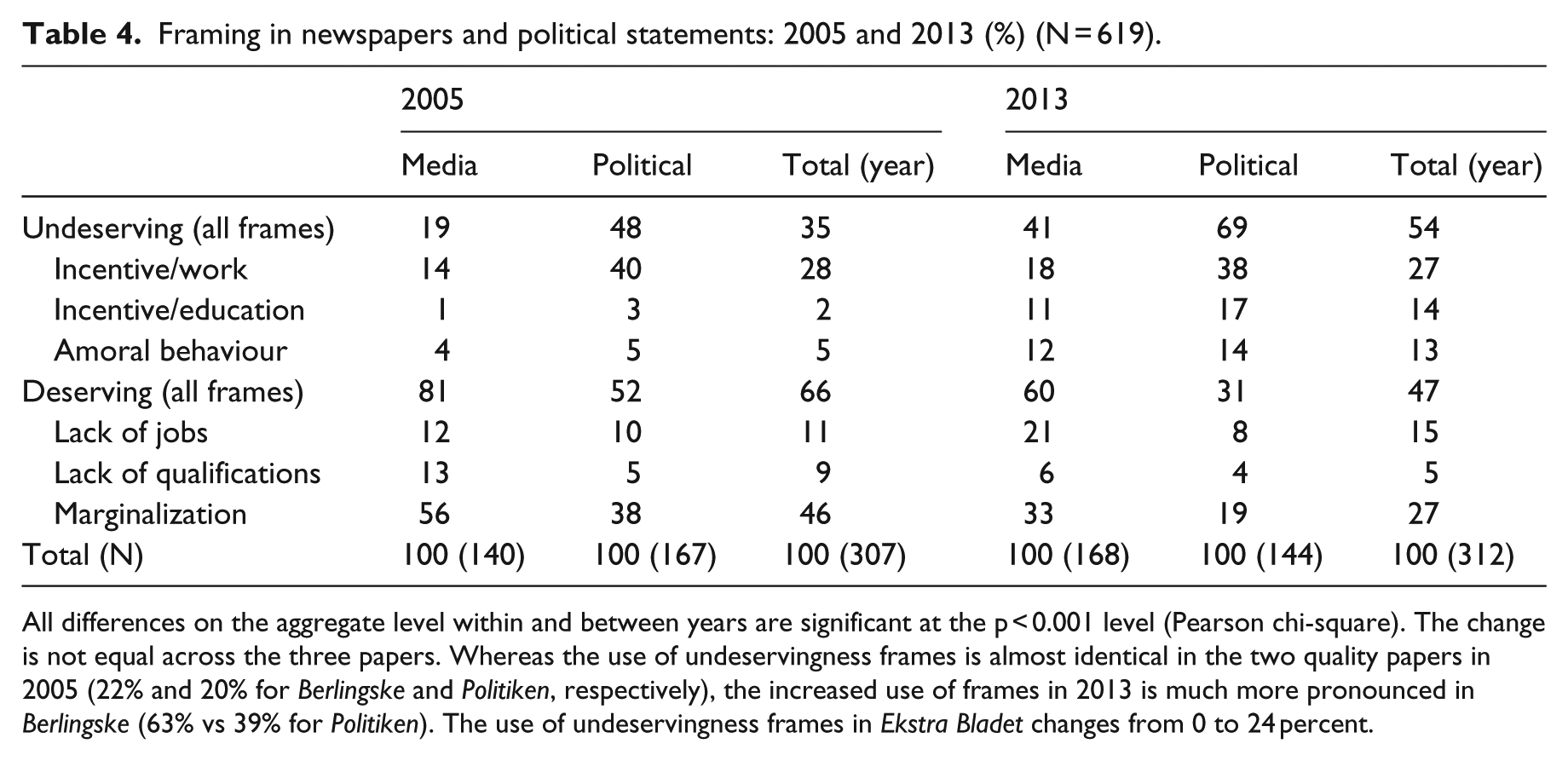
All differences on the aggregate level within and between years are significant at the p < 0.001 level (Pearson chi-square). The change is not equal across the three papers. Whereas the use of undeservingness frames is almost identical in the two quality papers in 2005 (22% and 20% for Berlingske and Politiken, respectively), the increased use of frames in 2013 is much more pronounced in Berlingske (63% vs 39% for Politiken). The use of undeservingness frames in Ekstra Bladet changes from 0 to 24 percent.
The specific frames applied by the media also illustrate some important differences. The preferred frame of the media is the marginalization frame (56% in 2005), whereas lack of jobs and lack of qualification are less prevalent. Marginalization remains the most frequently applied frame by the media in 2013. However, journalists also apply the lack of jobs frame and apply frames that present recipients as undeserving more frequently. In 21 percent of the coded articles, the dominant media frame is that recipients are struck by unemployment caused by conditions outside of their control, meaning that a high level of benefits is fair and expected to be temporary. Apparently, the onset of economic crisis in between the 2 years has given rise to an increased use of the lack of jobs frame in the media, whereas this frame is less prominent in political framing in 2013, used mainly by the Red–Green Alliance.
The strongest polarization between political framing and media framing in both years is, however, found in the case of the incentive to work frame, which is the most frequently applied political frame, but only found in 14 percent of the cases of media framing in 2005, on par with lack of jobs and lack of qualifications, and 18 percent of the cases in 2013. Given the high level of political commitment to the incentive to work frame, the limited changes in media commitment to this frame in both years provide the strongest indication of a pervasive and continuous discrepancy between political framing and media framing. The media, putting it simply, remain unwilling to adopt the incentive to work frame preferred by the political side of the table. Political efforts at frame building remain unsuccessful insofar as the media largely reject the frame. However, the media do adopt the incentive to educate and amoral behaviour frames to a larger degree.
The analysis provides ambiguous results for H2. On one hand, the discrepancy between frames in political statements and the frames used by journalists is considerable, in particular in the case of the incentive to work frame. In general, journalists rely primarily on the marginalization frame, followed by the lack of jobs frame in 2013, whereas politicians rely on the economic behaviour frames. These results do not support the assumption that media coverage of welfare reforms involving a reduction of social benefits reflects the political framing of recipients as deserving or undeserving. On the other hand, the change in media framing accurately reflects the development in political framing from 2005 to 2013 on the level of overall balance between deservingness and undeservingness. This logic is illustrated by Figure 2: the change in political balance towards framing of recipients as undeserving is closely mirrored by a similar change of balance of the media.
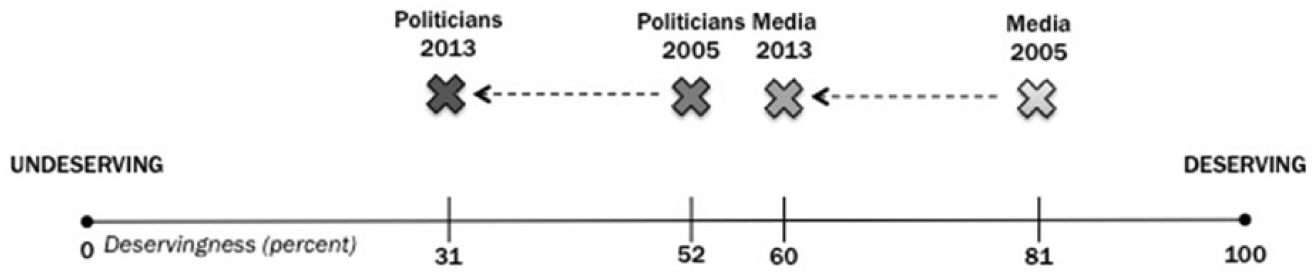
Changes in framing. Politicians and media: 2005 and 2013 (%) (N = 619).
A further indication of the changing position of the media between 2005 and 2013 is the tone towards recipients of benefits. As shown in Table 5, approximately half of the articles coded adopt a neutral or balanced tone towards recipients of benefits in 2005 as well as 2013 (49% and 51%, respectively). However, the balance of stories adopting a negative tone vis-à-vis a positive tone changes significantly between the 2 years: whereas only 14 percent of the coded articles adopt a negative tone in 2005, 29 percent of the articles are predominantly negative in 2013. The share of articles adopting a positive stance towards recipients of benefits, correspondingly, drops from 35 to 22 percent. As in the case of framing balance, this development is found across the three newspapers, but appears more pronounced in the centre-right newspaper (Berlingske).
Tone of newspapers towards recipients of benefits: 2005 and 2013 (%) (N = 314).
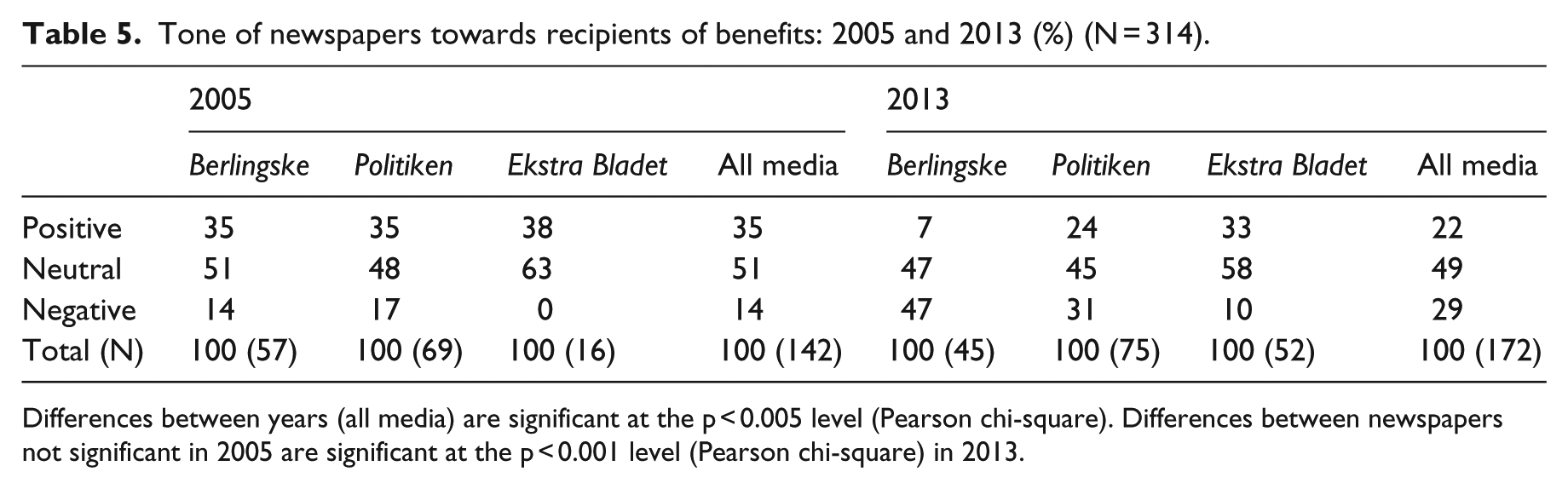
Differences between years (all media) are significant at the p < 0.005 level (Pearson chi-square). Differences between newspapers not significant in 2005 are significant at the p < 0.001 level (Pearson chi-square) in 2013.
The increased use of undeservingness frames and the changing tone towards recipients of benefits do not provide grounds to support H2. However, the results do merit a moderation of outright rejection. Although univocal support for theories of source dependency and/or indexing would have required a higher degree of convergence between the frames applied in political statements and the media, the data also suggest that journalistic frames are far from unaffected by political framing. There is indeed an effect of political framing insofar as the media change position on deservingness along with the politicians. The media, in other words, ‘keep their distance’ to the political framing of deservingness, but nevertheless change position with the politicians. Politicians and journalists ‘slide’ along the continuum from deserving to undeserving together.
Does political conflict matter?
With respect to the impact of political conflict on media coverage, Table 6 provides a clear indication that the tone of the media towards the reform is decidedly less critical in 2013, where the situation approaches consensus in the political realm, compared to the high level of political conflict in 2005. The 2005 reform is treated with a negative tone in 72 percent of the cases. Only 9 percent of the articles assume a positive stance. The amount of neutral articles remains stable across the 2 years, but the negative tone towards the 2013 reform is much less pronounced. The number of articles assuming a positive tone has increased to 37 percent, not far from the level of articles expressing a negative tone the same year. The narrowing of deservingness and the more critical stance towards recipients of benefits are, in other words, complemented by a more positive stance towards reform in the media. However, the tone does remain predominantly negative towards reform also in 2013.
Tone of newspapers towards the reform in question: 2005 and 2013 (%) (N = 226).
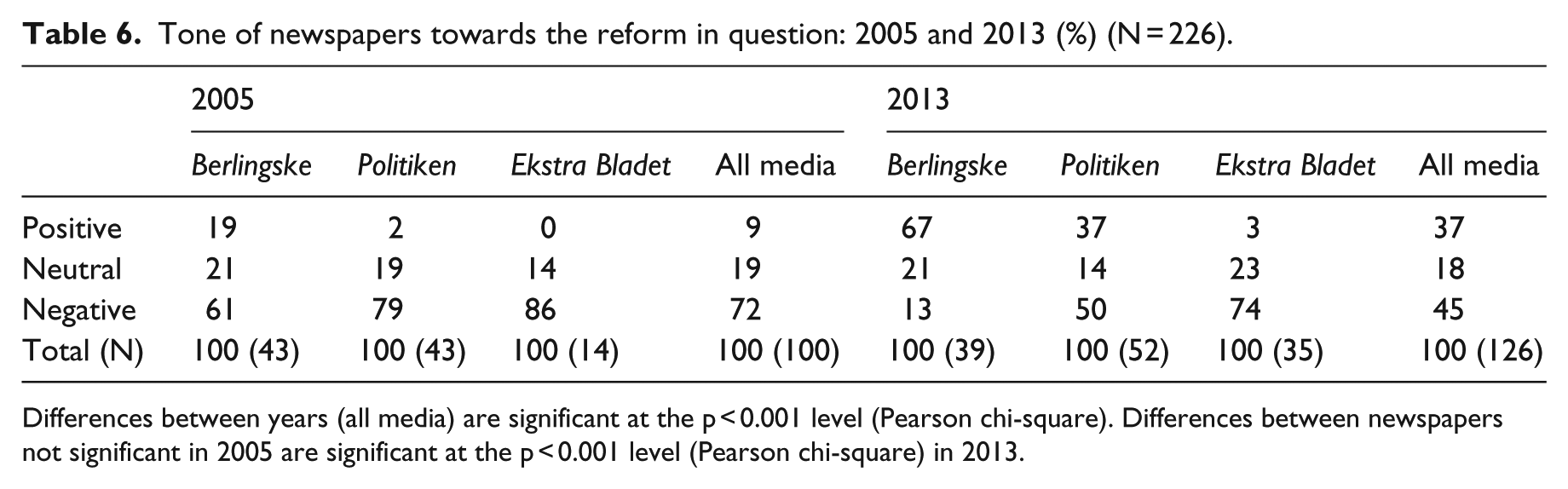
Differences between years (all media) are significant at the p < 0.001 level (Pearson chi-square). Differences between newspapers not significant in 2005 are significant at the p < 0.001 level (Pearson chi-square) in 2013.
An additional measure of the media stance is whether articles contain explicit journalistic critique of the statements made by political actors, that is, whether the journalist assumes a critical stance by questioning political statements directly rather than relying on juxtaposition of different sources. Such explicit journalistic critique is exercised only to a limited degree: in general, 23 percent of the included articles contain explicit critique of political statements quoted by the journalist. Within this limited use of explicit journalistic critique, there is nevertheless a significant difference between 2005 and 2013. Whereas explicit journalistic critique appeared in almost one-third of the articles in 2005 (32%), the use of explicit critique is down to 12 percent in 2013 (not displayed in the table). The low level of explicit critique voiced in 2013 does indicate a rather uncritical stance by the media, suggesting that the near political consensus on the reform in question has indeed reduced the level of criticism in the media. Thus, the negative tone towards reform is accompanied by explicit critique of political statements in 2005, whereas the more positive stance is accompanied by a less explicit critique in 2013.
Adding the level of explicit critique and the stance towards reform to the already established changes in tone towards recipients and narrowing of deservingness provides strong support for the assumption that the media are more critical under conditions of political conflict and hence available sources of critique from within the parliamentary realm, than under conditions of political consensus. Although the conditions in 2013 do not constitute full consensus, the broad coalition behind the reform can reasonably be taken to constitute as good an approximation to consensus on the issue in question as can be found in a multi-party system. The changes in the position of the media between 2005 and 2013 are considerable and one-directional on all the available measures in the analysis: although the media retain a critical role, the overall commitment to a critical position is significantly reduced in 2013.
The analysis, however, also makes it clear that the media never abandon their critical role altogether. A further qualification of the assumption that the media will assume a less critical role under conditions of political consensus due to the lack of available critical sources within the political system is presented in Table 7, which displays the distribution of all sources used in the included articles. The leading party of the government coalition, which is also the home party of the minister responsible for the reform in 2005 as well as 2013, is the most widely used source in both years. The political conflict over reforms is clearly displayed in 2005 with the Social Democrats assuming the role as opposition leader and main contender on welfare issues, whereas the near lack of opposition to the reform in 2013 results in a significantly reduced role for the formal opposition leader (‘Venstre’) and an even distribution among the remaining parties, although the Red–Green Alliance (‘Enhedslisten’) does receive slightly more coverage in its position as sole political voice against the reform.
Sources quoted by the media: 2005 and 2013 (%) (N = 673).
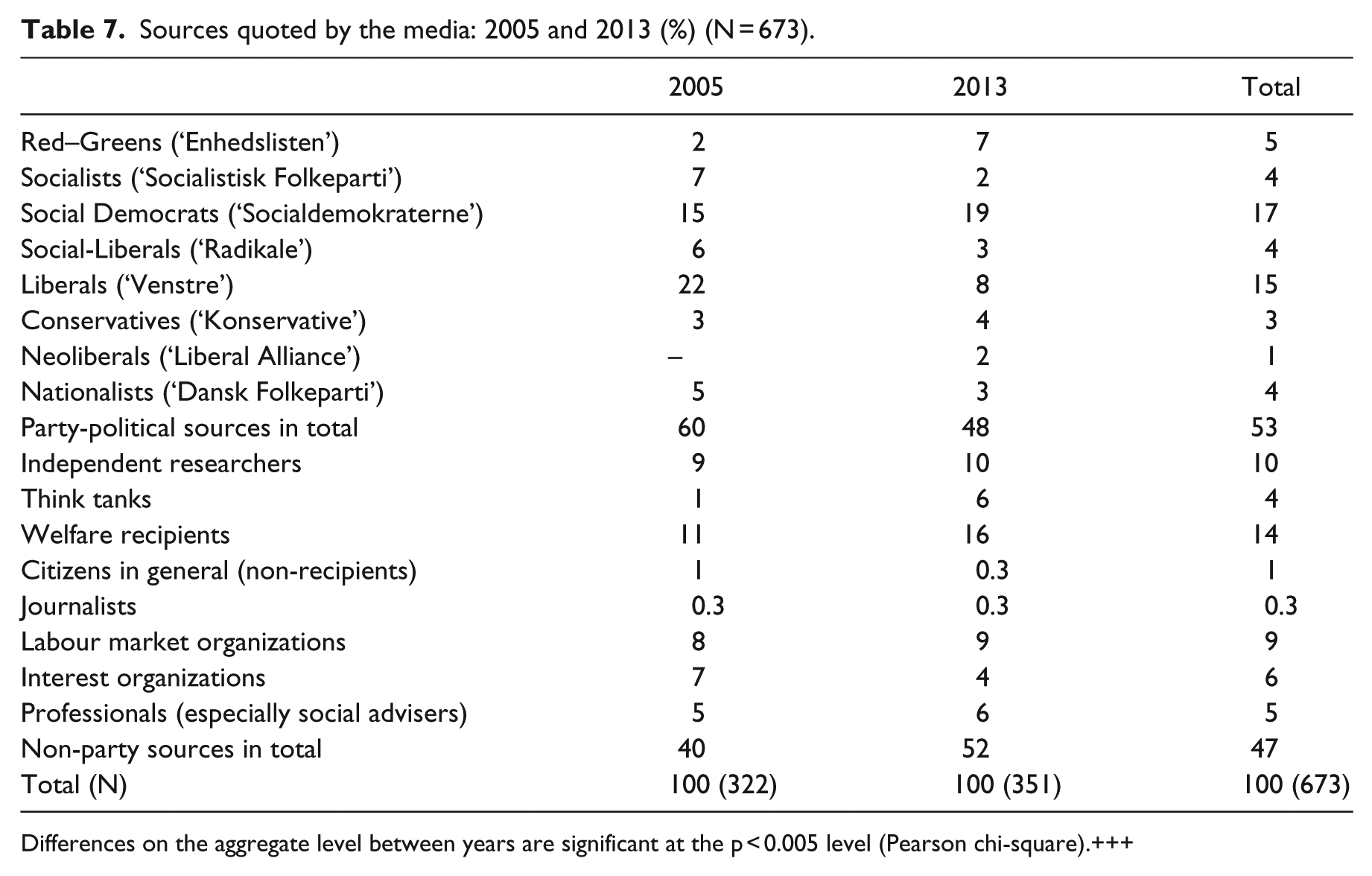
Differences on the aggregate level between years are significant at the p < 0.005 level (Pearson chi-square).+++
Although the low number of cases on the disaggregated level invites a level of caution, the results also show an increased reliance on a plurality of ‘outside’ sources in 2013. Key among such sources are recipients of benefits, which often appear in critical case stories or as critical contrast to political statements. Indeed, recipients are the second most quoted source in 2013, approximating the level of the Social Democrats heading the reform. Whereas the main source of critique was found inside the political realm in 2005, the main conflict seems to be between the Social Democrats and the recipients at the receiving end of the reform in 2013. Researchers and think tanks are also quoted more frequently, although to a lesser extent. Taken together, the results indicate that the lack of available critical sources within parliament prompts the media to seek alternative sources outside of parliament to a greater extent in order to maintain what has been called ‘attitudinal balancing’ (Strömbäck and Shehata, 2007: 804). However, the results should be considered a qualification of H3, which is supported by the analysis.
Conclusion
The article provides a clear indication that welfare retrenchment is accompanied by political attempts to frame recipients as less deserving. In a wider sense, the results question the ‘widely accepted’ idea that the politics of retrenchment simply is the politics of blame avoidance (Green-Pedersen and Haverland, 2002: 44). Strategies of blame avoidance undoubtedly remain important, but strategic framing of deservingness adds a distinct dimension to the politics of welfare retrenchment. However, our study is also bound to the parameters of two reforms in one country. Further substantiation of the claim that strategic framing of deservingness has established itself as a distinct component of welfare retrenchment politics will require more studies within and across countries. Moreover, the relation between the politics of retrenchment and the policy substance of reforms requires attention. Whether strategic framing of deservingness can also be found in other types of reform than recommodification reforms poses a vital question for further research.
Moreover, our results have shown that media are not just a platform for political framing but are also far from being unaffected by changes in political framing. The fact that these results are based on a single study in the context of the Danish media system must of course be kept in mind. In addition to studies from other media systems, future research on whether the media follow or fight political framing of deservingness is also in need of more specific assumptions than those provided by the rather general theory of journalistic source dependency. This theory is widely used in communication research and has proved useful in facilitating a first step towards the inclusion of the media as an important actor in the wider debate about deservingness and welfare retrenchment. Future research, however, should also seek out additional theories about the complex interplay between politics and media.
Footnotes
Funding
The author(s) received no financial support for the research, authorship and/or publication of this article.