



Abstract
Education policy is a salient topic both in political debates and in the scholarly literature. Still, the study of individual policy preferences on education policy has received little scholarly attention, mostly because existing comparative surveys provide only very crude measures on education policy. To address this research gap, we conducted a representative survey of public opinion on the details of education policy in eight Western European countries. This article, first, presents analyses of these data, focusing on people’s preferences for public expenditure on education relative to other social policies as well as its distribution across different education sectors (early childhood and pre-primary education, general schools, vocational education and training, and higher education). In contrast to existing surveys, our survey forces citizens to prioritize between different policy areas and education sectors. We investigate determinants of individual preferences, focusing particularly on self-interest, ideological norms and institutional feedback effects. We find that individual educational background, partisan ideology and having children are significantly associated with variation in preferences. Furthermore, we find tentative evidence for self-undermining institutional feedback effects.
Introduction
As the introduction of this Special Issue outlines (Di Stasio and Solga, 2017), studying education as an integral part of welfare state regimes had long been a neglected field of research, even though scholarly interest has grown significantly in recent years (Busemeyer, 2015; Iversen and Stephens, 2008; Solga, 2014). Much of the existing work in comparative welfare state research is concerned with the macro-level of policy-making and the connection between education and welfare state regimes (Iversen and Stephens, 2008; West and Nikolai, 2013). Vice versa, scholarship in the tradition of educational sociology mostly analyses the micro-level and institutional determinants of educational choices with a particular focus on class biases in access to education and associated inequalities (see, for example, Breen et al., 2009; Brzinsky-Fay and Solga, 2016; Van de Werfhorst and Mijs, 2010). This article, in contrast, analyses individual policy preferences and attitudes towards education policy – in short, public opinion. This is an important and yet under-researched issue because education and human capital formation are at the centre of the increasingly popular model of the ‘social investment state’ (Bonoli, 2013; Hemerijck, 2013), and yet it is largely unknown how robust and extensive political support for this new model of the welfare state really is (see also McDonnell, 2009: 425).
Our article addresses this significant research gap in different ways. First, our analysis makes an important empirical contribution. The small but growing literature on public opinion about education policy (Ansell, 2010; Busemeyer, 2012, 2015; Busemeyer et al., 2011; Busemeyer and Jensen, 2012; Garritzmann, 2015, 2016) relies on readily available comparative surveys of public opinion, such as the International Social Survey Programme (ISSP), the European Social Survey (ESS) and the Eurobarometer. These surveys, however, only include very few and general questions about education policy. Instead, we use new data from a representative survey of public opinion on education and welfare state policies in eight Western European countries (Germany, France, Denmark, Sweden, Ireland, the United Kingdom, Spain and Italy), which deals with some of the deficiencies in existing surveys. For one, we present a more fine-grained analysis of public attitudes towards the distribution of fiscal resources across different sectors of the education system (early childhood education, general schooling, vocational education and academic higher education), which is not available in existing comparative surveys. The second empirical contribution is that we compare support for education policies in constrained and unconstrained settings in order to obtain a better estimate on the robustness of support for education spending. More specifically, we study respondents’ spending priorities by forcing them to choose between different policy fields (education vs other social policies) as well as between educational sectors. From a more theoretical perspective, our article shows that socio-economic variables, in particular individual educational experiences, are systematically related to policy preferences. Furthermore, we find that the association between indicators of material self-interest and preferences becomes stronger in constrained settings compared to unconstrained ones.
Before proceeding, it is important to emphasize that this article focuses on determinants of policy preferences for public spending. This is in line with the focus of much of the existing literature discussed in the next section. Of course, spending is not the only (and maybe not even the most important) policy issue when it comes to education policy, but comparing preferences for (changes in) public spending provides a common ground for comparative analyses. This is harder to do in the case of those policy proposals which depend on specific national and temporal contexts. Nevertheless, our survey also includes questions about policy preferences other than spending, which are, however, analysed elsewhere.
Literature review and theory
The study of public attitudes and policy preferences on welfare state policies has become a major field of research in recent years (see Svallfors, 2012 for a recent overview). The existing literature can be roughly divided into three different camps: one strand of literature emphasizes material self-interest as a crucial determinant of policy preferences and individual-level attitudes towards the welfare state. From this perspective, individual variables, such as income, educational background, gender, labour market status and social risk, shape individuals’ attitudes on different welfare state policies (e.g. Busemeyer et al., 2009; Cusack et al., 2006; Hacker et al., 2013; Rehm, 2009; Rehm et al., 2012; Schwander et al., 2015). People are expected to support those policies from which they derive concrete benefits themselves. A second, contrasting perspective is provided in scholarship that emphasizes the role of norms and values as determinants of preferences and attitudes. This literature has shown that in addition to material self-interest, normative and partisan ideologies, altruistic concerns, religiosity and intergenerational solidarity also influence welfare state attitudes (e.g. Goerres and Tepe, 2010; Margalit, 2013; Scheve and Stasavage, 2006).
Third, there is a growing literature that studies the way that institutional contexts shape individual preferences (Blekesaune and Quadagno, 2003; Jaeger, 2009; Svallfors, 1997, 2012; see also Pierson, 1993 who introduced the notion of policy feedback). In many ways, this literature builds on the work on individual-level variables because the causal mechanisms by which institutions influence attitudes on the micro-level are related to material self-interest as well as norms and values. At first, this literature was mostly concerned with exploring the linkages between encompassing welfare state regimes (Blekesaune and Quadagno, 2003; Svallfors, 1997) and individual preferences, assuming a general congruence between institutions and preferences. The findings of this literature were rather mixed, however (Jaeger, 2009). Therefore, more recent scholarship focuses on particular institutional dimensions while also developing more concrete theoretical expectations on these (Busemeyer, 2012).
Against the background of this large literature, our article addresses public attitudes towards (several kinds of) education policies. This field has not yet received a lot of scholarly attention, even though – as we show below – education is a policy field, which enjoys a high degree of support from the general public. It also has strong implications for socio-economic inequality (Busemeyer, 2015; Solga, 2014) and social mobility (Breen et al., 2009), which is why many scholars root for a transformation of existing welfare states towards the ‘social investment’ model (Hemerijck, 2013; Morel et al., 2012). So far, only few studies have analysed individual-level attitudes and preferences towards education policies from an international comparative perspective, probably related to the limitations of existing comparative public opinion surveys in that respect (Busemeyer et al., 2017). Using these existing data, Busemeyer et al. (2009) find that – in contrast to other social policies – individual support for more public education spending is strongly conditioned by age with the elderly being less supportive of spending. Moreover, Busemeyer (2012) and Busemeyer and Jensen (2012) study how macro-level factors such as existing levels of socio-economic and educational inequalities, as well as the institutional set-up of the education system, affect people’s preference on education spending. Ansell (2010) and Garritzmann (2015, 2016) investigate public opinion on financial aid to higher education students, a much more redistributive area. Yet, when it comes to preferences for different kinds of education policy – the focus of this article – international survey data contain no information. Hence, Busemeyer et al. (2011) used data from a survey conducted in Switzerland to study this issue.
In developing our theoretical framework, we draw extensively on existing scholarship in the study of public attitudes mentioned above. In general, there are some similarities in the determinants of individual-level support for education and welfare state policies, but there are also some important differences. Due to the dearth of studies on preferences regarding the distribution of spending across different educational sectors, there is little theory on the determinants of these types of preferences. Hence, our theoretical framework and our empirical analysis need to remain somewhat exploratory.
First, we develop hypotheses on the impact of individual educational background. As Busemeyer et al. (2011) showed for the case of Switzerland, individuals tend to support additional spending on those sectors of the education system with which they have individual experiences. This can be conceived of as a ‘socializing effect’. This is less obvious than it may sound because it could also have been expected that individuals develop policy preferences different from their own experiences. For instance, someone with an educational background in vocational education and training (VET) might prefer policies that promote the expansion of higher education so that his or her children will be better able to receive this kind of education. Vice versa, a person with an academic background might oppose the further expansion of higher education and support VET instead so that there is less competition for himself or herself and for his or her children (see also Di Stasio, 2017). However, we hypothesize that the socializing effect of individual educational background is stronger than the ‘rational rationing’ effect. Hence, individuals with a vocational (academic) educational background are expected to support policies that expand the provision of vocational (academic) education (Hypothesis 1).
Second, in addition to educational background, we expect that the respondents’ income situation matters (Ansell, 2010; Busemeyer, 2012; Garritzmann, 2015, 2016). Of course, educational background and income are correlated, but the correlation is not perfect (if only because there is an increasing heterogeneity of incomes for individuals with a higher education degree as a consequence of academic expansion). Therefore, we hypothesize that both have separate effects on attitudes. The effect of income on preferences is related to material self-interest. We posit that support for different policies is driven by expectations on the relative payoff for individuals themselves or their associated kind, in particular children. It is well known that the class bias in access to particular sectors of the education system is stronger in some cases than in others. This is most obvious in the case of higher education: children from higher socio-economic backgrounds still have a much higher probability of attending higher education institutions compared to children from weaker socio-economic backgrounds (Breen et al., 2009). A similar development has been observed in the case of early childhood education and care (Van Lancker, 2014): despite the fact that children from parents with a weak socio-economic background would benefit more from attending formal childcare institutions, middle-class parents are more likely to actually make use of available services in order to be better able to combine work and family life. In sum, we expect individuals from high-income households to support policies that promote higher education and early childhood education and care, whereas low-income respondents should have a stronger interest in promoting general and vocational education (Hypothesis 2).
Third, the existing research on welfare state attitudes repeatedly revealed that individuals have a strong interest in the continued provision of welfare state services and benefits, which provide concrete benefits to themselves (Hypothesis 3). This general argument can be applied in different ways to our research question. For one, it implies that students should have a stronger interest in increasing education spending in general as well as spending on ‘their’ type of education more specifically (usually higher education since we only include individuals aged 18 and above) compared to adults who are no longer in the education system. In a similar vein, parents are expected to support additional education spending, although their preferences on the distribution of resources across the education sectors are difficult to predict since they depend on their children’s current educational status. A straightforward expectation is that parents of younger children favour concentrating spending on early childhood education and care as well as on schools, whereas parents of older children are more interested in higher expenditures on post-secondary education (vocational and higher education).
Fourth, in addition to variables related to self-interest, we posit that the individuals’ political attitudes and normative orientations matter. Previous research has shown for the case of Switzerland that ideological orientations matter mostly with regard to the overall level of public spending on education rather than its distribution across education sectors (Busemeyer et al., 2011). Therefore, we expect that the association between policy preferences and ideological orientations will be stronger in the case of overall levels of spending compared to its distribution. Furthermore, left-leaning individuals should be more supportive of policies that promote the expansion of those sectors of the education system, which are more open to the inclusion of children from lower socio-economic backgrounds (general and in particular vocational education). In contrast, right-leaning individuals should support the promotion of sectors that benefit the better-off (higher education and early childhood education and care) (Hypothesis 4).
Finally, we expect that the institutional set-up of the education system affects policy preferences. There are, however, conflicting predictions in the theoretical literature on ‘policy feedback’ regarding the dominant direction of this association. On one hand, Pierson (1993) and many others emphasize the centrality of self-reinforcing feedback mechanisms. According to this perspective, individuals would support those kinds of institutions, which are already in place in their respective countries. This is because they either derive concrete benefits from these institutions (what Pierson (1993: 624) calls ‘resource’ or ‘incentive effects’) or because people’s normative expectations vis-à-vis the state are shaped by them (‘interpretive effects’, Pierson, 1993: 610; see also McDonnell (2009) for an application to the case of education policy). On the other hand, institutions can also generate effects that are ‘self-undermining’ in the long term (Jacobs and Weaver, 2015). This kind of feedback signals that the public might come to demand policies that are different from the institutional status quo (Soroka and Wlezien, 2010). Empirically, the existing evidence is mixed on which type of feedback is dominant, but there are good reasons to expect that self-undermining feedback effects will dominate, in particular if they interact with concrete socio-economic pressures (Hypothesis 5). This is because citizens are more likely to demand policy change if they are dissatisfied with the current institutional status quo (Jacobs and Weaver, 2015).
Data and methods
The INVEDUC survey
Given the weaknesses of existing comparative surveys of public opinion briefly discussed above, we conducted an original survey in eight European countries in 2014: 1 Denmark, France, Germany, Ireland, Italy, Spain, Sweden, and the United Kingdom. Unfortunately, due to funding constraints, no Eastern or non-European countries could be included. Hence, the scope of our argument and empirical analysis is restricted to Western Europe, but covers a wide variety of countries and welfare state regimes. In each of the eight countries, we surveyed a representative sample of 1000–1500 adults (aged 18–99). Overall, we have 8905 valid observations. The fieldwork was conducted in early summer 2014 by a professional survey institute via computer-assisted telephone interviewing (CATI) (see Busemeyer et al., 2017 for a descriptive overview and more details).
Dependent variables
The Investing in Education in Europe (INVEDUC) dataset contains a number of questions that are relevant for the purpose of this article. Next, we discuss the wording of the questions that we use as dependent variables. We start with a question that essentially replicates the question asked in the ISSP ‘role of government’ surveys: Q1: In the following, I will name several areas of government activity. Please tell me whether you would like to see more or less government spending in each area. Keep in mind that ‘more’ or ‘much more’ might require a tax increase.
The survey then named ‘education’ as one of nine policy fields (healthcare, unemployment benefits, old age pensions, social assistance to the poor, financial support for families, education, labour market and public employment programmes, defence, environmental protection). Respondents were offered the usual Likert-scale answers: ‘spend much more’, ‘spend more’, ‘spend the same as now’, ‘spend less’, ‘spend much less’, plus a residual category ‘don’t know’.
As discussed above, this question has several weaknesses (for instance, it does not distinguish between different education sectors), but it was nevertheless included in the INVEDUC survey in order to be able to anchor and compare the survey’s results with existing data. Another major problem with this question is that no constrains are added, that is, respondents could express support for more public spending in all the areas mentioned without having to take into account revenue constraints. As a simple solution to this problem, we added a second question, forcing respondents to select only a single policy area where they would like to see public expenditure increased: Q2: If the government could increase spending for only one area of its activity, which one of the following should it be in your opinion?
As answer categories we offered the same nine policy areas used before, but in this case, respondents had to make a choice between the different policy areas. The order of the policy fields was randomized in order to avoid that the ordering of the suggested answers somehow affects respondents’ answers.
In order to address the second major weakness of existing surveys (i.e. no differentiation between education sectors), we included two additional questions: Q3: Let’s talk about the distribution of public spending in the education sector. Please tell me whether you would like to see more or less government spending in each of the following areas. Keep in mind that ‘more’ or ‘much more’ might require a tax increase.
Respondents were offered four answer categories: ‘Pre-school and early childhood education’, 2 ‘general school education’, ‘vocational education and training’ and ‘universities and other higher education’. Of course, we could have differentiated further between even more fine-grained categories, but we believe that these four groups cover the major areas and conflict lines well while simultaneously keeping the question framing as simple and comparable as possible. For each of the four education sectors, respondents were asked whether they would like to ‘spend much more’, ‘spend more’, ‘spend the same as now’, ‘spend less’, ‘spend much less’ or whether they ‘don’t know’.
Moreover, mirroring the spending priority question for various fields of government activity (Q2), we again forced respondents to make a priority statement about the education sectors: Q4: If the government could increase spending for one part of the education system only, which part should the government choose, in your opinion?
Here, respondents had to choose one and only one of the four education sectors or a residual category (‘don’t know’ or ‘no answer’). Again, we randomized the order of the offered answer categories.
Methods
When studying the determinants of these preferences, we run a set of regression analyses. We dichotomize the respective dependent variables in the common fashion, that is, for Q1 and Q3 we code respondents who demand ‘more’ or ‘much more’ spending as ‘1’ and all others as ‘0’. For the priority question (Q2), we coded those respondents who mentioned ‘education’ as ‘1’ and respondents who mentioned other areas as ‘0’. In the case of Q4, we run different regression models for each of the education sectors, where a coding of ‘1’ represents respondents prioritizing that particular sector. We use logit regressions in order to study the determinants of the respective preferences. As we are also interested in country-level determinants (such as how the level of current education spending in the respective sectors affects popular demand), we would ideally include these factors as macro-level variables in multilevel models, but due to the low number of macro-level observations (eight countries), this is unfeasible (Stegmueller, 2011). As a best-practice solution, we pool the data for all countries and include country fixed-effects (i.e. country dummies) in the regressions to control for country differences and we cluster the standard errors by country to account for the nested structure of the data. 3 We comment on differences across countries (related to Hypothesis 5) in the final section of the empirical analysis.
Control variables
In the regressions, we use a standard set of control variables: age, household net income (in country-specific quintiles), education (distinguishing between five categories: basic education, upper secondary (general), upper secondary (vocational), post-secondary non-tertiary and tertiary education), gender, household composition (having small or older children), being a single parent, working in the public sector and ideological self-placement on the left–right scale. Further details on operationalizations of these variables, descriptive statistics, robustness tests and missing data can be found in the Online Appendix. 4
Findings
Descriptive findings
Table A in the Online Appendix provides an overview of the descriptive statistics for all variables included in our analysis (cf. also Busemeyer et al., 2017 for additional descriptive analyses). 5 Here, we focus on some major findings. First, asking respondents for their support for more public spending on education without enforcing any constraints (Q1 from above) reveals a large majority of about 75 percent of all respondents supporting more or much more governmental spending on education, which is similar to findings based on ISSP data (Ansell, 2010; Busemeyer, 2012, 2015; Garritzmann, 2015, 2016). When respondents are forced to choose only one policy area for additional spending (Q2), education turns out to be the most favoured category in the pooled sample (27 percent vs 22 percent for healthcare, the second most chosen category). This is an impressive confirmation of Ansell’s (2010) claim that education is an ‘archetypical crowd-pleaser’ (p. 136).
Next, we turn towards preferences for spending increases across the different education sectors (Q3). In the cases of early childhood education (50 percent) and higher education (47 percent), about half of all respondents express support for more or much more spending. This is a considerable share. Yet, support for increasing spending on general and vocational education is even higher: here, a clear majority of 62 percent want to increase spending (in both cases). This finding is partly at odds with a core claim in the social investment literature (Bonoli, 2013; Hemerijck, 2013; Morel et al., 2012), which often assumes that public demand is particularly strong in the cases of early childhood education and higher education. When forcing respondents to pick one and only one education sector where they would like to see more public spending (using Q4), the popularity advantage of general and vocational education over higher education and early childhood education becomes even more pronounced. When forced to prioritize, 39 percent of respondents choose general school education to receive more public spending, compared to 30 percent for VET. In contrast, higher education (17%) and pre-school and early childhood education (15%) are mentioned to a much lesser degree.
Individual-level characteristics associated with education policy preferences
Next, we report results of our regression analyses to study the individual-level characteristics associated with these preferences. Due to the cross-sectional design of the survey and the nature of our data, which is observational rather than experimental, these should not be interpreted as causal effects in the strict sense but rather as correlational associations. We present the results of coefficient plots in order to facilitate readability (Jann, 2013); detailed regression tables are provided in the Online Appendix (Tables B1, B2 and B3). The coefficient plots display average marginal effects of all covariates. Figure 1 displays the determinants of support for additional education spending. In the left panel, we use the question wording that does not contain any particular constraints (Q1). On the right-hand side, we employ the question that forces citizens to prioritize (Q2). Thus, a comparison of the two figures reveals which factors are associated with support for education spending in a constrained and in a non-constrained environment.
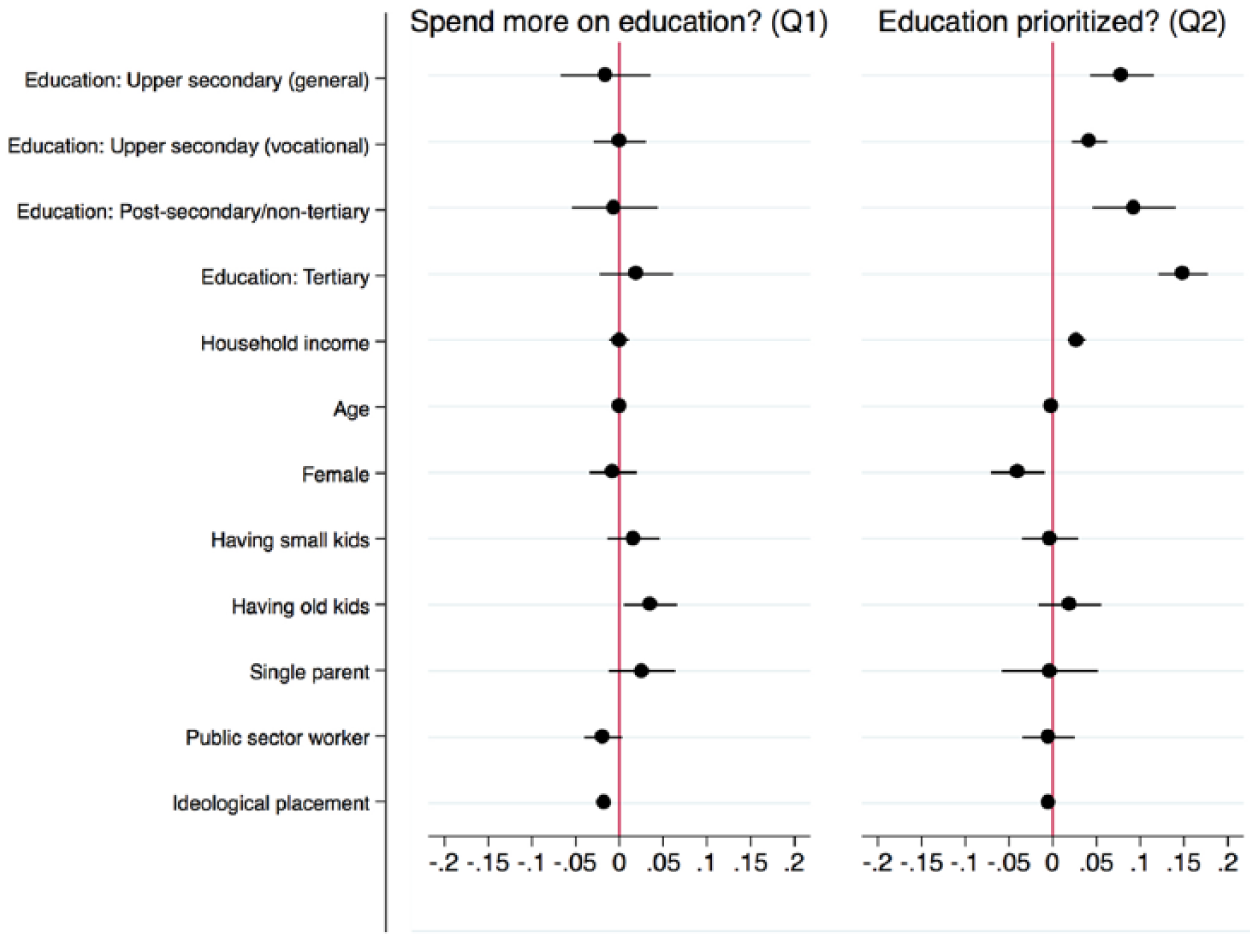
Determinants of support for education spending in an unconstrained (Q1, left-hand side) and constrained (Q2, right-hand side) scenario.
In the non-constrained environment (Q1), we find a statistically significant association between partisan ideology and spending support. Since higher values on this scale indicate a higher degree of conservatism, left-leaning individuals are found to be more supportive of spending increases. Reproducing previous findings (Busemeyer, 2012), respondents’ income position does not have any effect on spending support. The same holds true for educational background. There is some evidence that parents of older children are more in favour of public spending on education.
The picture changes considerably, however, once we move into the constrained scenario (Q2). In this case, partisan ideology loses its explanatory power. Instead, educational background and income turn out to be significant predictors, confirming Ansell’s (2010) and Garritzmann’s (2015, 2016) findings for higher education. Compared to the baseline category (basic education), the coefficients of all other education degrees are positive and significant, that is, respondents with higher educational degrees are more likely to prioritize education over other policy areas. Furthermore, the magnitude of the estimated effect becomes larger for higher levels of education. We have similar findings regarding income. In other words, when respondents are forced to choose between different fields of government activity, high-income and highly educated citizens choose the policy, which is less redistributive compared to other social policies. We can reproduce this finding when using respondents’ individual income position instead of their household income. Moreover, we tested for non-linear effects but found the effect of income to be linear (which is why we present the simpler metric form here). Our indicators of narrow self-interest (having children at different ages) turn out not to be significant predictors of preferences.
In Figure 2, we analyse preferences for the distribution of public resources separately across different education sectors. Similar to Figure 1, the left-hand side displays findings for the question without constraints on spending (Q3). Again, we find a significant association between support and partisan ideology: left-leaning individuals express more support for public spending in general, so they also support more spending on all sectors of the education system. This association with partisan ideology disappears, however, once we move into the constrained scenario on the right-hand side, where respondents were forced to prioritize between different education sectors (Q4). In this case, the ‘socialization thesis’ (Hypothesis 1) is supported by the finding that highly educated individuals are also more likely to express support for the concentration of public resources on higher educational levels. More specifically, respondents with a vocational background are significantly more likely to demand higher spending on VET, whereas respondents with a background in academic higher education prefer to prioritize public expenditure on higher education instead (this finding is a bit weaker in the constrained scenario, however). 6 Interestingly, we also find that respondents with the lowest educational background (the baseline category) are more supportive of pre-primary education. This might be related to the fact that children from lower socio-economic status groups are underrepresented in this sector of the education system across Europe (Van Lancker, 2014), which is why their parents demand more spending in order to compensate for this, or might simply be due to the fact that they are less likely to support higher-than-basic forms of education than other respondents.
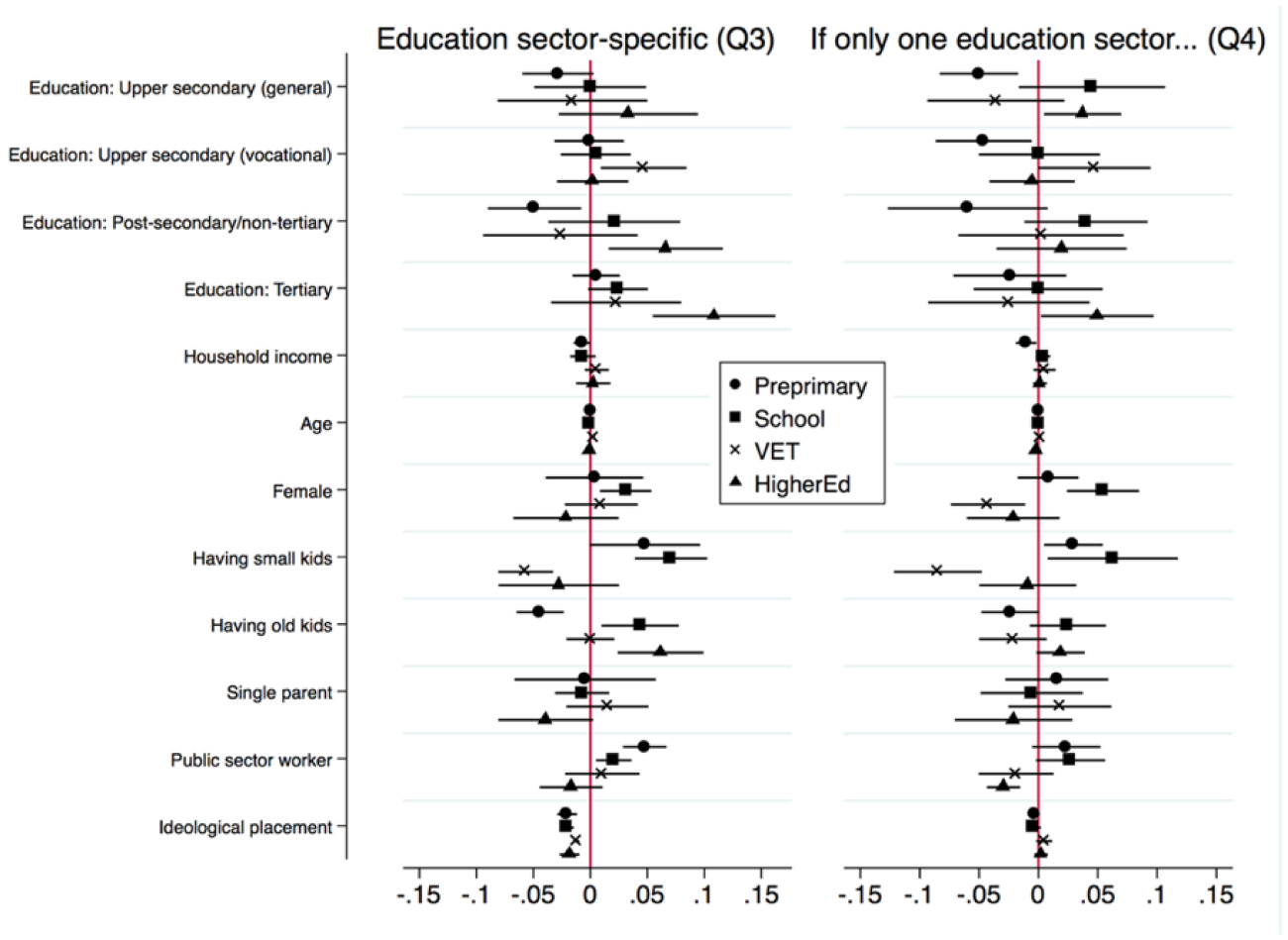
Determinants of support for distribution of spending across education sectors (panel on the left: no constraints; panel on the right: respondents forced to prioritize).
Somewhat contrary to our expectations, income does not seem to matter when it comes to the distribution of resources across sectors with the important exception of early childhood education, where we find a negative association, which we discuss in greater detail below. Again, the finding is highly similar when using individual income instead. There is, however, evidence for another kind of self-interest at work: parents with children at home express spending preferences that are in line with the educational needs of their children, and these associations are rather similar across the different scenarios: parents with small children (<10 years) prefer concentrating public spending on early childhood education and care as well as general schools and are less supportive of spending on vocational and higher education. Vice versa, parents of older children (≥10 years) prefer to channel resources to general schools and higher education. Interestingly, we do not see an increase in support for spending on VET for parents of older children. This could be explained by the fact that they expect their children to attend higher education rather than VET, which in turn might be related to popular perceptions of the supposedly lower status of VET relative to academic education in most European countries.
Variation across countries
Finally, we explore the cross-national variation in policy preferences. For reasons of space availability, we concentrate on cross-country variation in spending priorities across education sectors. Figure A in the Online Appendix displays additional descriptive statistics (see also Busemeyer et al., 2017 for more details). All in all, we find that general school education is the category chosen most in the majority of countries. In Denmark and France, however, the public regards additional spending on VET as more important. Even though it does not occupy the top spot, VET is also popular in Spain, Italy, and the United Kingdom, whereas pre-primary education receives more support in Germany, the United Kingdom, and Ireland. Finally, higher education is mentioned as priority in Italy and Spain to a much higher degree than in the other countries. Hence, there is some evidence that citizens demand additional spending in those educational sectors, which are not yet fully developed in their respective countries. This is, for instance, early childhood education in Germany, higher education in Italy or vocational education in France.
Moving beyond descriptive statistics, a simple way to substantiate this further is to interpret the country fixed-effects (i.e. country dummy variables) from the regression analyses substantively. To do this, we estimated a multinomial model (which produces the same result as the series of logit models presented above), regressing the answers to the forced-choice scenario on educational sectors (Q4) on the independent variables. Figure 3 displays the average marginal effects of the country dummies (cf. also Table C4 in Online Appendix). Germany is chosen as the reference category. The advantage of this procedure compared to simple descriptive statistics is that it takes into account differences in the socio-demographic composition across countries to the extent that they are captured by the individual-level control variables. The downside is that it is not immediately clear how large the support for the different sectors in the individual countries actually is.
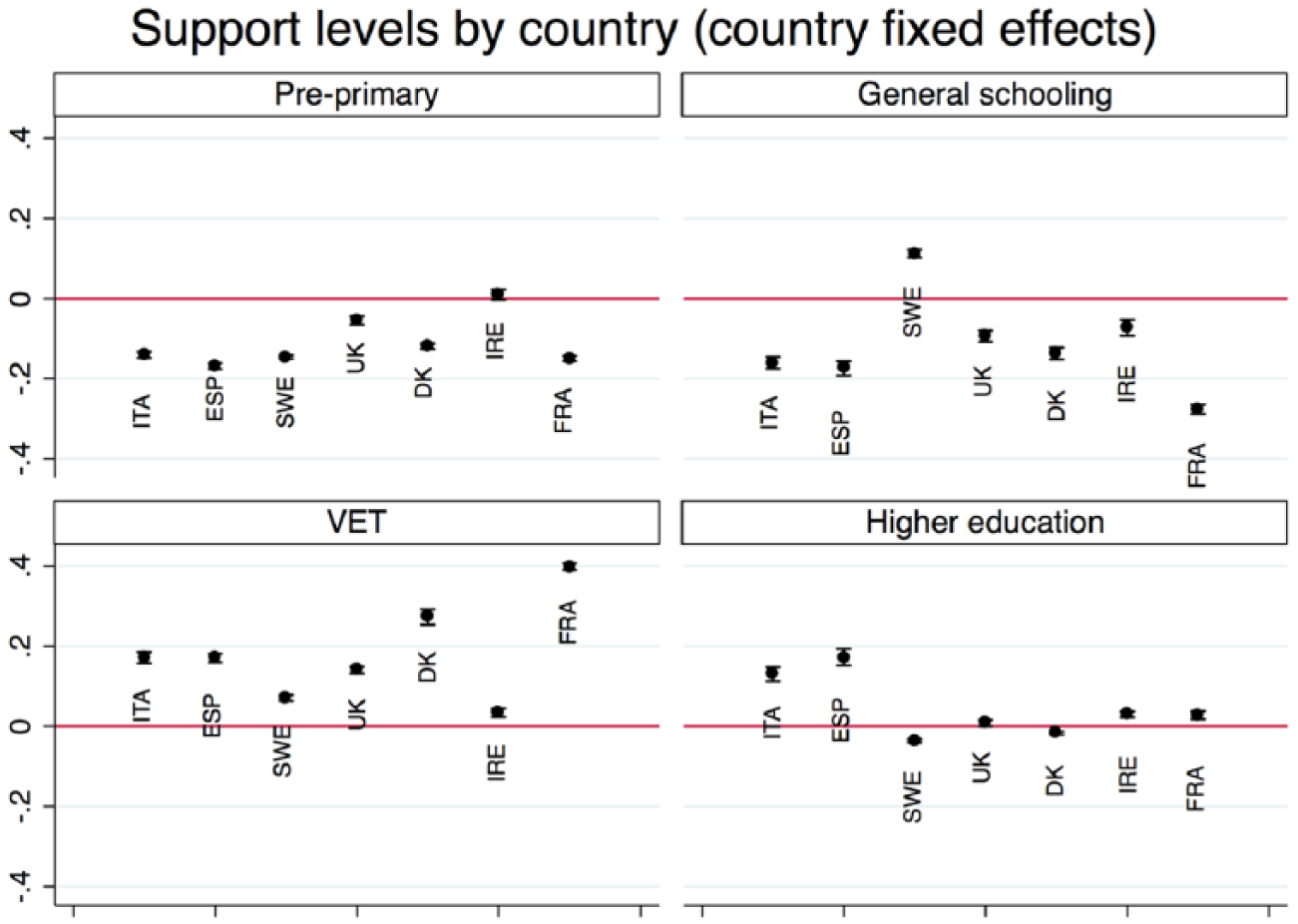
Respondents’ preferences towards public education spending across different educational sectors and different countries when forced to select only one spending area.
The broad pattern hinting at self-undermining feedback effects seen in the descriptive statistics is also present in Figure 3. The upper-left panel shows that support for prioritizing pre-primary education is particularly high in Germany since almost all other countries (except Ireland) are below the zero line. In contrast, support for prioritizing VET is low in Germany in international comparison, but particularly high in France and Denmark as well as Italy and Spain. Confirming the descriptive statistics, relative support for more spending on higher education is exceptionally high in Southern Europe, but there is little cross-national variation in support for higher education among the other countries. There is more cross-national variation in the support for general schooling (upper-right panel), with Swedish and German respondents being most likely to prioritize this sector of the education system and French respondents the least likely.
Discussion
In the following, we summarize and discuss the empirical findings in relation to our hypotheses. First, our analysis confirms that educational background is strongly related to policy preferences, providing support for the ‘socialization thesis’ (Hypothesis 1). The higher individuals’ education, the more likely they are to support investments in education rather than other kinds of social policies. Moreover, they are also more likely to favour the concentration of public resources on the education sector, which fits their individual education experiences (i.e. academic higher education or vocational education). There is mixed evidence for the thesis that respondents’ income position matters (Hypothesis 2): in the unconstrained scenarios, income is not significantly associated with education policy preferences, potentially because the overall level of support is very high. In the constrained scenarios, however, the association between income and preferences is stronger: Richer individuals favour education over other social policies (probably because it is less redistributive and they are more likely to benefit). Somewhat against expectations, however, richer individuals are not more likely to prioritize investments in higher education and they are even less likely to favour prioritizing early childhood education, even though childcare services tend to be used more often by wealthier individuals. A potential explanation is that these groups prefer keeping these education sectors exclusive and oppose further expansion.
Furthermore, we find that self-interest related to individuals’ position in the welfare state matters (Hypothesis 3). Parents with small children at home are in favour of concentrating public resources on early childhood education and general schooling, that is, those education sectors with the greatest benefit to them. Parents with older children, in contrast, are less supportive of spending on early childhood education and would like to distribute resources to higher education instead. What is more, partisan ideology has been confirmed to be strongly associated with policy preferences (Hypothesis 4). This is – mirroring the findings for income – mainly the case for the unconstrained scenarios, however. As soon as respondents have to prioritize spending, their ideological standpoint matters less and their self-interest plays a bigger role.
Why should self-interest be more important in the constrained scenarios compared to the unconstrained ones? One potential explanation is that respondents simply think harder about their real preferences when confronted with choice scenarios. Given the widespread popularity of education, few politicians would openly oppose educational expansion as Busemeyer et al. (2013) confirm studying party positions. This dynamic could also play out on the micro-level of policy preferences. Citizens would not openly oppose further spending on education (partly because of social desirability bias), but when forced to choose between policies that provide concrete benefits in the present (e.g. social transfer programmes) and others that create diffuse benefits in the future (e.g. education policy for those who do not directly benefit from educational investments as parents or teachers), respondents opt for the former rather than the latter. Our findings show that this dynamic even plays out when comparing different sectors of the education system.
Finally, we found some evidence for institutional feedback effects (Hypothesis 5), but our conclusions in this respect must be preliminary given the limited number of countries and the cross-sectional nature of the data. All in all, it seems that institutional feedback effects could be conditioned by socio-economic problem pressure. If existing institutions perform sufficiently well, there is little popular demand for large-scale change. But if the institutional status quo is perceived to produce undesired outcomes, public opinion is likely to favour policy change (as is also argued in Jacobs and Weaver (2015)). Rather than completely abandoning public education when dissatisfied with the current performance, respondents favour more public investments in those educational sectors which are perceived to contribute to the solution of pressing socio-economic problems. Following Chung and Meuleman (2017), this can be called an ‘improvement reaction’ rather than a ‘punishment reaction’ from critical citizens (p. 51).
There are several examples in the data that fit this pattern. First, there are countries suffering from high levels of youth and general unemployment in the wake of the economic and financial crisis, where citizens prioritize investments in post-secondary education such as VET and higher education (Italy, Spain and France). This could be because these types of education are closer to labour market needs. Second, support for additional spending on general schools is particularly high in Sweden, even though spending levels are already high in international comparison. This could be related to a significant deterioration in educational performance in Programme for International Student Assessment (PISA) in recent years, changing perceptions of the relative performance of the system, which leads citizens to demand more investment to counter this trend. Third, we find strong support for increasing spending on early childhood and pre-primary education in Germany, where increasing demand for childcare provision seems to have outstripped the (also increasing) supply in recent years.
Conclusion
In concluding, we would like to come back to the issue of ‘education as social policy’, the core theme of this Special Issue. Our findings entail some positive and some worrisome news for proponents of welfare state reform towards the social investment model (Bonoli, 2013; Hemerijck, 2013; Morel et al., 2012). The good news is that education is indeed very popular across different countries and socio-economic groups, even if citizens are forced to prioritize between education and other social policies. Thus, supportive public opinion can create propitious tailwinds for policy-makers engaging in education reform. However, the important caveat is that once policy-makers engage in decisions about the distribution of scarce fiscal resources across different policies and/or sectors of the education system, they are confronted with politically difficult distributive conflicts between constituencies rooted in material self-interest (cf. also Busemeyer and Garritzmann, 2017).
Furthermore, our survey also revealed that the priorities of policy-makers at the European Union (EU) and national level are not entirely aligned with the demands of European populations. For instance, the EU’s ‘Strategic Framework – Education and Training 2020’ 7 prioritizes the expansion of higher tertiary education and early childhood education but does not really address VET or primary education. Our survey, however, shows that most people would like to see more investments in general schooling and VET rather than higher or early childhood education. The high levels of support for additional spending on general schools might be related to the fact that it prepares for participation in higher education, whereas support for VET could be driven by labour market concerns. The mismatch between public demands and policy-makers’ priorities on the EU level is, of course, related to the limited competencies of the EU in education policy. Nevertheless, our survey shows that VET is widely considered to be a credible alternative to academic higher education in many European countries and that citizens in countries in which it so far remains institutionally underdeveloped would like to see more, not less, public investment in this sector. Of course, in countries with dual apprenticeship training systems such as Germany, employers have a high degree of autonomy in their hiring decisions with potentially discriminating effects (see Protsch and Solga, 2017), and public demands vis-à-vis the state might be less important in these settings.
Footnotes
Supplementary Material
The online appendix material is available online.
Funding
The author(s) disclosed receipt of the following financial support for the research, authorship, and/or publication of this article: We gratefully acknowledge funding from an European Research Council Starting Grant (grant number 311769).
Notes
References
Supplementary Material
Please find the following supplemental material available below.
For Open Access articles published under a Creative Commons License, all supplemental material carries the same license as the article it is associated with.
For non-Open Access articles published, all supplemental material carries a non-exclusive license, and permission requests for re-use of supplemental material or any part of supplemental material shall be sent directly to the copyright owner as specified in the copyright notice associated with the article.
