




Abstract
In the mid-1970s, the great Norwegian scholar Stein Rokkan argued that the consolidation of the national welfare state was going to set definite limits to European integration. While the impetuous strengthening of the latter – from Maastricht to Lisbon – has largely disproved Rokkan’s factual expectations, developments during the last decade seem to have vindicated the theoretical insights which underpinned his original argument. If appropriately re-elaborated, such insights can help us to identify the conditions under which the economic and social dimension of the European Union might be reconciled in the future.
Introduction
The Norwegian social scientist Stein Rokkan (1921–1979) remains an endless source of inspiration and fascination for scholars working on European politics with a longue durée perspective. The big passion of Rokkan was the development of Europe’s nation states and their transformation into mass democracies. He had no time to systematically research what he saw as the last formative step of the nation state: the expansion of public welfare. Nor did he seriously consider European integration – a novel process which had just taken off in the 1960s, at the height of Rokkan’s scientific trajectory. Yet, in a relative unknown paper written in 1975, Rokkan formulated a short, but crystal clear argument which linked, precisely, the welfare state and European integration. 1 Stretching a bit my language – for the sake of argument and debate – Rokkan’s reasoning might be defined as a sort of ‘impossibility theorem’: the nationalization of the citizenry inherent in the democratic welfare state was going to set definite limits to Europeanization. In the context of his theory, the full-fledged consolidation of the national, democratic and welfare state left no space for taking further steps and building a supranational political entity founded on ‘a genuine community of trust’.
The aim of this short article is to revisit Rokkan’s impossibility theorem: has it been disproved or vindicated? After summarizing in the first section the tenets of Rokkan’s theory and his specific argument, the second section will show how the latter was initially disproved by factual developments, while the third section will argue in favour of (delayed) vindication. The fourth section will suggest some corrections to the Rokkanian perspective with a view to making it more suitable for prospective – in addition to retrospective – analysis. Somewhat paradoxically, in my reformulation Rokkan’s perspective can be turned from a pessimistic argument about the obstacles to Europeanization into an analytical springboard for identifying possible pathways for further integration.
Bounded structuring and the ‘impossibility theorem’
How were the European states and nations ‘built’? To address such a grand question, Rokkan laboriously weaved together a theoretical framework in which the notions of boundaries and structuring occupy a central role. Structuring (that is, structure formation) connotes the stabilization of social interactions and institutional forms within a given territorial community through the creation of specific coalitions among actors and government institutions. In the wake of some critical historical junctures, centre–periphery relations and cleavage structures got ‘crystallized’ or ‘frozen’, that is, they came to be embedded in, and supported by, a particularly dense network of organizations (especially corporate and partisan organizations, but also service bureaucracies), whose main effect was (and still is) precisely that of reproducing the structures themselves. Structuring processes are typically associated with the presence of boundaries – the second fundamental concept. ‘Boundary’ identifies virtually any kind of marker of a distinctive condition, relevant for the life chances of a territorial collectivity and perceived as such by the collectivity itself. In line with the tradition of Max Weber, boundaries are fundamental mechanisms of territorial and social closure and thus sources of group formation, instruments for resource allocation and at the same time potential targets of contention (Ferrera, 2018).
In order to unravel the internal logic of ‘bounded structuring’, Rokkan built on the work of Albert O Hirshman (1970) and conceptualized the process in terms of an interdependence between the external closure of a given space and its internal differentiation. Historically, state formation implied a gradual foreclosure of exit options for actors and resources, the establishment of ‘system maintenance’ institutions capable of eliciting domestic loyalty and the provision of channels for internal voice, that is, claims addressed to national centres (their authorities) from social and geographical peripheries (their actors).
Figure 1 visualizes Rokkan’s model of bounded structuring. State-building, nation-building, mass democracy and the welfare state are the four ingredients and at the same time the four time phases of territorial system-building in modern Europe. Loyalty is placed towards the end of the system-building line, to connote the set of we-feelings and affectual/traditional attachments (identity) to the territorial community resulting, precisely, from increasing social and system integration.
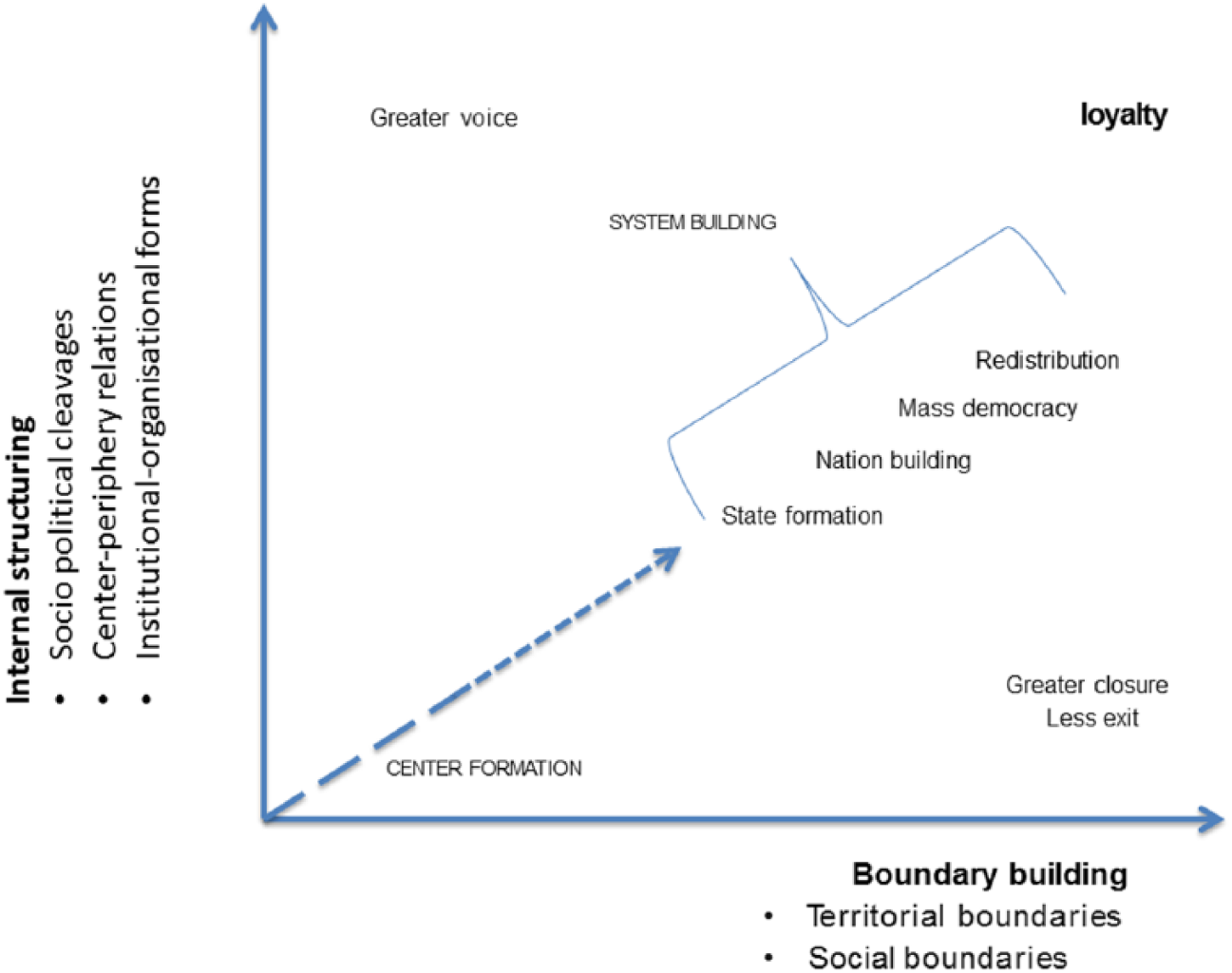
The process of “bounded structuring” of the European Nation State.
The fusion between territorial control and identity, mass democracy and the welfare state produced very solid and highly integrated political systems. While recognizing the importance and to some extent the inevitability of cross-border economic transactions, Rokkan seemed to think that such processes could be managed through the establishment of appropriate legal frameworks – creating modern analogues of the medieval lex mercatoria.
Writing in the 1960s and 1970s, Rokkan remained very sceptical about the overall import and prospects of European integration. And here we come to the ‘impossibility theorem’. In his 1975 paper, the Norwegian scholar came to argue that the interweaving of cultural identities, democratic participation and social sharing within the nation state container would foreclose any type of genuine Europeanization of democracy and welfare. European integration was deemed to remain circumscribed to a form of administrative cooperation for economic exchanges. The impossibility theorem can be summarized in a number of distinct propositions: 2
Mass democracy has strengthened territorial identities, mobilized citizens and entrusted them with direct electoral control of political authorities and their decisions.
The welfare state has completed the nationalization of the citizenry and sealed the perimeter of genuine communities of trust.
A key component of the latter is a generalized belief in the efficiency and fairness of the territorial government.
Counter-pressures for external transactions – especially of an economic nature – will not disappear and may require extensive forms of cooperation among executive bodies.
Any transfer of substantial authority (i.e. exclusive decision-making prerogatives) from territorial governments under direct democratic control to agencies untied from the latter ‘will prove very difficult’.
At this point, we can raise the key question of this article: was Rokkan right in positing an irremediable juxtaposition between the nationalization of identity and solidarity and any substantial progress of Euro-pean integration? To what extent has the impossibility theorem been disproved or vindicated?
Empirical grounding but gradual disproval
Let us locate ourselves in the 1960s and try to observe developments through Rokkan’s eyes. The integration project had taken off with grand intentions. Most of the Founding Fathers were ambitious federalists, driven by ethical commitments (the fight against belligerent nationalisms and the promotion of inter-state peace and prosperity) and practical goals (setting up a supranational authoritative infrastructure to uphold security in the new cold war environment). The proposed establishment of the European Defence Community – meant to evolve into no less than a ‘European Political Community’ – was a huge and brave effort undertaken by would be centre-building elites. The plan failed, and it did so after the vote of the French Parliament: it was notably a democratic institution under direct popular control that blocked the initiative. After this failure, the integration project was de facto downgraded to an economic process of cross-border liberalization and, until the early 1970s, the European Economic Community (EEC) operated essentially as a market making machine regulated by law and based on executive cooperation. Whether directly or indirectly, factual developments were perfectly in line with Rokkan’s theory and possibly grounded its very elaboration.
With the benefit of hindsight, let us now start our assessment by looking more closely at the 1970s. This was a problematic and turbulent decade (the breakdown of the Bretton Woods monetary regime, two oil shocks, an intensification of the cold war after the Prague Spring): these upheavals might well have shattered the fragile EEC building. What happened instead was more integration. The customs union was completed and ambitious plans started to be outlined for a fully fledged economic and monetary union (EMU). After experimenting with a currency ‘snake’, the European monetary system was created in 1979. The decade also witnessed the somewhat silent birth of the European Union’s (EU) social dimension: minimum standards for domestic labour markets and social protection systems, anti-poverty programmes, funds for territorial cohesion and regional development, as well as the expansion of social security coordination (Ferrera, 2005). The first direct elections of the European Parliament (1979) inaugurated in their turn the gradual alignment of supranational decision-making with the normative code of democratic legitimation. All these innovations were made possible by a poorly visible, but very significant change of the political and cultural climate within the ruling elites, both political and intellectual. During the 1970s, national leaders became increasingly aware of shared interests and – encouraged by an increasingly proactive Commission – developed a modicum of we-feelings and higher mutual trust (Ferrera and Burelli, Forthcoming; Van Middelaar, 2013).
The fall of the Berlin wall in 1989 opened an unexpected window of opportunity for a political quantum leap. With Maastricht (1992), the newly born European Union embarked upon a deliberate and ambitious attempt at system-building (Flora, 1993). New functional competences were attributed to supranational institutions, including in the area of employment and social protection. What is more important in our perspective is that a common membership space was put in place under the authority of the Court of Justice of the European Union (CJEU), greatly expanding the two basic sets of rights which Rokkan had associated with citizenship in the European tradition: ‘rights to options’ and ‘right to roots’ (Flora et al., 1999: 172). Founded as it was on nondiscrimination (first and foremost in terms of nationality: rights to roots) and free movement (for taking advantage of the opportunities available anywhere in the Union: rights to options), EU citizenship has indeed created that level-playing field which is a precondition for a territorial government to become (and being perceived by its citizens) as efficient and fair.
With all their limitations, these developments have trespassed the ‘definite limits’ posited by the first four propositions of the impossibility theorem. In terms of bounded structuring, the EU has clearly moved beyond centre formation and has proved to be able to fully engage itself not only in state-building but also in experimenting with democratization and (in a more limited way) redistribution. If this diagnosis is correct, we can tentatively conclude this section by saying that, while the original impossibility theorem had indeed an empirical grounding in the way things had worked during the initial phase of integration, factual post-Rokkanian developments have disproved the Maestro’s theoretical scepticism. There are, however, other chapters in the story.
Delayed vindication
During the 2000s, a number of novel developments increased the socio-economic impact of a deeper and wider integration – especially in the old member states. The most important transformation was the Eastern enlargement, which extended the number of member states to 28 and hugely increased the internal diversity of the EU in terms of economic and welfare state development. The Eastern enlargement drastically altered the structural profile (to use Rokkan’s concept) of the Union, generating a fertile ground for the emergence of new strains and lines of divisions. Let us think of the vast migration flows from East to West after 2004, the new competitive pressures due to the posting of workers, to freedom of services (the famous Polish plumber), to company relocations to low cost member states. In the wake of EMU, EU leaders tried to strengthen political union by establishing a fully fledged European Constitution. But the popular rejection of the Constitutional Treaty in the Spring of 2005 in France and the Netherlands marked a political watershed: those referendums in fact sealed the irreversible entanglement between European integration and mass politics, confirming with a vengeance the first warnings of the early 1990s (the Danish and French referendums on the Maastricht Treaty in the Summer of 1992). Political elites were able to orchestrate a bypass and adopt the Lisbon Treaty in 2009. But ever since, it has become clear that the ‘mass politicization’ of integration triggers off centrifugal dynamics and neo-nationalist backlashes.
Figure 2 visualizes how Rokkan’s model can be applied to EU-building. The latter may, in principle, be conceptualized as a novel higher order process of boundary reconfiguration and internal re-structuring. In this case, however, supranational system-building can only take place at the expense of national systems. For the latter, EU-building works, as it were, as state-building in reverse. In this case, Rokkan’s theory predicts ‘destructuring’. This general process implies an ‘unfreezing’ (unsettling, deranging) of pre-existing voice channels and organizations and a de-stabilization of the underlying centre–periphery and cleavage constellations.

EU building and national de-structuring.
The re-visitation (and broad generalization) of Rokkan’s theory in the face of EU-building has been masterfully provided by Bartolini (2005). His message is clear: institutional democratization and the direct connection between the dynamics of supranational integration and those of national mass politics are deemed to generate an ‘explosive mixture of problems’ (p. 409). As is well known, the euro-crisis and the ensuing great recession have heavily aggravated the problematic mixture. Building on a Rokkanian background, Hans Peter Kriesi and his collaborators have conceptualized and investigated the new conflict constellation which emerged in the wake of EMU, the Eastern enlargements and the crisis (Kriesi, 2010; Kriesi et al., 2012). The EU as such has become a major source of contention, originating a novel ‘integration–demarcation’ cleavage.
At this point, let us get back to the impossibility theorem. Recent developments seem to clearly vindicate its theoretical logic and its predictive validity. We must however speak of vindication a contrario. Initially, factual developments have disproved the theorem’s expectations by showing that European integration was indeed able to move beyond ‘definite limits’. That transfer of substantial authority from national governments to supranational institutions (which for Rokkan was very unlikely) has indeed taken place. Developments have been slow-moving, generating incremental, sometimes unintended and cumulative effects. And, with some delay, they have given rise to a process implicitly predicted (a contrario) by Rokkan’s theorem: integration has eventually clashed with nation-based democracy and social sharing, unleashing dangerous and destructive conflicts. In the theorem, Rokkan suggested that the nationalization of the citizenry inherent in the welfare state would not necessarily imply ‘an increase of feelings of xenophobia and distance from others’ (Flora et al., 1999: 265). In certain countries, right wing formations have unfortunately fomented xenophobic and even racist orientations and actual behaviours which have gone beyond Rokkan’s wildest dreams. The last decade has unearthed the structural contradiction (to use Bartolini’s words) between the dynamics of EU-building and the preservation of the cultural, redistributive and political capacities of national governments. In such a context, can the new supranational centre really ‘hold’? Or are we faced with an unstoppable spiral of system disintegration, in the wake of an increasingly loud ‘voice for exit’ (the UK case)?
Trapped inside the theorem?
In order to address this question within a Rokkanian framework, we must elaborate on propositions 2 and 3 of the theorem. Their key elements are ‘the formation of a genuine community of trust’ and its necessary underpinning, that is, ‘a generalized belief in the efficiency and fairness of the territorial government’. How might the latter be achieved? Under what conditions does system-building generate adequate trust and, ultimately, legitimation? ‘Territorial government’ has a very general connotation. For Rokkan, it basically refers to any form of political organization that (1) claims the validity and supremacy of its decisions beyond and above all temporary bargains in society; (2) claims the right to represent the common interests of the citizenry; (3) claims to embody the solidarity and shared cultural identity of the community; (4) commands enough resources for safeguarding internal order and cohesion and sustaining territorial redistribution; (5) makes sure that such resources reach all sectors/strata of the population, however weak and peripheral. To these general conditions, Rokkan adds an important caveat: ‘whether such claims are substantiated or remain purely verbal is a matter of resources and organization: how far can the state extract resources … and how far the political system makes it possible to spread such resources?’ (Flora et al., 1999: 264).
Historical processes of national system-building greatly varied in the way they addressed these challenges and in the solutions found. Tensions were especially marked in culturally divided societies. Rokkan investigated the Swiss case in particular depth. According to the Norwegian scholar, system-building could come to completion in Switzerland mainly thanks to two factors: (1) the crisscrossing of religious and linguistic oppositions, which did not coincide with cantonal borders and thus allowed for the formation of cross-local, functional alliances and coalitions; (2) the fact that two main languages, German and French, enjoyed equal prestige, were adequately spoken by the elites and thus facilitated their communication.
The unifying potential of these two factors provides some promising insights for EU-building. After all, also in the Union many oppositions crisscross each other, national languages have equal dignity and a lingua franca – English – facilitates (elite) communication and bonding. European system-building has already centralized significant financial and organizational resources. The orders of magnitude are tiny. But this element should not be overestimated, let alone dramatized. The common budget is indeed small (1% of the total Gross EU Product), but the right to extract dedicated resource is a formalized prerogative of the EU, with no temporal limits. In Switzerland, to this day the Bund’s taxing powers need to be periodically reconfirmed by the citizens through a national referendum. In its turn, the supremacy of EU law as well as its scope – at least in some sectors – is higher than in Switzerland. The EU problem lies less in resources and organization per se than in the logic which inspires their use – within the greater institutional and policy design of the Union’s political system. Regardless of its genetic drivers, the new conflict constellation described above signals an increased distrust in the ‘efficiency and fairness’ of the EU government. What is explicitly and vocally challenged by Eurosceptic formations is, precisely, the Union’s claim to represent common interests and to safeguard solidarity. As regards the former, the main indictment is that ‘opening’ and EMU have become a threat for the economic and social security of national citizens, do not create growth and jobs and generate asymmetric advantages among the member states. Furthermore, instead of being constructed from below (the citizenry), the common interest is unilaterally decided at the top, and largely shaped by unelected elites. As regards solidarity, the indictment is that the EU not only lacks a caring face, but that it undermines national sharing models and employment structures. The refugee crisis has amplified both indictments. On the one hand, the EU dictates (or so it is perceived) where immigrants should be admitted and what rights they should enjoy. On the other, it does not provide assistance or resources for the (perceived) ‘asymmetric’ damages of immigration.
Should we then conclude that the EU is trapped inside the impossibility theorem and that even prudent modes and forms of political federalization are deemed to fail under the counter-pressures that they themselves inevitably generate, in line with Rokkan’s expectations? An increasing number of scholars now share this view, even if their starting points are not necessarily Rokkanian (e.g. Bootle, 2012; Scharpf, 2010, 2016; Streeck, 2014). Let me suggest how to possibly escape from this theoretical predicament by proposing a reformulation and an analytical correction of the Rokkanian framework, without losing its basic thrust.
From impossibility to possibilities
There is no programmatic or built-in determinism in the theory of Rokkan. He explicitly distanced himself from economic functionalism and argued that his model of Europe sought to combine the tradition of Marx with those of Weber and Durkheim. In his work, however, he largely neglected the role of actors and choices in historical contingencies (Tilly, 1990). Rokkan was interested in what he called retrospective diachronics: ‘given an observed contrast in the values of variables at time tₓ, what combination of variables for earlier phases tₓ₋₁, tₓ₋₂ etc. can best account for these differences?’ (Flora et al., 1999: 15). His retrospective focus was mainly on macro-structures: social cleavages, party-systems, cultural/symbolic systems and so on. Rokkan was not equally interested in transition processes, which require prospective diachronics, that is, the identification of developmental alternatives within extant macro-constellations and of the contingent options available for situated actors on whose choices historical change ultimately hinges. 3
Figure 3 shows how the Rokkanian framework can be reformulated in a prospective direction. The starting point is still structural: historical change takes place within ‘structured constellations’ populated with institutions, political and social organized groups, established practices and ideational frames, cleavage and centre–periphery structures. The overall substantive profile of such constellations originates broad constraints and opportunities: certain paths of developments are foreclosed, other are favoured. At the edges, so to speak, of a given structured constellation, there is, however, a ‘possibility space’, i.e. a plastic frontier where all forms of conflict take place (social, political, institutional, ideational and so on) and where alternatives and options for future developments take shape (say: deepening as opposed to widening of integration; deepening through supranational as opposed to intergovernmental arrangements and so on). Political actors move within this possibility space and, with their choices, serve as “ferrymen” who transform one possibility (among the many) into actual reality, thus bringing about historical change.
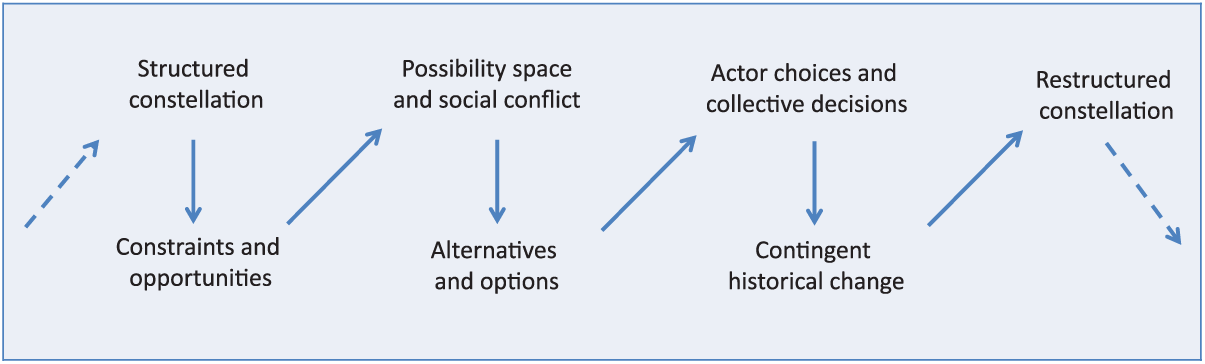
Historical change between structures and choices.
The task of prospective analysis is that of formulating grounded possibility judgements (i.e. are developments A, B, or C plausibly feasible, given the status quo?), starting from structural constraints and opportunities, proceeding to examine the available alternatives and options confronting each other within the conflict-ridden possibility space and then closing in, as much as possible, towards those near surroundings that shape actor motivations and decisions.
The notions of possibility spaces and possibility judgements (as well as the ‘ferryman’ metaphor) constitute my correction to the Rokkanian framework and are drawn from Weber (1978). For Weber and the neo-Weberians (e.g. Lepsius, 2011), observed historical contexts and their possibility spaces are inevitably torn by conflict. But the latter is not necessarily harmful: if appropriately channelled and managed, it can indeed carry out important functions, not least to create links between groups and to produce a fertile ground for constructive (as opposed to disruptive) change, under the guidance of responsible leaders.
How can we use my prospective reformulation and correction of Rokkan’s framework to identify the developmental possibilities, the alternatives and options which are available for the EU and its leaders in the current predicament? Are there margins for actors to set themselves free from the impossibility theorem?
It would be foolish to deny the significance of Euroscepticism and of the newly emerged ‘constraining dissensus’ (Hooghe and Marks, 2009) that has formed around integration at the domestic mass level. But – save for the United Kingdom, of course – survey and electoral results indicate that relatively vast majorities still support the EU and believe that it could (and should) be strengthened (Ferrera and Pellegata, 2017, 2018; Gerhards et al., 2018). On this backdrop, it seems exaggerated to argue that the EU’s current predicament leaves no margins whatsoever for the emergence of a Rokkanian ‘genuine community of trust’. Nationalized citizenries have not entirely fallen prey to those anti-EU orientations which characterize vocal minorities. Survey evidence reveals an unexpected degree of readiness to support steps for making the EU government fairer and more capable of spreading resources to all sectors/strata of the population, however weak and peripheral (Ferrera and Pellegata, 2017). There is, however, a big obstacle for moving in such a direction. Given the inadequate level of cross-national political structuring, the organization of voice from below around such issues encounters huge obstacles. Even if a fairer and solidaristic EU might actually match popular preferences, for the time being it is not realistic to expect the emergence of bottom-up demands and large-scale transnational mobilizations in support of euro-social objectives. Is there an alternative pathway?
In historical processes of welfare state building, big leap forwards in terms of both social and territorial solidarity resulted on several occasions from a top-down logic, based on the interest/wish of incumbent political leaders to preserve stability and consolidate the whole polity in the face of pressing functional challenges, social unrest or dire emergencies (Flora and Alber, 1981). This pathway is possibly the only one from which some advancement might be expected today. The first impulse for enhancing the efficiency and fairness of the EU government should come from above, that is, on the side of leaders motivated by farsighted system-building objectives and capable of creatively building on the existing conflict constellation in order to forge broad cross-interest coalitions. Unfortunately, during the last decade the EMU elite has made long steps in the opposite direction, emphasizing difference and apartness between national communities and their governments, denigrating, also symbolically, any mechanism of mutual support, promoting a historically unprecedented rule-based formalization of political authority. Among the potentially available alternatives and options, EU leaders seem to have chosen those with the highest potential of political disintegration. We must admit that the exercise of a leadership capable of re-forging collective identities has become difficult in a world increasingly based on fluid social relationships. But it still remains, in my view, within the horizon of political possibility. There is still room to steer away from disintegration. In the Eurozone countries, there still are, apparently, substantial pro-EU ‘silent majorities’. An ambitious strategy of electoral cultivation on the side of enterprising leaders could well leverage on their potential support for more integration in order to corner and side-line the very aggressive, but still minoritarian Eurosceptic challengers.
Conclusion
Rokkan’s theorem was definitely right in underlying the solidity and resilience of the democratic and welfare nation state and in predicting that European integration would encounter many obstacles. And yet integration has gone on, moving well beyond administrative cooperation for facilitating economic transactions. In combination with parallel and contingent developments (in particular the financial crisis and the great recession), the advancement of integration has however vindicated the logic of the theorem. Political centralization has activated those destructuring dynamics theorized (even if primarily a contrario) by Rokkan.
The nation state is likely to remain the strongest guarantor of political and welfare rights, the prime legitimate space for the practices of electoral democracy and social sharing. The logic of ‘closure’ will continue to encourage strategies of national defence and preservation. Based as it must be on the logic of ‘opening’, European integration will in its turn continue to operate as a destabilizing force for both nation-based electoral democracy and social sharing. Institutional and political tensions between these two logics and processes will not subside any time soon. But institutional collapse and political disintegration can be avoided through anticipatory strategies and delicate balancing acts. For all those who attribute paramount importance to participation, equality and solidarity, opening and integration are today mainly looked on with preoccupation and suspicion for their effects on national social contracts. But as Rokkan noted in his early commentary to Hirschman, while opening (exits/entries) inevitably has a destructuring potential, it can also be a potent generator of positive (i.e. virtuous) institutional innovation (Rokkan, 1974).
EU studies are today permeated by pessimism. The impossibility theorem is being resurrected in other guises (neo-Marxist, neo-institutionalist, post-functionalist and so on) (Ferrera, 2017). What is needed is a shift of focus in our debates from constraints to opportunities, from economic and institutional necessities to possibilities, choices, actors and ultimately leadership. And, if appropriately updated and re-elaborated in prospective terms, Rokkan’s approach can remain a precious starting line for moving in this direction and open a constructive discussion forum on the prospects for (social) Europe. To repeat Peter Flora’s words at the very end of his Introduction to the 1999 volume: ‘by looking into the past, Rokkan points to the future’ (p. 91).
Footnotes
Acknowledgements
The author first presented the ideas and arguments of this article in his Rokkan Memorial Lecture 2017, held at the University of Bergen on 5 September 2017. A warm thank to the event organizers and participants, for their questions and precious comments.
