



Abstract
One of the core dilemmas of current welfare politics is the question of how to ensure social protection while providing incentives to seek employment at the same time. A way to address this dilemma is to base policies and policy models on the principle notion that ‘work must pay’; in other words, income from employment should be higher than the social support of the unemployed. However, how accurately do these approaches and models represent the reality of benefit recipients, particularly in the context of increased employment precariousness? In this article, we use the cases of two disadvantaged regions in Czech Republic in order to contrast the presumptions of ‘making work pay’ policies with the everyday experience of welfare recipients. As we show, their situations are strongly shaped by current changes in the labour market, particularly the precarious character of accessible employment and high levels of indebtedness. The modelling of financial employment incentives and the public policies based on these calculations often do not correspond with the reality of welfare recipients that are often cycling in and out of precarious forms of employment. However, the authors’ main claim is that the very idea of the ‘work must pay’ approach focuses on the wrong question. A truly functioning financial incentive would need to focus not solely on the difference in income between those who work and those who do not work, but rather should analyse what type of arrangements allow working households to rise permanently above the poverty line.
Keywords
Introduction
One of the leitmotifs of labour market reforms and social protection systems in many European countries during the last two decades has been the notion that ‘work must pay’. On one side, slogans like ‘work must pay’ are sometimes used in political debates on the welfare state and welfare recipients, in line with the negative notion of undeserving welfare recipients who are passive and unmotivated to find work. While declaring that ‘work must pay’, the key message in such debates is often a call to sanction those perceived as demotivated or even workshy. On the other side, ‘work must pay’ refers to the desire to reform welfare systems and labour market regulations in order to increase the efficiency of the system, which should provide social protection and incentives to accept employment. In this sense, ‘work must pay’ principles are used in models by international organizations such as the Organisation for Economic Co-operation and Development (OECD) that seek to compare the efficiency of its member states’ welfare systems.
While acknowledging the usefulness of models and calculations which attempt to simulate the impact of a change in employment status on household income, we need to ask how accurately these models, which are based on the principle that ‘work must pay’ and which measure the financial motivations for employment, represent the reality of welfare recipients. This question is particularly salient given the trend towards a highly flexible and deregulated labour market. While there are significant differences between countries, people in marginalized positions of the labour market are often pushed into precarious or atypical forms of employment (Emmenegger et al., 2012; Rueda, 2005, Palier and Thelen 2010), with in-work and recurrent poverty becoming as important an issue as unemployment (Crettaz, 2013; Shildrick et al., 2012).
While the international literature on ‘work must pay’ policies focused mostly on Western countries, the slogan has also been resonating strongly in the Czech Republic. The principle was applied in a number of government-funded studies which sought to compare the income of working households with the income of unemployed households (Hora and Vyhlídal, 2016; Jahoda, 2006; Pavel, 2005; Trlifajová et al., 2014; World Bank, 2008; Žižlavský, 2010). Recommendations from these studies contributed to the direction of Czech welfare reforms over the past 10 years, introducing the logic that the state should support labour market participation by widening the difference between the disposable income of employed and unemployed citizens.
There are two reasons why Czechia’s social and economic environment offers an interesting opportunity to critically reflect on the applicability of the ‘work must pay’ logic. First, the Czech Republic has a very low-wage level, with one of the lowest minimal wages in the European Union (EU) at the time of this research (2014–2015), lower than neighbouring Eastern European countries like Poland and Slovakia, and Turkey as well (OECD.stat, 2017). This low-wage level arguably contributed to the popularity of ‘work must pay’ policies as there is widespread frustration over the small income difference between the working poor and the unemployed. Second, the Czech labour market is characterized by a comparably low share of part-time jobs (Eurostat, 2016b) and a high share of full-time open-ended employment (European Parliament 2016). However, over the past decades, it has trended towards increasing precarity in certain segments of the labour market and a rising proportion in long-term unemployment (Martiskova and Sedlakova, 2016; Sirovátka et al., 2009), which makes the Czech Republic a good case to test the impact of these trends on the possibilities of modelling financial incentives for employment.
Due to the increase in regional disparities after 1990, poverty and social problems are concentrated in a number of areas of Czechia that are either geographically remote and/or were severely affected by de-industrialization. Focusing on the situation of low-income households in two of these disadvantaged regions, this article critically examines policy implications and possible shortcomings of the notion that ‘work must pay’ in the specific environment of post-communist Central and Eastern Europe (CEE).
We have approached this analysis from a holistic perspective, taking into account not only the policy measures themselves but also other, related issues or fields, such as regional labour markets, knowledge of the tax and benefit system and its administration, individual non-financial motivations and the overall socio-economic situation of the households.
The article proceeds as following: we will first briefly describe the theoretical context and presumptions of the ‘making work pay’ approaches. Then we will discuss the development of the ‘making work pay’ approaches in the broader context of Czech social policy and summarize the findings from previous studies that sought to measure financial incentives for employment through household microsimulation models.
In the main part, we compare the findings of the household microsimulations with the everyday experience of welfare recipients in disadvantaged regions of the Czech Republic. In order to be able to do so, we sought to cover households with the same composition as those of the microsimulations. The findings are structured into four parts. In each of them, we describe one factor which influences the position of vulnerable households on the labour market yet is not acknowledged in the microsimulations used to design policies.
Our analysis, therefore, points to serious limitations in the ‘work must pay’ approaches. While pointing out how future microsimulations might be improved to address some of these shortcomings, we question at the same time the underlying logic of these approaches. From our point of view, focusing on the difference in income is not sufficient to cover the financial motivation for employment in situations where employment does not allow people to rise above the poverty line.
To some extent, this problem has its roots in the specific context of the Czech Republic as a low-wage economy. However, several factors that we identify relate to the broader processes of labour market precarization and the rise of low-wage sectors, which have also been described in more affluent European economies.
Theoretical introduction: why ‘make work pay’
The development of welfare policies over the past decades has brought a greater emphasis on the question of whether welfare support functions as a disincentive for employment. Although there are important differences depending on the political context and national traditions, the literature agrees on a general trend towards emphasis on labour market participation and individual motivation for employment across different welfare regimes. These are observable in the proliferation of activation schemes in which individual benefit recipients are often requested to demonstrate their availability for work (Bonoli, 2010; Bonoli and Natali, 2012; Clasen and Clegg, 2007; Taylor-Gooby et al., 2015; Van Kersbergen and Hemerijck, 2012).
The emphasis on the notion that ‘work must pay’ is in line with these trends. The attractiveness of the concept is closely linked to its intelligibility within the general public, promising to tackle the perceived negative impact of a supposedly overgenerous welfare state. In practice, however, it may take the form of a variety of goals and policy instruments, ranging from emphasis on poverty protection and employment incentives (through in-work benefits, tax deductions or a raise in minimum wage), to strongly controlling approaches to benefit reductions aimed at enhancing labour market participation regardless of the quality of employment. The concept is closely linked to New Labour’s policies and 1990s welfare-to-work programmes as part of attempts to re-constitute the welfare state in line with the neoliberal emphasis on individual responsibility, the fight against welfare dependency and market-driven solutions promoted by international organizations such as the OECD (Gray, 2001; Mahon, 2014).
By the late 1990s to early 2000s, social policy analysis and recommendations on both the international and EU level become increasingly sensitive to the negative impacts of rising inequality and processes of social exclusion and marginalization within the population (Hemerjick, 2012; Mahon, 2014). This translated into changes in policy approaches sometimes described by the term ‘social investment’ (see Nolan, 2013, for an overview of the term). In these approaches, the need to address structural issues (re)legitimized state intervention and spending, but the continuity of the neoliberal emphasis on labour market participation and efficiency led to the promotion of policy designs that maximize the returns of social expenditures, mainly through active employment and social participation (Jenson, 2012; Kersbergen et al., 2014; Rueda, 2005).The notion that ‘work must pay’ gained new importance as a promise to address one of the core dilemmas of this approach to social policy: the struggle between the social protection guarantee and stress on the involvement of people at risk of unemployment in the labour market (Bonoli and Natali, 2012). ‘Making work pay’ should not only ensure that the work is competitive with social benefit rates, but also allow for the supplementation of wages and the provision of low-cost services. Policies designed to ‘make work pay’ should be able to address the twin problem of persistent labour market difficulties and in-work poverty, to ‘get the incentives right’ and find an equilibrium between social protection and pressure on labour market participation (Immervoll and Pearson, 2009; Jenson, 2009). As such, ‘make work pay’ became one of the key tools for reducing benefit dependency and increasing labour market participation, as articulated in the European employment strategy through which the European Commission sought to react to increased levels of long-term unemployment in the continental EU states (De Lathouwer, 2004; Matsaganis and Figari, 2016; Porte et al., 2001; Verbist et al., 2007).
The ability of different states to ‘make work pay’ became an object of benchmarking. The calculation of the difference between welfare state payments and the financial rewards from employment became one of the tools used by both the OECD (Tax and Benefit Systems: OECD Indicators) and the European Commission Tax and benefits indicators database/EUROMOD when assessing the effectiveness of its member states’ labour market regulations. The microsimulation models based on the notion that ‘work must pay’ had been used in analyses evaluating the impact of welfare reforms on the financial incentives of employment, pointing to some important problems in the construction of welfare support (Bargain et al., 2010; Blundell, 2001; Danziger et al., 2002; Figari, 2010; Immervoll and Pearson, 2009; Kurowska et al., 2015; Martin and Immervoll, 2007; Navickė and Lazutka, 2016 ; Pearson and Scarpetta, 2000) (and for CEE countries, a particularly interesting analysis of the costs of the formalization of employment by Koettl and Weber, 2012). The financial incentive for employment is usually measured through household simulation techniques that compare the situation of households that are receiving welfare benefits with those that are employed. In these analyses, the main focus is on the relationship between welfare payments, wages and taxation. The financial motivation is usually measured through the replacement rate, with focus on the potential ‘traps’; in other words, situations when the shift into employment (or a wage increase) does not bring financial reward (Matsaganis and Figari, 2016; OECD, 2007).
While the EU, OECD and other international bodies had an important role in promoting the idea of ‘work-must-pay policies’, offering methodological tools to measure incentives, it would be wrong to assume that the Czech government simply implemented ideas coming from abroad. As will be shown in the next chapter, Czech policy-makers borrowed concepts from abroad, on the one hand, yet reacted to domestic debates, dominated by claims of widespread welfare misuse and calls for more efficient usage of state resources, on the other.
Czech social policies and the principle of ‘make work pay’
Having been part of the Soviet bloc for four decades, the Czech Republic underwent a far-reaching transformation after 1990, in which the role of the hitherto omnipotent state in the country’s economy was dramatically reduced through privatization of state property and attraction of foreign investment. While the social disruptions resulting from this process were not as severe as in most other post-socialist countries, the re-organization of the economy produced winners and losers, deepened regional inequalities, and led to the return of unemployment, a phenomenon that had practically not existed in the planned socialist economy (Drahokoupil and Myant, 2010; Švejnar, 1995).
The policies dealing with unemployment and low income were first constructed as ‘emergency measures’ (Offe, 1993) meant to moderate and compensate a negative and presumably temporal consequence of the economic transition as well as preserve social cohesion (Gallie et al., 2001; Potucek, 2004; Vanhuysse, 2006, Inglot, 2008). However, in the context of the dominant neoliberal discourse and the absence of strong labour unions and their political allies, the income protection policies gradually shifted closer to the safety net schemes of neoliberal regimes. As a consequence, Czechia’s current welfare system is characterized by a combination of a Bismarckian (conservative) pre–Second World War polices, its socialistic legacy and the strong influence of laissez-faire, market liberal ideology. As such, it does not fit easily into any of the established typology of welfare state regimes and did not develop equally in all areas (Potůček, 2004; Saxonberg and Sirovátka 2009; Saxonberg et al., 2013).
Similar to other states, the Czech Republic has two main schemes of support for the unemployed: unemployment support, an individual benefit based on previous insurance contributions, limited to 5 months in most cases; and social assistance, which is a tax-financed minimum income scheme, means-tested on the level of households. With the limited coverage of unemployment support (about one-fifth of the unemployed (Ministry of Labour and Social Affairs, 2016), the ‘making work pay’ policies and models in the Czech Republic are usually linked to social assistance and other tax-based benefits. The social assistance scheme has low public legitimacy, as its perception is strongly shaped by the alleged polarity between the ‘working and contributing’ majority and the ‘not working and not contributing’ Roma minority, who are perceived as the main beneficiaries (Rabušic and Sirovátka, 1999; Rat, 2009). Calls for a tougher approach towards ‘welfare misusers’ and ‘free-riders’ are, in the Czech Republic, an evergreen issue in every election campaign across the entire political spectrum. Even when used without any direct racial connotation, they are often understood as a hidden reference to the Roma minority (Hurrle et al., 2013). Furthermore, the low level of unemployment in the Czech Republic makes it attractive to explain ‘welfare dependency’ as the result of individual choices steered by a supposedly overgenerous welfare system.
These presumptions, supported by government-assigned analysis pointing to low financial incentives for employment (Jahoda, 2006; Pavel, 2005) and an increase in the number of the welfare recipients, shaped the new act on social assistance, which was introduced in 2007. The act fundamentally reformed the previous scheme from the mid-1990s, shifting the focus towards ‘activation’ and the reduction of public expenditure (Sirovátka, 2014). One of the main aims of these reforms was to increase the financial incentives for employment. This emphasis led to the introduction of new forms of testing income and a lower redefinition of the minimum guaranteed income for ‘inactive’ recipients than the existing subsistence minimum. The following years brought further legislative changes, which sought to reduce the value of benefits and to financially incentivize employment. 1 These reforms were strongly shaped by workfarist approaches, where people were required to work in return for social assistance benefits. The toughest workfarist approaches peaked in a 2011–2012 welfare reform (introduction of obligatory public services, expenditures control of benefit recipients and so on) and were abandoned not more than a year after their introduction, partly because they were found unconstitutional by the Supreme Court and partly due to political changes (Kotrusová and Výborná, 2015; Sirovátka, 2016). However, measures that aimed to increase the financial incentive of benefit recipients for employment remained intact. Furthermore, several changes in taxation and family benefits were introduced in this period, shifting support for (low-income) families from income-tested benefits towards in-work support (Horáková et al., 2013; Průša et al., 2013).
Despite these changes, the emphasis on financial incentives for employment, often explicitly translated into slogans like ‘work must pay’, remains one of the central goals in the social policies targeted towards low-income households and the unemployed across the political spectrum, with ongoing debate on the need for lower social benefits and extending in-work support. While the changes of the past 10 years sought to tackle financial disincentives for employment in the social system, the centre-right government decided at the same time to freeze the minimum wage during most of this period. The minimum wage, one of the lowest in the EU (Eurostat, 2016a), had stagnated between 2007 and 2014 (with the exception of a 500 CZK rise in 2012). Aiming to strengthen the economy’s competitiveness, this cheap labour strategy unintendedly undermined the goal of increasing the financial attractiveness of low-wage employment.
The effects of financial incentives for the employment of benefit recipients in the Czech Republic had been measured by several studies using microsimulation models (Jahoda, 2006; Pavel, 2005; World Bank, 2008; Žižlavský, 2010) calculated the consequences of various employment choices on household income through data from the preceding two abovementioned major welfare reforms (2007 and 2012). A more current attempt to model these choices focused particularly on the situation of low-income households (Trlifajová et al., 2014).
In all of these analyses the authors used several model-type households (usually single adult households, single adults with children and two adult households with children) and calculated the impact of full-time employment at different wage levels on the overall financial situation (disposable income) of the previously unemployed household, whose income was composed solely of welfare benefits. Most of the analyses used the marginal effective tax rates in order to assess the extent to which taxes and benefit loss reduce the financial gain of employment. The last of the analyses (Trlifajová et al., 2014) also measured the relative difference in disposable household income before and after employment (percentage increase/decrease of monthly income after covering housing) and the absolute difference in disposable income before and after employment (absolute increase/decrease of monthly income after covering housing).
According to these calculations (Trlifajová et al., 2014), low-paid employment brings a relative income difference, but the absolute value is not high – it might be questionable whether it is sufficient even to cover the additional costs that come with employment, such as travel costs, food or childcare. Yet the calculations imply that if there are no additional costs, employment should be rewarding, both for households with and without children, for whom the difference in income is mostly due to the child tax credit (in-work benefit conditional upon employment, delivered through employers monthly with the wages of one of the parents). However, with low-wage, full-time employment, households with children still qualified for support from social assistance (and other benefits) as their income was below the state-defined poverty threshold. In this situation, the wage increase results only in modest increases of disposable household income (Trlifajová et al., 2014).
Confronting make work pay with reality: methodology
To what extent do these findings correspond to the everyday experience of welfare recipients? As we have stated, we have analysed making work pay policies from a holistic perspective, aiming to understand to what extent models based on this paradigm are able to capture the complex realities of benefit recipients. In order to examine this question, we will replicate household microsimulation studies using qualitative research methods based on interviews with benefit recipients and administrators.
Our aim was not to have a representative sample, but to conduct the research in a context that is typical for the largest group of those who are unemployed. The Czech Republic has seen a rapid rise in inter-regional differences since 1990 (Meier and Franke, 2015). Unemployment, particularly long-term unemployment, has a strong regional dimension (Ministry of Labour and Social Affairs, 2016); the unemployment rate is highest in structurally disadvantaged border regions, which are either of old-industrial or rural character. While the situation of such regions is usually discussed under the prism of the transition, it needs to also be seen much more broadly as part of the story of de-industrialization and industrial change, which had already affected workers with lower qualifications in Western countries much earlier. Hampl and Müller (2011) refer to this double challenge by distinguishing between ‘post-totalitarian’ and ‘post-industrial’ transformations. Although, contrary to public perception, the problems of unemployment and poverty are not restricted to the Roma minority; due to a number of structural reasons and the long history of discrimination, Roma are overrepresented among the unemployed and benefit recipients (Fundamental Rights Agency (FRA), 2012; Hurrle et al., 2013). The last two decades saw a trend towards the exclusion of the Roma from the labour market and spatial concentration in so-called socially excluded localities, mostly located in these disadvantaged regions (GAC spol. s.r.o, 2015). The trend towards segregation is driven by the absence of a co-ordinated policy of social housing on the national level, and it has created a situation where populist local politicians have strong incentives to either concentrate unpopular populations in segregated localities or to encourage them to move somewhere else (Hurrle et al., 2013).
Aiming to focus on regions with a higher concentration of people on the borderline between employment and welfare, the research was conducted in two of these regions. Both of them have been facing a long-term decline in jobs and, in the Czech context, high levels of overall and long-term unemployment. The first one has an urban character with high levels of unemployment being mostly the result of the continuous process of de-industrialization, while the second has a more rural character, which also implied higher commuting costs. The region’s decline started in the mid-1990s with the end of textile manufacturing.
The fieldwork was conducted between October 2014 and January 2015. While this was already a period of economic recovery in the Czech Republic, the recovery had not yet had an impact on the local labour market situation in the selected regions.
The core part of the research was based on in-depth interviews with low-income households on the border between welfare and employment (30 persons from 26 households). The main criterion for selection was current experience with social assistance schemes. Moreover, in order to be able to compare this experience with findings from the model, we needed to cover in each locality households with the same composition as previously used in the modelling: two adult households with children (represented by 12 households), one adult households with children (7 households), and households without children (7 households). Approximately half of the respondents were of Roma ethnicity. Multiple generation households as well as households with additional income, such as pensions, long-term care benefits, disability benefits or insurance-based unemployment benefits were excluded.
Both the economic situation of the household and employment motivation represent sensitive issues (especially in the context of rising control and stigmatization of welfare recipients in the Czech Republic). For this reason, we used informal networks to contact the respondents. In each locality we cooperated with two or three local non-governmental social service providers to reach potential interview partners. While some of the partners were clients, others were acquaintances of the co-operating organizations’ staff members. The involvement of social service providers also allowed for the identification of households which, in the opinion of the service provider, represented typical problems of households on the border between welfare and employment in the region. Cooperation with multiple service providers helped us to check for individual bias. The respondents were offered a small remuneration for the interview, which, as we perceived, engendered positively a feeling of dignity and, consequently, mutual trust. The interviews attempted to capture the interview partners’ work trajectories to see how welfare support and employment interlocked. They further focused on the economic situations of the households and experience with the welfare system (including knowledge of the system and access to information), as well as other sources of income.
In addition to this, a set of interviews was conducted with a total of 17 local labour market professionals: labour office employees responsible for the administration of benefits and employment services on the local level (6), employees of a non-governmental organization responsible for the implementation of employment projects (5), and local employers offering low-waged employment (6). This allowed us to better understand the wider context of the individual narratives. Furthermore, we have used these interviews as a means of triangulation (which does not imply that the narratives cannot be mutually conflicting).
The interviews with low-income households allowed us to identity a number of key issues which the respondents mentioned most often as crucial factors when explaining their position on the labour market, these were then used for coding and further analysis. The resulting structure was kept in the presentation of the findings in the following chapter, which is divided into four sections.
Based on the situations of our respondents, described in the interviews, we developed simplified scenarios and calculated the difference between unemployment and employment. As a first step, we used the methodology of the microsimulations. The disposable income has been defined as the household’s resources after covering housing costs. Similar to previous models (Jahoda, 2006; Pavel, 2005; Trlifajová et al., 2014; World Bank, 2008; Žižlavský, 2010), the status of unemployment was defined as the situation where a household receives all benefits to which it is entitled by law: child allowance, a housing benefit and social assistance benefits (subsistence minimum and additional housing supplement). Employment was calculated with the inclusion of taxation (including the monthly individual tax deduction and child tax credit, which is a form of in-work benefit) and obligatory health and social insurance for this type of employment. Benefits based on previous financial contributions (unemployment insurance) and pensions were excluded.
In the second step, we also took into consideration factors which had been identified as crucial in the interviews yet were not considered in the microsimulation methodologies. The calculation of these factors required the study of relevant tax and social welfare legislation and learning about its practical application by employers, labour offices and other relevant authorities.
This analysis revealed that the identified factors can change the financial incentives for the household in very significant ways. In order to illustrate our argument, four graphs were constructed that demonstrate these effects. Please note that the scenarios have been simplified in order to reduce the amount of possible variations. Therefore, the amounts in the graphs do not necessarily fully comply with the amounts mentioned in the quotes from interviewees.
Confronting MPW with reality: the everyday experience of welfare recipients
‘Making work pay’ is predicated on models that assume rational choices about stable, long-term employment. But the outcomes of the interviews have shown that the experience of benefit recipients is characterized by chaotic cycling in and out of low-wage and precarious employment, with important implications for the socio-economic situation and strategies of the household. In the following part, we will focus on the four key areas most respondents mentioned when explaining their personal situation: (1) accessibility of employment and its impact on the possible choices of welfare recipients, (2) knowledge of the system and its impact on the possibility of making a ‘rational’ choice, (3) the difference between an increase in income and the perception that employment is financially rewarding, and (4) over-indebtedness and its impact on household strategies. These areas are crucial to understanding why the reality of the respondents differs in important ways from the inexplicit assumptions on which the previously described models are based.
Limits of accessible employment
The households on the border between welfare and employment are strongly impacted by the process of segmentation in the Czech labour market and the rising number of atypical or nonstandard employment relationships (see, for example, Martiskova and Sedlakova, 2016; Sirovátka et al., 2009).
While the majority of the respondents had been employed in the 1990s with long-term full-time positions, the labour market trajectories in the following decade were shaped by an increase in part-time and temporary employment, prolonged periods of unemployment and the increased importance of public work schemes (temporary full-time low-skilled employment for minimum wage). However, while designed as temporary interventions that should support beneficiaries making the transition into the private labour market (Sirovátka, 2014), the public work schemes were, particularly by middle aged people and older, perceived as the only possibility for full-time employment: I just couldn’t find a job. Then I found that you could earn a bit at the employment office after the floods, and through that I went to the town council [public work] … otherwise I’d never get a job. All my husband and I could get our hands on was just temporary part-time work. (Woman, couple, adult children)
Next to the subsidized public work schemes, the respondents were most often employed through so-called ‘employment agreements’. The Czech Labour Code recognizes two types of agreements on work that is performed outside of the employment relationship. These contracts are designed for occasional work of limited scope as a more flexible alternative to an employment relationship. In some cases, this employment was temporary and/or part time, while in others it lasted for several months or even years. Some of the respondents employed through these agreements received additional money informally: I always have a temporary job in a hotel, always on a temporary contract … but the employer is decent. They pay ten thousand crowns in the contract and, besides that [outside the contract], they pay my health insurance. (Woman, no family)
Under certain circumstances (if the wage is 10,000 CZK or lower) these agreements do not have to include health and social insurance. Consequently, when employed, many respondents were covering the health insurance, obligatory in the Czech Republic, themselves. None of them paid pension insurance, as these payments are not obligatory, and the costs were perceived as too high: I’ve never had really illegal work … I’ve always worked on [temporary] contracts. For seven years I worked like that for a businessman, who was a millionaire, and didn’t even want to pay my social and health insurance … Then I worked on a contract for a friend and he told me, look, Pepa, even if I give you [an employment contract with] the minimum wage, it doesn’t pay off. (Man, couple, adult children)
The majority of respondents were moving back and forth between these types of employment and welfare support. While microsimulation models assume that people are employed full-time through a regular labour contract, which covers contributions to health insurance and pension funds, the more precarious combinations leave such costs to the employee. Although the income might be slightly higher in some cases, the additional costs for health care significantly reduce the amount of money the household could spend to cover living costs.
Making work pay models neglect thus the crucial role of the nature and extent of labour market demand. The limited accessibility of employment strongly shaped the possible choices of the welfare recipients we were interviewing; the available employment offers were often of a different character than the regular (full-time) employment used in the models to calculate financial incentives. Even if limiting our focus to formal employment, different forms lead to different levels of taxation, insurance payments and access to in-work benefits.
Limited knowledge of the system and benefit non-take up
The unstable situation of the labour market also influenced how the respondents thought about the question of whether it ‘pays to work’. Most of them did not understand the system and their perception was usually based on anecdotal knowledge of the experiences of other welfare recipients. The complexity of the system of welfare support, which consists of several types of benefits (with differentiated administration proceedings in different departments), means that the administrators themselves are often not familiar with the system as a whole: I don’t really know what we’re entitled to get … The people at the unemployment office don’t know anyway. Our housing benefit was reduced. When I didn’t work, it was lower than when I did work. So I went there to ask, and they said they didn’t know, that it was what the computer calculated … I have no idea how it’s calculated. (Woman, couple, 2 children)
The difficulties in estimating the financial impact of employment were greater for those who were involved in temporary employment as it has different impacts on different benefit payments due to different time frames used in the assessment of eligibility. Social assistance is evaluated on a monthly basis, housing subsidies are evaluated quarter and the child benefit, once a year. Once the eligibility for the payment is established on the basis of the income situation in the past assessment period, it is paid throughout the following assessment period without considering changes of income that might occur within this period of time.
Figure 1 illustrates the effect of these rules on the income of a single-parent household with two children in the case of temporary employment over a 3-month period. In the first month of employment, the combination of earned income and reduced social benefits leads to a significant increase in income. The amount is lower in the following 2 months of employment, as the household benefits are lowered. However, the economic situation is still significantly better than in the times before entering employment. The opposite is true after employment had ended: The social benefits do not return to the initial level immediately (month 5). In many cases, this is the moment when households become indebted.
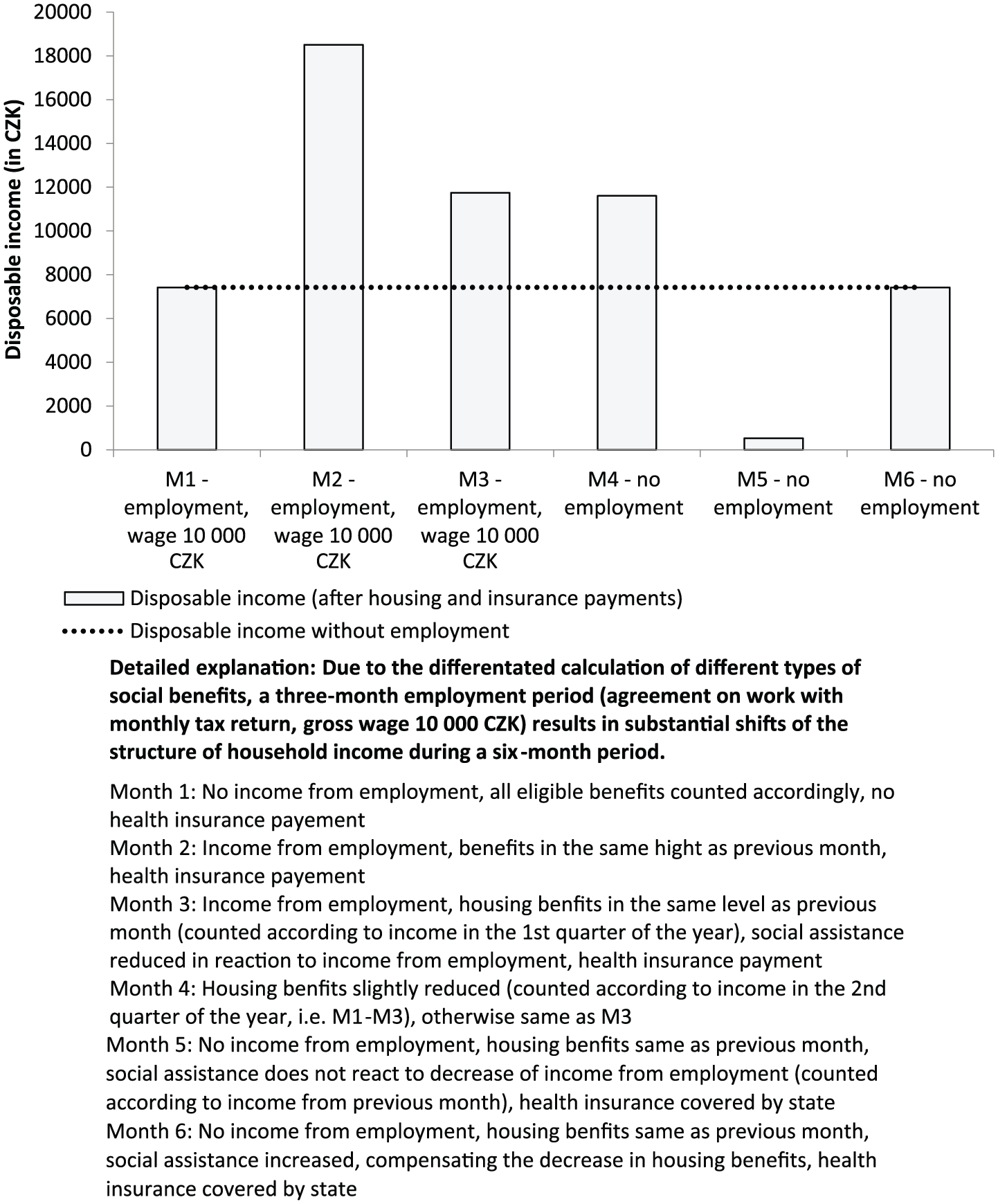
Impact on temporary employment on household monthly disposable income (1 adult + 2 children).
Yet, in evaluating the models’ accuracy in calculating the financial incentives for employment, it was most striking that many of the respondents did not know about the possibility of combining full-time employment and benefits, and even when they did. In some cases they were told that they were not entitled: When I first went to apply for the housing benefit, they told me I wasn’t eligible: ‘You earn 12 thousand crowns, you’re living in luxury’, and ‘With such a wage you don’t stand a chance’. Well, and then they told me to move into a smaller flat … Most people would give up. They get fobbed off, but I’m employed in social services, I knew I was entitled … In the end they said, ‘Well, try it then’. (Woman, no children)
As we have shown in the previous part, according to microsimulations, most households still qualify for support from social assistance (and other benefits) as their income was below the state-defined poverty threshold. Figure 2 shows the impact of the non-take up of various benefits on the disposable income of a household of one adult and two children. The comparisons show how non-take up significantly reduces the financial benefit of employment in comparison to the model outcomes. While the non-take up of any benefits shown in the case on the right is unlikely to occur, in the case of low-income families with children, the non-take up of social assistance (second case from the right) is likely to be much more common.
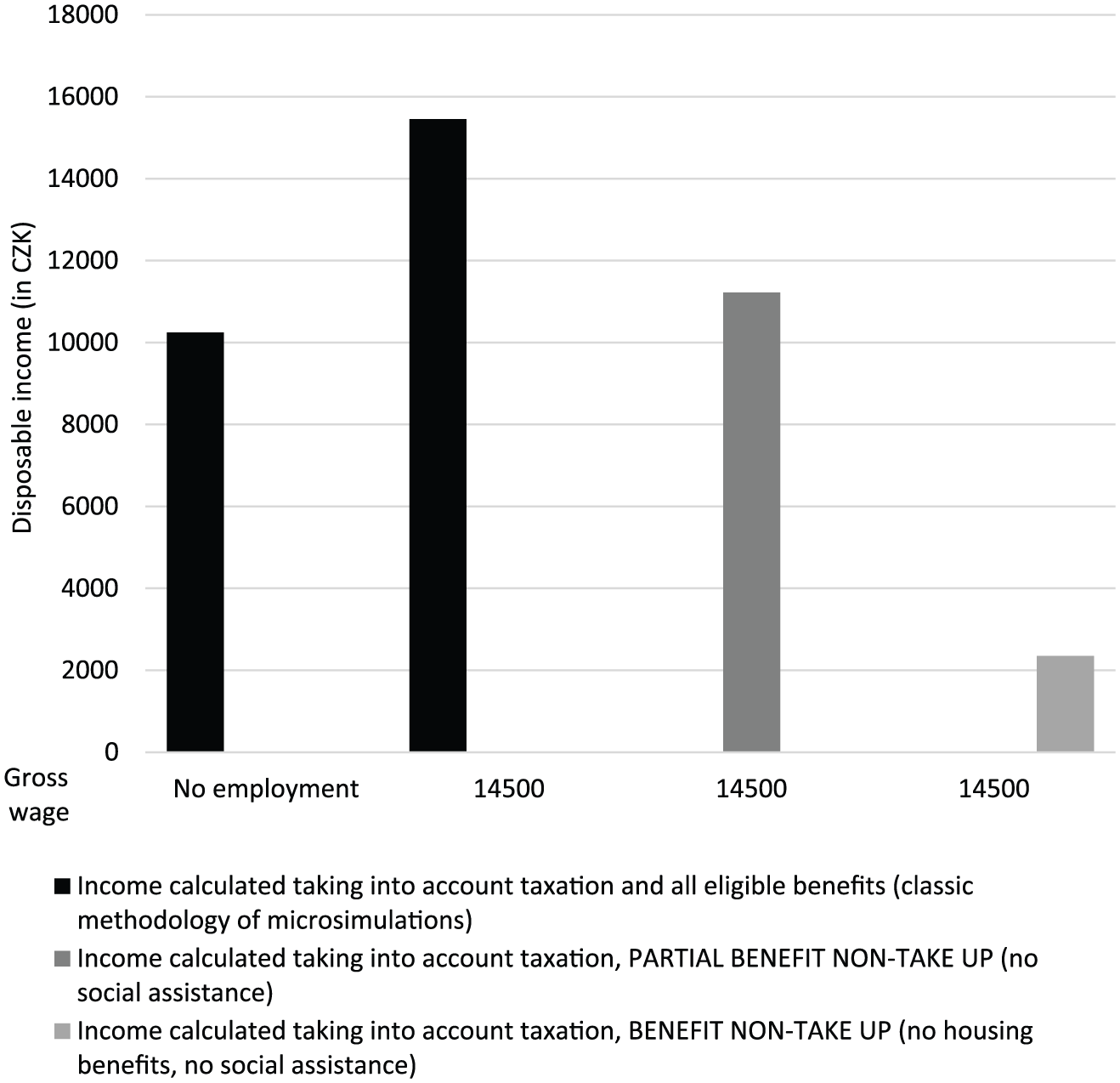
Impact of benefit non-take up on household disposable income (2 adults + 2 children, 1 person employed).
One reason for this is limited awareness about the possibility of combining earned income with social assistance, which is often perceived as benefits for those who do not work. In addition to this, the acceptance of social assistance comes with strict restrictions and incursions into privacy. Combined with stigmatization and lack of knowledge, this implies that many low-income households do not apply for social assistance if they are employed, although their income is below the poverty level. This corresponds with data on social assistance recipients, which shows a low level of formal economic activity (Šimíková, 2012; Hora and Vyhlídal, 2016).
The lack of knowledge of the benefits system and the high level of non-take up corresponds to the literature that points out that there is no evidence of the ‘dependency culture’ proposed by the political right (Dean and Taylor-Gooby, 1992; Dunn et al., 2014). Furthermore, and more importantly for our analysis, it shows that, whereas general knowledge about the difference in income between full-time employment and benefits corresponded vaguely to the models, in many situations (such as temporary employment or low-wage employment) the benefit recipients were either unable to predict the financial impact or their knowledge was incorrect.
Income increase × financially motivating employment
So far we have discussed the knowledge of the difference in income with or without employment. However, the interviews showed that the difference in income per se does not imply that certain employment was perceived as financially motivating.
The financial motivation for accepting low-wage employment was strongest in single or two adult households because of the perceived impossibility of covering even basic needs from welfare support: If we lived only on the benefits, we’d get just 4,000 and we’d be screwed. We wouldn’t make ends meet even if we ate only those Chinese instant noodles. (Man, couple with adult children, employment through public works)
However, for many households the relative increase of income resulting from employment was not motivating as the absolute increase of income was too low. This applied particularly when the employment required additional costs (commuting, food, childcare and so on). These costs may not only reduce the financial reward from employment, but even push the household into a situation where their income is lower than before accepting the employment: Now I got a job offer as a chambermaid, but for minimum wage and far away, and I don’t have a driving licence. With the commuting they’d have to offer me at least 12,000 [CZK] gross, otherwise it won’t pay off at all. (Woman, 2 children)
For many households, entering low-wage employment usually did not bring a significant change in income. It only brought a shift in the importance of different financial sources, shifting the main source of income from welfare support to employment. All households were combining the income from employment and/or social support with informal employment, support from wider family and loans: Now my husband gets paid 10,500 and I get 8,500, so we get a lot. It’s a great change from only 5,000 … but those basic things like buying clothes, furniture – our [grown-up] son helps us with that. (Woman, couple, 1 child)
The quotations above also capture an important feature, present in most of the interviews: neither low-wage employment nor benefits per se offer adequate income to cover the expenses of a household: Wages are low, that’s the problem. It’s not the high benefits. I haven’t met a single person who could live off benefits. In that case they can’t live off minimum wage either. (Head of a Job Counsellor unit)
The necessity to combine different sources to cover basic needs increases the importance of informal employment as a critical additional source of income. Informal employment thus becomes a ‘survival strategy’ as it is described by MacDonald (1994) in the British post-industrial context. In the words of one of the respondents: Without some odd jobs, we wouldn’t even have enough to buy food … We had to take out a loan when the boys started their school, otherwise we wouldn’t have made it … We paid that off just thanks to those odd illegal jobs. (Woman, couple, 3 children)
This precarious position leads to the development of strategies beyond the reach of formal regulatory frameworks, which are further contributing to the continuation of irregularity resulting in growing informalization (Slavnic, 2010). The households find themselves in a vicious circle, where the source of finances change, but the overall financial impact is limited as it often does not provide a way out of poverty and recurrent dependency on social support.
In this part, we have shown that the financial motivation to accept low-wage employment, which appears rewarding in the models, might in reality be much lower. However, we need to emphasize that we were focusing on the financial aspects of employment motivation. As could been seen from the employment trajectories of many of the respondents, the lack of financial motivation does not imply that employment might not be perceived as motivational for other non-financial reasons (social contact, status and so forth), as has also been outlined in some literature (Dunn et al., 2014; Ervasti and Venetoklis, 2010; Nordenmark, 1999).
Over-indebtedness
Many of the households that were interviewed were over-indebted and faced a number of property seizures. According to the estimation of interviewed Labour Office employees, over half, in some cases three quarters, of welfare recipients are facing property seizures.
For these households, accepting formal employment might lead to a decrease in disposable income: I just got a job offer for 12,000, but it wouldn’t pay off. I’ll only go to work when my husband has a job and we’ll be able to apply for insolvency. When I worked, we had 15,000 and now that we’re at home, we have 17,000. (Woman, couple, 2 children, low housing costs)
2
For over-indebted households, the financial incentive for employment is shaped by a different logic than that used in the microsimulation models. Once the person is employed, the creditors seize part of their wages. As the entitlement for social assistance and housing benefits are calculated on the basis of income before wage seizure, the wage increases may not result in an increase of disposable income; in certain circumstances it can even result in an income reduction. This effect is illustrated in Figure 3 with the example of a household with two children. The black colour illustrates households without wage seizure. The microsimulation models allowed us to show that if the family is entitled to social benefits, substantial increases of earned income result only in modest increases of household income (Trlifajová et al., 2014). However, when the wage is subject to wage seizure, the economic benefit from accepting work is reduced by almost half, and the increase of wage does not result in economic improvements. In some cases, it can even lead to a slight reduction of family income (the two cases on the right). The final household disposable income considerably differs from the microsimulation models.
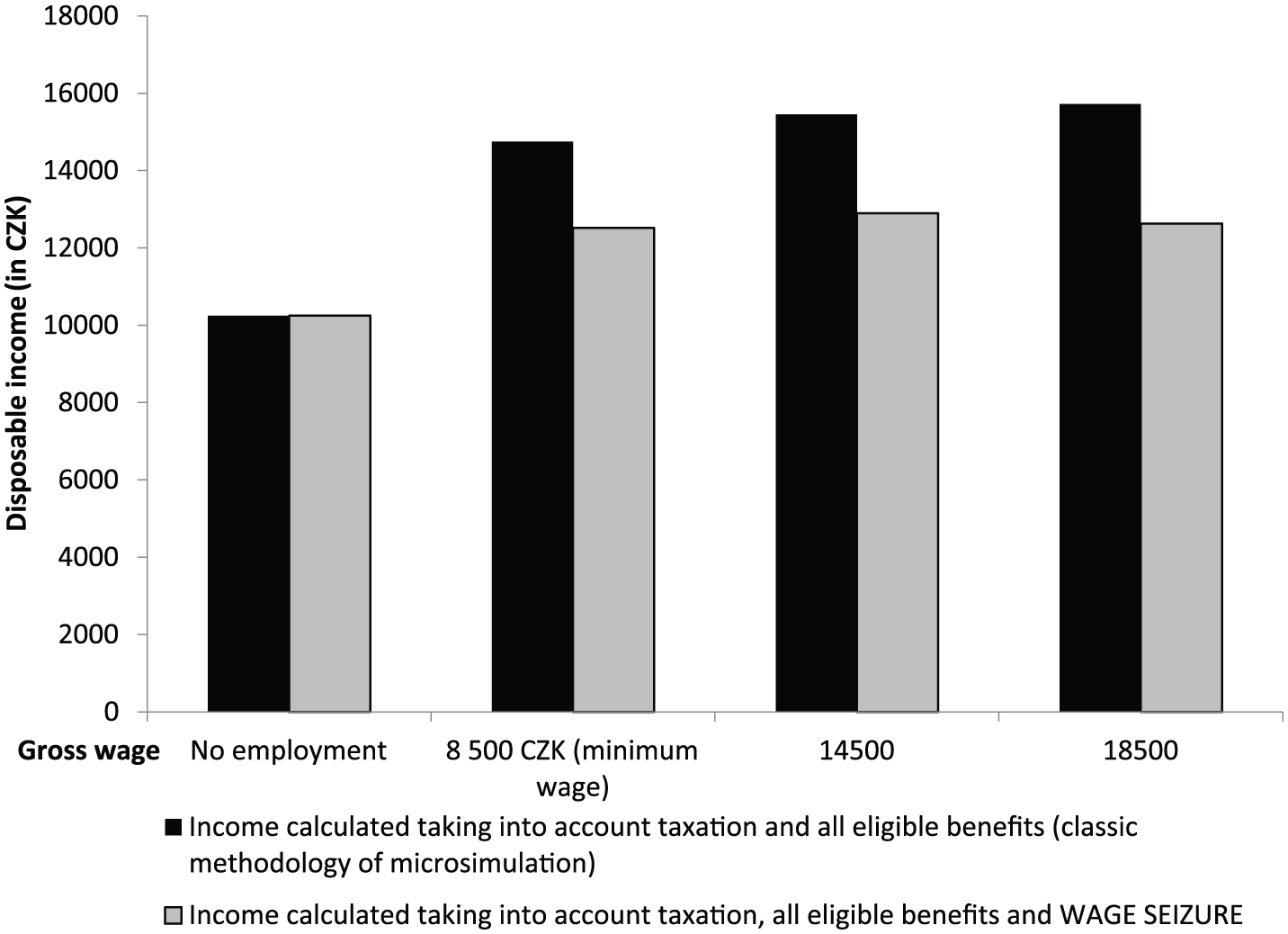
Impact of over-indebtedness on household disposable income (2 adults + 2 children).
In order to explain the situation of over-indebted households, we need to further take into consideration that the effects of indebtedness are especially problematic in combination with the other factors mentioned previously. This could concern short-term employment illustrated in Figure 1, where wage seizure in those months with high income could dramatically reduce income. As indebted families do typically live without any financial reserves, accepting employment can thus turn into a highly risky option. Figure 4 illustrates the combination of wage seizure and non-take up of social assistance. Although working families with income below living costs are entitled to social assistance, many people are not aware of this fact. While we demonstrated already in Figure 2 how benefit non-take up increases vulnerability, this effect further increases when it is combined with wage seizure. When accepting employment at minimal wage without applying for social assistance, the household income is drastically lower (5709 CZK) than in the case of families living from social benefits without employment (10,250 CZK). While the family income rises with the increase in salary, it is still, even in the case of the highest wage category included in the figure (a gross wage of 18,500 CZK), lower than the income of a household whose members do not work. One result of this is extreme poverty, which often leads to new debts or the loss of housing. Another is a preference for semi-formal or informal employment.
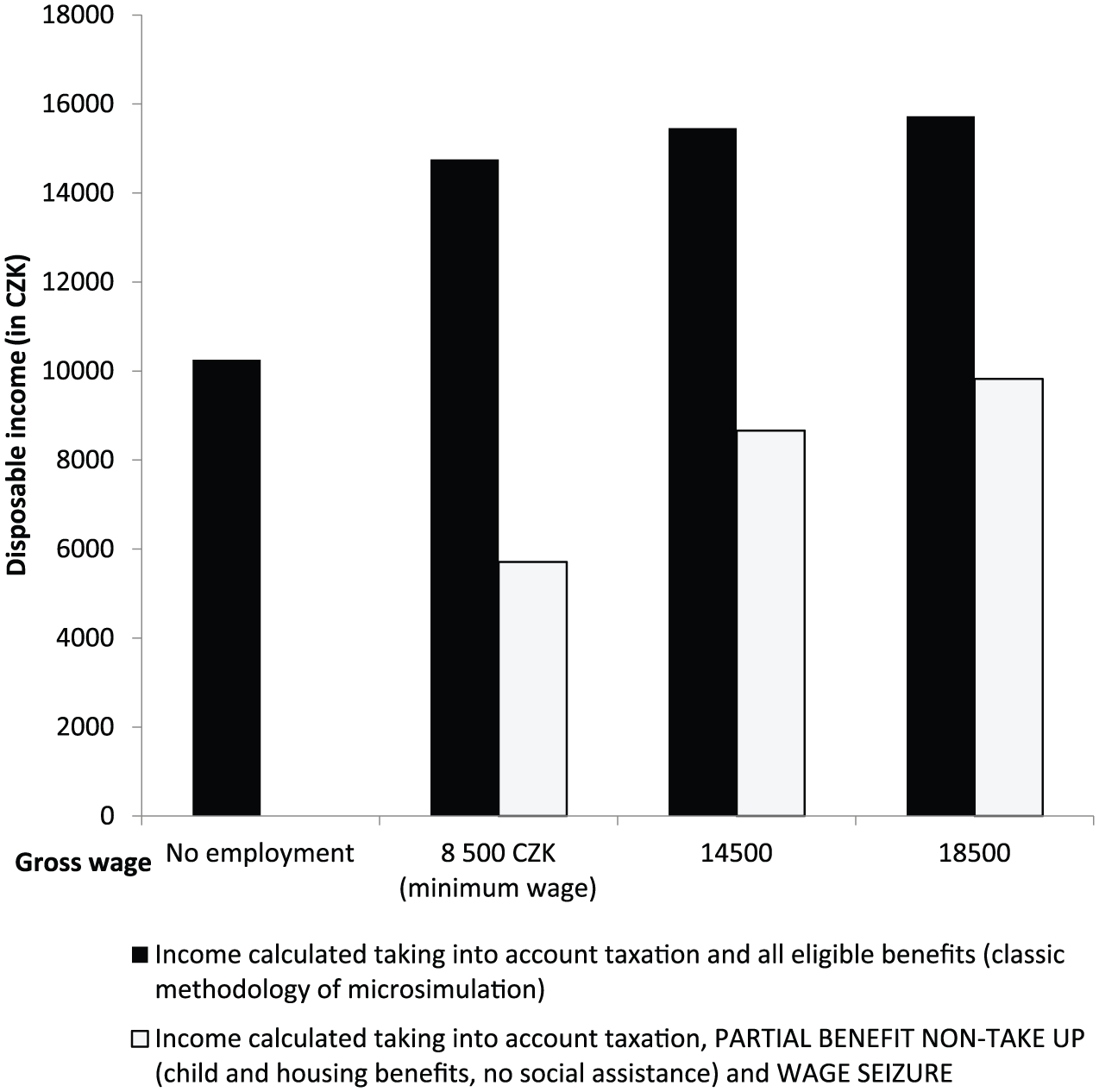
Impact of over-indebtedness and benefit non-take up on household disposable income (2 adults + 2 children).
However, the possibility of entering into the process of debt relief, which is conditional upon the ability to pay 30 percent of debts over 5 years, creates an important motivation for employment. For those with lower debts, even low-rewarding (although not temporary) employment may open the way to debt relief: If I had a proper job, with a wage of 20 or 25 thousand, I’d pay off the execution and we could live a normal life … That’s what a neighbour of mine did. When he was young, he fooled around with some loans as well, but now he has a salary of 35,000. It took him five years to pay off the debt, but now it’s all settled. (Man, couple, 2 children)
Given the extent of indebtedness in the Czech Republic and its concentration in the poorest households, these cases are not negligible. The level of over-indebtedness is one of the highest in the Europe (Angel and Heitzmann, 2015). According to data from the Chamber of Bailiffs published in 2016 by research institutions and non-governmental organizations (NGOs) on a specialized website, one in ten Czech citizens live in an over-indebted household. Furthermore, individual debts rapidly grow in time due to the inability to pay multiple loans from different creditors and high debt-collecting fees. The data show that the problems of over-indebtedness are more concentrated in post-industrial regions with higher unemployment rates and among the poorest groups of the population reaching between 18 percent and 33 percent in most places (Hábl, 2017). The experience of over-indebtedness throughout the country is very common among those on the margins of the regular labour market.
Whereas we have previously pointed to certain limitations in modelling employment motivation, indebtedness or more particularly the over-indebtedness of households, brings in new factors that are overlooked in the microsimulation models. However, these factors are central to the employment strategies of over-indebted households.
Conclusion
The principle of ‘work must pay’ has influenced the formulation of social policies in the last two decades. Various policies were introduced to ensure that people who work are better off economically than those who do not work. The promotion and design of such policies is often based on microsimulation models which aim to calculate the difference between income from work and social welfare.
Focusing on the case of the Czech Republic as an example of a low-wage economy, in this article we aimed to compare the models of financial incentives for employment with the real experience of people who live on the border between employment and welfare support.
Conducted in two disadvantaged regions, the interviews were realized with a relatively small group of people who had been identified by social service providers as making their living along this borderline. Although the size of the sample and the selection method does not allow us to consider our findings fully representative of the situation of this group in the Czech Republic, it is possible to draw a number of important conclusions that are of great relevance. The interviews revealed first that the Czech labour market has seen in recent years a rise in precarious forms of employment in the low-skill sector, corresponding to the processes of dualization/segmentation of the labour market described in other countries.
The interviews further revealed that the calculations of financial incentives for employment do not often work in the way predicated by the mathematical model. Why do the models fail to represent this type of situation properly?
In order to understand the limits of financial incentives for employment models, we must first return to their presumptions. Although this is not always explicitly said, existing policies that were influenced by the ‘work must pay’ idea seem to derive from the notion of a dichotomy between unemployment, on one hand, and permanent full-time employment on the other hand. Similarly, the models calculating financial incentives are usually based on regular full-time employment. The financial incentive is expressed as the difference between the household income before and after the acceptance of these types of employment.
The household simulation techniques are based on models assuming rational choices about stable, long-term employment. This implies we expect that (1) an individual (or a household) is deciding between unemployment and acceptance of employment (entering the formal labour market), and (2) that his or her financial motivation is shaped by the difference of income in these two situations. Yet, if we aim to capture the situation of low-income households who find themselves in a precarious position on the labour market, both of these presumptions are problematic.
First, whereas permanent full-time employment is still prevalent in the Czech Republic, accessible employment opportunities for welfare recipients in disadvantaged regions do not often fit into the categories used in the modelling of financial incentives for employment.
This not only means that their income is taxed in different ways, but also that employment might bring additional costs (such as a need for the payment of health insurance) and/or that part of the reward might be paid outside of the formal agreement. Furthermore, households might not profit from in-work benefits targeted to low-income households (such as the child tax benefit) used in the modelling.
The accessible forms of employment led to a blurring of the borders between reliance on welfare support and employment as a main source of income. The respondents were moving back and forth between employment and welfare support as a main source of income. With different timeframes used in the evaluation of a household’s eligibility for different types of benefits, the measurement of the financial impact becomes further complicated.
Second, recipients of benefits are often unable to predict correctly how a change in their employment status will affect their household income. The reasons for this are the system’s complexity and the state’s reluctance to inform citizens proactively about their rights to social assistance. This could result in non-take up of benefits, which worsens the social situation of vulnerable families. Particularly in the context of the precarious character of accessible employment, the complexity and limited knowledge could also discourage unemployed people to actively seek employment, as changes tend to result in periods of financial instability.
Third, and maybe most importantly, it might be reductive to express the financial incentive by the difference between income before and after employment. In the households we interviewed, neither low-wage employment nor benefits offered adequate income to cover the expenses of a household.
The respondents were combining income from employment and/or welfare benefits with informal employment, support from wider family and loans, finding themselves in a vicious circle: the sources of income changed but employment did not allow them to escape poverty. It also did not allow them to avoid dependency on social support, which comes with strict obligations, monthly visits to the labour office and the possibility of controls.
This economic situation has led to the development of strategies beyond the reach of formal regulatory frameworks, contributing to a reproduction of irregularity resulting in growing informalization. For people in such situations, restrictive types of ‘work must pay’ policies that further complicate access to social support are not motivating yet increase the risk of social exclusion.
Fourth, there is the issue of over-indebtedness, which introduces a different logic to both the perception of financial incentives for employment and its economic impact on household income. A large proportion of welfare recipients face multiple property seizures that strongly shape their economic strategies and which could contribute to the preference for employment on a precarious and/or informal basis.
The mathematical modelling of financial employment incentives and public policies, which were put into place on the basis of such calculations, do not correspond well with today’s reality of precarious work. Is it not possible to come up with improved models? Ones which would more closely reflect the reality of low-income households in disadvantaged regions?
While it is certainly possible to construct more complex models, which are able to deal with the combination of social security dependence and the semi-informal short-term work typical in the case of our respondents, it is less clear if it would be possible to ‘fine-tune’ the existing mechanisms of the social state in a way that would be much more motivating. Based on the research findings, the ‘work must pay’ approach might be criticized for focusing on the wrong question. A truly functioning financial incentive would need to not only focus solely on the difference of income between those who work and those who do not work, but also analyse what type of arrangement would allow working households to rise permanently above the poverty line.
However, being able to calculate this difference would still be useful for people who consider how the acceptance of a temporary job might affect the financial situation of their family. While the ‘work must pay’ approach is too simplistic to offer good guidance for the formulation of public policies, developing more complex (user-friendly) models, which would allow citizens both to check their current entitlements and predict the impact of changes, could be useful on a practical level and strengthen the awareness of people in vulnerable situations.
Footnotes
Funding
The author(s) disclosed receipt of the following financial support for the research, authorship, and/or publication of this article: The study was supported by the Charles University project GA UK No. 376216 and by the Charles University Specific Academic Research Projects Competition project No. 260462.