




Abstract
Early Childhood Education and Care (ECEC) has become a strategic component of the Social Investment (SI) paradigm. Growth in this field of social policy – quantified as an increase in public spending and coverage rates – is often taken as indicative of a wider attempt to reformulate welfare state intervention through an SI approach. However, SI agendas have produced differentiated impacts in different contexts. In scenarios of budget restraints, some governments have increased coverage and controlled costs at the same time by allowing for higher staff-to-child ratios and group sizes, externalizing management costs or worsening the working conditions of professionals. These strategies can severely compromise the quality of the provision offered. This is likely to have more effect in those contexts in which provision needs to be developed under more stringent conditions of financial viability. The article analyses two such cases, Italy and Spain, where general conditions of permanent austerity are combined with a comparatively reduced capacity for public spending. Focusing on the qualifications and the working conditions of professionals working in ECEC as a fundamental aspect of the quality of provision, this article compares the two segments of ECEC: early child development (0–2) and pre-primary education (3–5), in both Italy and Spain since the early 1990s. The working conditions of primary school teachers are taken as a frame of reference. We conclude that, despite the fact that there has been an overall expansion of ECEC in both countries, only the (early) policy developments in pre-schooling can be seen as conforming to what have lately been codified as the principles of an SI strategy; at the same time an evident tension exists between the expansion and the quality of provision in the more recent development of childcare services for very young children.
Social investment and early child education and care
The Social Investment (SI) strategy is an approach to social policy that emphasizes equalizing life chances rather than life outcomes, with the underlying goal of ‘preparing rather than repairing’ (Bonoli, 2005; Esping-Andersen et al., 2002; Morel et al., 2012). Early Childhood Education and Care (ECEC) is at the centre of SI. With a specific focus on children, investments in the early years help to level the playing field by minimizing the ‘accident of birth’ (Heckman, 2013) and breaking the intergenerational transmission of inequality. Thus, whereas in the past scant political attention was paid to the importance of giving children the resources they might need and deserve, the current ‘politicization of childhood’ (Jenson, 2008) has led international agencies and governments around the world to commit to ECEC expansion in what seems to be a widely accepted and homogeneous discursive framework.
However, fundamental questions still arise. Can we really correlate an increase in ECEC spending with child poverty reduction and more equal opportunities among children? Does ECEC attendance have a compensatory effect on children’s development (Morabito et al., 2013)? What tensions arise when policy development takes place under conditions of permanent austerity in welfare states (Hemerijck, 2017; Pierson, 1996, 1998)?
As always, the evidence collected so far indicates a picture that is far more complex than the scenario suggested by metanarratives. First, the way in which SI approaches are translated into actual policies and their specific impacts tend to be filtered by context-specific institutional and socio-economic conditions (Kazepov and Ranci, 2017). More particularly, research indicates that higher coverage puts greater pressure on the quality of existing provision by, for instance, increased ratios, larger group sizes or greater contact time required of teachers, or a worsening of their working conditions.
In light of these issues, the argument that greater ECEC coverage is per se an indicator of SI is called into question. The aim of this article is to contribute to this debate. We consider the conditions and qualifications of the workforce as key variables for understanding the tension between quality and availability of childcare services, on the basis of the argument that providers shape the content of services (Gambaro, 2017).
This focus on ECEC workers illustrates the difficulties of SI policies in countries such as Italy and Spain, where these services have long been underdeveloped. Following Morgan (2005), high public investment in ECEC services is likely to exponentially increase public expenditure in countries where workers’ protection is high. This is only partially the case for Italy and Spain. In these two countries, the growth of early childhood development (0–2) and pre-primary education (3–5) has followed different historical paths. We argue in this article that the differentiated timing of their expansion, reinforced by the fact that the two segments of ECEC belong to two different welfare domains, has led to differentiated trajectories not just with regard to growth but also with regard to aspects of workers’ rights, wages and related quality of service.
This article is structured as follows: the next section conducts a preliminary discussion on ECEC quality, stressing the importance of employment conditions. The third section describes the origins and development of ECEC in the two countries. Then follows an analysis of workers in both segments. Using ISCO and NACE codes, we display the amalgam of professions coexisting in ECEC services, and how these correspond to indicators of qualifications, job stability, non-standard employment contracts and pay. In the final section we offer a discussion as to the implications of these two distinct segments of ECEC in regard to the working conditions of professionals.
Understanding quality in ECEC
ECEC, as defined by the Organization for Economic Development and Co-operation (OECD) and Eurostat, refers to formal early years’ provision of services to children younger than compulsory school age. These services are provided outside the child’s home and with some level of structure. Countries typically organize these services in either a unitary system or a split one. While the former offers different arrangements comprehensively for children of all ages before they enter elementary school, the latter typically organizes ECEC in two stages: early years’ education and care for under-3s, which is regulated mostly at the regional and/or municipal level, and pre-primary education for children aged 3 to the beginning of primary school, for which in many countries the state takes greater responsibility. For the sake of brevity, in the article we will use the terms ‘early childcare’ or ‘childcare’ referring to the 0–2 age group (although these services often provide not only care, but also education), and the term ‘pre-primary’ when we refer to the 3–5 age group.
Definitions of quality in ECEC differ greatly among different countries, actors and institutions. Partly because of this heterogeneity, the instruments and criteria to assess quality are not homogeneous either. For analytical purposes, a distinction is often drawn between structural and process quality. The former refers to the more standard indicators used to measure conditions in the physical environment, qualifications and training levels of the staff, and working conditions. It includes measures such as staff-to-child ratios and group sizes, staff turnover, or occupational mobility and opportunities for retraining. Process quality is harder to standardize for cross-national comparisons, since it refers to either pedagogical or relational aspects in the school environment (Bennett, 2008: 48). It is thus considered more a relative than a universal measure, one that is closely dependent on the cultural context and on interactional processes across ECEC systems (Bennett, 2008).
According to several reports, the integration of services for all children into a unitary system provides a common institutional context with a well-defined distribution of administrative competences, more coherent policies, higher qualifications, requirements and pay levels (CoRe, 2011; European Commission, 2014). In contrast, in countries where ECEC services are organized according to the age of children (the so-called ‘split system’) the risk of fragmentation among different forms of provision is much higher than in countries where there is a common institutional context for children under compulsory education age (European Commission, 2011). While more solid learning curricula and pedagogical elements are being introduced at the pre-primary level, the care needs of the very young are still subject to much looser interpretations (León et al., 2014a: 34).
For the purposes of this article, we concentrate on one specific element of structural quality: the qualifications and employment conditions of staff, which is one of the criteria established by the ‘quality targets’ of the EC Childcare Network (Childcare Resource and Research Unit, 2004). Many experts stress that high-quality ECEC provision depends largely on the qualifications, working conditions and salaries of care workers, educators and teachers. Poor staff qualifications and working conditions hinder the professionalization of the sector, while pay parity between ECEC staff and primary school teachers results in higher professional standards and lower staff turnover (CoRe, 2011: 49).
The association between the quality of services, on one hand, and qualifications and working conditions on the other, is particularly strong in a labour-intensive industry like ECEC, which is heavily affected by ‘cost disease’ (Baumol, 1967). Because the price of services is highly dependent on labour costs while productivity cannot grow through technological innovation, in the absence of public support, cost containment can be obtained mainly through wage compression, and this is likely to be detrimental to the quality of services.
We use Labour Force Survey (LFS) data for the two countries to identify workers with teaching responsibilities in the two main ECEC segments in Italy and Spain (see the fourth section, below). As a reference point for working conditions, we incorporate primary school teachers into the analysis. We expect the dividing line in ECEC between early child development and pre-primary education in the two countries to show the better positioning of the latter in terms of education and job conditions, thanks to their closer proximity to primary school teachers.
The institutional and political economy context
ECEC policies in Spain and Italy have three main features in common: first, a traditionally low level of public expenditure on childcare and pre-primary education (in 2014 this was 0.9% of GDP in Italy and 1.24% in Spain; www.eurostat.org), mainly explained by the familistic nature of their welfare states (Saraceno, 1994) and the low participation of women in paid employment; second, the early universalization of pre-primary provision under the auspices of the education system; and third, the late development, with respect to analogous trends in other European countries, of early childcare services for children under 3.
Table 1 displays these aspects in comparison to ECEC developments in other European countries. In the late 1980s, pre-primary schools in Italy had reached a coverage level which was higher than that in many other Continental European countries (including Germany) and close to that of the Scandinavian countries, while early childcare was hardly developed at all. In Spain, the universalization of pre-primary education happened later, while early childcare provision has undergone quite a strong acceleration in the past 15 years. Overall, while pre-primary schools are virtually universalized services in both countries, early childcare for those aged 0–2 has a much lower level of coverage.
Coverage of ECEC services by cycle in some European countries, late 1980s and 2012/2013.

Source: Anttonen and Sipilä (1996); for 2014 OECD Education Database.
The split system implies a differentiated institutional structure of the two sub-sectors comprised in the ECEC sector. Pre-primary schools, even though non-compulsory, are widespread in both countries. They answer to the National Ministry of Education, and are subject to national regulations as regards adult-to-child ratios, curricula, staff educational requirements and so on; also, their financing is largely national. In contrast, early childcare is much more decentralized in not only its implementation but also in its regulation. National laws on early childcare are rather loose, while the definition of specific regulatory elements (staff-to-child ratios, qualifications and training of educators, structural characteristics of facilities, requirements regarding pedagogical approaches) is devolved to the regional level (respectively, the Regioni and the Comunidades Autónomas); at the same time, implementation is the responsibility of the municipalities, which fosters very pronounced territorial disparities. In both countries, national funds finance only the creation of new facilities, but not their running costs (or when they do so, only for a very limited initial phase), and regional contributions earmarked for ECEC vary widely across regions, with the result that the financial resources available in individual municipalities and their degree of political sensitiveness to the issue play a major role in the breadth and type of provision that is developed in each location.
The dualistic structure of ECEC policies in Italy and Spain stems from long-term historical processes and is mirrored in the split institutional configuration of the overall ECEC system, a feature common not only to all Southern European countries, but also to other Continental European countries such as Germany and France (CoRe, 2011; European Commission, 2014).
In Italy, there is a long history of pedagogical schemes centred on supporting children from disadvantaged backgrounds. The overarching aim has been to homogenize children’s abilities and habits and prepare them for primary school. Shortly after the Second World War, more than one-third of children aged 3–6 were already attending a scuola materna provided either by municipalities, religious institutions or industrial employers. The universalization of pre-primary enrolment started with the 1968 law in which the state committed itself to creating pre-school facilities in areas of the country that were barely covered. The state also progressively took over many facilities that had previously been managed by municipalities, some of which were eager to shift these costs to the state. Although legal entitlement was never introduced, in two decades, the coverage rate of children aged 3–5 grew from 50 percent in 1968 to 90 percent in 1988, reaching 99 percent in 1999. This was achieved thanks to the parallel decline in the birth rate: the numbers of children decreased by 1.1 million – 38 percent in the same period (Sabatinelli, 2016). The law had an impact especially on the composition of supply: state provision rose from 0 percent to almost 60 percent. The remaining provision is to this day provided by municipal pre-primary schools (around 10%) and private facilities, for the most part publicly recognized (scuole paritarie) and subsidized (around 30%; Sabatinelli, 2016).
As for services for younger children, in the 1960s and 1970s, grassroots initiatives and the feminist movement focused their attention on the need to increase childcare coverage, and a national law on municipal daycare centres was passed in 1971. The law represented a milestone in a field that until then had been regulated essentially at the local level. Regulation was however delegated to Regions, which had come into being only 1 year previously, thus paving the way for differentiated advances in quantity and quality over the following decades (Mari, 2011). All in all, development was scant: in 1992 public coverage was still marginal, with 5.8 percent of children aged 0–2 in public childcare (Istituto degli Innocenti, 2001) and private provision was minimal.
In Spain, the expansion of free pre-primary education for children aged 3–5 started two decades later than in Italy but developed rapidly. In the 1970s, pre-primary provision basically consisted of one free non-compulsory full-time year for children aged 5 in preparation for primary education. The legacy of the authoritarian and patriarchal Francoist regime explained this meagre development. The National Organic Education Law (LOGSE), a major reform introduced in 1990 by the socialist government (PSOE), introduced pre-school education as a universal right within the national curriculum. It divided ‘infant education’ (educación infantil) into two main tiers: one for the under-3s and the other for children aged 3–5. In practice, however, the impetus towards universalization was given to the second tier, covering 3 whole years before entering primary education. Subsequent reforms maintained the commitment towards pre-primary education in terms similar to that of primary education, but left childcare provision for younger children largely unresolved (Ibáñez and León, 2014: 278).
In both countries, therefore, the development of pre-primary education came about early, driven by the inheritance of influential pedagogical paradigms and a strong push for equalizing opportunities through public education in a readiness-for-school approach. In Italy, the state committed itself in this fashion in the late 1960s, and in Spain in the post-authoritarian era in the 1980s. Also, as was the case in the pioneering developments of other Catholic countries such as Belgium and France, state–church competition for control of the educational sector contributed to motivate a decisive general striving towards universalism (Bahle, 2009).
What is important is that the universalization of pre-primary schools in Italy and Spain started before the growth of the numbers of mothers in the workforce. Later, when the needs of working mothers/parents eventually became more evident, from the second half of the 1990s onwards, universal pre-primary coverage, either free or very affordable, was already consolidated. As in other countries where the educational paradigm was the main driver for the development of ECEC (Scheiwe and Willekens, 2009), pre-primary expansion in both countries followed a pattern that consisted in the clear administration of competences, tight state-level regulation, secure financing through public revenues, and specific criteria regarding objectives and benchmarks.
In other words, the framing of pre-primary education as part of an explicit collective interest in high-quality universal public education enabled almost full coverage rates in both countries. Its supply-driven development and consolidation, in a period not yet affected by the fiscal crisis of the welfare state, created a path dependency that has to a large extent protected the sector from major cutbacks in recent times of austerity.
However, the origins and development of early childcare services for children under the age of 3 have been very different. In both countries, in comparative terms, the need to expand provision for the under-2s was highlighted rather late, when the objective of fostering women’s employment had already become pervasive on the European agenda, but also when permanent austerity had become the inescapable framework for any policy developments. Not by chance, initiatives to expand coverage came together in both contexts with the inclusion of non-public providers as the direct or indirect beneficiaries of earmarked public funds.
In Italy, it was only in the early 2000s that national funds started to be earmarked once again for the creation of daycare centres, in order to expand coverage that was still marginal (6.5% public and 7.4% overall in 2000; Istituto degli Innocenti, 2001). In 2003, the educational value of daycare centres was formally acknowledged by the Constitutional Court, reflecting ongoing changes both in culture and practices, although opinions on early childcare options continue to be divided (Eurobarometer, 2010). In 2007 an ‘Extraordinary crèche plan’ was issued, co-financed by the Regions, which thanks to the 2001 constitutional reform now had exclusive legislative powers for social policies. Although asserting the commitment of the state in developing ECEC, the plan had a rather unambitious quantitative goal (+65,000 places). The wide gap between the northern and southern regions, which the plan intended to reduce, instead actually increased by 1.5 percent between 2003 and 2013, when public or publicly subsidized coverage reached only 11.9 percent at the national level, ranging widely at the regional level between 24.4 percent in Emilia Romagna and 1.4 percent in Calabria.
Meanwhile, there was growth in private providers in the field, in correlation with significant externalization trends: in fact, only 54 percent of ‘municipal’ places are directly provided by Municipalities (Sabatinelli, 2016). Outsourcing policies are implemented to try and control expenditure while not reducing provision, since they allow a reduction in the cost of the workforce. Private providers can, in fact, hire ECEC workers with national job contracts that foresee lower hourly pay rates and longer and more flexible working hours, saving up to 15 percent if all employees have open-ended contracts, even more if non-standard contracts are used (calculations in Mari, 2011). Lately, facilities are also being increasingly outsourced to hybrid bodies, such as (supra)municipal special agencies, foundations and institutions, that can disregard some of the obligations that public authorities must uphold, not least the need to apply the public administration collective agreements (Neri, 2016). Due to austerity measures, implying both cuts in state transfers to municipalities and limitations on hiring staff, outsourcing has also recently started to affect municipal pre-schools (Neri, 2016). For the same reasons, an upswing is observed in the transfer of municipal pre-primary schools to the state, whose schools have better working conditions (and shorter opening hours), thus highlighting a divergent trend. Most recently, the 2017 school reform introduced an ‘integrated system’, encompassing services for both 0–2 and 3–5 age groups and aiming to expand the 0–2 coverage to reach the Barcelona target of 33 percent and reduce differences between areas. It is nevertheless too early to assess the results of the reform.
In Spain, the rapid growth of female employment in the mid-1990s generated a strong unmet demand for care services for children under 3. Following rapid economic growth, coverage for children aged 0–2 more than trebled, rising from 10 percent in 2000 to over 30 percent in 2010 (Ministry of Education, Culture and Sport (MECD) and Instituto Nacional de Evaluación Educativa (MECD), 2014). In the absence of a clear regulatory framework, childcare expansion has been very uneven across the country and has also allowed private initiatives to flourish. Much of the expansion has been the result of mixed provision, while fully private daycare centres represent more than half of the total supply.
Care provision for children under 3 is not a right under law. Access and cost vary according to different target mechanisms at municipal level and types of provision. The most recent attempt to foster the educational character and limit the assistentialist nature of childcare provision came in 2006 under the centre-left government of the PSOE. The new Organic Law of Education (LOE) and the Educa 3 three-year development plan aimed to support the creation of 300,000 new places for early child development over the 2008–2012 period. However, the programme’s real outcomes were ephemeral: by 2011, only 71,000 new places had been created. The economic crisis, together with the difficulties of coordinating different levels of government hindered its implementation. Early childcare provision has been highly vulnerable to the budget cuts executed since 2010 at the state, regional and local levels (Ibáñez and León, 2014). Since demand is still large, outsourcing (privatization of the management of publicly owned day-care centres) has become widespread under the crisis.
In both countries, thus, the need to expand early childcare coverage under harsh financial constraints generates strong tensions that pave the way to management options which tend to affect the working conditions of the staff employed in the services. This, in turn, is deemed to have important effects on the quality of these services.
Working conditions
In this section, we analyse the working conditions of employees working in the two main ECEC segments in Italy and Spain. We consider teachers employed at primary schools as a reference point because they are employed in a well-established sector with higher stability, greater public recognition and higher wages.
A first analysis of the Labour Force Survey (LFS) data for Italy and Spain allowed us to identify workers with teaching responsibility in these three segments. We selected these workers according to two criteria: their profession, represented by the ISCO08 3-digit code and the economic sector as defined by the NACE code (another three digits). The data were pooled to allow a significant statistical analysis. For Italy, we considered the four national LFS quarterly surveys carried out in 2015 and we dropped all repetitions. For Spain, we pooled the two LFS quarterly surveys carried out in 2014 and 2016 (after six survey waves) to avoid repetitions due to sample rotation. Our investigation was developed in two steps. First, we looked at what professions are involved in each specific segment of the ECEC industry. Second, we selected only teachers (excluding workers with more auxiliary, care-based roles), and we considered to what extent their working conditions were different in the two segments of the ECEC sector.
The professional configuration of ECEC
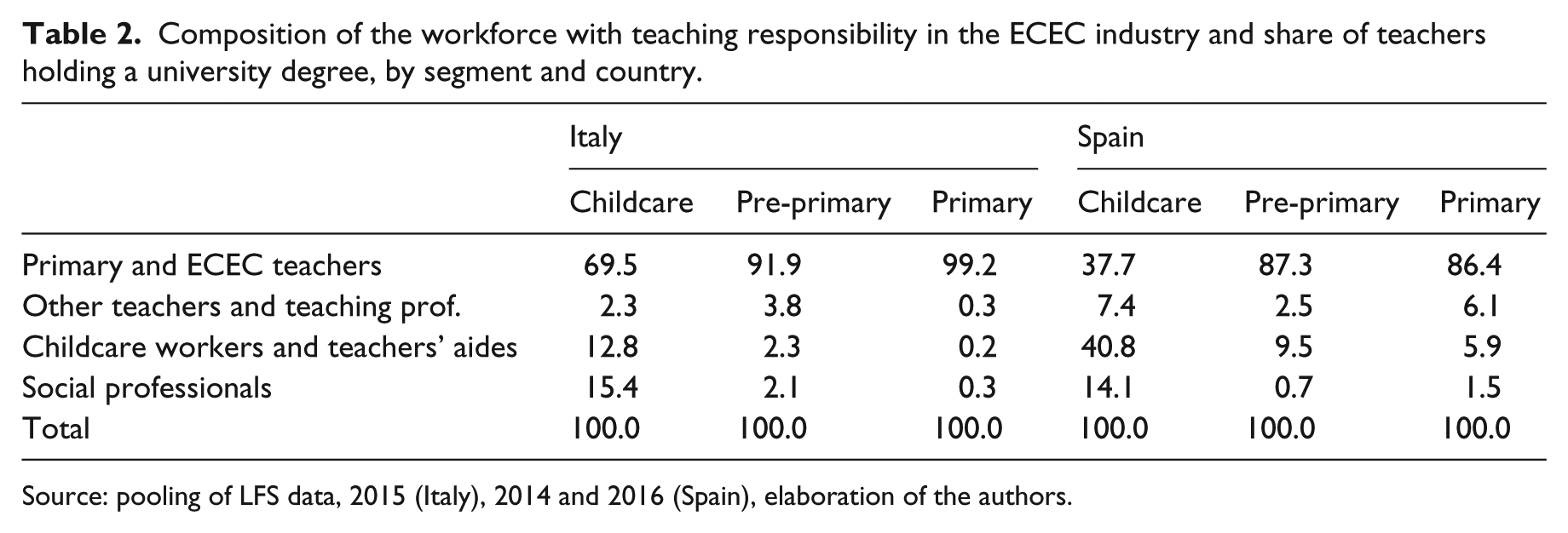
The great majority of ECEC workers are coded in the ISCO08 as ‘primary school and early childhood teachers’ (code no. 234). However, the workforce is composed of people with several different qualifications. These include: ‘other teachers and teaching professionals’ (ISCO08 codes no. 232, 233 and 235); ‘childcare workers and teachers’ aides’ (ISCO08 code no. 531) and ‘legal, social and religious associate professionals’ (ISCO08 code no. 341) (International Labour Office (ILO), 2012).
As shown in Table 2, while pre-primary and primary school staff coded as ‘qualified teachers’ represent at least 90 percent of the total workforce with teaching responsibilities in both Italy and Spain, in the childcare segment a large proportion of workers with different qualifications (28% in Italy and 55% in Spain) are employed. This fact clearly reflects the plurality of professional roles and tasks involved in early childcare, where educational and care functions are still interwoven due to the very young age of the children enrolled in them.
Composition of the workforce with teaching responsibility in the ECEC industry and share of teachers holding a university degree, by segment and country.
Source: pooling of LFS data, 2015 (Italy), 2014 and 2016 (Spain), elaboration of the authors.
Working conditions
To compare the contractual conditions of workers in the two ECEC segments and in the primary school segment that we use as a benchmark, we conducted a specific analysis of only professional teachers (code 234 ISCO08). We considered (a) levels of qualifications, (b) contractual conditions and employment stability over time and (c) wage levels.
Level of qualifications
In both countries, teachers employed in childcare are less qualified than their colleagues who work in pre-primary or primary schools, with the exception of older teachers in Italy (see Graph 1). In Spain, almost all primary school teachers (99%) have a university degree regardless of their age, while in Italy the proportion is much lower. This difference is partially due to the presence in Italy of a large stock of teachers who do not hold a university degree, which only became mandatory in 2010. Conversely, in all segments, younger teachers have higher qualifications, confirming an upward trend. In Spain, instead, the universalization of pre-primary education at the beginning of the 1990s introduced opportunities for re-skilling teachers already working in the sector (Ibáñez and León, 2014).
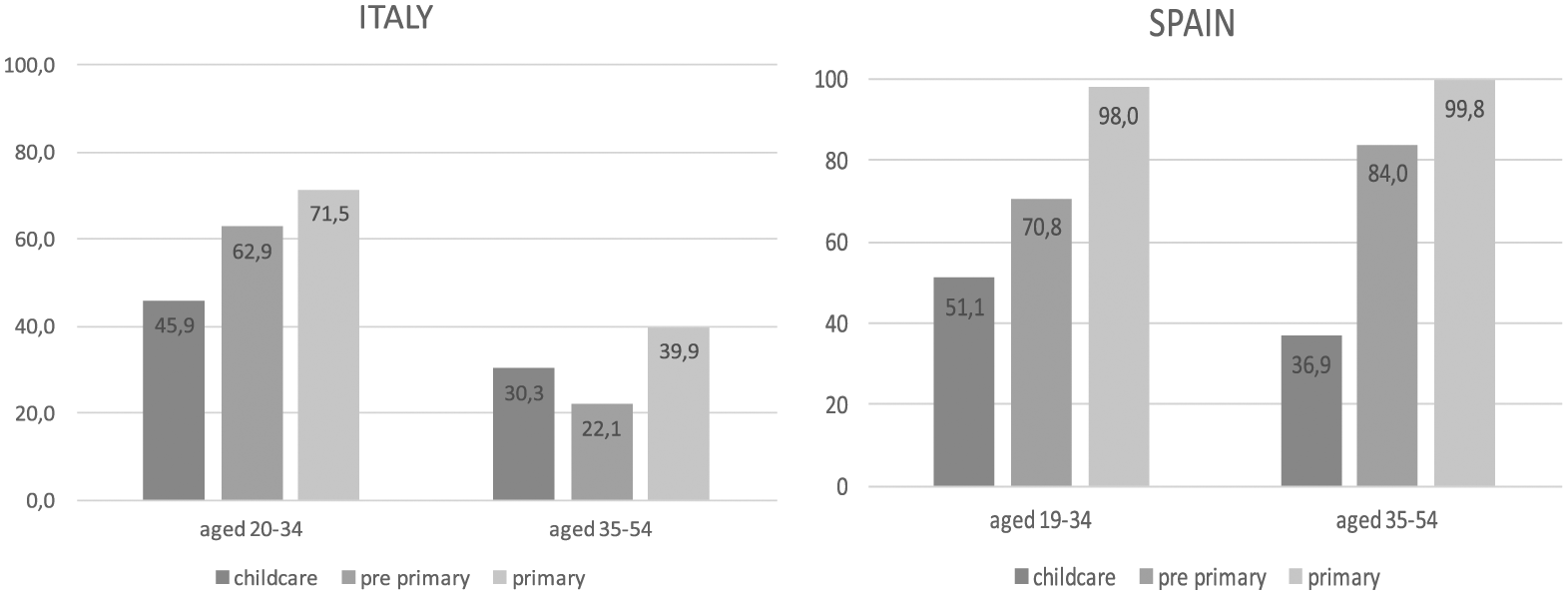
Share of teachers holding a university degree by segment and age, Italy and Spain.
Employment stability
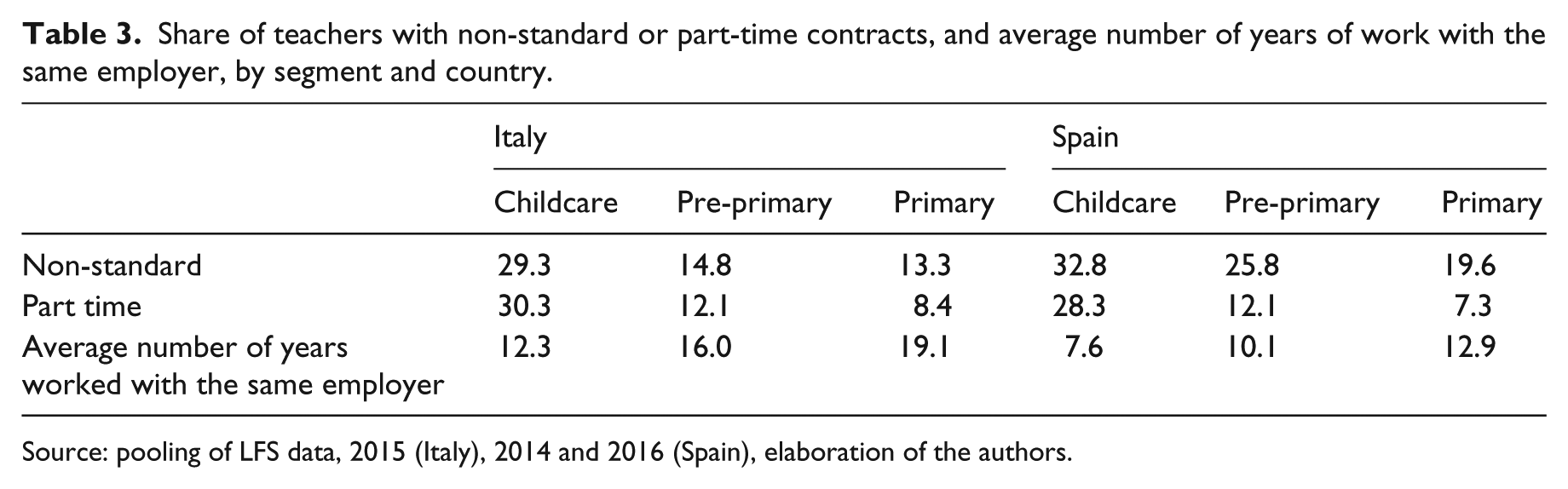
We now consider non-standard and part-time job contracts (see Table 3). Non-standard employment contracts comprise fixed-term, occasional and all sorts of atypical working contracts. Part-time jobs are considered separately. In Italy and Spain, working part time is largely involuntary, and is linked to labour-market insecurity. This is very different, thus, from countries where part-time work is a work–family balance option for working parents (mostly mothers; Maestripieri and León, in press).
Share of teachers with non-standard or part-time contracts, and average number of years of work with the same employer, by segment and country.
Source: pooling of LFS data, 2015 (Italy), 2014 and 2016 (Spain), elaboration of the authors.
In the public education sector, widespread use is made of temporary contracts to fill teacher shortages. These interinajes in Spain and supplenze in Italy have been stretched to such an extent that they have become the normal contractual position for new teachers for several years until their contracts become permanent; this produces long-lasting job insecurity in the entry phase. Teachers with these transitional contracts suffer various forms of discrimination (e.g. difficult access to promotions) and, above all, they do not enjoy income continuity.
In Italy, teachers in childcare settings are more likely to have non-standard job contracts (proportionally double that of the other segments), while the proportion of teachers in pre-primary and primary education with standard employment contracts is quite similar. Childcare teachers are also significantly more likely to work part time (30% vs 12%). In Spain, not only are part-time jobs or non-standard employment contracts more common among childcare teachers, but the share of non-standard job contracts in the pre-primary segment is also significantly higher than in primary schools.
The high presence of non-standard employment contracts is expected to reduce the continuity in teachers’ careers by exposing them to a series of temporary jobs with different employers. In Italy, on average, childcare teachers work for the same employer for 12 years: a much shorter time than teachers in the pre-primary or primary segments. In Spain, the average length of continuous employment is only 7.6 years for childcare teachers, increasing to 10.1 years for pre-primary teachers and to 12.9 years for primary teachers.
Similar results are obtained by breaking down the data by age (see Graph 2). Non-standard employment contracts are generally more common among younger teachers, as would be expected. In Italy, the share of non-standard contracts for young primary teachers is the highest due to the widespread use of temporary contracts as a way into the sector. However, for older teachers, job insecurity is much higher for childcare teachers: 25 percent of them have been long trapped in fixed-term contracts. In Spain, the same trend is observed: while 30 percent of childcare teachers aged 35 and above still have non-standard contracts, the proportion among their colleagues with the same age in the two other segments is half that.
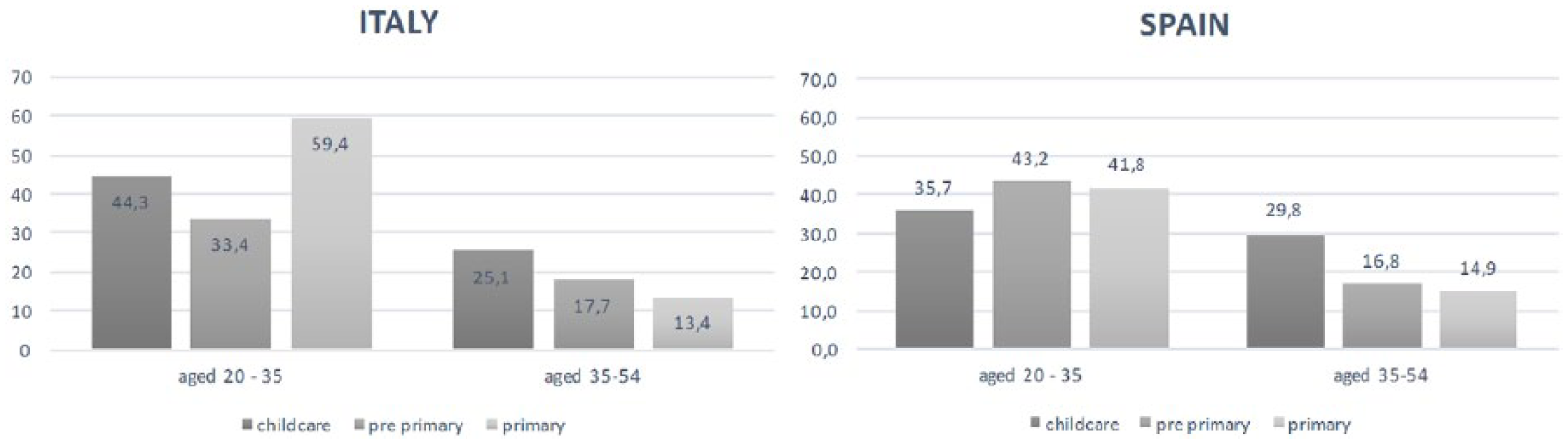
Share of teachers with non-standard contracts, by segment and age, Italy and Spain.
Wages
In order to assess the differences in wages between the two different ECEC segments, we considered both the monthly and hourly wages of full-time teachers in Italy (micro-data were available only for this country).
As shown in Table 4, 31.4 percent of childcare teachers have a monthly salary lower than 1000 euros: the percentage for pre-primary and primary teachers is respectively 9 percent and 5.7 percent. The monthly wage gap between childcare teachers and their pre-primary colleagues is –15 percent. There is therefore a significant group of childcare teachers whose salaries are very poor and significantly lower than those of their colleagues with the same qualifications who work in the pre-primary segment. In turn, pre-primary teachers’ monthly salaries are lower than those of their colleagues in the primary sector (–6.7%).
Average working hours, monthly and hourly wages, length of employment by segment and relative gaps (only full-time teachers, Italy); average monthly gross wages (Spain).
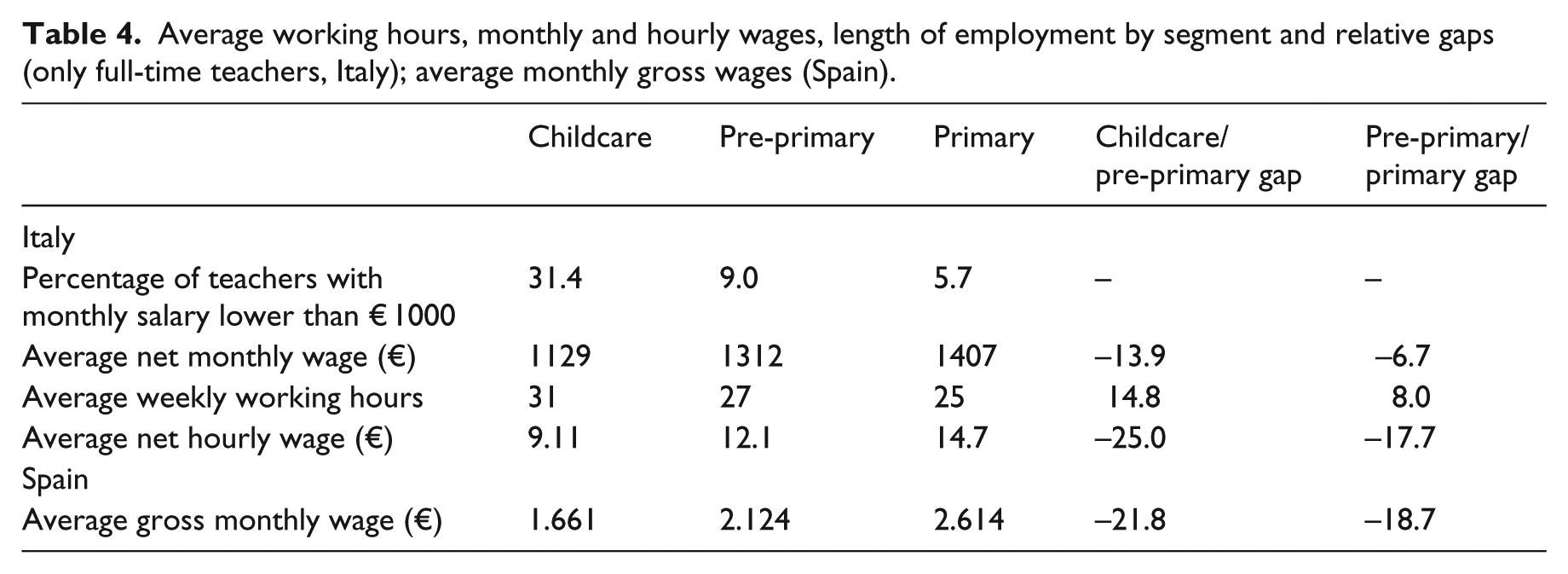
Since childcare teachers work significantly more hours than teachers employed in other segments (see Table 4), an additional way of analysing the wage gap across segments is to consider hourly wages. The hourly wage gap between childcare and pre-primary teachers is –25 percent, while between pre-primary and primary teachers it is –17.7 percent. The wage gap between childcare and pre-primary teachers is therefore wider than the gap between primary and pre-primary teachers.
In Spain, data on average gross yearly wages (available by combining survey results with administrative records) confirm the same phenomenon. Teachers in childcare services are paid 21.8 percent less than teachers with analogous qualifications who work in pre-primary schools. Pre-primary teachers are in an intermediate position as their wage gap with respect to primary teachers is –18.7 percent.
Finally, we control the wage dynamics for the level of qualifications of teachers and the length of their careers, and across the different ECEC segments (see Graphs 3 and 4). Childcare teachers have the lowest wages regardless of their qualifications and their ages, with the sole exception of older teachers with 3-year degrees and very long careers (although their wage gaps with primary teachers is still very high). We can conclude that the wage levels of childcare teachers are less affected by their education levels than by the segment of the labour market in which they work.
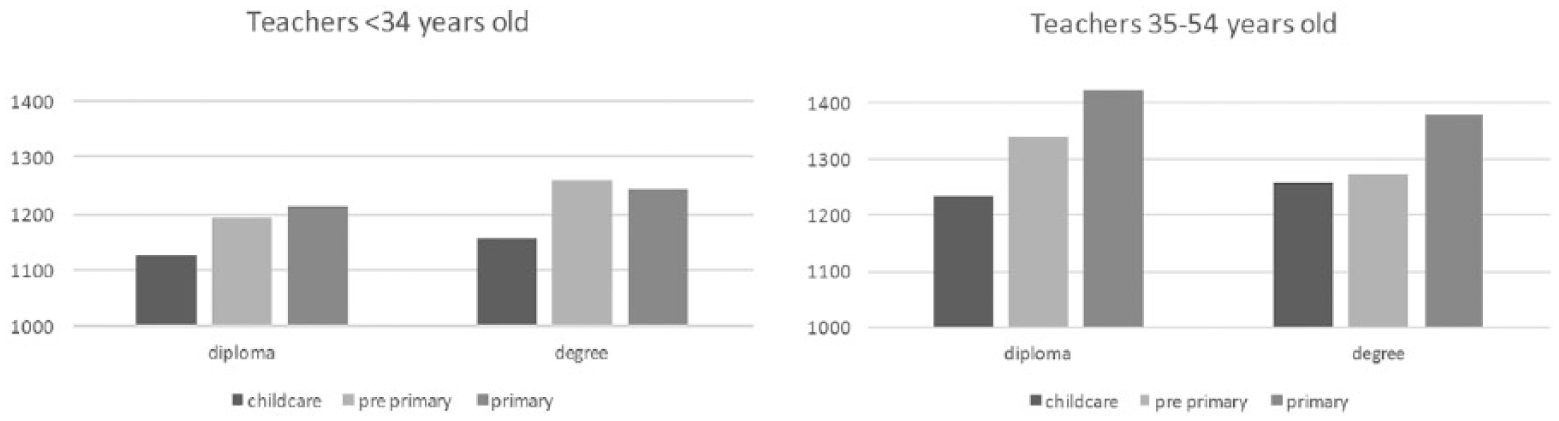
Average monthly wages by level of education and age group of workers in the different ECEC segments (only full-time teachers, Italy).
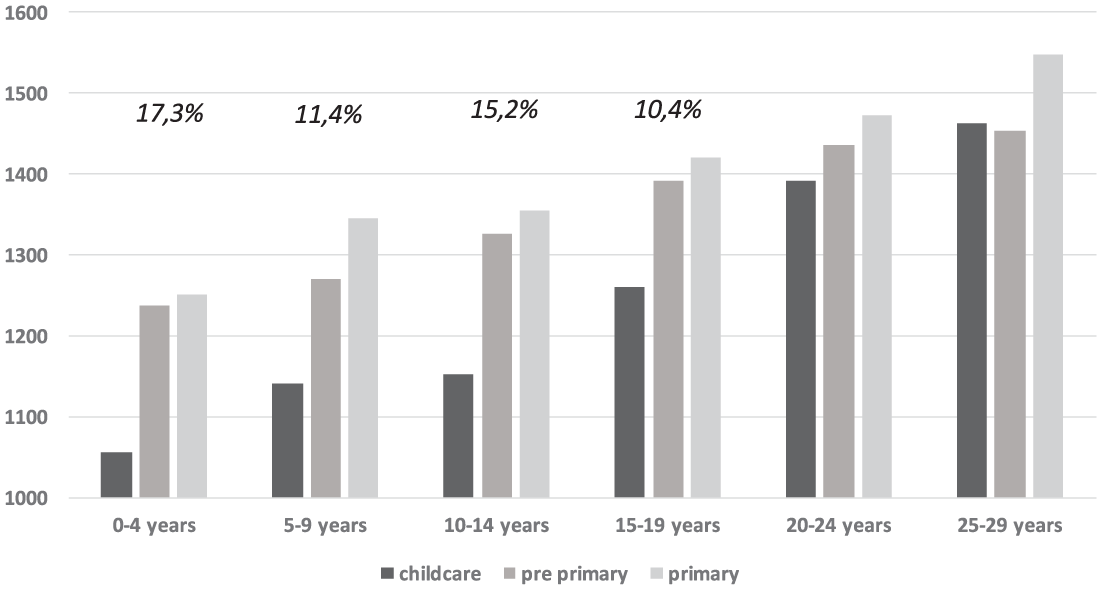
Average monthly wages by length of career of workers in the different ECEC segments (only full-time teachers, Italy).
In educational systems, wage progression may be mainly affected by seniority rather than by an employee’s level of qualifications. Graph 4 shows that even when taking this into consideration, the wages of childcare teachers are persistently lower than those of pre-primary or primary teachers. While the wage gap between pre-primary and primary teachers is very low for different career levels, in the case of childcare teachers the wage gap persists for teachers with 15–19 years of career history. The gap is sharply reduced only in the later stages of their careers.
Conclusion
Very young children’s rights to care and education have by now been politically recognized in most European countries. The costs associated with the growth in ECEC provision have led to several strategies – from outsourcing to re-familialization – that may eventually compromise quality. The tension between universalism and quality has become especially pervasive since the beginning of the economic crisis and, in many countries, it has given rise to clear-cut differentiations depending on the type of ECEC supply (León et al., 2014b).
We have shown in this article how the expansion of pre-primary schools and childcare services took place at very different moments in time in Italy and Spain, leading to significantly diverging trajectories.
The universalization of pre-primary education was set as a national goal in the late 1960s in Italy and two decades later in Spain, in a period when state spending to universalize access to public services was not yet challenged by the fiscal and legitimacy crises of the welfare state. The educational goal of pre-primary education, aimed at preparing all children, regardless of their family background, for compulsory schooling stimulated a wide social and political consensus, ensuring a harmonized development with primary education. In contrast, services for younger children expanded much later in both countries, in response to rising female employment and growing work–life balance needs, but lacked an overarching political strategy. The mixed nature of these services, which have some educational content, but whose expansion is mainly triggered by pressing work–family conflicts, has paved the way for patchy coverage. Unlike the consolidation of pre-primary education, childcare expansion has been highly vulnerable to budget constraints in times of reduced resources and legitimacy for public spending. The consequences in terms of quality of provision are likely to be significant. In this article we have analysed quality in relation to the profile, educational levels and working conditions of professionals with teaching responsibilities working in ECEC in the two countries.
Our analysis has shown that the working conditions of teachers are more affected by aspects inherent to the distinction between pre-primary and childcare services than by their own individual qualifications. Basic organizational processes such as contractual agreements, career development and wage bands are different between the two ECEC segments. While pre-primary teachers have standard contracts and well-protected jobs, in the childcare sector the percentage of non-standard and part-time jobs is much higher. In both countries, wages are strongly differentiated between the two segments. In some important ways, in the two countries many teachers in the childcare segment are trapped in career paths that seem very different from those of pre-primary and primary teachers, leading to important differences with regard to job security, continuity and pay.
These findings are to a certain extent at odds with the SI paradigm since they imply that, first, extension and effectiveness in this sector cannot be simply measured through coverage, and second, that quality, measured through the working conditions of teachers, differs greatly between childcare and pre-primary education. In a dynamic perspective, taking into account our empirical results and the trends in coverage, funding and supply that have been highlighted previously, it seems clear that in both countries, expansion of childcare services has come at the cost of low wages and precarious working conditions for many teachers, especially the younger ones. This is consistent with falling public investment trends in both countries and growing outsourcing or hybrid management forms. In parallel, though, we have shown that younger teachers have higher levels of education than their older colleagues, which is coherent with a trend towards upgrading qualification requirements. The financial burden of such an improvement seems thus not to have been paid, or rather to have been paid through the compression of labour costs. Therefore, the impact on quality of services by having better-trained staff could eventually be jeopardized by worsened contractual conditions. These dilemmas and trends in ECEC services deserve to be researched further in the future.
Footnotes
Acknowledgements
We would like to thank the two anonymous reviewers for invaluable suggestions and comments. We would also like to thank Andrea Parma and Alejandra Peña for their help with data analysis.
Funding
The author(s) disclosed receipt of the following financial support for the research, authorship, and/or publication of this article: This research was financed by research project CSO2017-88906-R “Investing in children: politics, policies and outcomes”, Spanish Ministry of Science and Technology.