



Abstract
This article contributes to the study of the demand side of welfare politics by investigating gender differences in social investment preferences systematically. Building on the different functions of social investment policies in creating, preserving, or mobilizing skills, we argue that women do not support social investment policies generally more strongly than men. Rather, women demand, in particular, policies to preserve their skills during career interruptions and help to mobilize their skills on the labour market. In a second analytical step, we examine women’s policy priorities if skill preservation and mobilization come at the expense of social compensation. We test our arguments for eight Western European countries with data from the INVEDUC survey. The confirmation of our arguments challenges a core assumption of the literatures on the social investment turn and women’s political realignment. We discuss the implication of our findings in the conclusion.
Introduction
In democracies around the globe, social policymakers increasingly make use of social investment policies (Bonoli, 2007; Esping-Andersen, 2002; Hemerijck, 2017; Morel et al., 2012). In contrast to traditional, compensatory welfare state policies, social investment policies – such as childcare provision, education, and active labour market policies (ALMPs) – are centred on human skills and capabilities, aiming to create, mobilize, or preserve human skills and capabilities and on increasing the employability of citizens (Garritzmann et al., 2017: 37). While determinants and effects of social investment policies on the macro-level occupy a central place in the welfare state literature (for a recent overview see Hemerijck, 2017), the public opinion side, that is, people’s attitudes and preferences toward social investment, has received less attention (we discuss the few exceptions below). We aim to contribute to fill this lacuna by exploring gender differences in social investment preferences systematically.
In our view, understanding gender differences in welfare state preferences is crucial for two reasons: first, public opinion affects both politics and policymaking (Iversen and Soskice, 2001; Manza and Brooks, 2007; Rehm et al., 2012). Welfare state politics is particularly strongly driven by coalition dynamics, both on the micro- and macro-level of decision-making (Häusermann, 2010). A core assumption in this literature is that women are among the most vocal and strongest beneficiaries of social investment; therefore, insights about gendered patterns of support for social investment contribute to our understanding of the dynamics of welfare politics. Second, studying the preferences of women in trade-off scenarios, that is, where the introduction or expansion of one policy comes at the expense of other policies or at fiscal costs, also adds to the ongoing debate on women’s political re-alignment from conservative and religious to left parties (Emmenegger and Manow, 2014; Giger, 2009; Inglehart and Norris, 2003; Schwander, 2018a), the role of social policies in this realignment process (Huber et al., 2009; Iversen and Rosenbluth, 2006; Morgan, 2013) as well as to the literature on the electoral implication of social policy reforms (Giger and Nelson, 2011; Schwander and Manow, 2017).
We aim to provide a generalized, theoretically guided description (Gerring, 2012) of gender differences in attitudes toward a social investment state. To do so, our study assesses differences between men’s and women’s attitudes toward a range of social investment policies, including policy priorities. The last step is crucial in our times of permanent austerity (Pierson, 2001): confronted with new welfare demands, but limited resources, policymakers often must – explicitly or implicitly – prioritize one policy goal over another, a reality which the literature on social policy preferences has recently started to incorporate (Boeri et al., 2001; Bremer and Schwander, 2019; Busemeyer and Garritzmann, 2017; Fossati and Häusermann, 2014). For women, choosing between compensatory and investment social policy is a particularly demanding question as they are considered to be at the receiving end of both compensatory policies (trying to ‘catch up’ to obtain similar protection status to that of men) and investment policies (Huber et al., 2009).
We examine gender differences in attitudes toward social investment policies using a unique public opinion survey conducted in eight European countries: the INVEDUC survey (Busemeyer et al., 2018). Challenging common assumptions in social investment research and the literature on women’s political realignment, our findings do not support the notion that women are core proponents of social investment grosso modo. Rather, we find that women are more supportive of some social investment policies, but not others. We explain this finding by introducing a more fine-grained distinction between three types of social investment policies: ‘skill creation’, ‘skill mobilization’, and ‘skill preservation’ social investment policies (Garritzmann et al., forthcoming). Women (still) are the main care-givers, resulting in several labour market disadvantages (on women’s higher exposure to atypical employment and career interruptions, see Estévez-Abe, 2006; Häusermann et al., 2015; Schwander, 2019). Yet, at the same time – at least in most advanced economies and for younger generations – women’s educational attainment has not only caught up with but even exceeded men’s; thus, we argue that women’s main challenge on the labour market is not the acquisition of (additional) skills but the employment of such skills in the labour market and their preservation in case of career interruption. We therefore expect that women demand, in particular, policies to preserve their skills during career interruptions and help to mobilize their skills on the labour market while being less concerned about additional skill creation policies.
Empirically, we establish first that women express more support for skill preservation and mobilization policies (that is, early childhood education and care (ECEC) as well as active labour market policies (ALMPs)) than men but also show that preferences do not vary regarding skill creation policies (that is, education). In a second step, we investigate gender differences in a trade-off context, where respondents have to choose between skill preservation and mobilization policies, on the one hand, and traditional social compensation policies, on the other. We find that if forced to prioritize between two policies that they both support in general, women are less likely than men to prioritize social investments over compensation which we relate to women’s generally weaker social and economic position. The final section concludes and discusses the implications of our findings for the study on social policy preferences as well as the related literatures on political realignment of women and welfare state changes.
Women as core supporters of the social investment turn? The puzzle
Given the crucial role that the welfare state plays in mitigating social risks in modern societies, the popularity of both the compensatory and investment side of the welfare state among the public comes at no surprise. Additional spending on pension and healthcare, for instance, is supported by large majorities in European countries (Jensen, 2014). Social investment policies, too, are highly popular among citizens across the political spectrum (Vanhuysee and Goerres, 2012) and can be used as ‘affordable credit-claiming’ (Bonoli, 2013: 8) by politicians. Education, in particular, has been characterized as an ‘archetypical crowd-pleaser’ (Ansell, 2010: 136). Nonetheless, we know surprisingly little about public opinion on social investment, let alone major conflict lines structuring these preferences.
Regarding the gender dimension of such conflicts, it is often argued that women – together with the middle class – are the main supporters because they are the clearest winners of the social investment turn: women benefit from social investment as labourers and care-givers (Häusermann, 2010; Häusermann and Schwander, 2012; Jenson, 2010; Morel et al., 2012). Moreover, the political left’s project of an active, ‘women-friendly’ welfare state that enables women to participate in the labour market is argued to be crucial to explain women’s turn to the left (Iversen and Rosenbluth, 2006; Morgan, 2013). Women should also support the social investment state, because social investment services (e.g. childcare facilities or schools) are an important source of female employment (Esping-Andersen, 2009; Huber et al., 2009). The argument is echoed in the study of women’s political re-alignment from conservative or religious parties to left parties (Emmenegger and Manow, 2014; Giger, 2009; Inglehart and Norris, 2003; Schwander, 2018a). Several literatures thus put forward strong arguments in favour of the idea that women are core supporters of the social investment turn.
The underlying preference dynamics have – to the best of our knowledge – never been studied, however. Preferences for social investment have only recently received scholarly attention (Bremer and Schwander, 2019; Garritzmann et al., 2018; Häusermann et al., 2015; Häusermann et al., 2016; Neimanns et al., 2018), but have not been studied from a gender perspective. As Kvist (2015: 133) rightfully summarizes: Paradoxically, there has [. . .] been little scholarly attention to gender aspects of the social investment strategy, despite many researchers emphasizing the strategy has important gender aspects (see contributions in Morel et al., 2012) and despite a multitude of gender studies on the causes and effects of the various policies making up the social investments.
Yet, a brief glance at empirical evidence puts doubt on the assumption of women being core social investment supporters: Figure 1 displays regression coefficients of gender on citizens’ preferences toward social investment, using the factor scores identified by Garritzmann et al. (2018) as the dependent variable. If women were more supportive of social investment than men, we should see significantly positive gender coefficients. The figure presents four models. The first model includes gender as the only independent variable, while the other three check whether subsequently including additional controls (that is, respondents’ labour market status, socio-demographic characteristics, ideological viewpoints, general attitudes) changes this relationship. 1 Most importantly, irrespective of the model specification, Figure 1 does not reveal any gender differences regarding social investment preferences at conventional levels of significance. Both men and women are equally supportive of social investment in general. This is the motivating puzzle of this article.
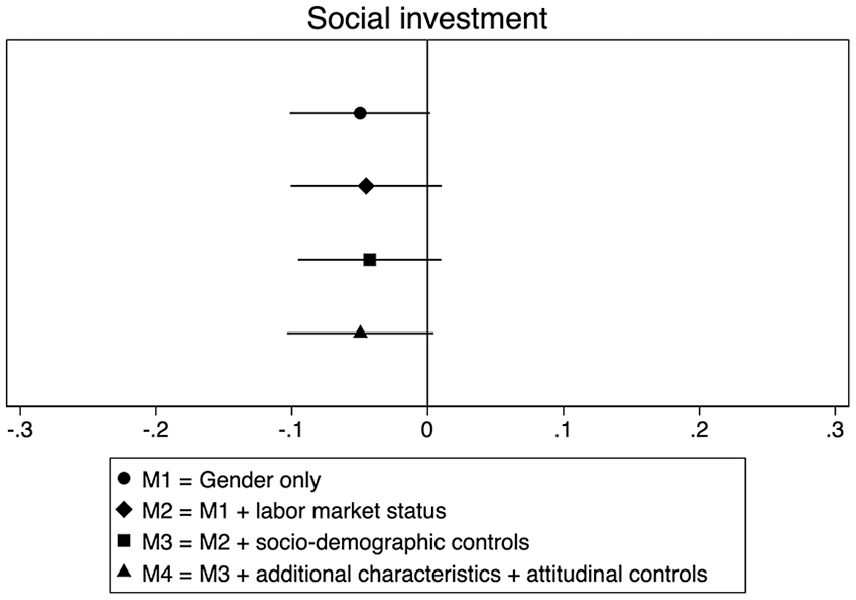
Gender differences in preferences toward social investment.
Women’s attitudes toward skill preservation, mobilization, and creation
Social investment policies are designed to help citizens to adapt to changing economic environments by investing in their human skills and capabilities (Hemerijck, 2017; Morel et al., 2012). These investment policies, in particular public ECEC, children-oriented family policies, or skill-oriented ALMPs, prioritize long-term returns over short-term benefits to voters (Beramendi et al., 2015). Garritzmann et al. (forthcoming) define social investments as policies that aim at creating, preserving, or mobilizing human skills and capabilities and accordingly distinguish three types of social investment policies: ‘skill creation’ policies providing individuals with new or updated skills; ‘skill mobilization’ policies facilitating the use of one’s skills on the labour market; and ‘skill preservation’ policies helping to safeguard and bolster one’s skills and capabilities during critical life-course transitions (such as parental leaves or spells of unemployment).
Picking up this distinction, we develop an argument why women are more likely to favour social investment policies that aim at preserving and mobilizing their skills, while gender differences should not occur in the case of skill creation policies. Our argument is based on the dominant line of rational choice arguments to explain social policy preferences: we expect women to be more supportive of policies that are to their direct advantage. 2
We argue that the mobilization and preservation of skills is of major concern for women’s economic outlook. Most women still bear the main responsibility of care work within their families (Gornick and Meyers, 2008). Despite rising female labour market participation, women are still likely to withdraw (at least temporarily) from the labour market or to reduce their working hours (more than men) when starting a family. Compared to men, they are faced with additional social risks given these likely career interruptions and the difficulties of reconciling work and family life (Estévez-Abe, 2006). Accordingly, women should be particularly supportive of policies that aim at preserving and mobilizing their skills. The next two sections outline our expectations toward two ideal-typical policies that preserve and mobilize skills.
ECEC policies are important tools to mobilize women’s skills and capabilities for the labour market and to help facilitate labour market (re-)entry. 3 Given that (unpaid) care work de facto still lies primarily within the responsibility of women in all advanced societies, it therefore seems straightforward from a rational choice perspective why women would support public, high quality childcare (Blome, 2017; Schwander, 2018a). Men, by contrast, are less affected by the existing family policy arrangement in their allocation of time to care and paid work (Bünning and Pollmann-Schult, 2016). In that sense, childcare services help women overcome their additional social risks due to giving birth and child rearing (Estévez-Abe, 2006).
In a similar vein, ALMPs help to facilitate (re-)entry into the labour market in case of job loss, career interruption, or other difficult life-cycle events. The insider–outsider literature translates this into clear predictions: those with an over-proportional risk of becoming unemployed or to be in precarious labour market situations (the outsiders) should be in favour of ALMPs as they facilitate re-entry into the labour market while those who do not expect to benefit from these policies (the insiders) show more reservation (Rehm, 2011; Rueda, 2005; Schwander, 2018b; Schwander and Häusermann, 2013). 4 To the extent that women are more likely to become unemployed or be precariously employed (Häusermann et al., 2015; Schwander, 2019), they should be more supportive of ALMPs as a way of facilitating labour market (re-)entry, preserving and mobilizing their skills.
By contrast, we do not see strong reasons why women and men should differ in their preferences toward ‘skill creation’ policies. 5 Over the last decades, women have continuously caught up with the educational attainment of men. Today, the share of female graduates even exceeds those of men: the gender gap in tertiary attainment among young adults in the OECD has increased from 9 percentage points in 2008 to 12 percentage points in 2018. In Western Europe, the proportion of tertiary-educated women among 25–64-year-olds is higher than the same proportion of men (OECD, 2019: 43). When it comes to vocational education, in contrast, the enrolment rates of young men remain higher than those of women in all OECD countries, except Israel (OECD, 2019). This might be related to the kind of skills that are acquired in vocational education: vocational training tends to convey specific skills (Estévez-Abe et al., 2001) which are less attractive to women as these skills depreciate more rapidly during career interruptions and hamper career/job changes (Estévez-Abe, 2006). This reinforces our point that women’s main concern on the labour market are the preservation and mobilization of skills rather than their acquirement.
Accordingly, we hypothesize:
Policy priorities
Yet, the literature portrays women not only as strong supporters of the social investment state but also of a passive compensation state. This is relevant in the second part of our analysis, where we study the gender dynamic of policy priorities. We maintain the rational choice argument: as for social investment, women should be more supportive of social compensation than men as they can expect to gain more from such state intervention. Hence, to the extent to which women on average are less likely to be employed and occupy economically more vulnerable positions than men, women should benefit from and therefore support social compensatory policies more strongly than men. Empirical studies provide ample evidence for this rational-choice reasoning (Dallinger, 2010; Finseraas, 2009; Häusermann et al., 2016; Stegmueller et al., 2011). 6 Women’s strong support of the safety net provided by the welfare state is also one of the reasons for the ‘modern gender vote gap’ where women turned to left parties (Giger, 2009; Iversen and Rosenbluth, 2006).
What, however, if women had to choose between compensatory or investing policies? Confronted with new welfare demands, but limited recourses, policymakers nowadays often must – explicitly or implicitly – prioritize one policy goal over another, a reality the literature on social policy preferences has started to incorporate (Boeri et al., 2001; Busemeyer and Garritzmann, 2017; Fossati and Häusermann, 2014). In our article – and building on our previous arguments – we focus on the potentially toughest choice for women by examining women’s policy priorities if expanding skill preservation and mobilization of social investment is only possible at the expense of social compensation.
For policy priorities, formulating clear expectations about gender differences is more difficult as women are considered to be at the receiving end of both compensatory policies (trying to ‘catch up’ to obtain similar protection status to that of men) and of skill preservation and mobilization investment policies (trying to achieve and maintain labour market participation). Two scenarios are theoretically possible: (1) women might be more willing to sacrifice social compensation in order to achieve more skill preservation and mobilization whereas men might prioritize social compensation. In a contrary scenario (2) women might favour compensation over skill preservation and mobilization social investments to first establish a safety net before seeking labour market re-integration. In that scenario, men would be more willing to trade compensation for investment because of their more stable economic position.
Since both scenarios seem equally likely, we formulate two competing hypotheses:
Next, we explain how we test these propositions empirically.
Research design, data, and methods
To study gender differences in preferences toward social investment we rely on the INVEDUC survey (Busemeyer et al., 2018). The survey offers high-quality data with a particular focus on social investment policies and policy trade-offs and covers eight West European countries (Sweden, Denmark, Germany, France, Italy, Spain, United Kingdom, and Ireland), representing the entire variety of ‘worlds of welfare’ (Esping-Andersen, 1990) in Western Europe. In each country, a representative sample of 1000–1500 respondents were interviewed (overall 8905).
Dependent variables
We argued that ECEC as well as ALMPs aim at preserving and mobilizing human skills and capabilities, whereas education policies primarily aim at creating skills. We therefore use these three policies as ideal-typical examples to test our theoretical propositions. First, we use a question about respondents’ preferences about whether government should ensure sufficient childcare places. The question reads: ‘Please indicate whether you strongly agree, agree, neither agree nor disagree, disagree or strongly disagree with the following statements – The government should ensure sufficient childcare services for children of working parents.’
Second, we rely on a question asking respondents about their preference toward education spending: ‘Please tell me whether you would like to see more or less government spending in each area. Keep in mind that ‘more’ or ‘much more’ might require a tax increase – Education.’
Third, to operationalize respondents’ preferences toward ALMPs we use the question: ‘Governments and political leaders like to propose new policy reforms in order to address important social issues. Please indicate whether you would strongly agree, agree, neither agree nor disagree, disagree or strongly disagree the following reform proposals. – Giving the unemployed more time and opportunities to improve their qualification before they are required to accept a job’.
Arguably, this operationalization covers only one aspect of ALMPs (see the broader discussion in Bonoli, 2013 or Vlandas, 2013); yet from a social investment perspective this up-skilling element is exactly the most important one, and should be particularly important for women seeking labour market (re-)entry (Gallego and Marx, 2017). Moreover, (1) this operationalization has already been used in other surveys, such as the Eurobarometer for instance (Kananen et al., 2006), (2) it has been shown to work successfully in pretests of the INVEDUC survey (Busemeyer et al., 2018; Gensicke et al., 2014), and (3) empirically it clusters on a ‘social investment dimension’ with other social investment policies (cf. Garritzmann et al., 2018).
In a final step, we acknowledge the pressing reality to prioritize some policies over others to study whether the prioritization of social investment and social compensation differs across genders. The INVEDUC data offers several trade-off questions that confront respondents with scenarios where they have to make ‘hard choices’ between social investments and social compensation. We use one question that includes the toughest choice for women, that is, a trade-off between skill preservation and mobilization policies on the one hand against compensatory social policies on the other. More concretely, we investigate whether gender differences emerge when the expansion of family-oriented social investment policies will only be possible at the expense of unemployment benefits or pensions – two ideal-typical compensatory policies. The sample was randomly divided into several groups for an experimental split-sample design. One quarter of the respondents in each country was asked to respond (strongly agree, agree, neither agree nor disagree, disagree, strongly disagree) to the following statements, respectively:
7
Split 1: ‘Imagine the government plans to enact reforms involving a 10% increase in the budget for financial support and public services for families with young children; and wants to finance this by cutting the benefits for the unemployed.’ Split 2: ‘Imagine the government plans to enact reforms involving a 10% increase in the budget for financial support and public services for families with young children; and wants to finance this by cutting old age pensions.’
Independent variable
Our main variable of interest is gender, which we operationalize as a dummy taking the value 1 for females and 0 for males. 8
Methods
The empirical purpose of this article is descriptive, that is, to analyse whether women and men state distinct preferences. We use logistic regression analyses as a descriptive tool here and analyse whether preferences differ between men and women, whether these differences are statistically significant at conventional levels, and whether the differences are substantive in size. Using regressions moreover has the advantage that we can include other potential factors shown to influence respondents’ preferences. Arguably, some of these factors (e.g. respondents’ labour market status or ideological viewpoints) are also affected by gender and therefore potential channels through which gender matters for social policy preferences.
We report four model specifications for each dependent variable. We first present a ‘gender only model’ that includes gender as the only independent variable. In a second model, we add respondents’ labour market status (full-time workers, voluntary part-time workers, involuntary part-time workers, retired, unemployed, in education, housework, permanently sick, other) to see whether possible gender differences disappear when we control for labour market status. In model 3 we additionally include at set of standard socio-demographic variables, that is, age (in years), household income (measured in country-specific quintiles), and education (measured by respondents’ highest degrees in five categories). Finally, model 4 covers a range of other potential variables: whether respondents are public sector workers (yes = 1), union members (yes = 1), or single parents (yes = 1); their subjective risk of becoming unemployment in the next 12 months (in four categories); and respondents’ ideological self-placement, testing both a uni-dimensional left–right scale (from 0 to 10) and alternatively a two-dimensional scale distinguishing an economic left–right and a social value GAL-TAN dimension. Including this many variables of course adds complexity to the model – as said, however, our main interest here is whether these control variables alter gender differences in social policy preferences.
We dichotomize our dependent variables and present logistic regression models as we are theoretically interested in support of (vs indifference and opposition to) policy proposals. Yet, we also explore the robustness of the results using ordered logit, multinominal, and partial proportional odds models to ensure our results are not driven by the dichotomization of the dependent variables. All regressions include country fixed-effects to control for differences in support levels across countries and compute country-clustered robust standard errors to control for unobserved heterogeneity.
Results
Preferences toward social investment in unconstrained scenarios
Figure 2 displays gender differences for three paradigmatic social investment policies: ECEC, education, and ALMPs. The figure is based on logit models and shows whether gender differences exist. Technically speaking, we show average marginal effects of gender on preferences based on four model specifications with different sets of control variables. Supplementary Tables A2 to A4 in the Online Appendix show the full tables confirming the robustness of the results if we use the full empirical variation in ordered logit models instead.
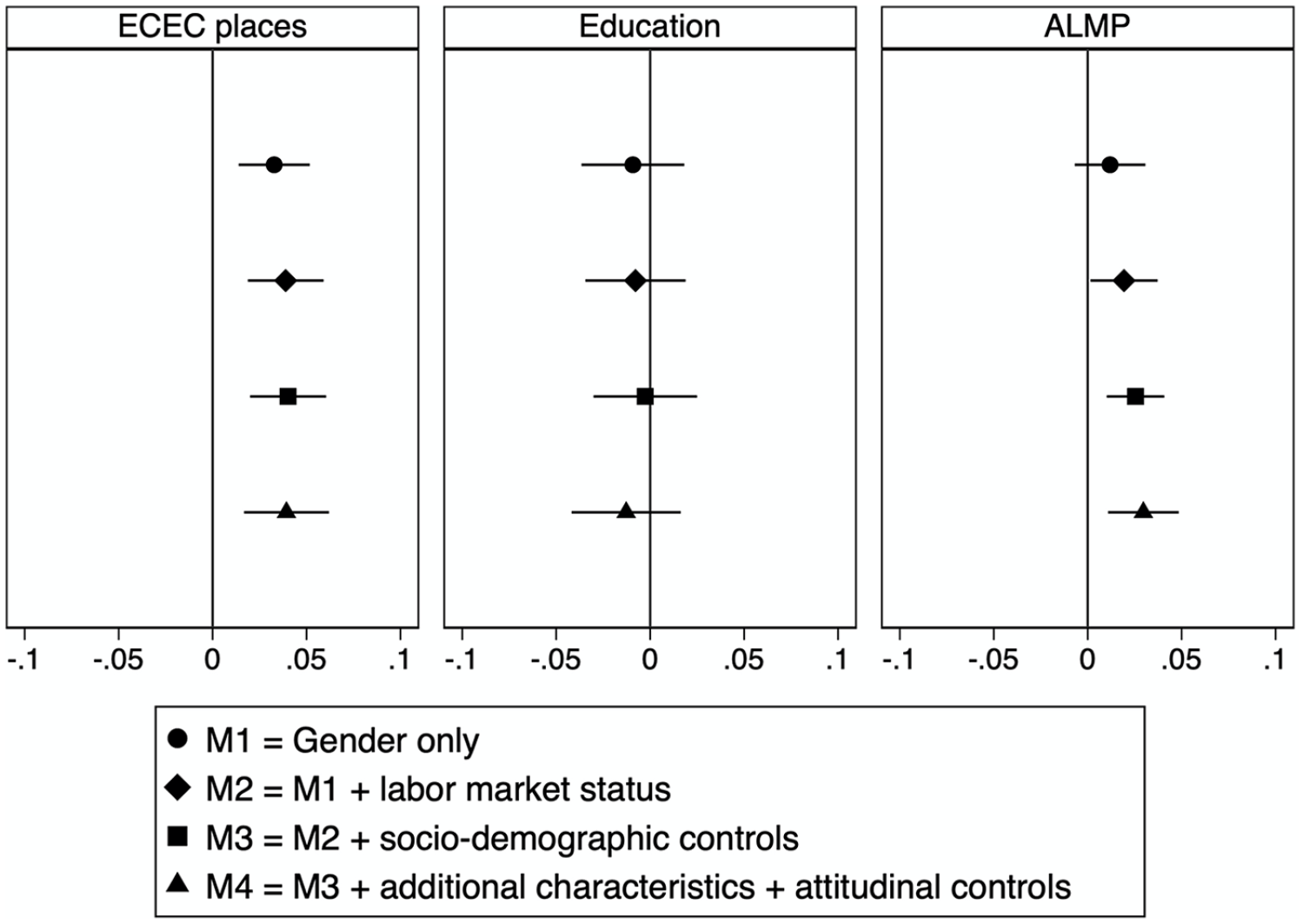
Gender differences in three paradigmatic social investment policies.
The main insight of Figure 2 is that we find significant gender differences in preferences toward ECEC and (in most models) for ALMPs, but not for education. Hence, women are significantly more likely than men to support skill mobilization and skill preservation policies, but we do not detect significant differences for skill creation policies; a finding that holds when we include additional control variables. However, adding control variables affects gender differences toward preferences toward ALMP: when gender is included as the only predictor, we do not find significant differences between men and women (at the conventional 95% level). Yet, the more control variables we add (that is, the more potential channels through which gender might matter we control for), the clearer the gender differences become. This finding is interesting for at least two respects: first, it is somewhat counter-intuitive because one would have expected that controlling for addititional factors might decrease gender differences – yet, the opposite is true. This indicates that gender matters through other channels besides those covered here (see Häusermann et al. 2016, on the relevance of the household composition on social policy preferences), an issue that could be addressed in future research. Second, the findings reveal why some men are so supportive of ALMPs: their preferences toward ALMPs can – at least partly – be explained by several aspects of materialistic self-interest and ideological viewpoints. The most important take-away from Figure 2 remains, nevertheless, that we observe gender differences for ECEC and ALMPs, but not for education policy.
Substantively, the estimates for gender are about 0.04 for both ECEC and ALMPs; substantially this means that ceteris paribus and controlling for a range of alternative factors, women are 4% more likely than men to express support for public ECEC and ALMPs. Comparing the size of gender differences to some of the control variables (in terms of standard deviations) to get a better understanding of the substantive significance of the findings, we find that gender matters substantively, but less so than other factors: for attitudes toward ECEC, respondents’ education, ideology, being a single parent, and income are (substantially) more important factors than gender. For attitudes toward ALMPs, ideology and education are more powerful explanations than gender, but preferences differ more strongly by gender than by respondents’ income and single-parent status. Overall, Hypothesis 1 is fully supported by the data: preferences toward skill mobilization and skill preservation investment policies are strongly gendered, while those on skill creation investment policies are unrelated to gender.
Preferences in constrained scenarios
In the next step of the analysis, we move toward the analysis of preferences under constrained scenarios to understand gender differences in the prioritization of social investment and social compensation. We study results for the trade-off question where social investment expansions are only possible at the expense of social compensation. Similar to the previous figure, Figure 3 shows gender differences (technically: average marginal effects) between men and women on agreement to support families on the expense of unemplyoment benefit (left hand panel) and on agreement to support families on the expense of old age pensions (right hand panel) in four model specifications. In both trade-off scenarios, the coefficient of gender is negative and significant at a 95% level, and is largely unaffected by the inclusion of control variables. 9 Substantively, this implies that women are less likely than men to support social investment expansions at the expense of social compensation. Put differently, women prioritize (the maintenance of) social compensation over (the expansion of) social investment, while men are significantly more likely to state support for social investment expansions, even if these came at the expense of social compensation. Above, we theorized that a priori it is unclear how women position themselves when having to make the difficult choice between social investments and social compensation. The results are clearly in line with Hypothesis 2b, stating that women prioritize compensation over social investment.
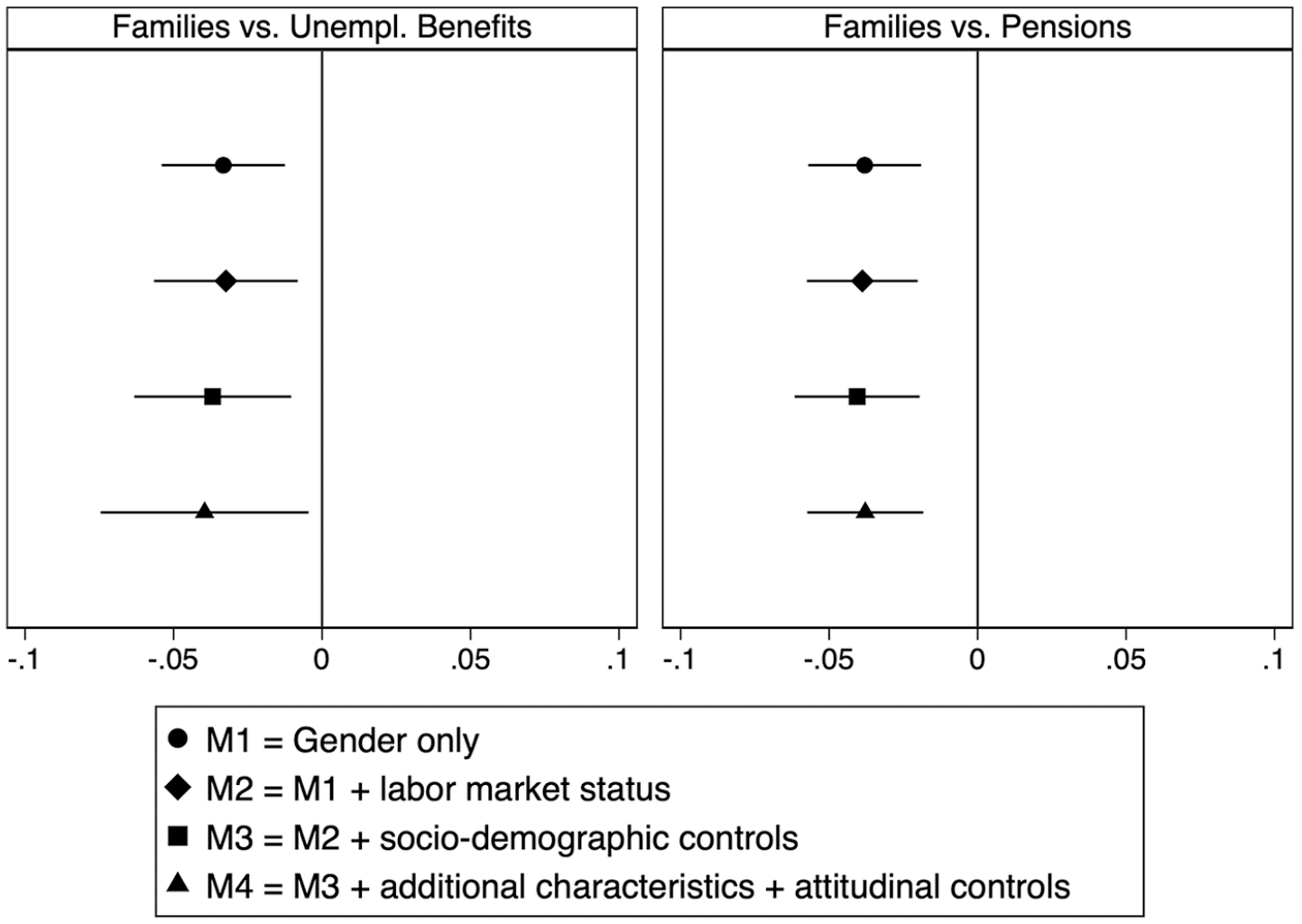
Gender differences in trade-off scenarios.
Subgroup analysis: Beyond the assumption of ‘unitary groups’
So far, our analysis has treated women and men as unitary groups with coherent preferences. Yet, it might be that these findings mask differences within specific parts of the population. It might, for example, be the case that women are more in favor of social investment, but only at a certain age (e.g. during the typical child-bearing age, where they face the pressure of reconciling work and family life). It is also possible that our general observation differs by educational background. Munzert and Bauer (2013) for instance find that in Germany attitudes toward gender equality are more strongly polarized between less educated men and women than in the higher educated segment of the population. Gender differences might further be moderated by family status: single mothers for instance might favor different policies than women in stable relationships while the family status would be less relevant for men.
In order to test these – and other – potential differences in sub-populations, we estimated several hundreds of regressions testing for different interactions of gender with various control variables for the different dependent variables. 10 For example, we interacted gender with being a single parent, age (in linear and non-linear ways), education (highest education levels and years of education), and ideology (both one- and multidimensional). Overall, however, these models did not produce any coherent story (see also Ares, 2017). While some of the interactions show small differences in some models, none of the findings were systematically robust across model specifications and dependent variables. Therefore, we abstain from discussing these results here in detail.
In addition, we tested for substantive differences across countries and welfare contexts, again not producing any systematic variation. We also checked for variation in the answer distribution between men and women, as it might be the case that men express more a extreme stance, while women take more moderate positions (which is empirically, however, not the case). Given these results, we feel comfortable concluding that our findings are robust and that treating women and men as coherent groups is valid.
Concluding discussion
A growing literature investigates the mass dynamics behind social investment reforms so popular among political elites and academic scholars. This article contributes to the study of the demand side of the social investment turn by investigating systematically how women’s and men’s preferences toward social investment differ. Investigating gendered patterns of social investment preferences is worthwhile in our view because women are considered a key group in the social investment turn (Häusermann, 2010; Häusermann and Schwander, 2012; Huber et al., 2009; Jenson, 2010; Morel et al., 2012; Morgan, 2013).
Building on the distinction between ‘skill creation’, ‘skill preservation’, and ‘skill mobilization’ social investment (Garritzmann et al., forthcoming), we advance a rational choice argument that women do not support social investment in general more than men but that gender differences occur only for those investment policies that are to women’s specific benefits. Given that women still bear the main responsibility for family work which results in instable and atypical employment patterns, we argue that women might be particularly supportive of skill mobilization and skill preservation, but not of skill creation policies. We test our expectations with data from the INVEDUC survey in eight West European countries and find our expectations confirmed: we observe gendered patterns of support for ECEC as well as for ALMPs – two paradigmatic policies for the preservation and mobilization of skills – but do not detect systematic gender differences regarding education policy (the paradigmatic policy for the creation of skills). The findings are robust across different model specifications and to the inclusion of different sets of control variables. Moreover, extensive tests of moderating variables did not reveal any systematic factors. Thus, we feel comfortable concluding that we are not ‘missing’ gender differences by treating women and men as unitary groups.
Our finding that women are not core supporters for social investment in general challenges core assumptions in the literature on the social investment turn and questions standard assumptions about the electoral feasibility of and parties’ electoral strategies toward welfare state reforms. Does this imply that gender is not a relevant conflict line for the politics of social investment? We caution against such an outright rejection of the relevance of gender. Gender matters for skill mobilization and preservation policies, so one could expect that a gender-cleavage might appear in the politics of these policies.
Moreover, while our results show that gender is not an important determinant of policy preferences toward social investment in general, gender might still be important in other respects. First of all, gender – at least to some degree – is an important determinant of some of the variables that do matter for preferences: although women are today more likely to be higher educated than men, they are – on average – still poorer, more precariously employed, and also more left-leaning than men. Gender thus still matters, but in rather indirect ways. Second, there might be additional channels through which gender affects preferences that we have not covered in our analysis (as discussed above, some findings point in this direction). This could be an avenue for future research that could complement ours, for example, also by using different research designs such as in-depth interviews of focus groups. Third, our results suggest that parties cannot hope to capture ‘the female vote’ just by focusing on social investments in general, as we detected a more nuanced pattern with women supporting above all active labour market and early care and education policies. Vote-seeking strategies are further hampered by the fact that preferences are even more complex once we acknowledge today’s common trade-offs.
There is evidence that gender matters on the policymaking level, as previous studies found that women’s agency is highly relevant for expanding social investment policies, both in term of descriptive and substantial representation (Blome, 2017; Elsässer and Schäfer, 2018; Huber et al., 2009; Morgan, 2013). The interesting puzzle – to be addressed in future research – is then that while gender matters for voting behaviour and policymaking, gender differences are not that straightforward and more complex when it comes to the ‘intermediary’ step of policy preferences. Clearly, we need to know more about the circumstances that make women (and men) support social investment and how such support translates into political action.
Supplemental Material
sj-pdf-1-esp-10.1177_0958928720978012 – Supplemental material for Gender and attitudes toward welfare state reform: Are women really social investment promoters?
Supplemental material, sj-pdf-1-esp-10.1177_0958928720978012 for Gender and attitudes toward welfare state reform: Are women really social investment promoters? by Julian L. Garritzmann and Hanna Schwander in Journal of European Social Policy
Footnotes
Funding
The authors disclosed receipt of the following financial support for the research, authorship, and/or publication of this article: Hanna Schwander would like to thank the Swiss National Science Foundations for generous funding of the project ‘Disentangeling the gender vote gap – a refined analysis of womens political realignment’ (PZ00P1 161234). Julian L. Garritzmann received no financial support for the research, authorship, and/or publication of this article.
Notes
Supplemental material
Supplemental material for this article is available online.
References
Supplementary Material
Please find the following supplemental material available below.
For Open Access articles published under a Creative Commons License, all supplemental material carries the same license as the article it is associated with.
For non-Open Access articles published, all supplemental material carries a non-exclusive license, and permission requests for re-use of supplemental material or any part of supplemental material shall be sent directly to the copyright owner as specified in the copyright notice associated with the article.
