



Abstract
Scholars and policymakers who call for social investment (SI) policies hope that SI policies reduce income inequality and poverty, among other policy goals. Meanwhile, some others point out potentially less pro-poor effects of SI policies. There are relatively few cross-national studies that empirically examine the distributional effects of SI policies. The current study seeks to fill the gap by investigating the effects of SI policies on income inequality in OECD countries. The empirical analysis finds mixed results. Parental leave benefits reduce market income inequality, but other family support policies do not lessen inequality, and family allowances and paid leave (the length of generous leave) even increase it. The effects of some family policies are partly context-specific. In contexts where there are a large number of single-mother households, parental leave benefits reduce market income inequality. There is no stable evidence that education and active labour market policy (ALMP) reduce market income inequality. Education and ALMP, however, reduce disposable income inequality (even after controlling for left governments and Nordic countries). The article suggests that in countries with high education and/or ALMP spending, the skills of workers towards the lower end of the income distribution may be relatively high (even though their pre-tax and transfer income may be low), and it may make their income salvageable with redistributive policies. In this sense, SI policies and conventional redistributive policies may be complementary in reducing disposable income inequality.
Keywords
Introduction
Social investment (SI) policies have been employed by EU countries in recent decades to promote robust, competitive knowledge economies and to reduce inequality and increase social inclusion, by investing in and enhancing human capital. They have also been employed to address new social risks by improving employment prospects for workers and individuals who are at risk of unemployment or in precarious employment, or those who are in in-work poverty or are involuntary non-participants (Hemerijck, 2017; Morel et al., 2012). SI policies aim to both raise and activate human capital. Governments hope that human capital investment, such as education and job training, will mitigate those new social risks by better preparing workers for jobs and promoting their employment and social inclusion and will reduce the intergenerational transmission of poverty. Governments also hope to reduce inequality and poverty by encouraging employment and labour market participation among those who may not otherwise participate in work by implementing active labour market programmes.
Of all individual programmes of SI policies, it has been hoped that family support policies, in particular, encourage female labour market participation and improve women’s and/or their family’s income and reduce poverty for parents as well as for their children. Particularly, single-parent households have a higher risk of poverty, and one of the causes is that they lack the resources that two-parent households have to keep full-time employment and income associated with it (Maldonado and Nieuwenhuis, 2015; Nieuwenhuis and Maldonado, 2018). If family policies can provide families with resources, such as free or low-cost childcare and paid parental leave, parents are more able to keep employment and income, or so proponents of the policies hope.
There is literature analysing the nature, origin and political determinants of SI policies (for example, Hemerijck, 2017; Morel et al., 2012). There are, however, relatively few cross-national studies that assess whether, and how successfully, SI policies achieve their goals and combat the problems they are designed to solve, including the reduction of inequality and poverty. 1
This article aims to fill the gap by empirically analysing whether SI policies reduce income inequality, using time-series cross-national data from OECD countries. There are multiple channels through which different SI policies can potentially affect household income inequality. The article first explains how SI policies may potentially reduce inequality and describes expectations suggested by previous literature and my theoretical conjectures from the SI policy perspective. Then it implements the empirical analysis.
To anticipate the findings, the empirical analysis finds mixed results. Parental leave benefits reduce market income inequality, but other family support policies do not lessen inequality, and family allowances and paid leave (the length of generous leave) even increase it. The effects of some family policies are partly context-specific. In contexts where there are a large number of single-mother households, parental leave benefits reduce market income inequality. There is no stable evidence that education and active labour market policy (ALMP) reduce market income inequality. However, education and ALMP reduce disposable income inequality (even after controlling for left governments and Nordic countries). The article suggests that in countries with high education and/or ALMP spending, the skills of workers towards the lower end of the income distribution may be relatively high (even though their pre-tax and transfer income may be low), and it may make their income salvageable with redistributive policies. In this sense, SI policies and conventional redistributive policies may be complementary in reducing disposable income inequality.
How might SI policies reduce inequality from the SI perspective?
Increasing income inequality has been one of the features of the post-1970s period in industrialized countries. Wide-ranging factors have been argued to contribute to inequality – from deindustrialization and the expansion of service industries, to technological advances and the emergence of the new knowledge economy, financialization, globalization and international competition, the decline of labour unions and the dualization of workers, change in the family structure (e.g. single-parent families), unemployment, an expansion of non-standard employment and in-work poverty, neoliberal reforms in the 1980s and 1990s, and employment protection (Bradley et al., 2003; Goldin and Katz, 2008; Hope and Martelli, 2019; Huber and Stephens, 2014; Kenworthy and Pontusson, 2005; Kwon, 2016; Pontusson et al., 2002; Rueda and Pontusson, 2000; Wallerstein, 1999).
EU governments adopted the Lisbon Strategy in 2000 to, among other goals, safeguard against new social risks and mitigate social exclusion and improve the financial sustainability of the welfare state by, for instance, encouraging employment and making it easier for parents to balance work and family life. By investing in and promoting human capital and increasing labour market participation (activation), they hoped to mitigate inequality and poverty that have lingering negative effects on not just adults, but also their children, who are disadvantaged from the beginning of their lives and who are less likely than their peers to have as many opportunities to receive a good education.
The SI policies proposed belong to policy areas in education, family support, and ALMP, among others. SI policies are envisioned to address new social risks, which include economic difficulty experienced by vulnerable groups, such as single mothers and their children, at-risk workers in nonstandard or precarious employment, and others who are in in-work poverty. The means by which governments hope to address these risks are by investing in and improving the skills and knowledge of individuals and workers and by activating them (increasing their employment and labour market participation). In the following, I explain how the SI perspective expects SI policies to improve and activate human capital and promote employment and reduce inequality, if SI policies are effective at all.
Fostering skills
Education and vocational training help improve the human capital of workers and students. With skills and knowledge, workers can find jobs and secure income, which help reduce inequality, as unemployment is a major source of low income. Though high government spending on education is not a substitute for quality, high spending can allow for larger salaries, better qualifications and motivation for teachers, and also smaller class size, which help improve the quality of education. Government spending can also provide students with scholarships, which enable students with fewer financial resources to go to school and invest in skills. If students from low-income families can get a good education, they will have better job and income prospects, enabling them to leave low income and poverty, which will also improve their children’s education and their employment and income prospects.
Early childhood education and care (ECEC) promotes children’s non-cognitive skills and motivation, which later help learning and skill acquisition in their youth and adulthood (Cunha et al., 2006). If it thus helps their skill formation, it will enhance their future employment and income prospects. Further, their higher educational attainment and income can advance their own children’s skill investments and acquisition, creating a virtuous cycle of skill investments and positive economic outcomes and allowing them to leave poverty traps. The wide availability of childcare also enables mothers to participate in the labour market and be gainfully employed, which can reduce the risk of low income and poverty.
For individuals from low-income families, the costs of education are relatively high. As a result, they may underinvest in education and skills, which in turn can lead to less human capital and lower employment and wage prospects. Government provision of free or low-cost education therefore promotes skill investments. Large education spending makes it possible to reduce school tuition. Educational inequalities and their negative effects are widespread in OECD countries (OECD, various years). Low public spending and the high costs of tertiary education suppress the college enrolment rates of students from low-income families, which negatively affects their employment and wages in later years. Large public spending and free or inexpensive education can lower the costs of education and encourage education for low-income students.
Since costs and credit constraints are an obstacle to human capital investment, government redistribution and other social benefits may also contribute to human capital investments in that low-income students and families can better afford education with augmented incomes (e.g. income assistance, child allowances, maternity leave benefits, tax credits, unemployment benefits). Various welfare programmes providing cash transfers and in-kind services can directly or indirectly increase the incomes of low-income households. There is some indirect evidence to suggest that redistribution encourages education and better academic and wage outcomes – the OECD (2010) reports that individual income tax progressivity and unemployment benefits are correlated with a smaller influence of parental socioeconomic background on children’s academic achievement and their wages.
Enabling mothers to work and earn income: Family policy
One of the symbolic SI policies in the area of family policy is policy measures to enable mothers to work and earn income. Single mothers particularly have difficulty finding or keeping full-time employment and income, because they do not have a partner with whom to share childrearing and household responsibilities. For instance, if their children get sick, single mothers may have to choose between childcare and work, unless a policy exists to support such childcare leave. Furthermore, when single mothers become unemployed, they do not have a spouse or partner whose income can provide a buffer against income losses. Losing employment can therefore send single mothers into poverty. 2 They lack the resources that coupled households have. As a result, they have higher incidence of unemployment, non-standard employment and poverty.
Even in two-parent households, however, childcare responsibilities tend to fall heavily on mothers. If mothers cannot work because of childcare responsibilities, it can cause financial difficulties, particularly in low-income households, in the current economy of declining real wages.
Publicly funded childcare – if it is widely available and free or low-cost – can enable mothers to balance work and family life and improve their employment prospects or labour market participation and lift their financial conditions. Maternity and parental leave also makes it possible for mothers to work while raising children, and is hoped to improve mothers’ employment and labour market participation. Further, with paid parental leave, mothers do not have to worry about the negative financial consequences of leave, and it can facilitate their employment. Without paid leave, mothers may have to choose between children and work.
Maternity and parental leave can also potentially increase women’s incentive to invest in skills, as they know that they can continue their careers even with children and will not have to waste skill investments (Bassanini and Venn, 2007). By encouraging women’s skill investments, maternity and parental leave can increase women’s employment and income prospects. Leave benefits can also encourage women’s skill investments, as benefits are calculated as a portion of their last salaries. Skills may then improve their employment prospects.
Family (child) allowances can boost the incomes of low-income households and may be able to make skill investments more accessible. If augmented incomes encourage education, it may enhance individuals’ employment and wage prospects. In that respect, family allowances can also be included in SI policies, though they are not often classified as an SI policy.
By contrast, if such allowances work as a disincentive to work, family allowances will not improve employment or income. Nieuwenhuis et al. (2012) report that higher family allowances reduce mothers’ employment.
ALMP
ALMP – job training, placement services, employment incentives, work experience programmes, and job creation – is hoped to contribute to employment by providing job training, coaching and supporting job searches, and giving participants employment or job experiences. Income from employment can keep individuals out of low income and poverty. ALMP is also hoped to serve as a policy tool to retrain or reeducate workers with obsolete skills, so as to improve their employment and income prospects. Passive labour market programmes such as unemployment benefits may also encourage employment by providing the unemployed with time and financial means to find a job or invest in skills without worrying about earning a living. However, unemployment benefits may also work against employment if they work as disincentives.
Activation policies also include measures to reduce incentives for the unemployed to stay unemployed and remain on welfare payrolls, or to create positive incentives to work. These policies include reducing unemployment benefits after a certain length of time, tightening eligibilities, and providing in-work benefits, employment subsidies and tax benefits. On the other hand, reduced benefits and tightened eligibilities can work to worsen the financial conditions of low-income workers and families in need. If such happens, it may increase income inequality.
Previous empirical results
Scholars and policymakers who call for SI policies hope that SI policies reduce income inequality and poverty, among other policy goals, but empirical data is mixed on whether SI policies achieve such goals. On the one hand, there are studies reporting that certain SI policies produce favourable outcomes. On the other hand, there are studies suggesting that SI policies are less pro-poor and may even increase inequality and/or poverty.
Huber and Stephens (2014) report that education spending reduces market income inequality. Huber et al. (2020) show that public education spending reduces wage dispersion.
Most other studies are done on disposable income inequality or poverty as a dependent variable. Busemeyer (2015) reports that public education spending reduces disposable household income inequality. Maldonado and Nieuwenhuis (2015) find that long parental leave, a small portion of unpaid leave, and high family allowances reduce disposable income poverty among all households with children. Rovny (2014) similarly reports that ALMP and family allowances reduce disposable income poverty among low-educated young workers. Misra et al. (2007) also report that family allowances and childcare measured as enrolment rates reduce disposable income poverty, but since these scholars study only disposable income inequality or poverty, there is no telling whether those policies reduce disposable income inequality/poverty by lessening market income inequality/poverty or by affecting (that is, increasing) the size of redistribution. Therefore, the current study examines both market and disposable income.
By contrast, Thevenon and Manfredi (2018) report that family allowances and parental leave benefits do not reduce disposable income child poverty. Van Vliet and Wang (2015) argue that social programmes have become less redistributive and report the results of statistical analysis that when Nordic countries are excluded from the sample, shifts in government spending to SI policies is positively associated with disposable income inequality and poverty among 11 European countries (that is, SI policies increase inequality and poverty). When the Nordic countries are included, however, there is no significant association between SI spending and inequality, while there is some indication that SI policies reduce disposable income poverty.
Moller et al. (2003) also find that none of education, vocational education, family (child) allowances, and maternity allowances affect pre-tax and transfer poverty among the working-age population, but they find that vocational education (enrolment) and family allowances increase the size of poverty reduction, while maternity allowances do not affect poverty reduction. 3 In another study, Alper et al. (2020) find that parental leave benefits increase market income poverty and the size of redistribution.
Cantillon (2011) discusses why poverty rates have not decreased in Europe, despite the implementation of SI policies and an increase in employment and incomes. She suggests a couple of reasons. First, increased employment did not benefit workless households much. Second, income protection for workless households became less generous. Third, social policies became less pro-poor – that is, SI expenditures flow more to higher-income households (double-income households with high education) in the forms of childcare support and parental leave than to low-income low-education households. The second and third points are plausible, since one of the characteristics of SI policies is activation, and activation was partly promoted by reducing unemployment benefits and tightening eligibilities.
Some studies provide empirical data that suggest that the benefits of parental leave and childcare tend to flow more to work-rich high-income households than to work-poor low-income households (Bonoli et al., 2017; Ghysels and Van Lancker, 2011). Parental leave and childcare are disproportionately used by employed women, and high-skilled women are more likely to be employed than low-skilled ones. The benefits of parental leave and childcare are linked to employment. Ghysels and Van Lancker (2011), particularly, show that much larger amounts of monetary benefits of childcare and parental leave go to higher-income households than to low-income households, by using the case of Flanders, Belgium. That leads Ghysels and Van Lancker (2011) to suggest that childcare and parental leave have reduced the redistributive character of family policy in most EU countries.
Overall, past research has produced both the results suggesting that SI policies reduce disposable income poverty or inequality and those reporting conversely that the policies do not reduce disposable income poverty or inequality. There is a dearth of research that examines the effects of SI policies on market income inequality, except for Huber and Stephens (2014). Thus, my study looks at both market income and disposable income inequality. It also analyses the effects of family support policy, education and ALMP, as most past studies do not study the latter two.
Empirical analysis: Data
I analyse time-series cross-sectional data from 18 OECD countries from approximately 1980 to 2010 to examine the relationships between SI policies and income inequality (‘approximately’ because data availability varies across countries). 4 The data are annual.
Dependent variable
The two main dependent variables are pre-tax and transfer Gini coefficients (market income) and post-tax and transfer Gini coefficients (disposable income) among the working-age population. The data used are the Luxembourg Income Study (LIS) data. We use the database compiled by Thewissen et al. (2016), using the LIS data. We also use additional variables for robustness checks, which will be explained below.
Theoretically, the SI perspective is not perfectly clear about whether the counter-inequality effects of SI policies should manifest themselves in market or disposable income inequality. Insofar as the SI perspective partly envisions SI policies to achieve what conventional compensation-type redistributive policies (e.g. unemployment benefits, disability benefits and other income assistance) do not achieve (i.e. employability, skills and knowledge, and sufficient incomes), one could imagine that the effects should show in market income inequality. However, that would not preclude the kinds of inequality that SI policies may remedy whose effects show up in disposable income inequality. For example, SI policies may raise the income of a low-income household to a level that is salvageable with redistributive policies, even though their market income is initially under the poverty line. Therefore, this article examines disposable income inequality also as a dependent variable.
Many studies analysing the determinants of inequality use disposable income inequality as the dependent variable, but if one only examines disposable income inequality, one will not know whether certain factors reduce disposable income inequality by reducing market income inequality or increasing the size of redistribution, even when one finds a negative effect (Alper et al., 2020). We can learn much by examining the effects of factors on both market and disposable income inequality.
Independent variables
Independent variables of main interest are government spending on family support (per child 0–14 years in age), education (per student) and ALMP (per unemployed person). Family support includes child allowances, childcare support, ECEC, parental leave benefits and single parent payments. Education is public spending on education at all levels. ALMP includes job training, employment services including counselling and vocational guidance, youth measures, direct job creation, and employment incentives and subsidies. Family support and ALMP spending is expressed in US dollars at current PPPs and current prices. I wanted to use the same measure for education spending, but the time-series of the education spending data is far more limited than spending data expressed as a percentage of GDP. I therefore use per student education spending as a percentage of GDP to avoid having too few observations. Per target population spending in US dollars is used wherever possible, because the per GDP measure can change values even when spending does not change at all, but the GDP (denominator) changes. 5 All three variables are divided by appropriate target population. They are also in natural logs. Per target population spending is chosen, because what matters more than the size of GDP is how much governments spend for target populations. These independent variables (except education) come from or are calculated from OECD.Stat (https://stats.oecd.org). Education is from UNESCO Institute for Statistics (http://data.uis.unesco.org).
For family support policy, we also use four additional disaggregate variables, which are measures of individual programmes within family support policy, to examine whether and how the disaggregate policies affect inequality differently. I also enter these additional independent variables, given that most studies that examine the effects of work–family reconciliation policies use such disaggregate variables as parental leave, childcare and family allowances.
Paid leave is a measure of work–life reconciliation policies, combining maternity leave, parental leave and childcare leave. Following Nieuwenhuis et al. (2019), I calculated the total number of weeks of leave, for which the leave benefit replacement rate is 60% or above. The original data come from Gauthier’s (2011) Comparative Family Policy Database.
Leave benefits is public spending on maternity and parental leave benefits per child 0–4 years in age expressed in US dollars at current PPPs and current prices.
ECEC is public spending on early childhood education and care per child 0–4 years in age. They are both from OECD.Stat.
Family allowance is the average amount of monthly family allowances that families would receive for their first, second and third child as a percentage of the average gross monthly earnings of a productive worker (the amount is divided by three to arrive at per child allowances) (Nieuwenhuis et al., 2019). The original data are from Gauthier (2011).
We also use two disaggregate variables for ALMP to examine whether and how the disaggregate policies affect inequality differently. Training is government spending on job training per unemployed person. Placement is government spending on public employment services per unemployed person. These individual programmes probably increase the employment prospects of at-risk workers more than the other ALMP programmes.
Control variables
Labour institutions such as unions, wage coordination and collective bargaining coverage have been shown to reduce income inequality by compressing wage differentials between high- and low-skill workers (Kenworthy and Pontusson, 2005; Pontusson et al., 2002; Wallerstein, 1999); so we control for these. Unions is union density. Coordination is a measure of wage coordination. Bargaining is collective bargaining coverage. The data are from Brady et al. (2014) who use Visser (2013).
Manufacturing declined and service industries rose in importance in the economies of industrial countries, with the end of the postwar Fordist mass production system and the subsequent rise of the new knowledge economy. Globalization also has increased industrial countries’ reliance on service industries, as globalization shifts manufacturing out of high-wage countries to low-wage ones. Manufacturing offered better paying jobs for low-skill workers in the Fordist system (Huber and Stephens, 2014). In contrast, in the post-Fordist economy, these low-skill workers gain low-paying jobs in service sectors. Deindustrialization has thus been argued to contribute to higher income inequality: so we control for manufacturing sector employment (Industry employment).
For a large majority of families, employment is the main source of income. Unemployment leads to reduction in income. Unemployment affects low-skill workers more than higher-skill workers. It reduces the former’s income and likely increases income inequality: so we control for unemployment (Unemployment).
Some demographic factors also affect inequality. One such factor is single-mother families (Huber and Stephens, 2014). Single mothers have difficulty getting or keeping full-time jobs, because they lack resources compared to two-parent families. Single mothers are also vulnerable to income losses from unemployment, since they do not have a partner whose income supports the family in the absence of mothers’ income. We control for it by entering children living in single-mother households as a percentage of all children (Single mothers). The data are from Brady et al. (2014).
Lastly, we enter total social spending per capita (Social spending) and healthcare spending per capita (Healthcare) to control for the potential effects of those programmes on income inequality and isolate their effects from the estimates of our main SI policy variables.
Methods
With time-series cross-section (TSCS) data, the OLS assumption of independence of errors among observations may be violated. Therefore, we correct for heteroskedasticity and serial correlation. A common estimation method in comparative political economy is Prais-Winsten regressions (with panel-corrected standard errors (PCSEs) and first-order autoregressive error process), but it cannot be used in our case, because the dependent variables have time gaps. Many of our models show serial correlation, so we use an alternative, robust cluster variance estimator, which corrects for heteroskedasticity and serial correlation. This is our baseline estimation, but we also test the results with other common estimation methods to check robustness. The other methods are random effects (REs) and fixed effects (FEs) estimation both with robust cluster standard errors.
Results
Market income inequality
Table 1 reports the results of the baseline models. Against our expectations, family support is positive and significant, while education and ALMP are negative but insignificant. The results suggest that family support increases market income inequality, and education and ALMP do not affect it. 6 The results do not depend on the length of lags. The results are also robust to different estimation (Supplemental Table S1). It is also not the case that the results suffer from reverse causation which would imply that high inequality causes high family support spending, either in order to counter inequality or because an automatic stabilizer kicks in. We switch the places of the dependent variable (inequality) and the independent variable (family support) in our equations, and estimate the effects of inequality on family support spending (Supplemental Table S2). Inequality does not increase family support spending, except with a 10-year lag (with which we cannot eliminate the possibility of reverse causation).
Determinants of market income inequality.

Robust cluster standard errors in parentheses.
p < 0.1. **p < 0.05. ***p < 0.01.
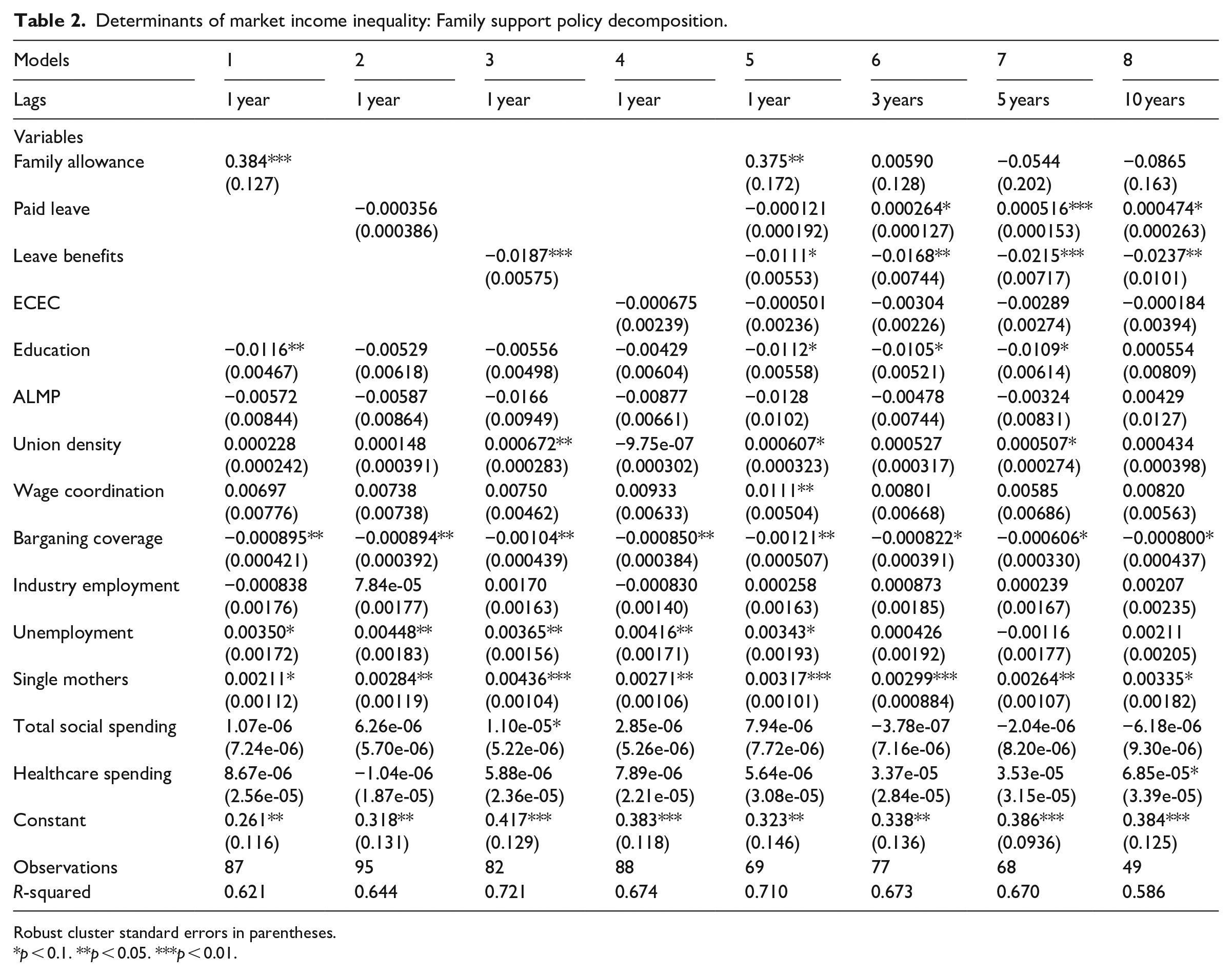
The analysis so far does not return results suggesting that family support reduces inequality, but there is the possibility that the particular choice of the independent variable – total family support spending per child 0–14 years in age – is not suited for detecting the pro-equality effects of family support. So, we now replace the variable with four disaggregate variables, which are measures of individual programmes within family support policy. The results are reported in Table 2.
Determinants of market income inequality: Family support policy decomposition.
Robust cluster standard errors in parentheses.
p < 0.1. **p < 0.05. ***p < 0.01.
We have evidence that parental leave benefits spending per child reduces market income inequality. In contrast, family allowances (immediately) and the length of paid leave (with some lag) increase inequality. The positive result of total family spending in Table 1, thus, likely comes from the effects of family allowances and the length of paid leave. The result for the length of paid leave is similar to the results of Alper et al. (2020) who argue that generous parental leave leads people to take leave, and it reduces their market income, but our results here suggest that high levels of leave benefits reduce market income inequality, while the length of leave increases it. Since the payment of leave benefits is reflected in disposable income, the interpretation from the SI perspective is that leave benefits reduce market income inequality because they encourage or enable mothers to work. 7
The regression coefficients in model 3 suggest that a 10% increase in parental leave benefits per child leads to a 0.0018 decrease in the pre-tax and transfer Gini coefficient (average Gini is 0.406).
As for family allowances, they may serve as disincentives to work, as household members receive the non-work-related benefits. If so, that reduces their market income.
It is also possible that family support works in contexts where governments want the policy to work. One such context may be single-parent households. Single-parent households have a higher risk of poverty, and one of the causes is that they lack the resources that two-parent households have to keep full-time employment and the income associated with it. If family support policies can provide them with resources, such as free or low-cost childcare and paid parental leave, they may be better able to keep employment and income.
So, I entered into regressions an interaction term of individual family policies and the size of single-mother households. Figure 1 shows a marginal effect of parental leave benefits on market income inequality, conditional on the size of single-mother households. The marginal effect shows a downward slope and is negative and significant at around where the size is 11% and above. As Supplemental Table S3 shows, the interaction term also is negative and significant, indicating that the downward effect becomes larger as the size of single-mother households becomes larger.

Marginal effects of maternity and parental leave benefits on inequality.
What this result suggests is that in the presence of a large size of single-mother households, parental leave benefits reduce market income inequality. It may be the case that when the size of single-mother households (potential beneficiaries of leave benefits) is small, the benefits of maternity and parental leave accrue more to high-education high-income households. High-education, high-income households are more likely to use parental leave, and leave benefits are also paid as a portion of one’s income (Ghysels and Van Lancker, 2011), but where there are many single-mother households, the benefits also flow to the low-income households, and it reduces inequality. If this result is ever trustworthy, one can say that family support policy works (reduces inequality), at least in one of the areas where it is needed or where there are many potential beneficiaries in need of such service and benefits. For the other family support policies, the interaction term is not significant. Neither are their marginal effects.
I also decomposed education and ALMP spending. There is some indication that pre-primary school spending may reduce market income inequality, but education spending at the other levels is not significant (Supplemental Tables S4). Public spending on job training may also lessen market income inequality (Supplemental Table S5).
Supplemental Table S6 shows the results of regressions with longer lags of ECEC in consideration of the possibility that the benefits of ECEC may take many years to appear. One of the general purposes of ECEC is to enable mothers to participate in the labour market and be gainfully employed, which reduces the risk of low income and poverty. These effects may appear in a relatively short time, but ECEC has another function, which is to enable children from low-income, low-education households to mitigate the negative effects of disadvantages resulting from their socioeconomic backgrounds. ECEC promotes children’s non-cognitive skills and motivation, which later help their learning and skill formation in their youth and adulthood (Cunha et al., 2006). If it helps their skill formation, it will enhance their future employment and income prospects. The models in Supplemental Table S6 use various longer lags. However, we do not observe pro-equality effects in any of the models, except in models with a 20-year lag, but since the 20-year lag reduces the number of observations used in the regression to 34, this result should be viewed with great caution. It is still possible that the effects of ECEC may take a longer time to show up, but the analysis of such long-term effects needs to await the availability of data that make such analysis possible.
Disposable income inequality
Table 3 reports the results of the analysis of the determinants of disposable income inequality. As with the results of market income inequality, family support is positively associated with disposable income inequality, indicating that it increases inequality. However, education and ALMP are now negatively and significantly associated with disposable income inequality (while they were indistinguishable from zero with market income inequality). That suggests that education and ALMP reduce disposable income inequality, though they do not reduce market income inequality. 8
Determinants of disposable income inequality.

Robust cluster standard errors in parentheses.
p < 0.1. **p < 0.05. ***p < 0.01.
We need to eliminate the possibility that the relationship between education and ALMP and disposable income inequality is spurious. One possibility is that both (1) education and ALMP and (2) inequality are affected by a third factor that both increases education and ALMP and reduces inequality. Our main suspects are left governments and Nordic countries. So, we control for left governments (left government control) and Nordic countries (a Nordic dummy) in our regressions in turn. (Another is large social protection, but it is already controlled for with total social spending.) The results are reported in Supplemental Tables S7 and S8. As we can see, the negative signs for education and ALMP remain and are significant even when left government is entered (Supplemental Table S7). They also remain negative and significant when the Nordic dummy is entered (Supplemental Table S8). We also excluded the four Nordic countries from the sample and ran the same regressions (Supplemental Table S9). Education and ALMP remain negative and significant. Therefore, the negative and significant coefficients on education and ALMP are not due to left governments or Nordic countries that have high spending on education and ALMP and a large size of redistribution and low disposable income inequality.
The regression coefficients in model 1 suggest that a 10% increase in per student education spending (as a percentage of GDP) leads to a 0.0015 reduction in the post-tax and transfer Gini coefficient (average Gini is 0.287), and similarly a 10% increase in ALMP spending per unemployed person leads to a 0.0025 reduction. In contrast, a 10-percent increase in total family support spending per child leads to a 0.0012 increase.
As in the analysis of market income inequality, I decomposed family support policy to check whether its disaggregate programmes differently affect disposable income inequality. The results (Supplemental Table S14) indicate that the individual programmes do not affect inequality. 9
Why, then, do education and ALMP not reduce market income inequality but lessen disposable income inequality? The following is no more than a speculative interpretation, but I suggest that in countries with high education and/or ALMP spending, the skills of workers towards the lower end of the income distribution may be relatively high (even though their pre-tax and transfer income may be low), and it may make their income salvageable with redistributive policies, such as various social benefits and income assistance. Huber et al. (2020) suggest that public education spending reduces wage dispersion partly by raising the skills (math scores) at the mean and 25th percentile of the skill distribution, though their dependent variable is pre-tax and transfer wage dispersion. It is easier for low-income individuals to get back up on their feet with the help of social policies and redistribution, if they have skills thanks to education and vocational training. In this sense, SI policies and conventional compensatory policies may be complementary in reducing disposable income inequality.
In contrast, in countries with low education and ALMP spending, the skill level of workers towards the low end of the income distribution may not be high enough for social policies and redistribution to lift them up. In other words, low education and ALMP spending creates inequality that is more difficult to correct with social benefits and redistribution.
More analysis is necessary for us to gain a better understanding of these results, but the results are not likely to be a fluke. We find similar results when we use poverty rates as the dependent variable. That is, education and ALMP do not affect market income poverty, but reduce disposable income poverty. Family support increases market income poverty, but does not affect disposable income poverty (Supplemental Tables S15 and S16). Thus, there seems to be something systematic about the effects of education and ALMP improving the conditions of inequality and poverty at the disposable income level.
With regard to control variables for market income inequality regressions, unemployment and single-mother households are positive and significant, indicating that they increase market income inequality, which is consistent with the expectations. Bargaining coverage is negatively and significantly associated with inequality. For disposable income inequality, unions and bargaining coverage significantly reduce inequality, consistent with the literature. Single-mother households reduce disposable income inequality, as government policies respond to the need for redistribution (Huber and Stephens, 2014).
Discussion
The goals of SI policies are, among other goals, to safeguard against new social risks, mitigate social exclusion, and improve the financial sustainability of the welfare state, by investing in and promoting human capital and by encouraging employment and making it easier for parents to balance work and family. Some scholars raise concerns that SI policies may be less pro-poor, as SI expenditures flow more to higher-income households (double-income households with high education), for instance, in the forms of childcare support and parental leave, than to work-poor low-income households. They also worry that SI policies may displace spending on social protection programmes and reduce the redistributive character of those conventional programmes, hurting the poor. The empirical analysis of this article finds mixed results about this debate.
On the one hand, we find that education and ALMP reduce disposable income inequality, but the size of the effects does not seem to be too large, and there is not stable evidence that they reduce market income inequality. On the other hand, while we find that parental leave benefits reduce market income inequality, family allowances and the length of paid leave increase it. No other SI policy reduces market income inequality, with the possible exceptions of ECEC with a 20-year lag, pre-primary school spending and job training. Further research is necessary to get clearer answers to the questions about the positive and negative effects of SI policies on inequality. The effects of individual SI policies (particularly, family support) vary, and the effects of SI policies as a whole are not of an all-or-nothing nature, barring a sweeping conclusion about their effects. Fine-tuned analysis of SI policies seems warranted.
A limitation of the current study is that none of the SI policy variables take into account those policies’ qualitative properties or environments for policy implementation. The variables are mostly monetary size of government spending or generosity of those policies.
Therefore, one clear possible explanation for only limited evidence suggesting the benefits of family support policies is that the quality of those policies matter, not the size of government spending or programme generosity. It is, for instance, easy to imagine that ECEC policies matter to employment and equality, but it is the quality and effectiveness of ECEC in promoting students’ skill acquisition and future employment and incomes or enabling parents to balance work and family that matter, not spending size. Thus, analyses are needed that use substantive, qualitative measures of SI policies for independent variables.
Another possible explanation is that SI policies as implemented currently in industrial countries are indeed less pro-poor and do not contribute to reducing income inequality, as suggested by some previous scholars (Bonoli et al., 2017; Cantillon, 2011; Ghysels and Van Lancker, 2011). That is, family support policy has the potential to work, but just not in the way it is currently implemented. If such is the case, again it becomes necessary to study the qualitative properties of SI policies in affecting the employment and incomes of workers to understand how the policies affect income inequality.
Supplemental Material
sj-pdf-1-esp-10.1177_09589287211018146 – Supplemental material for Do social investment policies reduce income inequality? An analysis of industrial countries
Supplemental material, sj-pdf-1-esp-10.1177_09589287211018146 for Do social investment policies reduce income inequality? An analysis of industrial countries by Takayuki Sakamoto in Journal of European Social Policy
Footnotes
Acknowledgements
I thank Rense Nieuwenhuis and the anonymous reviewers for helpful comments.
Funding
The author disclosed receipt of the following financial support for the research, authorship, and/or publication of this article: This research was supported by Grants-in-Aid for Scientific Research, Japan Society for the Promotion of Science [18K01415].
Supplemental material
Supplemental material for this article is available online.
Notes
References
Supplementary Material
Please find the following supplemental material available below.
For Open Access articles published under a Creative Commons License, all supplemental material carries the same license as the article it is associated with.
For non-Open Access articles published, all supplemental material carries a non-exclusive license, and permission requests for re-use of supplemental material or any part of supplemental material shall be sent directly to the copyright owner as specified in the copyright notice associated with the article.
