




Abstract
As an age-group, young people are most at risk of poverty. Yet significant cross-national variation persists, which seems puzzling: the countries displaying the highest levels of youth poverty are (uncharacteristically) Nordic. How can such diversity be accounted for? Is the welfare state part of the story? First, I argue, unlike most studies, that in order to measure youth poverty it is better to use material deprivation and subjective poverty indicators, rather than income poverty. Second, I hypothesize that the welfare state has two potential routes to the alleviation of youth poverty. On the one hand, via ‘individualization’ of claims (allowing young people to claim benefits as full adult citizens), access to income support leads to lower levels of youth poverty. On the other, youth poverty levels can also be reduced through investment in young people’s human capital, in line with the ‘social investment’ strategy. These claims are confirmed by multilevel logistic regressions on three waves and across 23 European countries of the Eurofound’s European Quality of Life Survey.
Keywords
Introduction
Inequalities and poverty are on the rise – especially since the beginning of the economic crisis in 2008. However, this trend does not hit the whole population evenly: young people represent one of the categories most at risk of social vulnerability. In fact, young people are among those hit hardest by both unemployment (Gáti et al., 2012) and poverty (OECD, 2014) – and this is truer still in the context of the crisis brought about by the COVID-19 pandemic (Eurofound, 2020). As a result, many authors depict young people as more likely to be a ‘new social risk (NSR) group’ (Bonoli, 2005). NSR stems from structural socioeconomic trends, including the transformation of the labour market (flexibilization, precarization of a range of workers) and demographic changes (increased life expectancy, changing gender roles, increased female labour force participation, break-up of traditional household structure, immigration) (Taylor-Gooby, 2004). These changes have led to the birth of NSR, such as work poverty, having low or obsolete skills, the conciliation of work and family, having a frail relative, and these NSR are more likely to be experienced by specific parts of the population: immigrants, women, low-skilled workers – and the young, not only because of higher unemployment and difficulties accessing employment, but also because of the issue of funding longer studies in higher education. NSR groups represent a challenge to the welfare state, which struggles to provide them with the proper coverage and social protection that would prevent them from falling into poverty, although the literature has progressively shown how a ‘new welfare state’ has been promoted in order to deal with these NSR (Bonoli and Natali, 2012). Still, in these works, the specific issue of young people’s social coverage is under-analysed. To what extent does the welfare state cope with the issue of youth poverty?
Despite such a common trend of greater vulnerability for young people in comparison with other age groups, cross-national variation seems to remain quite significant on two levels. First, as far as the welfare state is concerned, the literature has stressed the high cross-national variation with regards to coverage of NSR groups (Bonoli and Natali, 2012; Lynch, 2006; Tepe and Vanhuysse, 2010) and outsiders (Emmenegger et al., 2012). Second, cross-national variation in youth poverty is also significant, yet does not reflect the variation found in the literature on poverty across the general population. Nordic countries, for example, with their generous welfare states (Brady and Bostic, 2015; Korpi and Palme, 1998) and despite low levels of poverty in general, display the highest levels when it comes to young people, reaching around 30% in Denmark. Although some authors have pointed to measurement issues (see below, and Ferragina et al., 2015), this puzzle is not fully addressed in the literature. In this article, I therefore try to answer the following research questions: 1. How is it possible to account for cross-national variation in youth poverty levels? 2. Is the welfare state relevant in the fight against youth poverty?
The aim of the article is to assess the effect of two welfare state dimensions on youth poverty, measured in a specific way. The literature has in fact emphasized certain specificities regarding young people and poverty, yet few studies have tried to assess the determinants of youth poverty at country level, analysing the effect of the welfare state. To do so, two issues need to be addressed. First, the literature has usually used the income poverty measure – yet because this indicator raises many problems when it comes to young people, I argue in favour of both the material deprivation indicator and the subjective poverty measure when your focus is on young people. Second, the way the welfare state matters for young people needs to be fully theorized, without sticking to the black box of ‘welfare generosity.’ Accordingly, we must distinguish between social transfers and access to income support on one hand, and social services within the ‘social investment state’ on the other (Morel et al., 2012). The first aspect varies according to the ‘individualization’ of income support (which allows young people to claim benefits in their own right as full adult citizens), while the second relates to the level of investment in their human capital. I argue that when access to income support is individualized, youth poverty is reduced, and that the higher the investment in young people’s human capital, the lower the likelihood of their being in a situation of poverty.
The article is structured as follows. The next section presents the literature review and the general argument. In the section after that, to test these claims, I present the research design, before turning to the presentation of the results of the logistic multilevel regressions. The last section discusses these results and concludes by stressing the contributions made to the literature.
Theory
Literature review
Young people’s greater vulnerability to poverty is stressed in the literature. Some authors have compared poverty levels between different age groups, usually at the macro level. Kangas and Palme (2000) highlighted the fact that ‘the young have replaced the old as the lowest income group’ (Kangas and Palme, 2000: 349) as a result of the expansion of higher education, greater difficulties entering the labour market and the lack of appropriate social protection. Even so, they admit to ‘struggling with some measurement problems in this context, which makes it difficult to draw any conclusions at this point’ (Kangas and Palme, 2000: 350). Fahmy (2014) also insisted on the fact that income poverty is consistently higher among young people in most European countries, in comparison with other age groups. However, although she mentions cross-national variation in this, she does not further analyse it.
On the contrary, Ferragina et al. (2015) have tried to systematically analyse the cross-national variation of the NSR level (including youth income poverty rates) by proceeding with cluster analyses, and their results largely confirm the typology of welfare regimes, showing that NSR are, for instance, more prominent in Mediterranean countries. They do nevertheless stress the fact that it does not really hold for youth poverty, since its level is higher in Nordic countries as a result of the measurement effect of calculating poverty at the household level (Ferragina et al., 2015: 6–8). Furthermore, although this study identifies cross-national variation of social outcomes with regards to welfare regimes, the effect of institutions is assumed, rather than measured.
Antonucci et al. (2014) have tried to bring the welfare state back in, by proposing an analysis of the situation of young people through the lens of ‘welfare mixes.’ Young people’s resources come from a mix of three sources: (labour) market, state and family. These ‘welfare mixes’ largely reflect the three welfare regimes described by Esping-Andersen (1990) and affect inequalities among students for instance: the greater the role of the state (through generous universal student support), the lower the level of inequalities (Antonucci, 2016).
Is this true of young people in general, not only of students? Some authors have tried to assess the effect of the welfare state in alleviating youth poverty. Brady et al (2009) have shown that ‘welfare generosity’ does reduce income poverty levels in households headed by someone aged under 30. In this study, Nordic countries remain a puzzling case – why do they display such high levels of youth poverty, even as they simultaneously display the highest levels of welfare generosity?
In an attempt to open the black box of ‘welfare generosity,’ Guillén and Pavolini (2012) used EU-SILC data to conduct further analysis of youth poverty. Confirming previous studies, they do indeed show that ‘welfare policies appear less able to protect those aged between 18 and 24 years from the risk of poverty than older people’ (Guillén and Pavolini, 2012: 170). Thanks to descriptive statistics, their analysis identifies two groups of countries, but their sample remains rather limited, focusing on just eight countries, none of which is a Nordic country.
Rovny (2014) further tried to evaluate such an effect of the welfare state by using a larger sample combined with multivariate analyses. In addition to analysing the overall effect of welfare generosity, she also tried to disentangle this effect by distinguishing between different social policies. Using multilevel modelling (with LIS data), she shows that neither social spending nor family policies serve to benefit the low-skilled young women and men most at risk of poverty. The most important predictor of a decrease in poverty levels among this population is active labour market policies (ALMP), followed by passive labour market policies.
Two aspects of Rovny’s (2014) analysis call for further investigation. First, in measuring the effects of social policies, she has relied exclusively on public spending indicators, even though the literature has long shown, in the wake of Esping-Andersen (1990), that the institutional characteristics of social policies are crucial – regardless of spending level. Second, she has also used the income measure of poverty, which raises multiple issues when it comes to young people, and to which I shall now turn.
How should youth poverty be measured?
All of the abovementioned works rely on the income measure of youth poverty, usually by considering as ‘poor’ any individual whose disposable income is below 60% (or 50%) of the national median equivalized income. Use of such an indicator can, however, lead to problems when it comes to young people. Indeed, Fahmy (2014) has emphasized the fact that in terms of youth poverty, country profiles vary hugely, depending on the poverty indicator used – income poverty, material deprivation or subjective poverty.
The income poverty measure fails to take into account intra-family transfers; it assumes that young people, once they leave the parental home, are financially independent – which is not always the case. Students who have left the parental home, for example, can continue receiving money from their parents – though with such a measure calculated at the household level, these intra-familial transfers are not taken into account (Gáti et al., 2012). Moreover, parental support does not necessarily take the form of a financial transfer and can be in-kind (for instance, through accommodation owned by the family and provided to the young person) (Aassve et al., 2007: 10).
As a result, an indicator focusing exclusively on income can miss part of the problem since leaving the parental home can statistically lead to income poverty (Aassve et al., 2006, 2007; Ayllon, 2015) while not necessarily resulting in a change of actual living conditions. It can thus make more sense to use other poverty indicators to address such issues. Many scholars working on poverty have, for example, fostered the indicator of material deprivation, in the wake of the seminal work of Townsend (1979). In fact, poverty needs to be understood as the ability of a citizen to ‘participate’ in society, and it should be measured in terms not just of income but also of actual consumption and living conditions. The idea, then, is to measure the proportion of the population living below a certain threshold, calculated as access to a range of basic goods (Nolan and Whelan, 2011).
If we are to really get to grips with youth poverty, it is also crucial that our understanding includes the subjective side of poverty. In fact, in the wake of Amartya Sen’s (1999) work on capabilities, not only is material deprivation favoured over monetary measures of poverty (Anand et al., 2021), but subjective indicators are also fostered and encouraged (Kingdon and Knight, 2006). This is why, in order to really grasp what is at stake when dealing with poverty among young people, it is necessary to also use this kind of subjective indicator, which measures both an individual’s feelings of poverty, of belonging to the society and their expectations of their own social trajectory over their life course. The last, especially, because young people can be in a current situation of material deprivation while investing in their human capital (if in higher education for instance), eventually leading to a high level of income later on (Becker, 1964). In the literature, this subjective aspect is usually accessed through the ‘economic strain’ indicator, which relies on the question ‘Are you able to make ends meet?’ Although the literature has shown that material deprivation and economic strain are correlated (Whelan et al., 2001), here it makes sense to keep them distinct, analytically, in order to understand youth poverty.
Hypotheses
How can the welfare state affect youth material deprivation and economic strain? To address this question, it is necessary to understand how the welfare state matters to young people and to what extent it can structure their entry into adulthood (Shanahan, 2000) and access to autonomy – what has also been called ‘youth welfare citizenship’ (Chevalier, 2016). ‘Welfare citizenship’ refers to the possibility individuals have of accessing financial independence to support themselves and participate in society; it is therefore the opposite of being in a situation of poverty. This access to independence is structured by state intervention, through a range of different policy instruments.
The state can implement public transfers that deliver income support to young people, for example, with family benefits, student support, housing benefits or unemployment support, which might be called young people’s ‘social citizenship.’ Such ‘social citizenship’ can take two forms. It is ‘familialized’ when young people are considered children, and due to high age limits (around 25 years), young people remain ‘dependent children’ in social protection. By the same logic, those young people pursuing studies are still considered dependent on their families, hence with student grants being awarded according to parental income. Social citizenship is, however, ‘individualized’ when young people are considered adults. Lower age limits allow them to directly access social assistance benefits sooner (around 18 years). Likewise, student support is no longer dependent on parental income where young people are considered financially independent of their families – which allows the majority of students to access some kind of public support.
This dimension relates to young people’s access to social protection and income support: when social citizenship is individualized, young people are able to claim income support directly, and subsequently access resources. Since the literature has shown that social protection and welfare generosity have a decisive effect on cross-national poverty levels, it can be theorized that: the more individualized youth social citizenship, the more generous the welfare state with young people, the less poverty is found among young people in terms of material deprivation and/or economic strain (H1).
Public transfers and income support are not the only type of policies structuring entry into adulthood, however. In fact, being an adult and accessing autonomy also mean going from school to work, allowing young people to access employment. The state can also structure the school-to-work transition by easing access to employment, which has been called youth ‘economic citizenship.’ Using Pohl and Walther’s (2007) analysis of ALMP targeted at young people, Hadjivassiliou et al. (2019) have, for instance, distinguished five ‘school-to-work transition regimes.’ These regimes relate to the way the state structures the school-to-work transition, using education policies, ALMP and labour market regulation.
Skills formation is indeed central to school-to-work transition. This focus on human capital to promote employment – and hence autonomy – therefore has to do with the new ‘social investment state’ and the central role played by social services (Morel et al., 2012). This social investment state is supposed to better cover NSR by investing in human capital and hence adopting a dynamic life-course approach. Thus far, however, its effect on poverty is fairly unclear and continues to be debated in the literature. Some have argued that it does not lead to poverty reduction because of Matthew effects (Cantillon, 2011) and eviction effects with (passive) social policies (Vandenbroucke and Vleminckx, 2011; Van Vliet and Wang, 2015). They nevertheless underline the fact that this result cannot be generalized – it is not happening in Nordic countries, for instance. It is indeed important to distinguish the Nordic approach to social investment, which is a combination of social protection and social investment, and the ‘Third Way’ approach, which develops social investment at the expense of social protection (Morel et al., 2012). Cronert and Palme (2017) have shown that while the Nordic approach can reduce poverty, the same is not true of the Third Way approach. Noël (2018) has also shown the extent to which social investment can reduce poverty, confirming the results previously found by Solga (2014) and Vaalavuo (2013).
With regard to entry into adulthood, the crucial aspect is the extent to which young people acquire the skills necessary to accessing good quality employment. In fact, investment in human capital goes hand-in-hand with a higher share of high-quality, high-skilled, well-paid jobs (Nelson and Stephens, 2012), which would prevent people falling into poverty. This promotion of human capital can also have a decisive impact on youth poverty by raising the skills levels for outsiders in general and the young unemployed in particular – as shown by Rovny (2014) with regards to ALMP, and by Plavgo and Hemerijck (2020), who theorized the ‘social investment life-course multiplier.’ For them, at both micro and macro levels, social investment can alleviate poverty through improved productivity, higher employment and lower gender gaps. Human capital can also be crucial to understanding the subjective aspect of poverty, since it can be seen as an investment likely to secure the person’s job situation over the life course (Becker, 1964). As a result, I hypothesize that: when youth economic citizenship is oriented towards social investment by investing in young people’s human capital, young people are less likely to fall into poverty in terms of material deprivation and/or economic strain (H2).
Research design
Data
Multilevel modelling is used to estimate the effects of the two hypotheses (H1, H2) discussed in the previous section. In order to do so, I rely on the European Quality of Life Survey (EQLS) from Eurofound. This survey is well suited for the research question since it has multiple variables on both living conditions and attitudes towards living conditions. It has been conducted every 4 years, from 2003 to 2016 (four waves), across more than 20 European countries. Respondents are randomly selected for face-to-face interviews, which is the best practice for such data. The sample size is at least 1,000 achieved interviews per country. One limitation of such a dataset is therefore the small size of the sub-sample that young people represent. To deal with this issue, I have made two choices in order to increase the number of respondents and increase the statistical power of the analysis.
First, I have relied on three waves: the 2007–2008 wave, the 2011–2012 wave and the 2016–2017 wave. I have used three waves rather than one (excluding the first wave, which does not include all relevant variables) in order to increase the number of individuals, thus strengthening the statistical power of the analyses. Second, I consider the population aged 18–34; 18 because it is the age of civil and political majority in most countries – an official ‘end’ of childhood. The age of 34 was chosen because of the postponement of the youth period, that is, the ages at which people cross the different thresholds of adulthood, like leaving the parental home, ending education or accessing employment (for a state of the art, see, for example, Shanahan, 2000), although other age ranges are sometimes used in the literature (18–24 or 18–29 for instance). It also allows for the size of the sample to be increased. Lastly, the analyses concern the 23 European countries covered by the survey for which the relevant variables are available.
Dependent variables
The two measures of youth poverty (see above) are available in EQLS. Concerning material deprivation, the literature usually considers that a case of severe material deprivation exists where an individual cannot afford at least the following three items: ‘to keep one’s home adequately warm’, ‘to have a meal with meat, chicken, fish every second day if desired’ and ‘to pay for a week’s annual holiday away from home (not staying with relatives).’ Here, I replace the item ‘being able to afford a week’s holiday’ by ‘being able to have friends or family for a drink or meal at least once a month’ for two (statistical and theoretical) reasons. First, as Figure A1 shows (supplemental material), a significant proportion of young people cannot afford a week’s holiday (more than 40% of young people in several countries), so that it is not the best indicator of material deprivation. Furthermore, the question may not capture young people’s behaviours, since it does not take into account holidays at relatives’ homes, even though this may be a very prominent practice among young people. Second, the share of young people being able to afford a drink seems both more relevant from a statistical perspective and capable of capturing a practice that is more common among young people. Accordingly, I have created a binary variable on material deprivation: a young person is in a situation of material deprivation when she cannot afford a warm home, some meat and having a drink.
To measure the feeling of poverty, I use the ‘economic strain’ variable found in the literature about ‘being able to make ends meet’ (Fahmy, 2014; Whelan et al., 2001) as a proxy, which I recoded as a binary variable. Figure A2 in the supplemental material presents the distribution of young people across the various poverty statuses.
Independent variables
For my independent macro variables, I have constructed two new synthetic indexes for the two dimensions identified. Concerning young people’s social citizenship, my synthetic index is comprised of two variables: net total student support (as a percentage of net average production worker wage) for a 20-year-old enrolled full-time in undergraduate education at a public higher educational institution in the capital city, and the replacement rate of social protection for the young unemployed person. The former directly comes from the new Student Support and Fees Dataset (SSFD), provided as part of the Social Policy Indicator (SPIN) database (Nelson et al., 2020), while I calculated the latter using the online OECD ‘Tax-benefit web calculator.’ More precisely, I computed such a replacement rate for a typical youth pattern, that is, a 20-year-old person, single and without children, without a job for the past 2 months and without having made any social security contributions, with previous earnings equal to 0% of the average wage but annual housing costs of 20% of the average wage. Based on a comparative detailed analysis of legislation on entitlements, the calculator gives the replacement rate – that is, net income as a percentage of national average wage, taking into account unemployment benefits, social assistance and cash housing benefits for rented accommodation.
In the wake of Esping-Andersen (1990), it is widely acknowledged in the literature that replacement rates are a better proxy for welfare generosity than social spending indicators. It is assumed that the more individualized the social citizenship is, the more undergraduates are able to access student support (since it is no longer dependent on parental income) (see Chevalier, 2016), and the more young people can claim social benefits (and access income support) in their own right. Thus, the higher the social citizenship index, the more individualized (and generous), and the less familialized, young people’s social citizenship is.
Concerning social investment and youth economic citizenship, the index is also comprised of two variables: public spending in training-oriented ALMP from the OECD, and the proportion of people aged 30–34 having tertiary attainment, according to the Eurostat online database. In addition to being generally considered typical of the social investment strategy, these upskilling policies also primarily concern young people; the overwhelming majority of students in higher education (HE) are young people under 34, and the majority of recipients of ALMP are also young people (because of their higher unemployment rate), rendering such a policy youth-oriented (Lynch, 2006). Thus, the higher the economic citizenship index, the higher its social investment orientation. To create the two synthetic variables, I computed the mean of the two variables each time, after standardizing them. The definitions and sources of all variables (including control variables at both micro and macro levels) are presented in Table A1, with their descriptive statistics being provided in Table A2 (supplemental material).
Control variables
Definitions and sources of variables.
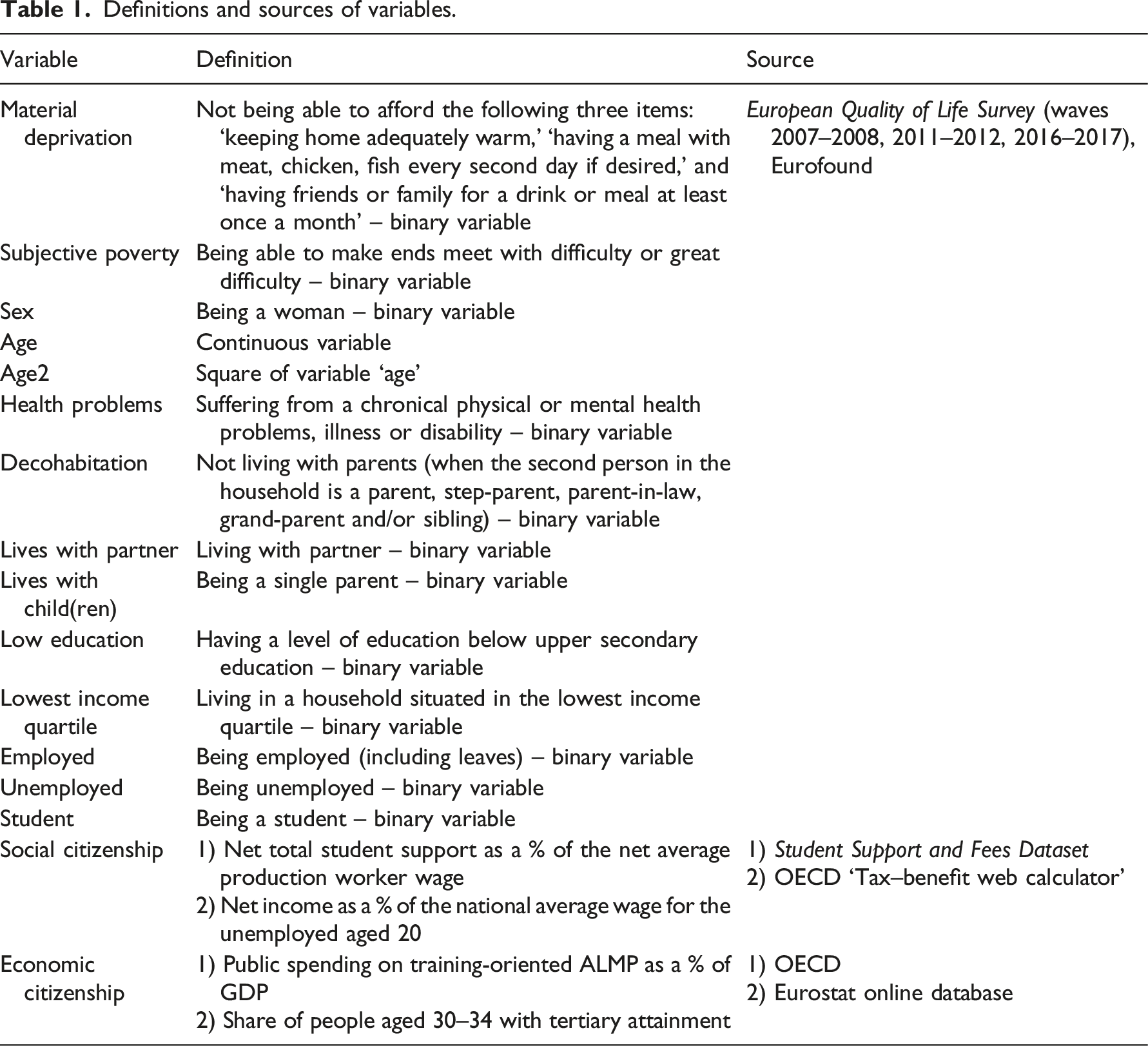
At the macro level, I have included three control variables: size of welfare state (social spending as a percent of GDP); macroeconomic conditions (economic growth measured as the annual change rate of GDP); and economic development (GDP per capita). All three of these variables come from the OECD data.
Statistical estimation
In this article, I proceed with multilevel regressions, given that the data structure is hierarchical and nested in different levels. The first level is micro with individuals. The second level relates to the different waves of the survey for each country (66 country-waves). The third level concerns 23 countries.
Because my two dependent variables are dichotomous, I have conducted multilevel (mixed) logistic regressions, 2 with random intercepts at both the country and the wave-within-country level. Such multilevel modelling accounts for compositional differences across countries in the sense that macro variables effects are net of micro variables (that is, net of countries’ demographic and labour market compositions – the micro variables included in the model). As robustness checks, I also include other macro-level variables as controls, and try different measures of my dependent variables, main independent variables, and other statistical estimations (supplemental material).
Results
Multilevel analyses
At the macro level, there seems to be significant cross-national variation on both youth poverty indicators (Figure 1).
3
Whereas Nordic countries usually display the highest levels of youth income poverty (see above), we can see that if we change the measure of poverty using material deprivation and subjective poverty, they present to the contrary the lowest levels in Europe: the Nordic paradox of youth poverty seems to be indeed a statistical artefact of the income measure of poverty, confirming the use of other measures. Both individualized social citizenship and social investment-oriented economic citizenship are negatively correlated to both youth poverty indicators (Figure A5 in the supplemental material), following H1 and H2. Young people in a situation of subjective poverty and material deprivation (%) per country (average of the three waves). Source: EQLS (2007-2011-2016).
Results of multilevel logistic regressions (DV: young people’s material deprivation).
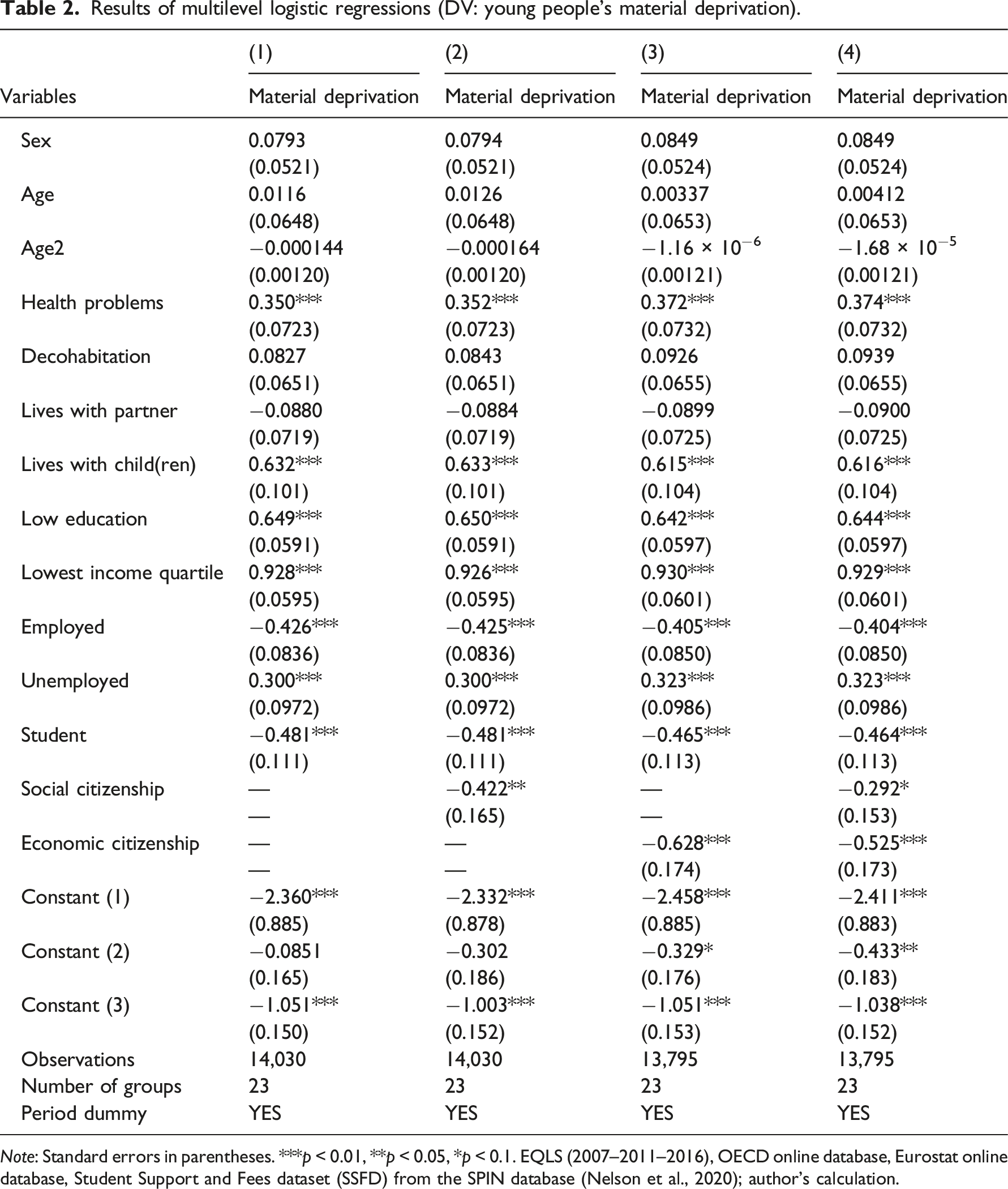
Note: Standard errors in parentheses. ***p < 0.01, **p < 0.05, *p < 0.1. EQLS (2007–2011–2016), OECD online database, Eurostat online database, Student Support and Fees dataset (SSFD) from the SPIN database (Nelson et al., 2020); author’s calculation.
Results of multilevel logistic regressions (DV: young people’s subjective poverty).

Note: Standard errors in parentheses. ***p < 0.01, **p < 0.05, *p < 0.1. EQLS (2007–2011–2016), OECD online database, Eurostat online database,
To better interpret these results, Figure 2 shows the predicted probabilities of being in a situation of material deprivation (top) and of feeling poor (bottom) depending on levels of social citizenship (left) and economic citizenship (right). This allows us to both compare the overall effect of the welfare state on the two different measures of young people’s poverty (comparing figures at the top with figures at the bottom) and distinguish these effects according to the dimension of the welfare state considered (comparing figures on the left with figures on the right). Predicted probabilities of young people’s material deprivation and subjective poverty across levels of social and economic citizenships.
First, it appears that both dimensions are most effective at reducing material deprivation: predicted probabilities of being in a situation of material deprivation falls from more than 0.2 to less than 0.05. For instance, all other things being equal, young people living in a country like Greece, where social citizenship is strongly familialized (thus limiting access to income support), are more likely to suffer from material deprivation by about 15 points in comparison with those living in a country like Sweden, with highly individualized social citizenship. The likelihood of being in a situation of material deprivation is almost divided by five in a highly individualized and social investment welfare state. However, predicted probability of feeling poor ranges from more than 0.15 to less than 0.05, regardless of dimension. All other things being equal, young people living in a country like Slovakia, where the level of investment in their human capital is low, are more likely to feel poor by about 15 points, in comparison with those living in a country like Denmark, where investment in human capital is high. Though this difference remains significant, it is smaller than the reduction of material deprivation produced by the two dimensions of the welfare state, since the probabilities are divided by three. To complement previous results, Figure 2 thus allows us to say that the welfare state can reduce young people’s material deprivation even more than it reduces their subjective poverty.
Second, the difference between the two dimensions seems to be confirmed. The effect of economic citizenship on material deprivation is stronger than that of social citizenship: in other words, social investment does have an immediate and concrete effect on young people’s material situation, probably by fuelling the availability of good quality jobs and the increase in productivity, more than through access to social benefits. Yet for subjective poverty, it is the other way around: the effect of social citizenship on economic strain is stronger, in comparison with the effect of economic citizenship. In addition to the material consequence of accessing benefits, social citizenship also seems to make young people feel more secure, which is not the effect primarily put forward in the literature on poverty and the welfare state, since it tends to focus on income-related issues. Still, this last difference is small, and does require further investigation. In terms of robustness checks, I have run complementary analyses in several steps and they largely confirm my results (see supplemental material for a detailed description).
Conclusion
In a context of increasing difficulties for young people, to what extent can the welfare state buffer youth poverty? This article seeks to answer this question by evaluating the macro level determinants of youth poverty in Europe, using three waves of Eurofound’s EQLS. To that end, I decided to take a different path from that taken by most studies on youth poverty by choosing not to use the income measure of poverty, which raises a range of statistical issues when applied to young people. Instead, I have used two other indicators: material deprivation and subjective poverty. By using these indicators of youth poverty, the Nordic paradox is resolved since they display low levels of poverty: their high level of youth income poverty is mostly an artefact of the monetary measure of poverty applied to young people. Multilevel modelling has allowed estimation of the effects of two distinct dimensions of the welfare state: social citizenship (access to income support) and economic citizenship (investment in human capital).
On the one hand, the individualization of social citizenship (considering young people as full adult social citizens), which permits wider access to income support, reduces both material deprivation and subjective poverty among young people. In fact, the familialization of social citizenship (considering young people as children) prevents young people from claiming and receiving social benefits in their own right, and this has two effects: a material effect on young people’s standard of living, and a cognitive effect on how young people think about their own inclusion in society. Furthermore, this phenomenon can also more generally reinforce or counteract inequalities among young people: familization, by giving to the family of origin a crucial role in supporting young people, can reproduce inequalities across families and thus young people, while individualization, by giving support regardless of the family, would help reduce inequalities among them. On the other hand, investment in young people’s human capital also reduces both their material deprivation and their subjective poverty. In terms of material deprivation, investment in young people’s human capital seems a positive move, in support of the social investment strategy.
Despite, however, its having a similar negative effect on poverty in general, some surprising results have emerged in terms of the strength of the effect of the welfare state dimensions on the two youth poverty indicators. In fact, social citizenship seems to have a stronger effect on subjective poverty than it does on material deprivation. This is puzzling, in the sense that the literature on poverty and the welfare state has largely focused on income inequalities – emphasizing the redistributive effect of the welfare state (Brady and Bostic, 2015; Korpi and Palme, 1998). This result calls for further analysis on the effect of the welfare state on subjective poverty.
These results enrich the literature in several ways. The first is by contributing to the comparative literature on poverty and inequalities through systematic investigation of the specific situation of young people. Though they represent a segment of the population hit particularly hard by economic and social difficulties, surprisingly few studies address the issue of youth poverty and how welfare states can manage such an issue. The second is by contributing to the literature on the ‘new welfare state’ (Bonoli and Natali, 2012) by theorizing the two dimensions of the welfare state that are relevant to youth poverty, and showing empirically how well they perform in poverty reduction. Sticking to ‘welfare generosity’ does not allow a full understanding of how the welfare state can alleviate poverty among young people; it is necessary to theorize how the welfare state structures entry into adulthood and young people’s access to autonomy. The third way is by contributing to the literature on social investment by arguing that social investment does indeed reduce poverty despite the existence of studies arguing that social investment leads to a Matthew effect at the expense of the poor. I show not only that it has a negative effect on subjective poverty (which could relate to a classic human capital story over the life course), but also that it produces objective effects on material deprivation among young people, as described in the ‘social investment life-course multiplier’ theorized by Plavgo and Hemerijck (2020).
Still, more research is needed on youth poverty and how the welfare state can handle such an NSR, especially concerning the issue of housing. In fact, to understand young people’s entry into adulthood, their access to housing is part of the story, but it requires a more thorough investigation not only of the housing market, which should be addressed at the infra-national level in order to fully take into account differences between territories, but also of the housing policy of the state. This was beyond the scope of this article but should be addressed in further research.
Supplemental Material
sj-pdf-1-esp-10.1177_09589287231176778 – Supplemental Material for Can the welfare state reduce youth poverty? The determinants of material deprivation and subjective poverty among young people in Europe
Supplemental Material, sj-pdf-1-esp-10.1177_09589287231176778 for Can the welfare state reduce youth poverty? The determinants of material deprivation and subjective poverty among young people in Europe by Tom Chevalier in Journal of European Social Policy
Footnotes
Declaration of conflicting interests
The author(s) declared no potential conflicts of interest with respect to the research, authorship, and/or publication of this article.
Funding
The author(s) received no financial support for the research, authorship, and/or publication of this article.

Supplemental Material
Supplemental material for this article is available online.
Notes
References
Supplementary Material
Please find the following supplemental material available below.
For Open Access articles published under a Creative Commons License, all supplemental material carries the same license as the article it is associated with.
For non-Open Access articles published, all supplemental material carries a non-exclusive license, and permission requests for re-use of supplemental material or any part of supplemental material shall be sent directly to the copyright owner as specified in the copyright notice associated with the article.
