




Abstract
This study examines the political determinants of parenting leave policy across 21 OECD countries from 1970 to 2021. While prior research has linked parenting leave expansion to social democratic and Christian democratic governments, this paper argues that party positions in the two-dimensional ideological space—socio-economic left–right and socio-cultural libertarian–authoritarian—better explain policy preferences. Using mixed-effects ordered logit models, the analysis reveals that socio-cultural rather than socio-economic positions drive parenting leave expansion. Governments with libertarian socio-cultural orientations are more likely to extend paid maternity, paternity, and parental leave for both mothers and fathers. These findings remain robust even when controlling for party family, indicating that the influence of Christian democratic and social democratic governments stems from their shifts towards libertarian positions. The study provides new insights into the partisan determinants of parenting leave policy, highlighting the role of socio-cultural competition in shaping welfare state transformations in post-industrial democracies.
Introduction
Parenting leave policy has become a focal point in welfare state research, reflecting broader tensions between labour market participation and caregiving responsibilities. As advanced democracies navigate demographic shifts and evolving gender norms, understanding the political determinants of parenting leave schemes is crucial for explaining welfare state transformations in the context of post-industrialisation. In particular, parenting leave policies illustrate how welfare states balance care responsibilities with labour market participation, making them a key component of social investment strategies.
However, while existing research has identified social democratic and Christian democratic parties as key promoters of parenting leave expansion (Ellingsæter, 2014; Engeman, 2023; Engeman and Burman, 2023; Ferragina and Seeleib-Kaiser, 2015; Fleckenstein, 2011; Fleckenstein and Lee, 2014; Huber and Stephens, 2000; Morgan, 2013; Morgan and Zippel, 2003; Von Gleichen and Seeleib-Kaiser, 2018; Wiss and Wohlgemuth, 2023), the mechanisms driving partisan support remain under-theorised. Many studies rely on party family affiliation as a proxy for policy preferences, without distinguishing the types of leave policies that different parties support. On the one hand, social democratic governments have generally promoted gender-egalitarian leave policies—such as well-paid maternity and parental leave for mothers and non-transferable, well-paid quotas for fathers—consistent with broader commitments to equality (Ellingsæter, 2024; Ellingsæter and Leira, 2006; Engeman, 2023; Huber and Stephens, 2000; Korpi, 2000). However, the assumption that economic egalitarianism automatically translates into gender equity preferences is rarely interrogated. On the other hand, Christian democratic parties have traditionally supported long, low-paid parental leave and home care allowances, reinforcing a male-breadwinner model (Morgan and Zippel, 2003). Yet, in recent decades, some Christian democratic governments have updated their work-family reconciliation strategies by endorsing better-paid, shorter leaves and institutionalising ‘daddy quotas’ (Fleckenstein, 2011; Fleckenstein and Lee, 2014; Morgan, 2013; Wiss and Wohlgemuth, 2023). These empirical variations highlight the limitations of the party family approach: it cannot adequately differentiate among party preferences for functionally distinct parenting leave schemes, nor can it account for evolving policy preferences within the same party family. Overall, we still lack a clear understanding of the ideological dimension that underlies partisan preferences for different types of parenting leave policies.
This study argues that socio-cultural, rather than socio-economic, dimensions structure the politics of parenting leave. To move beyond party family as an explanatory factor, this study draws on theories of post-industrial electoral realignment (cf. Beramendi et al., 2015; Häusermann, 2010; Hooghe and Marks, forthcoming; Kitschelt, 1994, 1995, 2004; Kriesi et al., 2008), feminist social policy (Ciccia and Verloo, 2012; Fraser, 1994; Leitner, 2003; Lister, 1994; Saraceno, 2016; Saraceno and Keck, 2010), and the social investment state (Giuliani, 2022, 2023, 2024; Häusermann, 2018). Unlike other welfare policies that primarily involve income redistribution, parenting leave policies regulate gender norms, family models, and work-family balance. Hence, policy positions on the socio-cultural axis are more influential for parenting leave programmes than those on the socio-economic axis. Parties with socio-cultural libertarian orientations, which advocate individual autonomy and gender egalitarianism, are more likely to support paid maternal, paternity, and parental leave schemes. By contrast, authoritarian parties, which uphold traditional family structures, tend to resist such expansions. This ideological lens helps explain not only cross-party differences but also the internal evolution of party platforms over time.
To test this argument, this study employs mixed-effects ordered logit models on a dataset of 21 Organisation for Economic Co-operation and Development (OECD) countries (1970–2021). This approach accounts for the hierarchical structure of the data, with country–year observations nested within governments, thereby ensuring robust estimates of partisan effects.
The findings reveal that socio-cultural cleavages, rather than left–right economic positions, drive parenting leave expansion. Libertarianism on cultural issues—not economic leftism—predicts longer paid leave schemes for both mothers and fathers. These results show that debates over parenting leave are not merely distributive conflicts but also ideological struggles over gender norms and family models. By demonstrating that parenting leave policymaking is shaped by socio-cultural competition, this study contributes to broader discussions on welfare state transformation, social investment, and the realignment of party systems in post-industrial democracies.
This article proceeds as follows: The next section reviews the literature on parenting leave policy and its political determinants, followed by the development of a two-dimensional model of party-preference formation for parenting leave schemes. Later, the paper presents its data, estimation strategy, and empirical findings. Finally, the conclusion summarises the key arguments and discusses this study’s contributions to comparative political economy and welfare state research.
Literature review
Among leave policy studies, terminology varies across countries and disciplines. Following the latest handbook on leave policy (Dobrotić et al., 2022: 4), the term parenting leaves is used here as an umbrella concept covering all types of leave that allow parents to care for young children. Maternity leave is generally regarded as a health-related entitlement for mothers, intended for use in the period immediately before, during, and following childbirth. Similar to maternity leave, paternity leave is defined as the leave available to fathers around the time of a child’s birth. Parental leave is defined here as a care-related entitlement granted to both mothers and fathers following the conclusion of maternity or paternity leave. While clarifying these distinctions is essential for conceptual precision, understanding the drivers of these leave policies remains equally important.
Most sociological and political studies on parenting leave programmes analyse these schemes as part of broader efforts to support women’s employment, comparing their generosity across countries in the context of Esping-Andersen’s (1990) well-known welfare regime theory. However, while cross-national comparisons have contributed to our understanding of parenting leave systems, fewer works have examined their political determinants. Among those that do, two main approaches dominate: one emphasises women’s political representation, while the other focuses on political partisanship.
Feminist welfare regime theories
Feminist social-policy scholars have challenged Esping-Andersen’s (1990) welfare regime typology for overlooking the gendered aspects of welfare states, and have developed alternative regime typologies that incorporate gender relations by comparing family policies, including parenting leave schemes, across countries (Bettio and Plantenga, 2004; Ciccia and Verloo, 2012; Dearing, 2016; Gornick et al., 1997; Javornik, 2014; Javornik and Kurowska, 2017; Kurowska, 2018; Leitner, 2003; Meyers et al., 1999; Ray et al., 2010; Saxonberg, 2013; Szelewa and Polakowski, 2023). These studies are significant because they embed parenting leave policy within the wider welfare state structure, clarifying how different regimes shape gender relations.
However, regime typologies classify policies but do not explain their emergence and development. While these studies categorise parenting leave schemes, they do not account for the political dynamics that drive their adoption and expansion. To understand these dynamics, it is necessary to examine political determinants beyond categorising each country’s parenting leave and childcare policies.
Women’s political representation
A second body of feminist research highlights the role of women’s political representation in shaping parenting leave schemes (Atchison, 2015; Atchison and Down, 2009; Kittilson, 2008; Koole and Vis, 2010; Lambert, 2008). Several studies argue that a higher proportion of female legislators is associated with earlier adoption and greater generosity in parenting leave policies (Kittilson, 2008; Lambert, 2008). Other studies argue that female cabinet ministers also play a role in advancing women-friendly policies, including parenting leave schemes (Atchison, 2015; Atchison and Down, 2009). While this research provides important insights into the role of women’s representation, it does not fully explain why governments with similar gender compositions pursue different approaches to parenting leave. Political ideology and party competition may also shape these policy outcomes.
Political partisanship
Another strand of the literature focuses on government partisanship and electoral competition. The expansion of family policy—including parenting leave schemes—has traditionally been associated with social democratic parties, particularly in Scandinavian countries (Borchorst and Siim, 2008; Ellingsæter, 2024; Huber and Stephens, 2000; Iversen and Stephens, 2008).
More recent works highlight the role of Christian democratic parties in continental Europe, showing how they have adapted parenting leave policies to changing labour market dynamics and electoral pressures (Alvariño and Thies, 2025; Blum, 2010; Ferragina and Seeleib-Kaiser, 2015; Fleckenstein, 2011; Fleckenstein and Lee, 2014; Morgan, 2013; Morgan and Zippel, 2003; Von Gleichen and Seeleib-Kaiser, 2018). Morgan (2013) argues that centre-right parties adapt family policy positions in response to the erosion of their traditional voter base and emerging electoral incentives, particularly to attract dealigned or previously under-mobilised women voters. Alvariño and Thies (2025) also argue that centre-right parties, as consenters rather than protagonists, may support expansive parental leave policies when compelled by coalition or support partners. Schwander (2018) further claims that the realignment of supporters of Christian democratic and social democratic parties is linked to the modernisation of family policy. Additionally, recent studies highlight the role of partisanship in the adoption of earmarked leave for fathers (Ellingsæter, 2014; Engeman, 2023; Wiss and Wohlgemuth, 2023).
Although these studies have advanced our understanding of the political determinants of parenting leave, they remain limited in their ability to generalise mechanisms across party types. Common to these studies is an attempt to challenge the existing power resources theory. Within its framework, which has viewed the welfare state as a tug–of–war between capital and labour, social democratic parties, on the side of labour, have been regarded as the drivers of family policy (cf. Korpi, 2000).
However, since parenting leave programmes cannot be reduced to redistributive policies that protect workers against social risks ex post, recent studies have focused on the role of centre-right parties, particularly Christian democratic parties (Fleckenstein, 2011; Fleckenstein and Lee, 2014; Morgan, 2013; Morgan and Zippel, 2003). In this context, centre-right parties have used policies that promote women’s employment, including parenting leave policies, as a means of retaining their support base, which has been transformed by de-industrialisation and the feminisation of the labour market (see also Schwander, 2018). The paternity leave and parental leave for male parents have also been similarly analysed (Engeman, 2023). Notably, the party family approach is ill-suited for theorising changes within centre-right parties that have shifted their policies from preserving a male-breadwinner family model—low-paid, extended parenting leave—towards promoting women’s employment through better-paid, shorter leave for both mothers and fathers (Morgan, 2013; Morgan and Zippel, 2003). This approach also does not explain why some Christian democratic parties have a positive effect on such policies, while secular centre-right parties and populist radical right parties have a negative effect. To fully understand these variations, we must move beyond party-family classifications and identify the ideological and strategic factors that shape party preferences.
Two–dimensional model of party strategy for family policy
This study integrates insights from research on post-industrial electoral realignment (cf. Beramendi et al., 2015; Häusermann, 2010; Hooghe and Marks, forthcoming; Kitschelt, 1994, 1995, 2004; Kriesi et al., 2008), feminist welfare state theory (e.g., Ciccia and Verloo, 2012; Fraser, 1994; Leitner, 2003; Lister, 1994; Saraceno, 2016), and the social investment state (Giuliani, 2022, 2023, 2024; Häusermann, 2018) to argue that party preferences for parenting leave policy reflect their position in a two-dimensional space of political competition. In advanced industrial democracies undergoing economic and social transformation due to the transition to a knowledge economy, the emergence of post-materialistic values has reshaped political competition from a one-dimensional left–right divide to a two-dimensional structure (cf. Ignazi, 1992; Inglehart, 1977, 1990). In this space, the socio-economic left–right axis intersects with the socio-cultural libertarian–authoritarian axis. 1 Parenting leave policy is not solely about income redistribution; it also reflects societal norms on gender roles in both labour market participation and caregiving responsibilities within families. Consequently, party positions within this two-dimensional space shape their preferences for parenting leave schemes.
In this regard, the feminist social policy literature helps relate the design features of leave policies to partisan preferences in the two-dimensional space. This research tradition juxtaposes familialism and de-familialism: the former enables families to internalise the care function and tends to reinforce a gendered division of care work, whereas the latter reduces individuals’ reliance on family for care and supports women’s economic independence (Leitner, 2003: 358; see also Lister, 1994: 37; McLaughlin and Glendinning, 1994: 65). However, familialism does not necessarily contradict de-familialism: many welfare states combine familialising and de-familialising measures—so-called ‘optional familialism’—such as extensive public childcare services alongside in-home childcare subsidies (Leitner, 2003: 360; Lohmann and Zagel, 2016; Zagel and Lohmann, 2020). To identify the antagonistic design choices within parenting leave policy, following Daly (2011: 7), this study treats individualisation as the opposing pole to familialisation for analysing the direction of family policy reforms (see also Lewis, 2001; Lohmann and Zagel, 2016). 2 Individualisation denotes a principle framed around self-sufficiency and independence, tied to activating every individual and group for participation in the labour market (Hobson, 2004: 75), whereas familisation refers to strengthening family-based care organisation and traditional gendered roles (i.e., male-breadwinner/female-caregiver model). As Leitner (2003: 358) notes, parenting-leave policies are familialising insofar as they allow the family to internalise its caring function. Yet, depending on their specific design, they can also foster individualisation by facilitating mothers’ smooth return to paid work after childbirth and reinforcing their economic autonomy. Longer leave schemes with low wage replacement are associated with familialisation through mothers’ withdrawal from paid work and the reproduction of the male breadwinner/female caregiver model, whereas shorter, better-paid maternity and parental leaves advance individualisation by mitigating labour-market exit and supporting women’s economic autonomy (Akgunduz and Plantenga, 2013; Boeckmann et al., 2015; Misra et al., 2011). Moreover, non-transferable quotas reserved for fathers (e.g., ‘daddy months’) shift unpaid care towards a more egalitarian division and thus contribute to individualisation (Brandth et al., 2022; Kotsadam and Finseraas, 2011; Pylkkänen and Smith, 2004).
The socio-cultural dimension is especially decisive in the policy-making of parenting leave schemes. Parenting leave policy—granting employment-protected leave for childbirth and early childcare—assumes a model in which mothers re-enter the workforce after a temporary care period. Thus, preferences for parenting leave schemes are shaped not only by economic ideology but by each party’s normative conception of gender roles and family organisation (see Ciccia, 2022)
In this study, the socio-cultural dimension of party competition is conceptualised as a continuum from familialisation to individualisation. As discussed above, familialisation promotes care being performed within the family—typically by mothers—whereas individualisation emphasises individual autonomy and state/market support to reconcile work and care responsibilities. Authoritarian parties are located toward the familialisation end and stress traditional family structures with caregiving primarily assigned to women. By contrast, libertarian parties are located toward the individualisation end and back policies that promote individual autonomy, gender equality, and shared caregiving, including gender-neutral leave schemes and externalisation of childcare. This dimension aligns with feminist typologies that distinguish, on the one hand, models relying on a gendered division of labour within the family and, on the other hand, models in which (mostly female) caregivers are entitled to economic and social independence supported by the state and/or market (e.g., Fraser, 1994; Leitner, 2003; Lewis, 1992; Lister, 2003).
Figure 1 illustrates how party preferences for family-support policies align with their position in the two-dimensional ideological space. Party strategies on parenting leaves vary with their placement along these two axes. Partisan differences on the two-dimensional ideological space. Source: Created by the author.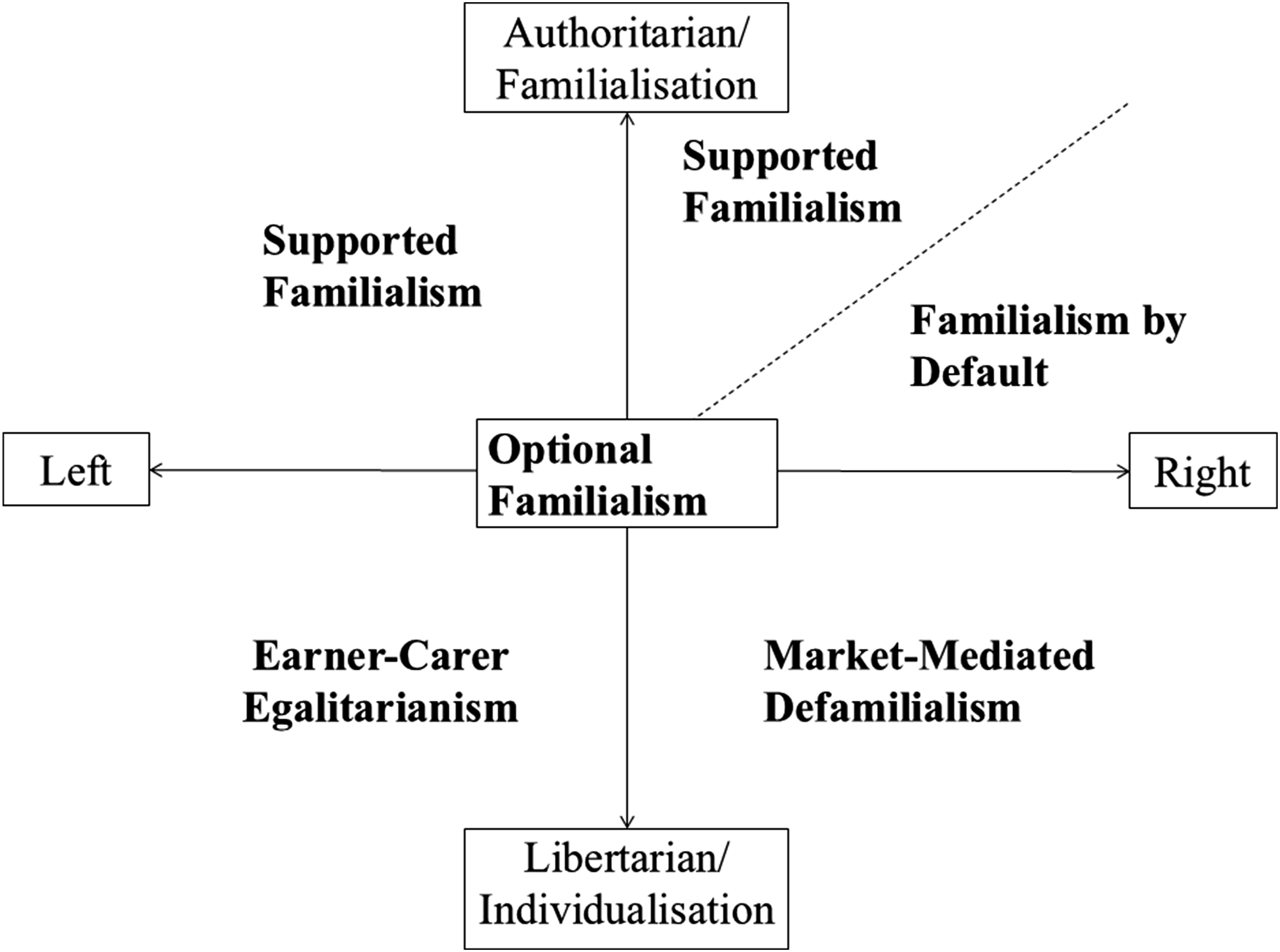
Left-libertarian parties (third quadrant) adopt earner-carer egalitarianism, also termed the dual-earner/dual-caregiver model, which ‘envisions a social economic outcome in which men and women engage symmetrically in both paid work and in unpaid caregiving; as such, it is fundamentally gender egalitarian’ [italics in original] (Gornick and Meyers, 2008: 322). The welfare state supports care provided by parents and by others, socialising childcare costs and equalising access to quality services across income groups. Left-libertarian parties readily expand the public role to correct social inequalities and externalise unpaid care work at home, viewing this as essential to women’s independence and self-realisation. Earner-carer egalitarianism is consistent with their ideological orientation on both socio-economic and socio-cultural dimensions.
From this vantage point, parenting-leave design poses a dual challenge. On the one hand, without job-protected leave around pregnancy, childbirth, and early childcare, many women may exit the labour market, undermining the goal of independence through paid employment. Left-libertarian parties therefore advocate adequately paid maternity and parental leave during the period of intensive infant care. On the other hand, excessively long leaves, especially when low paid, risk human-capital deterioration (e.g., Boeckmann et al., 2015; Misra et al., 2011) and statistical discrimination in hiring and promotion (cf. Mandel and Semyonov, 2005; Mandel and Semyonov, 2006). Accordingly, when weighing expanding infant-care services versus extending leave duration, left-libertarian parties tend to prioritise the former; and where they do expand leave, they emphasise adequate wage replacement to prevent economic penalties for leave takers.
In addition, left-libertarian parties are typically favour in structuring parenting-leave entitlements on an individual—not family—basis through extending paternity leave and non-transferrable parental-leave quotas reserved for fathers. Because family-level entitlements tend to default to mothers, they can reinforce the traditional family model. By contrast, individual, use-it-or-lose-it rights for each parent raise fathers’ uptake and prevent leave from concentrating on mothers. Increasing fathers’ uptake of leave directly address the current imbalance in which women disproportionately bear temporary labour market exits due to childbirth and childcare (Brandth et al., 2022) and moves policy towards Fraser’s ‘universal caregiver’ ideal (Fraser, 1994), even where such measures impose additional costs on employers, social-insurance systems, or public finances.
Right-libertarian parties in the fourth quadrant of the figure pursue market-mediated de-familialism, which corresponds to ‘de-familialisation via the market’ (Esping-Andersen, 1999; Saraceno and Keck, 2010: 676–677). They support women’s economic independence and shared care, but prefer market provision and fiscally lean instruments over tax-financed expansion of public services. In this logic, the welfare state’s role is to enable choice and maintain labour-market attachment—not to build large universal programmes. This logic promotes time-limited parenting-leave entitlements that prevent labour-market exit, coupled with non-transferable parental-leave quotas reserved for fathers where feasible, alongside childcare expansion through market (e.g., private provision, vouchers, and tax credits) rather than broad public-sector growth.
From this perspective, long and generous leave schemes that raise tax burdens or embed strong statutory obligations are viewed as counterproductive because they risk encouraging extended withdrawal from paid employment and expanding the public budget. By contrast, shorter, well-targeted leave with strong return-to-work incentives is acceptable when it sustains employment and keeps fiscal exposure contained.
Meanwhile, right-libertarian parties tend to be more supportive of individual leave entitlements and father-targeted measures as they align with goals such as promoting women’s independence through labour market participation and fostering a more equitable distribution of domestic care work between genders. However, they only support these policies if they do not lead to a higher tax burden or public sector expansion. If non-transferable leave quotas reserved for fathers do not affect the scale of redistribution, right-libertarian parties have no reason to oppose expanding this type of programmes.
Left-authoritarian parties in the second quadrant of the figure are characterised by supported familialism—a policy logic in which the state underwrites care performed within families, typically through cash transfers, tax instruments, and longer, often transferable parenting-leave entitlements, which not seeking to rebalance the gendered division of unpaid care work. As Saraceno (2016: 316) puts it, these are policies that, via direct or indirect transfers, help individuals within families uphold their financial and/or caring responsibilities. In distributive terms, parties in this quadrant readily expand the public role to support family care but they are cautious about externalising care to public services or the market, and they do not prioritise measures aimed at equalising caregiving between men and women. 3
From this vantage point, parenting leave is used to stabilise a maternal-care norm while accommodating rising female labour-market participation. Where labour-market entry by mothers becomes widespread due to de-industrialisation and service-sector expansion, left-authoritarian parties are more likely to maintain or extend maternity and parental leaves for mothers than to invest heavily in early-childhood education and care (ECEC) services (cf. Morgan and Zippel, 2003). Longer and low-paid leave schemes enable temporary exits from paid work during infancy while aligning with the ideal of ‘mothers caring for their own infants at home’. By contrast, broad expansion of public childcare services is viewed as crowding out family care.
Consistent with this logic, these parties are generally reluctant to expand paternity leave or to promote non-transferable parental-leave quotas reserved for fathers. Short paternity leave may be tolerated on family-oriented grounds, but father-reserved, non-transferrable entitlements, such as ‘daddy’s months’, are opposed as social-engineering tools that disrupt established gendered roles within the family. In sum, the left-authoritarian quadrant supports redistribution to families and time at home through parenting leaves, but does not deploy leave design to challenge the male-breadwinner/female-caregiver model (Saraceno, 2016; Von Gleichen and Seeleib-Kaiser, 2018).
Right–authoritarian parties in the first quadrant of the figure are expected to adopt either supported familialism or familialism by default, depending on their location within the quadrant. Saraceno (2016: 316) defines the latter as a policy logic that ‘occurs when there are no, or very scarce, publicly provided alternatives to family care and/or financial support for needy family members’. While economically moderate but socially authoritarian parties seek supported familialism, socially moderate but free-market liberal ones pursue familialism by default. Right–authoritarian parties seek to maintain traditional gender norms while avoiding an expansion of the public sector. Consequently, even when faced with the transition to the knowledge-based economy and feminisation of the labour market, these parties tend to act as a consenter rather than a protagonist in adapting to social change (cf. Korpi, 2006). As a result, while this type of parties consistently seeks supported familialism in some cases (e.g., CDU/CSU in Germany), it oscillates between supported-familialism and familialism by default (e.g., Christian Democrats in Italy) (Blome, 2017).
From this ambiguous position, right–authoritarian parties take a nuanced approach to parenting leave policies for mothers. Following the logic of supported familialism, on the one hand, they sometimes support extending maternity and parental leave periods to enable mothers care for their infants at home. On the other hand, they oppose reducing spousal dependence by making a paid parenting leave arrangement more generous because it reflects neither supported familialism nor familialism by default.
By contrast, these parties are unlikely to expand parenting leave programmes for fathers. Even if the financial burden is minimal, policies that encourage men’s active participation in childcare and promote a more equitable gender division of domestic care work are seen as social-engineering interventions that contradict the ‘natural’ principle that ‘women should raise children at home during infancy’. As long as these parties uphold the male breadwinner/female caregiver model (see, e.g., Lewis, 1992; Von Gleichen and Seeleib-Kaiser, 2018), they have no reason to support the promotion of paternity leave and non-transferrable parental leave with quotas earmarked for fathers.
Finally, this study locates optional familialism at the centre of the two-dimensional ideological model. Recent research shows that many welfare states assemble hybrid bundles combining familialising and de-familialising measures—often termed optional familialism (Leitner, 2003; Lohmann and Zagel, 2016). Substantively, this can take the form of concurrent support, for example, well-paid, non-transferable parental leave quotas for fathers (de-familialising) alongside home-care allowances (familialising). Centrally positioned coalitions—drawing from different quadrants—may converge on such mixes owing to coalition bargaining, pronatalist aims, or work-life balance objectives. Although this study does not explicitly test this policy logic, it incorporates its theoretical possibility into the model.
From the two-dimensional party competition model described thus far, this study tests the following hypotheses:
In the following sections, this study tests these four hypotheses based on data.
Research design
This study analyses the effects of government partisanship on the introduction and expansion of parenting leave schemes. We begin by describing how the dependent variables are measured, followed by an explanation of the independent variables. Next, we outline the measurement of control variables. Finally, we explain this study’s analytical approach.
Dependent variables
This study employs, as its dependent variables, the duration of job-protected leave legally entitled to mothers and fathers. The public budget allocated to maternity- and parental leave programmes is not a valid measure of their generosity, as these are mainly regulatory schemes. Instead, this study focuses on legislative changes to maternity, paternity, and parental leave schemes across governments in 21 OECD countries from 1970 to 2021 (OECD, 2023). 4 The rationale for examining policy changes in leave schemes rather than their absolute duration is the assumption that government partisanship influences changes in public programmes rather than their absolute level.
Furthermore, this study analyses changes in parenting leave legislation using a trichotomous coding system. For instance, a reform that adds four weeks to an existing leave period may carry different implications depending on the country and time period. This can be illustrated by comparing the impact of four additional weeks of parental leave in a system in which only pre- and post-birth maternity leave exists with that in one in which a year of parental leave is already in place. If the absolute increase in weeks were used as the dependent variable, the effect of government partisanship would be estimated under the assumption that its impact was uniform across all countries and time periods, leading to significant estimation errors. 5 To address this, this study simplifies the dependent variable into a trichotomous measure, where +1 indicates an expansion of parenting leave, −1 indicates a reduction, and 0 indicates no change, regardless of the magnitude of the expansion or reduction.
Since a reduction in the duration of a specific parenting leave scheme does not necessarily indicate a retrenchment of entitlements, dichotomous variables are also employed for robustness checks. Indeed, governments may reduce the maximum length of paid or unpaid leave entitlement for mothers. Such changes are often aimed at introducing greater flexibility—particularly by enabling leave-sharing with fathers. For instance, in 1996, Austria reduced the duration of paid parenting leave available to one parent from 24 to 18 months, but this effectively introduced a six-month father quota, as the total length of parenting leave granted per child remained the same at 24 months (OECD, 2022: 3). The dichotomous variables are coded as +1 if parenting leave is extended, and 0 otherwise, regardless of whether the policy remains unchanged or is shortened.
To test the four hypotheses, this study examines five dependent variables: total paid leave, total unpaid leave, total long leave, paid paternity leave and total paid leave for fathers. First, ‘total paid leave’ indicates whether the right to paid, employment-protected maternity and parental leave for mothers is expanded or reduced from the previous year. For Hypothesis 1, this is restricted to schemes with a duration of no more than one year after childbirth. Second, ‘total unpaid leave’ records whether the right to job-protected but unpaid maternity and parental leave for mothers is expanded or reduced from the previous year. For Hypothesis 2, this is likewise limited to schemes of no more than one year after childbirth. Third, for Hypothesis 3, ‘total long leave’ records whether the right to job-protected maternity, parental, and extended leave available to mothers beyond the point at which a relevant child reaches one year of age is expanded or reduced from the previous year. Fourth, ‘paid paternity leave’ indicates whether the right to paid, job protected leave for fathers, which is usually short leave of absence for employed fathers at or in the first few months after childbirth, is expanded or reduced. Fifth, ‘total paid leave for fathers’ records whether the right to paid, employment–protected leave reserved (or effectively reserved) for the exclusive use of the father is expanded or reduced. The total paid leave for fathers includes paid paternity and father-reserved portions of parental leave. The last two indicators test Hypothesis 4 and capture policy efforts to redefine fathers’ roles in child-rearing and challenge traditional gender norms.
Independent variables
This study uses two indicators as explanatory variables—the socio-economic left–right policy position and the socio-cultural libertarian–authoritarian policy position—to estimate each political party’s position in the two-dimensional ideological space. To measure each party’s policy position, the study relies on party-manifesto data collected by the Manifesto Project (MRG/CMP/MARPOR) (Budge et al., 2001; Klingemann et al., 2006; Lehmann et al., 2024). While various methods exist to estimate policy positions from manifesto data, this study adopts the logit scale developed by Lowe et al. (2011). This scale is based on the logarithm of the ratio between the frequencies of quasi-sentences assigned to ‘right’ versus ‘left’ (or ‘authoritarian’ versus ‘libertarian’) categories.
The logit transformation is theoretically and empirically superior to traditional additive or proportional difference measures: it avoids problematic scale boundaries, reduces distortion caused by the total manifesto length or issue salience, and better captures perceived differences in policy emphasis by reflecting the diminishing marginal impact of each additional sentence. Specifically, each party’s socio-economic and socio-cultural policy positions are defined as follows:
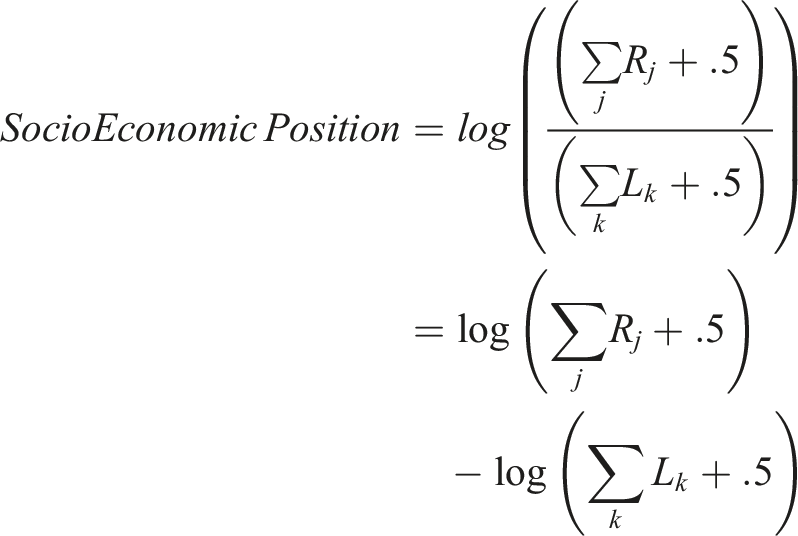
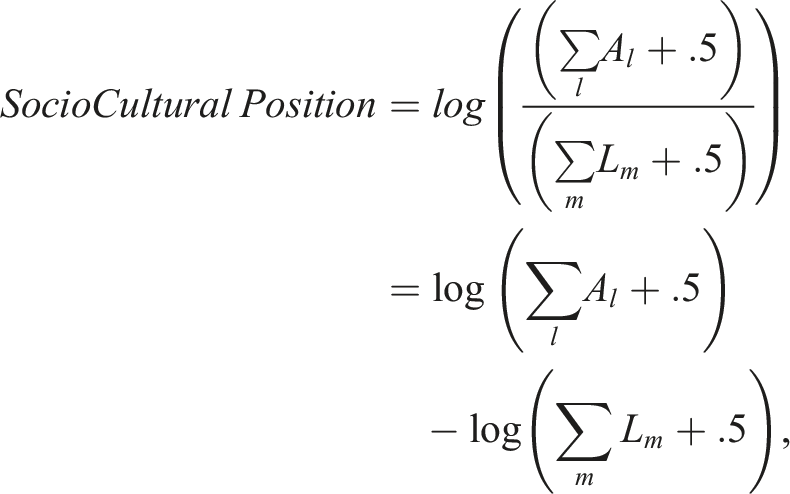
After measuring each political party’s policy positions in the two-dimensional policy space, the study estimates government-level policy positions. For this purpose, two composite indicators are constructed: government socio-economic left–right policy position and government socio-cultural libertarian–authoritarian policy position. These indicators represent the average policy positions of governing parties, weighted by each coalition party’s seat share within the governing coalition in the lower house. Data on government formation and dissolution dates, duration, number of seats, and parties in government were obtained from Woldendorp et al. (2000), Armingeon et al. (2023), and European Journal of Political Research Political Data Yearbook (various issues). Finally, the annual government policy positions are standardised by subtracting the overall median of each position variable, so that a value of zero represents the median position on each dimension.
Figure 2 presents a scatter plot between the socio-economic left–right and the socio-cultural libertarian–authoritarian policy positions. The figure indicates that the socio-economic and socio-cultural policy positions are weakly correlated (Pearson’s r = 0.276). In addition, each symbol represents the party family of the largest governing party among the ruling coalition. As this figure illuminates, the variation in government-policy positions along the socio-economic and socio-cultural dimensions is evident even within the same party family. Notably, some social democratic governments are positioned in the centre–authoritarian space, while certain Christian democratic governments align with the left-libertarian space. These findings reinforce the validity of this study’s approach—directly measuring government-policy positions rather than using party family as a proxy. Scatter plots between socio-economic and socio-cultural policy positions. Source: See the main text.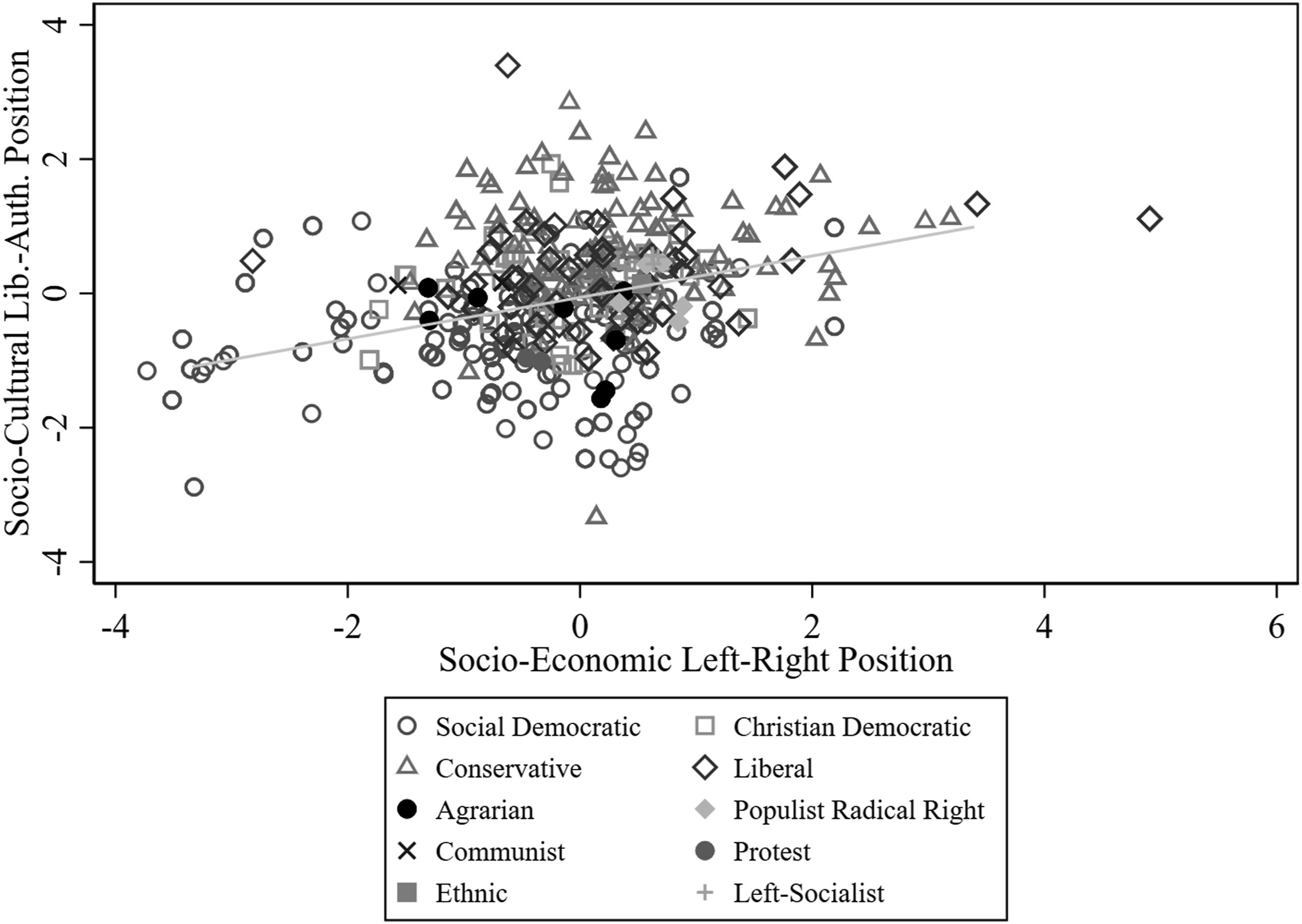
Control variables
To accurately estimate the impact of government-policy positions in the two-dimensional policy space on the expansion of parenting leave schemes, this study incorporates several control variables into its regression models.
First, this study claims that party positions in the two-dimensional ideological space, rather than party-family affiliation, drive parenting leave policy. To test this, the regression models include party family as a control variable. If policy positions serve as the causal mechanism linking party-family affiliation to parenting leave development, the effects of policy positions should remain statistically significant even after controlling for party family. 7
As identified in the literature review, the most compelling alternative to the partisanship model is the women’s political representation hypothesis, which claims that—regardless of government partisanship—higher political representation of women leads to the expansion of maternity- and parental leave programmes for mothers and promotes measures encouraging men to take paternity and parental leave. Because the present study focuses on party ideology rather than representation, it treats women’s representation as a control rather than a theory to be tested. Accordingly, the models include the percentage of female legislators, alongside period dummies to absorb time-specific shifts in the salience and meaning of representation (see below). As such, the coefficient is interpreted as a control, not a causal parameter of primary interest.
To account for supranational influences, this study includes three EU-directive dummies. The EU Directive (1996) dummy corresponds to Council Directive 96/34/EC (framework agreement on parenting leave) and is coded 1 for EU member states from 1 January 1997 onward, 0 otherwise. The EU Directive (2010) dummy corresponds to Council Directive 2010/18/EU (revised framework agreement on parenting leave) and is coded 1 for EU member states from 1 January 2010 onward, 0 otherwise. The EU Directive (2019) dummy corresponds to Directive (EU) 2019/1158 (work–life balance for parents and carers) and is coded 1 for EU member states from 1 January 2020 onward, 0 otherwise. Non-EU countries are coded 0 for all three indicators.
This study also controls for economic, socio-structural, and business-cycle factors, which may influence parenting leave expansion. Since the transition to a post-industrial service economy and the feminisation of the labour market create new demands for work-family reconciliation policies, the models include the service sector employment rate, the female labour force participation rate, and the log of gross domestic product (GDP) per capita as indicators of these structural changes. Additionally, since advanced democracies often respond to declining birth rates by expanding public programmes that help families to reconcile paid employment with caregiving responsibilities (cf. Von Gleichen and Seeleib-Kaiser, 2018), the total fertility rate is included in the regression models. Since governments may also encourage temporary labour market exit through various leave schemes during periods of labour surplus and economic downturn (cf. Morgan and Zippel, 2003), the study includes the real GDP growth rate and unemployment rate as indicators of business-cycle fluctuations.
Finally, to control for broader historical trends in parenting leave expansion, the models include dummy variables for the 1970s, 1980s, 1990s, and 2000s, with observations from 2010 onwards serving as the reference category. These variables account for period effects common to all advanced democracies. Taken together, the inclusion of period dummies and time-trending macro-structural covariates allows the regression models to partial out secular shifts in gender norms across affluent democracies. Consequently, estimates for government policy positions are interpreted conditional on, and effectively net of, these temporal controls (see Table A2 in the Supplemental Material for details on variable definitions and data sources).
Estimation strategy
To analyse variations in government programmes across nations and over time, researchers must carefully design quantitative analyses as analytical methods significantly impact outcomes. While panel-data analyses of time-series and cross-sectional (TSCS) data based on country–year observations are widely used in comparative political economy, the structure of annualised TSCS data presents challenges for identifying partisan effects (cf. Garritzmann and Seng, 2016; Plümper et al., 2005; Schmitt, 2016). Standard approaches, which involve analysing annual TSCS data using a lagged dependent variable, panel-corrected standard errors, and/or unit–fixed effects, correlate yearly changes in a dependent variable with independent variables (cf. Beck and Katz, 1995). However, since partisan composition rarely changes annually but shifts at elections, these methods artificially inflate observations, leading to underestimated standard errors and overly confident estimates (Garritzmann and Seng, 2024: 8)
To address these methodological issues, this study adopts mixed-effects models (Garritzmann and Seng, 2024; Gelman and Hill, 2006). This approach allows for estimating fixed effects, which are uniform across units, and random effects, which are heterogeneous across units. The data in this study can be viewed as a hierarchical structure in which country–year observations are nested within cabinets, which are further nested within countries. By controlling for variations at both the cabinet and country levels as random effects, this approach ensures more accurate estimates of the effects of government-policy positions. Additionally, standard errors are clustered by country to account for unit heterogeneity.
This study employs a mixed-effects ordered logit model. The dependent variables measure reductions, absences, or expansions of legal amendments to parenting leave legislation and cannot be treated as continuous variables as the distances from −1 to 0 and from 0 to 1 lack inherent meaning. Consequently, a mixed-effects ordered logit model is used.
As a robustness check, this study reports results from a mixed-effects complementary log-log (cloglog) model. When the dependent variables are dichotomised into years with expanding parenting leave and years without expansion, they exhibit an asymmetrical distribution, as years without amendments vastly outnumber those with amendments. Since logit and probit models assume symmetry in the dependent variable, the cloglog model better accounts for this asymmetry.
To address the time dependence of dependent variables, this study adopts the cubic polynomial approximation (Carter and Signorino, 2010). Since the dependent variables are trichotomous and not independent of each other, the probability of an event partially depends on the time elapsed since the previous event. If time dependence is not modelled, the estimated coefficients of explanatory variables may be biased. To control for this, this study records the number of years since the previous event occurred and includes the duration, its square term, and its cubic term in the regression models.
Finally, all partisan variables are one year lagged as it is assumed that a government in year t–1 influences the public policy implemented in year t. While government composition may not immediately affect parenting leave programmes, the effects of government-policy positions are expected to take time to materialise.
Empirical findings
Regression of the changes of parenting leave policy on government policy position by using mixed-effects ordered logit models (1970–2021).
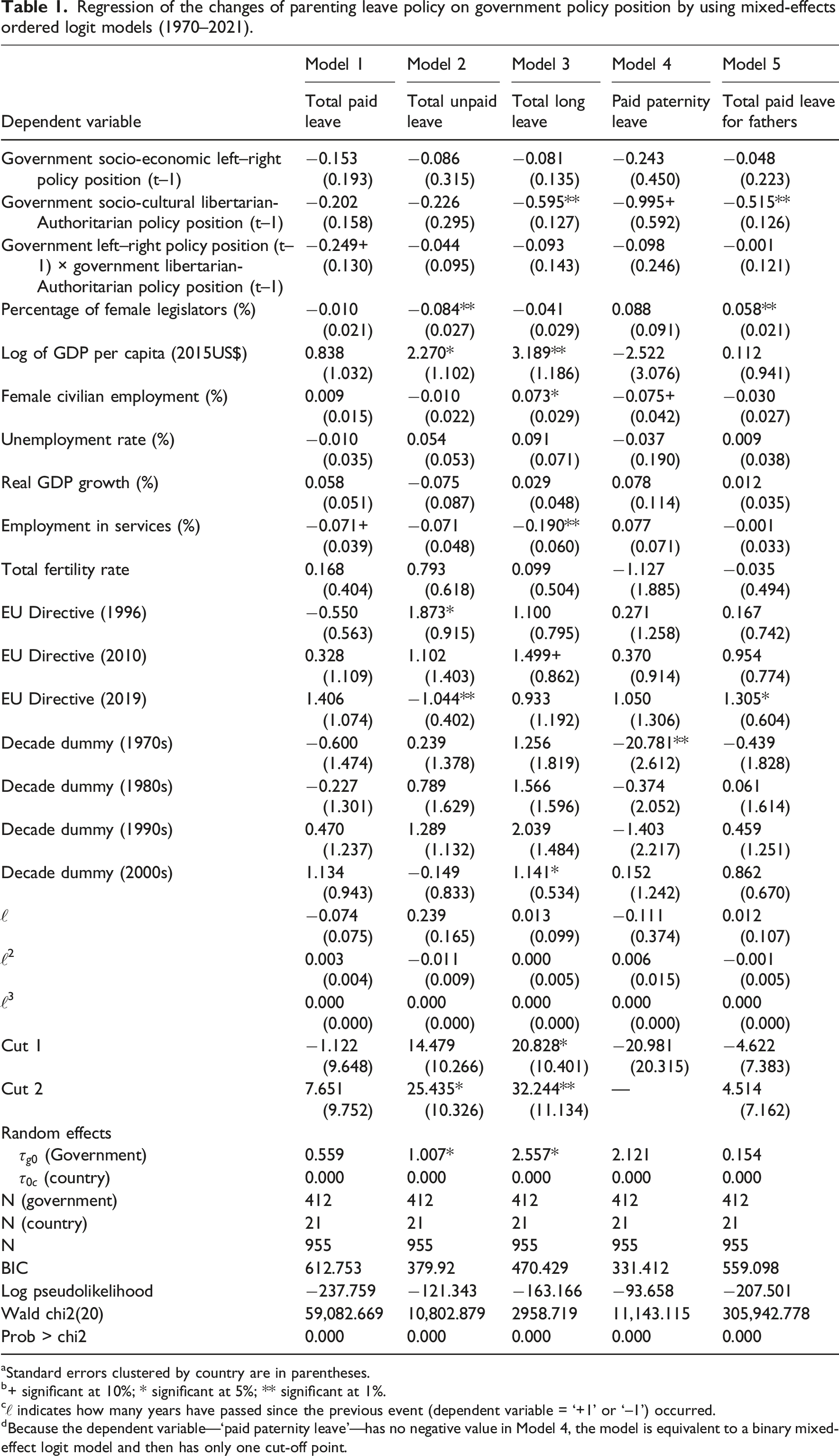
aStandard errors clustered by country are in parentheses.
b+ significant at 10%; * significant at 5%; ** significant at 1%.
cℓ indicates how many years have passed since the previous event (dependent variable = ‘+1’ or ‘–1’) occurred.
dBecause the dependent variable—‘paid paternity leave’—has no negative value in Model 4, the model is equivalent to a binary mixed-effect logit model and then has only one cut-off point.
The analysis also examines whether the interaction between a government’s socio-economic and socio-cultural policy positions influences the expansion of parenting leave schemes. The interaction effects were estimated using the variance–covariance matrix of each regression model (cf. Brambor et al., 2006; Kam and Franzese, 2007) with the results presented in Figure 3(a)–(e). Average marginal effects of a government’s socio-cultural libertarian–authoritarian position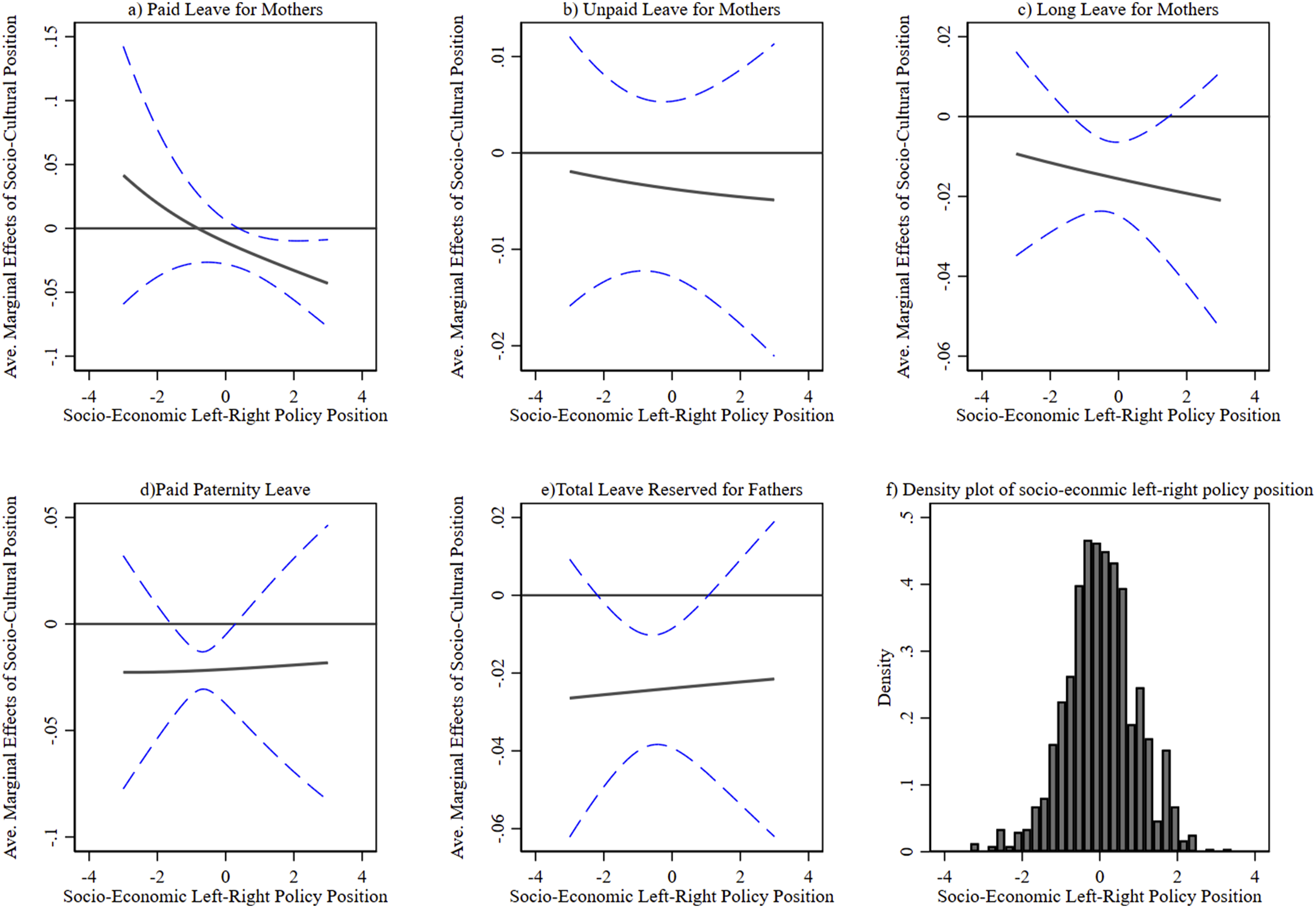
Figure 3(a) reveals that paid maternity and parental leave for mothers are more likely to expand under centre-to right-libertarian governments, contradicting the expectation in Hypothesis 1 that left-libertarian governments would be the primary drivers of short, paid parenting leave expansion. The socio-economic position variable remains statistically insignificant 8 , while left-libertarian governments exhibit no discernible impact on paid parenting leave expansion. This pattern is theoretically plausible once we consider policy trade-offs consistent with the two-dimensional model: right-libertarians tend towards market-mediated de-familialism and want to reduce fiscal burdens, while left-libertarians prioritise gender equality supported by public institutions even if they put burdens on public budget. The German case during and after unification is illustrative: while the CDU/CSU-led coalition government pursued to prolong the leave entitlements, the SPD pressed for more childcare facilities for infants under three years old (Blome, 2017: 150–153; Erler, 2009: 122–124). Quantitative evidence likewise links left-libertarian governments to increases in public childcare expenditure (Hieda, 2013). Taken together, the interaction result and these empirical evidence suggest that although being on the libertarian side of the socio-cultural dimension is a prerequisite for expanding paid parenting leave, when faced with a trade-off between expanding public childcare services for infants and providing paid parental leave, centre-right governments are more likely to choose the latter.
Figure 3(b) estimates the impact of a government’s socio-cultural libertarian–authoritarian position on unpaid parenting leave for mothers. Contrary to Hypothesis 2, the figure shows that the socio-cultural libertarian positions have a positive but insignificant effect as the 95% confidence interval covers zero across the entire socio-economic dimension. This result demonstrates that socio-cultural policy positions alone do not provide a consistent explanation for unpaid parenting leave expansion.
Regarding long-term parental leave for mothers, the results challenge the assumption in Hypothesis 3 that authoritarian governments are the primary drivers of these policies. Contrary to our expectation, Figure 3(c) indicates that the socio-cultural libertarian position has a statistically significant and positive effect on long-term parental leave expansion among moderate governments on the socio-economic dimension. This finding suggests that long-term parental leave is not exclusively used to reinforce the male breadwinner model but serves multiple political objectives. For instance, a left-libertarian government, such as the Trudeau government in Canada, extends the length of parental leave to make it more flexible as a means of achieving gender equality (Blum et al., 2018: 90–110), whereas a left-authoritarian government, such as the Sorsa government in Finland, may prolong ‘home care leave’ to accommodate agrarian party demands and allow mothers to care for children at home (Lammi-Taskula and Takala, 2009).
The results for fathers’ parenting leave expansion largely support Hypothesis 4, confirming that governments in more socio-culturally libertarian positions are more likely to expand paid paternity leave and parental leave reserved for fathers. Figure 3(d) shows a positive, statistically significant association between a government’s socio-cultural position and the likelihood of expanding paid paternity leave. Figure 3(e) also shows a positive, statistically significant effects for total paid leave available to fathers (paternity plus father-reserved parental leave). These findings reinforce the idea that the policy schemes of non-transferable parenting leave quotas for fathers reflect socio-cultural attitudes towards gender roles and family structures.
To establish the robustness of these findings, three additional model specifications were tested. The first set of robustness checks controls for party-family affiliation by including party-family variables in the models (Appendix B in the Supplemental Material). Figure B1(a–e) illuminates that the average marginal effects of a government libertarian–authoritarian position are almost the same as those in the original models exemplified in Figure 3. These results confirm that party families themselves have no direct impact on parental leave policy once government-policy positions are accounted for.
The second set of robustness checks replaces the government socio-cultural libertarian–authoritarian policy position with the government individualisation–familialisation policy position, which more narrowly captures the gender dimension of family policy (Appendix C in the Supplemental Material). 9 Figure C2 shows that, although the estimated marginal effects on ‘paid leave for mothers’ are only marginally significant, the substantive conclusion is unchanged: governments scoring higher on individualisation are more supportive of reforms that challenge traditional, gendered family models.
The third set of robustness checks involves re-estimating the models using a mixed-effects complementary log-log (cloglog) model to assess whether the results are sensitive to model specification with a binary dependent variable (Appendix D in the Supplemental Material). This model specification is also theoretically more plausible. As discussed in the section on dependent variables, very few governments have curtailed parenting leave entitlements; rather, they have shortened the leave period to facilitate sharing between fathers and mothers. The findings from mixed-effects cloglog models are consistent with those obtained from the mixed-effects ordered logit models, indicating that the core empirical findings are robust to the changes in both the specification of the dependent variable and the estimation technique.
Overall, the results demonstrate that parenting leave policy is primarily contested along the socio-cultural rather than the socio-economic dimension. Governments with socio-cultural libertarian positions are more likely to expand parenting leave schemes, while those with authoritarian positions are more resistant to such expansions. These results provide compelling evidence that parenting leave policymaking is shaped more by socio-cultural party competition than by the traditional left–right economic one.
Conclusion
This study examined the political determinants of parenting leave policy in affluent democracies. Existing partisan studies have claimed that Christian democratic and social democratic governments play a central role in expanding parenting leave programmes for mothers and fathers (Ellingsæter, 2014; Engeman, 2023; Engeman and Burman, 2023; Ferragina and Seeleib-Kaiser, 2015; Fleckenstein, 2011; Fleckenstein and Lee, 2014; Huber and Stephens, 2000; Morgan, 2013; Morgan and Zippel, 2003; Von Gleichen and Seeleib-Kaiser, 2018; Wiss and Wohlgemuth, 2023). However, these studies have largely failed to theorise and generalise the reasons why certain centre-right parties—particularly Christian democratic but not secular authoritarian or populist radical right parties—have supported parenting leave expansion. This study presented an alternative approach to the studies relying on party family classifications and argued that policy positions in the two-dimensional ideological space provided a more theoretically meaningful explanation.
The empirical analysis of TSCS data from 21 OECD countries from 1970 to 2021, using mixed-effects ordered logit models, provided strong evidence in support of this claim. The findings demonstrated that libertarian governments in the socio-cultural dimension are the key drivers of parenting leave expansion. These governments not only develop paid parenting leave schemes for mothers but also extend the length of leave entitlements for fathers. The findings further demonstrate that Christian democratic and social democratic governments have expanded parenting leave in recent decades, not because of their party family affiliation, but rather because their socio-cultural positions have shifted towards the libertarian end of the spectrum. This shift is likely due to structural and electoral pressures (cf. Fleckenstein and Lee, 2014; Morgan, 2013; Schwander, 2018), reinforcing the argument that party family labels are insufficient to explain the trajectory of parenting leave policy.
This study’s contribution to the literature is threefold. First, it clarifies the mechanism linking party family to parenting leave policy, addressing a longstanding gap in research that has largely treated this relationship as a ‘black box’. Second, it advances the literature on social investment by examining the ideological dimension along which recommodifying rather than decommodifying policies are contested. While prior research has extensively explored the functions and variations of the social investment state (cf. Bonoli and Natali, 2012; Esping-Andersen, 2002; Garritzmann, 2021; Garritzmann et al., 2022a, 2022b; Hemerijck, 2017; Morel et al., 2012), it has not sufficiently examined the political cleavages underlying these policies. This study challenges the conventional view that social investment policies, which focus on human capital development and labour market (re)integration, are contested along the socio-economic dimension in the same way as cash-transfer programmes. Instead, it demonstrates that parenting leave policies, as a core component of the social investment state, are primarily debated along the socio-cultural dimension rather than the traditional redistributive left–right spectrum.
Third, this study contributes to research on post-industrial political realignment by demonstrating how the emerging socio-cultural cleavage has shaped the transformation of the welfare state. While previous research has extensively examined how socio-cultural attitudes influence individual-level welfare preferences (Brazzill et al., 2020; Bremer and Bürgisser, 2023; Busemeyer and Neimanns, 2017; Busemeyer and Sahm, 2022; Busemeyer and Tober, 2023; Eick et al., 2023; Fossati and Häusermann, 2014; Garritzmann et al., 2018, 2023; Häusermann et al., 2020, 2022; Häusermann and Kurer, 2022; Neimanns et al., 2018), relatively little attention has been paid to how party-level socio-cultural preferences are translated into actual welfare policies (except Beramendi et al., 2015; Bonoli, 2007, 2013; Häusermann, 2018; Hieda, 2013, 2021; Röth and Schwander, 2021). This study addresses this gap by demonstrating that parental leave expansion is shaped by the socio-cultural positions of governing parties rather than by party-family affiliation or socio-economic left–right positions.
Despite its contributions, this study has certain limitations. First, it does not account for the distributive aspects of leave policy. The analysis focused on whether governments extended the right to take job–protected leave for childbirth and caregiving. However, governments also influence the wage-replacement rate of benefits provided during leave. A government’s socio-economic left–right orientation is likely to affect this facet of leave policy, which may help explain why the left–right policy position variables did not reach statistical significance in this study. Future research should explore this issue in greater detail, particularly by investigating how governments with differing economic positions design the financing and generosity of parenting leave benefits. Second, while the regression models include period dummies and macro-structural covariates, the data do not permit complete identification of evolving gender norms across time and countries. Unobserved normative change may therefore remain in the error term and should temper strong causal claims. Third, this study did not empirically disentangle the complex interplay among structural changes such as deindustrialisation and the feminisation of the labour market, shifts in voter demand for work-family reconciliation policies, and parties’ strategic responses to these changes. Qualitative research shows that the erosion of traditional support base and the growing importance of young women voters have prompted centre-right parties to adopt employment-centred family policies (Fleckenstein, 2011; Fleckenstein and Lee, 2014; Morgan, 2013). Future studies should empirically test models that capture the strategic relationships between voters, parties, and policy choices (e.g., Schwander, 2018).
Supplemental Material
Supplemental Material - Beyond left and right: Socio-cultural determinants of parenting leave policy in advanced democracies
Supplemental Material for Beyond left and right: Socio-cultural determinants of parenting leave policy in advanced democracies by Takeshi Hieda in Journal of European Social Policy.
Footnotes
Acknowledgement
Previous versions of this paper were presented at European Conference on Politics and Gender (Ghent University, 8–11 July 2024), the Annual Conference of the Japan Association for Comparative Politics (online, 28–29 June 2025), and various seminars in Harvard University. I thank all participants for their feedback. I especially appreciate helpful comments from Agnes Blome, Mary Alice Haddad, Takeshi Ito, Junpei Suzuki, Linda White, and two anonymous reviewers.

Ethical considerations
This article does not involve any studies with human participants or animals.
Funding
The author disclosed receipt of the following financial support for the research, authorship, and/or publication of this article: This research is funded by JSPS KAKENHI Grant-in-Aid for Scientific Research(C) (grant no.: 22K01333) and Grant-in-Aid for Fund for the Promotion of Joint International Research (Fostering Joint International Research) (grant no.: 23KK0242).
Declaration of conflicting interests
The author declared no potential conflicts of interest with respect to the research, authorship, and/or publication of this article.
Data Availability Statement
The data that support the findings of this study are openly available in Harvard Dataverse (https://doi.org/10.7910/DVN/OTQX8U).
Supplemental Material
Supplemental material for this article is available online.
Notes
References
Supplementary Material
Please find the following supplemental material available below.
For Open Access articles published under a Creative Commons License, all supplemental material carries the same license as the article it is associated with.
For non-Open Access articles published, all supplemental material carries a non-exclusive license, and permission requests for re-use of supplemental material or any part of supplemental material shall be sent directly to the copyright owner as specified in the copyright notice associated with the article.
