




Abstract
Despite much research on citizens’ welfare deservingness considerations, the literature typically overlooks the diverse meanings individuals attribute to their stances on the issue. The same welfare deservingness stance might mean something fundamentally different across individuals, ranging from perceiving it as, for example, an issue of economic redistribution to an issue of cultural values. This diversity in meanings has significant implications for our understanding of welfare solidarity. While recent qualitative studies have explored these nuances, this study offers an innovative quantitative approach to uncover the distinct meanings citizens attribute to their welfare deservingness considerations. Utilizing correlational class analysis on data from an original representative survey of Dutch citizens (n = 2131), I uncover five distinct meanings of welfare deservingness: (1) conventional progressive versus conservative; (2) (dis)trust of ethnic others; (3) economic (anti-)chauvinism; (4) moralized redistribution; and (5) traditional versus inclusive solidarity. These different meanings each include individuals with both lenient and strict stances on welfare deservingness. The social bases of these meanings differ substantively, as groups with distinct characteristics adhere to them, based on differences in, for example, socioeconomic position, educational level, and political preferences. These findings reveal that different groups have fundamentally different things in mind when they think about the welfare deservingness of others. As this study provides a stepping stone for meaning-oriented research on welfare attitudes more broadly, its implications are discussed for social policy analysis, as well as avenues for future research.
Introduction
Citizens’ considerations about the welfare deservingness of others are fundamental to the study of welfare attitudes and as such to the field of social policy analysis. A thorough understanding of these considerations is key, as they reflect public perceptions of welfare solidarity and conditionality. However, what citizens actually mean when they think about welfare deservingness might differ substantially. This study analyzes these differences by uncovering the meanings citizens attribute to welfare deservingness considerations.
These considerations reflect how and why citizens view social groups as deserving of welfare (cf. Larsen, 2006; Meuleman et al., 2020; Van Oorschot 2000, 2006), and they illustrate how logics of redistributive justice are applied to the issue of welfare (Miller, 1999; Rothstein, 1998). It is well established that welfare deservingness considerations are structured along various criteria. For example, according to the need criterion, welfare deservingness opinions are informed by on one’s capacity to provide for oneself, while the reciprocity criterion concerns the contribution of one’s due (financial) share to the social security system (cf. Van Oorschot, 2000, 2006). As such, much research has demonstrated that these varying welfare deservingness perceptions exist at a general level, yet such studies often fall short of truly capturing people’s own understandings due to the analytical and methodological constraints inherent in deductive approaches (e.g., Mau, 2003; Van Oorschot, 2000).
Recently, several studies have addressed this limitation, by employing small-n qualitative methods to explore citizens’ deservingness considerations, highlighting the variation in how these are applied (e.g., Heuer and Zimmerman, 2020; Laenen et al., 2019; Nielsen et al., 2020). A key implication of this emerging line of research suggests that different groups have different things in mind when they think about welfare deservingness. This offers a novel take on the principal question in the field concerned with ‘who should get what, and why?’ Indeed, two people might similarly endorse the need criterion, but one may do so for reasons inspired by economic incentivization, while another might do so for reasons inspired by cultural convictions. As such, the two attribute vastly different meanings to their seemingly similar scores on this welfare deservingness criterion. Nonetheless, it remains unclear whether this holds true for the broader population, and what such differing perceptions of welfare deservingness entail more generally. This study therefore addresses the question of what citizens’ welfare deservingness considerations mean and what are the social bases of these meanings?
Drawing from studies examining the meanings citizens attribute to other contentious issues (DeKeyser and Roose, 2021; DiMaggio and Goldberg, 2018; Lindner et al., 2024; Van den Hoogen et al., 2022), I apply a novel statistical technique to uncover distinct meanings attributed to the issue of welfare deservingness across the population. By doing so, this study presents an innovative approach to examining welfare attitudes and serves to illustrate the broader relevance for the field of social policy analysis.
I make use of an original, representative survey conducted in 2020 in the Netherlands. This context is relevant for two reasons. First, the Dutch parliament features a wide range of political parties with diverse opinions on social policy and welfare deservingness, which is reflected in the variation in public opinion on welfare among Dutch citizens (ESS Round 8, 2016; cf. Lindner et al., 2022). Second, the Dutch population is fairly balanced when it comes to their welfare solidarity with disadvantaged social groups (ESS Round 8, 2016), meaning Dutch attitudes on the issue are not skewed towards any particular ideological stance. Consequently, findings based on this context reflect popular welfare attitudes commonly observed in other countries with similarly comprehensive welfare states, such as those in the Nordic and continental European countries.
Theory
Different perceptions of deservingness considerations
Citizens apply different criteria when assessing the welfare deservingness of others, reflecting how the public views the conditional legitimacy of target groups to receive social assistance (e.g., Larsen, 2006; Meuleman et al., 2020; Van Oorschot, 2000). These criteria are evaluated across five dimensions: control, attitude, reciprocity, identity, and need (CARIN) (Van Oorschot, 2000; Van Oorschot and Roosma, 2017). The control criterion refers to the degree of control individuals in need have over their situation. Attitude relates to the demeanor of those receiving aid, including their compliance with social security policies. The reciprocity criterion involves the extent to which recipients demonstrate willingness to reciprocate, such as through work. The identity criterion considers the alignment of recipients with the dominant culture. Finally, the need criterion assesses the perceived level of concrete financial need.
The deservingness criteria help reveal how target groups are ranked on their relative deservingness. Numerous studies have applied these to assess public opinion on welfare targeting (e.g., Gielens et al., 2019; Gugushvili et al., 2021a; Heuer and Zimmerman, 2020; Van Oorschot, 2000), to examine their cross-national application (e.g., Gugushvili et al., 2021a; Van Oorschot, 2006), and to track their evolution over time (e.g., Jeene et al., 2013). Moreover, these criteria have helped to explain the low support for welfare rights among ethnic minorities (e.g., Kootstra, 2016; Magni, 2022; Reeskens and Van der Meer, 2019) and lower socioeconomic classes (e.g., De Vries et al., 2022).
The existing literature has demonstrated that people’s stances on key issues in the domain of the welfare state – such as the extent of minimum income coverage or the eligibility of immigrants – are shaped by broader orientations, such as welfare cultures (Van Oorschot et al., 2008) and moral economies (Mau, 2003). These studies highlight that the political economy of the welfare state largely rests on the public legitimacy of norms and values regarding redistribution and solidarity. While these works have provided vital insights, they primarily approached these encompassing value systems from deductive and institutionalist perspectives, assuming that welfare regimes are informed by shared and relatively uniform moral frameworks of redistribution and solidarity (Mau, 2003; Van Oorschot et al., 2008). Consequently, little attention has been paid to the heterogeneity in how citizens themselves attribute meaning to welfare deservingness (cf. Gugushvili et al., 2021b). As a result, this line of research often implicitly assumes that citizens in a particular welfare context (i.e. intra-regime) attribute the same meaning to deservingness. This study seeks to address this gap by examining how citizens, within a single institutional context, ascribe differential meanings to welfare deservingness – thereby advancing the study of the cultural factor in social policy analysis.
In that sense, the Dutch context is strategically relevant because – like many other OECD countries – its social policy institutions have undergone substantial transformation. The generous welfare model of the late twentieth century was progressively narrowed from the mid-1990s onward, with entitlements increasingly restricted and policy shifting from welfare provision to work activation. This trajectory is not unique to the Netherlands; similar reforms have taken place across many welfare states (Horn et al., 2023). These institutional changes have heightened public support for welfare conditionality and selectivity (e.g., Achterberg et al., 2014), including concerns about the deservingness of immigrants (Eick, 2024). Additionally, the political prominence of the radical right – most notably Geert Wilders’ PVV – keeps such issues on the public agenda. Understanding how Dutch citizens make sense of welfare deservingness therefore provides insights that are both case-specific and relevant to other contexts experiencing comparable developments.
To illustrate what it implies that citizens attribute different meanings to their deservingness considerations more concretely, consider that it is likely that different groups interpret the same survey question on welfare deservingness in markedly different ways, shaped by the distinct meanings embedded in their evaluations. Take an often-used question from the European Social Survey (Round 8, 2016): “Should it be the government’s responsibility to ensure a reasonable standard of living for the unemployed?” One person might view this question primarily through an economic lens, agreeing because they believe that supporting the unemployed promotes macroeconomic stability and prevents adverse outcomes such as reduced consumer spending. Another person may interpret the same question through a cultural or moral lens, agreeing because they see poverty among the unemployed as a threat to societal cohesion, based on values like solidarity, compassion, and collective responsibility. Although both respondents express the same level of agreement with the item, they attribute fundamentally different meanings to it. Importantly, these divergent meanings imply that they may react in very different ways to concrete policy proposals. For instance, the first person might support a proposal to increase benefits for the unemployed when framed in terms of boosting purchasing power, while remaining unmoved by a moral framing that emphasizes injustice or the hardship of living without work. Conversely, the second individual may respond positively to a solidarity-based appeal but not to an economic stimulus rationale.
Taking these distinct meanings seriously therefore becomes crucial for understanding why public responses to social policy proposals – particularly those invoking solidarity, social justice, or conditionality – can diverge, even among individuals who express similar levels of support for particular welfare deservingness criteria. Because conventional approaches to welfare attitude research are typically unable to detect such underlying meaning structures, this study offers a first step toward a more fine-grained account of the belief systems that shape perceptions of welfare deservingness.
Recent qualitative research has already enriched our understanding of how citizens interpret welfare deservingness criteria, challenging the aforementioned dominant approach. Laenen et al. (2019) demonstrated that individuals from different countries consider criteria like control and reciprocity, sometimes extending beyond the established CARIN framework. Similarly, Heuer and Zimmerman (2020) found that while Germans may agree on rank-orderings of deservingness, their judgments are shaped by distinct underlying criteria. Lindner et al. (2022) further revealed that even when specific criteria are commonly emphasized, the reasoning behind their emphasis might vary widely.
Immigrant welfare deservingness has received particular attention in the recent qualitative turn in the field. Studies by Nielsen et al. (2020), Hänig (2019), and Theiss (2023) highlight how immigrant (un)deservingness considerations are shaped by individuals’ perceptions and predispositions toward target groups, with diverse and sometimes contradictory interpretations of criteria like neediness and reciprocity. At the institutional level, Singhaas (2021) found that German welfare workers often rely on heuristics rather than consistently applying deservingness criteria.
Building on these small-n qualitative studies, this study employs large-n quantitative data to explore how citizens attribute different meanings to their welfare deservingness considerations.
Uncovering meanings of contentious issues
What does it entail when citizens attribute a meaning to a contentious public issue? In essence, it comprises a particular understanding of the issue that is collectively shared by a group. This understanding highlights a cultural schema – a shared notion about the nature of the issue and its significance in relation to other socio-political phenomena (cf. Goldberg, 2011; Martin, 2000; Zerubavel, 1997).
The analytical approach employed in this study acknowledges that the same survey item measuring attitudes toward an issue may carry different meanings for different groups of people (cf. DiMaggio et al., 2018). These differences are reflected in the varying ways the item relates to other relevant issues. So, to uncover a distinct meaning shared among a group of citizens, it is essential to interpret how the issue under scrutiny relates to other relevant issues. This involves identifying unique patterns of relationships with relevant other attitudes, which can then be interpreted to reveal the different meanings attributed to the issue under scrutiny. As such, by examining how stances on welfare deservingness relate in unique ways to other relevant socio-political issues, the specific meanings attributed to welfare deservingness can be discerned.
This analytical approach, which uncovers distinct patterns of correlations across the same set of attitudes within a dataset, originates from cultural sociology (Boutyline, 2017; Goldberg, 2011; cf. Sotoudeh and DiMaggio, 2023). It reveals different systems of beliefs about a particular issue domain, which reflect distinct patterns in public opinion on an issue (Converse, 2006 [1964]). These are “configuration [s] of ideas and attitudes in which the elements are bound together by some form of constraint or functional interdependence” (Converse, 2006 [1964]: 3). Individuals sharing a belief system may disagree on the level of support for an issue, yet still agree on the underlying principles that define their stance (Martin, 2000). For instance, two people might hold opposing stances on whether a group deserves welfare, but their perception of the issue is through economic considerations, thus sharing a belief system. This aligns with Van Oorschot et al.’s (2008) notion of ‘welfare cultures,’ who noted that “Various groups in society may have their specific perceptions of the actual or preferred welfare culture, and welfare cultures may contain ambiguous and even contradicting elements” (p. 11). In this sense, belief systems operate at a higher level of abstraction, providing the broader interpretative lens through which individuals make more concrete evaluations of welfare deservingness.
In this study, I use the term belief system in a domain-specific sense: it refers not to a comprehensive worldview per se, but to patterned interrelations among attitudes on a given political issue and closely related issues. This follows the usage of the concept from more recent applications (Boutyline, 2017; Daenekindt et al., 2017; Goldberg, 2011), which treats belief systems as empirically detectable configurations of meaning within issue domains. Yet, in line with the traditional literature on belief systems, the adherence to issue-domain specific belief systems most likely reflects individuals’ broader socio-political beliefs. Moreover, the adherence to particular domain-specific belief systems should be considered as analytically separate patterns of meaning that have distinct evaluative logics.
The two fictitious belief systems in Figure 1 highlight how people’s attitudes interrelate differently across belief systems. Assuming the items measure support for a strict welfare deservingness stance, laissez-faireism, social distrust and ethnocentrism, the belief system on the left shows that welfare deservingness is linked positively to all three issues. Here, support for (opposition to) strict welfare deservingness aligns with support for (opposition to) laissez-faireism, social distrust, and ethnocentrism, reflecting a traditionally conservative meaning. Conversely, in the belief system on the right, a strict (lenient) welfare deservingness stance only correlates with support for (opposition to) laissez-faireism, and is unrelated to social distrust or ethnocentrism. In this case, welfare deservingness is based on economic conservatism. These belief systems illustrate how links between the issue of welfare deservingness and other relevant issues can vary between belief systems, revealing different meanings attributed to the issue under scrutiny. Fictitious belief systems. Nodes represent political attitudes, where “des” measures a strict welfare deservingness stance, “lais” measures laissez-faireism, “ethno” measures ethnocentrism, and “distru” measures social distrust. Wider and darker lines represent stronger correlations. Absence of lines means no correlation.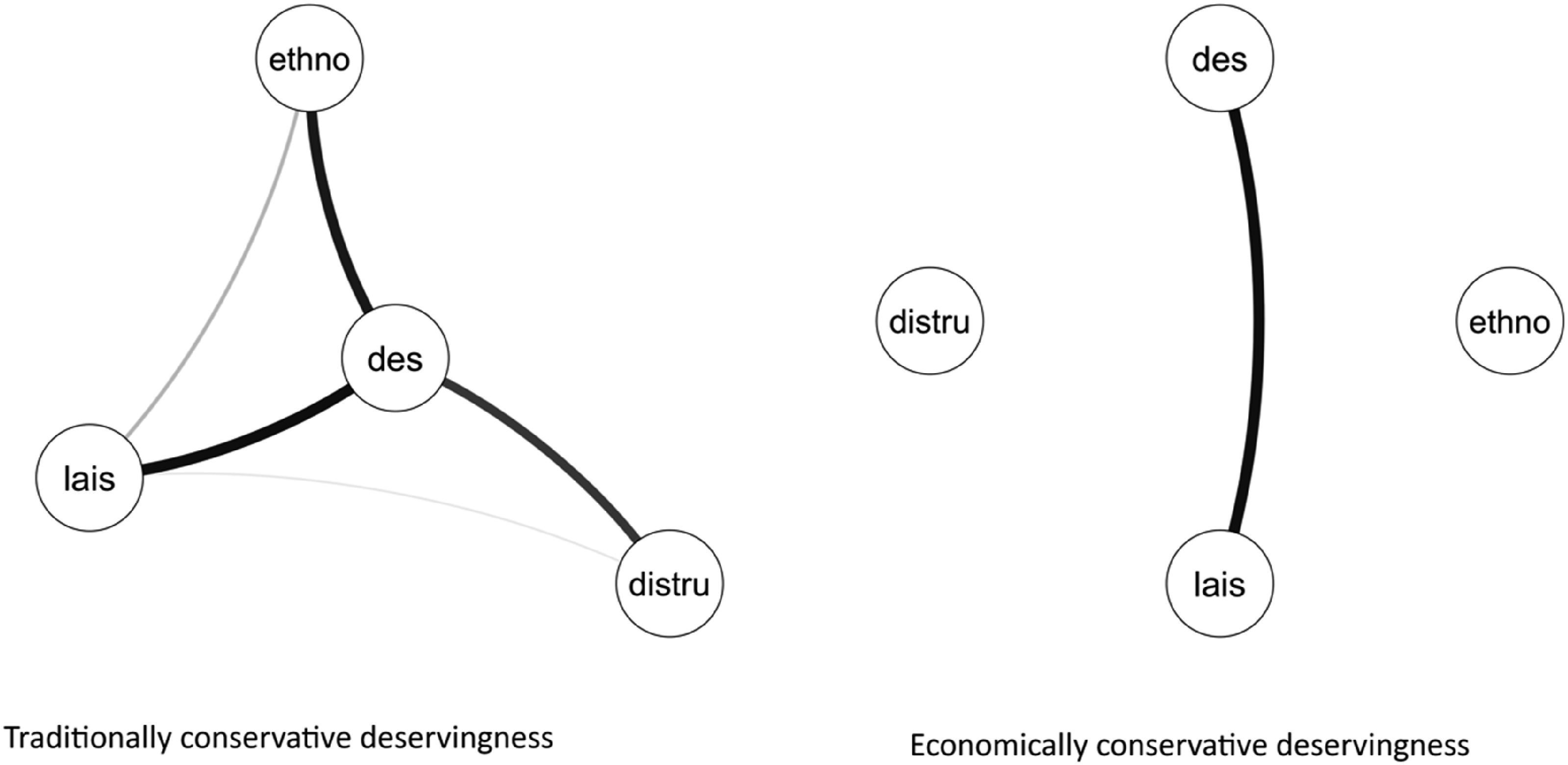
This approach to using belief systems to uncover distinct meanings attributed to political issues has established empirical merit, having been applied to various issues such as European Union support (Van den Hoogen et al., 2022), market attitudes (DiMaggio and Goldberg, 2018), and welfare chauvinism (Lindner et al., 2024).
Relevant political attitudes in the study of welfare deservingness
Revealing various belief systems in this study is accomplished by linking measures of welfare deservingness with factors that have been identified as relevant in prior research. These entail attitudes about economic redistribution, ethnocentrism, social trust, and religiosity. In the empirical sections of this study, these are operationalized into an analysis of how survey measures of these factors are interrelated.
First, evidently, concerns about economic redistribution are closely tied to welfare opinions (e.g., Svallfors, 1997; Van der Waal et al., 2007), particularly perceptions about the neediness of social groups (e.g., Van Oorschot, 2006). For instance, Gielens et al. (2019) found that beliefs about economic egalitarianism shape distinct attitudinal profiles on welfare deservingness, with supporters of egalitarian redistribution prioritizing the needs of others in their assessments.
Second, beliefs about ethnic others, ethnocentrism, play a key role in welfare deservingness considerations. Many studies link this to welfare chauvinism (cf. Careja and Harris, 2022; Leruth et al., 2024). Specifically, research on attitudes toward immigrants’ and ethnic minorities’ welfare deservingness consistently shows stricter evaluations compared to native groups (e.g., Gilens, 1999; Harell et al., 2016; Kootstra, 2016; Reeskens and Van der Meer, 2019).
Third, opinions on welfare deservingness relate to social (dis)trust in others and feelings of anomie (e.g., Achterberg et al., 2011; Gielens et al., 2019). For instance, research shows that social distrust is associated with support for more exclusionary beliefs about welfare dependency (Staerklé et al., 2020).
And fourth, beliefs about the strictness of religious convictions, or religious belief, affect welfare deservingness considerations. Van Oorschot’s (2006) seminal study established this link, showing that religious denomination shapes support for specific deservingness criteria — for instance, Protestantism’s association with the need criterion (Jeene et al., 2013).
Drawing on prior research that has examined the different belief systems on other sociopolitical issues (Daenekindt et al., 2017; Dekeyser and Roose, 2021; DiMaggio et al., 2018; DiMaggio and Goldberg, 2018; Lindner et al., 2024; Van den Hoogen et al., 2022), it can be expected that differences between the uncovered meanings attributed to deservingness reflect variation in the level of integration among the underlying attitudes. For some, welfare deservingness is likely to be closely intertwined with all above-mentioned attitudes, indicating a more integrated belief system that is reflective of more general conventional left- versus right-wing ideological alignments. For others, however, deservingness may be perceived as a more narrowly defined issue. For example, some may view deservingness chiefly through an economic lens, meaning their redistribution attitudes are more strongly correlated with their deservingness attitudes than with other attitudes. Again, others might interpret deservingness primarily through immigration attitudes, with ethnocentrism playing a more central role than other attitudes.
The social bases of welfare deservingness beliefs
To aid in interpreting the meanings attributed to welfare deservingness, I also analyze their social bases. By this, I refer to the social background characteristics that the literature on political attitude formation – and welfare attitudes in particular – has shown to be central in shaping people’s worldviews. These backgrounds influence how individuals relate to political institutions and the development of social policies (cf. Hall, 1997; Mau, 2003; Svallfors, 1997). In practice, I descriptively compare respondents across belief systems on a set of factors known to inform welfare deservingness considerations. This reveals the distinct social characteristics of each belief system, which in turn aids their substantive interpretation.
An important indicator of people’s worldviews concerns their socioeconomic position (e.g., DiMaggio and Goldberg, 2018), which is notably relevant for issues about economic redistribution (e.g., Achterberg and Houtman, 2009; Alesina and La Ferrara, 2005). Income, more specifically, is a crucial indicator of welfare attitudes (Van der Waal et al., 2007) and redistribution (e.g., Jæger, 2013). As such, income serves as a factor that is used to examine the unique social characteristic of a belief system. Moreover, work status is an important indicator of livelihood precarity, and thus of the extent to which individuals may worry about making ends meet. Such socioeconomic positions inform egotropic orientations toward welfare, a factor whose significance has been well documented (e.g., Kuziemko et al., 2015; Meuleman, 2019; Van Oorschot, 2006).
Similarly, education is a key factor shaping people’s worldviews (Zerubavel, 1997). This is for various reasons, such as being an indicator of one’s economic opportunities, and, more concretely, as a proxy for one’s cognitive abilities or political sophistication (Bovens and Wille, 2017). Specifically, it also correlates with deservingness opinions, as lower education levels are, on average, linked to a stronger emphasis on the control criterion (Jeene et al., 2013).
Citizens’ political preferences are also a relevant indicator of worldviews, particularly reflecting the diversity of ideological belief systems (Converse, 2006 [1964]). Specifically, research on the belief systems of citizens across European countries reveals their significant associations with voting behavior (Van Noord et al., 2025). Regarding welfare deservingness, support for a stricter deservingness regime, for instance, is common among the religious right, particularly orthodox Protestants (Van Oorschot, 2000), which also underscores the relevance of religious denomination to shaping people’s unique perceptions of deservingness. Historically, Catholicism’s focus on charity and benevolence fostered state-sponsored welfare, while Protestant laissez-faireism and anticlericalism hindered it (Manow and Van Kersbergen, 2009). As such, religious denomination and political preference will also be considered among the adherents of a belief system.
Issues of welfare deservingness are also a prominent media topic and, crucially, framing and priming effects abound (cf. Mau, 2003; Scheufele and Tewksbury, 2007). Typically, media portrayals frame an impoverished position as resulting from a ‘culture of poverty’ or as personal failure (e.g., Epp and Jennings, 2020; Gilens, 1999; Lepianka, 2017). More specifically, research shows that ethnic minorities are framed differently in highbrow versus lowbrow media (Elchardus and Siongers, 2007). As such, variations in media consumption likely inform welfare deservingness considerations in distinct ways, and this factor will be used to compare the social backgrounds of the belief systems.
Lastly, age and gender differences are well-established determinants of attitudes toward welfare, particularly with respect to welfare deservingness considerations (e.g., Van Oorschot, 2006). Younger people tend to hold more lenient views, whereas older people often regard specific subgroups – such as pensioners – as more deserving (Jeene et al., 2013; Laenen and Roosma, 2022; Van Oorschot, 2006). Moreover, women are generally found to place greater emphasis on distributive selectivity. This may be because they are more frequently dependent on welfare benefits themselves (cf. Jeene et al., 2013) or because they are more often professionally involved in welfare services.
Methods, data, and measures
Method and analytical strategy
To uncover the meanings that are attributed to welfare deservingness, I apply the novel statistical technique Correlational Class Analysis (CCA) (Boutyline, 2017). CCA detects distinct networks of beliefs, based on unique patterns in Pearson correlations between the same set of survey items. As such, each uncovered network reflects a distinct belief system (cf. Van Noord et al., 2025). When welfare deservingness items are linked to the items on relevant other issues, distinct belief systems exhibit unique relationships between deservingness and the related issues. Interpreting these attitudinal patterns within belief systems and differences across them highlights the unique meanings attributed to welfare deservingness (cf. Lindner et al., 2024; Van den Hoogen et al., 2022). This is aided by descriptively examining the distinct social background characteristics of the belief systems.
Technically speaking, CCA generates a matrix of absolute correlations between variables, with a modularity algorithm identifying distinct clusters where variables exhibit similar correlations. Visualizations of these similarly structured networks are produced using qgraph in R, applying the Fruchterman-Reingold algorithm (Epskamp et al., 2012).
This analytical approach differs from more conventional techniques. Whereas factor analysis reveals a single underlying structure assumed to apply to all respondents, CCA does not impose such homogeneity. Factor analysis presumes that once a set of dimensions is extracted, all attitudes are organized along those same dimensions. CCA, instead, inductively identifies distinct configurations of beliefs that coexist within the sample. As a result, CCA does not group respondents by how strongly they support or oppose an issue, but by the patterns in how their attitudes relate to one another, thereby uncovering the underlying meaning structures. These belief systems may include individuals who disagree on specific items yet share a common cognitive framework linking them (DellaPosta, 2020). Although Latent Class Analysis (LCA) has been used to study heterogeneity in solidarity with immigrants and deservingness (Gielens et al., 2019; Gugushvili et al., 2021a, 2021b), LCA identifies subgroups based on absolute response levels and a predetermined number of classes. CCA, by contrast, distinguishes clusters based on unique correlation patterns among attitudes – such as links between deservingness and other beliefs – without a priori assumptions about the number of clusters.
Data
This study uses data obtained in January 2020 among members of the LISS (Longitudinal Internet Studies for the Social Sciences) panel administered by Centerdata (Tilburg University, the Netherlands) (De Koster et al., 2023). The questionnaire was fielded before the COVID-19 pandemic in the Netherlands. The panel comprises a probability-based sample drawn from the population register by Statistics Netherlands and is representative of the Dutch population overall. A total of 2935 individuals were contacted for the study, with 2218 of them agreeing to participate (response rate of 75.6%). I excluded 39 respondents who completed the questionnaire in less than 10 min, as it could not be reasonably completed with valid answers within this timeframe, as well as 15 others due to straightlining. Respondents who did not answer one or more of the items included in the CCA were also omitted (33 respondents). As such, 2131 respondents were included in the analysis used to reveals the different meanings.
Items used in the CCA
Respondents’ welfare deservingness attitudes were measured using the deservingness principles scale (Meuleman et al., 2020). The survey included five empirically validated deservingness items, each representing a criterion. These widely recognized measures reliably capture public perceptions of welfare deservingness. Figure 2 and Table SI (supplemental material) provide an overview of the items. Visualization of the different belief systems (n = 2131). Nodes represent attitudes and lines represent correlations between them. Solid (dashed) lines represent positive (negative) correlations. Wider and darker lines represent stronger correlations.
In addition to the five deservingness items, eight other items measured the related four political attitudes used to interpret the meanings reflected in the belief systems (Figure 2 and Table SI). Since it cannot be assumed a priori that citizens interpret the item-pairs per related concept uniformly, they are included separately rather than being combined as unidimensional variables. All 13 items in the CCA, including those on deservingness, are measured using 7-point scales, ranging from ‘completely disagree’ (1) to ‘completely agree’ (7), which is in line with the methodological assumptions (Goldberg, 2011). All items were coded so that higher scores indicated more conservative positions, that is, support for strict deservingness, laissez-faireism, ethnocentrism, religious belief, and social distrust.
Variables used for exploring the social bases of the belief systems
Table SII (supplemental material) shows an overview of the variables for the social bases of the belief systems. The missing observations on these variables were omitted from the subsequent analysis on the social backgrounds of the belief systems. They were not excluded from the main CCA analysis, which detects the distinct belief systems about welfare deservingness.
Income is measured as the net monthly household income in Euros. I excluded two unlikely high observations. In addition, 15 respondents reported having no household income, which is highly unlikely within the Dutch system of minimum income assistance, and were therefore omitted. Finally, 219 respondents declined to provide income information and are treated as missing on this variable. Age was measured as age in years, with no missing observations. Gender was measured as a binary variable with male and female categories and had no missing observations.
Media preference was measured by assessing preference for either highbrow or lowbrow news through an item that asked about preference for De Volkskrant (highbrow) or Algemeen Dagblad (lowbrow) on a 7-point Likert scale. This variable had 22 missing observations.
Education was measured based on the highest level of completed education and coded in three categories: less (ISCED 0–2), medium (ISCED 3–4), and more (ISCED 5–8) educated. Respondents who said they had received “no education” were coded as missing, as this was likely to be invalid in the context of the Dutch system of compulsory education. As such, there were 60 missing observations on this variable.
Religious denomination was measured using the categories “not religious,” “Catholic,” “Protestant,” “other Christian,” “Muslim,” and “other non-Christian.” The information for this variable was obtained from a separate dataset documenting the religious backgrounds of LISS panel respondents. However, not all individuals who participated in the survey wave containing the CCA items were included in that auxiliary dataset. Consequently, the variable contains 273 missing cases: 21 respondents explicitly indicated that they did not know their religious affiliation, while the remaining 252 respondents were not asked this question and therefore lack denominational information.
Lastly, political preference was measured with preference for the following party families: populist right, old right, new left, old left, Christian democratic, Christian orthodox, and other. I separately categorized those who indicated they “would not vote.” Respondents who said they would leave their vote blank, did not have the right to vote, did not want to share their preference, or did not know this, were coded as “missing.” As such, there were 487 missing observations on this variable.
Lastly, labor status was measured using the question “What is your primary occupation in daily life?,” with the options ‘paid employment,’ ‘unemployed,’ ‘student,’ ‘homemaker,’ ‘retired,’ ‘on social assistance (including disability benefits),’ and ‘other.’ 24 observations were missing from this variable.
Results
Five meanings of welfare deservingness
The CCA yields five belief systems. These respectively represent 19.8% (conventional progressive vs conservative), 19.4% ((dis)trust of ethnic others), 21.9% (economic (anti-)chauvinism), 15.8% (moralized redistribution), and 23.1% (traditional vs inclusive solidarity) of the views of the 2131 respondents included in the analysis. The labels of these belief systems are inductively derived from the observed patterns of correlations between items and reflect the predominant normative or attitudinal orientation that characterizes each one.
These five belief systems uncovered by the CCA have a better model fit (Akaike information criterion [AIC] = 81,818.43, and Bayesian information criterion [BIC] = 84,707.25) than a single-cluster solution (AIC = 86,441.34, and BIC = 87,019.10). This indicates heterogeneity in the population in how citizens perceive welfare deservingness.
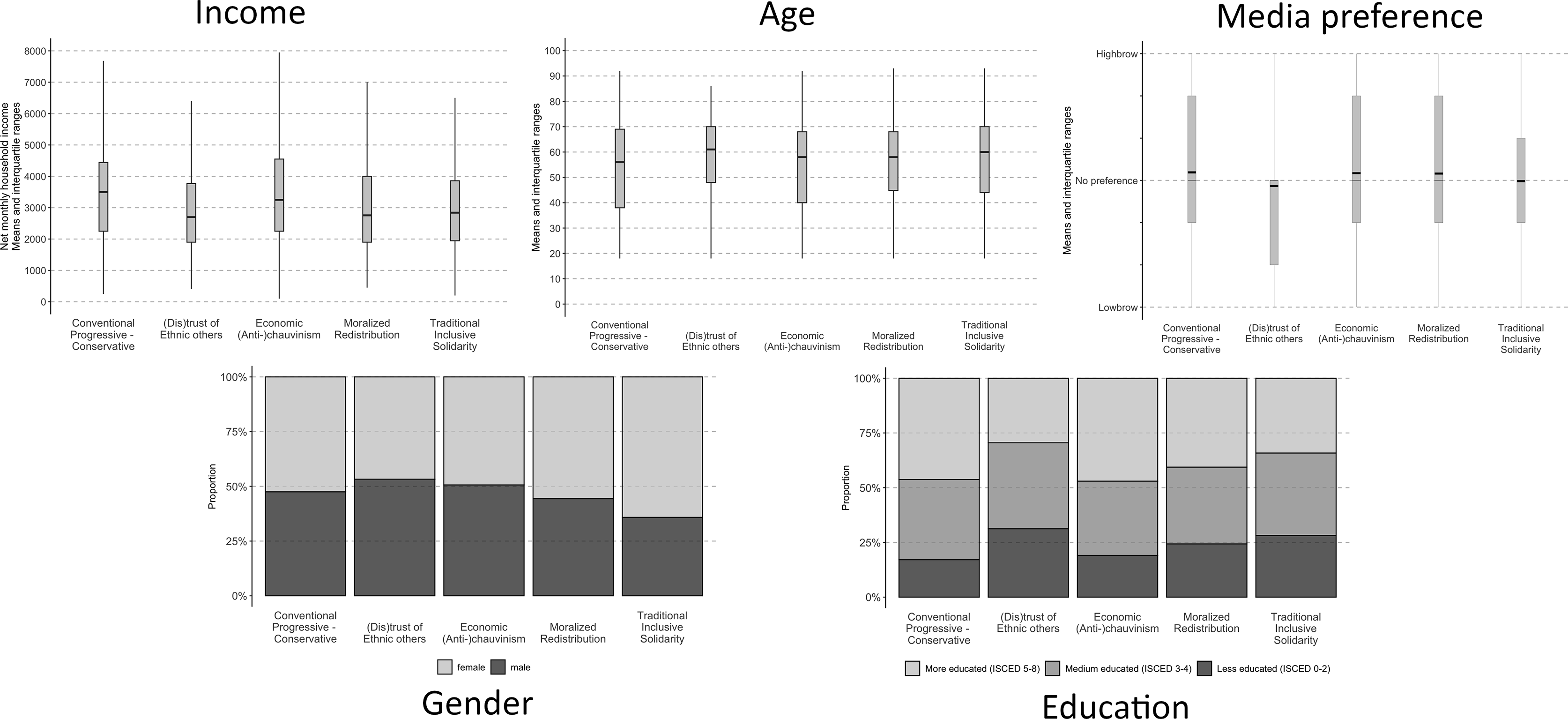
The findings are interpreted by firstly discussing the unique correlations between the items. Figure 2 visualizes the networks of attitudes for each belief system and Figure 3 displays the Pearson correlations between the items in each belief system. Secondly, the social bases for each belief system are discussed (Figures 4 and 5). Thirdly, to interpret opposing stances within a belief system, the social bases for (dis)agreement with the item “It is not fair that people receive social benefits to which they have not contributed” are discussed. This item was chosen because it has the highest loading on the one-factor solution of the five deservingness items. While the five deservingness items represent distinct dimensions (Meuleman et al., 2020), this item captures the concept of deservingness most broadly. The figures supporting this analysis are provided as supplemental material (Figures SI–SVIII). Correlations between the items in the five belief systems (n = 2131). Values are Pearson’s correlations. Social bases by belief system. Missing values have been omitted pairwise. For income n = 1907; age n = 2129; media preference n = 2109; gender n = 2129; education n = 2071. Social bases by belief system. Missing values have been omitted pairwise. For religious denomination n = 1855; political preference n = 1642; labor status n = 2109.

Deservingness as conventional progressive versus conservative
In the first belief system (n = 423), deservingness considerations correspond to either a conventional conservative or conventional progressive meaning. Figure 2 demonstrates that all the items included in the analysis are closely correlated. Welfare deservingness attitudes are thus correlated with all the other issues (Figure 3). Specifically, the figures show that a stricter deservingness attitude corresponds to support for laissez-faireism (correlations ranging from 0.26 to 0.41, averaging 0.31), ethnocentrism (correlations ranging from 0.28 to 0.40, averaging 0.35), religious belief (correlations ranging from 0.14 to 0.28, averaging 0.21), and social distrust (correlations ranging from 0.18 to 0.31, averaging 0.26). On the other hand, a lenient welfare deservingness stance corresponds to opposition to these attitudes. Thus, the meaning attributed to welfare deservingness within this belief system reflects a broader conflict between conservative and progressive orientations.
The conventional character of this belief system is reflected in the social bases of its respondents, with their incomes, education, and political preferences aligning with the demographic scope of the Dutch population (Figures 4 and 5). The only standout feature is the relatively high share of secular individuals (87%), as there is only a slight majority of the Dutch population that identify as not religious (55%).
Deservingness as (dis)trust of ethnic others
In this second belief system (n = 413), respondents’ deservingness attitudes relate to ethnocentrism and social distrust, while they have very little to do with their religious or economic attitudes (Figure 2). More specifically, a strict (lenient) stance on welfare deservingness primarily correlates with support for (opposition to) ethnocentrism (correlations ranging from 0.33 to 0.47, averaging 0.41) and, to a lesser degree, social distrust (correlations ranging from 0.17 to 0.39, averaging 0.29) (Figure 3). The other issues (religious belief and laissez-faireism) are not at all relevant to welfare deservingness. Thus, respondents’ deservingness considerations revolve around the (dis)trust of ethnic others.
The people who adhere to this belief system prominently have a lower socioeconomic position, as they generally have a lower income, as well as less education (Figure 4). They also tend to be older, more frequently male, and more likely to prefer low-brow media (Figure 4). Interestingly, unlike adherents of other belief systems, they typically do not express support for the old right (Figure 5). The ethnocentric meaning of this belief system is furthermore highlighted by the large share of respondents who favor the populist right, as these parties’ political agenda setting prominently features anti-immigration discourse.
Figure SVII underscores the marked ethnocentric character of this belief system. Among respondents who agree with the statement “It is not fair that people receive social benefits to which they have not contributed,” a relatively large proportion (32.2%) vote for the populist right – a pattern that aligns closely with the agenda-setting orientation of this party family. Furthermore, this strict ethnocentric meaning is typically supported by men (60.8%, Figure SIV) who are medium or less educated (a combined 76.9%, Figure SV). Conversely, those who disagree with this statement and view deservingness as a matter of trust in ethnic others typically vote for the political left (a combined 70.2%, Figure SVII) and are more educated (52.3%, Figure SV).
Deservingness as economic (anti-)chauvinism
In the third belief system (n = 467), deservingness attitudes are closely correlated with economic attitudes and, to a lesser degree, with attitudes about ethnocentrism, social distrust, and religion (Figure 2). More specifically, Figure 3 shows that a strict (lenient) welfare deservingness stance strongly correlates with support for (opposition to) laissez-faireism (correlations ranging from 0.15 to 0.53, averaging 0.38) and, to a lesser degree, with support for (opposition to) ethnocentrism (correlations ranging from 0.17 to 0.51, averaging 0.31) and social distrust (correlations ranging from 0.22 to 0.34, averaging 0.27). Interestingly, attitudes on religious belief correlate negatively with welfare deservingness attitudes (correlations ranging from −0.06 to −0.23, averaging −0.17), suggesting that a stricter deservingness stance aligns with aversion to religious belief, or, vice versa, that a lenient deservingness stance aligns with support for this. The key distinction from the previously discussed meaning is that laissez-faireism is closely linked to deservingness and ethnocentrism. Taken together, these correlations highlight that welfare deservingness is perceived as an issue of (limited) economic redistribution of public resources, especially concerning immigrants.
The social bases of the respondents in this belief system also differ notably from the previous one. This meaning is common among more advantaged citizens, with respondents generally having higher incomes, more education, a preference for high-brow media (Figure 4), and a tendency to vote for mainstream parties (Figure 5). Notably, a relatively large proportion of respondents identify as Protestant, which is also reflected in the significant number who prefer Christian orthodox parties (Figure 5).
These respondents predominantly adopt a lenient deservingness stance, viewing it as an issue of universal economic redistribution. This is evident when examining the social bases of those who (dis)agree with the statement used as an exemplary deservingness attitude. Respondents with this stance typically favor the political left (a combined 46.4%, Figure SVII) or a Christian party (a combined 25.3%), and are generally more educated (53.7%, Figure SV). In contrast, those in this belief system who adopt a strict stance, viewing the issue as economic chauvinism, typically support the political right, with 57.2% voting for the old or the populist right (Figure SVII), are more frequently male (59.3%, Figure SIV) and are generally medium or less educated (58%) (Figure SV).
Deservingness as moralized redistribution
In the fourth belief system (n = 336), economic considerations also strongly correlate with welfare deservingness attitudes. However, unlike the previous belief system, religious attitudes play a more prominent role. Furthermore, Figures 2 and 3 show that the five deservingness criteria are not strongly correlated. The ethnic identification item (des4) shows weaker correlations with the other criteria, suggesting that it is perceived as distinct from the main issue of deservingness (correlations ranging from 0.18 to 0.35, averaging 0.27, compared to an average of 0.50 among the other four deservingness items). Figures 2 and 3 also show that the four interrelated deservingness items weakly correlate with ethnocentrism (ranging from −0.03 to 0.38, averaging 0.14) and social distrust (ranging from 0.01 to 0.29, averaging 0.15), indicating that deservingness is not linked to ethnically driven social (dis)trust. Specifically, support for strict (lenient) welfare deservingness aligns with endorsement of (opposition to) religious belief (correlations ranging from 0.39 to 0.63, averaging 0.54) and laissez-faireism (correlations ranging from 0.25 to 0.58, averaging 0.43). Thus, the meaning of welfare deservingness here reflects a moral view of economic redistribution.
A relatively high proportion of respondents rely on social assistance (Figure 5), underscoring that welfare deservingness cannot be understood merely as a matter of rational economic reasoning here, but must also reflect the sociotropic and moral dimensions of redistribution. Figure 5 shows that a slightly higher proportion of respondents identify as religious compared to belief systems 1 and 2. More notably, political preferences reveal a marked shift: right-wing parties receive the least support, while the political left is favored by 49% of respondents, a striking increase compared to the overall sample (39%) (Figure 5).
Analysis of the social bases of those who (dis)agree with the statement serving as an exemplary deservingness attitude reveals that the lenient moralized redistribution meaning is common among political left supporters (59.7%, Figure SVII), the more educated (46.2%, Figure SV), and highbrow media consumers (41.6%, Figure SIII). In contrast, the strict moralized redistribution meaning is more prevalent among political right supporters (44.9%, Figure SVII) and the less educated (a combined 72.5%, Figure SV).
Deservingness as traditional versus inclusive solidarity
In the fifth belief system (n = 492), deservingness considerations are closely linked to religious and ethnocentric attitudes, with a weaker connection to social distrust (Figure 2). Notably, attitudes on economic redistribution are largely unrelated to the issue. Specifically, Figure 3 shows that support for strict (lenient) welfare deservingness correlates with support for (opposition to) religious belief (correlations from 0.19 to 0.57, averaging 0.39), ethnocentrism (ranging from 0.23 to 0.44, averaging 0.33), and, somewhat less, social distrust (ranging from 0.14 to 0.25, averaging 0.20). The prominence of these three issues suggests that welfare deservingness is viewed as a matter of community solidarity. This community can either be traditional, based on ethno-cultural belonging (for those supporting a strict stance), or inclusive, open to all regardless of cultural or ethnic ties (for those supporting a lenient stance).
The social bases in Figures 4 and 5 show that this group is diverse in terms of socioeconomic position, media consumption, and political preferences. A notable feature is the relatively high number of religious individuals, particularly Muslims and Protestants (Figure 5), and a relatively high share of women (Figure 4).
An analysis of the social bases of those who (dis)agree with the statement representing an exemplary deservingness attitude reveals that political leanings, not religious denomination, inspire citizens’ stances on deservingness in this meaning. As shown in Figure SVII, those who disagree with the statement (supporting the lenient stance) typically vote for the political left (42.8%) or Christian Democrats (15.2%), aligning with the inclusive (left-wing) and merciful (Christian democratic) welfare deservingness emphasized by these agendas. Conversely, those who agree with the statement (supporting the strict stance) favor the populist or old right (19.5% and 11.9% respectively) or vote for other parties, such as the elderly-focused 50PLUS (15.7%) (Figure SVII). Furthermore, these groups differ in education, with the inclusive solidarity group being relatively more educated (48.9%, Figure SV) and the traditional solidarity group typically having medium or less education (72.2%, Figure SV).
Robustness checks
Two separate sensitivity analyses were conducted to assess the robustness of the CCA results. The first excluded respondents with a migration background, and the second excluded respondents who receive social assistance benefits.
Given that welfare deservingness considerations are closely related to beliefs about immigration, I first reran the analysis on the subsample of respondents without a migration background (n = 404; see Figures SIX and SX in the supplemental material). This analysis produced a set of belief systems that closely mirror those identified in the main results, thereby supporting the robustness of the findings.
The second analysis excludes respondents receiving social assistance benefits (n = 121; see Figures SXI and SXII in the supplemental material). In this case, one belief system – moralized redistribution – no longer emerges, while the other four belief systems remain present. This pattern is consistent with the social basis identified in the main analysis (Figure 5), which shows that a relatively large share of respondents who adhere to the moralized redistribution meaning are themselves social assistance recipients. The disappearance of this belief system when this subgroup is removed suggests that their distinctive perceptions of deservingness play a central role in shaping the meaning of moralized redistribution.
Although this robustness check yields results that differ slightly from the main analysis (due to the omission of the moralized redistribution belief system), it does not undermine the overall robustness of the findings. The remaining four belief systems continue to map closely onto the meanings of welfare deservingness identified in the main analysis.
Conclusion and discussion
Inspired by recent small-n qualitative research that highlights the heterogeneity of citizens’ perceptions of welfare deservingness, this study examined the meanings attributed to that issue among the population-at-large. To do so, I analyzed original survey data collected from a high-quality panel that is representative of the Dutch population.
Using an innovative analytical approach, I identified five distinct belief systems regarding welfare deservingness, each reflecting a unique meaning of the issue. Citizens who adhere to these different meanings differ markedly in socioeconomic positions, cultural tastes, political preferences, and religious denominations. As such, a shared welfare deservingness stance can stem from vastly different perceptions. Notably, only a minority subscribes to the conventional meaning that situates deservingness within a broader conservative-progressive divide, while the majority of citizens adhere to meanings that are markedly unique, offering distinct perceptions of the issue.
To briefly illustrate these meanings, citizens may approach welfare deservingness from fundamentally different interpretative standpoints. Some understand it as an extension of conventional ideological beliefs, where stricter or more lenient views align with broader progressive or conservative orientations. Another group may primarily interpret deservingness through (dis)trust of ethnic others, evaluating welfare eligibility based on perceived ethnically based group boundaries. For others, deservingness centers on economic (anti-)chauvinism, emphasizing how limited public resources should be distributed in a globalized economy, particularly vis-à-vis immigrants. A fourth group perceives it as moralized redistribution, evaluating welfare deservingness through moral and religiously inspired notions of fairness and subsistence. Finally, some citizens frame the issue as a question of traditional versus inclusive solidarity, perceiving welfare deservingness as an expression of community membership that can be defined either narrowly or expansively.
These findings have four key implications for welfare attitudes research. First, they underscore that welfare deservingness is evaluated across multiple dimensions, as outlined by the CARIN framework (e.g., Van Oorschot, 2000; Van Oorschot and Roosma, 2017). This is evident in the identified belief systems, where all five criteria contribute to the unique meanings of the issue, demonstrating their broad relevance. The only exception is the moralized redistribution meaning, where identity does not shape the perception of deservingness.
Second, these findings expand our understanding of deservingness dimensions by showing that perceptions of each dimension vary according to the meaning attributed to welfare deservingness. For instance, respondents who align with the moralized redistribution meaning view the need criterion as a matter of allocating resources based on moral altruism, whereas those aligning with the economic (anti-)chauvinism meaning interpret it as a question of managing national resources vis-à-vis a competitive international arena. In this sense, the meanings people attribute to deservingness are reflective of the broader logics underpinning different welfare systems: the solidaristic meanings resonate with universalistic welfare models that emphasize collective responsibility, while the economically chauvinistic meaning reflects a productivist and nationally demarcated welfare logic. So, while previous research has examined how value orientations inform policy preferences across welfare regimes (e.g., Mau, 2003; Van Kersbergen, 2009; Van Oorschot et al., 2008), this study demonstrates that such systemic orientations are also reflected within citizens’ perceptions of this key issue in the welfare domain. These findings thus offer a more nuanced picture of the contested nature of public opinion on deservingness considerations and, by extension, of welfare attitudes more broadly and in comparable institutional contexts.
Third, the findings suggest that the resonance of policy proposals related to welfare deservingness depends strongly on how these proposals are framed, even among individuals who express similar levels of support for the underlying principle. For instance, citizens who interpret deservingness through a logic of moralized redistribution are likely to respond positively to adjustments in minimum-income schemes when these are justified in terms of collective solidarity and moral obligation. By contrast, individuals who adhere to an economic (anti-)chauvinist meaning are likely less receptive to solidaristic framing but more responsive to justifications emphasizing enhanced purchasing power for the poorest national citizens and protection against the risks associated with globalized capitalism.
Fourth, this study refines the established observation that different groups prioritize distinct welfare deservingness criteria. For example, lower-educated individuals typically favor conditional, merit-based welfare access, expecting recipients to demonstrate a docile attitude (cf. Meuleman et al., 2020). Beyond this, it highlights additional social factors – media, political and religious orientations – that shape perceptions of welfare deservingness. By examining both political and religious affiliations, this study distinguishes two seemingly similar meanings: economic (anti-)chauvinism and moralized redistribution. The former is more prevalent among socioeconomically advantaged citizens, while the latter, with its focus on morally just redistribution, is featured among supporters of left-wing and, to a lesser extent, Christian parties.
The meaning-oriented approach to analyzing welfare deservingness in this study opens avenues for future research. First, to address the interplay between attitudes and meanings, and the institutions that shape welfare policies (cf. Hall, 1997), a first question concerns how, and to what extent, contextual conditions shape the meanings attributed to welfare deservingness, their relative salience, and the distribution of strict and lenient stances within each meaning. Previous research has shown that welfare regime types influence how citizens perceive the deservingness of different social groups generally (Larsen, 2006; Van Oorschot, 2006) and immigrants specifically (Van der Waal et al., 2013), suggesting that institutional contexts play a mediating role in shaping belief systems and the evaluations they inform. Relatedly, it is plausible that different institutional contexts would give rise to additional or alternative meanings, as belief systems identified in this study should not be regarded as an exhaustive catalogue of all possible meanings attributed to welfare deservingness.
Second, since the five identified meanings arise from interpreting correlations between survey items, qualitative follow-up focus groups with adherents of these meanings could enhance the internal validity of these findings, demonstrating how researchers’ interpretations align with citizens’ own views.
Third, building on the implication that groups who attribute different meanings to welfare deservingness may respond differently to the same policy proposal – even when they express similar levels of support for the underlying criterion – future research could examine how these distinct meanings shape responses to information. Exploring their impact on citizens’ interpretations of contentious welfare issues, like ethnic diversity, could clarify divergent responses to contentious welfare support. Treating these meanings as moderators in future experimental studies may further explain the causal link between ethnic minority status and low deservingness rankings (e.g., Harell et al., 2016; Kootstra, 2016; Van der Meer and Reeskens, 2021).
Fourth, further research is needed to systematically explore how social bases shape meanings attributed to welfare deservingness. Qualitative comparative methods (e.g., Taylor-Gooby et al., 2019) could further explain how social characteristics and specific meanings are linked. Alternatively, investigating causal relationships could reveal how social bases influence adherence to particular meanings. Cross-country comparisons could also shed light on the conditions under which certain social characteristics are relevant to meaning adherence. This would further address the aforementioned interplay between institutional context and the variation in meanings attributed to welfare deservingness.
In conclusion, this study highlights the importance of understanding the meanings citizens attribute to welfare deservingness. It serves as a stepping stone to meaning-oriented research, offering a valuable analytical approach to the field of social policy analysis. By examining citizens’ perceptions of a contentious social policy issue using this approach, this study expands our understanding of the factors shaping the public legitimacy of welfare.
Supplemental material
Supplemental Material - Mapping the meanings of welfare deservingness: A correlational class analysis of citizens’ perceptions
Supplemental Material for Mapping the meanings of welfare deservingness: A correlational class analysis of citizens’ perceptions by Thijs Lindner in Journal of European Social Policy.
Footnotes
Acknowledgments
The author sincerely thanks the members of the European Governance Group (EGG), the Erasmus Institute on Culture and Stratification (EICS), and the participants of the deservingness stream at the ESPAnet 2025 conference for their valuable feedback on earlier versions of this paper.

Funding
The author received no financial support for the research, authorship, and/or publication of this article.
Declaration of conflicting interests
The author declared no potential conflicts of interest with respect to the research, authorship, and/or publication of this article.
Supplemental material
Supplemental material for this article is available online.