




Abstract
What does it mean for states to protect populations against climate change? As environmental risks are becoming more frequent and severe, the ability of states to maintain the wellbeing of their populations is challenged. Yet, despite growing debates about social-ecological risks and policies, the question of how to protect societies from the social consequences of environmental risks and disasters remains little addressed in social policy and welfare state studies and a critical gap in the literature. This article advances a research agenda for conceptualising social protection against environmental risks. We identify avenues for research for understanding the various forms of socialisation of environmental risks and the policies that protect populations against their impacts across Europe and North America. We analyse these policies from a conceptual, historical, and comparative perspective, looking at how they provide forms of welfare, how they interact with social policies, and how climate change transforms welfare states’ role in protecting populations against environmental risks in the context of just adaptation.
Introduction
What does it mean for states to protect populations in the age of climate change? The increase in disasters caused by climate change and planetary disruptions is affecting the ability of states to maintain social well-being. Environmental risks, defined as the probable economic, social and material impacts of environmental hazards such as droughts, storms, wildfires and heatwaves, are becoming a major threat to lives and livelihoods, turning disasters into a key political issue (Park, 2022) and a threat to welfare states’ financial sustainability (Hay, 2023). Climate change increases the frequency and intensity of environmental hazards, while environmental degradations increase human exposure and vulnerability. According to the International Panel on Climate Change (IPCC), losses associated with global warming cannot be avoided in the short term, even if strong action is taken to limit its scope to 1.5°C, which is now unlikely. Climate change impacts will largely depend on adaptation measures implemented by governments worldwide to ‘reduce vulnerability and exposure, strengthen the level of socio-economic development and adaptation’ (IPCC 2022).
Adaptation and protection against the material and wellbeing losses associated with increased environmental risks are becoming important issues for social protection systems. However, welfare states’ historical institutions, i.e. those related to the ‘decommodification’ of risks (Esping-Andersen, 1990), have so far remained relatively blind to the environment. The sustainability of current social policies – or unsustainability would some argue (Laurent, 2021, 2024) – largely depends on economic growth models that contributed to environmental degradation. Welfare states’ conceptualisations reflect the economic world of the 20th century: a world oblivious to ‘nature’ that does not consider how it threatens the environment, and in the long run, destroys its own foundations (Fanning et al., 2022).
A growing debate on eco-social policies is seeking to reconcile environmental issues and social well-being. Pioneering contributions highlighted the interactions between climate change, environmental policy and social policy, asking how welfare states could adapt to environmental constraints and new risks (Gough et al., 2008; Meadowcroft 2005). Some explored the social and political implications of environmental policies, emphasising the necessity of integrating climate and social policy (Duit et al., 2016; Gough, 2016), or compared environmental and welfare states (Hasanaj, 2023; Koch and Fritz, 2014; Zimmermann and Graziano, 2020). Various scholars sought to define a ‘sustainable welfare state’ (Büchs and Koch, 2017), a ‘green state’ (Eckersley 2004), a ‘social-ecological welfare state’ (Laurent, 2021), or eco-social policies (Mandelli, 2022) that combine equity and social justice with climate change mitigation policies (Hirvilammi and Koch 2020). Others argued for shifting from welfare to climate mitigation states (Gough, 2017), or that climate change leads to re-thinking key concepts of the welfare state, such as risk, citizenship or well-being (Hirvilammi et al., 2023).
These contributions initiated discussions about the scope and nature of Western welfare states and the alignment, intersections and contradictions of welfare and climate policies. Yet, the question of how to protect populations from the impacts of environmental hazards and disasters remains underexplored in social policy literature, despite burgeoning work on socio-ecological risks (Gough 2008; Hirvilammi et al., 2023; Johansson et al., 2016; Mandelli et al., 2026; Schaffrin 2014; Vielle et al., 2025). This article contributes to these debates by developing a research agenda exploring the relationship between environmental risks and social protection. Drawing on welfare state studies and environmental risk and disaster studies, we identify key conceptual challenges and empirical gaps and illuminate them with comparative insights. Rather than a literature review or systematic comparison, the article advances conceptual and empirical understanding of environmental risk protection policies – i.e. the various interventions that aim to protect societies against environmental hazards, extreme weather events, and disasters 1 – and their relationship with social policies. It focuses on Europe and North America to preserve analytical consistency and build on existing comparative welfare state research, while acknowledging that social protection in the Global South remains beyond our scope.
We propose four research avenues. First, we emphasise key conceptual challenges regarding the relationships between environmental risk, social risk and social protection. Second, we draw attention to the historical development of environmental risk protection, and its legacies in shaping current responses to climate risks. Third, we outline a comparative research agenda to characterise and explain the diversity of existing policies. Finally, we examine how climate change challenges existing environmental and social protection governance arrangements and raises new questions regarding the social and environmental justice implications of climate adaptation.
Beyond decommodification: Environmental risk protection as welfare provision
Environmental risks sit uneasily with classical conceptualisations of the welfare state as ‘committed to providing basic economic security for its citizens by protecting them from market risks associated with old age, unemployment, accidents and sickness’ (Weir 2001: 16432). They are not labour market risks per se: although they affect economic development, they fall outside the work-welfare nexus typical of social protection (Hirvilammi et al., 2023). Some proposed a ‘social-ecological nexus’ understood as the intersection of social inequalities, ecological crises and environmental degradation to bring environmental and social risks under a common analytical frame (Laurent 2024: 21). We pursue this line of argument by addressing two conceptual questions: can environmental risks be understood as social risks in the welfare state tradition? And to what extent can environmental risk protection be considered a form of welfare provision?
Conceptualising environmental risks as social risks
Social risk is the organising concept of the welfare state. It refers to threats to individuals’ income, health and wellbeing arising from industrial society that are considered beyond individual control and within the remit of the state through social policy (Mandelli et al., 2026). Historically confined to unemployment, sickness, disability, old age and workplace accidents, the concept broadened with post-industrial transformations to encompass ‘new social risks:’ precarious employment, changing family structures, lone parenthood and care responsibilities (Bonoli 2007).
Environmental risks have long remained absent from welfare state and social policy scholarship for several reasons. First, the responsibility for environmental risks has historically been ambiguous: hazards were often framed as ‘acts of God’ (Steinberg 2006) or natural events exogenous to society and, therefore, outside the institutional remit of welfare states. The rise of private insurance for material damages further entrenched the separation between environmental risk and welfare state (Ewald 1986). Second, environmental risks were perceived as rare and catastrophic, contrasting with the individually uncertain but collectively predictable risks covered by welfare states (Garcia-Garcia et al., 2022). This unpredictability legitimised their management through ad hoc emergency arrangements rather than permanent welfare institutions, what Castles (2010: 96) identifies as a key reason why disasters fall ‘well below the intellectual radar of most contemporary welfare state specialists.’ Finally, environmental risks were long framed primarily in terms of material damage to assets, leaving their broader social implications overlooked.
This separation is increasingly untenable as each of the factors that justified it have been progressively undermined. First, with climate change, environmental hazards are no longer exogenous to society but are themselves by-products of economic and social development. Second, climate change is transforming the nature of environmental risks: growing frequency and severity are making these hazards less episodic and more actuarially foreseeable, weakening the case for managing them through ad hoc emergency arrangements rather than permanent institutions. Third, environmental risks extend far beyond material damages to assets, encompassing adverse health outcomes, income loss, food insecurity, forced displacement and long-term territorial decline (Mandelli et al., 2026). Underlying these shifts is a reconceptualization of environmental risks themselves, driven by scholarship in human geography, political ecology and disaster sociology emphasising that environmental hazards become disasters through socially produced vulnerability rather than physical events alone (Cutter 2012; Giry 2023; Tierney 2019).
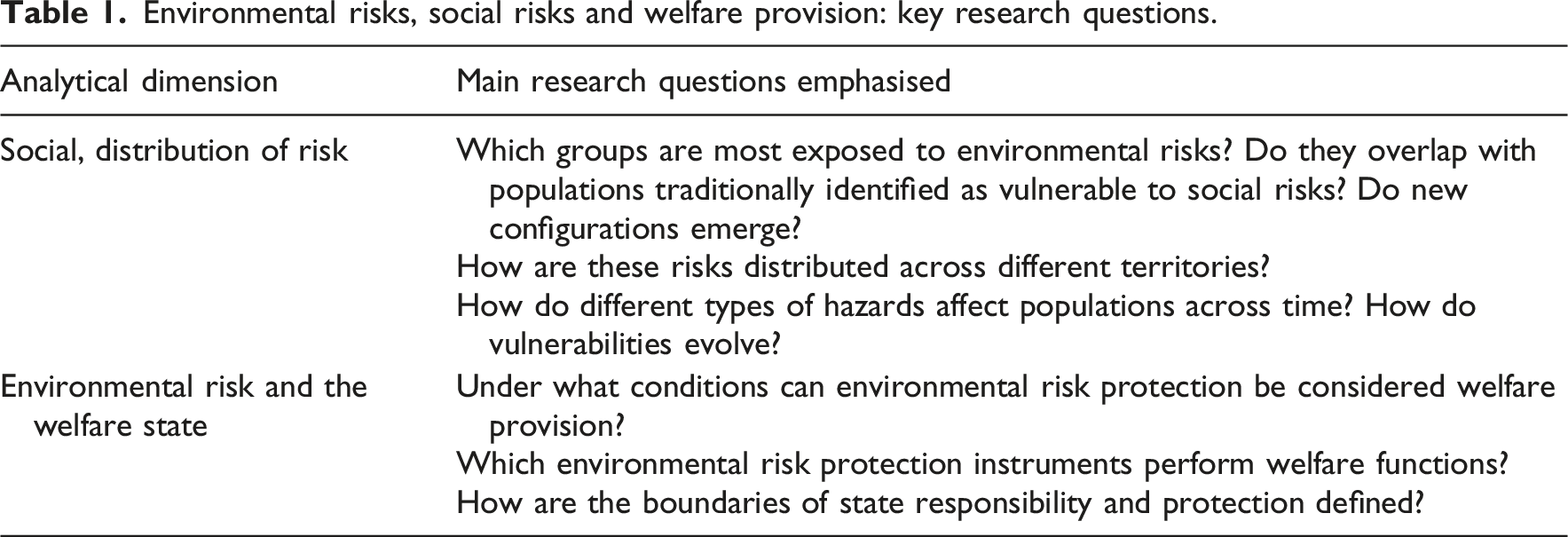
Environmental risks, social risks and welfare provision: key research questions.
Environmental risk protection as welfare provision
Once we accept that environmental risk are social risks, the question becomes whether the policies designed to address them fall within the remit of the welfare state. An analytical difficulty stems from the fact that environmental risk protection sits uneasily between environmental and welfare states, which are organised around distinct institutions, instruments and objectives. Environmental states rely on regulations and prohibitions to protect the environment from harmful human activities, while welfare states are more concerned with redistributing resources and providing social services through taxation and public expenditure (Duit et al., 2016; Meadowcroft 2005). However, protecting populations from environmental disruptions draws on instruments and policies from both worlds, and encompasses a wide range of interventions that operate in practice as forms of welfare provision while not typically qualifying as welfare policies (Elliott 2021). These include, for instance, measures aimed at reducing exposure through protective infrastructures such as seawalls, dykes and levees, limiting disaster losses through insurance arrangements, or supporting recovery through emergency services.
Whether these interventions constitute welfare intervention depends on how the welfare state is defined. If welfare states are understood as social insurance mechanisms providing revenue replacement for workplace accidents, employment loss, old age and sickness, then environmental risk protection appears largely outside this perimeter. In contrast, broader understandings of the welfare state as a state committed to ensuring the wellbeing of its citizens and social equality (Garland 2014; Hay 2023), to managing collective risks (Giddens 1999) and to minimizing disruptions to social life (Foucault 2004) suggest that environmental risk protection is integral to that political and epistemic project.
This broader perspective resonates with theoretical developments that have expanded the analytical boundaries of the welfare state beyond its original foundations in social insurance. Recent scholarship has incorporated preventive social investment strategies (Morel et al. 2012), regulatory approaches (Benish and Levi-Faur 2020), and fiscal instruments (Morel et al. 2018). A growing number of policy domains, including education (Busemeyer and Nikolai 2021), childcare (Morgan 2006), youth policies (Chevalier 2016), and long-term care (Österle and Rothgang 2021), have been reconceptualised as integral components of welfare state activity. Building on these developments, proponents of socio-ecological welfare states (Hirvilammi et al., 2023; Laurent 2021, 2024) argue for expanding welfare state boundaries by integrating the environment. These perspective invite analysing environmental risk protection as a form of social policy ‘by other means’ (Seelkopf and Starke 2019) and to confront it with classical social policies instruments.
Although we argue that environmental risk protection falls within an expanded definition of the welfare state, such argument calls for more inquiries and raises a number of questions (Table 1). Which specific instruments should be considered as forms of welfare provision, and which should not? For instance, can investments in protective infrastructures such as dykes or seawalls be considered welfare provision? Can they be compared to social investment policies? How is state responsibility for environmental risks constructed, and how are the boundaries of responsibility defined?
The historical legacies of protective policies against environmental risks
Policies designed to protect populations from environmental risks and disasters are a longstanding state responsibility; however, their development remains unexplored in welfare state research. Examining how environmental risk protection has emerged, how it was institutionalised, and how it relates to welfare state development offers both historical depth to contemporary debates on climate adaptation and a research agenda on its own right.
Entangled origins, distinct institutionalization: The rise of a specific form of social protection against environmental risks
Social protection and environmental risk protection have historically followed distinct but intertwined paths. While welfare states emerged from nineteenth-century industrialisation as instruments of social compromise (Esping Andersen 1990), protection against environmental risks partly sides with that history and finds its roots in disaster relief and early infrastructural interventions to control exposure to hazards and support economic activity. Early interventions date back to the seventeenth and eighteenth century, in response to environmental disasters and large-scale industrial accidents, as ‘changing attitudes to the control of nature and the role of knowledge and expertise gave rise to a much more proactive role of the state’ (Van Bavel et al., 2020). Modern states sought to alleviate the plight of populations in exceptional circumstances such as wars, pandemic or catastrophes (Bandopadhyay, 2022), that enabled them to offer protection to populations and assert their power in Western but also colonial contexts (Cabane, 2023).
In France, public interventions took the form of ad-hoc calamity funds and fiscal relief for affected population following earthquakes (Quenet 2005), floods, or drought (Pontier 2018), which eventually led to the establishment in the 1930s of a public compensation fund for disasters victims, partly financed by a national lottery. In the United States, federal disaster relief emerged under President Lincoln in the 1860s, as successive waves of floods and droughts ruined crops in the South and as large sections of the population, already torn apart by the Civil War, faced hunger (Davies, 2014). The Congress regularly allocated recovery funds after plagues, boats sinking (Landis Dauber 2012), and disasters such as the 1871 Chicago fire and the 1906 San Francisco earthquake (Remes 2015).
European and North American states have also long invested in preventive infrastructures to reduce environmental hazards exposure. Flood defences in the Netherlands date to the medieval period; early modern France built large hydraulic structures such as the dikes and retaining walls of the Canal du Midi (Mukerji 2007); Denmark reinforced its coastline following floods in the nineteenth century (Soens 2013); and successive Flood Control Acts in the United States funded extensive river engineering projects that served both protective and economic and urban development purposes (Barry 2007; Freudenburg et al., 2009). From the nineteenth century onwards, regulatory measures complemented protective infrastructure, as authorities began to map hazards, regulate land use and restrict settlement in risk-prone areas, as illustrated by the 1935 French Water Act (République Française, 1937) and the progressive regulation of building and land use to reduce exposure in England (Penning Roswell 2019).
The second half of the twentieth century brought consolidation and institutionalisation to early forms of protection against environmental risks. Emergency management expanded through specialised bureaucracies and the broadening of civil defence to an ‘all hazards’ approach (Collier and Lakoff 2008). National disaster management frameworks, such as the French ORSEC plans, FEMA in the United States (Roberts 2016), or the development of safety regions in the Netherlands, institutionalised rapid intervention, preparedness and post-disaster assistance. Private insurance expanded its coverage, while public authorities remained central through regulation, subsidies, reinsurance mechanisms and compensation schemes, producing hybrid public–private systems across most Western countries (Kraehnert et al., 2021). At the same time, preventive strategies expanded through large-scale infrastructural investments, reflecting a technicist belief in controlling the environment through major engineering works, such as extensive flood control systems in the United States and the United Kingdom (Penning-Rowsell et al., 2014) or in the Netherlands with the Dutch Delta Plan (Wesselink et al., 2015). However, this reliance on technological solutions began to erode towards the end of the century, as regulatory and planning instruments gained prominence and nature-based approaches challenged purely engineering-based strategies (Johnson and Priest 2008). Land-use regulation, hazard mapping, risk-based insurance pricing and building standards increasingly aimed to limit exposure, reshape settlement patterns and build resilience.
This overview suggests that environmental risk protection should be understood as a long-term process. As historical institutionalism emphasizes (Pierson 2005), public policies generate long-term institutional effects, policy feedback and path-dependent trajectories that structure subsequent policy choices and constrain the range of available alternatives. Early investments in protective infrastructures, emergency management, and insurance arrangements created durable institutional configurations, vested interests and financial commitments that make policy change costly and politically difficult. Environmental risk protection policies are likely to generate policy legacies and lock-in effects, as illustrated by the ‘dyke effect’ in flood protection policies, whereby costly infrastructures generate long-term commitments and specialised technical and administrative arrangements that constrain the direction of policy over time (Han and Kasperson 2011).
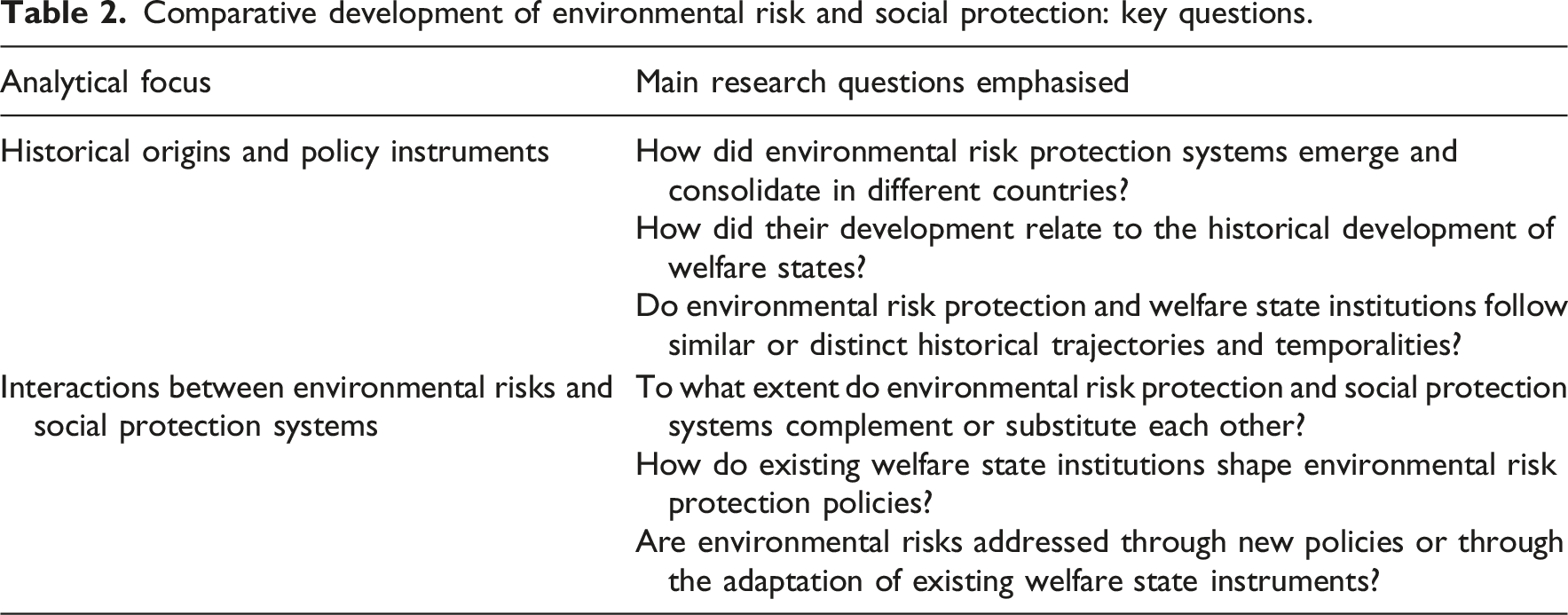
Comparative development of environmental risk and social protection: key questions.
Beyond fragmentation: The interactions between environmental risk protection and social protection
While environmental risk protection developed separately from social protection, the two domains nonetheless frequently overlap and interact. Environmental health policies, especially the regulation of air and water pollution constitute a notable example. In the nineteenth century, rapid industrial growth in European and North American cities produced serious nuisances such as smog, chemical pollution, foul odours, generating growing litigation that pushed public authorities to regulate exposure to protect citizens and create stable business expectations (Fressoz 2024), with France adopting a first pollution law in 1810 (Le Roux and Letté 2013). Water sanitation followed a similar logic, with extensive infrastructural investments aiming to reduce exposure to the bacteria responsible for cholera and plague outbreaks across nineteenth-century Europe.
The provision of social benefits after disasters constitutes another longstanding area of overlap. In the United States, disaster assistance played a pivotal, albeit overlooked, role in the early development of social policy. The 1914 Great Salem Fire prompted the creation of an unemployment relief programme that later evolved into the United States Employment Service (Remes 2015). The 1927 Mississippi River flood triggered one of the largest federal relief operations in U.S. history, reshaping public expectations of state social responsibilities (Collier and Lakoff 2021). Alongside veterans’ benefits (Skocpol 1995), federal disaster recovery funds were instrumental in shaping New Deal policies (Landis Dauber 2012).
Long overlooked, these historical entanglements prefigure the current recognition that social protection instruments play a central role in disaster management. In the United States, disaster assistance measures, including temporary housing programs and the National Flood Insurance Program (NFIP), interact with classic welfare benefits (Brown and Chang 2024). In France, existing policies such as short-time work schemes, furlough arrangements and victims’ compensation funds complement both disaster assistance programmes and the disaster insurance CATNAT (Calavreso et al., 2025; Elbaum 2022). In Spain, a ‘climate leave’ allows workers to stay home when meteorological alerts render travel and work unsafe (Bosits 2025). The adaptation of social protection to disaster contexts is also attracting attention from international organisations including the UN Office for Disaster Risk Reduction and the World Bank, though their focus is predominantly on the Global South (Costella et al., 2024) and requires systematic extension to Western contexts.
More generally, the relationships between environmental risk protection and social protection, their boundaries, complementarities and possible tensions remain understudied and call for a systematic analysis of their articulation (Table 2). Recent work on the complementarities between welfare and environmental states (Hasanaj 2023; Mandelli 2022; Zimmermann and Graziano 2020) could provide a conceptual basis to understand under what institutional conditions social protection and environmental risk protection policies reinforce each other, complement or substitute for one another, and how these interactions vary across welfare regimes in terms of policy instruments, coverage, and governance arrangements. However, more comparative analysis is needed to trace the institutionalisation paths of environmental risk and social protection policies, the specificities of national approaches and their respective orientations and goals.
Comparing variations in environmental risk protection
Understanding how environmental risk protection interacts with welfare states is a key research question that remains largely neglected. In many ways, empirical research should drive conceptual development, and more systematic comparative knowledge is needed to understand specific national approaches. Given the limited comparative literature on these issues, we provide more questions than answers. We make suggestions for such a comparative agenda, highlighting empirical and analytical gaps to understand the environmental risk protection policy mixes and the drivers behind the diversity of national approaches.
Mapping environmental risk protection across countries
Systematic comparative data on the variety of instruments, policies and national approaches to environmental risk protection remains scattered, while a large share of the existing literature, often rooted in environmental studies, lacks an explicit social perspective. Existing works tend to focus either on single hazards, such as droughts or floods (Bressers and Kuks 2019; Wiering et al., 2017), or on single instruments such as disaster insurance (Jarzabkowski et al., 2023; Parth 2025).
Existing comparative studies emphasise cross-national variation primarily through differences in the level of socialisation of insurance systems. For instance, Denmark, Spain, France or the U.S. have national insurance or reinsurance arrangements, whereas countries such as Germany, Austria, Sweden, Finland and the Netherlands rely more heavily on market arrangements and private insurance, with state intervention usually limited to exceptional circumstances and emergency management measures. This focus on disaster insurance may overlook countries such as the Netherlands, where heavy and longstanding investments in protective infrastructures constitute another path of socialisation. Although insurance itself is not public, environmental risk is nonetheless heavily socialised through protective infrastructures. This suggests that environmental risks protection can operate through different policy logics, not only through compensation and insurance, but also through investment in prevention and risk reduction infrastructures.
A way to analyse national variations in environmental risk protection is thus to consider the variety of national instruments to distinguish the orientation and goals of the policies, especially the extent to which they focus on prevention, residual emergency response, and compensation. Rather than studying these orientations separately, examining how they are combined within national policy mixes provides a richer understanding of environmental risk protection systems and may allow fuller comparisons with different welfare state configurations. Future research should aim to better conceptualise these institutional configurations, particularly regarding policy boundaries, public–private interactions, levels of government involved, resources devoted, and beneficiary profiles.
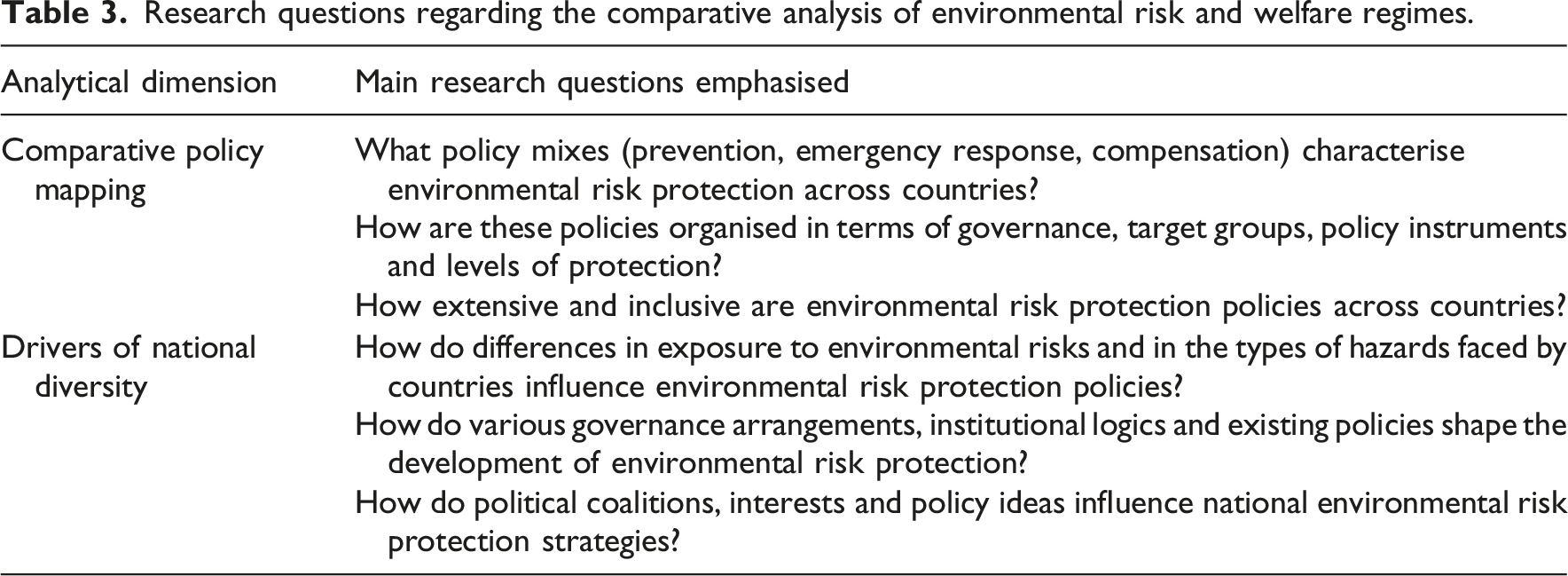
Research questions regarding the comparative analysis of environmental risk and welfare regimes.
Explaining the diversity of national approaches
Explanation of the diversity of national approaches have likewise received less attention. Many contributions are implicitly functionalist, arguing that environmental risk protection policies emerge in response to problem pressure from growing environmental hazards. Social policies are likewise often interpreted as a response to the scale and magnitude of risks: classical social risks were a product of industrialization (Flora, 1986), while new social risks stemmed from the transition to a post-industrial society (Bonoli 2007). As environmental risks may be considered ‘third-generation social risks’ (Gough 2008; Johansson et al., 2016; Mandelli et al., 2026), national variations in the policies that tackle them could be associated with environmental risks’ frequency and severity. For example, the more a country is affected by flooding, the more it will socialize associated risks, by developing public re-insurance, as in France, or by investing in flood protection infrastructures, as in the Netherlands. Empirical research should examine under what circumstances risk exposure triggers policy development or shapes policy instruments.
At a more institutional level, path dependencies highlighted in the context of water-based protection infrastructures (Han and Kasperson 2011) can explain policy trajectories, their legacies and the configuration of policy instruments. New institutionalist approaches call for examining whether and how environmental risk protection reflects Esping-Andersen’s welfare state regimes, which are characterised by distinct articulations of state, market, and family provision (1990). These configurations generate inertia, as welfare systems evolve gradually along paths consistent with their structures and are rarely fundamentally reshaped by disasters. Building on this perspective, we can hypothesise that different welfare regimes give rise to distinct approaches to environmental risk protection: liberal regimes may place greater emphasis on emergency management as residual state intervention; conservative-corporatist regimes might focus on compensation and income protection; and social-democratic regimes are likely to center on prevention, in line with their stronger orientation towards ex-ante intervention, including social investment policies (Morel et al. 2012).
Relatedly, state structures and the distribution of responsibilities across levels of government (Cucca et al. 2023) could help understand national variation. The extent and form of political decentralisation shape welfare state regimes (McEwen and Moreno 2008; Sellers and Lidström 2007) – an observation that is likely to be relevant for environmental risk protection, where prevention and adaptation policies are often implemented at the local level. This calls for further investigating how these policies are affected by decentralisation and local governments’ political, administrative and fiscal capacities.
These questions (Table 3) remain largely unaddressed in existing literature on environmental risk protection. Future research is needed to understand how exposure, institutional logics and policy legacies, public-private arrangements and multi-level governance jointly shape countries approaches to environmental risk protection, and how these configurations relate to welfare regime variation as climate change intensifies pressure on existing arrangements.
Climate change and the destabilization of existing environmental risk protection arrangements
As climate change increases the frequency and severity of extreme weather events, the sustainability and adequacy of existing protection arrangements is under pressure. This section highlights two interconnected set of research agendas: the consequences of the normalisation of environmental risks for protection systems, and the distributive dimensions of protection against climate change, which are increasingly visible in discussions around just adaptation.
The normalisation of environmental risks: New challenges for welfare states
The changing nature of environmental hazards will likely constitute growing challenges for the viability, scope and legitimacy of environmental risk protection policies. A first challenge relates to the funding and adequacy of protection instruments that were designed to deal with rare and unpredictable events when those risks are becoming recurrent. Staggering costs create significant problems for states as insurers of last resort, regulators and crisis managers. Between 1980 and 2020, the EU experienced 1,040 climate-related disasters that cost 3% of GDP (CRED, 2020) and amounted to €77 billion losses in 2023 (European Commission, World Bank 2024). The US has witnessed a rapid increase in disaster expenditures, reaching to 4% of its GDP in 2021, a number that could climb to 20% by the mid-2030s (Hay 2023).
Relatedly, private insurance of assets and properties is showing signs of market failure, threatening the affordability and availability of coverage in highly exposed areas such as Florida, Louisiana or California, where premiums have skyrocketed while major insurers have withdrawn coverage altogether (Hemmati et al. 2025). Protection gaps, i.e. ‘the uninsured portion of the economic losses caused by climate-related disasters’ (European Central Bank 2023:5, EU Commission 2021) are widening: only a quarter of climate-related losses are currently insured in Europe, dropping to around 5% in countries such as Hungary and Romania. As private markets crumble, states are increasingly called upon as insurers of last resort to absorb losses. In the United Kingdom, the threat of insurer withdrawal prompted the creation of Flood Re in 2016, a temporary backstop mechanism supposed to cease in 2035 but already put into question by mounting flood losses. Italy adopted mandatory catastrophe insurance for firms in 2025 (OECD 2026), and France’s CATNAT scheme raised premiums in 2024, paving the way for a more comprehensive reform (Viennot et al. 2025). At the EU level, the creation of public-private mechanisms including public reinsurance or risk-sharing mechanisms between EU countries is increasingly discussed (EIOPA & ECB 2023).
Escalating costs also call for further adaptation and prevention. Yet, the preventive pillar of environmental protection is also strained. Efforts to reduce environmental risks and prevent disasters remain largely insufficient, while constraints on public expenditures limit investment in adaptation and protective infrastructure, as their anticipated costs are enormous. For example, Nicholls et al. (2019) estimate that it would cost $18.3 trillion to protect only half of the world with coastal flood defences this century. These pressures raise questions regarding the financial and political sustainability of these policies. Some even argue that escalating costs could spiral into a fiscal crisis (Hay 2023), threatening welfare state legitimacy as environmental risk protection budgets compete with social policy spending.
How do these dynamics intersect with ongoing welfare state transformations? State retrenchment (Starke 2006), together with increasing fiscal and ideological pressures on social policies in European and North American countries (Streeck and Schäfer 2013) have led to less generous provision, budget constraints on health care, unemployment benefits and pension systems, rising economic insecurity and deepening inequalities. At the same time, constrained public resources have reduced states’ problem-solving capacities (Lodge 2013), while changing notions of protection suggest that neither full prevention nor full compensation can be expected from the state anymore (Baker and Simon 2002; Rothstein et al. 2013). Combined with broader de-socialisation dynamics of established social risks (Hacker 2019), these developments are likely to increase social vulnerability to disasters by weakening individual coping capacities and public capacities to provide assistance. Relatedly, a proliferation of crisis management organisations, funds and policies across levels of government (Cabane and Lodge 2024) has been interpreted as a response to states’ growing difficulties in preventing risks and reducing vulnerability, increasingly shifting the politics of governing towards crises (Borraz and Cabane 2017).
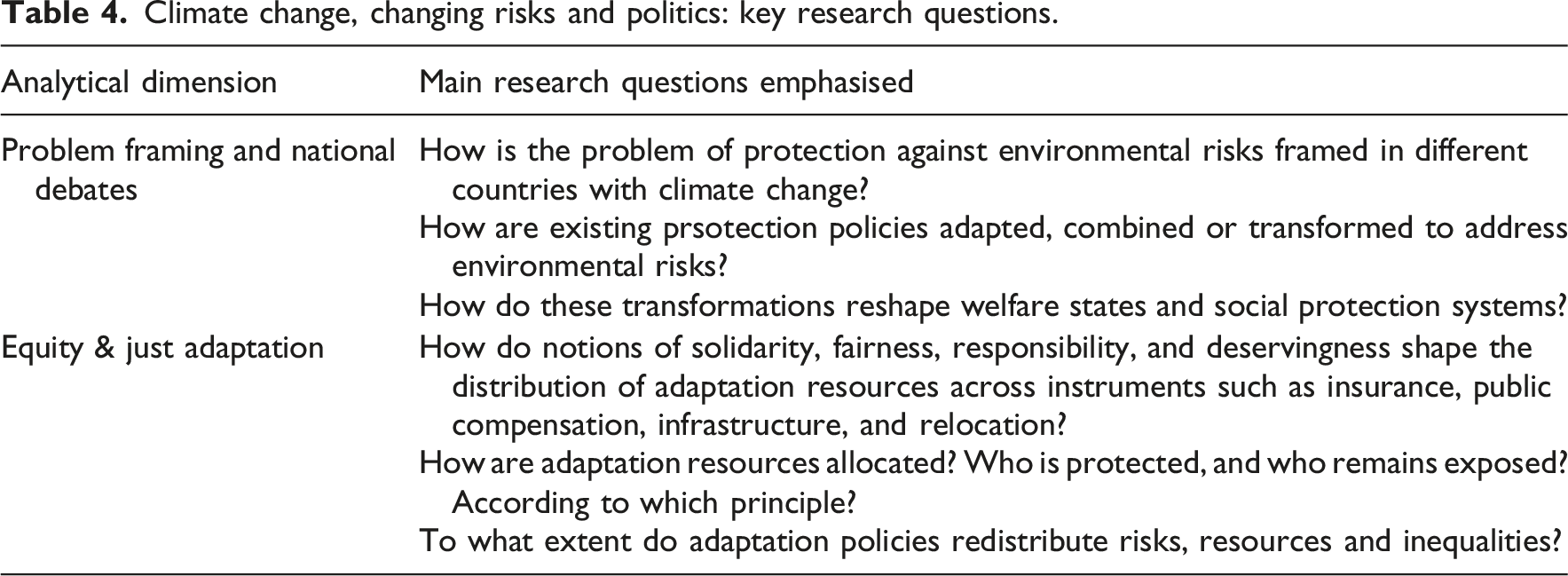
Climate change, changing risks and politics: key research questions.
Just adaptation and the distributive politics of protection
The welfare state was born out of a commitment to social justice in western democracies. Climate change is putting this commitment under pressure: as risk exposure grows and vulnerability is unequally distributed, the question of who is protected is becoming increasingly political. The notion of just adaptation precisely invites to analyse adaptation and environmental risk protection policies as inherently political and distributive processes. Protective infrastructures and policies do not merely distribute safety and economic security; they redistribute losses by embedding moral and political judgements about which risks are acceptable, which territories should be protected, and who should bear the costs of adaptation (Elliott, 2017). Just adaptation raises questions about solidarity, redistribution and collective responsibility that sit at the heart of welfare state research.
These distributive tensions are becoming increasingly visible as rising costs make equal protection of all territories and populations unlikely. Governments face difficult choices — whether to defend, tolerate risk, or organise retreat — long framed through technocratic cost-benefit analyses but now emerging as explicit questions of social justice. Adaptation policies raise distributive questions about who can remain, who must relocate, and which losses are deemed inevitable. In the United States, homeowners exposed to recurrent flooding have strived against federal flood insurance reforms, contesting rising premiums and reduced public solidarity (Elliott, 2021). In the Netherlands, opposition to de-poldering projects revealed conflicts around nature-based solutions perceived as unfairly sacrificing communities for the sake of others. In France, distributive tensions have emerged around insurance and future adaptation pathways: households affected by drought-induced shrink-and-swell of housing foundations have demanded fairer compensation under the CATNAT regime, while debates over coastal erosion along the West Atlantic coast pits costly protective infrastructures against strategic retreat. These cases highlight that each mechanism of protection – insurance, infrastructure, or compensation – embeds a normative vision of who should bear climate risks, their costs, and under what conditions.
A large body of research in environmental justice shows that environmental risks interact with existing social inequalities (Bullard 2021; Fothergill and Peek 2004), exacerbate pre-existing disadvantages (Hallegatte, 2021; Cutter 2012), and contribute to the production of unequal risk landscapes. However, vulnerability cannot be reduced to poverty alone. It is historically produced and institutionally mediated through insurance systems, land-use regulation, housing markets and compensation mechanisms, including in more affluent contexts (Kuhlicke et al., 2011; Eriksen et al., 2017; Nielsen et al., 2023). Recent work further suggests that climate change is increasingly exposing lower middle-class groups to risk, creating new forms of inequality among populations often situated at the margins of traditional protection systems (Beaussier et al. 2024; Rhodes and Besbris 2022). Protective measures do not systematically benefit the most vulnerable. Flood protection infrastructure can divert water towards less affluent areas (Steinberg, 2006). Urban greening and nature-based solutions may contribute to processes of green gentrification (Pearsall, 2018). Insurance can make coverage (and therefore housing) unaffordable for low- and middle-income households in high-risk zones (Elliott, 2021; Hudson, 2020).
Just adaptation requires equitable distribution of benefits and burdens, and recognition that adaptation is a political process shaped by power relations, institutional legacies, and distributive choices. How these dynamics unfold across countries and policy arenas is a major area of research for social policy and political research. How do adaptation and protection policies redefine social and territorial vulnerability? Who gains and who loses from existing policies? To what extent do different policy tools reduce or reinforce inequalities in adaptative capacities? How do changing risk profiles interact with welfare institutions to redefine the boundaries of collective protection? Addressing these questions is essential to understanding whether adaptation policies advance environmental justice or reproduce entrenched privilege in a warming world (Table 4).
Conclusion
This article has developed a research agenda on the welfare dimensions of environmental risk protection, structured around four interconnected avenues. First, we argued that environmental risks should be conceptualised as social risks, and that environmental risk protection constitutes a distinctive form of welfare provision. Second, we showed that environmental risk protection historical roots matters and that its entanglement with social protection shapes current institutional arrangements. Third, we called for systematic comparative analysis of environmental risk protection regimes, their instruments, their drivers, and their relationships with welfare states regimes. Fourth, we argued that climate change is normalising environmental risks in ways that strain existing protection arrangements and raise fundamental questions of just adaptation that sit at the heart of welfare state research.
Taken together, these four agendas make a common claim: environmental risk protection is a central challenge for contemporary welfare states. The article’s contribution lies in its integration of welfare state scholarship with environmental risk and disaster studies, two fields that developed largely in parallel. It calls for incorporating environmental risk protection into the analysis of comparative welfare regimes, for considering the historical legacies of protective policies and for engaging with the distributive and justice dimensions of climate adaptation. As climate change accelerates, these questions will only become more urgent. Which populations will be protected, and on what principle? Will environmental risk protection expand welfare state functions or accelerate their retrenchment? Will adaptation advance justice or reproduce privilege? A final avenue beyond our scope concerns the Global South, where welfare and insurance institutions are more recent or still emerging and climate vulnerability is often acute. As climate change further destabilises environments and exceeds individual state capacities, learning from these experiences and developing global risk-sharing mechanisms will be essential.
Footnotes
Acknowledgement
The paper was presented at multiple seminars and conferences (ESPANET, Sciences Po, CES, EPG) from which we benefited greatly. We are grateful to Bruno Palier (CEE, Sciences Po), Olivier Borraz (CSO, Sciences Po), Matteo Mandelli (CEE, Sciences Po) and Eloi Laurent (OFCE, Sciences Po) as well as the reviewers for their input and feedback that greatly improved this article. We also gained much insights from the Sciences Po Socio-Ecological Transitions seminars.

Ethical considerations
This article is a research agenda paper and does not present original empirical data. It draws exclusively on academic and administrative sources that are publicly available. All materials used have been properly attributed, and every source is cited in the reference list in accordance with APA guidelines.
Funding
The authors disclosed receipt of the following financial support for the research, authorship, and/or publication of this article: The research presented in this article was supported by two funded projects: one from the French Ministry of Social Affairs (MIRE-DREES – APR “Rethinking social protection in the light of environmental crises”) and one from the French National Research Agency (ANR-24-CE41-7514).
Declaration of conflicting interests
The authors declared no potential conflicts of interest with respect to the research, authorship, and/or publication of this article.