




Abstract
Background
Isokinetic studies of wrist flexion and extension (WFE) have been conducted mostly in the concentric mode. However, the eccentric counterpart is of specific importance in strength profiling while both modes are differently expressed in women and men.
Objective
to characterize the isokinetic concentric and eccentric isokinetic strength of the dominant side WFE, in a group of healthy young women and men and explore their respective internal and external relationships.
Methods
20 women and 20 men were tested while standing with forearm in neutral position, using a RoM of 60° and a speed of 120°/s for both contraction modes. Isometric grip strength was measured using a standard apparatus.
Results
Men were significantly stronger than women, the flexors significantly stronger than the extensors and the eccentric strength significantly higher than its concentric counterpart. A correlation matrix based on the concentric and eccentric peak moments of the WFE revealed that men had significantly higher correlation coefficients compared to women.
Conclusions
While supporting the efficiency of the test position, the significant sex-related difference in the strength correlations pattern may reflect an acquired-adaptive trait but this assumption requires further research.
Introduction
Isokinetic testing of wrist muscles involves two movement patterns: flexion/extension and radial/ulnar deviation, with the first pattern being the more explored. 1 In similarity to any other muscle-joint system, isokinetic strength measurement of the wrist flexors (Flx) and extensors (Ext) involves elements like body and forearm-hand segment position, range of motion (RoM), angular speed and contraction type. However, with respect to the wrist, some of these elements pose unique challenges.
Forearm and body position is one. Wrist testing is typically performed while the subject is in sitting and the forearm supported in most cases in pronation, possibly reflecting a higher degree of comfort compared to testing in supination.2–5 However, from the biomechanical point of view, the preferred position is the neutral namely between fully pronated and fully supinated forearm, which minimizes a possible length-tension bias. 6 This testing position mandates the turning of the dynamometer's axis to a vertical orientation but the mechanical design of most commercially available isokinetic dynamometers renders testing in neutral forearm position while sitting, largely untenable. To solve this difficulty testing in standing provides a solution.2,7 However, these studies were quite distinct: testing of women 7 or men, 2 while using different dynamometers, RoMs and angular speeds, denying a general perspective and derivation of representative strength values.
Another methodological issue relates to the eccentric strength of wrist muscles and the relationship to their concentric counterparts. While the eccentric functionality does not play a pivotal role in daily activities, in some particular instances such as mountain or wall climbing 8 or medicolegal analysis of muscular weakness, 9 knowledge regarding the eccentric strength is of particular importance. This aspect of the wrist Flx and Ext was first reported in a study of healthy women and men using the prone forearm - siting position. 10 However, the concentric (con) and eccentric (ecc) tests were not conducted in same speeds and therefore an accurate figure for the Ecc/Con strength ratio (ECR) which is a central isokinetic characteristic could not be obtained. Notably, in a later study based on 15 healthy women and a test speed of 90°/s, ECRs of 1.22 ± 0.22 and 1.53 ± 0.40 for the Flx and Ext, were reported, respectively. 7 These values are well within the expected variations of this parameter at the applied speed.
Of specific importance in isokinetic profiling is the difference in performance between women and men. This issue has been highlighted in numerous publications embracing practically all muscle groups that are amenable for isokinetic testing. As a general guideline, the studies revealed that the absolute strength (in Nm) of females was 55–60% that of males while its normalized (in Nm/kgbw) counterpart was higher by 10–15%. 9 Although not explicitly presented in the leading studies,3,4,10 estimates based on the isokinetic strength of the wrist Flx and Ext which appeared in these papers do indeed point out that the ratio PMwomen/PMmen, where PM is the peak moment (torque), are well within this range. However, none of the studies offered a comprehensive analysis including both sexes and relating to the internal relationships between the two contraction types, or the relationship between the isokinetic strength of these muscles and that of the isometric grip, which is typically performed in neutral forearm rotation.
Therefore, the main objective of this study was to explore and compare the sex-related variations in isokinetic concentric and eccentric strength parameters of the wrist Flx and Ext using the forearm mid-position.
Methods
Participants
Forty healthy participants, 20 women and 20 men, ranging in age between 21–35 years, were recruited via social media and notice board. All were right side dominant based on which hand they use for writing. The mean (SD) age (y), stature (cm), weight (kgf) and BMI of the women were 26.3(3.2), 163(6.0), 59.1(10.2) and 22.1(3.0), respectively, while the parallel values for men were 27.1(3.8), 176.0(6.7), 74.0(10.9) and 23.8(2.4). None of the participants had a medical history relating to the forearm-hand territory and none of the women were pregnant during the time of testing. This study was approved by the IRB of the Levinsky-Wingate Academic College (N. 414, 13.07.23).
Experimental procedure
Instrumentation
Participants’ height and weight were measured using a stadiometer (Tanita Leicester Height Measure, England) and a calibrated digital scale (Life bl312, China) respectively. Grip strength was measured using the standard Jamar 5-rung dynamometer (Fabrication 12-0602 Jamar Hand Evaluation set, USA). The strength measurements were carried out using a Biodex System 4 Pro (Shirley, NY) isokinetic dynamometer which was calibrated prior to the commencement of the study.
Test protocol
All measurements related to the right (dominant) arm and conducted in a single session. The participants were asked not to engage in any strenuous upper limb activity including training 48 h preceding the test session. Given the horizontal plane of motion of the hand during the tests, no gravitational correction was indicated. The tests were performed in standing (Figure 1). Participants whose height was less than 180 cm, were asked to stand on a specially constructed pedestal in order to ensure a comfortable elbow flexion of 60–75°. The forearm was supported in mid-position using 3 straps for maximal stabilization: one close to the elbow joint, one located at the middle of the forearm and a distal strap, close to the wrist. Axes alignment was conducted so that the motor's shaft and the ulnar styloid which marked the flexion-extension axis of the wrist joint became co-linear (Figure 1). Participants were asked to grip a cylindrical handle which extended from the lever at a matched individual distance.
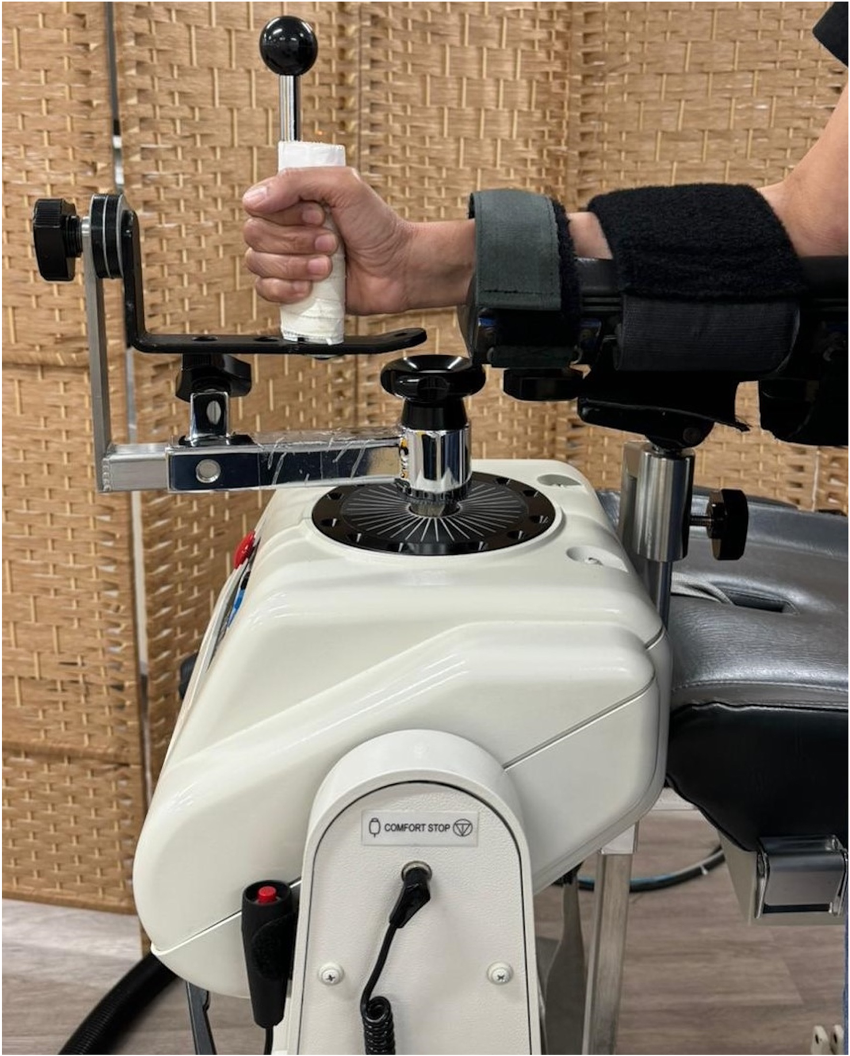
Wrist testing with grip.
For defining the test RoM, the reference (zero) position was defined as that of the fingers in comfortable extension and co-linear with the forearm. Thus, for all 4 tests: 2 (flexion/extension) × 2 (con/ecc), the RoM was 60°. However, for the concentric action of the Flx, the RoM started at 15° of extension and ended at 45° of flexion while for concentric extension, the RoM started at 55° of flexion and ended at 5° of extension. These RoMs were determined during the pilot study and were based on participants’ comfort, especially with respect to the eccentric action of the muscles. A single angular speed of 120°/s was applied in all tests and established during the pilot study based on a higher degree of inter-repetition consistency along with better comfort as reported by the participants, compared to speeds of 60 or 90°/s. A general warm-up consisting of 3 min of treadmill walking at a pace of 4.5–6 km/h preceded the specific familiarization procedure which consisted of 3 repetitions at an increasing concentric submaximal effort of 50, 70 and 90% of the subjective maximal effort.
The criterion tests consisted of 3 reciprocal pairs of maximal concentric and eccentric contractions, first of the Flx followed by Ext. During the test, verbal encouragement was given by the examiner to the participants. Following the isokinetic tests, grip strength was measured using the Jamar dynamometer in either the 2nd and 3rd rung, as selected by the participant. For each position, three maximal grip (G) contractions were carried out each for a duration of 3–5 s with a 45 s rest allowed between repetitions. The total duration of a full testing session was around 30 min.
Data analysis was performed using the SPSS (v. 27.0) program. Significance was set at p <0.05. For descriptive statistics, quantitative variables were described using the mean and SD. The maximal value of the 3 isokinetic repetitions for each individual muscle, movement and contraction was used as the representative PM score. The same was applied for the static grip test. The following four ratios were calculated for Flx and Ext movements: 1. between muscles - same contraction ratio namely: Fcon/Econ and Fecc/Eecc, 2. same muscle – eccentric to concentric ratio (ECR) namely: Fecc/Fcon and Eecc/Econ (the ECR).
Each dependent variable was examined for normality assumption via skewness (SK <[2.0]) and kurtosis (K <7.00) procedures. Skewness values ranged between − 0.12 and 0.245 and kurtosis values ranged between – 1.2 and 0.709. Therefore, a normal distribution was assumed for dependent variables. 11 A three-way ANOVA was conducted on all PM variables, three within factors and one between factor (sex). This analysis revealed two noteworthy results: a significant interaction between sex and the 2 main effects (muscle group, contraction mode) which indicated that women and men react differently in each condition as well as a significant difference between the sexes with high effect size. Therefore, a 2-way ANOVA (repeated measures model) of the form: 2 (Flx vs. Ext) X 2 (con vs. ecc) was used for each sex separately. For the calculated ratios, an independent t-test was conducted to compare the ratio values between muscles, across muscle and sex differences. None of those factors were significant, hence allowed pooling.
To compare the sexes via overall correlation patterns of the PM, we conducted a Mann-Whitney test on the Fisher's Z-transformed correlations values. We choose an un parametric test due to the small sample and deviation from normality.
Results
None of the participants complained of inconvenience or pain during or following the tests.
Descriptive statistics
The mean (SD) values of the concentric and eccentric PMs of the Flx and Ext, are outlined in Table 1. In terms of the absolute isokinetic and grip strength values, women's level of strength was uniformly around 60% (range: 57%-62%) that of men's, irrespective of the muscle group or contraction mode. This figure increased by about 15% (range: 11%-16%) upon applying bodyweight normalization of the strength scores, Nm/kgbw (isokinetic) and kg/kgf (isometric) alike.
Values of isokinetic peak torque for wrist flexors and extensors, eccentric/concentric ratios and grip/no grip ratios for men and women.
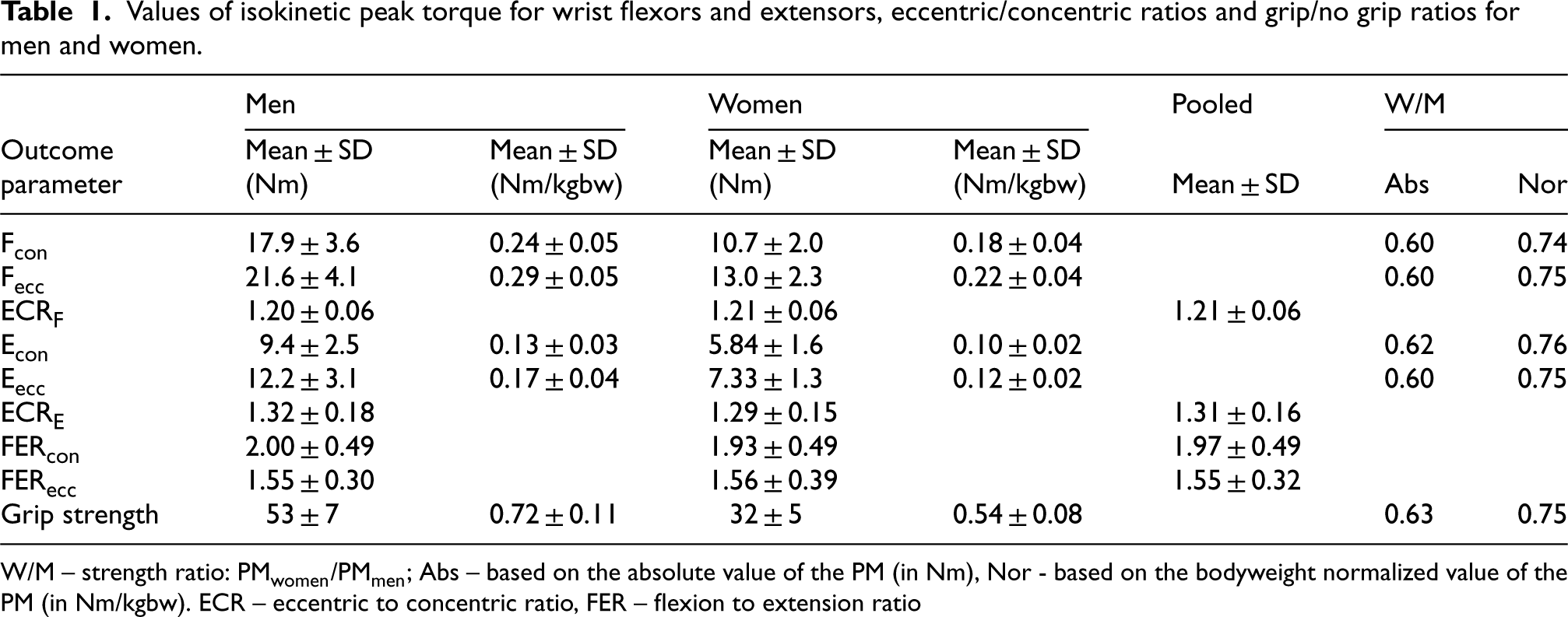
Values of isokinetic peak torque for wrist flexors and extensors, eccentric/concentric ratios and grip/no grip ratios for men and women.
W/M – strength ratio: PMwomen/PMmen; Abs – based on the absolute value of the PM (in Nm), Nor - based on the bodyweight normalized value of the PM (in Nm/kgbw). ECR – eccentric to concentric ratio, FER – flexion to extension ratio
A two-way ANOVA with repeated measures was conducted to examine the effect of the following main factors: Muscle group (Flx vs. Ext) and Contraction (concentric vs. eccentric) on the PM, has yielded the following results with respect to the two participant groups:
Women
There was a significant effect for movement : F(1,19) = 88.85, p <.001, η2 = 0.824, a significant effect for the contraction mode: F(1,19) = 504.30, p <.001, η2 = 0.964, and a significant effect for the interaction (move*cont), F(1,19) = 16.35, p <.001, η2 = 0.463. The results indicate that Flx movement was associated with a significantly greater mean PM compared to Ext (PMF – 11.85 Nm, PME – 6.59 Nm) while eccentric contraction was associated with a significantly greater mean PM compared to its concentric counterpart (PMecc – 10.17 Nm, PMcon – 8.27 Nm). The interaction effect showed that in both movements the ecc contraction had a significant greater PM compared to con mode, but the differences between the two contraction modes in the flexion movement were greater than in extension.
Men
There was a significant effect for movement: F(1,19) = 137.22 p <.001, η2 = 0.878, a significant effect for contraction mode: F(1,19) = 167.22 p <.001, η2 = 0.898, and a significant effect for the interaction (move*cont), F(1,19) = 4.80, p <.05, η2 = 0.202. The results indicate that Flx movement was associated with a significantly greater mean PM compared to the Ext (PMF – 19.74 Nm, PME – 10.79 Nm), eccentric contraction was associated with a significantly greater mean PM compared to its concentric counterpart (PMecc – 16.89 Nm, PMcon – 13.64 Nm). The interaction effect showed that in both movements the ecc contraction had a significatly greater PM compared to con contraction, but the differences between the two contraction modes in the flexion movement was greater than in extension.
Strength ratios
Two types of ratios were examined: 1. between muscle groups - same contraction mode, namely: Fcon/Econ and Fecc/Eecc; 2. within muscle group - between contraction modes, namely: Fecc/Fcon and Eecc/Econ. The results of a paired t-test testing difference between muscle groups ratio revealed a significant effect: t (1,39) = 3.39, p <.001, d = 0.54. The results indicate that the con mode F/E ratio (M = 1.96 ± 0.48) is significantly greater compared to the ecc mode (M = 1.84 ± 0.44). Second paired-t test examined the difference between contraction ratio revealed a significant effects t(1,39) = 3.63, p <.001, d = 0.53. The results indicate that the ratio ecc/con of the extensors muscle group (M = 1.30 ± 0.16) is significantly greater than of the flexors muscle group (M = 1.21 ± 0.06)
Correlational analysis
The correlational analysis (Table 2) included all pairs of the basic isokinetic outcome parameters (OP) e.g., Fcon and Fecc, as well as those between the isometric grip and each of the OP, with respect to ‘sex’. To compare the overall difference between the two correlation matrices (women and men) the Fisher's r-to-z transformation for each pair was first used followed by a Mann-Whitney test. The analysis revealed that men have higher correlation coefficients compared to women: z = 1.96 p = 0.049. Three findings emerge from the correlation matrix. First, the relationship between the 4 Flex isokinetic combinations and isometric OP reached significance and were of moderate strength: 0.45–0.60 with no significant differences between women and men.
Peak moment correlation (Pearson's r) matrix: women vs. men. Each cell in the matrix includes the r value in women (top) and men (bottom).
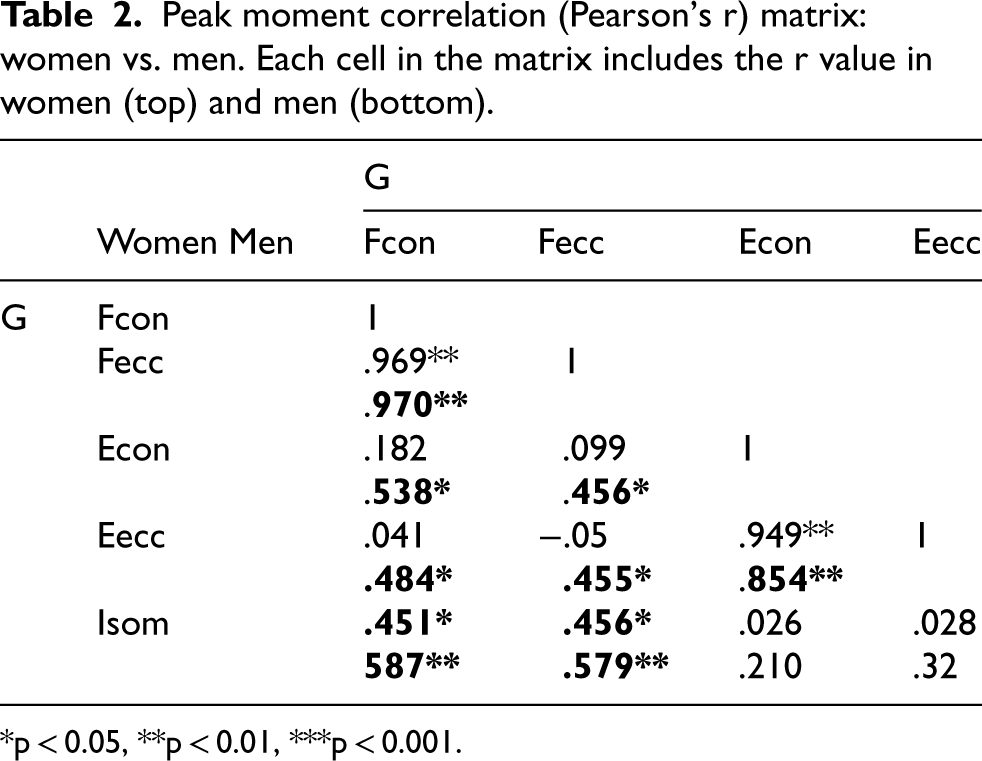
Peak moment correlation (Pearson's r) matrix: women vs. men. Each cell in the matrix includes the r value in women (top) and men (bottom).
*p < 0.05, **p < 0.01, ***p < 0.001.
Second, there were very strong correlations between the PMs of the ‘within-muscle’ concentric and eccentric values. In both women and men, the r values were 0.85 and higher. Third, there was a significant moderate correlation between the PMs of the ‘between-muscle’ concentric and eccentric values in men, whereas, no correlation was found in women.
The main objective of this study was to explore and compare the sex related variations in isokinetic concentric and eccentric strength profile of the wrist Flx and Ext. The tests were conducted in standing with the forearm placed in mid-position.
In terms of the isokinetic strength measured at the dominant side in the common G set-up, specific reference is made to two previous studies which tested the Flx and Ext in the con mode across a wide age span but in forearm pronation position. Using the same dynamometer's make, a RoM of 100° and speed of 90°/s in women of similar age group (20–29), mean (SD) PM values of 10.7(2.4) and 5.7(1.4) Nm were recorded for Flx and Ext, respectively, while for men of same age decade, the parallel values were 18.4 ± 3.8 and 9.4 ± 1.6 Nm. Applying the same dynamometer and a very similar protocol but a shorter RoM of 45°, Harbo et al. (2012) reported that in women under 30 years of age, the mean (SD) PM values were 13(4) and 7(±2) Nm for the Flx and Ext, respectively, whereas for men of same age decade the parallel values were 21(5) and 11(3) Nm. In the current study, we used a different RoM (60°) and especially speed (120°/s) but a similar dynamometer. The obtained PM values were in almost perfect to close agreement with previous studies.3,4,7,10,12 Comparison to the bodyweight normalized strength values is relevant only with respect to one study only which related to this alternative form of expression. 10 Thus, in the current study the concentric strength of the Flx (at 120°/s) was 0.18(0.04) vs. 0.26(0.06) (in the above study) whereas the respective figures for the Ext were 0.10(0.02) and 0.12(0.03), evidencing a close match especially in terms of the Ext. Moreover, the higher contraction speed in the present study would tend to reduce the concentric strength and thus an even closer match could be envisaged had the strength findings been compared with respect to the same speed. On the other hand, the eccentric strength was different: 0.22(0.04) (in the current study) vs. 0.35 ± 0.11 10 for the Flx and 0.12 ± 0.02 vs. 0.28(0.06) for the Ext, respectively. However, given the extremely high ECR for Ext in the previous study 10 the disparity may reflect a measurement problem with the latter's. In addition to the isometric findings, the current grip strength values, comply almost perfectly with those quoted in a previous leading source namely, for women: 32 vs. 33kgf (mean value), respectively and for men: 53 vs. 55kgf, respectively. 13
Two other important isokinetic markers are the agonist-antagonist (Flx/Ext) strength ratio: expressed respectively for concentric (FERcon) and eccentric (FERecc) contraction modes as well as the ecc/con ratios: ECRExt and ECRFlx. The FERcon indicates that the Flx were generally twice as strong as the Ext, with mean values that were very similar between the women (1.93) and the men (2.0) closely matching previous studies.3,4,10 The FERecc was somewhat lower (1.55) due to a relatively higher Eecc, but in this case as well, the mean values were practically identical in women (1.56) and men (1.55). The mean value for the ECRF in both women and men stood at 1.2, rising slightly to 1.3 for ECRE and complying well with the known range in other muscles. 14 Of note, the values of ECRF obtained in the present study are well aligned with the estimated mean interpolated ECRF (at 60°/s) values of 1.29 in women and 1.26 in men reported before. 10
Strength relationships: women vs. men. The inter-sex strength ratio PMwomen/PMmen is of a particular value as it provides both an additional insight through the absolute (Nm) and relative (Nm/kgbw) strength of the tested muscles and validation of the protocol. In the present study this ratio was perfectly aligned with both muscles as amply evidenced by Table 2. Moreover, normalizing the strength according to bodyweight resulted in a mean increase of the ratio by 15% (11%-16%). Similar increases have been documented before in papers relating to the trunk flexors and extensors with a difference of around 10%, 15 and knee extensors and flexors with an increase of 13%. 16 In the current study, strength normalization resulted in a very homogenous increases in the PMwomen/PMmen ratio amounting to 14–17%. Of note, the grip isometric strength, yielded values that were in excellent compatibility with its isokinetic counterparts namely the absolute peak force (PF) ratio: women/men, was 0.63 while the normalized PF was 0.75. We therefore argue that put together, the findings outlined in Table 2, strongly support the robustness of the present testing protocol.
Interestingly, a non-obvious inter-sex strength pattern emerges from this study. Based on the correlational analysis that consisted of the main set of outcome parameters (OP): Strength grip, Fcon, Fecc, Econ and Eecc, men and women have a similar pattern in all combinations related to the same muscle group yet men are distinguished by significantly higher correlations than women.
That women differ from men in several isokinetic strength and strength-related parameters is well documented. Besides being weaker than men, in both absolute and bodyweight adjusted terms, women present with other differentiating factors related to isokinetic performance. For example, women fatigue faster than men in terms of reduction in knee PM and dynamic control ratio (Hecc/Qcon) values 17 as well as hampered with larger decreases in work output during concentric knee extension following contractions at high speed. 18 On the other hand, women exhibited greater elbow flexion fatigue tolerance than men. 19 In the elderly age group, women exhibit better ankle moment variability during a short bout of isokinetic effort, 20 while their rate of velocity development during isokinetic contractions is lower than that of men. 21
An attempt to explain this finding led to a literature search utilizing various databases and including keywords such as ‘females’, ‘males’, ‘women’, ‘men’, ‘comparison’, ‘isokinetic’, ‘strength’, ‘synergy’, but no previous relevant papers could be extracted. Against this background, one important element should be borne in mind namely, that at the basis of this finding are sets of maximal isokinetic contractions. Not only do the obtained PM values, isokinetic and isometric (grip), align closely with previous studies, the results indicate an excellent internal consistency with respect to the isokinetic ratios: FER, ECR and PMWomen/Men. The mean values of these ratios closely comply with findings derived from other muscle groups. Moreover, the same PMWomen/men characterized the isometric effort associated with the hand grip test. It should also be mentioned that there was no apparent reflexive or cognitive hindrance in the form of pain inhibition or secondary gain, respectively, which could suggest that the participants were not performing maximally. Thus, we tend to rule out an association with potential cortical mechanisms-mediated sex differences although this point deserves further research.
Rather, we speculate that the enhanced coherence in men relative to women and with respect to the dominant hand, may reflect an adaptive process which responds to higher strength demands they engage in. Especially in western cultures, and when called upon, manual manipulation of heavy objects is normally undertaken by the male sex. A higher coherence pattern may facilitate the synergistic patterns like the wrist extensors and fingers flexors. To test these speculations further research involving other antagonistic muscle groups in both women and men is needed including topics such as: fatigue/endurance especially of the wrist Flx and Ext; the analysis of these muscular interactions in women involved in highly demanding sporting tasks involving wrist muscles such as weight lifting or parallel bars; the expression of coherence in the dominant vs. non-dominant side; exploring these patterns in girls vs. boys where the demands have not yet taken place as well as focused isokinetic-EMG studies.
In addition to the isokinetic variations, the relationship between isokinetic flexion variables and grip strength is noteworthy. Among other things, a strong grip is enabled by proper positioning and stabilization of the wrist. This mandates a strength balance between the wrist extensors and wrist flexor muscles which ensures optimal length-tension relationships. The correlational findings reveal a fair relationship between the isometric grip and the wrist flexion strength. No such correlations were observed regarding wrist extension. In this case as well, the values were higher in men than in women. However, their almost perfect symmetry in the concentric and eccentric conditions is remarkable. To the best of our knowledge, this finding is reported for the first time. It should also be borne in mind that these values explain only about 20–25% (R2) of the inter-relationships. Thus one may conclude that grip and wrist muscle strengths are quite independent of each other, although given the different type of contraction: isometric and isokinetic in the former and the latter, further research is needed to put this finding in perspective.
A major limitation of this study is that the results refer to the dominant hand only. This may impact both the enhancement of the net wrist flexion strength as well as the coherence pattern. We therefore suggest that future studies explore the bilateral WFE as well as further explore the moment output sharing between the wrist and fingers’ flexors under submaximal conditions, particularly in relevant specific occupations alongside the assessment of muscular deficiencies in select pathologies involving wrist muscles, especially the flexors.
Conclusions
This study establishes the inter-contraction and antagonistic muscles strength ratios relating to the movements of flexion and extension in the wrist. In addition, it indicates that testing of WFE using the neutral forearm position while standing erect may be a valid approach to this measurement.
Footnotes
Acknowledgements
The authors would like to thank Mr Igal Zano from the Levinsky-Wingate Academic College for preparing the specially designed forearm support and for his technical aid.

Ethical approval
This study was conducted according to the Declaration of Helsinki after explaining fully the purpose of the study and the experimental methods to the subjects in advance, obtaining their written consent, and receiving approval from the Ethics Committee at Levinsky-Wingate Academic College (No. 414, 13.07.2023).
Author contributions
Conception: Eitan Shemy and Smadar Peleg.
Performance of work: Eitan Shemy and Takashi Okada.
Interpretation or analysis of data: Michal Arnon and Smadar Peleg.
Preparation of the manuscript: Eitan Shemy, Michal Arnon, Takashi Okada and Smadar Peleg.
Revision for important intellectual content: Eitan Shemy, Michal Arnon and Smadar Peleg.
Funding
This research did not receive any specific grant from funding agencies in the public, commercial, or for-profit sectors.
Declaration of conflicting interests
The authors declared no potential conflicts of interest with respect to the research, authorship, and/or publication of this article.