



Abstract
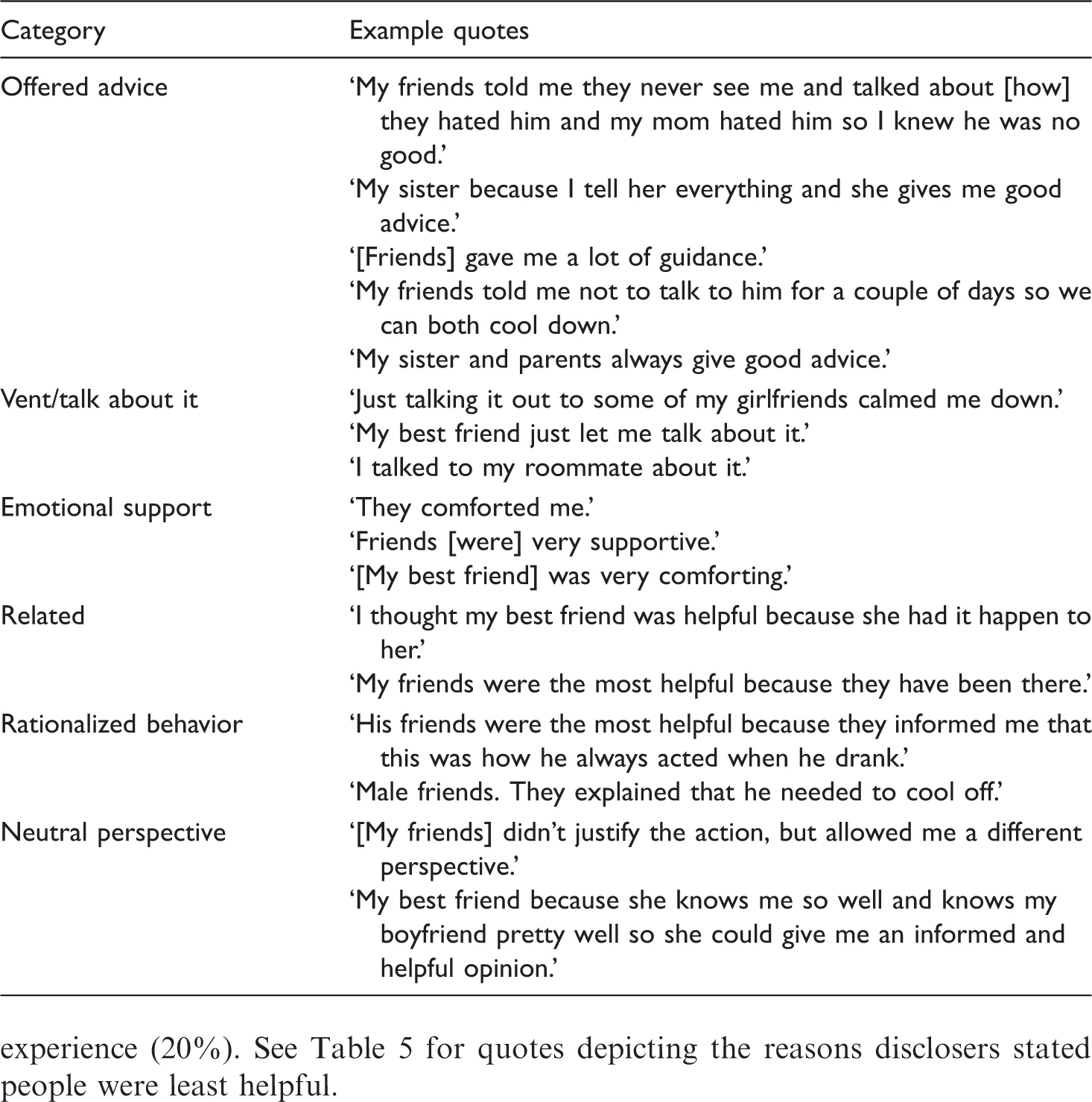
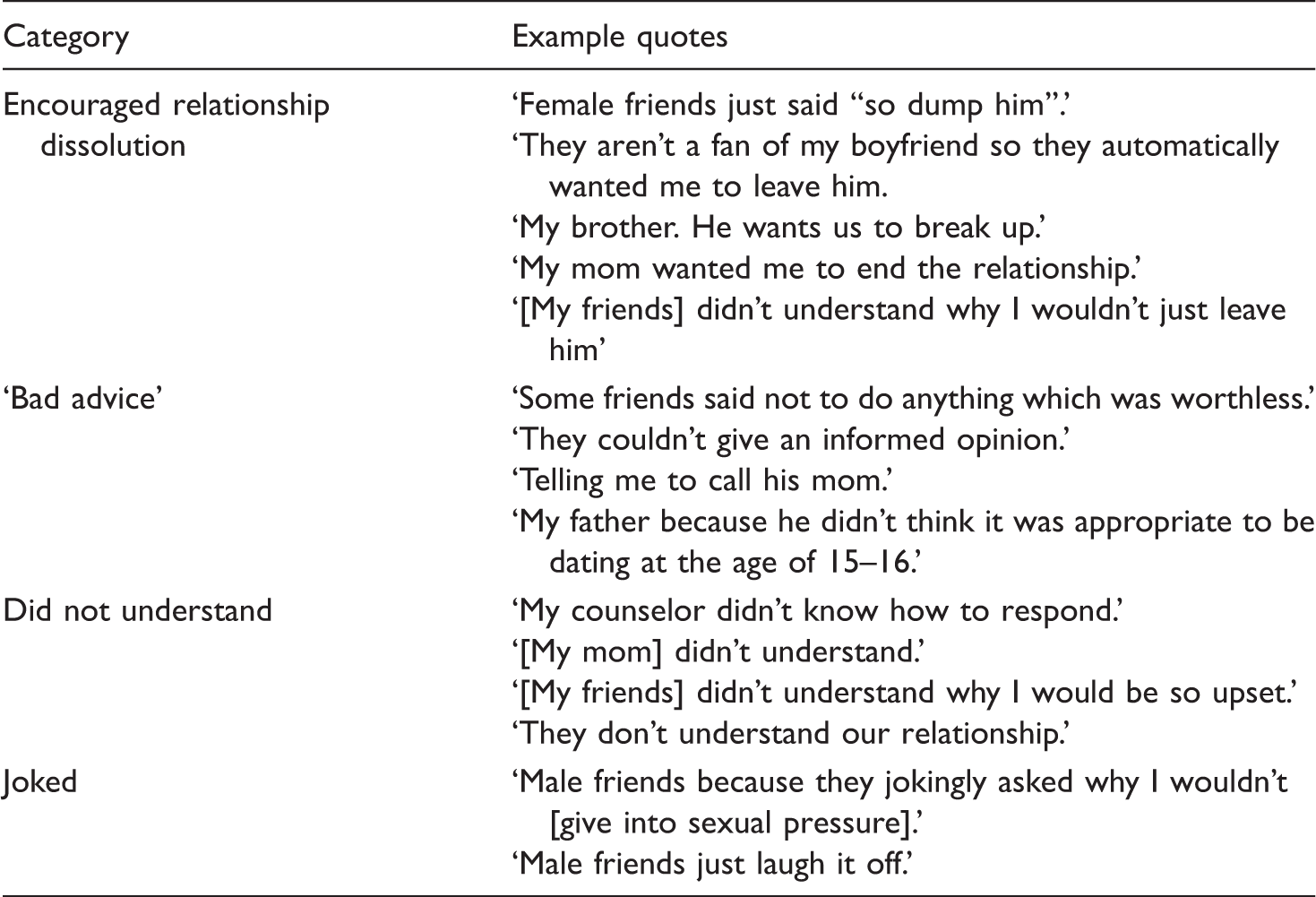
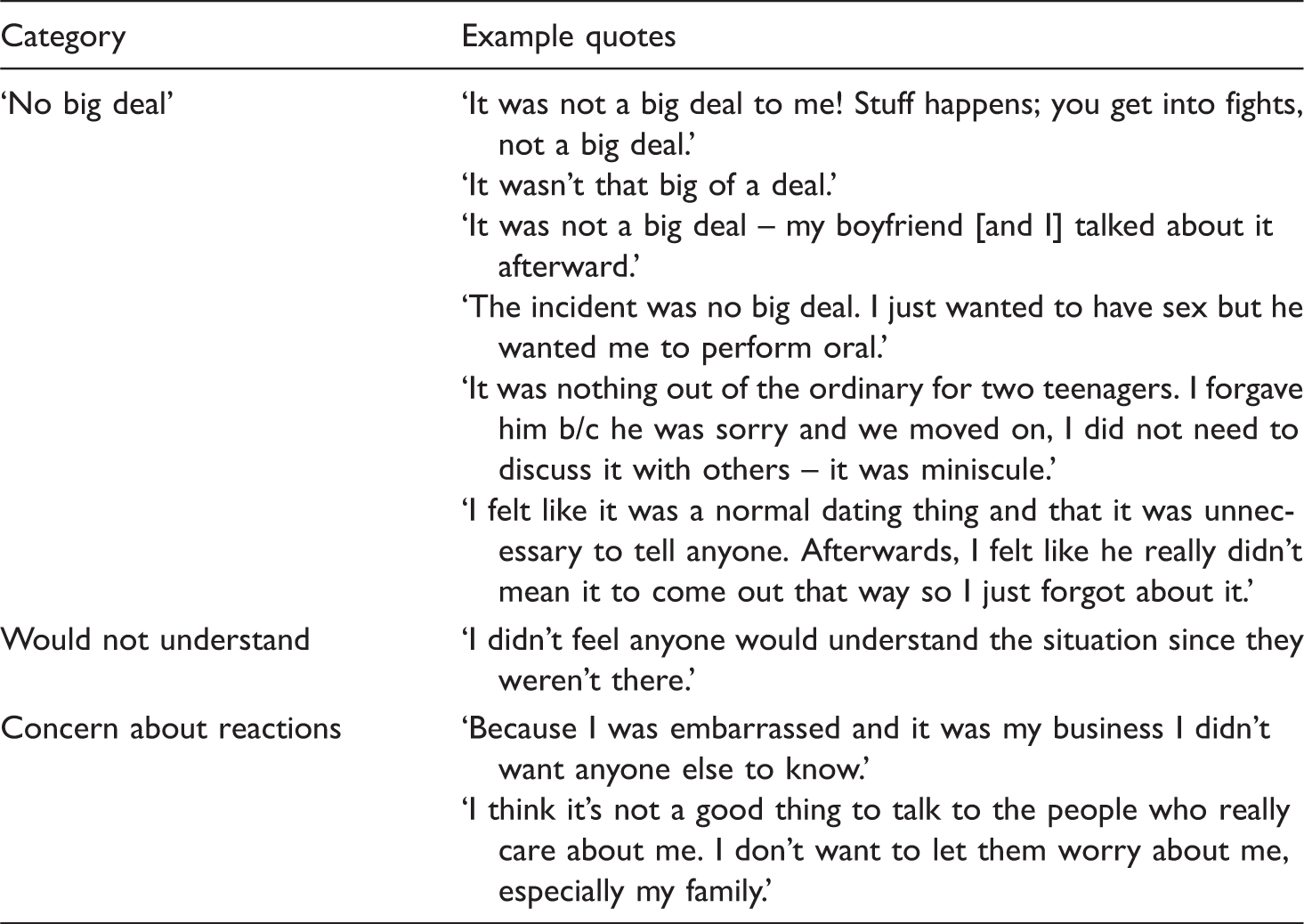
The researchers utilized quantitative and qualitative methods to examine college women’s disclosure of dating violence. Quantitative analyses showed that disclosure of dating violence was related to stress associated with abuse, partner blame, and thoughts about ending the relationship. Qualitative content analyses demonstrated that women’s minimization of the abuse was the most commonly given reason for nondisclosure. Women who disclosed dating violence reported that the following responses to their disclosures were most helpful: receiving ‘good advice’, the opportunity to vent/talk about it, receiving comfort and other emotional support, rationalizing the partners’ behavior, and providing a neutral perspective. Conversely, the following responses were reported as least helpful: being told to end the relationship, not understanding, joking about the experiences, and ‘bad advice’. Implications for intervention and future research are discussed.
The majority of women will be the victim of dating violence during their lifetime (Edwards et al., 2009). A burgeoning body of research documents the deleterious consequences of dating violence to victims and society (Lewis and Fremouw, 2001). Less research, however, has focused on women’s disclosure of dating violence, especially research utilizing mixed methodologies and samples of non-treatment seeking college women in abusive dating relationships. Using a feminist lens, the purpose of the current study was to explore this gap in the literature. In particular, the present study represents a follow-up to Mahlstedt and Keeny’s (1993) mixed-methodological study about US college women’s disclosure of dating violence.
Mahlstedt and Keeny (1993) found that 92% of abused women disclosed the abuse to at least one source, and that these women were much more likely to disclose abuse to informal support services than formal support services. Specifically, they found that although only 9% of abused women disclosed dating violence to police, 80% disclosed dating violence to a friend. Other common informal support sources to whom women disclosed were relatives, including mothers (43%), sisters (47%), brothers (33%), and fathers (15%). These rates of disclosure are similar to rates of sexual assault disclosure found in more recent studies with college (Orchowski and Gidycz, forthcoming) and community (Ullman, 1996, 2010) samples.
Mahlstedt and Keeny (1993) also documented that women endorse barriers to disclosure such as embarrassment about the abuse, believing that the abuse is a private matter, fear for their own safety, or concerns about social reactions. Orchowski and Gidycz (forthcoming) found that women who endorse lower levels of self-blame were more likely to disclose sexual violence than individuals who endorse higher levels of self-blame. The data from these studies are consistent with Ahrens (2006) and Ullman’s (2010) assertions that violence against women serves to reinforce women’s powerlessness in a patriarchal society, and that silence (or nondisclosure) symbolizes this powerlessness.
In addition to assessing rates of disclosure and reasons for nondisclosure, Mahlstedt and Keeny (1993) assessed social reactions to abused women’s disclosure. These researchers found that the most commonly reported responses to disclosure were that confidents ‘listened’, ‘gave helpful advice’, and were ‘angry with the assailant’. The least frequent responses were ‘trivialized it’, ‘saw me as a failure’, and ‘made decisions for me’. Responses that women reported as the most helpful included: ‘understanding,’ ‘advice-giving,’ ‘listening,’ and ‘interrupting victim blame.’ Mahlstedt and Keeny reported that excessive advice giving (e.g. to leave the abuser) was often interpreted by women as an insinuation of victim-blame, and were considered by women to be the most unhelpful responses. These results underscore the differences in social reactions that women receive to their disclosure of dating violence within the context of a patriarchal culture.
Although the Mahlstedt and Keeney (1993) study contributes to our knowledge of disclosure of dating violence, there remains a dearth of research assessing reasons for nondisclosure and the responses from confidants that college-aged women who disclose dating violence perceive as the most and least helpful. Also, there have been considerable efforts in our society (e.g. media awareness campaigns, dating violence prevention, and intervention programming) to raise awareness about dating violence over the past years (Gidycz et al., 2011), which may have contributed to changes in disclosure processes (Ullman, personal communication, January 6, 2011). In order to build upon the results of earlier research, we attempted to answer the following questions utilizing quantitative data: To whom do women disclose dating violence? What are the correlates of women’s disclosure of dating violence? Utilizing qualitative data, we attempted to answer the following questions: For women who disclosed, who was the most helpful and why? Who was the least helpful and why? For women who did not disclose, what were their reasons for doing so? Of note, we agree with other researchers (e.g. Ahrens, 2006; Ullman, 2010) that social reactions to interpersonal violence emanate from broader social norms and attitudes related to violence against women and gendered power relations. Although we did not directly assess these social norms and attitudes in our study, we assert that these invariably affect social reactions to disclosure and survivors’ perceptions of helpfulness and unhelpfulness of specific responses. We thus use a critical feminist lens when interpreting and discussing our results.
Method
Participants
Participants included 44 women who reported at least one incident of sexual, physical, or psychological abuse in their current heterosexual relationship, as measured by the Conflict Tactics Scale-Revised (CTS2; Straus et al., 1996) and obtained from a larger screening sample (N = 107). The 44 women were predominantly young (mean age = 19.30, SD = 1.36) and white (82%).
Measures
The CTS2 (Straus et al., 1996) was used to identify women currently in relationships characterized by dating violence. Women (N = 44) who endorsed any experiences of physical, sexual, or severe psychological dating violence in their current relationships on the CTS2 were considered to be in abusive relationships and included in the study analyses. Abused women most commonly reported experiences of what Straus et al. (1996) consider moderate forms of abuse (e.g. being pushed/shoved, verbally coerced to have sexual intercourse) in their current relationships, as opposed to more severe forms of abuse (e.g. being choked, physically forced to have intercourse).
Following the CTS2, women were asked to review their answers on the measure and pick the most severe/upsetting experience that they endorsed, and to answer the remaining questions about this experience. Specific questions (with response options ranging from ‘Not at all’ to ‘Very much’) assessed self-blame, partner blame, and how stressful the experience was for participants. Additionally, participants were asked if they thought about ending the relationship following the specific incident (‘Yes’ or ‘No’). A question also assessed who participants told about the experience. After these forced-choice response questions, women completed three open-ended questions about the most helpful and least helpful responses to their disclosure, as well as reasons for nondisclosure. For each question, women were asked to provide ‘several sentences’, and written responses ranged from a few phrases to several sentences.
Procedure
Following institutional review board approval, participants were recruited through introductory psychology courses and were compensated with course credit. Data were collected in groups, which included informed consent, survey completion, and debriefing and referral information.
Participants’ written responses to open-ended questions were independently content analyzed (Krippendorf, 1980) by two raters who were doctoral students in clinical psychology. In the first steps of content analysis, coders read participants’ responses repeatedly in order to obtain the Gestalt of the data. Second, words and phrases that addressed each of the questions asked were highlighted. This was done in an effort to identify and categorize all aspects of women’s responses to the various open-ended questions. Third, similarities and differences in the responses to each of the questions were noted and led to the emergence of categories of similar responses. After initially coding all participants’ responses using these initial categories, the researchers examined all data within a particular code and some codes were combined, whereas others were split into subcategories. As suggested by Joffe and Yardley (2004) there is considerable overlap in content and thematic analytic approaches. Whereas the researchers focused primarily on the manifest content of the data (derived from content coding), the categories were also used to explore themes across categories at a more latent level in the discussion section using feminist theory.
Results
To whom do women disclose dating violence?
Rates of disclosure
Note: Percentages exceed 100% because many participants disclosed to multiple sources.
What are the correlates of women’s disclosure of dating violence?
Means (and standard deviations) for variables of interest

Rates of disclosure as a function of thoughts about the ending relationship

For women who disclosed, who was the most helpful and why?
Quotes depicting most helpful responses
For women who disclosed, who was the least helpful and why?
Quotes depicting least helpful responses
For women who did not disclose, what were their reasons?
Quotes depicting reasons for nondisclosure
Discussion
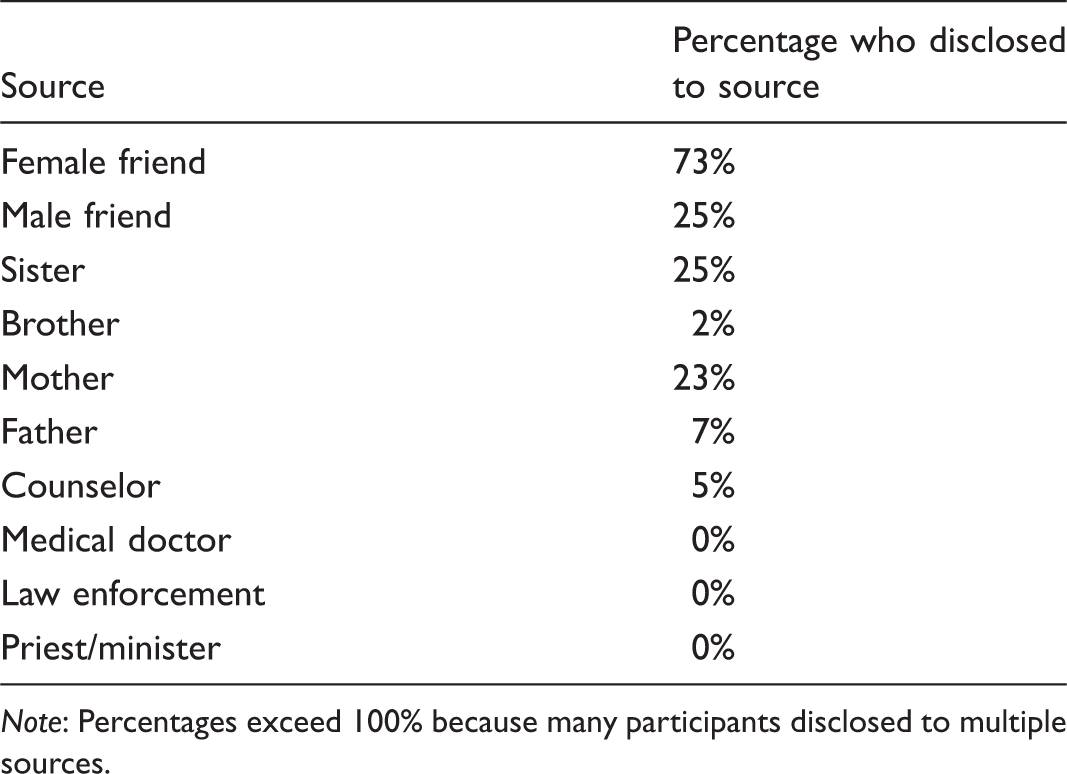
The purpose of this study was to assess college women’s disclosure of dating violence utilizing a mixed methodological design. Similar to Mahlstedt and Keeny’s (1993) study, many women were able to break their silence and disclose dating violence. Almost all women who disclosed did so to an informal support, most commonly female friends. Additionally, quantitative results demonstrated that there was a relationship between several factors – stress associated with abuse, partner blame, and thoughts about ending the relationship – and the disclosure of dating violence. However, given the retrospective nature of this study, the temporal sequencing of these variables is unclear of the temporal sequencing of these variables (i.e. if a certain thought or emotion led to disclosure, or if the act of disclosing and the responses of others led to a certain thought or emotion).
Qualitative content analyses suggested that women’s minimization of the abuse was the most commonly mentioned reason for nondisclosure. In fact, 80% of nondisclosers chose not to discuss the experience with anyone because it was ‘no big deal.’ This finding may be reflective of larger social ideologies that legitimize and normalize violence against women, often leading victims to internalize these norms and beliefs (Baly, 2010; Wood, 2001). Additional reported reasons for nondisclosure included fear that no one would understand, feelings of embarrassment, or believing that the experience was a private matter, all of which are consistent with Mahlstedt and Keeny’s (1993) research and consistent with patriarchal social structures that influence micro-level disclosure processes. For those women who disclosed dating violence to others, responses from confidants varied in their perceived helpfulness. Perhaps due to the fact that 98% of women in this sample who disclosed did so to friends, friends were perceived as both the most helpful (56%) and least helpful confidants (49%). Indeed, consistent with Mahlstedt and Keeny, women often disclosed to multiple friends, some of whom were helpful and some of whom were unhelpful.
Interestingly we found that whereas some individuals reported a particular response (such as telling one to leave) was helpful, others found the same response unhelpful. This finding is consistent with the transtheoretical model of change (Prochaska and DiClemente, 1984) and other research with abused women (e.g. Enander, 2011), such that for women who are in contemplation or preparation stages of leaving, advice such as being told to leave may be perceived as helpful (and consonant with one’s own beliefs), whereas for precontemplative individuals, being told to leave would be dissonant with one’s own beliefs about her relationship. This finding may also be related to patriarchal cultural factors and social discourses that maintain some women in abusive relationships and affect how women understand their role in relationships and their subjectivity as women. This notion is related to feminist research suggesting that some women internalize oppressive social norms regarding gender ideologies and hold more accepting attitudes of violence against women (Baly, 2010; Wood, 2001), which undoubtedly affects the extent to which women find certain social responses to their disclosures of dating violence helpful or unhelpful.
Several limitations of the current study and suggestions for future research are noted. First, the sample size was small and the participant demographics of our sample were homogenous (i.e. white, heterosexual women). This limited our ability to assess differences in perceived helpfulness and unhelpfulness among the varying types of supports (e.g. informal vs formal supports) and different abuse types (e.g. physical, sexual, and psychological). Additionally, the retrospective nature of this study did not allow us to assess the temporal sequencing of the correlates of dating violence or how disclosure of dating violence relates to women’s long-term adjustment and relationship stability – questions that could be followed up using longitudinal mixed-methodologies with larger, more diverse samples. Additionally, it is unclear from the qualitative data what constituted participants’ perceptions of ‘good’ and ‘bad’ advice, as well why some participants viewed responses as helpful and others viewed the same responses as unhelpful. Accordingly, future research could attempt to understand participants’ perceptions of various types of advice using more rigorous and in-depth qualitative methodologies (e.g. interviews) and assess readiness to change, empowerment, and cultural variables as possible explanations for variability in what women view as helpful and unhelpful.
Despite these limitations, the findings from the current study offer implications for dating violence programming and social awareness efforts. Given the large percentage of women who minimized the abuse, there is a need for psychoeducation and public awareness campaigns to educate people about dating violence. Further, these data underscore the importance of educating others – especially college students since they are the most likely source of their friends’ disclosures – on how to respond to the disclosure of dating violence. Although dating violence prevention programs often provide suggestions on how to help a friend in an abusive relationship (Black and Weisz, 2008; Foshee et al., 1998; Senn, 2011), findings from the current study underscore the complexity in what women deem as helpful and unhelpful responses to their disclosures of dating violence. Indeed, some of the responses that women reported as helpful (e.g. minimize the abuse) are responses that program developers and facilitators discourage and consider harmful. Clearly, this is a critical area for more mixed-methodological and participatory action research that must include dialogue between researchers, clinicians, program developers, survivors of dating violence, and their formal and informal supports. Furthermore, programming efforts alone will not lead to widespread change in reactions to disclosure because these interpersonal reactions are situated in larger patriarchal social and institutional contexts that legitimize violence against women, and these too must be addressed.