



Abstract
There is increasing visibility of dissident sexualities and genders in media debates about families, including resistant discourses that challenge delegitimising claims about queer families. There remains, however, a lack of research that assesses the ways in which discourses seeking to defend queer parenthood function to challenge or, at times, reinforce hetero-gendered norms. Families formed by gay men have generally received less attention, both in the media as well as academic scholarship. In this paper, we explore resistant discourses deployed in mainstream print media, attending particularly to news reports about queer fathers and their children. Through a critical thematic analysis of South African newspapers, informed by feminist discursive psychology, we identify four themes in resistant ways of talking: de-gendering parenthood, normalising queer parents, valorising queer parenting, and challenging the heteronormative gold standard. We conclude with the political implications of such resistant talk, as part of a project of transforming restrictive hetero-gendered norms.
Introduction
The media shape public ideologies in significant ways and have long been one of few sources of information about sexual minorities available to the general public, functioning “hegemonically to reveal and construct dynamic power relationships and their sexual politics” (Landau, 2009, p. 84). The media in general, and news media in particular, have thus been identified as forming an important part of strategies for transforming oppressive constructions of sexuality and gender (Landau, 2009). It has been argued that public acceptance can be promoted through increased positive portrayals of queer families (Lubbe, 2008). Bernstein and Reiman (2001) state that “[w]hen queers decide to come out in the context of their relationships, how they represent themselves [and, we would add, how they are represented] has implications for political and cultural change” (p. 8). However, as Gamson (2001) points out, “the desire to be recognised, affirmed, validated, and to lay the cultural groundwork for political change … . has tended to inhibit careful analysis of the dynamics of becoming visible” (p. 70). This observation points to the need to interrogate the ways in which queer families are portrayed in the media, not only in relation to invalidating or oppositional arguments, but also those that appear to work in favour of queer families. Accordingly, our aim in this paper is to explore the relationship between visibility, gender transgression, and the politics of queer families. We do this by investigating how gay men and their families are represented in South African mainstream media.
Queer politics play out within a broader setting in which there is still strong conservative opposition towards queer families – seen as a threat to the hetero-patriarchal order, and to society itself (Bernstein & Reiman, 2001). At the same time, there have been broad cultural shifts towards inclusivity and acceptance of diversity, often expressed in (neo)liberal terms (Brickell, 2001). These liberal arguments have been adopted within political movements that attempt to combat discrimination on the basis of homosexuality “as a difference as benign as left-handedness, which would have no meaning in the absence of discrimination” (Bernstein & Reiman, 2001, p. 12).
In the South African context constitutional protection on the grounds of sexual orientation – listed along with signifiers such as race, class, and gender – exemplifies a political strategy of assimilation (Hames, 2008). In contrast, other political movements, notably those driven by feminist and queer theories, seek to transform the current hetero-gendered order and espouse a politics of transgression (Bernstein & Reiman, 2001). Scholars who support transgressive politics do so on the basis that assimilation produces new forms of invisibility and different opportunities for the exclusion of those who threaten the norm (Walters, 2001). As Walters (2001) argues, “[h]istory has shown us—with horrifying detail—the ways in which forms of bigotry sustain themselves and even grow in the face of assimilation” (p. 340). Indeed, “the accomplishments of previous social movements have created a society in which discrimination, sexism, and even homophobia is not as overt as it once was. Covert forms of discrimination are subtle and seemingly innocuous” (Sowards & Renegar, 2006, p. 60).
In this paper, we take up a feminist discursive psychology standpoint to explore the transformative potential of counter narratives, or “resistant talk” as we term it, in news media reportage. We analyse media constructions that implicitly or overtly challenge negative constructions of gay fatherhood, thus potentially working to support queer families. Our analysis adds to a small, emerging body of knowledge about the relationship between media discourses and queer politics. This scholarship is largely located in the global North, often concentrating on United States media products (e.g. television talk shows) and focused either on queer families more generally or on lesbian mothers (e.g. Alwood, 1996; Clarke & Kitzinger, 2004, 2005; Gamson, 1998, 2001; Landau, 2009; Riggs, 2007). There is therefore a paucity of work in Southern contexts focused on constructions of gay fathers and their children.
The lack of specific focus on gay men as parents corresponds with the broader marginalisation and invisibility of gay fatherhood, as well as parents who identify as bisexual, transgender, or intersex, in both media and scholarship (Mallon, 2004; Morison & Reddy, 2013). This can be understood as part of a general tendency to overlook men in relation to the domestic sphere. The exception is news reporting on fathers who are regarded as problematic (and thus newsworthy), resulting in the predominance of images of violent or “deadbeat” fathers (Prinsloo, 2006). This is changing in relation to heterosexual men, as “new”, hands-on fatherhood becomes a more visible and socially desirable identity (Morison & Macleod, 2015). Queer fathers, however, remain on the margins of these discussions.
In attempting to address these research gaps, we examine the ways that queer fathers and their families are constructed in contemporary South African mainstream print news media discourse through a feminist discursive psychology lens. We draw our data from a research project about gay men and fatherhood that included a media analysis. We begin by contextualising the issue through outlining the media landscape in which resistant talk typically occurs. We then provide some information regarding our research design, explicate our analytical approach, and present our results.
Queer families in the media: A polarised debate
Media discourses related to queer parenthood are framed against a profoundly hetero-patriarchal backdrop so that heterosexuality and male dominance are central to definitions of “normal”, “healthy” families (Morison & Reddy, 2013). Using the heterosexual, male-headed nuclear family as the standard, lesbians’ and gay men’s families are construed as “alternative” at best and, at worst, as “deviant”. The durability of these hetero-patriarchal norms means that, despite a broad shift in public rhetoric towards the general expression of liberal tolerance of sexual and gender nonconformity, there remains significant opposition to homosexuality (Burridge, 2004). Queer families, therefore, find themselves in a paradoxical situation as the “age of visibility produces both realities: the hopeful moment of rights and inclusion and the fearful moments of victimisation and reaction” (Walters, 2001, p. 340).
Growing support of queer rights frequently coexists with conservative discourses against same-sex unions (Jowett, 2014) or queer family rights (Clarke, 2000). Similar to such international contexts, civil and reproductive rights are legally protected in South Africa. Though data on the number of queer South African families are not readily available, such civil unions are registered with growing frequency 1 (StatsSA, 2011, 2013). As in other English-speaking liberal democracies, such as the USA or UK, the uptake of reproductive family rights, and experiences of queer persons more generally, is deeply raced and classed. In terms of social exclusion, it has been noted that White and middle class queers generally experience “mundane” heterosexism, while those who are Black and working class also face more severe social sanction (Riggs, 2007). In South Africa, such opposition frequently takes more extreme forms such as violence or rape, which may be less common (though not absent) in more affluent, global North countries. Nevertheless, it could be argued that, as in other countries where liberal tolerance is officially espoused, expressions of heterosexism become less blatant and instead are indirect or veiled within tolerant rhetoric, in order to accommodate political changes. Such veiled heterosexism occurs in response to situations where being seen as homophobic would be undesirable, such as in public debates or the news media (Brickell, 2001; Burridge, 2004).
Accordingly, we argue that some counter-arguments, which ostensibly support queer family rights, may still normalise the hetero-patriarchal nuclear family form and “Other” queer families, particularly those underpinned by the discourse of liberal tolerance. We shall show how the political efficacy of ostensibly resistant constructions is undermined by and reinforces particular heteronormative, gendered assumptions. As a result, resonating with the findings of other studies, the hetero-gendered norm itself is rarely questioned in media discourses, and heterosexism (or homophobia) is not usually interrogated in any meaningful way (Clarke & Kitzinger, 2004; Morison & Reddy, 2013).
Focusing on media discussions, gay and lesbian people’s right or fitness to parent is usually framed as controversial and disputable. The topic is often presented as a polarised issue. Conservative arguments seek to uphold the heterosexual nuclear family as the norm while liberal counter-arguments support family diversity (Clarke, 2001). This framing of the topic as a debate is reinforced by the journalistic style of balancing reportage by presenting “both sides” of the argument, in an apparent attempt at objectivity (Clarke & Kitzinger, 2004; Landau, 2009). This “argument then counterargument structure” places advocates of queer families in a defensive position (Landau, 2009, p. 88). Moreover, Landau (2009) contends, it lends false credibility to “both sides” of the topic under investigation, inadvertently legitimating the controversial – even threatening – nature of the subject and reaffirming the need for public scrutiny.
Several investigations of various media forms – such as daytime talk television (Clarke & Kitzinger, 2004, 2005; Gamson, 2001), print news (Landau, 2009; Morison & Reddy, 2013), and radio interviews (Riggs, 2007) – have identified a number of common arguments used by both opponents and proponents of queer parents and families. As can be expected, arguments in favour of queer parenting are often deployed in response to delegitimising or hostile arguments. We discuss these arguments below.
Arguments against gay and lesbian parenting
Arguments against queer families identified in the media broadly resonate with familiar, well-documented arguments against general divergence from hetero-gendered norms (e.g. Hicks, 2003; Peterson, 2011). They cohere around the idea that the only moral and natural way to create a family is within the confines of a normative heterosexual nuclear model. These arguments frequently draw on religious discourses (Clarke, 2001). In spaces where liberal tolerance is valued, arguments that hold particular weight draw on psychologised notions of children’s needs and adequate parenting (Morison & Reddy, 2013). Appeals to (hypothetical or real) children’s welfare allow speakers to defend normative family configurations without explicitly condemning non-conforming sexualities and thus to appear neutral and avoid being heard as prejudiced.
Arguments about children’s well-being typically cite concerns about the children’s “normal” psycho-sexual or gender development (Clarke, 2000). The assumption is that “grow[ing] up with a ‘mother’ (female) and a ‘father’ (male) is a vital prerequisite for the ‘normal’ development of personality, enabling boys to develop an identity as heterosexual men and girls to develop an identity as heterosexual women” (Folgerø, 2008, p. 138). Children of queer parents are also frequently depicted as at risk of psychological harm or social exclusion (especially bullying), because of negative societal perceptions of queer families (Clarke, 2001). These arguments construct the heterosexual nuclear family “as a guarantor of ‘normal’ child development” and often obscure the possible harm associated with a heteronormative sexual and gendered order and the hetero-patriarchal family model in particular (Clarke, 2001).
Counter-arguments in support of gay and lesbian parenting
Scholars have also identified counter-arguments in the media that challenge oppressive sexual and gender norms to some extent (Landau, 2009). They have noted an overall shift in tone in recent years, in line with the changing cultural conditions discussed earlier, towards liberal tolerance of difference and the positioning of queer families as one of many “diverse” family forms (e.g. Clarke & Kitzinger, 2004, 2005; Gamson, 1998, 2001), which we also noted in the South African context. Instead of positing difference as harmful, sympathetic appeals are made to inclusivity and the acceptance of “alternative” family forms (Gamson, 2001).
Interestingly, such counter-arguments often also use children’s needs rhetoric but towards different ends (Morison & Macleod, 2013). These arguments emphasise the importance of emotional “needs” that can be provided by a parent of any gender (Gamson, 2001; Landau, 2009; Morison & Reddy, 2013). For example, Clarke and Kitzinger (2004) identified a love-makes-a-family trope – in which “love is presented as a positive feature of lesbian and gay families to offset the negative implications of gayness” (p. 205) – as the most common rhetorical strategy in “pro-lesbian/gay discourse” on US and UK television talk shows. This trope may serve to render such families as nonthreatening and familiar, as does another common argument that emphasises the normality of queer parents.
Normalising arguments minimise difference, frequently shifting parents’ gender from the centre of the debate, in order to counter assumptions that “lesbian and gay parents are significantly different (because of their ‘deviant’ sexuality)” (Clarke & Kitzinger, 2004, p. 203). Instead lesbian and gay parents’ similarity to straight parents is emphasised, for example, by highlighting their commitment to their children and engagement in familiar parenting tasks (Clarke & Kitzinger, 2004).
Existing scholarship has noted the limitations of counter-arguments, indicating how, despite overtly challenging the heteronormative family ideal, these arguments also at times subtly collude with heteronormativity (Bernstein & Reiman, 2001). For instance, tolerance or acceptance of gay and lesbian parenthood is contingent on promoting the gender binary and extended on condition that their “children grow up to be appropriately feminine or masculine and, of course, heterosexual” (Landau, 2009, p. 95). The political strategy that emerges then is one of assimilation, rather than transformation, as heterosexuality is retained as the ideal referent.
Building on these observations, our aim is to examine the arguments deployed in favour of gay parenthood in South African news media and to assess their potential to resist or reinforce hetero-gendered norms. In the following section, we explicate our methodology and present four themes, which encompass resistant talk, from our thematic analysis. Two of these themes resonate with findings of earlier research, as we shall show. The other two are novel and shed new light on the political implications of resistant talk. We examine these implications in the “Concluding discussion” section, where we consider the political limitations and opportunities of resistant talk in relation to a project of transforming oppressive hetero-gendered norms.
Methods
The data corpus
To locate news articles for analysis, we conducted a systematic search of online South African media archives and databases (SA Media Archive, Google news, IOL, and the Media24 Archive). We selected all relevant print or online articles published in mainstream newspapers and magazines. Relevance was determined according to whether the piece focused substantially on queer parents and families. Articles about queer issues in general or with no substantive focus on childbearing, family formation, or parenting were excluded. Our search was conducted using keywords in English and Afrikaans, which are dominant languages of the mainstream South African press.
Summary of major topics addressed in overall dataset.
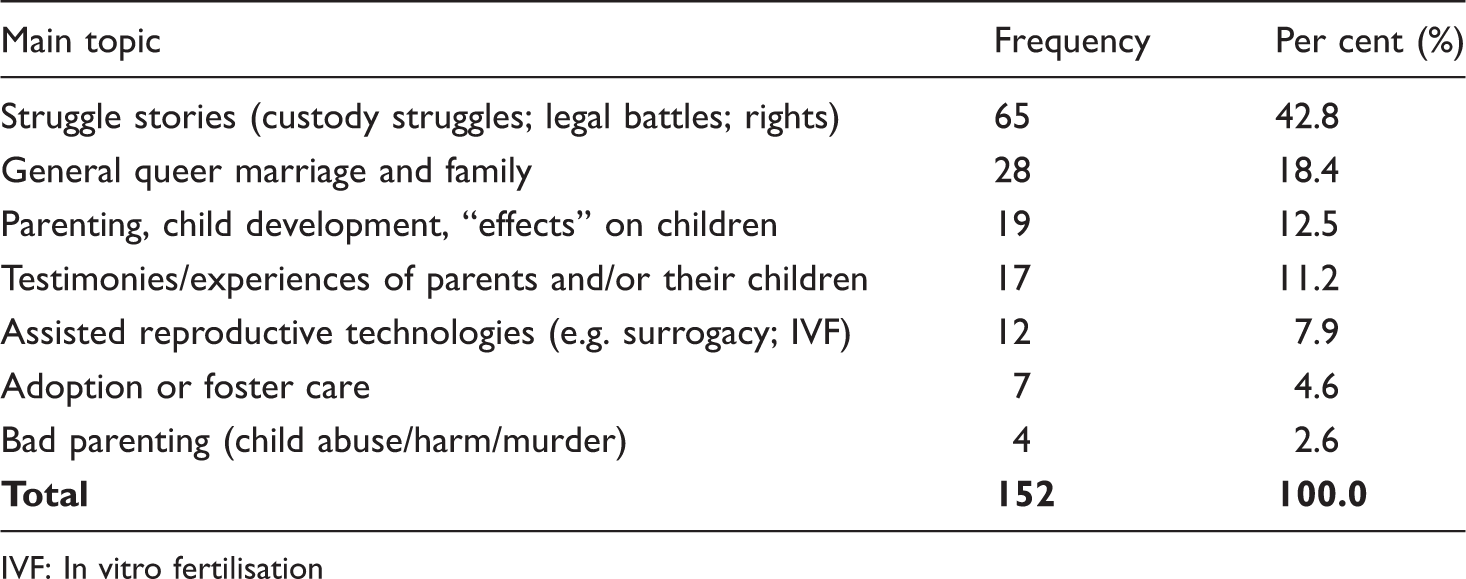
IVF: In vitro fertilisation
Summary of main focus of articles in overall dataset.
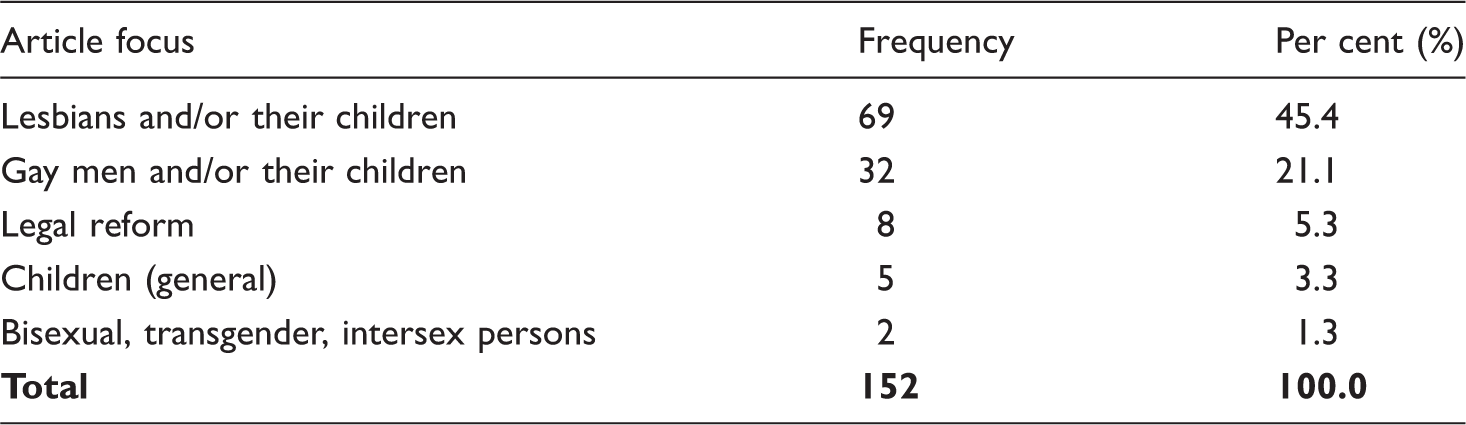
We focussed our analysis on articles about gay men and their families (32) as well as those reporting on queer families more broadly (13). It is within these 45 articles that we identified instances of resistant talk. The descriptive analysis of the dataset also included an assessment of the framing of articles: whether the overall tone was hostile or positive/supportive of queer families; or generally attempting to be balanced or neutral. A minority of articles (13.2%) were negative, with most stories either written in an overtly positive (46.1%) or a balanced or neutral style (40.7%).
Data analysis
The articles were analysed using Braun and Clarke’s (2012) approach to thematic analysis, which comprises six phases, namely: (i) familiarisation with the dataset through repeated readings, (ii) initial code generation, (iii) construction of preliminary themes, (iv) refinement of themes through comparison with coded extracts and the entire dataset, (v) naming and defining themes, and (vi) generating the narrative report of the findings. We approached the analysis from a critical, constructionist standpoint, working within a feminist framework.
After coding and classifying the data according to themes, we interpreted the resulting thematic structures using theoretical and analytical concepts drawn from feminist discursive psychology (Reynolds & Taylor, 2005). We were concerned with the overall rhetorical organisation of talk, the discursive purpose of particular rhetorical strategies, and how these reinforce or resist existing power relations – particularly gendered power relations (Bamberg, 2004). The analysis focuses on the broad discursive functions and potential effects of these ways of speaking. Next we discuss the themes identified in pro-queer parenting in news media, focussing specifically on talk about gay men and their families.
Resistant talk in South African news media
We constructed four main themes evident in arguments supportive of queer parenting, each reflecting different rhetorical strategies and with different implications for countering hetero-gendered norms, as indicated earlier. Below we explore the major rhetorical strategies evident in each theme, showing how they respond to arguments against queer parenting. The first two themes that we discuss are de-gendering parenthood and normalising gay and lesbian parenting. These were more common and correspond with themes identified in previous research, reviewed earlier (e.g. Clarke, 2002; Clarke & Kitzinger, 2004). We discuss these in order to show how they manifest within this particular context. The remaining two themes – valorising queer parenting and challenging the normative gold standard of parenting – were less common in our dataset and only briefly alluded to in the existing literature. We use data extracts in the analysis for illustrative purposes, with bold font to highlight aspects of the data that we wish to emphasise. After presenting the themes, we evaluate the political implications of each of the rhetorical strategies discussed.
De-gendering parenthood
The first theme encapsulates talk that responds to a gendered construction of parenting in which a mother is the main caregiver and a father the secondary “helper” parent (Nentwich, 2008). This was achieved by means of a de-gendering rhetorical strategy (Morison & Macleod, 2015; Schacher, Auerbach, & Silverstein, 2005) that separates parenting from gender and works to place fathering on equal terms with mothering, as illustrated in the following extracts. Gay dads do not have maternal instinct and basic parenting skills. They are inferior parents: The fair-haired bespectacled man
The de-gendering rhetoric evident in the quotes also challenged the feminisation of childcare and concomitant decrease in paternal responsibility and involvement. The disruption of the stereotypical association of femininity with emotionality, which positions women as better suited to cater to the all-important emotional “needs” of children, is facilitated by drawing on the contemporary discourse of “new fatherhood” (Nentwich, 2008). This discourse is characterised by the positioning of “the father’s role as a ‘mother-like’ caregiver” (Eerola & Huttunen, 2011, p. 214). This is especially well illustrated by the second extract, which shows a common trope of describing queer fathers’ caregiving in terms that denote good mothering (being “tender” or emotional). In other instances, gay parents were described as highly involved in hands-on care, such as “stay[ing] awake through the night to care for the two newly born babies” (“British gay couple will fight to keep twins”, Anonymous, 1999, Beeld).
De-gendering rhetoric dovetails with the “love makes a family” discourse referred to earlier, in which love and care are portrayed as “the building blocks of family life, as qualities (which are not necessarily related to sex and gender) that all families should (ideally) possess” (Clarke & Kitzinger, 2004, p. 205). However, it is possible to see that the positioning of men as primary caregivers is not possible without a fair bit of rhetorical work, and it is not entirely taken for granted either. For instance, the explicit statement that “John” is “the primary caregiver” (which would likely go unremarked on if the person in question were female), descriptions of tasks usually associated with mothering (such as nappy changing and feeding), and the appropriation of the essentialist language of natural motherhood (“a deep psychological bond”) work to expand traditional constructions of mothering to include men and fathers.
Normalising gay and lesbian parenthood
The second theme coheres around talk that emphasises the ordinariness of queer parents and depicts “lesbian and gay families in ways that render them familiar and nonthreatening to the heterosexual majority” (Clarke & Kitzinger, 2004, p. 205). As discussed earlier, a common discrediting strategy employed by opponents of queer families is positing non-normative families as “unnatural”, “damaged”, and inherently deficient based on their divergence from the norm. A normalising strategy resists such discursive positioning, as evident in how queer parents’ sameness to heterosexual parents, or their common humanity, is emphasised in the following extracts. He [adoptive father] is also confident that whatever issues arise in their relationship, they will cope… His basic philosophy is: ‘I’m a gay parent. I’m like every other parent just a little bit different’. (“Gay man celebrates hard-won fatherhood”, Beaver, 2000, IOL News) According to [one of the fathers] it is amazing how ‘normal’ it is as gay parents to raise children. ‘All the things that happen to us also happen to heterosexual parents. The babies’ nappies need to be changed. Their winds must be rubbed out. They say ‘goo’ and ‘dada.’ If their fever is 40 in the middle of the night, then gay parents are just as hysterical as straight parents. And when the children have nightmares or want a hug, it does not matter to them that their parents are gay or straight. Not even a little bit’. (“A family like any other”, Anonymous, 2008, Beeld)
The rhetorical strategy of minimising difference works to “establish that same-gendered mothers and fathers are capable and acceptable parents” (Morison & Reddy, 2013, p. 7) and suggests an orientation towards broader arguments about the damaging effects of gay “lifestyles” on children (Clarke & Kitzinger, 2004). This is well illustrated by the following extract, quoted from an article about attitudes towards same-sex marriage and parenting within the Christian church and includes the response from a minister of a progressive church. Some gay relationships and gay marriages do not work out, says Muller. Just as some heterosexual marriages and relationships do not work out. It’s a
Finally, as part of such a normalising strategy, articles frequently featured “good gays”, who were implicitly positioned as acceptable fathers. This argument was reinforced by descriptions of gay couples that emphasise aspects that are usually considered essential to childrearing (Morison & Macleod, 2015). The data contained frequent references to parents’ marital status and the duration of the relationship. For example, parents were described as follows: “A married gay couple… who married in January after being involved for 14 years” (2010, Bamford, IOL News). There were also often descriptions of parents’ professional status or financial well-being, for instance: “The couple, who live in an upmarket Johannesburg northern suburb… made an undertaking in court papers to pay all medical expenses” (2010, Mooki, The Star). Such descriptions target anti-gay parenting arguments focused on children’s best interests, summed up by the following quote in opposition to gay parenthood: “the family provided the best conditions for rearing children – the family being the stable, loving relationship between a married father and mother, he said” (Anonymous, 2006, Business Day). This theme encapsulates rhetorical work that emphasises the ability of gay parents to live up to this ideal.
As discussed earlier, normalising arguments tend to rely on liberal discourse but avoid pointing to difference from the heteronorm, let alone the potential benefits of difference. We did however identify some resistant talk that constructed queer families as being different in positive, socially desirable ways, as shown in the following two themes.
Valorising queer parenting
The third theme points to the benefits of queer families. It responds to conservative concerns about potential psychological damage caused to children raised in queer families, and the universally positive outcomes associated with parenting in the heterosexual nuclear family, as discussed earlier. In the following extract, for instance, an expert opinion lends credibility to resistant talk suggesting that there are possible positive social and psychological impacts of an adopted child being raised by a gay parent. Gilbert [a sociologist] feels that Maria [a child adopted by a gay father] could even turn out to have an advantage over other children, in terms of being a more
Almost invariably it is found that the children are equally as emotionally and socially adjusted as children in control groups with heterosexual parents. The only difference is that sometimes it is found that
This strategy is compelling in that it is difficult to oppose the view that children should be raised to be tolerant and accommodating to difference. It challenges dominant media constructions that uncritically present heterosexual parenting as the only context in which capable parenting can take place. As researcher Judith Stacey notes, the tendency to downplay or deny difference from the heteronorm is related to the “fear that such evidence will be used to discriminate against gay families”, but instead of denying differences, these should be welcomed by democratic societies (Silsby, 2001).
Challenging the heteronormative “gold standard”
Finally, in a similar vein, some resistant talk challenged the hetero-patriarchal nuclear family and its assumed benefits for childrearing more directly. This involved highlighting the potential negative effects of raising children within this family configuration by pointing out its negative interpersonal and structural effects. Such claims were sometimes reinforced by comparisons of loving, capable queer parents with neglectful, abusive, and dysfunctional heterosexual family arrangements. The following extract illustrates how some commentators highlighted the harm that occurs at the hands of heterosexual parents. The many cases of the torture and abuse of children by heterosexual fathers and mothers should, by now, have cured us of the myth that these are ‘normal’ or ‘natural’ parents. Where is the justice in applying such prohibitive standards to gay parents? (“Should gays be allowed to adopt?”, Alibaih-Brown, 1999, The Star)
Similarly, other commentators pointed to possible undesirable effects at the broader societal level, identifying the heterosexual nuclear family as a potential site of inequality, social exclusion, and harm that extends beyond its negative impact on queer persons and their families. In the excerpt below, for example, an academic and activist comments on a South African family policy.
4
The skewed premise [in the proposed legislation] is that ‘the family’ is imbued with qualities that make it inherently ‘nurturing and supportive’. In reality, many families ‘nurture’ unequal social relations between men and women, rich and poor, black and white, queer and straight.… Women’s subordination is reproduced in families where boys are raised to assume masculine dominance and girls are told (most recently by the president) that marriage and child rearing is their primary social role… The green paper’s hallowed ‘family’ is often a pretty unsafe place. (“Are we really family?”, Judge, 2012, City Press)
Concluding discussion
We now consider the political implications of the rhetorical strategies present in the themes discussed and assess their potential to challenge restrictive hetero-gendered norms. Previous research proposes that queer families need to be constructed and represented on “their own terms” and that politically effective strategies should not be based on “straight values” (Gamson, 2001; Morison & Reddy, 2013; Riggs, 2007). In our research, we were thus attuned to the possibility of rhetorical strategies that appear to operate on their “own terms”, rather than reinforcing the heteronorm.
The first two themes (de-gendering parenthood; normalising gay and lesbian parents) are clearly limited in this regard. This is not to say that they do not challenge gender norms and heteronormativity at all; de-gendering talk “challenges seemingly consistent categories, such as ‘father’, ‘mother’, ‘man’, ‘woman’, ‘heterosexual’, and ‘homosexual’” (Folgerø, 2008, p. 146). Such talk potentially subverts the gendered logic of “doing family”, allowing both men and women to perform non-traditional roles. This subversion paves the way for more equitable parenting practices within heterosexual relationships (Schacher et al., 2005). It may also allow gay men to challenge beliefs about men as inferior parents. Likewise, normalising rhetoric contains some subversive potential in that it challenges assumptions about deviant difference and homosexuality as a master identity in which sexuality overrides one’s parental status (Clarke & Kitzinger, 2004).
Nevertheless, neither rhetorical strategy supports transgressive politics, because each remains structured around “the oppressor’s discourse” (Smith, 1994, p. 235) and so does not greatly challenge heteronormativity. Instead, each to some extent supports established understandings of “The Family”. This is evident in arguments which retain assumptions regarding the superiority of the two-parent norm in ways that largely map queer families onto the heterosexual template and in so doing maintain the heterosexual nuclear family as the ideal. Such arguments draw on a familiar “conjugalisation of reproduction” discourse, that contains procreation within heterosexual marriage, in which the male–female romantic dyad becomes the parenting dyad (Morison & Macleod, 2015), with families created outside of such a union being considered illegitimate, unnatural, and tenuous (Folgerø, 2008; Macleod, 2001). In our data this configuration is extended to accommodate two same-sex parents as forming a parenting dyad. However, while challenging the gendered character of parental roles, in which mothers are seen as natural parents, the ideal of a conjugalised, two-parent structure of parenting often remained unquestioned. Likewise, arguing that queer families compare favourably to the heterosexual ideal means that this ideal remains the standard against which all families are measured (Hicks, 2005). This suggests that the preferred context in which children should be raised remains the nuclear family. Not only does this obscure classed and raced values that often underpin the nuclear family ideal, but it also circumvents challenges to the heteronorm.
The talk in both of these themes (de-gendering and normalising) thus fits queer parents into existing understandings of the family and parenthood and only partially challenges the heteronormative discourses in which ideas about biological kinship, gender complementarity, and family life centred around a co-resident couple are interwoven and support the heterosexual ideal (Folgerø, 2008). Furthermore, rhetorical strategies that make claims to “sameness” or “normality” obscure the radical differences that shape queer parents’ lives, deny possible benefits of lesbian and gay parenting, and divert attention from the ways in which institutionalised discrimination oppresses lesbian and gay parents (Riggs, 2007). These arguments are articulated in the voice of liberal tolerance, which encourages the acceptance of “Others” into mainstream culture (Morison & Reddy, 2013). Since change is allowed to occur only within the status quo, there is limited scope for long-term social change that includes those who do not measure up so well to the heteronormative gold standard. Transformation is thus limited to the (conditional) tolerance of “alternative” families in hetero-patriarchal society.
In contrast, the final two themes (valorising queer parenting; challenging the heteronormative gold standard) seem to hold greater promise for transformational politics. These encompass ways of speaking that emphasise the benefits of queer parenting for children in terms other than how well they match up to this gold standard and interrogate the heterosexual nuclear family as ideal. These instances of talk were, however, infrequent and it is worth noting that in the mainstream media analysed, these resistant voices are largely those of gender activists, using an academic framing as expert voices, and presented in what can be described as more “liberal” press. While this is admittedly a somewhat marginal position, in relation to the mainstream press, it holds the potential to challenge the status quo and offer the promise of long-term social transformation.
A closer look at the central concerns of each of these counter-arguments provides some indication of how these ways of speaking can be moved from the peripheries of the debate. What is useful about all four of these arguments is that each to some extent steers the discussion away from a preoccupation with family form and towards family functioning. The first two (de-gendering and marginalising) are hamstrung by their articulation within an oppressive discourse, as we have noted. However, the second two (valorising and challenging) refuse the subordinate positioning of queer families as a starting point for dissent. Eschewing the more defensive positioning of the first two rhetorical strategies, these more radical counter-arguments create a new benchmark, based on a different set of “family values” centred upon ideals of tolerance and equality; these values, as intimated in the theme, already hold sway within liberal democracies. By placing the argument in these terms, it is possible to highlight the extent to which family functioning may help achieve these ideals. Though child welfare is upheld as a concern – which is guaranteed primarily by what families do rather than what they look like – this is balanced with a broader view of other family members’ needs and rights, and these are aligned with children’s needs or best interests.
This alternative set of values admittedly may not appeal to those committed to conservative family values. Yet, when they are linked to broader social issues that go beyond family politics, the argument may become more persuasive. In particular, the final theme of challenging heteronormativity as ideal offers a strategy for allowing wider engagement with oppositional talk: by connecting the interests of queer families to more commonly shared concerns of inequality and violence in traditional family structures, such resistant talk might find greater traction in public discussions.
In light of our broader aim of addressing the relationship between the ways that queer families are rendered visible, gender transgression, and queer politics, we have shown how particular South African media constructions feed into assimilationist and/or transgressive political strategies. We have shown how long-term socio-cultural transformation is not undermined only by obviously invalidating or oppositional arguments, but also how this may occur more insidiously within arguments that at face value appear to support queer families. This supports previous findings, related to general queer politics, of the limitations and drawbacks of liberal discourses. We have also identified alternative ways of speaking that appear to offer more possibilities for long-term socio-cultural transformation. These strategies propose a fundamental shift in the current hetero-gendered order and hold potential benefits not only for sexual minorities but also for broader gender power relations. Nevertheless, as we have indicated, such arguments remain at the periphery of public discussions of queer families and, in their present form, draw on academic discourses that may be alienating in the broader social milieu. We have provided some initial thoughts regarding how such strategies could be taken up in advocacy work and filtered into mainstream discussions, but further research would assist with this aim.
Footnotes
Authors' note
Both authors work as Research Psychologists at the Human Sciences Research Council, South Africa, and are also Research Associates of the Rhodes University Psychology Department and Critical Studies in Sexualities and Reproduction research programme.
Acknowledgements
The authors gratefully acknowledge the guidance and inputs of their team member, Vasu Reddy.
Declaration of conflicting interests
The author(s) declared no potential conflicts of interest with respect to the research, authorship, and/or publication of this article.
Funding
The author(s) disclosed receipt of the following financial support for the research, authorship, and/or publication of this article: This work was supported by the Ford Foundation (grant number 0145-0593).