



Abstract
Social media has become an important aspect of contemporary culture and cultural change; it has accordingly become a valuable resource for informing feminist theory. Social media is a digitized social reality that lends itself to analysis and research. This study examines rape culture in the widely used social media platform, Twitter. We collected tweets from four days surrounding the Torrington and Steubenville Rape Trials and the Rehtaeh Parson’s story of rape, victimization, and suicide. Using qualitative content analysis, we identified three themes related to rape culture: (1) the virgin–whore binary and the just world, (2) sharing information on the sexual assault cases as subnews, and (3) rape myth debunking to support victims. Additional analysis indicated that Twitter users who engaged in victim blaming were more likely to be retweeted and have more followers than Twitter users who engaged in tweeting victim support content. The research demonstrates that rape culture is an aspect of social media and that data about rape culture can be readily accessed and studied. It also suggests that in future research, social media can be used to study how individuals and groups who are exhibiting rape culture interact with others who are engaged in victim support.
Introduction
The purpose of this research is to understand how rape culture (i.e. ideologies or behaviors that condone or normalize sexual violence), victim blaming (i.e. the belief that victims are somewhat or completely responsible for their victimization), and slut shaming (i.e. shaming women for presumed sexual activity) are portrayed in social media surrounding discussions of sexual assault cases in mainstream media. To date, few studies have considered how social media is used to engage in digital feminist activism by advocating against rape culture, both online and offline (Keller, Mendes, & Ringrose, 2016; Mendes, 2015; Sills et al., 2016). However, less is known about how social media (i.e. Twitter) may be used to exacerbate rape culture (e.g. by blaming survivors for rape). Here, we examine responses to three high profile rape cases (one rape case in Torrington, Connecticut; one rape case in Steubenville, Ohio; and one rape, bullying, and suicide case in Nova Scotia, Canada) on Twitter. Specifically, selecting the words “rape and whore” or “rape and slut,” we examine 603 victim-blaming and slut-shaming tweets as well as responses to those tweets around the time that these cases were in mainstream media outlets.
Rape statistics and rape myths
The U.S. National Intimate Partner and Sexual Violence Survey found that as many as one in five women and one in 71 men are raped (Black et al., 2011). Research indicates that between 5 and 31% of rape survivors report rape to authorities (Fisher, Daigle, Cullen, & Turner, 2003; Heath, Lynch, Fritch, & Wong, 2013). Because rape survivors are blamed for their own victimization, they are less likely to report rape to law enforcement due to feelings of shame but also because they fear authority figures will not believe them (Weiss, 2010). Page (2008) found that law enforcement were not likely to believe victims were raped when they did not fit the stereotypical image of a rape victim (e.g. had a past relationship with the perpetrator). Another study found that 43% of prosecuting attorneys displayed a moderate to high level of rape myth acceptance (Gylys & McNamara, 1996). The existence of a rape culture makes rape less likely to be reported and is also a form of victimization that stigmatizes and blames rape survivors for their victimization (Lea, 2007; Ryan, 2011).
The pervasiveness of rape in a society is not only a by-product of actual rape instances but also of how rape is constructed by society. The social construction perspective argues that social, cultural, and historical meanings shape individuals’ attitudes and beliefs toward social topics. In other words, what individuals make of a topic is often based on their perception of reality (Berger & Luckmann, 1966). Such perceptions are often learned. Thus, social construction is based in part on social learning where both primary socialization (e.g. the family) and secondary socialization (e.g. the media) influence attitudes, thoughts, and behaviors (Akers & Jensen, 2006; Berger & Luckmann, 1966). Researchers have determined that rape is socially constructed through a rape culture (i.e. attitudes toward gender and dating scripts that normalize sexual violence) that legitimates rape and creates certain standards for rape victims (e.g. rape victims are often believed to have certain attributes or to engage in certain behaviors; Anderson & Doherty, 1997; Lea & Auburn, 2001; Ryan, 2011). The social construction of such standards includes rape myth acceptance, gender and sexuality stereotypes, and victim blaming (Brownmiller, 1975; Burt, 1980; Suarez & Gadalla, 2010).
Rape myths are a part of a rape culture and are upheld at the macro-level (e.g. media, laws, and institutional practices), the community level (e.g. shared consensus of beliefs), and the individual level (e.g. rape-supportive attitudes; Edwards, Turchik, Dardis, Reynolds, & Gidycz, 2011; Levine, 2017). Payne, Lonsway, and Fitzgerald (1999) identified seven rape myths: “she asked for it,” “she wanted it,” “he didn’t mean to,” “she lied about it,” “not really rape,” “rape is a trivial event,” and “rape is a deviant event.” We draw from Payne et al. (1999) to define these rape myths and describe how they are used to justify rape, excuse the offender, and blame the victim.
Rape and rape myth acceptance are closely tied to gender inequality in society, as gender is a primary frame for organizing social relations (Levine, 2017; Ridgeway, 2008). Gender arrangements at the societal level serve to control the socialization and power relations in society. Perceptions of gender displays as being “gender appropriate” are not without consequences. Rape survivors are often shamed for violating their appropriate “sex category membership,” by use of rape myths associated with “nonfeminine behavior” (e.g. “she asked for it”), whereas, rape perpetrators who claim the rape myth, “he didn’t mean to” are excused (e.g. boys will be boys) because such behavior is deemed normative to his sex category membership (West & Zimmerman, 1987). Further, women who are sexually objectified are also more likely to be blamed and are believed to experience less injury or harm from rape than women who are not sexually objectified (Loughnan, Pina, Vasquez, & Puvia, 2013).
Victim blaming
Victim blaming upholds power relations in society, and consequently allows individuals to socially distance themselves from victims of crime, while absolving perpetrators or persons of higher social status from punishment (Ryan, 1971). Embedded in victim-blaming ideology is the “just world hypothesis” which is the assumption that individuals receive morally fair consequences and outcomes based on their behaviors (Eigenberg & Garland, 2008; Lerner, 1980). Applied to criminal victimization, just world beliefs lead to the assumption that victims must have done something to cause their own victimization, shifting the focus away from perpetrators.
The socialization of rape myth acceptance, just world beliefs, and victim blaming, learned through primary (e.g. family) or secondary socialization (e.g. media; Akers & Jensen, 2006; Berger & Luckmann, 1966) can have serious ramifications for victims of crime, such as underreporting of rape (Fisher et al., 2003; Heath et al., 2013; Weiss, 2010), and a false sense of security. For example, women are taught to fear “stranger rape” when in fact women are most likely to be raped or assaulted by someone known to them (Edwards et al., 2011). Furthermore, just world beliefs reinforce the idea that perpetrators are not responsible for sexual assault or rape such as exemplified through the common rape myth, “he didn’t mean to” (Payne et al., 1999). Misinformation about sexual violence and “appropriate victims” are supported by rape culture (i.e. just world beliefs and rape myths).
Rape culture and media
Rape myths frequently appear in the media, and public opinion has been altered by the presentation of sexual violence in the media (Emmers-Sommer, Pauley, Hanzal, & Triplett, 2006). Studies have found the prevalence of rape myths in television (Kahlor & Eastin, 2011), movies (Smith, 2012), pornography (Hald, Malamuth, & Yuen, 2010), and newspaper coverage (O’Hara, 2012). Furthermore, one study found that, in conditions where participants were exposed to rape myth-supportive articles as opposed to rape myth-challenging articles, participants were more likely to absolve a presented perpetrator of their crime (Franiuk, Seefelt, Cepress, & Vandello, 2008). Research examining newspapers on a trial case found that the impact the media has on reinforcing rape myths is detrimental and tends to define rape as a random act rather than a social problem (O’Hara, 2012).
To date, less is known about how rape culture presents itself in social media, particularly in response to mainstream sexual assault cases. While there are many prosocial uses of social media (e.g. to combat rape culture; Keller et al., 2016; Mendes, 2015; Sills et al., 2016), harassment or exchange of negative language as humor is also being shared online, often among large audiences where authority figures may not be present (O’Keeffe & Clarke-Pearson, 2011; Prensky, 2001). All three cases discussed in this manuscript include young female victims whose rape victimization first came to light via social media (i.e. Twitter). In all three cases, the victims were blamed for their rape victimization and were continually bullied and harassed thereafter both online and offline.
Concerns arise when the exchange of negative, aggressive language is used to attack, harass, or cyberbully another individual, particularly when victims are suffering multiple forms of repeated victimization, such as online and offline bullying, sexual assault, and sexual harassment (Campbell & Raja, 1999). Samples of New England high school and middle school students (ages 11–20) indicated having sexual rumors spread was more upsetting than any other form of bullying (Gruber & Fineran, 2007). Social media can be used to exacerbate the problem of sexual violence toward minorities via use of humor and jokes related to one’s gender, race, sexuality, or sexual activities (McCann, Plummer, & Minichiello, 2010).
Technology, rape culture, and digital activism
Changing forms of technology and the popularity of social media have allowed individuals to influence others in a readily available public setting (e.g. the blogosphere and Twitter; Westerman, Spence, & Heide, 2014). Individuals can create their own version of the news or state their opinion in reference to mainstream news (Murthy, 2010; Westerman et al., 2014). An examination of rape myth language and public shaming (i.e. slut shaming or victim blaming) in social media is pertinent because of the unique nature of the social space and the ability of Twitter users to impact a large audience (e.g. one retweet can reach an audience of 1000 individuals; Murthy, 2010). Additionally, more research is needed to investigate how Twitter users may respond to victim-blaming and slut-shaming tweets pertaining to victims of sexual assault.
Studies have begun to examine how individuals respond to rape culture via digital activism efforts (Keller et al., 2016; Mendes, 2015; Sills et al., 2016) while other research has explored commentary on sexual assault cases on blogs and newspapers (Moody-Ramirez, Lewis, & Murray, 2015; Woods, 2014). Keller et al. (2016) examined posts on the antistreet harassment website, Hollaback!, the use of the hashtag #BeenRapedNeverReported, and also interviewed teens about their use of social media to challenge rape culture in and outside of their schools. Across these research projects, they found evidence of affective solidarity to be fostered by the use of social media to combat rape culture, such as the policing of girl’s clothing in school to everyday encounters with street harassment.
In a study of eight English-speaking nations holding SlutWalk marches, Mendes (2015) explored how SlutWalks were portrayed in both mainstream media as well as online feminist media sites. The researcher (Mendes, 2015) complemented this method by conducting interviews with 22 SlutWalk organizers around the world. In the eight countries examined (Australia, Canada, India, New Zealand, South Africa, Singapore, the U.K., and the U.S.), Mendes (2015) found social media sites were used to organize SlutWalks and participate in both online and offline feminist activism efforts. In a related study, exploring feminist digital activism in response to rape culture, Sills et al. (2016) found social media sites to be used to resist rape culture by which a counterpublic can be formed. Through interviews with 17 young people concerning their responses to rape culture in social media, this study also identified a “matrix of sexism” associated with everyday online and offline experiences of harassment and sexual assaults.
Similarly, researchers (Moody-Ramirez et al., 2015) examined newspapers and blogs before, during, and after a prominent rape trial in Steubenville, Ohio, finding newspapers to highlight social media’s role in documenting the rape while failing to discuss victim’s rights, rape awareness, or prevention. Blog posts, on the other hand, were found to be centered around victim’s rights and social media’s role in bringing justice to the case. Additionally, Woods (2014) highlighted the prominent use of feminist hashtags: #OpRollRed and #OccupySteubenville in response to the Steubenville, Ohio rape case, noting how the popularity of the hashtags waxed and waned as the case went to trial and as one of the convicted young men returned to the Steubenville, Ohio football team (Woods, 2014).
Collectively, research suggests that social media is used to victimize survivors of rape (Moody-Ramirez et al., 2015) and to advocate against a rape culture (Keller et al., 2016; Mendes, 2015; Sills et al., 2016). Additional research is needed to explore how individuals respond to instances of victim blaming surrounding sexual assault cases. Specifically, we ask the research question: How do individuals perpetuate rape culture on Twitter? The current research study explores how rape culture is portrayed and responded to surrounding the dates of media coverage on three prominent sexual assault cases from 26 March 2013 to 30 May 2013.
The study context
In two 2013 U.S. rape trial cases, one in Torrington, Connecticut and one in Steubenville, Ohio, social media users exposed the identity of rape survivors (on Twitter and YouTube) and used rape myths to blame the survivors for their victimization. Both rape cases included juvenile football players as the perpetrators and victims that were blamed for their “rape-inviting behavior” (McNamara, 2013; Payne et al., 1999). In both cases, the social media community defended the perpetrators and blamed the victims for reasons of promiscuous behavior, dress, and intoxication (McNamara, 2013).
The U.S. Steubenville Ohio rape case occurred on 11 August 2012 when a 16-year-old girl was repeatedly sexually assaulted by her male peers, who also captured photos and videos of the assaults. The victim of these assaults learned of her victimization through social media the next morning. Although the perpetrators deleted evidence from social media accounts, the content was later reposted. On 17 March 2013, two of the boys, Trent Mays and Ma’lik Richmond were criminally charged. Many of the news articles and discussions following the trial focused on the negative impact the trial decision would have on the perpetrators’ futures (Moody-Ramirez et al., 2015).
The U.S. Torrington, Connecticut rape case involved two 13-year-old girls who were sexually assaulted by perpetrators, Joan Toribio and Edgar Gonzalez, both of whom were 18-year-old football players from Torrington High School. In this case, among others that have occurred at Torrington High School, images of Twitter posts (i.e. tweets about the assault) were published in the Register Citizen, which is a local newspaper. These images showed how the community attacked the victims and attempted to absolve the perpetrators from their crime (McNamara, 2013).
Likewise, in a third alleged rape case in November of 2011, Rehtaeh Parsons, a 17-year-old girl of Nova Scotia, Canada, was gang raped by four boys, and was thereafter continuously sexually harassed and bullied by her peers and the community, both in person and in social media. The four boys who allegedly raped Rehtaeh shared images of the incident via social media, resulting in some students from her school calling her a slut and soliciting sex from her. On 4 April 2013, Rehtaeh was placed on life support after an attempt to take her own life; on 7 April 2013, she passed away (Valenti, 2014). Bullying and sexual harassment of rape survivors is a form of secondary victimization that has many health consequences, such as trauma-related symptoms, decreases in mental and physical well-being, self-esteem issues, lowered life satisfaction, and increases in substance use (Campbell & Raja, 1999).
Research studies have begun to examine media commentary in response to mainstream sexual assault cases (Moody-Ramirez et al., 2015; Woods, 2014). However, this has yet to be examined on Twitter, a platform that has been used to expose, bully, and publically shame rape survivors. Twitter is “event driven” by mainstream media news, allowing exploration of public opinion on a topic and offering users the ability to provide their own commentary or spin of the news (Murthy, 2010). For example, tweets on rape cases likely include the user’s opinion of the rape case(s), rape culture, and responses to mainstream news.
Twitter as a social medium
Twitter is considered a “micro-blogging” platform and content is generally available to the public unlike other inherently private platforms (e.g. Facebook and LinkedIn; Murthy, 2010). Twitter users may create posts, within a 140-character tweet limit, which may also contain hashtags for shared understanding, and use of @ signs to direct tweets to other users (Murthy, 2010). Individuals may also retweet a tweet. For instance, an audience of 1000 individuals on average can be reached if a Twitter user’s original post is retweeted once. This provides Twitter users an avenue for impacting public opinion and increasing their online social influence (Murthy, 2010).
The functions of Twitter provide users encouragement to increase online social influence, for example, by obtaining more followers or retweets, and more generally by increasing audience engagement (Murthy, 2010). One way of assessing the influence in social media, particularly on Twitter, is to measure the number of followers (i.e. indegree influence) and the number of retweets (i.e. spread of information). This information is available in the meta-data that is embedded in each tweet. The significance of examining retweets is especially salient since a single retweet can greatly expand the spread of the message to a much larger audience.
In this paper, through an examination of tweets containing the keywords, “rape and whore” and “rape and slut,” we examine how rape culture is established and perpetuated through Twitter. Discussions on rape cases were prevalent at the time of our data collection (30 March 2013–30 April 2013) in part because of mainstream media discussions of these cases during the time. First, we conducted a qualitative content analysis. Next, we used these data to provide descriptive and quantitative information (i.e. frequencies and chi-square tests). A quantitative content analysis was also conducted on the standpoint of the tweet (victim blame, neutral, or victim supportive). By assessing “indegree influence” (i.e. the number of followers that an account has) or spread of tweets (e.g. retweets), we can estimate the relative influence and dissemination of information on Twitter surrounding discussions of rape cases.
Method
The sample
Twitter data were collected using the Social Media Tracking and Analysis System (SMTAS). In this instance, tweets are the unit of analysis. Each tweet is representative of a “bit of social interaction” that tells us something about rape culture. In addition to tweets, SMTAS can retrieve detailed information on Twitter users’ accounts, including user names, time stamps, profile pictures, number of followers, and retweets. The computer system processes and analyzes the number of retweets and retrieves the number of followers of each Twitter account making it possible to assess scores of influence or the relative impact of tweets based on the spread of information (i.e. retweets).
We collected tweets with the specific requirement that “rape and whore” or “rape and slut” be present in selected tweets. Though this narrowed our scope, these terms provided the data necessary for us to examine discussions of common victim blame arguments presented by Twitter users. At the time of data collection, rape and bullying victimization cases were receiving media attention, making the search terms a popular topic. This facilitated collecting a large amount of tweets related to rape culture.
To assess popular events on Twitter, dates that had the most tweets related to rape culture per day were identified in the dataset: 3 April 2013 (n = 197), 10 April 2013 (n = 182), 25 April 2013 (n = 193), and 10 May 2013 (n = 219). The total sample included 808 tweets across the range of data collection (26 March 2013–30 May 2013). Two types of tweets were eliminated prior to data analyses. One type consisted of random curse words, including the search terms rape and whore, and the other type was describing religion as hate, religion as rape, and religion as a whore. The final sample consisted of 782 tweets for analysis. For the quantitative analyses, tweets without a content indicative of a standpoint on rape culture (e.g. news facts without comment or opinion) were eliminated from further analyses, leaving 603 tweets for analysis.
Data extraction
To develop a coding system, we used past literature on rape myths (see Payne et al., 1999) to identify seven common rape myths: “she asked for it,” “not really rape,” “he didn’t mean to,” “she wanted it,” “she lied about it,” “rape is a trivial event,” and “rape is a deviant event.” Multiple approaches were taken to analyzing the content of the tweets. Initial coding procedures began with an open, axial, and selective coding process (Strauss & Corbin, 1998) to create categories and develop themes of rape culture discussions on Twitter. However, since the data also contained a substantial amount of victim support and news tweets, an inductive approach was used to analyze the data (Strauss & Corbin, 1998). Ultimately, we turned to a grounded theory approach that involved both initial and focused coding (Charmaz, 2014). This process involved an initial line-by-line coding procedure followed by classification into identified categories and themes.
After identifying common discussions on rape culture, we then addressed whether victim-supporting tweets or victim-blaming tweets were more influential by assessing the number of followers and retweets. We categorized the number of followers and retweets by quartiles. Followers were categorized into four groups of influence: low (1–150), average (151–300), moderate (301–550), and high (551 plus). Because most of the sample consisted of having zero retweets, we categorized retweets into three groups: zero retweets (n = 341), less than 10 retweets (n = 153), and more than 10 retweets (n = 109). Chi-square analyses were used to measure influence (i.e. the number of followers and retweets) across victim-supporting and victim-blaming tweets. In the following section, descriptive details across the four event dates included in the dataset are discussed. Next, we present (1) a content analysis of all tweets, and (2) chi-square analyses to assess influence among victim-supporting versus victim-blaming tweets.
Results
Around the time of data collection, multiple rape cases resulted in trials (e.g. Torrington and Steubenville) and some cases in suicide (e.g. Rehtaeh Parsons) all of which made mainstream news, as well as news on Twitter. This led to very different standpoints (e.g. victim supporting, victim blaming, or sharing news on rape culture), as well as framing techniques (e.g. use of rape myths) for discussions on rape culture. The results for this study are presented in two ways: first, the qualitative content (i.e. emerging themes that answered the research question) is presented; second, the quantitative content (i.e. descriptive statistics and chi-square analyses) is presented. Both sets of results are organized around the standpoint of the tweet, that is, if the tweet supported rape culture or victims of sexual assault. To preserve the anonymity and confidentiality of Twitter users, we paraphrased and decontextualized the tweets for the presentation of the qualitative results. We chose to paraphrase the tweets because it would be relatively easy to identify the Twitter account users online since, at least at the time of collection, these tweets were available to the public and could be easily identified.
Qualitative data and emerging themes
The results of our coding process include three themes: “the virgin–whore binary and the just world,” “informational retweets as subnews,” and “rape myth debunking.” These three themes can be viewed on a continuum, with “the virgin–whore binary and the just world” falling on the victim-blaming end of the continuum, “information retweets as subnews” as somewhat neutral or supporting both victims and victim blame, and “rape myth debunking” as supportive of victims and the farthest away from victim blaming. Each of these themes is discussed below.
The virgin–whore binary and the just world
This theme is in line with the idea of “the just world hypothesis,” the beliefs that bad things happen to bad people, that there are virgins and whores, or that rape is merely a deviant event that happens to girls who behave or dress “inappropriately.” The first category described hostile and sexist attitudes toward women and the operation of the just world hypothesis. A clear example of this theme emerged through a discussion of the “worthless slut.” This category is found repeatedly in Twitter discussions and combines the seven categories from previous rape myth literature, including: “she asked for it,” “she wanted it,” “she lied,” “not really rape,” “rape is a deviant event,” “rape is a trivial event,” and “he didn’t mean to” because of the belief that “whores” or “sluts” cannot be raped. In other words, tweets falling in this category suggest that some victims of sexual assault deserve what they get. This perspective can be summarized using the following tweets from our sample: “Save a virgin, rape a whore.” In this sense, “whores” are perceived as the more deserving victims of rape, while virgins are spared. Another tweet defines the worth of a “slut” and women wearing booty shorts as worthy of rape: “I put holes in her because she was a stupid slut. She had booty shorts on talking about rape. LOL Foreshadowing.”
The previous tweets categorize women as either good or bad, and suggest that some women deserve to be raped. This notion is further explained by three other tweets: “You’re the type of girl I’d assault. I’d rape you and figure why not make ur pussy wider,” and “You like it, so its not rape bitch. Sit down and take it like a pretty little whore and don’t fight this shit.” These tweets suggest the worth of a woman is null once she can be categorized as a “slut or whore.” In this sense, “sluts and whores” are viewed merely as toys or objects for male aggression. This theme is primarily consistent with the myth that “rape is a deviant event,” meaning that rape only happens to “bad girls” who place themselves in bad situations and the rape myth that “he didn’t mean to,” suggesting that the girl sexually aroused him, leaving him no choice but to rape her. Thus operates the idea that if a woman is raped, it must be because “she asked for it” by dressing too promiscuously, as exemplified in the following tweets: “I will NEVER understand girls who complain about rape but go out dressed like a WHORE. #FOOL” and “Dressing like a whore increases chances for rape, and is sorta like asking for it #MYOpinion.” These tweets represent a standpoint on dressing inappropriately as a cause justifying rape. Victim-blaming tweets also endorse the rape myth, “she lied:” “no1 believes the slut who cries rape” and critique victim advocacy movements by questioning whether such events only promote consensual sex for sluts: “A university slut walk? That’s not promoting rape? But it is promoting consensual sex with sluts?” As a whole, these tweets suggest that rape is a bad thing and women who engage in behaviors that are perceived as tempting rapists are “asking for it,” and thus viable to prey upon.
In summary, when examining the data, it was apparent that the virgin–whore binary was used to justify rape as part of a just world for the tweets included in this study. This is problematic because it teaches women that they are responsible for their own victimization and places the blame on the victim rather than the perpetrator. Beliefs and support of rape culture ideology absolve perpetrators and decrease the chances that women will report rape or sexual assaults. This type of ideology aims to control women’s sexuality by blaming the victimization on the victim’s sexual reputation or selection of attire rather than looking more closely at attitudes toward rape relations and victimization. The just world hypothesis is problematic because it fosters beliefs that victimization is unlikely if individuals abide by cultural norms and behaviors associated with their sex category membership.
Informational subnews
Subtweeting, copying and pasting a tweet without crediting the original author, was found to be a popular form of news tweeting which was used for both supporting victims and victim blaming. In this theme, news is often subtweeted, but not retweeted. In addition, because of the 140-character limit, there is not much room for adding additional detail to the tweet when news tweets include hyperlinks to the news topic, such as: “Gang-rape victim, Rehtaeh Parsons, 17, killed herself’ attackers took picture of the assault & branded her as a slut http://…” Although, some Twitter users leave off web links and provide no link to the original source, for example: “Rehtaeh Parson Suicide: Halifax Teen Killed Herself After Being Raped & Slut Shamed Online.” The tweets generally mirror public knowledge, but can appear to have that ‘you heard it here first’ effect, giving individual Twitter users a sense of influence in reporting news (Murthy, 2010).
Twitter users appear to want to create their own news, even for emotional topics such as the suicide of rape victims. These types of subtweets often take the credit for news that larger corporations have already tweeted, but add an emotionally charged comment that seemingly tells the reader something about that Twitter user’s standpoint on a topic. Within this category, the majority of tweets adopted an angry or highly upset tone because the informational news was that of Rehtaeh Parsons, who committed suicide due to the trauma of being bullied after she was reportedly gang raped. In the data collection range, this was the only date (10 April 2013) that included mostly victim-supporting tweets, for example: “This is so tragic. Third case I’ve read about in a month #RIPRehtaeh.” While another tweet directly makes a reference to the similarities of the Steubenville case, “Omg similar to Steubenville in NS. He raped her, & she’s the slut? EndSlutShaming NOW! #RapeCulture #RIP.” The overarching theme of this day was a mixture of sadness, and hope that Rehtaeh can rest in peace as indicated by the following hashtags: “#RIPRehtaeh and #RehtaehParsons” and the tweet: “What’s wrong with kids these days … RIP Rehtaeh … you’re in peace now.” This theme was mostly comprised of data from 10 April 2013, but remained a constant theme throughout the dates included in the dataset. Tweets in this category were also a reflection of responses to mainstream media news coverage of sexual assault cases as well as television coverage of the topics, such as Law and Order’s episode on the Steubenville rape case. Thus, it appears when events are presented to highlight the victim’s experience that the negative effects of rape culture are more readily noticed and opposed.
Rape myth debunking (RMD)
RMD allows those who support victims to take a stand and combat popular rape myths. The two most popularly debunked rape myths include: “rape is a deviant event” and “she asked for it,” particularly for dressing promiscuously. One of the primary arguments found within this theme is that rape is not acceptable, under any circumstance.
Victim-supporting tweets argue that rape should not be justified as an acceptable outcome for reasons of dress, behavior, alcohol or drugs, or previous sexual encounters. The following tweets display how rape myths are debunked: “Past consensual sex, revealing clothing, curves, make-up, being unconscious, or the label of a slut NEVER justify rape #EndVictimBlaming,” “Rape is NOT ok. Pictures & videos of rape are NOT ok. Calling a victim a slut is NOT ok. #Rehtaeh,” and “Short skirts, flirting, being a “slut” or alcohol don’t cause rape. Rapists cause rape … ok #noexcuses.”
Another common category found within this theme is being tired of the isms (e.g. sexism, racism) and slut shaming (e.g. calling girls sluts for engaging in presumed sexual activities, including nonconsensual sex). The data also indicated that Twitter can be used to decrease rape myth acceptance, cyberbullying, and victim-blaming behavior, and increase support for rape survivors, for example: “if girls stopped slut shaming & men were taught not to rape, instead of telling girls how to avoid rape, the world …,” “There’s something bad wrong with what we are teaching children when they respond to rape with the word slut,” and “Every time you spread another joke about rape or call another woman a slut, or get annoyed over the fuss that women make, rape culture spreads.” The last and most prominent tweet aimed to end hateful speech was retweeted 18 times: “I am tired of people. Sexism, racism, homophobia, transphobia, ageism, slut shaming, and rape culture. I am just tired.”
An unanticipated finding: Victim-supporting tweets
The rationale for using the filters of “rape and whore” and “rape and slut” was to identify clear examples of victim blaming, as well as real-world attempts to slut shame survivors and victims of sexual assault. We were initially surprised that the same words were also filtering a relatively large number of victim-supporting tweets. Interestingly, the victim-supporting tweets that contained rape, slut, and whore were often initiated in reaction to the slut-shaming and victim-blaming comments of sexual assault and bully victims. Hence, not only did this enable us to examine victim-blaming tweets, but also to some extent, the dialog on social media between victim blamers and victim supporters. These data gave us the opportunity to address an additional research question, “Are victim blaming or victim supporting tweets more influential?” We addressed this question by conducting a chi-square analysis on a subset of the data (n = 603) comparing the online social influence (e.g. number of followers and retweets) of victim-blaming versus victim-supporting tweets. In the following sections, we provide descriptive statistics and chi-square analysis on the percentages of victim-blaming versus victim-supporting tweets across the rape and bully victimization cases discussed within this dataset.
Descriptive data
Descriptives of victim-blaming and victim-supporting tweets by date.

The relationship between victim blaming, victim supporting, and number of Twitter followers.
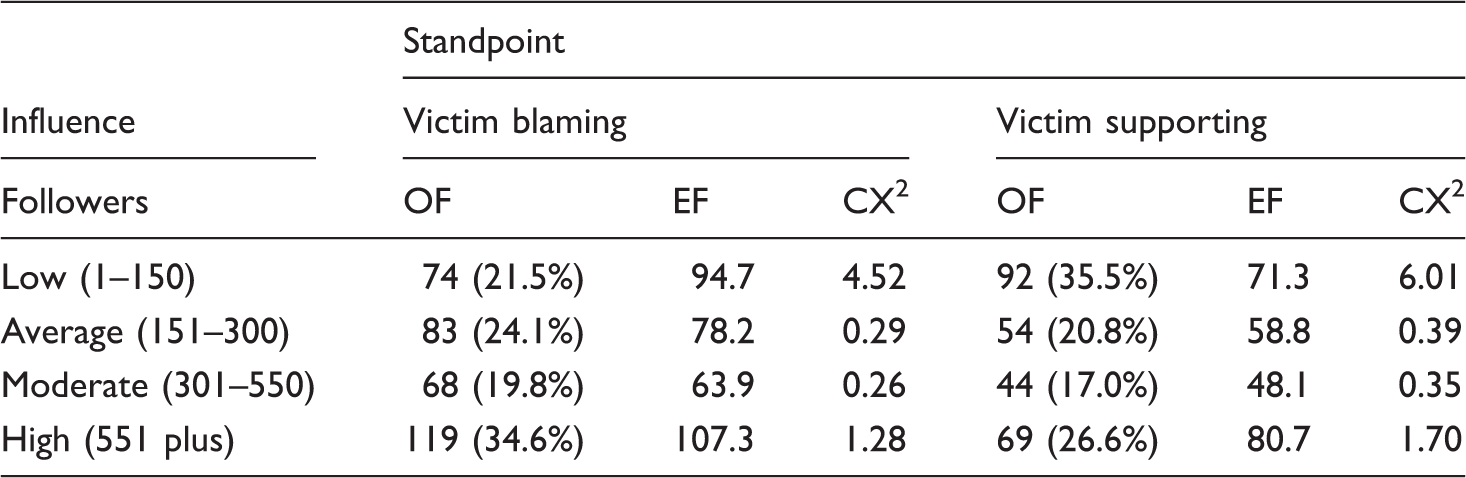
Note. N = 603, χ2 = 14.84, p = .002, OF is the observed frequency and column percentage, EF is the expected frequency, and CX2 is the cell chi-square value.
The relationship between victim blaming, victim supporting, and number of retweets.
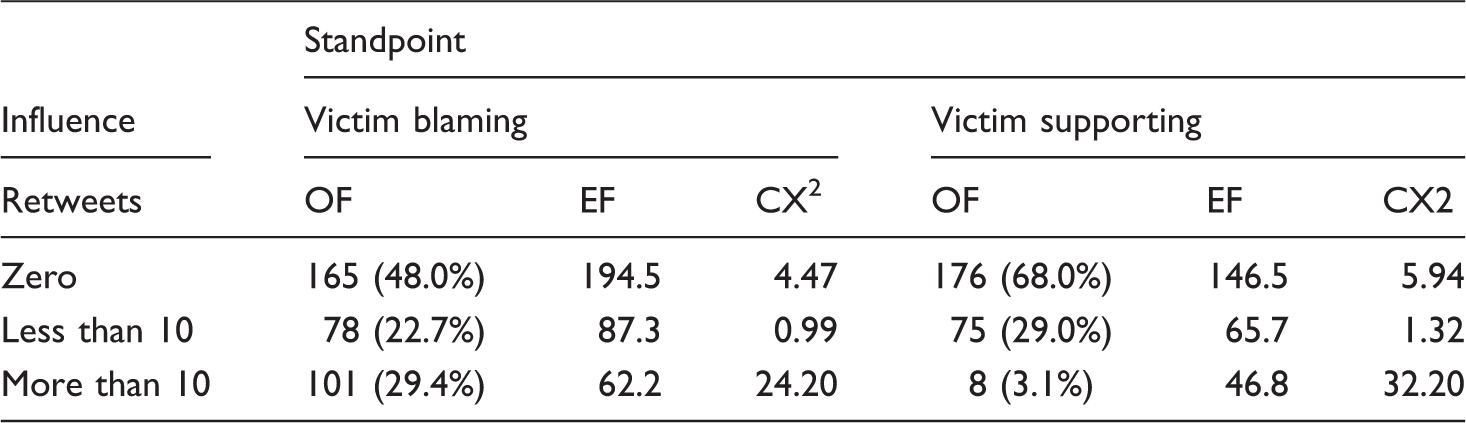
Note. N = 603, χ2 = 69.15, p = .000, OF is the observed frequency and column percentage, EF is the expected frequency, and CX2 is the cell chi-square value.
Followers
Twitter users engaging in victim blaming tended to have more followers than those tweeting victim-supporting content. Results of the chi-square test revealed a statistically significant relationship between the number of followers and the standpoint of the tweet (victim blaming versus victim supporting). As can be seen in Table 2, the greatest difference in victim blaming versus victim supporting influence occurred among those with the fewest followers (i.e. between one and 150 followers). Approximately 35.5% of Twitter users who tweeted victim-supporting tweets had the lowest category of followers (e.g. fewer than 150 followers) compared to 21.5% for victim blaming. Across the other three categories, accounts of victim-blaming tweets had more followers than accounts of victim-supporting tweets for average (24.1% versus 20.8%), moderate (19.8% versus 17%), and a high number of followers (34.6% versus 26.6%). Thus, those who tweet victim-blaming tweets tend to have more followers than those who tweet victim-supporting tweets.
Retweets
Victim-blaming content received more frequent retweets. Results of a chi-square test provide support for a relationship between the number of retweets and the content or standpoint (victim blaming or victim supporting) of tweets. In Table 3, the chi-square values reveal the greatest difference in influence of victim-blaming versus victim-supporting tweets to be occurring among tweets receiving more than 10 retweets. Chi-square values also suggest a meaningful difference occurring among victim-blaming and victim-supporting tweets receiving zero retweets. Victim-supporting tweets (68%) were more likely to not be retweeted at all compared to victim-blaming tweets (48%). Victim-supporting tweets were also more likely to obtain less than 10 retweets (29%) than were victim-blaming tweets (22.7%). However, victim-blaming tweets were substantially more likely to receive more than 10 retweets, 29.4%, compared to victim-supporting tweets, 3.1%. In other words, in these data, tweets that are victim-blaming focused are more likely to be retweeted in greater quantity than victim-supporting-focused tweets.
Discussion and future directions
Social media is a growing arena of engagement, discussion, and conflict between those who support victims and those who engage in victim blaming. Using the terms “rape and whore” and “rape and slut,” we identified numerous examples of both victim-blaming and victim-supporting content. Through qualitative analyses, we found the prevalence of three themes: (1) the virgin–whore binary and the just world, (2) informational subnews, and (3) RMD. Although we originally set out to examine victim-blaming attitudes in response to mainstream sexual assault cases, we also found a relatively high volume of tweets using social media to debunk rape myths, similar to studies finding the use of social media to advocate against rape culture (Keller et al., 2016; Mendes, 2015; Moody-Ramirez et al., 2015; Sills et al. 2016; Woods, 2014). This high volume of victim-supporting (n = 259) and victim-blaming tweets (n = 344) allowed us to complement our qualitative findings with quantitative (chi-square analyses), to assess the relative influence of both victim-blaming and victim-supporting tweets. Overall, victim-blaming tweets were found to be more influential both in terms of the number of followers and retweets. These findings highlight the importance of examining dialog or interactions between groups in social media, such as that of victim-blaming and victim-supporting content.
This research contributes to understanding attitudes and opinions of gendered sexual violence that occurs in a more “naturalistic setting,” as opposed to research that is based on survey and interview methods. Social media offers an opportunity to assess real-world examples of victim blaming that might otherwise be difficult to obtain. Twitter content is unique because it is unsolicited and opinions are openly discussed. We believe this research is crucial for understanding the ways in which social media content could affect rape survivors and society as a whole.
Although this research calls timely attention to a very important topic, this work is not without limitations. First, it is possible that our search terms resulted in a smaller and more extreme subsection of rape culture discussions on slut shaming. Second, Twitter is a relatively new source of information and consequently the nature of the data is less than complete (e.g. demographic data are not available for analysis). Thus, we have no means of asserting whether victim blamers have the same characteristics as a cross-section of Twitter users or whether they represent a specific subpopulation. Third, while we cannot interpret rape myth acceptance on the direct level that past experimental research has done, we have the advantage of directly observing social interactions that include victim-blaming commentary that are retweeted, indicating some level of acceptance.
It should be made explicit that we do not consider our social media tracking procedures to be representative of all rape-blaming tweets that are embedded in Twitter data. We were interested in examining the victim-blaming tweets that emphasized that victims deserved to be raped because of being labeled as a whore or slut surrounding rape cases in mainstream media. The influence of victim blame tweets may have been overestimated as a result of search term selection. For example, selecting more general terms, like “rape” or “sexual assault,” may have resulted in identifying more victim-supportive tweets.
Future research should examine what discussions result when more general search terms such as, rape and sexual assault, are discussed in social media. Another interesting study would expand on this work by including more general search terms related to sexual behavior. A benefit to examining these discussions in social media is that underlying attitude functions can be identified (e.g. the just world hypothesis) and altered by media campaigns and intervention efforts. Additional work is needed to assess types of victim supporting or intervention efforts that reduce the acceptance of rape myths and violence toward women, assess the mental health effects, and aim to improve online bystander interventions.
In this research, we have found that Twitter is a source for social scientists to study discussions of rape culture and it is also an important new social reality of how people are organizing and shaping culture and society. This analysis demonstrates the manner in which existent forms of victim-blaming behavior are transitioned into a social media reality, and the implications of this are potentially far reaching. Previously, victim-blaming discussions were exchanged within relatively small groups in more private settings, whereas now, through the use of social media, such as Twitter, a single victim-blaming tweet can potentially reach and influence the attitudes and beliefs of thousands to tens of thousands of individuals. These findings reveal an important concern for activists and researchers on Twitter, because rape myth acceptance, especially when used for slut shaming or victim blaming is harmful to rape survivors, rape victims, and society.
Footnotes
Declaration of conflicting interests
The author(s) declared no potential conflicts of interest with respect to the research, authorship, and/or publication of this article.
Funding
The author(s) received no financial support for the research, authorship, and/or publication of this article.