



Abstract

In our inaugural editorial, we described our vision for the journal. Drawing on the inspiration provided by the previous editors, we spoke of our commitment to expanding the international reach of the journal and to engaging fully with the possibilities and challenges of conjoining feminisms and psychologies (Macleod, Marecek, & Capdevila, 2014). We now announce that SAGE has offered us a contract to continue as editors for another term and that we have happily accepted.
This is an opportune moment to offer our reflections on the shape the journal has taken since we became the editors. As readers know, many things have remained the same. We continue, for example, to publish full-length articles, brief reports, and book reviews. We also continue the tradition of publishing Special Issues. We have initiated some new features as well: a series of occasional State of the Discipline papers; Virtual Special Issues (VSIs) available online; an online blog; additional student presentation awards; and a Twitter account.
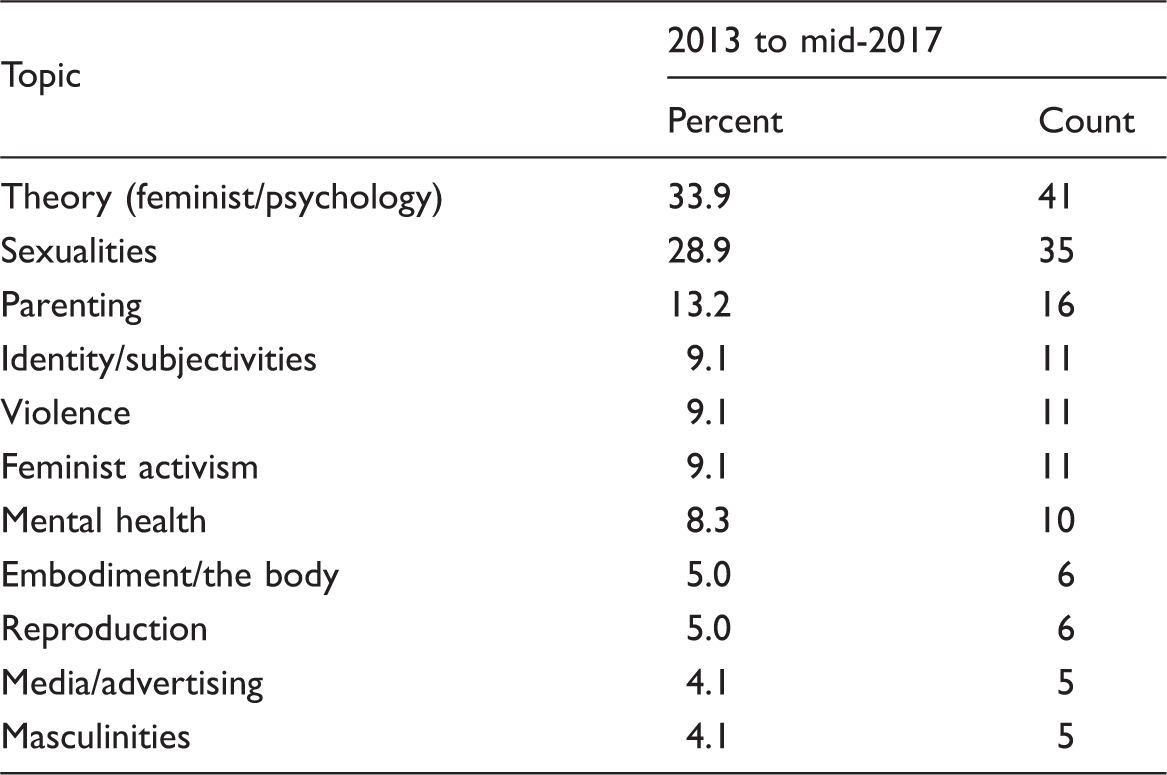
Topics covered in Feminism & Psychology from 2013 to mid-2017.
We view Special Issues and Special Features as a means of providing readers with an opportunity for sustained engagement with a body of work on a particular topic. Since we took over as editors, Feminism & Psychology has published the following Special Issues and Special Features, curated by guest editors with special expertise in the topic:
Advancing feminist psychological scholarship on Trans (24[2], 2014), edited by T Evan Smith and Megan R Yost; “Young feminists” doing recognition & reflexivity & (r)evolution (25[1], 2015), edited by Rachel Jane Liebert and Lucy Thompson; Feminism, suicide, and assisted dying (25[1], 2015), edited by Celia Kitzinger; Deconstructing Developmental Psychology 20 years on (25[3], 2015), edited by Jane Callaghan, Agnes Andenæs, and Catriona Macleod; “Functionalism, Darwinism, and the psychology of women” 40 years on: Reflections, implications and empirical work (26[3], 2016), edited by Lisa Lazard, Hale Bolak Boratav and Helen Clegg; and Abortion in context, Part 1, (27[1]) and Part 2 (27[2], 2017), edited by Jeanne Marecek, Catriona Macleod and Lesley Hoggart.
These special issues have sparked significant interest. For example, two of the three most downloaded articles in 2017 were the editorial introduction for Abortion in context, Part 1 (Marecek, Macleod, & Hoggart 2017) and Linda Beckman’s (2017) analysis of abortion politics in the USA, in the same issue.
The State of the Discipline series consists of articles written by scholars who have a long-standing engagement with a particular topic. In contrast to reports of empirical research or literature reviews, these articles apprise readers of the current state of knowledge about a topic. They summarise key developments and point out areas of conceptual and methodological debate among scholars in psychology and in feminist studies. We hope that articles in this series will promote further scrutiny and new ways of understanding, thereby encouraging nuanced work in the field. The inaugural State of the Discipline paper (Hollway, 2016) concerned the experiences of women becoming first-time mothers. Additional State of the Discipline papers will appear in upcoming issues of Feminism & Psychology, and we intend to commission additional State of the Discipline papers in the future.
Drawing on a survey of the subject matter of articles in Feminism & Psychology (described by Macleod, Marecek, & Capdevila, 2014), we have begun to commission VSIs. A VSI is a collection of articles previously published in F&P, compiled by guest editors who are experts in the field. These compilations provide readers with an overview of feminist thought about a particular topic or theme, as well as an easy way to locate pertinent articles. The first VSI, Constructing sexualities, was edited by Jacqueline Marx and Natalie Donaldson. The second VSI, Feminist theory, Part 1, was edited by H. Lorraine Radtke. A third VSI, Feminist theory, Part 2, also by H. Lorraine Radtke, will appear shortly. We are pleased that many readers have accessed the VSIs, which can be found on the journal webpage.
Blogs, as most readers know, are a widely used means of online communication. Feminism & Psychology now has a dedicated blog page. The page provides a forum for discussion of articles and other journal content, as well as for wider conversations around feminisms and psychologies as they relate to events and developments in the news. Recent posts have addressed issues concerning gender, sexuality, and sexual violence; they have also announced the winners of the 2017 student awards. We invite you to bring your work and ideas to this space by sending possible submissions to our editorial assistant for consideration. In addition, we have created a Twitter account (https://twitter.com/FemPsychJournal), and we invite you to follow F&P updates there.
Student award winners.

POWS: Psychology of Women Section; SPSSI: Society for the Psychological Study of Social Issues; PsySSA: Psychological Society of South Africa.
In our first editorial, we indicated that we aimed for wider global representation in the articles published in Feminism & Psychology. Based on the authors’ institutional affiliation, we are pleased to note an increase in the last four and a half years in the percentage of published articles from Africa (6.6% compared to 2% in the years 2000 to 2012), Australia (14% compared to 6.8%), the Middle East (2.5% compared to 0.5%), and the Nordic countries (9.1% compared to 3.2%). Unsurprisingly, given the inequitable distribution of research and publishing resources, the highest percentages of articles continue to be produced in the USA (28.1%) and the UK (22.3%).
We acknowledge with gratitude the many people who have contributed to the success of Feminism & Psychology. The quality of its scholarship rests heavily on the care and diligence of our peer reviewers. We are grateful for their constructive and creative insights in reviews. We rely as well on our editorial board to advise us and to promote and support the journal. In particular, we thank Sue Jackson, the Book Review Editor, and the Associate Editors Ngaire Donaghue, Eva Magnusson, H Lorraine Radtke, Kopano Ratele, and Sarah Riley, as well as Stephanie Taylor, the previous Book Review Editor, and previous Associate Editors Rosalind Gill and Helen Malson. We are also grateful for the support provided by the SAGE main office and production office. At the editorial office at Rhodes University, administrative assistance was ably provided initially by Lindsay Kelland, and then by Jabulile Mavuso and Ryan du Toit. We thank all three of them for their commitment to the journal and their sterling work. Jabulile, who will soon receive her PhD, will be leaving her position at the end of 2017; she will be missed. We welcome Sibongile Matebese, a talented Masters student in the Critical Studies in Sexualities and Reproduction program.
In conclusion, we are cognisant of the fact that in some parts of the world, the academy has long been inhospitable terrain for feminist and critical scholars; in other regions, it is becoming a challenging environment for feminist and critical scholars. As editors of Feminism & Psychology, we are committed to providing a space for scholarly work aimed at “dismantling of social inequalities and transforming women’s lives”, as was the intention of its founding editor (Wilkinson, 1991, p. 9).
Footnotes
Acknowledgements
Thank you to Ryan du Toit and Jabulile Mavuso who coded the articles appearing in F&P since we took over as editors, the results of which appear in this editorial.
Declaration of conflicting interests
The author(s) declared no potential conflicts of interest with respect to the research, authorship, and/or publication of this article.
Funding
The author(s) received no financial support for the research, authorship, and/or publication of this article.