



Abstract
Maternal child-centrism is widely regarded in Western societies as the ideal of being a good mother. However, it has recently been criticized for the toll it takes on mothers. This study examines the widespread maternal practice of child-centrism. It is the first, to our knowledge, to examine predictors of the tendency towards child-centrism. Nowadays, with the social unwritten imperative to prioritize children's needs regardless of maternal standpoint, this study aims to focus and shed light on mothers and to explore which maternal characteristics predict maternal child-centrism. Self-reported questionnaires were completed by 320 Jewish-Israeli mothers, dealing with maternal child-centrism, maternal characteristics (i.e. attachment style, anxiety, defensiveness, and negative and positive affect), and socio-demographic context. The results of the Hierarchical Regression analysis revealed that stress-related maternal characteristics of anxiety and defensiveness predicted maternal child-centrism. These findings may imply that child-centrism serves as a mechanism for overcoming distress faced by mothers struggling with current Western societal norms. Its relationship to the feminist conceptualization of the Myth of Motherhood is discussed.
The importance of parental attunement to children's needs is advocated in many developmental theories such as Mahler's Separation-Individuation process (Mahler, Pine, & Bergman, 1994), Kleinian Object Relations Theory (2002), Winnicott's notion of the “good-enough mother” (1953), and Bowlby's Attachment Theory (1988). This attitude continues to be dominant, when responsive and sensitive parenting to children's needs is perceived and empirically tested as a crucial component for child functioning and well-being (Broberg, 2012; Newland, 2015).
Contemporary parents, particularly women who are still regarded as the primary caregivers in Western societies (for example in New Zealand (Ritchie, 2001), Finland (Sevón, 2012), Israel (Sperling, 2010), North America (Apple, 2006), or Canada (Jacques & Radtke, 2012)), tend to interpret this attunement by setting their children's needs above their own (Craig, Powell, & Smyth, 2014; Lupton, 2011; Sevón, 2012; Wall, 2010). However, attuning to children's needs does not necessitate supplanting parent needs. As the notion of feminist sociological imagination stresses (Garey & Arendell, 2001), families are composed of individuals with both common and diverse interests. Moreover, prioritizing children's needs is well anchored in most Western formal policies in the form of allocating funds for child well-being above the needs of most other populations (Hennum, 2014; Yasenik & Graham, 2016). Indeed, this social perception pervades and shapes maternal attitudes underlying various child-centered patterns, especially over the last two decades (e.g. “intensive mothers”, 1 “helicopter mothers”, 2 “little emperor syndrome”, 3 etc.) (Hays, 1996; Janssen, 2015). Mothers who identify with such attitudes feel obligated to devote themselves financially, emotionally, temporally, and attentionally to their children—even at the cost of their own aspirations (Ashton-James, Kushlev, & Dunn, 2013; Craig et al., 2014; Elliott, Powell, & Brenton, 2015; Henderson, Harmon, & Newman, 2016). Furthermore, women in Western societies have almost uniformly embraced this model of “good mothering” (Guendouzi, 2006; Lupton, 2011).
However, child-centrism may have potentially negative consequences for mothers (Guendouzi, 2006; Hays, 1996; Henderson et al., 2016; Liss, Schiffrin, Mackintosh, Miles-McLean, & Erchull, 2013; Rizzo, Schiffrin, & Liss, 2013). The need to engage in quality time with the child, effectively restricting career, self-realization, leisure time, or other individual aspirations, can take its toll on a mother's mental, emotional, and physical health (Wall, 2010). In addition, recent findings implied a negative impact of maternal child-centrism on the development of children as well. In a recent study, Lavenda and Kestler-Peleg (2017) found that maternal child-centrism serves as a mediator of intergenerational transmission of sociability and is negatively associated with the sociability of the child.
Belsky's (1984, 2005) model of Social-Contextual Determinants of Parenting, based on Bronfenbrener's model of the Ecology of Human Development (Bronfenbrener, 1979), suggested that parenting is shaped by three domains: (1) the parent's characteristics, (2) the child's characteristics, and (3) contextual factors. This triad works as a mutually self-reinforcing system. Yet, Belsky (1984) insisted on the uniqueness of the parent's characteristics as a buffer against threats to the parent–child relationship. Thenceforth, this argument has been confirmed in a variety of studies (see, for example, Shai, Dollberg, & Szepsenwol, 2017; Smaling et al., 2016). Moreover, mothering is more consistently predicted by personality and mood as compared to fathering (Belsky, Crnic, & Woodworth, 1995).
Based on the notion of feminist sociological imagination (Garey & Arendell, 2001), that points to the patterns that emerge from the intersection of individual lives with the larger social, political, economic, and historical contexts within which they are situated, Burman (2008) emphasizes the great value of elucidating what is at stake in the contests between women's and children's rights, in order to identify specific strategies for action. The present study takes up this focus on maternal characteristics and its prediction of child-centric mothering, namely mothers' prioritization of children's needs above their own. Nevertheless, the focus on maternal characteristics should not be taken from a “mother-blame” standpoint (Garey & Arendell, 2001). Belsky's theory, among other theories regarding parenting, focuses on parental characteristics in order to investigate what factors shape and impact child development, which puts a tremendous burden of guilt and anxiety on mothers. The current study, on the other hand, focuses on the mothering role and therefore aims at exploring what characterizes women who adopt the social imperative and attempt to invest all of their resources for the sake of their children, at their own expense. To the best of our knowledge, this is the first attempt to examine this issue.
A set of maternal characteristics was chosen to assess the tendency towards child-centrism in the context of the social expectation of “good mothering.” The first characteristic selected was adult attachment. Adult attachment represents emotional states that exist within interpersonal space, reflecting the need to respond to others and to have others respond to us in return. It requires intimacy, reciprocity, sense of belonging and concern for others (Bowlby, 1969; Erikson, 1963; Winnicott, 1965). According to Bowlby (1988), attachment is shaped in early childhood and is relatively stable over the lifespan (Fraley, 2002; Pinquart, Feußner, & Ahnert, 2013). As such, it may clarify individual willingness to devote oneself to the service of others. Furthermore, the literature points to a relationship between maternal attachment and parenting skills. Mothers characterized by secure attachment were found to be more sensitive (Zimmer-Gembeck, Webb, Thomas, & Klag, 2015) and supportive of their children. They felt closer to their children and expressed more positive emotions towards them (Gallagher, 2015; Rholes, Simpson, & Blakely, 1995). Additionally, they were less likely to abuse them (Moncher, 1996), as opposed to mothers characterized by insecure attachment. Nevertheless, the associations between maternal attachment and child-centrism have yet to be adequately studied.
Anxiety and defensiveness were the second characteristics selected as they represent a mixture of personality traits and experiences acquired through coping with daily stressful life events (Grös, Antony, Simms, & McCabe., 2007; Trope & Pomerantz, 1998). The American Psychiatric Association (2013) characterizes anxiety as excessive, uncontrollable and often irrational worry. It can be evoked by various factors, among them daily routines (Endler & Kocovski, 2001) inherent in the mothering role (Zalta & Chambless, 2012). Although most social and psychoanalytic theories tend to idealize motherhood and to emphasize the tremendous impact mothers have on their children (Birns & Benner, 1988), this discrepancy between glorification and desired images of mothering, and the realistic daily experiences of it might produce high levels of psychological stress. Hays (1996) pointed out that complying with “the good mother” social imperative might lead to a “cultural contradiction.” Women are thus caught between their willingness to prioritize their children's needs before their own and the modern demands of individual ambition or restrictive circumstances (Arendell, 2000; Christopher, 2012; Guendouzi, 2006). This tension may generate anxiety and/or defensiveness (Lane, Merikangas, Schwartz, Huang, & Prusoff, 1990; Lupton, 2011; Tummala-Narra, 2009; Wall, 2010).
At elevated levels, anxiety is maladaptive and causes detrimental effects on daily functioning (Endler & Kocovski, 2001). Empirical studies conducted thus far are inconclusive on the impact of anxiety on mothering. Several studies found anxious mothers to be less affectionate and warm as well as more controlling (Gerlsma, Emmelkamp, & Arrindell, 1990; Whaley, Pinto, & Sigman, 1999). They were also shown to be more criticizing and catastrophizing (Moore, Whaley, & Sigman, 2004; Whaley et al., 1999), less efficient, and more disengaged when interacting with their children (Woodruff-Borden, Morrow, Bourland, & Cambron, 2002). However, other studies did not report any differences in parental behavior between anxious and non-anxious mothers (Ginsburg, Grover, & Ialongo, 2005; Turner, Beidel, Roberson-Nay, & Tervo, 2003).
Concerning defensiveness, the term is derived from Freud's concept of the defense mechanism, a technique the ego uses in times of conflict that may lead to neurosis (Freud, 1923). Defensiveness is the tendency to ignore unfavorable information about oneself. It is also a means of unconscious self-deception and even protection of vulnerable self-esteem from unpleasant emotional realities (Lane et al., 1990). Therefore, higher levels of defensiveness may increase emotional stability by preventing undesired intrusions, such as a threat to the self, fear or anxiety, to impact one's well-being (Bedi & Brown, 2005; Kline, Knapp-Kline, Schwartz, & Russek, 2001; Lane et al., 1990; Taylor & Brown, 1988). However, defensiveness was also found to be harmful for the individual's physical health as part of a repressive coping style (Denollet, Martens, Nyklicek, Conraads, & de Gelder, 2008; Jacobs, 2010).
The aspiration to be “the perfect mother” or “superwoman” may reflect such defensive behavior (Choi, Henshaw, Baker, & Tree, 2005; Tummala-Narra, 2009). Women thus adapt to social expectations and avoid confrontation with the internal conflict of motherhood. As far as we know, only one study has explored the defensiveness and parenting nexus, concluding that defensive mothers tend to report lower levels of parental stress as opposed to less defensive mothers (LaFiosca & Loyd, 1986). However, none of the studies investigated maternal anxiety and defensiveness in the context of child-centrism.
Positive and negative affect were the final maternal characteristics selected, representing a spectrum of affective dimensions. In Belsky, Crnic, and Woodworth's model terminology (1995), they are referred to as mood dimensions. Positive affect reflects the extent to which a person feels enthusiastic, active, and alert. In contrast, negative affect reflects subjective distress that subsumes aversive mood states, including anger, guilt, fear, and nervousness (Watson, Clark, & Tellegen, 1988). A meta-analytic review of the research on affect and parenting in nonclinical samples revealed strong associations between positive affect and supportive parenting as well as between negative affect and harsh parenting (Rueger, Katz, Risser, & Lovejoy, 2011). The nature of the association between maternal affect and child-centrism is, however, still vague. Although child-centrism is considered a sacrifice that parents make for the sake of their children (Hays, 1996; Liss et al., 2013), Ashton-James et al. (2013) reported that child-centric parents presented higher levels of positive affect during child care episodes (Aknin et al., 2013; Borgonovi, 2008). The authors explained that child-centrism may serve as a prosocial investment. Thus, the more parents invest in their children, the greater their parental well-being.
The current study
To the best of our knowledge, the present study is the first to examine maternal characteristics as predictors of child-centrism. Most of the studies exploring parenting view mothering through the lenses of a child-oriented agenda. The present study, on the other hand, examines mothering from a parent-oriented agenda.
In order to explore maternal characteristics as predictors of mothering, the specific context in which mothering takes place should be considered (Miller & Chen, 2001). The current study uses a sample of Jewish mothers of preschoolers, in Israel. By post-industrial societal standards, Israel is still characterized by a high degree of familism (Fogiel-Bijaoui, 2002; Lavee & Katz, 2003; Sinai-Glazer, 2016). Israeli familism is reflected in high marriage and fertility rates and low divorce rates compared to other Westernized societies such as the European Union, United States, Canada, and Japan (Central Bureau of Statistics, 2016; Fogiel-Bijaoui, 2002). However, as a familial society, the Israeli population tends to take for granted unequal gender division of labor. Women are expected to take on the role of mother and wife—as primary caregiver, responsible for household tasks and family well-being (Snir, Harpaz, & Ben-Baruch, 2009; Sperling, 2010).
In addition, the study's participants were mothers of preschoolers. At this age, preschoolers are relatively more independent and mature compared to younger toddlers. They are occupied with socialization at this age and with the task of developing their independence; hence, they are focused on discovering their unique abilities and skills (Bee & Boyd, 2002). Yet, preschoolers are still in need of constant oversight, dedication, and intensive care. Thus, it is reasonable to conclude that this phase of child development is more receptive to self-reflection by the mother. Even though active maternal involvement is still absolutely necessary, a certain space in the mother–child relationship begins to emerge (Mahler et al., 1994) which enables the examination of maternal tendency towards child-centrism.
The present study's hypotheses are: (1) Attachment style as a personality predisposition (that is, a basis for understanding development of emotions, behaviors, and attitudes) will determine the mother's tendency towards child-centrism; (2) Higher levels of anxiety stemming from social pressure and higher levels of defensiveness (consistent with social desirability) will positively predict the tendency towards child-centrism; and (3) Better moods (i.e. higher levels of positive affect and lower levels of negative affect) will positively predict the tendency towards child-centrism.
Method
Participants and procedure
Participants consisted of 320 Jewish-Israeli mothers between the ages of 27 and 51 (M = 37.10, SD = 4.34), with 12–27 years of education (M = 17.1; SD = 2.5). The majority were married, or reported living with a partner (93.8%), while the rest were single (0.6%), divorced (3.5%) or separated (2.7%). Participants had 2.83 children on average (SD = 01.10) between the ages of birth to 24. Participants were asked to fill out questionnaires referring to their child who was between four and six years old (M = 4.95, SD = 0.48). More than half of the sample worked full time (58.8%), 28.9% worked part time, and the rest (12.3%) were unemployed. The majority of the participants (85.4%) reported having income above the average income in Israel, 11.7% reported an average income and 2.8% reported a lower income compared to the average Israeli income.
Mothers were recruited at the end of their pregnancy to participate in the initial wave of data collection between the years 2008 and 2010. The recruitment was conducted through Public Health Funds in eight cities in central Israel. The current study uses the fourth wave of data collection. All 601 mothers who participated in the first wave were invited to fill out questionnaires through e-mails and text messages sent during 2014. An approval for conducting the study was obtained from the ethics committee of the four Health Funds of Israel, as well as the ethics committee of Tel-Aviv University. Consent to participate was sent electronically. The response rate was 53.24%, a reasonable rate compared to other studies spanning a substantial period of time (Corrigall & Konrad, 2007; Friesen, John Horwood, Fergusson, & Woodward, 2017). Attrition was partially due to difficulties in locating participants and to participants' unwillingness to expose more information about their lives, lack of time, and availability to participate.
Measures
Child-centrism
Child-centrism was assessed using the Child-Centrism Scale (Ashton-James et al., 2013): a 7-item scale from 0 (not at all) to 6 (very much), indicating the extent to which parents invest their resources in child needs at the expense of their own (e.g. “The needs of my children come before my own;” “My children are the center of my life,” etc.). The higher the score, the greater the degree of child-centrism. The Cronbach's alpha was 0.75.
Adults' attachment style
Attachment style was assessed using The Experience in Close Relationships Inventory developed by Brennan, Clark, and Shaver (1998). The scale consists of 36 items surveying personal feelings towards close relationships on a Likert scale from 1 (strongly disagree) to 7 (strongly agree). The items generate two central dimensions: Avoidance (e.g. “I try to avoid getting too close to my partner”) and Anxiety (e.g. “I worry a lot about my relationships”). The higher the score, the greater will be the personal tendency of avoidant/anxious attachment. The Cronbach's alpha was 0.89 for anxiety and 0.91 for avoidance.
Anxiety
Anxiety was assessed using a shortened version of The Revised Form of the Manifest Anxiety Scale, developed by Taylor (1953) that includes 28 true/false items describing participant feelings over the past two weeks (e.g. “I work under a great deal of tension;” “I worry quite a bit over possible misfortunes,” etc.). Negative items were reverse coded so that the higher the score, the greater the level of anxiety. The Cronbach's alpha was 0.82.
Defensiveness
Defensiveness was assessed using The Marlow-Crowne Social Desirability Scale (Crowne & Marlowe, 1960). The scale consists of 33 true/false items describing behaviors that are perceived by society to be exemplary, but which are enacted only infrequently (e.g. “I always try to practice what I preach,” “I am always willing to admit when I make a mistake,” etc.). This scale is commonly used to evaluate defensiveness (e.g. Kline & Allen, 2008; Mikulincer & Orbach, 1995). Negative items were reverse coded so that the higher the score, the greater the level of defensiveness. The Cronbach's alpha for the current study was 0.76.
Positive and negative affect
Positive and negative affect were assessed using The Positive and Negative Affect Schedule (PANAS) (Watson et al., 1988). The scale consists of 20 items rated on a Likert scale, from 1 (very slightly or not at all) to 5 (extremely). Participants were asked to indicate for each item the extent to which affect was experienced over the past two weeks. Two separate scores were calculated: positive (e.g. “happy”) and negative (e.g. “upset”), with the mean of the answers obtained from each index (Watson et al., 1988). The Cronbach's alpha was 0.87 for positive affect and 0.86 for negative affect.
Background variables
Participants were asked to report their socio-demographic characteristics. More specifically, their educational level was elicited by providing number of years of education and their socio-economic status by rating income relative to average family income in Israel.
Results
Ranges, mean scores, and standard deviations of study variables.

Hierarchical regression coefficients for predicting maternal child-centrism by maternal education, income, and psychological resources.
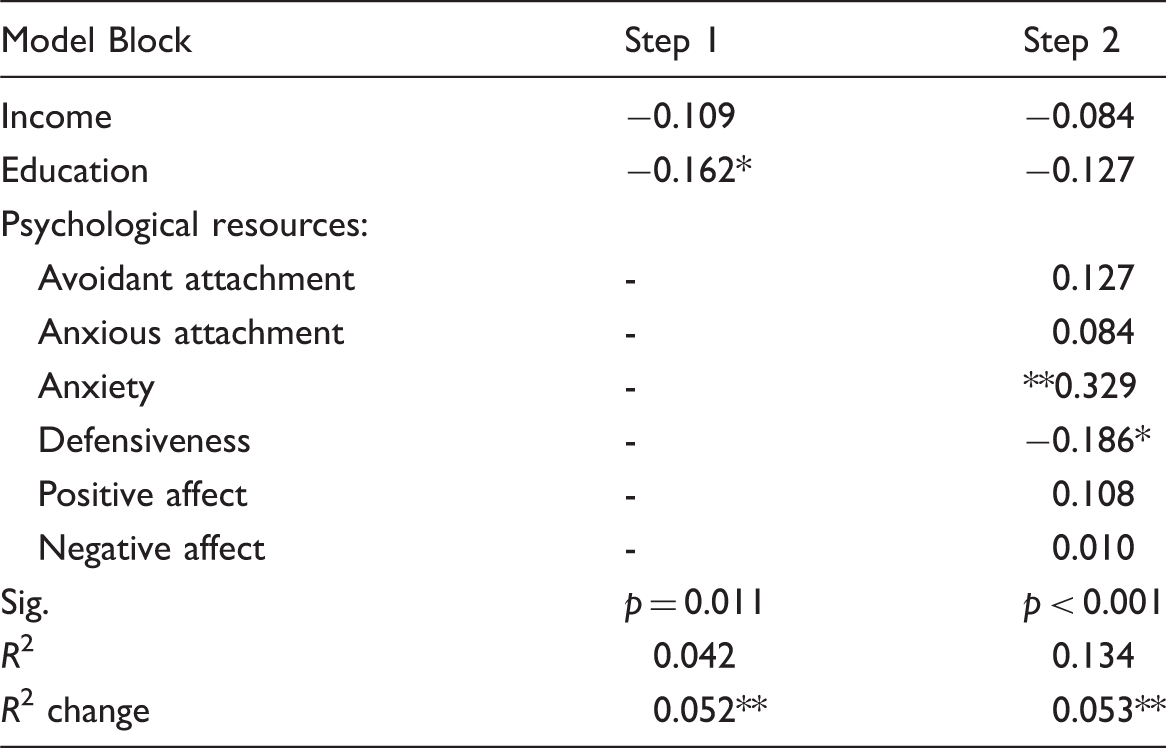
*p < 0.05; **p < 0.01.
As indicated in Table 2, the overall model explained 17.6% of the variance in maternal child-centrism. About 4% of the variance was accounted for by socio-economic factors, while the remaining 13% of the explained variance can be attributed to maternal characteristics. Of the socio-economic variables, the mother's education was found to be a significant predictor of maternal child-centrism (β = −0.162, p = 0.018). Maternal characteristics were confirmed to add a significant and unique contribution above and beyond these socio-economic variables (FΔ (6,207) = 5.607, p < 0.001). Nevertheless, contrary to hypothesis 1, attachment style was not found to significantly predict maternal child-centrism. Anxiety (β = 0.329, p < 0.001) and defensiveness (β = −0.186, p = 0.011) were found to be significant predictors of maternal child-centrism, confirming hypothesis 2. And finally, hypothesis 3 was not confirmed as positive and negative affect did not significantly predict maternal child-centrism. Therefore, anxiety and defensiveness were the only significant predictors of maternal child-centrism among the maternal characteristics.
Discussion
To our knowledge, this study is the first to examine predictors of child-centrism. Of the variables tested in the model, anxiety, defensiveness, and education were the only significant predictors. Non-significant predictors included maternal attachment and positive and negative affect. The findings indicate that lower levels of education and higher levels of anxiety and defensiveness predict higher levels of maternal tendency towards child-centrism. This mixture of findings ultimately confirms child-centrism as a complex maternal construct.
Of the controlled socio-demographic variables, level of education, but not income, was found to be negatively associated with child-centrism. Thus, higher levels of education were linked to lower levels of child-centrism. These results can be attributed to the competing social demands placed on well-educated ambitious women to fully engage in familial aspects as well as to excel in their career (Allen & Osgood, 2009; Hays, 1996; Komarovsky, 2004). These women feel pressured to be both intensive mothers and have successful careers, which causes them to take a ‘‘second shift’’ (Hochschild & Machung, 1989). As a consequence, their attention is forcibly divided, and their tendency towards child-centrism decreases (Craig, 2007, 2016). This finding is compatible with studies that documented a negative association between education and intensive mothering (Christopher, 2012; Henderson et al., 2016), and at the same time contradicts other studies, which suggested that low- and middle-class women are under more pressure to adhere to intensive child-centered mothering (e.g.: Elliott et al., 2015; Taylor, 2011). Interestingly, this contradiction highlights a gap in the literature regarding child-centered mothering. While some sources, including the present study, refer to the term “child-centrism” as an adopted maternal ideology that encourages maternal sacrifice for the sake of the child (Ashton-James et al., 2013; Henderson et al., 2016), other sources refer to it as the allocation of resources for the benefit of the child (Taylor, 2011). Accordingly, mothers from low socio-economic status who have scarce resources (e.g. educational level, income, time and energy, emotional availability, etc.) are forced to divide their resources among all family members, in order to maintain the physical existence of their household. In this sense, they are presenting low levels of child-centrism. Nevertheless, these mothers' attitudes towards child rearing reflect their will to go to great lengths for their loved ones—to take any job, to work double and triple shifts, and to sacrifice their own personal aspirations in order to meet their children's essential needs (Taylor, 2011; Vincent, Ball, & Braun, 2010). In this sense, as implied by the current study's findings, they are presenting high levels of child-centrism. On the other hand, mothers from a high socio-economic status have the privilege to allocate a variety of different resources for their children (shared activity time, higher education, extracurricular activity, etc.). In this sense these mothers present high levels of child-centrism, yet as a result of these potential resources these mothers develop their own areas of interest for their own benefit and self-actualization, which in turn balances and reduces the levels of child-centrism. Moreover, their resources enable them to resist and act against the social imperative dictating child-centric mothering, a privilege that mothers from low socio-economic status don't have. The association between maternal anxiety and child-centrism can also be accounted for by the predisposition of mothers with high levels of anxiety to worry over their children. This protective drive might be exaggerated by heightened sensitivity to perceive reality as a difficult and threatening force. Similarly, mothers with high levels of defensiveness might deny their authentic self in order to avoid confrontation with unpleasant emotions. That is, their focus on others (in this case, their children) is grounded in self-avoidance (Lane et al., 1990).
However, as feminist scholars have noted, mothering occurs in a wider social context, and in order to understand it, one should take prevailing gender ideologies into account (Arendell, 2000; Warner, 2005). Therefore, Belsky's process model of Social-Contextual Determinants of Parenting (1984, 2005) should be applied to the myth of motherhood powering child-centrism. According to feminist perspectives, rigid social constructs exist in relation to motherhood. These constructs are bound to socio-economic and gender disparities. They deeply affect the female experience and evaluation of motherhood. These constructs inform the myth of motherhood (Barak-Brandes, 2017; De Beauvoir, 1974). They also reflect a dichotomous perception of mothers as either good or bad (Oberman & Josselson, 1996). Moreover, motherhood is perceived in this myth as easy, natural, and the aspirational summit for all women. It delegates to women full and exclusive responsibility for the well-being of children. In reality, however, this ideal is mostly unreachable (Douglas & Michaels, 2005; Smyth & Craig, 2017). The negative effects of this unattainability are many: maternal feelings of guilt, shame, frustration, and distress (Choi et al., 2005; Jackson & Mannix, 2004; Oberman & Josselson, 1996; Rotkirch & Janhunen, 2010), exacerbated in mothers already characterized by high levels of anxiety and defensiveness.
Arguably, the relatively unique cultural context of Israel may influence and even amplify this sensitive dynamic between the myth of motherhood and maternal reaction. As noted, Israel is a child-oriented society. Married couples are expected to have children, while childless couples are not truly considered a family. Children are highly valued by their parents and society as a whole. For Israeli mothers, in particular, child-centric parenting seems to be the social norm. The Israeli focus on the well-being of children is encompassed by a larger social imperative of collective accountability, and this is reflected in various aspects of parenting (Lavee & Katz, 2003). For example, in Israeli culture, which prizes direct and openhearted communication (Shectman & Kenny, 1994), it is socially legitimate for a stranger to criticize a mother's parenting behavior (Rosenthal & Roer-Strier, 2006).
In addition, Israeli women are expected to prioritize their responsibilities as mothers (Snir et al., 2009; Sperling, 2010). This social imperative is operative even as most mothers de facto work outside the home (Central Bureau of Statistics, 2016). Moreover, the mother's share of the family income is generally regarded as a secondary contribution (Fogiel-Bijaoui, 2002; Sinai-Glazer, 2016). Facing these cultural expectations may evoke maternal discomfort and stress.
The literature suggests that although Westernized mothers find it difficult to meet these rigid social standards and cultural expectations, they are not seeking new alternatives (Elliott et al., 2015; Jacques & Radtke, 2012). In fact, they are making tremendous efforts to attain these unreachable goals (Choi et al., 2005; Craig et al., 2014; Douglas & Michaels, 2005; Kestler-Peleg, Shamir-Dardikman, Hermoni, & Ginzburg, 2015). Child-centrism may well be an expression of this social longing (Liss et al., 2013). Child-centrism may also represent a coping strategy for dealing with maternal cognitive dissonance caused by the gap between the psychological reality of motherhood and its mythic influence (Eibach & Mock, 2011; Johnston & Swanson, 2006). Child-centrism asserts itself as an unquestionable dogma of parenting and its imperviousness to criticism may in fact moderate maternal feelings of discomfort and stress.
Moreover, based on the feminist sociological imagination notion (Garey & Arendell, 2001), which facilitates a link between individual processes within families and patterns in the larger social world, Henderson et al. (2016) found that it does not matter whether or not a mother believes in intensive child-centered mothering since all mothers are subjected to the pressure of being a perfect mother. Given this comprehensive pressure, it seems that mothers who tend to be more anxious and/or more defensive react with a greater tendency to child-centered mothering. Therefore, mothers with high levels of anxiety are especially prone to resorting to child-centrism as a mothering technique. This embrace of an unattainable ideal may be a product of their need to gain a sense of control in a reality that might be experienced as exacting, judgmental, unpredictable, and even chaotic (Jackson & Mannix, 2004). However, mothers with high levels of defensiveness also tend to use child-centrism as a means of complying with the firm social imperatives, ignoring associated personal costs (Elliott et al., 2015; Henderson et al., 2016; Lupton, 2011). Maternal tendency towards child-centrism may bring with it child development benefits, but it may also be an indicator of maternal psychological difficulties in the face of rigid social expectations.
Study limitations
The most significant limitations of this study stem from the sample's representativeness or lack thereof. Most participants were married, relatively well-educated, and belonged to a relatively higher tier of income than the general population of Israel (Central Bureau of Statistics, 2016). Therefore, generalization of the research findings may be limited. Likewise, the current study does not refer to the various types of relationships, for example, no distinction has been made between participants who identify themselves as heterosexual and those who identify themselves as gay or lesbian. It is reasonable to assume that the majority of participants were heterosexual, but in the face of common gender division of labor, there is a possibility that different types of relationships will produce different associations between the study's variables (Gotta et al., 2011; Patterson, Sutfin, & Fulcher, 2004). Moreover, the current study did not refer to parenting types, namely shared parenting, single-parent families, etc. Including such information regarding the structure of the family and relationships within the family may contribute to the understanding of the associations between the study's variables. In addition, since the present study is a correlational one, causality cannot be drawn from its findings. One cannot rule out the possibility that, for example, maternal child-centrism causes maternal anxiety.
Future studies should include participants from various population sub-groups such as single mothers, lesbians, immigrants, as well as other nationalities and cultures. Longitudinal studies should be designed to enable causality testing. In addition, future research should examine child-centrism in the context of children's characteristics, tracking variation in child-centrism over time. Incorporating the child's own point of view on parenting styles may well be a fruitful research avenue.
Conclusions
The present findings confirm the link between anxiety and defensiveness and maternal child-centrism. The parental attitudes and practices may benefit preschool children, but they may also moderate discomfort caused by the cognitive dissonance of a woman's psychological reality in the face of a demanding myth of motherhood.
Policymakers and professionals working with mothers should be aware of the complicated context of child-centrism. They should be aware of the social pressures exerted on women to be “good mothers” in a certain way alone, and that these pressures might arouse women's anxiety and defensiveness, which urge them to act in accordance with the social imperative but stem from distress. Instead, women should be encouraged to adopt parental practices consistent with their needs, goals, and authentic values. Moreover, societies should support a varied palette of parenting styles enabling parent self-actualization to its fullest potential. Mutual parental support and equal sharing of responsibility for raising children and promoting their well-being may be an ideal that is, in fact, quite attainable.
Footnotes
Declaration of conflicting interests
The author(s) declared no potential conflicts of interest with respect to the research, authorship, and/or publication of this article.
Funding
The author(s) received no financial support for the research, authorship, and/or publication of this article.