



Abstract
Recent research has documented the rise of neoliberal and postfeminist sensibilities within young women’s sense-making and accounting activities in western countries – exemplified by the image of the “top girl”. Yet workplaces remain structured by male power and patriarchal norms. In this qualitative focus group study conducted in Auckland, New Zealand, we investigated how young professional women negotiate the contradictions between the “top girl” mode and gendered workplaces in their accounts of workplace difficulties. Our aim was to explore the affective dimension of participants’ identity struggles and to discuss possible implications for thinking about young professional women’s experiences of emotional distress. We identified shared narratives about how to “survive”, and suggest the imperatives bound up in them can be thought of as lessons that women learn to get by at work. In addition to reinforcing the status quo, they represent the negotiation of inherently conflictual professional identities, which places a considerable emotional strain on women.
Keywords
The last few decades have seen young women take advantage of reduced educational and career barriers; indeed, girls and young women are now frequently positioned as the most likely winners in an increasingly competitive world and thus have become a “metaphor for neoliberal discourse of personal performance, choice and freedom” (Ringrose, 2007, p. 481). Yet, despite this apparent success, women remain twice as likely to experience depression as men (Yu, 2018). This article investigates how young professional women negotiate and navigate the contradiction between “this … glamor-worker mode of feminine subjectivity” (Harris, 2004, p. 19) and the actuality of the contemporary work organization as a place of both implicit and explicit sexism and gender-stereotyping where the “white male norm” and the possession of various types of mostly inherited capitals still reign supreme (Acker, 2006; Burt, 1998; Haynes, 2012).
We were interested in exploring whether an in-depth investigation of this kind of affectively laden identity work can contribute to our understanding of women’s experiences of emotional distress. Our approach to the study was informed by the emergent cultural slot of the “top girl” identified by McRobbie (2007), which is associated with holding down well-paid jobs, standing on equal footing with male peers, leaving behind the traditional female role of caring for and nurturing others, and indulging in refined consumption habits. According to Harris (2004, p. 46), “[t]he picture … of the high-achieving schoolgirl who goes on to a well-paid, successful, professional career is indeed a reality”, which appears to be backed up by ever new statistics of female success within tertiary education and evidence of women’s greater participation at junior levels of formerly male-dominated professions like accounting and law. It seems, then, that all over the western world, young, well-educated, middle-class women today have left behind traditional notions of female success associated with the role of mother and housewife (Nielsen & Rudberg, 2000). Instead, they expect to be able to provide for themselves, to have fulfilling careers and love relationships characterized by mutual support and equality (Everingham, Stevenson, & Warner-Smith, 2007).
In this article, we analyse narratives of workplace difficulties provided by young professional women who took part in focus group discussions. Following Wetherell (2012), we contend that identity and affect are intimately intertwined. As narrativization can be seen as indicating perceived breaches between real and ideal or self and society (Bruner, 1990), analysing these accounts might reveal “construction sites” of identity, associated with heightened vulnerability and uncertainty. Furthermore, we are interested in the discursive resources underpinning the “top girl” identity and how these might relate to upholding the status quo. Recent research has documented the rise of a “postfeminist sensibility” within young women’s sense-making and accounting activities in western countries, characterized by “the prominence accorded to ‘choice’ and ‘agency’, the emphasis upon individualism, the retreat from structural accounts of inequality and the repudiation of sexism and (thus) of the need for feminism” (Gill, Kelan, & Scharff, 2017, p. 227). A core feature of this discursive mode is the incorporation of neoliberal ideas (Baker, 2010; Gill & Scharff, 2011). Several empirical studies found that these notions – i.e. around the importance of hard work and entrepreneurialism – are indeed taken up by young women (and men), for instance when making sense of their educational choices and imagined life trajectories (Nairn & Higgins, 2007) or in accounts about their working lives (Scharff, 2016). Neoliberalism’s inherent assumption of meritocracy, that is, “the sense that liberal-capitalist society will reliably provide opportunities for individuals to carve out relations of reciprocity that seem fair and that foster life as a project” (Berlant, 2011, p. 3), fits well with a postfeminist view that there are no gendered impediments to women’s success. Therefore, in line with other recent critiques of postfeminism (Dobson & Kanai, in press), our study explores the gendered affective dimensions of neoliberalism.
The gendered workplace
Gendering and gender-stereotyping are ongoing processes; a large body of research supports Acker’s (1990) claim of the “gendered organization” (Britton, 2000; Derks, Ellemers, Van Laar, & De Groot, 2011; Muhr, 2011): [O]rganizations reflect masculine values and power, permeating all aspects of the workplace in ways often taken for granted. Not only the formal structures of institutions, their recruitment, promotion and appraisal mechanisms and their working hours, but also informal structures of everyday interactions reinforce women’s inferiority. (McDowell, 1997, p. 29)
Similarly, “the dominant construction of professionalism” is “linked to traditional male working hours” (Smithson, 2005, p. 288). In a recent study on women lawyers’ career progression, Pringle, Harris, Ravenswood, Giddings, Ryan, and Jaeger (2017) found, for instance, distinctive gendering processes at work in large law firms in New Zealand resulting in what one participant described as “masculine-competitive” (p. 442) organizational cultures that are to a large extent determined by the mostly white male senior partners. What is more, the majority of the 52 female interviewees were accepting of this status quo, including accepting the persistence of “old boys” networks, sexist practices in male-female interaction and long working hours. Taylor (2011) points out that women’s professional identities, in this case as creative workers, form part of gendered subjectivities which are linked to particular practices such as the women lawyers’ non-resistant attitude described by Pringle et al. (2017). In a study on professional women’s relationship with alcohol, Watts, Linke, Murray and Barker (2015) found that participants view drinking as “a masculine ability demonstrating stamina” (p. 219) and as a prerequisite for conforming to workplace norms “set by male bosses” (p. 227).
However, Holmes and Schnurr’s (2006) analysis of data from the Wellington Language in the Workplace Project (LWP), one of the largest studies of this kind worldwide, suggests that normative pressures to “do masculinity” may be contingent in part on the type of workplace. In workplaces perceived as feminine, notably organizations which are “people-oriented” (p. 34), they found that the use of discursive styles traditionally associated with femininity by both women and men is regarded as unremarkable. While these findings seem to suggest the increasing valorization of “performances of femininity” and their use as “workplace resources” (Adkins, 2001, p. 669) at least in some industries, other studies show that women continue to face harsh social and career-related penalties for engaging in masculine-typed behaviour (Laadegard, 2011; Heilman & Parks-Stamm, 2007). Nadesan and Trethewey (2000, p. 228) analysed the advice given to women on how to build effective professional identities: The popular success literature contends that there are two paths to success and both must be pursued for its realization. First, women must rid themselves of specific psychological barriers acquired during childhood gender socialization. Second, women must learn to comport their bodies in a manner that minimizes their sexuality while, simultaneously, avoids the dangers of hyper-masculinization.
Both such largely invisible as well as more explicit forms of sexism and gender discrimination are common experiences for professional women (Elvira & Graham, 2002; Pringle et al., 2017; King, Botsford, Hebl, Kazama, Dawson, & Perkins, 2012; Leskinen & Cortina, 2014), which emphasizes their precarious and inferior position within work organizations. Although gender discrimination is such a widespread phenomenon, very few studies have investigated its impact on women’s mental and emotional well-being (Belle & Doucet, 2003; Landrine, Klonoff, Gibbs, Manning, & Lund, 1995; Ussher, 2011). Even less attention has been paid to the interaction between particular social identities such as the “top girl” mode, experiences of gender discrimination and emotional distress. By focusing on the affective dimension of young professional women’s identity work, this article aims to contribute towards closing this gap in the literature.
Methodology and methods
As part of a larger study on the socio-cultural context of experiences of depression in young high-achieving women (Chowdhury, Gibson, & Wetherell, 2019), the first author ran focus group discussions around work-related pressures and challenges with young professional women in Aotearoa/New Zealand. The aim of this study was to conduct in-depth qualitative research with a small sample which would allow us to focus in detail on emotionally conflictual aspects of participants’ identity negotiation. We were interested in talking to women who would be deemed “top girls” – that is high achievers who are successful in their careers. In order to avoid the difficulties connected with a self-definition of “being successful”, we recruited young professional women working in contexts and with potential career paths that would place them in this category.
After ethics approval was granted, participants were recruited through the dissemination of advertisements by a large professional services firm in Auckland, New Zealand, to their female employees, as well as snowballing through the first author’s personal networks. The purpose of the study was described to participants as “trying to better understand what it is like to be a young professional woman in New Zealand”, both in terms of difficulties and stresses as well as motivations and successes.
Demographic information on focus group participants.
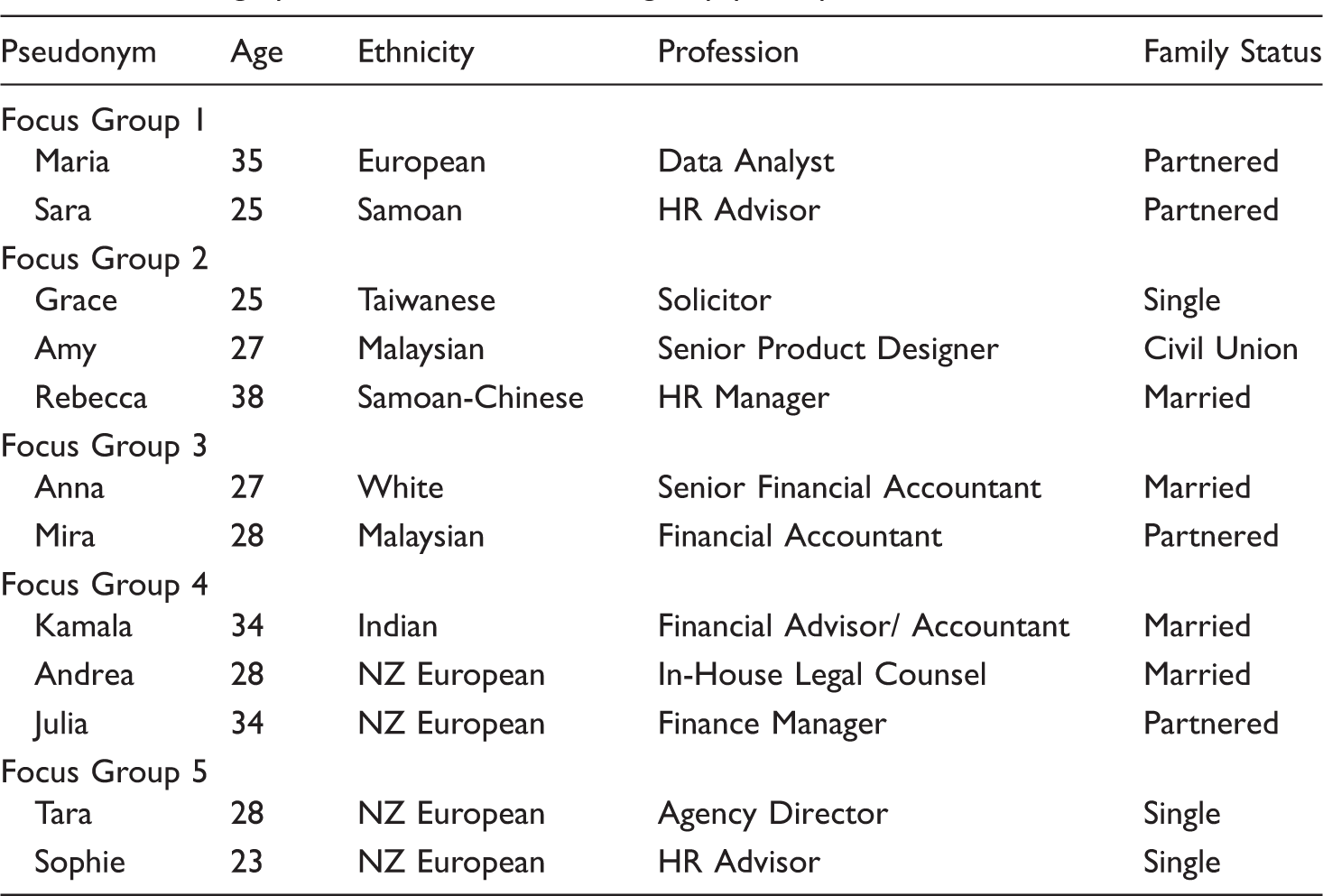
We hoped that placing participants in a peer group context would activate the social norms and practices which characterize their workplaces. Furthermore, the group format allows for the participants’ terms and views to take priority over those of the facilitator in shaping the course of the discussion (Kitzinger, 1994). Our aim was to explore emotional conflicts, for instance arising from the irreconcilability of the “women can have it all” discourse and experiences of sexism, and to thereby bring to the fore potential links between available identities, such as the “top girl” position, and negative affective reactions, such as worry, anxiety and frustration.
Group discussions always began with asking participants to comment on the idea of a “widening gender gap” in reference to a recent (NZ) newspaper article which reported girls’ and young women’s increasing educational and career success. The groups were conducted by the first author and did not follow a set interview schedule to allow for as much detail and exploration as possible, but all covered the following topics: participants’ definition of success, a question around whether “women can have it all” and the relevance of feminism for young women today, workplace difficulties and experiences of discrimination, and their thoughts on why young professional women might get depressed. One of the topics that emerged unprompted was (planning) motherhood and its potential career impacts. Discussions lasted between one and two hours and were audio-taped (with permission) and transcribed.
As a first step after completion of data collection, the first author listened to the recordings while reading the transcripts, removed identifying information and assigned pseudonyms. Initially the transcripts were coded thematically to gain familiarity with broad patterns and trends in the data; examples of early codes are “(career) success requires acting white and male”, “women and men are (naturally) different”, “women bring women down”, “women have to constantly prove their worth”. We noticed that the discussions contained numerous emotionally charged stories and short anecdotes about workplace difficulties, often describing their own or a female co-worker’s behaviour or emotional response. What these stories seemed to “do” was to formulate rules or lessons participants had learnt about “how to be a professional woman”. Narrating these experiences did, however, generate considerable negative affect in participants. This was reflected in the words participants chose but also in their tone, which could be described as exasperation or frustration. Additionally, topics and issues which generated a lot of (heated) discussion were considered affectively loaded. According to Wetherell (2013, p. 360), affect and discourse cannot be neatly separated – “entangling has always/already occurred as participants’ current actions usually orient to past familiar practice”. From this perspective, emotional struggles take the form of particular affective-discursive practices, as part of situated and therefore relational activities, shaped by the social identities in play. It seemed to us that participants expressed these struggles through the “lessons” contained in their accounts. The next step in the analysis thus consisted of collating all the data extracts containing stories and anecdotes on workplace difficulties. This approach was guided by the assumption that an important motivation for storytelling is to impart life lessons to others (Merrill & Fivush, 2016). This meant exploring what kinds of experiences warranted account-giving activities rather than investigating the story process per se. Narrating activity helps people cope with ambiguity. At the same time, particularly when accompanied by the expression of strong negative affect, it can be seen as an indicator of friction, of ruptures in participants’ professional identities. The analysis is structured around the main themes distilled from participants’ accounts of workplace difficulties organized in the form of survival lessons and explores the affective dimension of these instances of identity negotiation.
Analysis
Lesson One: Act like a man but don’t be a bitch
I have never once felt disadvantaged for being a female. And then I started working at [accounting firm], which is a fairly heavily male dominated firm, so I am in HR but I support […] the corporate finance team. So it’s really Wall Street, lads, lads, lads. It’s really been since I started working there that the gender differences have really hit me. (Sophie, 23, HR advisor) [I]t’s easy for a law firm to interview me and be like okay well you qualify on paper but you fit because, you know […] I can basically talk about any sports code, but that’s just like part of my personality. (Grace, 25, solicitor) My last role I did, I was the recruiter for a bank […] and my portfolio that I had was done with the commercial bankers, so my stakeholders were 95% male. Banking is very relationship based so to build relationships and get recruitment done, I was going out for drinks with all the males, hanging out with them. And I got to a stage where I realized that the best way to get them on board and to influence them was to almost become like a male. But funnily enough, fortunately my hobbies are quite male […] if I hadn’t had that passion, would I have gotten to where I am now? (Rebecca, 38, HR manager) The girl that used to work there […] we’ll talk about her as being a bitch because she liked things done in a certain way, so that made her a bitch. So it’s a way of do I then just not be nice to people at work because my personality is generally quite bubbly and quite friendly. Can I not be like that and do I just have to be one way all the time because then when I turn around and say okay no, enough, we need to do it like this and I am more direct, people turn around oh you’ve had a bad day, oh are things not good at home, is Peter not doing the dishes. That is the sort of response you get. (Andrea, 28, in-house legal counsel)
Lesson Two: Women (at the top) bring other women down
[W]omen bring other women down and then some women get to the top by you know all sorts of ways and I think that is a really negative thing? We don’t have females at the top we wanna aspire to because either they’re just an awful person and they’re bringing other women down or they’re really lonely and have nothing but work and we don’t have those people that we want to aspire to be. (Sara, 25, HR advisor) She was very all over the show in terms of her like how she would present herself to her team. Some days it was “morning, how are you”, all happy and then the next day it would just be like never make eye contact with you or acknowledge you. So that was really hard actually in that it literally had an effect on me every day because I never knew what she was going to be like, and whether you had to prepare to be shot down or whether it was like happy days and fine. I think they call it the Smurfette effect. So in Smurfs there is only that blond Smurf. In so many cartoons as you are growing up there is only that one hot chick or that one beautiful character that is a female among everyone else. So already sort of like starts injecting the sense of right, I need, if I am going to be that person, what do I have to do. I have to weed out my competition. I have to be faster, stronger. I have to fight harder. And so everyone else who are supposed to be on your side suddenly you are fighting against.
At the core of the Queen Bee narrative lies the assumption that success and femininity do not go together well, which acts as a strong deterrent for women when it comes to articulating their career ambitions, especially in a female peer-group context. None of the focus group participants defined success in terms of “going to the top”; instead ideas like “being able to do what I enjoy” (Amy), “contribut[ing] in some way” (Mira) and “being happy in your life” (Kamala) dominated. The two definitions differing from this type of discourse that were offered – “to be financially independent” (Andrea) and “earning a certain amount and having a certain job title” (Anna) – needed to be hedged with self-descriptions of being superficial. The fact that even in such a small sample there was very little variation in interviewees’ descriptions of success illustrates how powerful age-old notions of femininity, like modesty and other-centredness, still are. The anecdotes participants recounted about women who bring other women down can be viewed as cautionary tales that conjure up an anti-ideal of femininity, the cold-hearted woman at the top. Yet, the environments these young women operate in on a daily basis are built on the principles of competitiveness and entrepreneurialism. I found that with the male team that I was on there is always proving against each other, well you have to prove yourself, and I hate that type of you know you’ve got to constant... that really made me hate my life, hate myself, hate everything. I needed to be in bed all day on Saturday because I feel so sad. (Kamala, 34, financial advisor)
Lesson Three: Motherhood (still) is a career barrier
In this part of the analysis, we ask how the pressures and difficulties that young women face in balancing career and motherhood (Cahusac & Kanji, 2014; McIntosh, McQuaid, Munro, & Dabir-Alai, 2012) were dealt with by our sample. Of the twelve women interviewed for this study, only one was a mother. Nevertheless, motherhood became a dominant topic in the focus group discussions. I was scared when I went for this [job] interview because I thought to myself, and I know I am qualified, I know I have really good experience. I am confident in what I do in my ability. But I remember thinking “oh maybe because they look at my age, they see the ring on my finger, they think oh well that’s what’s next for her. Perhaps we shouldn’t take her in this role.” […] But they tell me “you were the best candidate”. So then I felt better. But then I think I don’t know if three females applied. But it does leave a little you know like a confidence thing on you. (Kamala, 34, financial advisor)
A more direct experience of discrimination that featured in participant’s talk was the scrutiny of women’s (potentially pregnant) bodies. So the only senior management person at our work that is female, she is the HR manager, she was leading a conversation at the lunch room because apparently somebody said that somebody is pregnant. And she was leading the gossip and going around quizzing people. “Oh, are you pregnant?” And like it’s completely normal. And everyone was like “this is terrible”. […] It’s like “that was really personal”. That is not something that you go around pointing at like, “you are an HR person, you should be leading by example”. You are not going to start going “are you pregnant?”. Or you walk down the hall and one of the older ladies will say to me “oh you’re next, you’re going to have the next baby”. And I am just like “no, don’t talk to me about that because it’s none of your business”. (Andrea, 28, in-house legal counsel) [I]n our auditing department we actually had quite a lot of managers […] that were women but they were all at that age and then they started having kids […] Audit is really, really hectic. They do midnight hours. It’s definitely very strenuous. And like a lot of them actually moved to kind of lower positions, even though they were on track to become partner, just so they could get a bit more of a work-life balance. It was kind of sad in that respect that the company couldn’t actually recognize they were losing talents […] because they wouldn’t be more flexible. (Anna, 27, financial accountant)
Lesson Four: Accept it – sexism is part of the game
I’m part of this mentoring group and we had this catch-up last week and one of the girls said something that absolutely shocked me […] She gets on really well with her boss who’s a male and she was at a client meeting and he was saying “oh you know this meeting is really, really important, so like maybe you could try to be a little bit flirty with the client” and she was just like “Excuse me? You want me to go in there and flirt with clients because I’m the junior young girl in the team?” And she was absolutely mortified and so she just she shrugged it off and she went into the meeting […] I mean it’s almost no surprise coming from a law firm that sort of thing happens but she said she doesn’t think her boss meant it in that way. She thinks he just used the wrong word but she said “I just had to talk to him about it because it made me feel so awkward” and just it was really demeaning for her that that’s why she was there to wear the short dresses and the high heels […] (Sara, 25, HR advisor)
The next story is not only about the emotional labour that women perform at work but also about the increased amount of actual work associated with sexist practices: We have issues that come up all the time at work which we will raise to the general counsel, he makes the decisions […]. He’ll leave us to go back and speak to whoever in the company we need to speak to, saying “unfortunately we can’t do this because of this, this and this”. Then they will often go above our head to their manager who will then talk to my boss who will then say no. […] And I think it’s partly being legal, people see us as a hindrance rather than just trying to do stuff properly. […] But I think there is also that, those girls, because we get referred to as the girls, “those girls don’t know what they are talking about. I’ll just go up to the manager who is a male and their boss and he’ll do it.” […] They cherry-pick. So they will ask one person. If they don’t like the answer they go to the next person. We talk in the team so we are like “oh he asked me about that and we had a 40 minute discussion yesterday about this and now you’ve gone and asked this person the exact same question”. But there is that worry that if there was a male there, we would have that as well, the men going to talk to the men just because they don’t like the response, the perceived response from the women. (Andrea, 28, in-house legal counsel)
Discussion and conclusion
In our analysis, we explored four gender-related “survival lessons” that young professional women learn in order to navigate gendered workplaces, namely that they are expected to find the right balance between feminine and masculine qualities, that they cannot count on same-sex solidarity, that motherhood (still) is a career barrier (if it is not “managed” adequately), and that they should tacitly accept that sexism is an inextricable part of being a professional woman. The irreconcilability of the assumption of equality inherent in both neoliberal and postfeminist discourse with the persistence of gendered and gendering practices within work organizations leads to potentially severe and disabling identity conflicts for young professional women. The richness of participants’ accounts suggests that coming to terms with these demands is an ongoing affect-laden process of re-writing and re-positioning themselves, a seemingly never-ending work of identity as the space set out for professional women is almost impossible to inhabit. Yet, coming to terms with and living with a hostile organizational reality is exactly what a “top girl” is expected to do.
Within a conventional organizational psychology framework, this affective-discursive struggle would likely be read as a manifestation of work stress; commonly, the onus for change would be placed on the individual woman (Newton & Fineman, 1995). Frequently invoked organizational ideals of individual resilience and stress-fitness brand negative emotional reactions to workplace conditions as dysfunctional and individual deficits. At first glance, it therefore seems to be encouraging that participants were very vocal about experiences of gender discrimination and sexism in the focus group discussions. However, their shock and frustration intertwined with what Gill, Kelan, and Scharff have termed ‘c’est la vie accounting’ (2017, p. 227), a kind of resigned acceptance of the status quo which imbued their talk with a sense of inevitability despite the frequently expressed conviction or at least hope that things are getting better. This kind of affect hinges on both postfeminist and neoliberal discourse with their focus on individual empowerment and self-management.
For Couldry (2010), a distinct feature of neoliberalism is an acceptance of economic and social reality as a “matter of necessity” (p. 14) – the market demands it and so it has to be. Neoliberalism “works” as long as it makes good on the promise of providing opportunities and rewarding effort with (financial or career) success because its individualist logic can be incredibly seductive and even empowering, particularly for girls and young women who identify with the “top girl” ideal. It is only when this equation does not add up anymore, when “apparently emancipatory discourses (and invocations of female voice) are combined with deeply retrogressive models of what counts as success for a woman” (Couldry, 2010, p. 120) that the cracks begin to show. The survival strategies on offer for young professional women are either to assimilate and therefore to self-silence or to leave their organization in the hope that they might find a less adverse environment elsewhere.
While our analytic focus lay on gender, in particular, the emergent “top girl” ideal, future studies with an explicitly intersectional approach that take into account race, class and sexuality are needed to better understand the connection between marginalized social identities in the workplace and emotional distress. The fact that half of our study participants had a “double minority status” potentially shaped their accounts in particular ways, i.e. by heightening their awareness of being “othered” or by making the “top girl” identity especially attractive as a survival strategy. However, as these self-positionings (i.e. being a Samoan or Asian woman) did not feature prominently in participants’ talk, we did not have adequate data for applying an intersectional lens in the analysis.
Our analysis has highlighted young women’s emotional struggles associated with building inherently fraught and contradictory professional identities within gendered organizations. Identification with the “top girl” ideal not only fails to equip young women with the right meaning-making “tools” for navigating sexist or “toxic” environments; it also encourages them to accept this status quo as if it were a fact of nature. In particular, we have attempted to show that the irreconcilability of contemporary female subjectivities, which construct young women as capable, in charge and efficient self-managers, and sexist work environments is a potentially heavy emotional burden young high-achieving women are expected to carry.
Footnotes
Declaration of conflicting interests
The author(s) declared no potential conflicts of interest with respect to the research, authorship, and/or publication of this article.
Funding
The author(s) received no financial support for the research, authorship, and/or publication of this article.