



Abstract
This article serves as a welcoming introduction to feminist epistemologies and methodologies, written to accompany (and intended to be read prior to) the Virtual Special Issue on ‘Doing Critical Feminist Research’. In recalling our own respective journeys into the exciting field of feminist research, we invite new readers in appreciating the steep learning curve out of conventional science. This article begins by sketching out the emergence of feminist scholarship – focusing particularly on the discipline of psychology – to show readers how and why feminist scholars sought to depart from conventional science. In doing so, we explain the emergence of three main ways of doing and thinking about research (i.e. epistemologies): feminist empiricism, standpoint theory, and the various ‘turn to language’ movements (social constructionism, constructivism, postmodernism, poststructuralism). We then connect the dots between feminist epistemologies, methodologies and methods. We close by offering suggestions to guide the readers in using the Virtual Special Issue on their respective research journeys.
Keywords
Feminist scholars, including feminist psychologists, have long debated the commitments and methods involved in conducting research and generating knowledge (Chen & Cheung, 2011; Cook & Fonow, 1986; DeVault, 1996; Fine & Gordon, 1989; Grabe, 2018; Haraway, 1988; Harding, 1987; Macleod, 2006; Magnusson & Marecek, 2017; Ussher, 1999; Wilkinson, 1997). These conversations can appear daunting or impenetrable to a reader just beginning to explore these debates. Equally so, the decades of writing on feminist research can be difficult to navigate when designing a feminist study. In this article, we speak to those in a position of learning (e.g. students, or researchers new to feminist research) or teaching (e.g. academics developing courses in methods, feminist psychology, or critical psychology).
We begin this article with a brief sketch of the emergence of feminist scholarship, particularly in psychology, and explain what was happening in the (social) sciences that compelled feminist scholars to either re-evaluate or depart from conventional science. We then turn attention to three main feminist epistemologies, or ways of thinking about knowledge and research, that have been taken up both within and beyond psychology: feminist empiricism, standpoint theory, and the various ‘turn to language’ movements (social constructionism, constructivism, postmodernism, poststructuralism). A goal of this article is to serve as an accompanying (and brief) introductory text to our Virtual Special Issue, ‘Doing Critical Feminist Research’ (see Lafrance & Wigginton, 2019). In doing so, this article explicates the broad and diverse terrain of feminist scholarship, while touching lightly on some disciplinary debates.
Feminist challenges to man-made science
Although purporting to be ‘objective’ and value-neutral, science has often functioned in the disservice of marginalized groups, and feminists have been among the most vociferous critics (e.g. Stacey & Thorne, 1985). For instance, pioneering feminist psychologist Naomi Weisstein was one of the first to document the systemic biases and stereotypes about women that dominated the discipline of psychology, ultimately classifying women as: inconsistent, emotionally unstable, lacking in a strong conscience or superego, weaker, ‘nurturant’ rather than productive, ‘intuitive’ rather than intelligent, and, if they are at all ‘normal’, suited to the home and the family. (1993 [1968], p. 207) While girls are moving from high school or college to motherhood, sizeable proportions of them are remaining at Stage 3, while their male age mates are dropping Stage 3 in favor of the stages above it. Stage 3 morality is a functional morality for housewives and mothers; it is not for businessmen and professionals. (Kohlberg & Kramer, 1969, p. 108)
Psychology has certainly not been the only discipline responsible for promulgating particular ‘truths’ about women. Feminist sociologists and anthropologists have also voiced critiques of their disciplines’ androcentric knowledge. In particular, these scholars began to question the homogeneous circle of white men located in Global North countries responsible for producing so-called ‘objective’ knowledge (Smith, 1987), who huddled together like footballers “facing one another between plays and speaking in codes that only team players could understand”, and playing a game that only they could win (Collins, 1992, p. 73). In response, feminist sociologist Dorothy Smith challenged the overwhelmingly white, male membership of this inner circle who were doing research ‘on’ women without considering its consequences or relevance ‘for’ women. She argued that: Women have been largely excluded from the work of producing the forms of thought and the images and symbols in which thought is expressed and ordered. We can imagine women’s exclusion organized by the formation of a circle among men who attend to and treat as significant only what men say. The circle of men whose writing and talk was significant to each other extends backwards in time as far as our records reach. What men were doing was relevant to men, was written by men about men for men. (Smith, 1987, p. 18) sociology claims to speak of the same lived world I inhabited with my children and yet somehow I could not find the world I knew at home with my children in the texts of sociological discourse. The sociologies and psychologies I had learned were not capable of speaking of what I knew as a matter of my life. (p. 157)
Feminist scholars across disciplines have shared a joint commitment to the task of re-writing knowledge in explicitly non-androcentric and decolonizing ways. Together, they have worked to understand how ‘conventional’ approaches to knowledge production, colloquially termed “good science”, might “promote or obstruct” the (re)making of democratic societies and gendered relations (Harding & Norberg, 2005, p. 2009). Part of this inquiry has involved a thorough consideration of the way in which science can be viewed as an institution, in much the same way that healthcare and education are institutions (Harding & Norberg, 2005). As an institution, science is complicit in governing, classifying and controlling populations by producing particular ‘truths’ about certain people/groups (Harding & Norberg, 2005) – truths that are far from being neutral, but are complicit with colonial, capitalist and patriarchal structures, and which ultimately reinforce an unjust status quo (Anderson, 2011; Fine & Gordon, 1989; hooks, 1990). In response, feminist scholars have made evident the ways in which biases inevitably arise throughout the research process (including which research questions are (not) asked, funded, published, and circulated), to demonstrate the value-laden influence of science, which has historically resulted in the privileging of some knowledges over others (Fine & Gordon, 1989; Harding & Norberg, 2005).
Overview of three main feminist epistemologies and their scope.
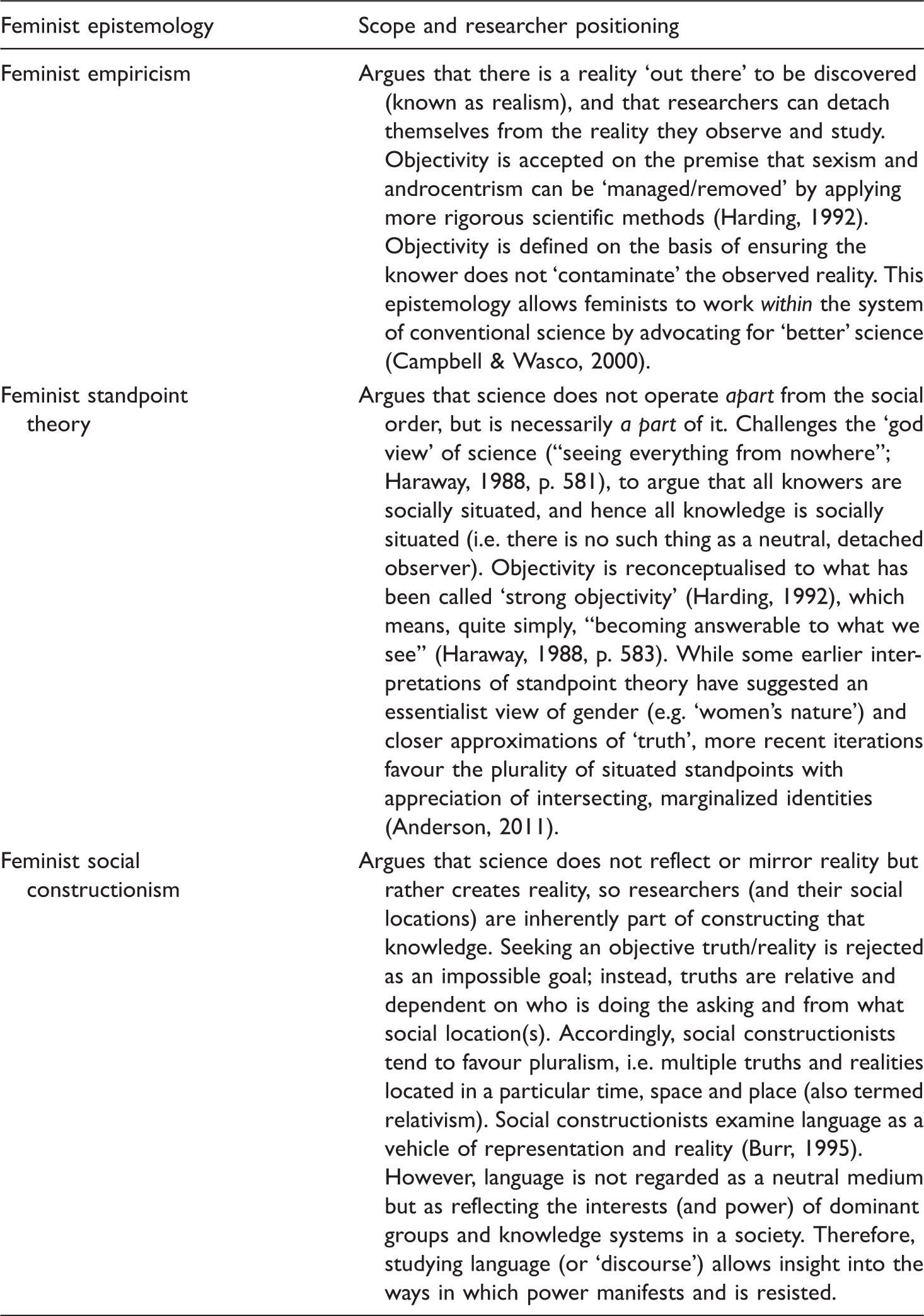
Collectively, feminist epistemologies have taken issue with the question of who can know – or, who is the knower (Anderson, 2011; Haraway, 1988). While each epistemology suggests its own approach to inquiry, there is a shared interest across approaches in interrogating how gender (and a multitude of social locations) situates ‘knowing’. This concern orients to a key critique of man-made science, or what Haraway (1988) describes as ‘the god trick’: being everywhere but nowhere all at once. Or put another way, mainstream science assumes a detached knower who is neutral in their question formulation, objective (and somehow removed) in their pursuit of studying and knowing reality, and value-free (and ‘position-less’: Smith, 1991) in their writing and representation of that reality.
Feminist empiricists conduct what most people understand as ‘science’. They assume that there is an objective reality or truth that is waiting to be discovered (Campbell & Wasco, 2000). With this in mind, empiricists apply conventional scientific methods and assumptions of rigour to observe and study reality. This involves modifying research practices or processes to remove any source of bias and ultimately to produce ‘better’ and more objective science (Harding, 1992). Indeed, it was feminist empiricists who worked to ‘correct’ the androcentric biases of science by including women in research samples and by asking questions that offered important insight into women’s experiences such as rape, mothering, and work-family conflict (Campbell & Wasco, 2000; Hesse-Biber, 2012). Harding (1992) explained the value of this epistemology for feminists in the social sciences … who were trying to explain what was and wasn’t different about their research process in comparison with standard procedures in their field. They thought that they were just doing more carefully and rigorously what any good scientist should do: the problem they saw was one of ‘bad science’. (p. 439) sexism and androcentrism could be eliminated from the results of research if scientists would just follow more rigorously and carefully the existing methods and norms of research – which, for practising scientists, are fundamentally empiricist ones. (p. 439)
Feminist standpoint theorists have pointed out how traditional approaches to science fail to acknowledge the influence of the context and perspectives of the ‘knower’ who is responsible for generating the questions, conducting the research, and interpreting the data to ultimately decide what counts as knowledge (Naples, 2007). Therefore, they rejected the claim that the researcher’s perspective can (ever) be stripped free from the research process by following technical scientific procedures (Harding, 1992; Hesse-Biber, 2012; Riger, 1992), and they fundamentally disrupted empiricists’ notions of ‘objective’, ‘value-free’ science (Haraway, 1988; Harding, 1992). Further, they argued that women’s experiences have not been adequately represented by mainstream research because they have been framed within, and interpreted by, dominant (i.e. men’s) conceptual categories. That is, women’s experiences have been understood in concepts and language largely developed by educated white men.
To reflect this predicament, Smith (1987) stated that women “have a ‘bifurcated consciousness’ – daily life grounded in female experience but only male conceptual categories with which to interpret that experience” (Riger, 1992, p. 733). Rather than starting from the a priori categories and assumptions of empiricist science, then, standpoint theorists begin inquiry with the experiences of individuals who are not members of dominant groups with the goal of opening up different ways of understanding by foregrounding ‘marginalised voices’. Harding (1996) explains: The point here is not that every poor or otherwise marginalised person already can or does ‘see the truth’, but rather that discourses oppositional to the dominant ones can arise as marginalised groups begin to articulate their histories, needs, and desires ‘for themselves’ instead of only in the ways encouraged by their ‘masters’ favoured conceptual frameworks. (pp. 445–6)
Although standpoint research may be conducted from the margins, it is never, as Harding (1992) reminds us, value-free, and new ways of dealing with the values and interests inherent in the process of inquiry are needed. She argues that the existing “methods and norms in the disciplines [empiricism] are too weak to permit researchers to systematically identify and eliminate” the values, interests and agendas of the scientific community (Harding, 1992, p. 440, emphasis in original). Therefore, objectivity, as operationalized within empiricism, cannot detect sexist, androcentric, or racist assumptions. On that basis, objectivity has been fundamentally reconceptualized within feminist standpoint epistemology. ‘Strong objectivity’ requires locating and interrogating the researchers’ subjectivity, so that researchers do not speak as invisible ‘god-like’ authorities, but instead as historically-placed subjects, with their own desires and interests (Harding, 1987). ‘Strong objectivity’ means acknowledging the “limited location and situated knowledge” we produce, and being answerable for what we see and how we see a particular reality (Haraway, 1988, p. 583).
The power in standpoint epistemology, therefore, lies in the epistemic privilege or authority gained through particular socially situated perspectives. Scholars have argued that the perspectives of systematically oppressed groups are of most value, because of their access to deep(er) knowledges of society (Anderson, 2011). For example, this epistemology led African American feminist scholars, such as Collins (1990), to articulate black women’s experiences of racism and sexism. In particular, standpoint theory enabled an understanding of how black women resist racist and sexist imagery of black women, empowering them to critique these representations and embrace their identities with pride (Collins, 1990).
Social constructionist, constructivist, postmodern, and poststructural feminists contributed to the critiques of feminist standpoint epistemology offered by African American feminists by emphasizing the ways in which our experiences of ourselves and the world are always grounded in context, and therefore forever shifting and multiple (Hare-Mustin & Marecek, 1994; Hollway, 1994; Riger, 1992). Therefore, they share with feminist standpoint scholars a rejection of empiricism and its notions of objectivity. Accordingly, they also share a fundamental distrust of ‘grand theories’ or law-like generalizations of human experience (e.g. any theory that presumes to represent a universal human experience, like morality).
Scholars working from these various frameworks (social constructionism, constructivism, postmodernism, and poststructuralism), henceforth referred to as social constructionists, 1 share a ‘turn to language’ to understand how knowledge and meaning are made. That is, they look to the ways in which language itself fundamentally shapes experience. Traditionally, language has been viewed as a passive vehicle that serves to express our internal thoughts, emotions and experiences (Burr, 1995). Instead, social constructionists articulate how the terms and concepts available within a particular social and political context reflect and reinforce prevailing systems of power (Marecek, 2003; Radtke, 2017). To acknowledge the performative role of language in the social construction of knowledge and experience, social constructionist scholars have taken up the term ‘discourse’. Discourse can be thought of as “a system of statements which construct an object” (Parker, 1992, p. 5). It refers to “a set of meanings, metaphors, representations, images, stories, statements and so on that in some way together produce particular versions of events” (Burr, 1995, p. 48). Therefore, the language or discourse available at a certain place and time “creates what we take to be reality” (Marecek, 2003, p. 62).
For social constructionists, then, the terms taken by empiricists to point to ‘entities within individuals’ (e.g. gender, intelligence, personality) are revealed as cultural artifacts (or social constructions) that empiricists, in studying and writing about them, then reify as ‘real’ and the way things are (this is called essentialism). In its most pernicious applications, such research has been mobilized to ‘demonstrate’ the inferiority/superiority of some genders and races over others – which all feminist scholars (regardless of their epistemology) condemn as reprehensible. For social constructionists, the problem with this work is not simply a matter of ‘bad science’, but of ignoring the social and political context in which people make meaning and of misattributing issues of power to the level of the individual. Thus, a social constructionist perspective on Kohlberg’s theory of moral development would view it as situated within a particular point in time and place (1950s and ’60s USA), reflecting the interests of white boys and young men and the available discourses about women within American culture at the time.
The anti-essentialist stance adopted by social constructionists turns research attention away from the ‘subject’ (i.e. looking inside the person at their ‘nature’) and toward language as the site of both meaning-making and power (Burr, 1995; Gavey, 1989; Weedon, 1987). For example, instead of regarding morality as an internal quality of the person, a social constructionist researcher would look to unpack the concept of morality itself and the ways in which it is constructed between people in localized instances of talk and text. Social constructionists might explore how ‘morality talk’ is mobilized in an exchange between people on the street, media representations of issues such as ‘teenage pregnancy’, in psychology textbooks, or in a presidential address. They might explore what discourses are drawn on to situate a speaker as ‘moral’ (e.g. ‘protecting’ national interests in relation to immigration policies). Whose version of morality is represented? How is it constructed and with what effects? Who ‘wins’ and ‘loses’ in the exchange? And importantly, how do those on the margins of society resist being positioned as less moral, less worthy?
How, then, to conduct research? The links between epistemology and methodology
How one engages in research (defined as methodology) necessarily flows from one’s epistemological commitments at the time of inquiry. Therefore, clarifying these commitments (about what and how we know, and who can know) is a first essential step in research. Those committed to feminist empiricism will remain guided by the standards of mainstream science in which objectivity and neutrality remain central. However, those who situate their investigations within standpoint or social constructionist perspectives will require radically new directions.
Abandoning the dictates of empiricism can be a disorienting experience. For example, drawing on the children’s book Alice in Wonderland by Lewis Carroll (1865), 2 Riger (1992) suggested that a traditional scientist trained in empiricism who is learning about postmodernism for the first time is comparable to Alice falling into a Wonderland of perplexing language and customs. What was once familiar and stable (e.g. traditional notions of ‘psychological variables’, such as gender, morality, or intelligence) is revealed as unsettled, problematic, multiple, and imbued with power relations. In other words, the world Alice (our former empiricist) once knew no longer ‘exists’ in concrete and fixed ways as it once did. It is our aim to guide researchers who, like Alice, are unfamiliar with the new terrain they are in – through both this article and the accompanying Virtual Special Issue (Lafrance & Wigginton, 2019).
Following the clarification of one’s epistemological position comes the consideration of research questions and accompanying methods. It is worth stating upfront that there is no ‘superior’ method, nor is there a method that is in and of itself feminist. Indeed, methods are merely tools or techniques for gathering data (Harding, 1987). However, even methods have assumptions built into them. Take, for example, the use of a survey measuring ‘femininity’. This method assumes an internal quality of individuals that can be measured independent of context. It also assumes that with its presumably sound psychometric properties, the construct of femininity is stable across time, cultures and populations. These assumptions are likely to sit comfortably for an empiricist who seeks to ‘uncover’ an observable truth/reality, yet are inappropriate for social constructionists and standpoint theorists who reject such assertions, and instead tend to be interested in language as a means of/for representation, and therefore often use qualitative methods (e.g. interviews or focus groups).
Perhaps, then, a more useful instruction is that certain methods better fit particular epistemologies in terms of their assumptions and possibilities for answering research questions (Marecek, 2003; Parker, 2007). For example, social constructionists and standpoint theorists might be interested in the experiences or meanings of femininity, and while their focus (i.e. research questions and associated methods of analysis) would likely vary, both would assume that these are socio-culturally and historically located.
Accordingly, with no distinctive feminist method (Harding, 1987), one cannot claim that qualitative methods (e.g. semi-structured interviews) are inherently ‘feminist’, or that quantitative methods (e.g. survey measures) are ‘unfeminist’. All methods can be used in sexist ways; and, conversely, all can be used toward feminist ends (Peplau & Conrad, 1989). In fact, a preoccupation with methods has often distracted from “the most interesting aspects” of feminist research, which is the research process (Harding, 1987, p. 1) – from design to dissemination. The issue at hand, then, is not one of ‘methods’ but of the larger consideration of methodology. Methodology refers to a “theory or analysis of how the research does or should proceed” (Harding, 1987, p. 3), which is where the distinctiveness (and, in our view, most exciting features) of feminist research lies. This requires a deep consideration of how we engage in the process of asking questions, developing ‘answers’, and representing and mobilizing the resulting knowledge.
Key methodological considerations for critical feminist research.

There is no single way to engage with this Virtual Special Issue. However, we would like to briefly offer some suggestions to those new to the field and looking for direction. One practical place to start would be to begin with a research journal in which to record one’s thoughts, inspirations, reactions, and observations throughout the research process – from the first intimations of a topic of inquiry, to the final process of dissemination. This journal may be used as a means of clarifying one’s epistemological commitments, which will then guide methodology and methods. Further, self-reflection, peer supervision, consultation with experienced researchers (e.g. supervisors), and further explorations of the literature all form part of ongoing reflexive practice. After having read the Virtual Special Issue, Table 2 – while not exhaustive – may at least serve as a useful anchor point for reflection throughout the research process. Fine (2016) reminds us of the importance of deeper reflection and engagement in our research processes, and in particular the “existential” question of “to whom are we accountable?” (p. 362). It is our intention that the methodological questions evoked in the Virtual Special Issue and summarized in Table 2 serve to ignite the imaginations of scholars and ultimately support transformative feminist research.
Conclusion
In recognizing the potential teaching value of a welcoming introductory article to critical feminist research, we envisioned this supplementary article as a starting point for those new to feminist research (to be read prior to reading the Editorial Introduction to the Virtual Special Issue). The purpose of this article was to sketch the emergence of feminist scholarship (particularly within psychology), and outline the challenges it sought to address of man-made science. Following this, we sought to connect the dots between epistemologies, methodologies and methods, as this relates to feminist scholarship, and offer guidance on how to use the Virtual Special Issue.
One goal of the Virtual Special Issue, more broadly, is to introduce critical feminist methodologies to the next generation of scholars by harnessing a sample of inspiring publications from Feminism & Psychology. In recalling our own respective journeys into this eclectic and exciting field, we invite new readers to appreciate the steep learning curve out of empiricism and into social constructionist and standpoint epistemologies. Those new to the field may be, like Alice, falling into – and then deconstructing – a Wonderland of perplexing language and customs. We hope that this article may guide and support new readers through the dense and complex conversations beyond the constraints of empiricism.
Supplemental Material
Supplemental material for Learning critical feminist research: A brief introduction to feminist epistemologies and methodologies
Supplemental Material for Learning critical feminist research: A brief introduction to feminist epistemologies and methodologies by Britta Wigginton Michelle N Lafrance in Feminism & Psychology
Footnotes
Declaration of conflicting interests
The author(s) declared no potential conflicts of interest with respect to the research, authorship, and/or publication of this article.
Funding
The author(s) received no financial support for the research, authorship, and/or publication of this article.
Notes
Author Biographies
References
Supplementary Material
Please find the following supplemental material available below.
For Open Access articles published under a Creative Commons License, all supplemental material carries the same license as the article it is associated with.
For non-Open Access articles published, all supplemental material carries a non-exclusive license, and permission requests for re-use of supplemental material or any part of supplemental material shall be sent directly to the copyright owner as specified in the copyright notice associated with the article.
