



Abstract
Though certainly not women's only site of identity or set of responsibilities in conflict settings, motherhood represents a distinct challenge within political violence. Yet, given the paucity of research on the topic, we still are operating without a clear understanding of how political violence jeopardizes maternal well-being and care-taking practices. Drawing on feminist perspectives on mothering, in the analyses presented here, the authors use content analysis to explore mothering and political violence from five focus groups with women in Palestine. Results demonstrate the considerable suffering mothers and children endure in war; the work mothers do to promote children’s well-being in this context; and how these efforts exhaust the psychological resources of mothers. Findings enhance a relatively small body of knowledge about the lived experiences of mothers within conflict settings, and point to the importance of tending to the strategies and needs of mothers who navigate political violence with and for their children.
Women provide the majority of care for the 3.5 million children around the world who live in settings of political violence, and they typically do so with severely compromised social and logistical support (Al Gasseer, Dresden, Keeney, & Warren, 2004; UNRISD, 2005). Yet, as important as mothering is within political violence, there is little on-the-ground exploration of this responsibility. We therefore are operating without clear understandings of how war and conflict jeopardize care-taking practices; how threats to the maternal role in political violence influence mothers’ mental health; or how mothers persist in these contexts.
The small body of literature that does exist brings to light the helplessness and despair mothers face as they are rendered unable to adequately protect or provide for their children (Takševa & Sgoutas, 2015). Studies of women in Afghanistan, Bosnia, Palestine, and Central and South America illustrate the amplified pressure mothers endure within political violence to provide for and protect children, and the guilt and grief mothers experience when they are not able to do so (Punamäki, 1987; Robertson & Duckett, 2007; Roth & Duaibis, 2015; Shalhoub-Kevorkian, 2003). A few studies also reveal how mothers confronting ongoing violence and oppression mobilize incredible warmth, strength, and resourcefulness to promote their children’s physical and emotional survival (Ajduković, 1996; Pavlish, 2005) – a process that has been termed parental resilience (Gavidia-Payne, 2015).
As this small but growing body of literature demonstrates, conceptualizing the complex experience and psychological toll of motherhood in settings of constant danger requires attending to mothers’ own articulations of struggle and resilience in their quotidian practices – what Scheper-Hughes (1993, p. 341) terms “the pragmatics” of mothering. Exploring the ongoing work and psychological ramifications of mothering within political violence demands we take seriously the experiences, identities, and subjecthood of mothers (Ross, 1995; Takševa & Sgoutas, 2015). Addressing the need to add to the small body of scholarship that explores motherhood within conflict settings, in the analyses presented here we used qualitative data from a series of focus groups with women in Palestine that we analyzed and explored within a critical feminist theoretical framework.
Geo-political context of mothering in Palestine
The ongoing political violence in the Palestinian context must be understood through a larger settler-colonial framework, characterized by Israel imposing systems of dispossession and control (Salamanca, Qato, Rabie, & Samour, 2012). This is done by the spatial constraint of Palestinian people and places via land takeovers, home invasions, and a series of Israeli-only roads and checkpoints that take up upwards of 40% of Palestinian land in the West Bank (Hammami, 2015; UN-OCHA, 2007; Weizman, 2007); arbitrary and politically motivated arrests, detainments, and imprisonment (Giacaman & Johnson, 2013; McNeely et al., 2015); ongoing economic, educational, and social de-development (Barber et al., 2014; Roy, 2016); and humiliation and control (Giacaman, 2018; Sousa, Kemp, & El-Zuhairi, 2019).
Research on women’s psychological experience in Palestine suggests that for women in this context, motherhood appears to be central to (though certainly not the only factor within) relationships among political violence, trauma, and resilience (Giacaman & Johnson, 2013; Peteet, 1997; Shalhoub-Kevorkian, 2006; Veronese, Cavazzoni, Russo, & Sousa, 2019). Qualitative studies have found that mothering in Palestine generates ongoing guilt, fear, and hopelessness due to the impossibility of protecting children from the trauma and humiliation of political violence – while also providing an amplified sense of purpose and meaning for women (Akesson, 2015; Punamäki, 1987; Roth & Duaibis, 2015; Shalhoub-Kevorkian, 2003). As this body of literature illustrates, to account for the multiple nuanced points regarding the experience of motherhood in conflict settings, we must move beyond simply asserting the importance of maternal care to more deeply explore the logistical constraints placed on maternal power within these settings, and the emotional ramifications of this process. This requires the use of critical feminist theories about motherhood, which we review below.
Theoretical overview
Explorations of the psychological experience of mothering typically rest on theories about the significance of the maternal-child bond for healthy child development, many developed by psychologists who spent their formative years treating traumatized children in the wake of the Second World War, including Freud and Burlingham (1943), Winnicott (1992), and Bowlby (1969). Yet, these theories do little to help us broaden our understanding of the practical and emotional experiences of mothers, particularly within adversities like war. To more deeply elucidate the actualities of women’s lived experience of this role, we must move beyond generalized claims about motherhood through centering feminist theoretical frameworks.
Pointing to the intensive work mothering requires, in the early 1990s, Ruddick (1995) proposed that the protection, nurturance, and training of children requires consistent emotional and mental attention and complex, unremitting practices and sets of thinking by mothers. At this same time, Collins (1994) deepened theories about mothering by proposing that in African American communities, mothers must constantly attend to fostering individual and collective identity and physical survival in their children, which requires regular negotiations around power structures. Indeed, analyses of mothering cannot be decoupled from understanding the contexts of power surrounding motherhood, as the meanings and functions of motherhood depend on the social and political contexts of mothers, and reflect constraints related to power and inequality (Arendell, 2000; Rich, 1976; Roberts, 1993; Rodriguez, 2016).
This growing body of critical feminist scholarship about motherhood points to several important areas of examination regarding women’s well-being and identity as tied to motherhood within oppressive circumstances. First, we must consider the logistical and psychological challenges of promoting children’s individual and collective identity and assuring children of their place in the world, when their world seems to be fundamentally hostile and opposed not only to the survival of the individual child, but also to the collective survival of their entire community or people (Collins, 1994; Davis, 2016; Scheper-Hughes, 1993). Through our analysis, we sought to uncover these challenges. Associated with the task of exploring these challenges, in the research presented here, we also aimed to bring to light the particular ways women in our study articulated the grief and loss – and also the resilience, power, and agency– that characterizes mothering within violent circumstances (Rodriguez, 2016; Tully, 1995).
Uncovering the realities of motherhood within conflict settings is only possible through soliciting and analyzing women’s own narratives of their experiences, as scholars from within Palestine have argued (Giacaman & Johnson, 2013; Shalhoub-Kevorkian, 2003), and we have sought to do so here. As we prioritized an analysis of women’s subjecthood as mothers, we also strove for a mindful balance, wherein we neither reduced all of Palestinian women’s experiences and actions to the role of mother, nor participated in ignoring or silencing women’s identity as mothers as a crucial part of their lived reality and psychological experience within political violence (Al Labadi, 2003; Allen, 2009; Pasternak, 2010).
Methods
The analyses presented here are situated in a larger collaborative cross-cultural research project which sought to explore the health consequences of the conflict and ongoing occupation for Palestinian women. The organizational study partner was the Palestinian Medical Relief Society (PMRS), one of the oldest and largest Palestinian-based healthcare non-governmental organizations. Team members included the lead researcher and first author, an American woman with no training in Arabic language who spent over 10 months in the West Bank doing field work (CS) and a Palestinian woman from the West Bank who was a community psychology student who led the focus groups, did initial translations, and analyzed the data alongside the lead researcher (ME-Z). We worked with another Palestinian woman who helped arrange logistics, took notes during focus groups, and consulted on the process.
All procedures were approved by the University of Washington’s Human Subjects Division. Data collection began in the West Bank using an ethnographic approach over three trips (in 2007, 2008, and 2009). This amounted to several months of participant observation conducted within these trips, as the lead researcher lived, shopped, and visited in local villages; did ride-alongs throughout the West Bank with healthcare workers and mobile clinics; shadowed mental health program supervisors and staff in their groups, site visits, and meetings; attended weddings and holiday celebrations; and informally interviewed a range of PMRS staff members. The lead researcher kept field notes via text and photographs throughout this time, documenting the lived realities of the occupation of the West Bank.
Field notes reflected not only external observations but internal ones wherein the lead researcher (CS) engaged in critical reflexive analysis of her outsider positionality and ethical engagement in the politics and practices of research as solidarity. Her own reflection upon the participant observation, as well as team discussions regarding the process, was an ongoing opportunity for the researchers to interrogate their own varied positionalities. For the lead researcher, the process drew into sharp relief her role as a transient outsider, endowed with the power and privilege based on her race, citizenship, class, and professional status, to come and go, both physically and emotionally. These dynamics highlighted the settler-colonial realities of the study site and process, and associated research dilemmas related to the imbrication of Orientalism and Western feminism within the colonial project (Barakat, 2018; Mohanty, 1988; Said, 1978). Responding to the dilemmas herein, we aimed to foreground the voices and knowledge of the Palestinian research partners and participants. Critical field notes and conversations among research partners buttressed the collaborative nature of the partnership, as did our process of commitment to eliciting the historical and material realties and specificities of women’s subjective experiences. In line with this second task, on the second trip by the lead researcher, we conducted five focus groups in Arabic in 2008 with adult Palestinian women.
The choice of focus groups was consistent with the mandate to engage in what Palestinian scholar Shalhoub-Kevorkian (2003, 2009) terms the “ideology of the voice,” which uses practices of listening closely to the narratives of those most affected by political violence to gain a deeper understanding of the realities at hand. As such, the dialogic structure of focus groups is consistent with emancipatory and feminist traditions (Kamberelis & Dimitriadis, 2005; Madríz, 1998).
According to the agreement between the lead researcher and PMRS, the selection criteria for the focus groups were broad. All adult Palestinian women were eligible to participate. We sought a diversity of ages, representation of women from rural and urban sectors, and a range of educational levels. PMRS staff recruited focus group participants from their clinics, including general health and eye-care clinics and children’s programs. PMRS staff approached potential participants with a prepared script explaining the study and its potential benefits and risks. Women were informed that the study was strictly voluntary and their access to services would not be affected by their decision to take part. Procedures for the focus groups also included an oral consent process following a script.
The five observations included the following number of participants in each group: Al Khalil (Hebron) (5), Nablus (7), Jerusalem (4), Qalqiliya (10), Tulkarem (6). Our focus groups, which lasted about an hour, were co-facilitated by two Palestinian women. We asked women three broad questions: What are the experiences within political violence that they, their families and their communities face? How do these experiences affect the well-being of individuals, families and communities? How do individuals, families and communities mobilize resilience in efforts to endure political violence?
Women in the groups represented a large range of demographics. All women were older than 18 and the age range went up to 80. Women came from both rural and urban sectors in five distinct sectors of the West Bank. Other than this information from our pre-established selection criteria and sampling plan, we did not collect detailed individual demographics on the women -- in large part because of concerns related to the delicate nature of collecting data in this setting and our concerns for women’s ease and confidence in the anonymity of the data, as women expressed fear about being identified. For example, in one focus group, once we explained that we were recording, all of the women got up and left the group and we had to re-recruit for that site.
Data were translated into English using a process in which the lead researcher compared two versions and deliberated with the Palestinian research team to establish a final translation – a technique that helped ensure fidelity of meaning across linguistic and cultural positionalities (Esposito, 2001; Temple, 2002). Since the focus group data were collected in 2008, through our collaborative research process we consulted not only about the translation of our data but also about the durability of our data over time. The year 2018 marked 50 years of Israeli occupation of the West Bank; by all accounts, the health and humanitarian crises caused by the Israeli policies and actions against Palestine have only worsened (Amnesty International, 2018; United Nations, 2018). Our Palestinian research partners and on-the-ground experts remain in the West Bank, including the co-author on this paper, who has worked as an accompaniment worker for over ten years. Their experiences corroborate the assessment that, unfortunately, the realities of the occupation have not changed in the past decade.
In the tradition of conventional and directed content analysis, we both applied and sought to further existing theories through our analysis (Hsieh & Shannon, 2005). In this sense, our approach to data collection and analysis reflected a balance of inductive and deductive approaches. During initial data collection, we consulted after each focus group to ascertain major themes and decide how to proceed. After all data collection was complete, the two researchers who were part of the original research team coded line by line, using coding that emerged from the data. Because of our commitments to investigating the daily experiences and emotional ramifications of living within political violence, they used in vivo coding and coding for processes, emotions, and consequences (Corbin & Strauss, 1990; Saldaña, 2016). These researchers used coding matrices to detail codes, their definition, and examples, and to sort smaller codes into broader categories. The lead researcher then constructed network displays to align the codes, organize and further analyze results (Attride-Stirling, 2001).
Our initial broad network display illustrated poignant themes that required more specific levels of analysis. One such theme was that of motherhood, with sub-codes that connected psychological reactions to the experience of mothering within this context. The strength and emergent nature of the theme of motherhood pointed to the salience of this role for participants, and the imperative for us to examine this theme in its own right. The research team, comprised of the two initial researchers and one new researcher, then embarked on a new process of developing, applying, and refining codes based on critical feminist theories of motherhood. As the coding process went on to its later stages, we relied on both our data and the critical feminist theories in which we immersed ourselves to develop our codes and themes and the various relationships among these, and used network displays to link our data to our theoretical concepts. In our final theoretical stage of coding, we constructed new network displays to sharpen our coding scheme, organize results, and align our analysis with the theories upon which we drew.
This final process of coding and analysis resulted in a conceptual model (Figure 1), based on a set of theoretically based codes. We used the analysis features of our analysis program, Dedoose, to generate statistics about the co-occurrence of themes and codes within the data (Dedoose, 2018). Coupling this analysis with our immersion in the quotes themselves assisted us in the discovering relationships between and the circular nature of subversion of maternal power and its reassertion, as well as how emotional suffering arises from this process.
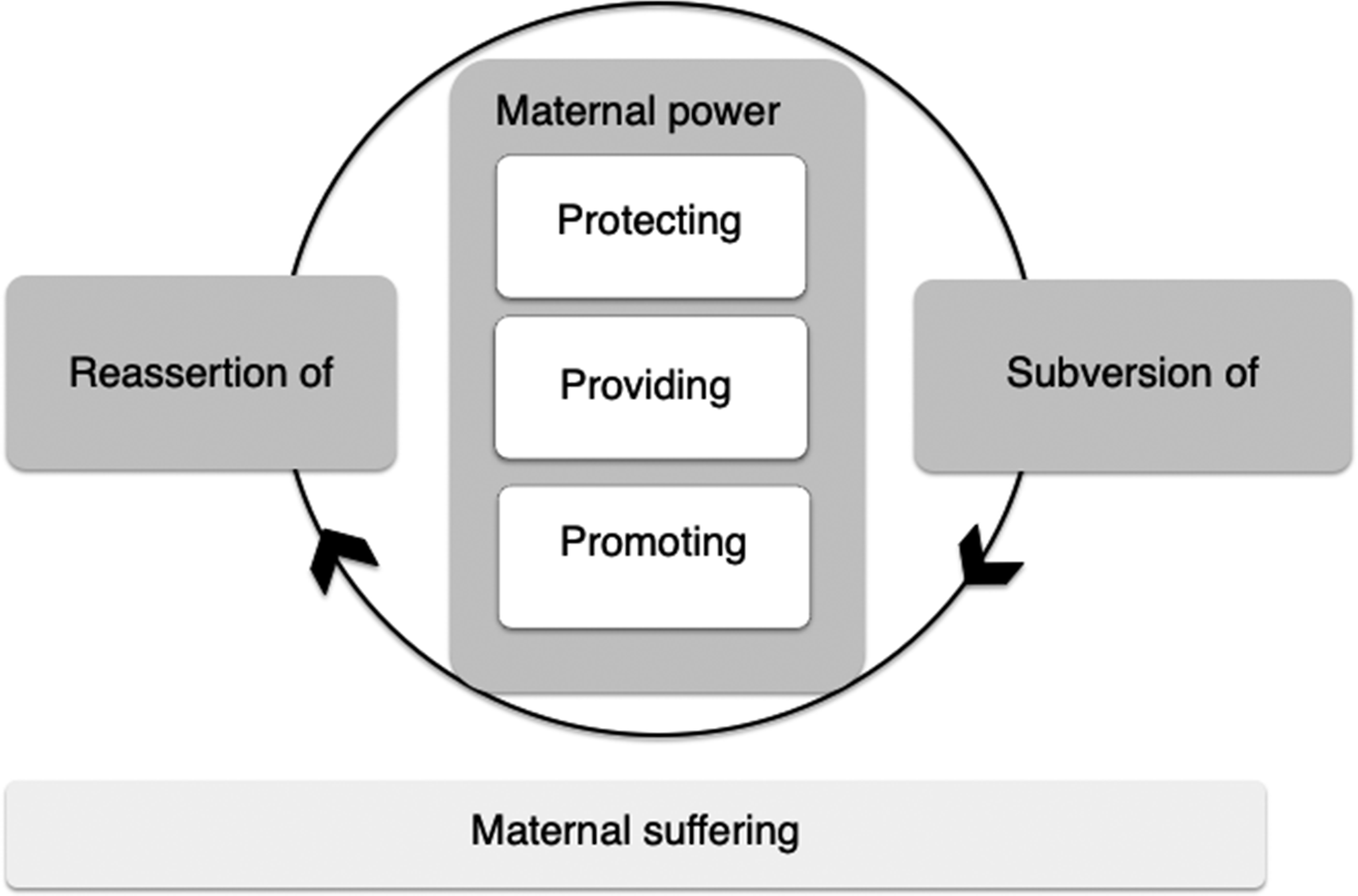
Conceptual model: The dialectic of mothering within political violence.
Results
Our analysis resulted in a conceptual model that situates our major findings within the critical feminist theoretical literature on motherhood reviewed above to highlight the ways in which women grappled with three major concerns related to their mothering in the Palestinian context: (1) protecting their children physically and emotionally; (2) providing for their children’s logistical and material needs; and (3) promoting children’s pride and sense of individual and collective identity. These emergent themes of protecting, providing, and promoting were informed by feminist theoretical notions of motherhood laid out by Ruddick (1995) – protection, nurturance, and training – and those laid out by Collins (1994) – ensuring physical survival and fostering pride and individual/collective identity against the backdrop of denigration.
Collins (1994) also asserted that ongoing negotiations around power are central to motherhood and that, within oppressive contexts, motherhood is a highly dialectical process wherein women constantly move between power and powerlessness. Reflecting this dynamic, our findings demonstrate how women continually experience and then respond to the subversion of maternal power as they reassert their agency and maternal role within considerable precarity. This ongoing dialectic is not without its emotional toll, however, and through our data, women’s narratives made clear the psychological costs of mothering within political violence – which we describe as maternal suffering.
“May God protect you”: Subversion of maternal power within political violence
Constraints on protecting. In one focus group, two mothers recounted the deaths of their older children. As other women witnessed and joined in telling these stories, groups demonstrated considerable grief, ascertainable via their tears and their verbal attempts at affirming other women’s stories and feelings though corroborating them and expressing anger, frustration, and empathy. One woman described how she lost her son. She recounted that she went to work the morning of a day that Israelis entered the area. Then: The Israeli army entered the area and my son went out to see. The Israeli army started to hit the kids. The kids started throwing stones and running back. Darkness fell, and no one knew he had been killed. But they saw either a bicycle or motorcycle that was his. The next day, everyone in the town was looking for him; they didn’t know for sure that he had died. The IDF [Israeli Defense Forces] decided to demolish the factory. They surrounded it with tanks. They asked all the workers to get out but they did not wait. My son was still inside. They threw a bomb and a fire started. People started to scream. The IDF prevented any source of help. My son was not able to make it. My son burned to death. I had to go to identify the body. It was so hard; I will never forget it. They knock on the door and enter like barbarians. [When they enter], we have to wake the kids at night. We’re so afraid they are going to take my husband. Sometimes they search us, and that is frightening. They attack us savagely.
Women’s stories of their attempts at physical protection were closely tied with their attempts at psychological protection of their children; for instance, one woman said, “They came to the car and starting hitting. At that time there were rockets being thrown. I tried to calm her down, she was very upset because she was crying.”
Constraints on providing. Women expressed increased pressure and desperation about making ends meet for their families, saying, for example: My husband used to own a restaurant before the occupation but now he doesn’t have anything. After the occupation, when the Intifada happened and all that, no one came to the restaurant, the whole place was burned, no one comes. We want just any income; we don’t have any income. I’m willing to do anything, but there’s nothing I can do.
Women described being divested of the means to support even children’s nutritional well-being, as did this woman, who said, weeping, “I don’t have anything to cook, all I have to cook is lentils and rice. I don’t have any other food I can cook for the family. Well, that’s our destiny, what shall we do? We just don’t have enough food for our families.” Another woman shared, “Sometimes even for a week, we cannot eat. We don’t have anything. This is the important information to tell you. It’s a miserable life.”
Again and again, women pointed to how impediments to movement inherent in the occupation compromised their abilities to provide their children with healthcare and education. One woman shared: I have a sick little boy. I have had to take him to the Mukasad Hospital in Jerusalem since he was 10 months old, and now he’s 4 years old. Before the Intifada he could enter Jerusalem to go to the doctor. Since the Intifada, they make it difficult for us to enter with the checkpoints and the permits. It is always a problem and sometimes I have to go by myself because they don’t give permission [for others to go with us].
Constraints on promoting. Daily hassles and humiliation factor into the shared daily realities of women and children in Palestine, interrupting the abilities of mothers to promote a sense of dignity and structure for their children. For example, one mother shared that once she was being questioned to see if she was taking part in the resistance (Intifada), and she had to bring her baby with her when she went for questioning: “I had to go down and I had a baby with me because they wanted to investigate me - they wanted to inquire if I belonged to the Intifada. So we stayed for 5 hours. I was so afraid that day.”
Women described encounters they had with Israeli soldiers in which they were frightened and demeaned alongside their children. One woman recounted going through checkpoints with her daughter and enduring humiliation as the Israeli soldiers taunted her and her daughter. The mother and her daughter responded by pretending they don’t understand Hebrew and trying to ignore them. Another woman in the group added she avoids checkpoints with her daughter, and instead has her husband accompany the daughter through them.
Mothers highlighted how impediments to movement undermined their power to promote children’s cultural and religious identities. Being prohibited from taking children to sacred sites represented a particular heartache for women, who, in two separate focus groups, told stories about trying to bring children to the Dead Sea and the Dome of the Rock. One woman described bringing her children to the Dead Sea, saying that she would like to be able to bring her children to see the historical places of Palestine. She recounted that when they got there, they had to beg to be allowed to go in the water, which the Israelis only permitted for five minutes, all the while deriding the family. In the end, she said: You feel sad because you are in your own land and water. You look there and you see all these Israelis have their playgrounds, their kids are happy playing and so on, and we cannot do the same, even in our own water.
Women talked about how children could not safely play outside and how, for their entire lives, “children don’t see anything but this kind of treatment and occupation.” As another woman put it, “They are born and live under the circumstances of the occupation, full of fears.” Descriptions of loss of childhood provoked mothers to reflect on their sense of powerlessness regarding protecting children’s innocence and hope: “It is sad for us because we don’t know what to tell our children about what the future holds.”
Maternal suffering within political violence: “I cry when I’m alone but I don’t cry in front of them”
Concluding her thoughts about her attempts to psychologically protect her young son, a woman simply ended by saying, “I can’t do more than encourage him. I can’t stop the fear that overtakes him.” One woman conveyed, “What affects you is when you see your son is captive or wounded and you can’t do anything for him.” Women’s narratives about powerlessness in terms of not being able to meet their children’s basic requirements, particularly for education and healthcare, reflected considerable psychological pain, illustrated by one woman’s testimony that “It’s really hard to know that we cannot fulfill our children’s needs,” resulting in her feeling “inadequate, like I just cannot do anything.”
As deeply as women seemed to feel a responsibility to be strong, they also were collectively clear about the emotional and physical toll exacted by constantly hiding their own anguish, evident in narratives like: “I cry when I’m alone but I don’t cry in front of them.” This demonstrable sense that mothers must be strong for their children was echoed by a woman in another group: “I would never cry in front of them; I want to show them strength.” The sense of maternal exhaustion created by mothering within political violence was palpable in participant observations and plainly illustrated by a woman in one of our focus groups who said, “I have been strong and strong all the time, to the utmost strength I can bear.”
Reassertion of maternal power
It was clear that mothers seemed to draw strength from their very role as mothers, and that they used culture and collective identity to build strength. For example, one focus group participant asserted, “As a mother, I have to keep on giving love and affection to my family, despite all the problems and difficulties we face.” Mothers’ internal fortitude laid the groundwork for the actual tactics they used to help their children, reasserting their work protecting children’s physical and mental health; providing for them materially and logistically; and promoting children’s integrity and sense of identity and pride.
Reasserting protecting. Women’s narratives highlighted their attempts at protecting their children physically and emotionally. Describing her attempts to keep her son safe during demonstrations, one mother said: My son didn’t do anything – he was caught walking in a demonstration. I don’t like my kids to stay in the street and be in the demonstration. I used to pressure my kids, force them to not be in the demonstration, [but] as much as you try to prohibit children from going, he will go sometimes. There was a friend of ours and I told him to take care of my son – watch him.
Reasserting providing. Women talked about their individual and community solutions to the poverty and lack of material goods they faced because of the siege. One woman reflected on the hard times of the first Intifada, saying: “During the Intifada, there was nothing; a person couldn’t even get 5 shekels to live on. So the women were forced to raise chicken, sheep, go and get dandelions and other wild herbs to eat. This is the only way she can feed her kids.”
Another woman detailed efforts at community helping and cooperating, such as sharing goods like food and bread. As well, women talked about education as an individual and communal source of strength, and their efforts at trying to support their children’s education: We have strong will, we will continue to follow this will, no matter what. Children go to universities and finish if they can. Even if [a loved one] died as a martyr,
1
that doesn’t mean it’s going to stop our life; our life will continue on. Yes, we face massive oppression and inhumanity, but we will continue our life. Despite the difficulties, we will continue to move on.
In compelling conversations, women in the focus groups also described the complexities within their responsibility to help children make meaning of their own realities. In one group, the women excitedly disagreed with one another about how and what children should be exposed to about the conflict. In the midst of one mother talking about how children see aspects of the conflict on the news, another woman interrupted her to tell her that she thought that children should not be exposed to the news. “But they do see it,” the first woman countered, going on to explain that children ask her to explain why things are happening, after they see acts like a tank demolishing a house. Another woman went on to convey to the group: “When my daughter sees somebody wounded, with an eye or hand missing, and she comes and asks me and complains to me, I don’t know how to explain it to her sometimes. Sometimes if I see somebody like this wounded, I don’t have the heart to even look at this person. This is how I feel, so what do you expect from a child seeing these things?”
The contentious task of sense making was also captured later in this same interchange by a woman’s reflection; she said her children should have awareness of the situation, including “the blood and how they massacre us,” because she wants them to identify with the Palestinian land and country: Sometimes I like my kids to see the martyr but sometimes I don’t. I like my kids to see what’s happening because I want them to still feel close to their land as Palestinians, because this is our country. That’s why I want them to see, because I want them to see the blood and see how they massacre us. When they get older, they will understand what the Israelis have done to us. If we don’t let them know what the situation is all about, then they will blame us that we are the terrorists, killing the Israelis – but we want them to understand.
Relatedly, our analyses revealed the ongoing obligation that mothers felt to maintain a sense of optimism in their children, in direct opposition to the realities that faced them. This was put simply by one woman who talked about how “we shouldn’t always frighten our children by telling them that the army’s here and they are going to shoot us,” admonishing the group, “we should not sow fear in the hearts of our kids.” She went on to say: We were forced to be occupied and we had to accept that reality. But we must never fail to have faith in God. Life goes on and we have to take what it is. We should always give our kids hope that things will change. We should at least give them a hope of a future.
Discussion
Women’s accounts highlighted both the anguish and the strength of mothers as they attend to complex mental and emotional tasks in their attempts to raise safe, moral, and culturally and historically conscious children within ongoing political violence. Our findings highlighted how hard women worked when physical and psychological violence surrounded their children, or when their children were arrested, to at least psychologically shield their children from pain. Mothers described holding their children, communicating with them openly, and offering what reassurance they could. Women’s narratives also highlighted how much mothers worked within considerable structural violence to ensure the finances of their family and to provide opportunities for education and healthcare. The economic constraints associated with motherhood in Palestine that our participants highlighted reflect findings of other scholars, who have found economic precarity to be core to the suffering of parents and children in conflict settings (Akesson & Badawi, 2020; Eggerman & Panter-Brick, 2010; Sim, Fazel, Bowes, & Gardner, 2018). Finally, mothers’ insistence on promoting dignity, identity, pride, educational success, and joy for their children revealed the ways individual survival is inexorably linked to community survival. Mothers described the strain of both protecting children from realities of the conflict while also explaining the phenomena in such a way as to nurture their children’s cultural and political identities and pride. Collins (1994) described this ongoing, complex responsibility undertaken by mothers within oppressive circumstances as they help their children accept life as it is while also fighting against fatalism and disheartenment as visionary pragmatism.
The distress detailed by mothers in our study reflects other findings from Palestine that highlight the ongoing fear, tension, and hopelessness mothers encounter in this setting (Punamäki, 1987; Punamäki, Qouta, Miller, & El-Sarraj, 2011). This growing body of work illustrates how, despite their best attempts, mothers in dangerous settings often face the limits of their power to effectively shield children from the realities of the violence and oppression – with deep implications for maternal well-being. For instance, one qualitative study highlighted a mother’s attempt at physically and psychologically protecting her children during a five-day siege on their house through attempting to comfort them and helping them to divert attention onto happy and safe memories and stories. Despite the maternal agency she demonstrated, the mother reported feeling extreme guilt about the lasting effects of this experience on her children (Punamäki et al., 2011). The emotional and cognitive experiences of mothering detailed by the women we worked with support the conclusions of other scholars who have identified the continual undermining of mothers’ sense of competence within the political violence of Palestine; this maternal power often becomes quite difficult to reclaim, try as a mother might (Akesson, 2015).
Within the many limits imposed on their mothering by political violence, in the narratives we considered mothers described how they modeled resistance and endurance for and with their children. They held and soothed their children and fought for their children’s access to healthcare and education. They instructed their children to be fair and act with morality to others. They prepared their children psychologically for prison. The ways in which the women in our groups described reasserting their maternal power suggest the concept of resilience as applied to mothering in conflict settings might be understood in the same way that scholars are now understanding resilience more generally. That is, it is not the magnitude or any assurance of victory that matters, but rather varied and regular attempts at logistically and emotionally surviving challenging circumstances (Anderson & Danis, 2006). Relatedly, our set of findings about resistance and resilience add to scholarship from other qualitative and ethnographic research that highlights the ways in which the daily work of mothering in Palestine very much embodies ongoing defense of collective well-being and sovereignty (Peteet, 1997; Shalhoub-Kevorkian, 2016). As drawn out by women in our focus groups, our findings reinforce feminist theoretical notions about the dialectics of motherhood and power (Collins, 1994), as women’s accounts underscore how mothering is not only a site of trauma and strife where women are divested of power, but also a site for a radical reassertion of power and individual-collective action, as Davis (2016) asserts.
It is important to note limitations of this study. First, we had a limited number of respondents and our recruitment was not random; therefore representativeness of the sample cannot be assumed. Second, while we are assured through our continued work in the region and consultation with expert reports that the realities described in our data remain highly relevant, it would be beneficial to have further studies done with more recently collected data. Finally, the emergent nature of the topic of mothering within conflict points to its salience as a theme; however, our focus groups did not specifically probe for this issue and motherhood was not a requirement for study participation. Had we anticipated this theme, our sampling frame and questions could have been tailored to uncover more information and greater depth related to the maternal experience. Relatedly, as the study was not aimed at the topic of motherhood at the outset, we did not collect data about the gender and ages of the children. Mothers confront distinct challenges and strategize their duties differently depending on various aspects of their children’s identities and developmental stages; tailoring the research to the topic of motherhood from the beginning, and inviting more deliberate reflection about how mothering practices might differ according to gender or ages of children, as well as other factors such as the age and background of the mother, may have considerably deepened our data.
These limitations notwithstanding, in highlighting the everyday experiences mothers encounter within conflict settings, our results point to the importance of taking seriously the subjectivities of mothers as they navigate political violence with and for their children. We sought to uncover the subjective experiences of women as mothers within settings of political violence. To this end, here we drew out the ways in which motherhood entails anguish and strength, and requires regular and complex sets of thinking as women balance both survival and resistance. In so doing, this study affirms the importance of analyzing the psychological experiences of mothers within feminist theoretical perspectives that honor how the tasks and emotional experiences of mothering reflect ongoing dynamics of power and powerlessness within which mothers operate (Collins, 1994; Ruddick, 1995; Scheper-Hughes, 1993). Uncovering the practical and emotional realities of maternal power and powerlessness is particularly important in settings of protracted violence and oppression. Gathering and reflecting on mothers’ subjective experiences, as we have done here, better equips us for policy and practice interventions that center the daily realities, strengths, and strategies of women who navigate political violence with and for their children (Murphy, Rodrigues, Costigan, & Annan, 2017; Peltonen & Punamäki, 2010).
Footnotes
Acknowledgements
We wish to acknowledge the Palestinian Medical Relief Society, particularly the drivers for their generosity of time and spirit and the staff at the clinics who welcomed us and carefully arranged for data collection. We also wish to thank the women who entrusted us with their experiences and narratives. You asked we carry and communicate your stories, and we hope we did so with care and integrity. The lead author wishes to dedicate this article to the late Dr. Angela Gilliam, with unending gratitude for her commitment to radical feminist theorizing and her support of her students.
Declaration of conflicting interests
The author(s) declared no potential conflicts of interest with respect to the research, authorship, and/or publication of this article.
Funding
The author(s) disclosed receipt of the following financial support for the research, authorship, and/or publication of this article: This research was funded in part by support from NIMH Grant T32MH20010. The content is solely the responsibility of the authors and does not necessarily represent the official views of the National Institutes of Health. The funding source had no role in study design; collection, analysis and interpretation of data; writing of the article; or the decision to submit it for publication.
