




Abstract
The biomedical view of eating disorders (EDs) dominates in their classification and treatment regardless of the importance of sociocultural factors in EDs. Critical feminist approaches to EDs try to relate them to oppressive situations, disempowerment and the construction of gender. Educational interventions with people with EDs may be an alternative to biomedical approaches, giving them opportunities to tell their stories, listen to themselves and take control of their lives. This article presents a thematic analysis of semi-structured interviews with professionals who carry out educational interventions for people with EDs. Findings show that the biomedical description and treatment of EDs remain unchallenged and recognising client voice may be a problem, even in educational interventions. Also, the potential negative consequences of the rigid control of the clients’ lives seem to be ignored. Feminist approaches to EDs are acknowledged but do not seem to guide any intervention. Sociocultural critical stances that would recognise the coherence or the transitions between what is considered as healthy and sick eating also seem to be lacking.
Keywords
Notwithstanding the hegemonic biomedical discourse on eating disorders (EDs), they are generally understood as being caused by biological, psychological, and social factors (Holmes et al., 2017). Feminist approaches to EDs have analysed the social and cultural construction of gender and “expectations surrounding female bodies, appetite, sexuality and social roles” (Holmes, 2016, p. 466) while sociocultural studies have looked for the association of EDs with certain social organisations and cultural factors (Katzman & Lee, 1997). Unlike psychiatry's growing interest in symptoms and disregard for patients’ histories and narratives in the last 50 years (Georgaca, 2013; Leader, 2011), feminist informed educational and therapeutic approaches may give people with EDs an opportunity to question oppressive structures and escape the reductionism of the EDs identity (Gremillion, 2003; Malson et al., 2004).
This article presents the findings of a small-scale exploratory research study that inquired about the views of professionals offering educational interventions for people with EDs in Spain. The main goal was to explore how professionals who carry out educational interventions for people with EDs explain the causes and treatment of EDs, describe their clients, and understand the role of their interventions and clients’ voice. We were particularly interested in the ways in which feminist or biomedical lenses, as conceptual frameworks for understanding EDs, permeate the educational interventions. We begin with an overview of the conceptual frameworks of EDs, namely, biomedical, sociocultural, and feminist. We then discuss the treatment and education of people with EDs and educational interventions with EDs in Spain and present our own study.
Biomedical, sociocultural, and feminist conceptual frameworks of eating disorders
EDs have been studied and theorised from many perspectives but are almost always conceptualised within medical or quasi-medical conceptual frameworks as individualised clinical entities (Malson et al., 2004) that affect mostly rich white people. The cultural causality of EDs is reduced to the idealisation of thinness, easy access to highly palatable foods (Treasure et al., 2010), and body image distortion (Gracia, 2014). While sociocultural and feminist approaches do not deny psychological or biological factors of EDs, biomedical paradigms marginalise critical sociocultural factors in the study and treatment of EDs (Holmes et al., 2017). Anorexia and bulimia have historically been described as disorders that affect mostly girls and young women from middle and high social classes of Western industrialised societies (Crispo et al., 2011; Holmes, 2016; Saguy, 2012). Yet there is no strong empirical support for the association between EDs and high socioeconomic status (Gard & Freeman, 1996; Litmanen et al., 2017; Mulders-Jones et al., 2017) or white racial identity (Marques et al., 2011).
Sociocultural understandings of EDs blur the line between normal and pathological, showing how culture is part of people's subjectivities, bodies, experiences and pathologised practices (Katzman & Lee, 1997). For instance, individuals are deemed responsible by health and education professionals for making healthy choices regarding their bodies (Evans et al., 2004) while discourses on healthy eating and lifestyle may be cultural signposts for people with EDs (e.g., “watch what you eat”) and often contradict medical and psychiatric advice (Musolino et al., 2016). Discourses regarding the body, health and self that have emerged in the curricula in schools in the UK, Australia, and the USA depict bodies as imperfect, unfinished, threatened and needing change. In a culture that blames the victim, being fat is interpreted as a sign of neglect of one's corporeal self, a shameful, dirty, or irresponsibly ill condition (Evans et al., 2004). Such messages on healthy eating and weight may increase anxiety and self-monitoring among those trying to attain elusive body norms (Larkin & Rice, 2005). These bio-pedagogies, or lessons about health and wellness, may help researchers to understand what it means to be “normal” or to have an EDs label (LaMarre & Rice, 2021).
Feminists have sought to understand EDs in several ways. Many feminist studies have analysed the impact of different cultural discourses on women's bodies. Larkin and Rice (2005) explored sexism, racism, classism, and other discriminatory factors that influence body-regulating behaviour, finding that body dissatisfaction may be present with or without EDs and that girls are harassed both for being considered fat or thin. Bucchianeri et al. (2014) also found that different types of harassment were associated with a broad range of negative behaviours and conditions. What may be perceived as unhealthy or maladaptive behaviours (e.g., binge eating) may be coping responses to harassment experiences. Piran and Cormier (2005) reviewed studies exploring the impact of different cultural discourses on women's bodies to determine the specific impact of three internalised expectations on EDs measures, namely: “attending to the needs of the other at the expense of the self in close relationships, not expressing anger outwardly, and treating one's own body as an object to be gazed at” (p. 551). Their findings suggested a correlation between these internalised expectations (i.e., self-silencing, anger suppression, self-objectification) and signs of EDs (i.e., disrupted eating patterns and body weight and cognitions that underlie EDs).
Another notable feminist approach to understanding EDs is the Developmental Theory of Embodiment (Piran, 2017). This theory addresses social processes that operate concurrently at the intersection of various dimensions of social location (e.g., age, social class, health, immigration), to create docile, corseted bodies, barred from agentic and equitable public participation. These social processes take place in the physical domain, including physical and sexual violations, coercive pressure to alter one's appearance, barriers to freedom of movement and physical action in public, and diminished opportunities for bodily care and attuned responses to bodily desires. The theory also addresses the adverse impact of constraining social constructions on embodiment, such as the expectation that women act or be “demure”. In a similar vein, the theory describes embodiment as disrupted by prejudice and harassment – as well as by barriers to accessing social power (including non-appearance-related social power), empowering relational connections, and membership in communities of equity.
Attention to the social and relational context is also key to feminist conceptualisations of EDs. Some scholars have noted that stigmatising discourses on obesity and EDs reinforce cissexist and heteronormative body standards. For example, Gordon et al. (2021) found an association between gender expression, peer victimisation and disordered weight-control behaviours: independent of sexual orientation identity, gender non-conforming youths and youths who experienced peer victimisation are more at risk of having disordered weight-control behaviours. Scholars have also used objectification theory to study how women's socialisation and experiences of sexual objectification have contributed to mental health problems such as EDs (Moradi & Huang, 2008). For Rinaldi et al. (2016), it is important to show a wide range of experiences around body size, shape and satisfaction to explain how people negotiate discourses about body shape and size, “how shaming is internalised, how regulation may function as a resistance strategy, and how variant bodies can be embraced, desired, and celebrated” (p. 25).
Treatment and education for people with EDs
In the past, psychological and psychiatric treatments for EDs were thought to have amassed a long history of failures (see Ben-Tovim, 2003; Robertson, 1992). EDs treatments were assumed to have little effect, low recovery rates, and a great potential for improvements (Malson et al., 2004). New developments in treatment of EDs such as psychoeducation, feminist approaches, and embodying practices may have changed this scenario somewhat, but issues regarding what may be considered recovery from an eating disorder remain (see Bardone-Cone et al., 2010; Landt et al., 2019). Also, a large population of people with EDs do not engage with the treatment and little is known about those who delay or resist professional care (Musolino et al., 2016).
A crucial issue regarding the treatment of EDs is the difference between how people with EDs are perceived by professionals and how they see themselves since this divergence may be an obstacle to treatment acceptability and successful treatment. People with EDs may deny their problem, perceive their eating as safe, or want to change their body to avoid sexual attention (Malson et al., 2004; Musolino et al., 2016). Symptoms of EDs like self-starvation could historically be seen as holy ascetical practices, but nowadays those drawing on biomedical approaches see people with EDs as victims of low self-esteem and social pressure, their agency and morality disregarded (Orsini, 2016). They may be entirely pathologised, thus voiceless and disqualified from negotiations about their treatment (Malson et al., 2004). Their powerlessness may be especially troublesome for those with EDs, because they are trying to gain control over their body and the lack of trust in them compromises the therapeutic alliance (Holmes et al., 2021). Since feeling understood may be a key factor for recovery, a contextual understanding of symptoms – which legitimises the eating problem and reduces treatment hierarchies by making the clients experts on their problems – could be an alternative to colonising biomedical norms (Katzman & Lee, 1997).
Gendered understandings of EDs also play a role in diagnosis and treatment within mainstream, biomedical approaches. Women with EDs may be constructed as powerless and not credible before having any diagnosis. In a well-known and highly cited study, Bray (1996) critically discussed the idea that EDs may be caused by an uncritical consumption of idealised body images in the media. This idea of a feminine “reading disorder” has been part of the common understanding of EDs for some time, and it seems to occupy “a critical space in relation to the oppressive influences of the mass media” (Bray, 1996, p. 416). Bray (1996) pointed out that the concerns regarding the reading practices of women and the devaluation of women's abilities to resist media interpellation go back to the 19th century. In this depiction, people with EDs are seen as weak-minded, docile, and infantile. Since psychiatry is traditionally androcentric, aligning irrationality with femininity would not be surprising (Bray, 1996).
Contrary to treatment based in biomedical understandings, less is known about feminist treatments of EDs. A feminist treatment environment for EDs should foster connections, interdependence, and cooperative, democratic decision-making rather than authoritarianism and competitiveness (Sesan, 1997). It should also recognise the role of social oppression in creating and maintaining eating and body distress, emphasise women's strengths, and empower them (Holmes et al., 2017). Holmes et al. (2017), who studied the responses to a 10-week group trial based on feminist approaches to EDs, found that it was useful to situate EDs within a broader context, that it could act as a kind of protection from dominant ideologies regarding femininity, and thus potentially reduce feelings of self-blame. However, they also found that locating the problem within the self rather than culture may offer individuals a greater sense of control and personal agency when it comes to conceptions of recovery. The critique and ambivalence of the trial participants towards feminist frameworks should also be noted, since these responses may hinder willingness to engage in such interventions (Holmes et al., 2017).
In contrast, however, Venturo-Conerly et al. (2019) found that some women related their recovery from EDs to feminist themes (e.g., recognising and rejecting harmful cultural norms) but it was not clear whether there was a causal relationship between adopting feminist views and recovering or whether recovering could be an act of rebellion. Similarly, Holmes (2020) found that women who considered themselves recovered from EDs endorsed how cultural constructions of gender could be relevant to the aetiology and experience of EDs and valued situating their eating problems within a wider cultural landscape.
Eating disorders and educational interventions in Spain
As in many other countries, work with EDs in Spain is highly medicalised; few scholars and practitioners steer away from the medical model (Labora, 2018). Generally, social or cultural aspects are considered mere contributing or facilitating factors that are disregarded in treatment (Labora, 2018). Gender biases in EDs are mostly ignored by practitioners, reducing the causality of EDs to the fear of gaining weight and the distortion of body image (Gracia, 2014). Yet, some multidisciplinary teams have developed community action programs that promote mental health while performing primary and secondary prevention (Ruiz-Lázaro, 2003).
Various Spanish clinical centres specialising in EDs advertise educational interventions in addition to their medical and psychological treatments. The goals and pedagogy of these workshops and individual tutoring may vary greatly according to the institution and professionals involved. For instance, nurses, psychologists, or social educators may teach, raise awareness, or lead participatory reflections about certain relevant subjects (e.g., social skills, self-image). These interventions go by different names – such as educational, socio-educational, psychoeducational, or psycho-pedagogical interventions – but for simplicity we refer to these collectively as “socio-educational”. Regardless of the professional in charge, its methods, goals and name, all socio-educational interventions promoted by clinical centres specialised in EDs were of interest to this study.
In Spain, social education is a university degree mainly offered in adult and informal education (Gradaïlle & Caride, 2018). Despite difficulties demarcating their functions, social educators are responsible for the preparation, monitoring, and evaluation of socio-educational programs and projects in various areas such as labour, law, and health. Social education is considered a response to the right to education (Gradaïlle & Caride, 2018) and Spanish social educators see themselves as social agents of change, empowering people and promoting critical awareness (Eslava-Suanes et al., 2018).
Little is known about educational interventions for people with EDs in Spain. For example, it is not known whether the professionals who carry out these interventions use a biomedical or feminist lens to make sense of the factors that contribute to eating disorders. More knowledge is needed regarding how a feminist lens is integrated into these professionals’ conceptualisation of eating disorders and the processes for change their interventions propose. Educational interventions may be an alternative to the medicalisation of EDs in Spain, provided these interventions do not simply reproduce a biomedical model. As a middle-class social educator and a psychologist teaching mental health courses in a social education degree critical of biomedical understandings of EDs, we were concerned with how feminist views could be a part of educational interventions. We examined whether and how critical feminist approaches would be present in interventions, how they considered the clients’ voices, views and thoughts, and their understanding of EDs as gendered disorders.
Methodology
This study was developed in accordance with the code of conduct for research integrity of the University of Barcelona and received ethical approval. All participants were informed about the study and signed an informed consent form that explained the research and assured their anonymity. We recruited participants through chain referral (Penrod et al., 2003). The Catalan Association against Anorexia and Bulimia referred us to the first participant, and we then contacted and invited another 11 professionals working in Barcelona or nearby. Only four more accepted the invitation, totalling five participants (Table 1).
Participants.
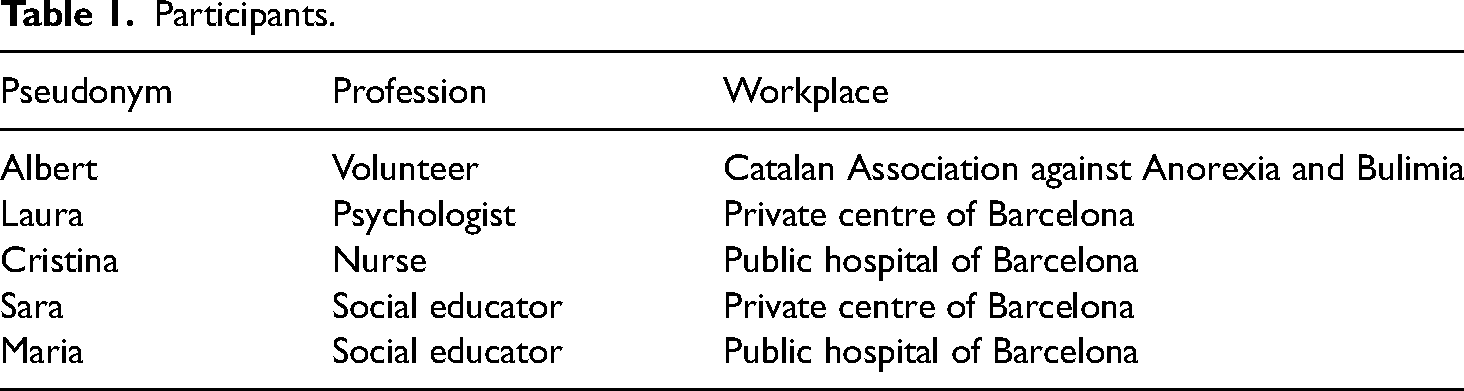
Semi-structured interviews were carried out by the first author and lasted between 30 and 40 minutes. The interviewer assumed a traveller position in which she was exploring something new while transforming in the process (Kvale & Brinkmann, 2009). The interviews were recorded and loosely followed these questions:
How are the people that come here? How important is the diagnosis of eating disorders? Why do you think EDs affect more women than men? What does the treatment consist of? What are the possibilities of a socio-educational intervention with EDs? What is the role of the family and the social context in the treatment of EDs? What is the role of the client's voice?
The theoretical framework of the research was based on a constructionist paradigm and its aims included identifying how different conceptualisations of EDs (i.e., biomedical or feminist) shaped participants’ answers. Therefore, the interviews were open, avoiding direct questions about the participants’ conceptual background and allowing them to answer spontaneously with descriptions, explanations, and examples. Accordingly, the participants were not considered as individuals with unitary and stable attitudes and beliefs. Instead, “complex collectivities of often contradictory, discursively constituted subject positions” (Malson et al., 2004, p. 484) were expected.
Due to our constructionist theoretical framework, goals, and the nature of our data, thematic analysis (Braun & Clarke, 2006, 2020) seemed the best choice. Since our research interests mixed explicit (e.g., client description) and latent (e.g., feminist conceptualisations) levels, both levels were present in the coding process done in parallel by both authors. After contrasting both codifications the final codes were: (1) conceptual frameworks, (2) diagnosis, (3) client profile, (4) family, (5) client voice and (6) role of socio-educational interventions. By combining and unfolding the six codes we built five themes. Our final themes were thus based mostly on the explicit (or semantic) level.
Causes of EDs: what causes and maintains EDs. Characteristics attributed to people with EDs. Role of family in development and persistence of EDs. Relevance of diagnosis and classification of EDs in treatment and socio-educational interventions. Giving clients’ voice in treatment of and socio-educational interventions with EDs.
These themes were built according to our goals and constructionist standpoints. They thus reflect our analysis of the participants’ answers to our questions, not necessarily how the participants understand EDs in other contexts and situations (e.g., meetings with clients or their parents).
Findings
General findings
All participants worked in centres that prioritised outpatient treatment over hospital treatment so as not to interfere too much with the clients’ daily routines and to normalise their lives. Most of the participants mentioned the importance of engaging the clients with an outside activity so that they progressively spend more hours in society than inside a rehabilitation centre.
According to the participants, socio-educational interventions seem to be gaining space and recognition amongst biomedical professionals. Even so, the only psychologist interviewed (Laura) was very critical regarding the role of social educators and socio-educational interventions, stating, “What is their [social educators’] function with EDs? […] I can see it when it is time to search for a job [for the patient] or when the patient has a very difficult family”. Laura's stance could be related to two issues that are not within the scope of this article: 1) the professional rivalry between social educators and psychologists and 2) the limits between socio-educational interventions and psychotherapies.
All the other participants defended the importance of socio-educational interventions for people with EDs. Though they could vary greatly, the workshop format and the educational goals were common features. Some workshops were described more as classes on EDs related subjects, others seemed to address personal difficulties of the clients such as social skills and self-esteem. Only two participants mentioned individual socio-educational interventions. Sara explained how she helps people with EDs to listen to themselves, find their motivation, develop agency, and plan their lives. She emphasised the need of “pushing” the clients to regain control of their lives. Besides developing social skills and self-esteem, Maria also commented on her moments of informal listening to the clients and how she participates in the control of their meals.
Theme 1: Causes of EDs: What causes and maintains EDs
The factors that cause and maintain EDs were a recurrent theme in the participants’ answers. The causes of EDs mentioned by all participants did not match a single conceptual framework. None advocated a pure biological cause (e.g., genetics) but only one gave a biopsychosocial explanation, rejecting theories based on a single causal factor. All participants cited theories studied by them or used by their institution. Despite working in different institutions and having different backgrounds, they repeated some of the same explanations and descriptions, like the iceberg metaphor: If we do not work with characteristics of the personality like self-control or the excess of perfectionism, all that really causes the disorder, the symptoms, is just the tip of the iceberg […] you can reduce the tip but if you do not work on all that is beneath it, there is no possibility of cure. (Albert)
Similarly, some form of external social pressure, such as media representations, was assumed as a cause of EDs by all participants, but only three stated that the clients uncritically accept the distorted images of ideal feminine bodies. In these examples, the deceiving nature of the media representations and the clients’ naivety are emphasised: There is a lot of social pressure regarding the body. They sell a body, an insane ideal, and an unreal ideal […] We show pictures to the patients, the real picture and the doctored one. (Laura)
We believe that what is happening before the onset of the disorder is a lack of acceptance of one's own body, some false belief that success is closely linked to what the others think of her, and that it is also closely linked to a certain stereotype, a certain body type, the pressure of the media, the pressure of publicity. (Albert)
Besides the social pressure for a perfect body, two participants referred to the pressure to succeed in various fields. For example: You must be a good student and be beautiful and be good at everything, right? […] And this imperative at an age when there is still a lot of mental development necessary it is too heavy a load. (Maria)
As this example shows, these participants related EDs to young girls trying to live up to unrealistic ideals and eventually “exploding in a way that they collapse and cannot go back to being the same person, because that demands the sacrifice of their health and desire” (Sara). The only participant that explicitly described EDs as multi-causal stated that the world of image would be a risk factor for boys and girls, but was keen to qualify that “we do not know what comes first: the interests towards aesthetics or the first anorexic thoughts or thoughts of perfection” (Cristina).
Besides social pressures and not accepting one's own body, Laura and Sara also referred to traumatic issues such as bullying and sexual abuse as causes of EDs, stating for instance: “Sexual abuse, bullying, very complicated home situations” (Laura). “Bullying can be pervasive, school bullying, sometimes bullying at work […] and also sexual abuse, within and outside the family” (Sara). These traumatic issues were coherent with the iceberg metaphor since they contributed to the hidden causes of EDs that lie “below the surface”.
Theme 2: Characteristics attributed to people with EDs
Describing people with EDs beyond their symptoms was important to the participants to justify and make sense of other descriptions (e.g., treatment, family). As they worked with clients from different groups, they spoke about clients of different ages with diverse levels of schooling and socioeconomic backgrounds. Though they all described EDs as an issue affecting young women, they did also mention young men, as shown below. Very few heterosexual boys come here. The studies […] show that the personality traits that are more aesthetic can also have a bias, a risk factor. But not for being homosexual, for being related with gay circles that are into fashion and stuff like that. (Cristina)
Now boys are starting to show up. Their profile is of a boy who is very feminine, and boys who are obsessed with exercising, going to the gym. (Maria)
All participants agreed that the clients with EDs were excellent students because of their self-discipline, perfectionism, and intelligence. The possible contradiction between their alleged intelligence and uncritically succumbing to social pressure went unnoticed and was not questioned by the researcher. Two participants associated this intelligence with something negative. Cristina stated that “the disorder caught their intelligence to crush them”, while Sara maintained that the clients used their intelligence to disguise the symptoms.
All participants emphasised the high degree of self-control and self-discipline of people with EDs in all areas of their lives. The degree of control associated with perfectionism and rigidity was considered as part of EDs, and only Sara hinted that their achievements in life were thanks to the self-control of EDs: “their way of seeing the world and relating to each other is correlated [to the disorder] and if they did what they did it is thanks to the disorder”. While Sara also added that clients hide the problem as much as they can, Cristina and Laura mentioned the feeling of normalcy of the clients: I have a patient that thinks that what she does is what she would normally do. But then her husband tells her that two years ago this [situation] would not be such a mess. (Cristina)
Many patients have a lack of awareness, such as thoughts that they do not verbalise or behaviours that are hidden because they see them as normal. (Laura)
All the participants mentioned the low self-esteem or the negative self-image of people with EDs. Both characteristics were understood as causal factors of EDs and not as possible consequences of the social reaction to or treatment of EDs. “But the problem is an internal problem of self-esteem, lack of confidence, failure to resolve conflicts in an appropriate manner, there is an emotional or conflict constraint, there is a lack of assertiveness” (Laura).
Theme 3: Role of family in development and persistence of EDs
All the participants recognised the importance of clients’ families in the onset and treatment of EDs, but with nuances. Two participants relativised the importance of the family in the onset of ED, yet all but one participant negatively described features of families that contribute to EDs: dysfunctional communication, overprotection, lack of information and boundaries, poor understanding, high expectations and pressure, and not complying with treatment. This is evident in the following remarks. You see families with an excessive cult of the body, or with a terrible eating style […] families that shout, that scream, that do not respect their children or themselves … families that talk about everything but their problems. (Laura)
All the participants mentioned interventions with the families, but their perceptions of the role of the family were quite dissimilar. Sara did not place the families among the causes of EDs but seemed quite concerned about families that did not enforce the treatment guidelines at home to avoid being the “bad guys”. Laura was the only participant who mentioned family as a source of information about the client, but also commented that some clients were the healthiest ones in their families. Cristina and Maria seemed more empathetic toward the suffering of the families while Albert was the only one who mentioned the differences between fathers and mothers: the excesses of punishments and threats of the former and the failed attempts of understanding of the latter. The interventions could be aimed at giving families information on EDs, helping them cope with their suffering, changing them (e.g., roles) or making them comply with the treatment.
Theme 4: Relevance of diagnosis and classification of EDs in treatment and socio-educational interventions
Although this theme was clearly associated with one of the questions of the interview, it was also connected to themes 2 and 5 and helped understanding the participants’ view of the clients. The diagnosis of a specific eating disorder was deemed necessary by all participants, but for different reasons. Three participants mentioned the need to tailor the treatment to the specific diagnosis of eating disorder. Also, three participants distinguished between the impulsiveness of people with bulimia and other EDs and Cristina justified the importance of the diagnosis to make clients aware of their disorder.
The importance of the diagnosis was minimised by three participants. According to Cristina, her institution does not treat each disorder separately because the clients with different EDs share many common traits. Sara relativised the importance of the diagnosis because it changes with adolescence and that there was not a pure case of anorexia, and Laura stated that the diagnosis was less important than the severity of the disorder.
Two participants argued for separating the diagnosis of an eating disorder from the person, stressing the difference between the disorder and the personality. Both Cristina and Albert tried to fight the stigma generated by labelling (Goicoechea, 2013). Albert, for instance, stated, “We want people to understand that they have a problem and not are a problem […] do not label yourself. The issue is that these disorders have a lot of stigma.”
The participants also related EDs to other disorders and psychodynamic interpretations. Sara mentioned autism spectrum disorder and changes in gender identity as possible antecedents of EDs or as issues that could better explain their symptoms. Laura cited many possible psychodynamic interpretations that could be related to EDs: Apart from self-harm, anorexia for example is “I want to disappear”, “I want to take up as little space as possible” and binge eating disorder is often “I fill myself with food because I feel empty” […] There are many fears behind it, fear of growing up, fear of not being liked, fear of being wrong … (Laura)
Although these psychodynamic understandings might not be an explicit part of a biomedical conceptual framework, they may play an important role in treatment and socio-educational interventions with EDs and thus would be interesting to be further explored.
Theme 5: Giving clients’ voice in treatment of and socio-educational interventions with EDs
Allowing client voice – accepting their opinions about their condition and treatment and letting them have a say in their treatments – was relevant to the participants and related to other themes. It was also controversial: only one participant stated that clients with EDs should have no voice whatsoever and the other four gave ambivalent answers. Four participants defended the importance of client voice, without saying why or because clients must want to change and commit to the treatment (Sara). Participants addressed the relevance of client voice differently. Four argued that people with a very low body mass index (BMI) are incapable of reasoning and understanding and must recover from the weight loss before having any voice or undergoing psychological or socio-educational interventions. Two others distinguished between the “healthy” and “sick” voice of the client: Cristina stated that “it is important to distinguish between the voice of the patient and the sick voice […] sometimes not even the patient knows why she is doing things”.
Besides the low BMI lack of reason and the argument of a healthy-sick binary, there were more subtle claims against clients’ voice. Clients may be heard and have some control over their lives if they ask for help and agree with the institution. Two participants stressed the importance of being aware of the problem and wanting help. Cristina mentioned that people with EDs must let themselves be helped and Sara stated that they had to put their lives on hold and accept that they needed help. Also, the comparison between EDs and drug addiction made by Laura and Sara justified prioritising the control of the symptoms over giving voice to the clients. I tell them “I ask you what you think, what you feel or what you do because I trust you, if I didn't trust you, I wouldn’t do it”. Sometimes we want to roll our eyes! You stop and think, but the choice is the patient's. (Laura)
Though Laura was the only participant that mentioned trust in the relationship with clients, trusting the clients’ commitment to recover and their decisions regarding their mental health seemed implicitly related to giving voice to them. Besides Laura's “we want to roll our eyes” expression, Cristina also mentioned the limits of client voice: If I can help you suffer less, I will, but we cannot help you to facilitate things that are part of the illness. […] If you tell me that you are not going to eat pasta anymore, […] I cannot help you with that. (Cristina)
Directly linked to the client voice issue is the matter of control: people with EDs were described as highly obsessed with control. All participants agreed that the first step of the treatment was to replace the clients’ control for theirs. Asked about the possible contradiction of fighting a need for control by controlling clients, participants justified their control to protect the clients’ lives and health and accepted the need to later negotiate and progressively accept the clients’ decisions.
Discussion
The study explored the conceptualisations of eating disorders and intervention approaches of five individuals who implement educational eating disorder interventions in Spain. Regardless of some differences between participants’ conceptualisations and approaches to interventions, the findings suggest that, overall, they embrace a medical model of eating disorders. Participants did appear to accept sociocultural understandings that do not preclude the pathologising of people with EDs. It was not possible to detect significant differences in their viewpoints and approaches between those who were social educators and those who were not. The blend of contradictory frameworks (Sayers, 2009) and conflicting views of EDs we noted are not new. Our findings in the Spanish context, therefore, confirm views that are coherent with the medical model of EDs (Labora, 2018). EDs are commonly understood as the result of individual pathology – personal food issues related to improving one's self-image, associated with childhood problems – and exacerbated by social forces mainly affecting women. Our participants generally seemed to understand EDs as multifactorial afflictions, but denied the agency of people with EDs and ignored some sociocultural meanings of their behaviours (Orsini, 2016).
Drawing on a biomedical perspective, participants explained the alleged vulnerability of people with EDs, that is, the interaction between significant physical and psychological changes and social challenges (Treasure et al., 2010), ignoring evidence on stigma theory, peer victimisation or peer bullying. Other than Cristina, who relativised all possible causes of EDs, the participants saw people with EDs as highly vulnerable to social and family pressures. Although the social and cultural construction of gender and the current expectations regarding women's bodies, and social roles was mentioned (Holmes, 2016), EDs were not seen as a feminist issue. They recognised some oppressive situations lived by people with EDs but could not go beyond fatphobia and body image distortion (Holmes, 2018). While the participants held views of eating disorders compatible with the biomedical lens, they refrained from explaining EDs as a simple “reading disorder” (Bray, 1996). However, Laura assumed that people with EDs had to be taught how to identify doctored body images presented by the media.
Feelings of normalcy experienced by some clients seemed strange to some participants. They interpreted it as a lack of awareness of the disorder and an obvious obstacle to intervention. The participants did not acknowledge the coherence between the clients’ eating habits and social messages about healthy eating and weight, thus lacking any critical sociocultural stance. Though they recognised the low self-esteem, the distorted self-images, or the shame felt by the clients about their bodies, none mentioned the bullying suffered for having an anorexic body (Larkin & Rice, 2005) or eating disorder or associated their low self-esteem with the social reaction to EDs or the professionals’ own lack of understanding of the clients’ feeling of normalcy (Musolino et al., 2016).
The need to break the clients’ control over their eating was an important issue overall: “the victims of social pressure” must accept the control of professionals who deny the legitimacy of their thoughts and eating habits. In some cases, this acceptance saves their lives, but the paradox of controlling clients while desiring their autonomy and rational self-control remains (Moulding, 2006). Some participants were aware of their control's limitations and the need for some long-term external control (e.g., family), possibly confirming the low recovery rates of treatments for people with EDs (Ben-Tovim, 2003).
Participants viewed EDs’ symptoms as reflecting the tip of the iceberg, indicating multiple underlying psychological and adjustment difficulties. Studies confirm the relationship between child sexual abuse and EDs. However, the divergence of the findings suggests that there may be substantial heterogeneity in this relationship and that definitions of child sexual abuse and EDs vary greatly (Smolak & Murnen, 2002). It is not within the scope of this article to discuss the accuracy of this model, yet we may discuss its implications. When all EDs’ symptoms are reduced to pathological effects of previous trauma, the legitimacy of those responses and the clients’ agency (Katzman & Lee, 1997; Orsini, 2016) are denied. Participants viewed people with EDs as intelligent, perfectionist and controlling, but also vulnerable to social pressures, with low self-esteem, unaware of their problems and victims of their intelligence and perfectionism. Only one participant acknowledged that the same perfectionism allowed them to be successful in certain areas (e.g., being a good student or athlete), and another one mentioned the transition between what is considered normal (e.g., dieting) and sick (Evans et al., 2004). It seems that treatments and educational interventions for people with EDs could benefit from the recognition of their reasoning and their sociocultural background. Then, maybe, the iceberg metaphor could be replaced by a more cartographic one, mapping endless rhizomatic connections with no hierarchical organisation (Guattari, 2012; Padilla-Petry et al., 2021).
The participants alluded to different ways their clients’ voices were muted. While one participant stated that the clients should have no voice, the others described conditional acceptance of their clients’ voices. Such acceptance was limited to when there is less risk to their lives (higher BMI) or the client agrees with the treatment, does not represent the sickness (Malson et al., 2004) and can be trusted. Splitting the client's voice into healthy and sick leads to the disregard of and failure to understand the sick voice. Since there is also a matter of trust (Holmes et al., 2021), people with EDs must learn the hard way to keep to themselves what may be identified as the disorder speaking, which contributes to widening the gap between their understanding of EDs and the biomedical construction of EDs (Orsini, 2016). Instead of being the experts on their problems, they are colonised by the biomedical discourse (Katzman & Lee, 1997). The price to be paid for the rigid control of the clients’ lives and the contradiction between first breaking their control and denying their agency and then pushing their self-esteem seems to be ignored.
Overall, the participants in the study held views that were most compatible with a biomedical lens. A feminist lens was mainly lacking in their descriptions of their work. Their interventions were not necessarily aimed at active agents and could be echoes of the medical treatment. Since the role of educational interventions with EDs in Spain is growing, the study suggests the value of examining these interventions’ goals and training programs and the worldview of the professionals in charge.
Conclusions
This research has three conclusions. Our participants mixed neurobiological and feminist frameworks, though the latter seemed less influential in treatment and the former remains unchallenged in its description and treatment of EDs. For the participants, the reality of EDs seems colonised by psychiatry in a way that critical sociocultural approaches are ignored, and feminist views may be dismissed as mere interesting sociological reflections on a neurobiological issue. Fat phobia, vulnerability to social pressures and childhood issues are emphasised while the reasoning of people with EDs is disregarded. Since understanding people with EDs is crucial to helping them, more research is needed to show how feminist frameworks could help in listening to and empowering people with EDs.
The contradiction of treating an intelligent control-obsessed “victim of social pressure” with more pressure and control is connected to a difficult dilemma: how to trust someone deeply committed to an unhealthy risky eating. The splitting strategy (trusting only the healthy voice) may lead to ignoring an important part of the clients’ thoughts. Educational interventions could be used to acknowledge the agency of people with EDs and make them experts on their problems instead of passive listeners in classes and workshops. Changing these interventions would require a change of the professionals’ frameworks and challenging the medical colonisation of eating habits. To avoid the reproduction of a paternalistic welfare model of some medical interventions, feminist studies on EDs should be discussed in the training of all professionals that may carry out educational interventions with people with EDs.
It is not clear how the background and training of the professionals that carry out educational interventions affect their perspectives on EDs and ultimately these interventions. We could expect social educators to be more open to feminist approaches and critical of biomedical approaches than professionals with clinical training, but our findings do not confirm that. It would be interesting to study the inspirations of professionals that carry out educational interventions. For instance, do the institutions that treat EDs override somehow previous critical perspectives establishing the biomedical view of EDs as the only viable way of treating and educating people with EDs? Further research on this subject could help in improving both the institutions’ work and the professionals’ training.
Footnotes
Declaration of conflicting interests
The author(s) declared no potential conflicts of interest with respect to the research, authorship, and/or publication of this article.
Funding
The author(s) received no financial support for the research, authorship, and/or publication of this article.
