




Abstract

Feminism & Psychology (F&P) was launched in 1991, a time the founding Editorial Collective described as one of vibrant feminist momentum and critical contestation. Their aim was bold: to carve out a space for feminist scholarship that was not only intellectually rigorous, but also unapologetically committed to disciplinary and social transformation. Thirty-five years on, this founding vision remains vital. Writing now as F&P's fourth editorial team, we take this moment to: (a) reflect on where the Journal has come from, (b) take stock of the complex terrain on which feminist psychology is currently practised, and (c) chart a course ahead in service of the Journal's core objective of fostering feminist scholarship that seeks not only to understand the current world but also to change it (Kurtiş & Adams, 2015).
Where We Have Come From
F&P's inaugural editorial, written by Founding Editor Sue Wilkinson (1991) and “aided and abetted by” by members of the Editorial Collective (Susan Condor, Christine Griffin, Margaret Wetherell, and Jennie Williams), laid out the Journal's foundational vision as follows.
F&P centres feminism in its conjunction with psychology. This is not simply about “gender” or “women”, but about feminism as a political, theoretical, and methodological commitment. The Journal is more than a venue for research, but a platform for critique, creativity, and facilitating social change. It publishes rigorous, reflexive, and politically engaged feminist scholarship, especially in relation to method and knowledge production in psychology and beyond. The tension between feminism and the discipline of psychology is recognised and not smoothed over. Attention to power is imperative, eschewing universalising frameworks in favour of attending to intersecting differences among women. F&P strives to provide a scholarly and political community. The Journal will endeavour to push the boundaries of both feminism and psychology, whether through new theoretical directions, marginalised topics, or under-represented voices.
As the Journal has developed and grown, these core principles and objectives have been refined or extended by subsequent editors, as summarised in Table 1 below.
Historical Themes in the Editorial Ethos of Feminism & Psychology.
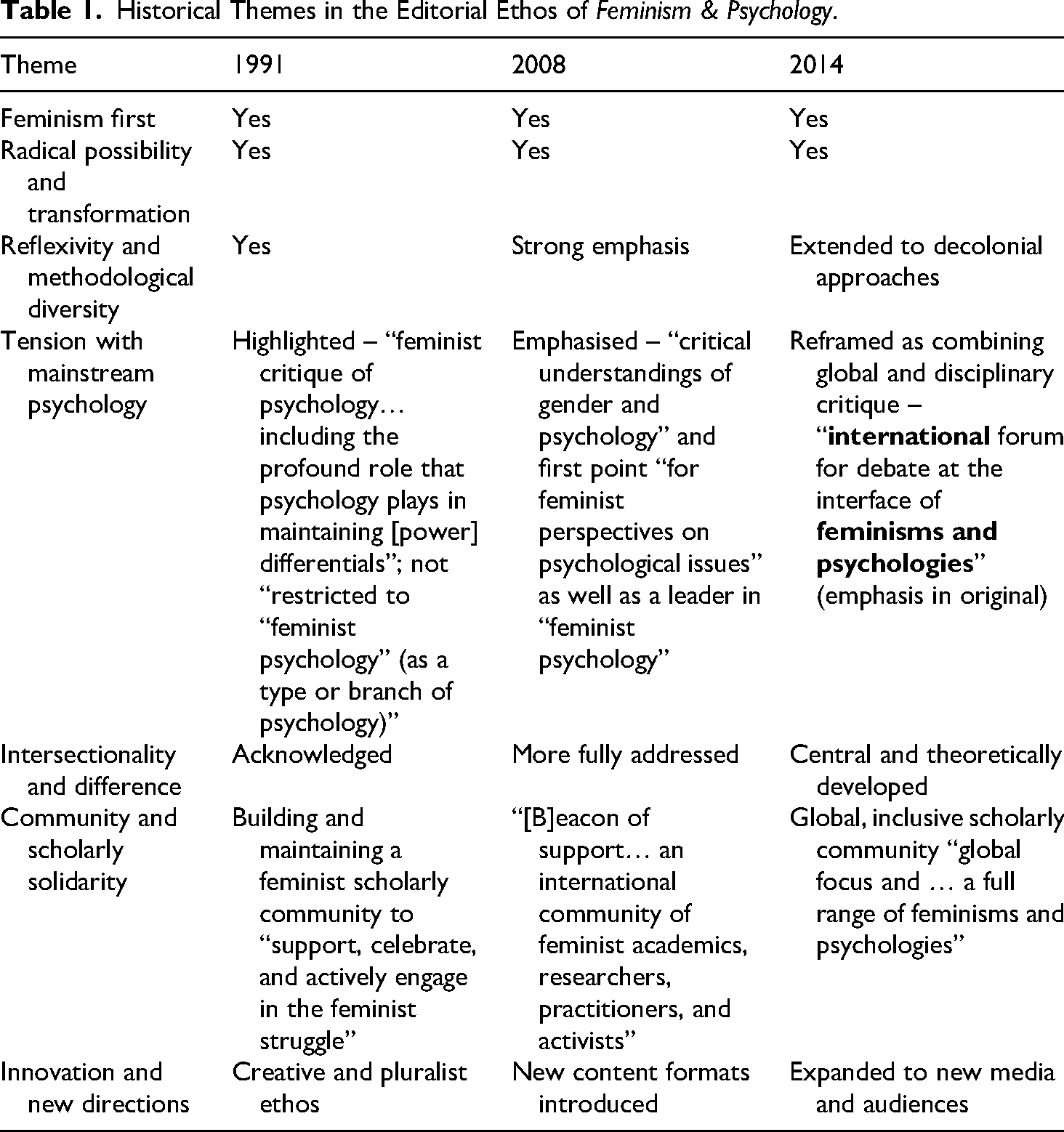
Seventeen years after the Journal's founding, incoming editors Nicola Gavey and Virginia Braun reasserted that feminist psychology must retain its radical edge and avoid becoming “just another branch” of psychology. As part of this, they envisaged F&P as a beacon of transformative possibility to sustain feminist scholars within, and sometimes against, the discipline. They strongly emphasised the Journal's commitment to critical reflexivity and methodological openness, welcoming both empirical and theoretical work, creative formats, and explicitly encouraging debate, reflexivity, and activist engagements (Gavey & Braun, 2008). To foster this, new publication formats were introduced. The Editors also responded to developments in feminist theorising, such as increased uptake of the theoretical concept of “intersectionality” and the rise of critical masculinities studies (Lorraine Radtke, 2017). Their inaugural editorial emphasises intersectionality (race, class, sexuality, nation) and broader basis for studying gender relations and cultural “constructions of gender [that] permeate all facets of our societies” (Gavey & Braun, 2008, p. 8), including critical explorations of men and masculinities.
Six years later, and 23 years after the Journal's founding, in 2014, the new Editor-in-Chief, Catriona Macleod (the first editor from the majority world 1 ) along with Editors Jeanne Marecek and Rose Capdevila, reaffirmed the founding vision as they framed F&P as a “forum for critical, radical, and provocative feminist scholarship” (Macleod et al., 2014, p. 3), enabling both theoretical innovation and activist commitment. They confirmed the priority given to feminism, while acknowledging plural and contested forms of feminism, asserting: “feminism[s] come first in our order of priority” (p. 5, their insertion). Highlighting the persistence of psychology's complicity in forms of oppression (e.g., colonialism, racism, neoliberalism), they recommitted to doing psychology “differently” and reaffirmed the need for critical and intersectional analyses of disciplinary practice itself. To this end, Macleod et al. (2014) further extended the Journal's original commitment to critical reflexivity and methodological openness by endorsing intersectional, decolonial, and Indigenous psychologies; encouraging student voices; and introducing new formats and technologies (e.g., virtual editions, social media, weblog). In this vein, the team highlighted the plurality of feminisms, and the importance of featuring feminist voices across geographical, cultural, and disciplinary boundaries in F&P.
This commitment to inclusivity and diversity has been crucial to F&P's objective of offering a space for provocation and contestation vis-à-vis mainstream psychology, sharpening as the Journal grew and feminism gained recognition in psychology. Initially, this was articulated in terms of internationalism in the founding editorial: We will also seek to make a space for a wider range of voices to be heard: by encouraging contributions from members of under-represented groups and from those at all stages of their careers. We also aim to open up the [J]ournal to those traditionally denied a ‘voice’ in psychology, although profoundly affected by it… We intend to redress the under-representation of … certain geographical areas, notably Africa, the Indian subcontinent, and South America (Wilkinson, 1991, pp. 10, 11).
These changes were intended to capture growing attention to intersectionality in feminism, highlighting plurality as well as contestation, in their words: “to underscore the global focus of the [J]ournal, to indicate that we intend to incorporate a full range of feminisms and psychologies, and to call attention to the ways in which feminisms have grown and shifted” (Macleod et al., 2014, p. 4).
The growth of feminisms also necessitated returning to a foundational issue that Wilkinson and colleagues had raised in 1991, namely, that the Journal is “highly reflective” of the editorial team's “own (white western academic) backgrounds” (Wilkinson, 1991, p. 11) and the need to work toward changing this. The 2014 incoming editorial team expressed renewed commitment “to expanding the [J]ournal's international scope, as well as bringing into sharper focus transnational and decolonial perspectives on psychology and on feminism” (Macleod et al., 2014, p. 4). In doing so, they highlighted that most scholarship in F&P hails from the Anglophone, minority world and an ongoing lack of scholarship from the majority world. This trend is clear when looking back over the past 34 years of publications, as shown further below in the discussion of decolonising feminist scholarship, as shown in Table 2. (See also Tables 2 and 3 further below.)
Author Affiliations 2000–2012.
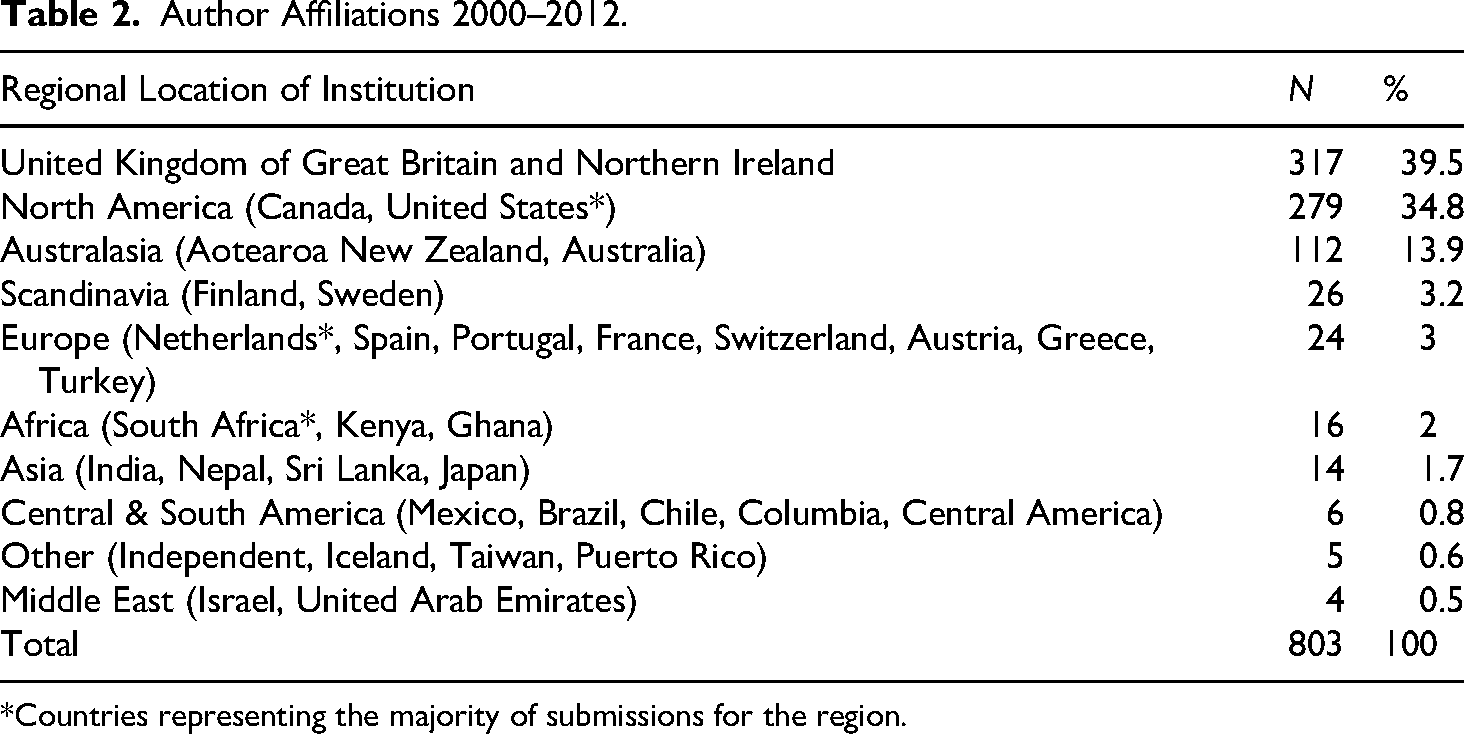
*Countries representing the majority of submissions for the region.
Corresponding Author Affiliations 2013–2025.
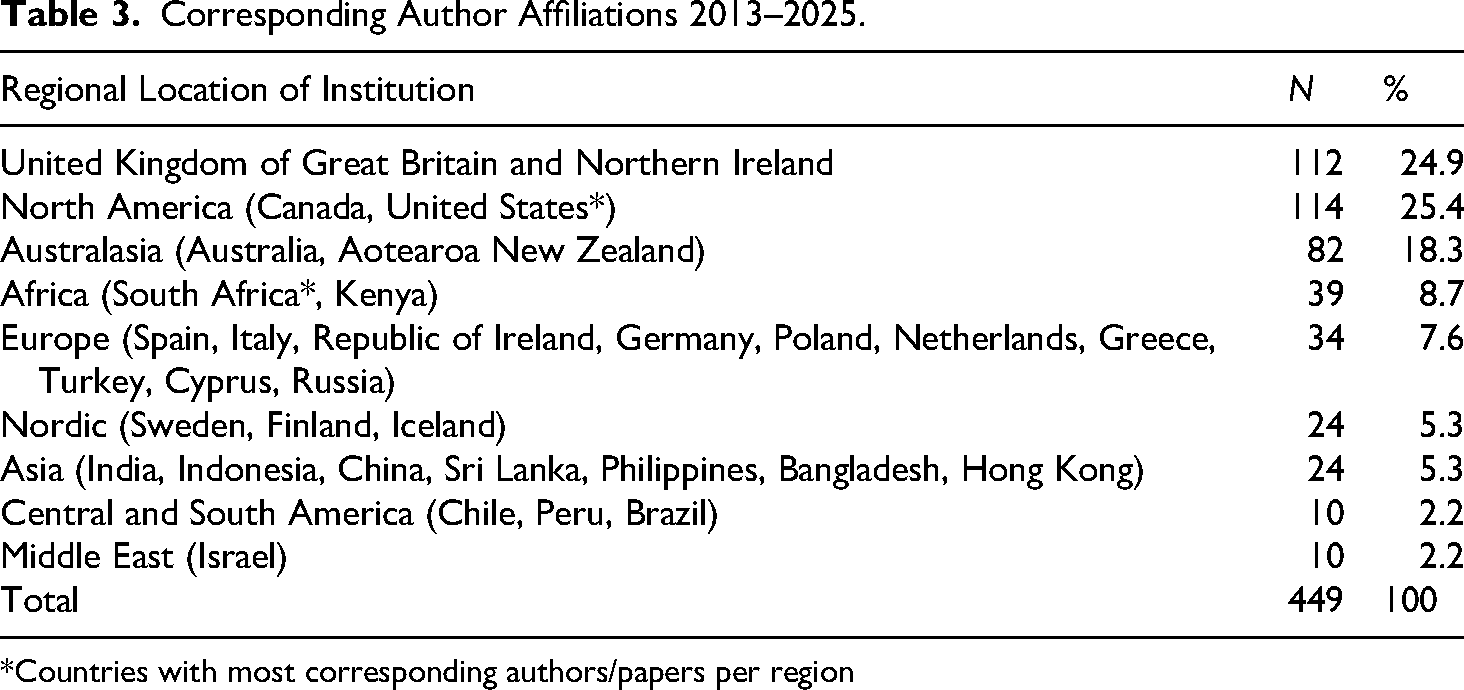
*Countries with most corresponding authors/papers per region
Taking Stock of the Present
Today, the global sociopolitical landscape remains shaped by the enduring struggles that galvanised F&P, alongside new and intensifying challenges. What marks this particular moment out, however, is “the widely shared sense that our current times are globally a time of unsettling political change and impeding climate collapse” (Kaiser et al., 2025, p. 150). We are living in a “poly-crisis”, a time characterised by multiple, interconnected crises that “have not only arrived at the same time [but] also feed each other, creating a sense of doubt and uncertainty” (Juncker in MacRae et al., 2021, p. 184). These will no doubt be familiar to readers: the COVID-19 pandemic, climate catastrophes, concurrent, protracted conflict, myriad geopolitical and socio-economic shocks worldwide, among others (Khosla et al., 2024).
We describe the present reality in the language of crisis, because this reflects global discourse and does seem to capture a pervasive sense of catastrophe. We realise, of course, that every generation may feel similarly and we are mindful that crisis rhetoric can obscure the historical and contemporary power relations that underlie sociopolitical conditions by allowing them to be seen as exceptional or unforeseeable (Kaiser et al., 2025; MacRae et al., 2021). This reminder to attend to power is crucial – and entirely consistent with F&P's long-standing emphasis on understanding the operation of power in both symbolic and material forms. It reminds us that it is not simply the context of instability, but how it is framed and responded to, that enables the reinstatement of regressive, exclusionary, and extractivist politics. In unsettled times, such politics gain traction under the guise of restoring order or pursuing economic rationality, reviving, and deepening long-standing inequalities within and across countries (Edström et al., 2024; Khosla et al., 2024). As Macleod et al. (2014, p. 4) reminded readers in their editorial, “even when significant progressive change takes place, new oppressive practices and power relations emerge and old ones take new forms” – hence the need for continued vigilance and struggle.
Against this turbulent contemporary backdrop, with its pervasive sense of crisis, backlash politics have flourished under the guise of necessary correctives to upheaval and disruption. We now find ourselves within a sociopolitical landscape marked by backsliding and backlash (Lewin, 2021; Nazneen & Okech, 2021). Many of the 20th-century movements for human rights, postcolonial independence, and social justice have not only fallen short of their promises, but have been actively undermined by resurgent conservative fundamentalisms (Hammack, 2018). Critical and feminist scholarship in psychology and beyond charts the resurgence of authoritarianism, ethnonationalism, and white supremacist heteropatriarchy; the legitimisation of violence and exclusion based on gender, race, sexuality, and religion; and the erasure of collective traumas (e.g., Fine, 2017, 2018; Hammack, 2018; Kessi & Boonzaier, 2018; Lewin, 2021; Sultana, 2021). Those who are already marginalised – especially women – are disproportionately impacted by the cumulative effects of such regressive politics, economic stress, climate shocks, and digital surveillance (Grabe, 2017; Khosla et al., 2024; Nazneen & Okech, 2021).
In many contexts – including liberal democracies – conservative, reactionary forces have rolled back hard-won gains. The United States is a striking example precisely because the country has positioned itself as a global beacon of democracy for over two centuries and is deeply influential in geopolitics. Notable regressions in recent years include through the overturning of federal abortion protections and the reinstatement of the Mexico City policy (known as the “global gag rule”), representing major blows to reproductive rights nationally and internationally. The concerted attack on sexual and gender diversity has also caused ripples globally, with some commentators arguing that these regressive politics have influenced other countries, directly and indirectly, to follow suit (Francis & McEwen, 2024; Lane et al., 2020; McEwen & Towns, 2025; Price et al., 2021).
Certainly, we are witnessing worldwide political and legal regression in relation to sexual and gender rights (Korolczuk et al., 2025). Feminist scholars now work in a contested terrain of gender, with the solidification over the past two decades of a transnational “anti-gender” ideology opposing reproductive justice, gender and sexual diversity, and sexuality education (Browne & Kazyak, 2025; McEwen & Towns, 2025). Conservative politics frequently purport to be neutral or even protective, aiming to reassert binary, cis-normative, and hetero-centric norms resulting in harmful outcomes, for example, in the increasing erosion of budding trans rights, gender-affirming care, and inclusive education (Ellis et al., 2025; Francis & McEwen, 2024; McEwen & Towns, 2025; Vadakka Chandran (Riza), 2025). Ironically, even feminist language is co-opted in such neoliberal and right-wing agendas (Evans, 2023; Lewin, 2021). This “discourse capture” (Lewin, 2021) appears in strategies ranging from anti-abortion groups branding themselves “pro-life feminists” to state actors mobilising “women's rights” to justify anti-Islamic or anti-immigrant policies (Lewin, 2021; Nazneen & Okech, 2021).
This sweeping regressive conservatism is sustained by mounting hostility to critical thought and “anti-intellectualism”, even in contexts that once championed tolerance and rights (Sultana, 2018). Across the world, “western liberal universities” (Chikane, 2024, p. 1) have seen renewed debate and growing concern regarding academic freedom (Butler, 2022, 2025; Chikane, 2024; Karran et al., 2022). The widespread “anti-woke” opposition to gender studies and critical race theory in the United States is a vivid illustration (Zelnick et al., 2023). Such anti-intellectualism is often cloaked in the language of “free speech” and “viewpoint diversity”, enabling bureaucratic mechanisms to suppress structural critique (Lewin, 2021) and privileging scholarship that claims objectivity – especially “hard” sciences and narrow forms of psychology (Butler, 2022; Kessi & Boonzaier, 2018).
This global pushback has directly affected the terrain of feminist and gender scholarship, including within psychology. Around the world, academic programmes in gender studies have been defunded or closed (Gimson, 2019). Such closures are often justified under the guise of economic rationalisation, as “macho politics” and managerialism converge to devalue feminist work. Elsewhere, feminist critique is increasingly marginalised under a regime of metrics, casualisation, and responsibilisation that rewards conformity and punishes dissent (Gill & Donaghue, 2016; MacLeod et al., 2021; Morison, forthcoming). In this climate, feminist scholars face growing precarity, surveillance, and accusations of political bias or “ideological capture”. Importantly, these dynamics target individuals – particularly women, Black, and Indigenous scholars (McAllister et al., 2021, 2022; Taylor et al., 2022) – but also restructure the institutional and epistemological conditions under which feminist psychology can be practised and sustained.
Anti-gender mobilisation and the rise of “gender critical” ideologies fuelling growing opposition to sexual and gender rights, highlight the importance, and current fragility, of feminist solidarities (Browne & Kazyak, 2025; Peel, 2025). We therefore believe that the continued existence of critical spaces like F&P is now all the more vital.
Critical Junctures
It is clear that the contemporary moment is marked by urgent and far-reaching transformations requiring feminist psychology to confront new terrains of struggle or to adopt different approaches. Although some of these issues, such as backlash politics, were already part of F&P's original terrain, others have gained salience in ways that demand renewed conceptual and political attention. These are critical junctures, transformative changes that challenge feminist psychology's commitments and orientations. Although concerns with backlash and social justice will continue to be important areas of interest to the Journal, in what follows, we highlight two such junctures that are critical in our present moment: decolonisation and the climate crisis. Both are generative of new conversations, strategies, and solidarities; and both present challenges that require us to confront the limits of current epistemic and institutional frameworks.
From Pluralising to Politicising: Decolonisation as Epistemic and Institutional Struggle
One of F&P's core aims has always been fostering a plurality of feminist psychologies. This commitment to pluralism must now be extended into a more politicised project of epistemic justice and decolonial praxis. In 2014, Macleod et al. (2014, p. 5) observed that the Journal's author base is overwhelmingly concentrated in the minority world, “speaking loudly to the over-representation of richer, more materially resourced countries” (p. 5), as shown in Table 2.
Three years later, in 2017, they reported some changes: In our first editorial, we indicated that we aimed for wider global representation in the articles published in Feminism & Psychology. Based on the authors” institutional affiliation, we are pleased to note an increase in the last four and a half years in the percentage of published articles from Africa (6.6% compared to 2% in the years 2000 to 2012), Australia (14% compared to 6.8%), the Middle East (2.5% compared to 0.5%), and the Nordic countries (9.1% compared to 3.2%). Unsurprisingly, given the inequitable distribution of research and publishing resources, the highest percentages of articles continue to be produced in the USA (28.1%) and the UK (22.3%) (Macleod et al., 2017, p. 405).
Proportional Comparison (%) of Author Region, 2000–2012 Versus 2013–2025.
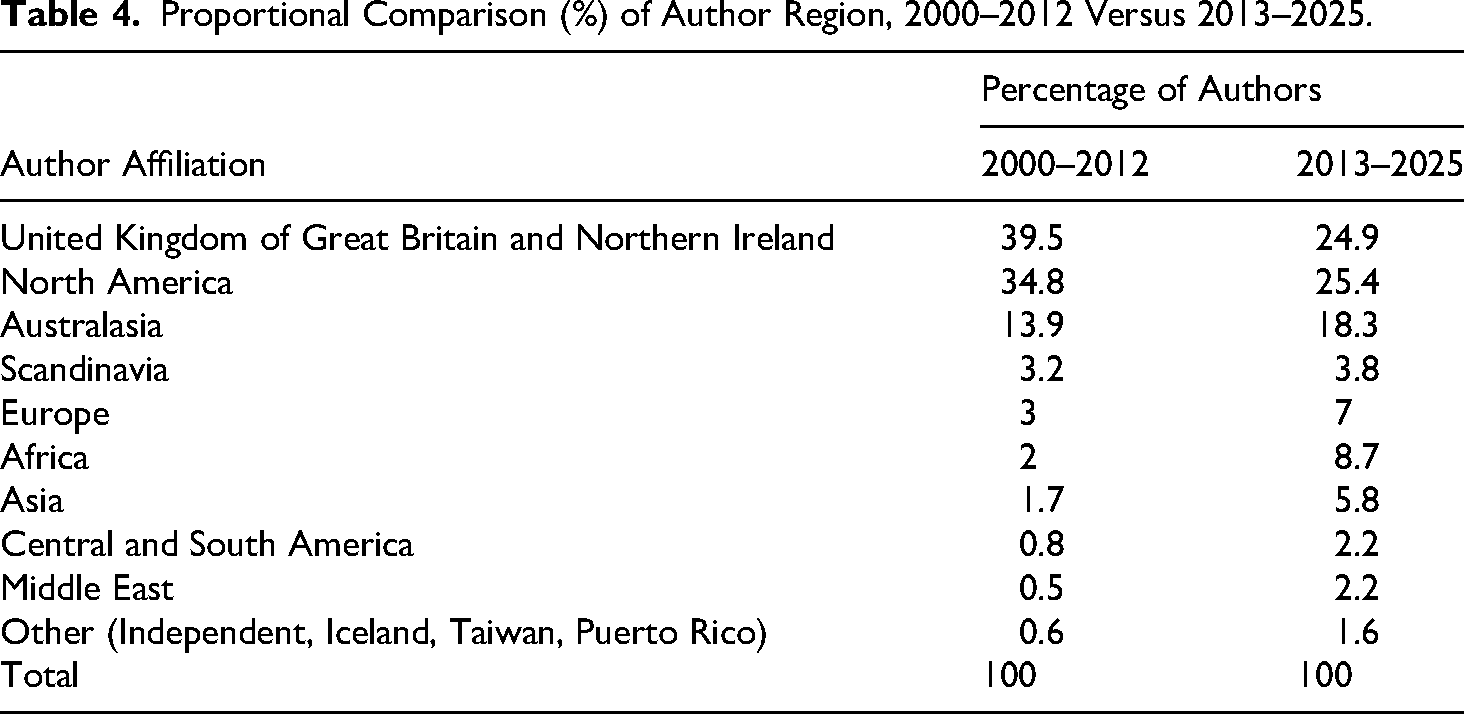
Of the total 449 manuscripts accepted between 2012 and 2025, almost 70% originated from just five Anglophone, global minority countries, namely:
United Kingdom (24.9%, down from 39.5% in the previous period), United States (19.2%, down from 26.7%), Canada (7.8%, down from 8.1%), Australia (9.6, up from 6.8%), and Aotearoa New Zealand (8.6%, up from 7.1%).
In contrast, many regions – including Asia, Latin America, Eastern Europe, and the Middle East – have only been marginally represented, often by single-digit submissions. Looking at the most recent figures, although we see high acceptance rates for some countries (e.g., South Africa), they remain relatively minor contributors to the Journal's overall published content.
Adding to Macleod and colleagues” naming of structural imbalance and material inequality across regions, we also consider the role of language. Language is both a practical and ideological barrier in academic publishing (Thiong'o, 1994). This is apparent in the high number of published articles by authors from English-dominant countries, who face fewer linguistic and conceptual barriers to publishing in F&P. Conversely, those from countries where English is not the main language – including both global minority countries (e.g., Germany, France) and global majority locations (e.g., Pakistan, Iran) – appear frequently among submissions but are rarely represented in published articles. The exception are majority world English-speaking countries, like South Africa, for which higher acceptance rates can perhaps be attributed to established critical psychology and feminist networks. These can help foster familiarity and alignment with the Journal's critical remit. (The presence of such networks in Australia and New Zealand may also confer an advantage to these English-dominant, global minority countries.) The significance of this trend is that, as Gatwiri et al. (2025, p. 3) assert, “the dominance of English and other colonial languages continues to marginalize knowledge grounded in Indigenous linguistic and cultural frameworks, reinforcing hierarchies of knowledge of legitimacy and accessibility”.
Another important aspect to consider is the composition of the editorial team. The editorship remained “white and western” – as per Wilkinson et al.'s (1991, p. 11) observation – until 2014, when Catriona Macleod stepped in as the first majority world editorial member. Eleven years on, Floretta Boonzaier was the second; she is the first Black woman to take up an editorial role. The current submission data affirm the importance of this issue; acceptance patterns are strongly aligned with the countries represented on the editorial team, and to some extent the wider editorial board. Again, we can link this pattern to well-established critical psychology communities in certain Anglophone countries, but it also points to the importance of editorial visibility, informal access, and epistemic familiarity. Editors not only review manuscripts, they also act as ambassadors, mentors, and cultural translators for the Journal. Their presence can shape who feels confident to submit, whose work is understood and valued, and which forms of feminist psychology are considered legible.
These insights underscore the need not only for diversification but also strengthening an explicitly decolonial orientation. In this regard, the Journal's 2020 Special Issue on “Feminisms and Decolonising Psychology” (Macleod et al., 2020) marked an important step, foregrounding the colonial entanglements of both psychology and feminism. The Editors argued for a decolonial feminist psychology, to grapple with psychology's complicity in imperialism, neoliberalism, and carceral governance, and work toward epistemic resistance. As Boonzaier et al. (2019, p. 1) observe, “psychology itself has been recognised as a form of settler-colonial knowledge”. This speaks to a one of the Journal's core foundational aims: to “turn the critical analytic eye back onto the discipline of psychology itself”, as Gavey and Braun (2008, p. 9) put it. Doing so includes recognising that feminist psychologies are themselves shaped by the sociocultural contexts in which they develop (Rutherford, 2021; Rutherford & Petit, 2015). Feminist psychology must reckon with its own colonial legacy and Eurocentrism (Boonzaier et al., 2025; Boonzaier & Van Niekerk, 2019; Cavazzoni et al., 2023, 2025; Kessi & Boonzaier, 2018; Macleod et al., 2023).
Feminist Psychology in an Era of Climate Change
Climate change is arguably the defining global challenge of our time, and our most pressing. Its impacts are gendered, racialised, and colonial, disproportionately affecting those already marginalised (Sultana, 2022a, 2022b). Feminist scholars have been slow to engage with the topic overall and there is a dire need for more feminist-informed social research highlighting the material and ideological dimensions of the climate crisis, and their deeply gendered nature (MacGregor, 2009). This is even more pertinent to the discipline of psychology, which has focused largely on individual affect and behaviour, rather than the full political and structural complexity (Barnes et al., 2022a). Instead, much of the psychological scholarship focuses on the individual level, considering affect and cognitions in order to improve adaptation, respond to mental health impacts (such as eco-anxiety, solastalgia, eco-paralysis) or promote pro-environmental behaviour (Clayton et al., 2015; Kern de Castro & Reis, 2025; Swim et al., 2009). Even environmental psychology tends to individualise harm and depoliticise the systems driving ecological collapse (Vavvos, 2024). This narrow focus reduces the solution-space to coping, resilience, and behaviour change (Morison, 2026).
Critical, socially attuned contributions remain rare and disparate, with notable exceptions like the more recent two-part special issue in the South African journal Psychology in Society (Barnes et al., 2022a, 2022b). Feminist psychology, with its attention to linkages between meaning, power, and inequality, and its legacy of social justice engagement, is well positioned to contribute to a more radical rethinking (Morison, 2026). For instance: Özge Savaş and Anjali Dutt (2023) use intersectional and decolonial feminist approaches to explore how climate change intersects with conflict and displacement. Meynell et al. (2024) examine the UK-based “BirthStrike for Climate” movement, illustrating how feminist theory can offer ethical, relational alternatives to dominant narratives of responsibility and sacrifice. Aside from a few exceptions such as these, feminist psychology, has been almost silent on the issue of climate change.
More broadly, critical feminist work from adjacent disciplines offers inspiration. Farhana Sultana's (2021, 2022) writing on critical climate justice, for example, foregrounds how marginalised communities are both most affected by and most excluded from climate governance. Sushmita Chatterjee's (2025) notion of “planetarian thinking” draws on transnational feminism to unmake nationalist boundaries, echoing Indigenous proposals regarding “planetary health” (Horton et al., 2014). Other feminist scholars writing in disciplines like women”s studies, demography, and development studies (e.g., Hendrixson et al., 2020; Senderowicz & Valley, 2023) have examined the reproductive justice implications of climate discourse, challenging populationist logics that blame the majority world for ecological collapse. Such work offers a much needed gendered and socio-structural perspective, without which climate change responses will be “insufficient, unjust, and therefore unsustainable” (MacGregor, 2009). Yet, feminist work remains lacking (Lawrence et al., 2025; MacGregor, 2009), and feminist psychology has much to offer. We argue that the time is ripe for feminist psychologists to engage this issue as researchers, as well as public scholars, educators, and activists. As with decolonisation, this is not just an opportunity but an imperative. The futures of our discipline, our communities, and our planet are inextricably intertwined.
Looking Ahead
Each new editorial team has reaffirmed Feminism & Psychology's commitment to a feminism-first, critical engagement with psychology, and to scholarship that contributes to social transformation. Eleven years on from the last editorial change, we too reaffirm this foundational vision. We remain committed to publishing work that is risky, unruly, or refuses orthodoxy – feminist work that does not play safe. In doing so, we reinvigorate Sue Wilkinson's (1991) call for creative exploration, updated for the current moment.
We see F&P as a critical home: a space for sustaining dissent, enabling epistemic disobedience (Mignolo, 2009), and collectively imagining more socially just futures. As Editors, we view our work not as gatekeeping or simply as curation, but as an ongoing feminist practice of care, refusal, and mentoring. At a time when academia is increasingly shaped by individualised metrics, precarious labour, and institutional pressures, these practices matter (Macleod et al., 2021). We remain committed to resisting the pull of narrow excellence frameworks, and to nurturing scholarship that speaks across boundaries – disciplinary, political, and geographic.
We have singled out two issues that we believe constitute critical junctures for feminist psychology today: the climate crisis and the project of decolonisation. These are not merely emerging “topics” – they are transformative political and epistemological challenges that reshape the terrain on which feminist psychologies must work. We look forward to publishing more work that centres these issues in ways that are contextually grounded, intersectional, and justice focused.
In relation to decolonisation, we are guided by those who have called for feminist psychology to move beyond inclusion and ask harder questions: What must feminist psychology unlearn? Who is it accountable to? Whose futures does it imagine (Boonzaier, 2025; Kurtiş & Adams, 2015)? We echo the call for epistemic disobedience (Bhana et al., 2025; Mignolo, 2009) as a necessary intervention into the enduring dominance of Euro-American frameworks and the politics of representation. Decolonial feminist psychology demands more than the symbolic diversification of authorship; it calls for a reorientation of editorial power, epistemic values, and scholarly practice, which includes creative ways of addressing questions around the ongoing coloniality of language.
We recognise that whose knowledge is published is shaped not only by who submits, but also by who holds editorial power. Our submission data suggest that manuscript acceptance is strongly aligned with countries historically represented on the editorial team. Editorial presence matters – not just to evaluate, but to encourage, mentor, and interpret. We reaffirm our commitment to building an editorial collective that reflects diverse positionalities, geographies, and epistemologies. In addition, we will actively seek to collaborate with guest editors from under-represented contexts – including those based in the majority world, Indigenous communities, and transnational diasporic spaces. These partnerships allow us to support regionally grounded knowledges, challenge dominant paradigms, and welcome intellectual traditions often excluded from Anglophone feminist psychology.
We are also inspired by the Special Issue on Feminisms and Decolonising Psychology, co-edited by Macleod et al. (2020), which explored the tensions and possibilities of working at this intersection. Building on this foundation, we hope to further deepen F&P's engagement with decolonial feminist praxis, particularly work that is grounded in memory, waywardness, community-building, radical love, and refusal (Boonzaier et al., 2025). We welcome research that explicitly links epistemic and institutional critique; that uses methods aligned with feminist decolonising commitments; and that attends to the colonial, racialised, and gendered dynamics of both research topics and knowledge practices.
Similarly, we invite further engagement with climate change and ecological crisis, through feminist and anti-colonial lenses. Feminist psychology has a vital role to play in advancing climate justice – foregrounding questions of power, relationality, and intersectional harm. We encourage work in this area that explores how gender, race, class, and geography shape both vulnerability and resistance, and that highlights alternative ways of knowing, relating, and imagining futures (Bhatia et al., 2020; Chatterjee, 2025; Sultana, 2021, 2022). Psychology has been slow to grapple with the structural and colonial dimensions of the climate emergency (Barnes et al., 2022b; Vavvos, 2024), and, as we have noted, feminist psychology has so far largely overlooked this pressing issue. Yet as Meynell et al. (2024) show, feminist theories can offer powerful resources for ethical, collective responses to climate breakdown. We hope F&P can contribute meaningfully to reshaping the broader discipline in this area, as part of our enduring commitment to social change (Gavey & Braun, 2008; Macleod et al., 2014; Wilkinson, 1991).
Finally, like our predecessors, we remain committed to widening the impact and accessibility of the Journal. As Wilkinson (1991) noted in her final editorial, F&P has not always succeeded in reaching practitioners and non-academic audiences. We want to build on the Journal's public-facing aims by revitalising the F&P weblog, appointing a dedicated person to lead it, and introducing short, accessible video abstracts for new articles. In time, we hope to offer plain-language commentaries alongside selected research articles. These developments speak not only to knowledge translation, but also to knowledge democratisation: broadening who F&P is for, and who feels spoken to by the work we publish.
In Closing
We are immensely grateful to our predecessors for sustaining and thoughtfully expanding Feminism & Psychology's foundational vision, in step with shifting academic, disciplinary, feminist, and geopolitical landscapes. Under their steady hands and incisive leadership, the Journal has flourished – growing in scope, reach and relevance, and firmly establishing itself as a leading platform for advancing feminist psychologies. It has served as a vital site for intellectual engagement, fostering critical debate, methodological innovation, and transformative scholarship.
Yet, the sense of possibility with which F&P began can feel distant today. These are indeed “revolting times” (Fine, 2016, p. 347) – marked by obscene inequalities and proliferating injustices, but also by the disruptive promise of radical movements and solidarities. It is precisely in such moments that we need what Fine (2016, p. 363) calls “critical optimism”: a praxis that traces circuits of dispossession alongside circuits of connection, and that remains attuned to both power and possibility. We aim to continue cultivating F&P as a space for such scholarship – one that does not shy away from complexity or contradiction, but instead holds space for dissent, imagination, and feminist struggle. In closing we echo Founding Editor Sue Wilkinson's (2007, p. 6) assertion that “equality is still a dream: one for which I will continue to struggle; one for which, as feminists, we must continue to struggle”. Continued and renewed feminist struggle – especially in these times of increasing inequity, reactionary politics, and the deepening climate crisis – remains hugely important for promoting a just world for all.
Footnotes
Acknowledgements
With warm thanks to Lorraine Radtke for her supportive reading and feedback on an earlier draft of the editorial.

Funding
The authors received no financial support for the research, authorship, and/or publication of this article.
Declaration of Conflicting Interests
The authors declared no potential conflicts of interest with respect to the research, authorship, and/or publication of this article.