



Abstract
According to the correspondence theory of truth, a proposition is true if and only if the world is as the proposition says it is. This theory has been both promoted and rejected by philosophers and scientists down through time. In this paper, we adopt the correspondence theory as a plausible theory of truth and relate it to science. First, we briefly outline the major extant theories of truth. We then present the correspondence theory in a form that enables us to show that the theory uniquely fulfills a crucial function in psychological research, because the interpretation of truth claims as suppositions that concern states of affairs in the world clearly explicates what it means for a theory to be true, and what it means for a theory to be false. For this reason, correspondence truth has the advantage of allowing researchers to properly understand the assumptions of scientific research as claims about the factual state of the world, and to scrutinize these assumptions. It is concluded that correspondence truth plays an important part in our understanding of science, including psychology.
Many scholars have taken the idea of truth and its place in life to be of major importance. Philosophers have taken truth to be an intrinsic good, worthy of pursuit for its own sake, as well as a good that enables us to understand the difference between being right and being wrong. They have also regarded truth as a major goal of disciplined inquiry and an indispensable part of an adequate philosophy of science.
Like all central philosophical concepts, the concept of truth has been the subject of considerable debate. A number of loosely related movements that go under the names of social constructivism, postmodernism, and the new pragmatism have declared that both science and the humanities should jettison the idea of aiming at “the truth” because it is pretentious and unworkable. In addition, some philosophers of science suggest that truth should play a greatly reduced role in science: for example, applying to empirical generalizations, but not to explanatory theories. Other philosophers believe that it is a mistake to search for a substantive theory of truth that sheds light on what the property of truth amounts to, maintaining that an austere, nonsubstantive understanding of truth is all we need and can expect.
We think a full consideration of the relevance of truth for science is warranted—what truth is, why it is important, what a concern for truth entails, and how truth actually plays out in science. These are of course important questions for philosophy to answer, but they also have an important role in helping us understand science. In this paper we are concerned with two of these matters: what truth is, and how it is implicated in scientific practice.
The basic aim of the paper is to adopt and use the concept of truth as ordinarily understood. By “truth as ordinarily understood,” we mean the intuitive notion that a proposition p is true if and only if the world is as p says it is. Henceforth, we will designate this idea by its usual philosophical name of correspondence truth. Before presenting the basic ideas of correspondence truth, we present a penny sketch of the different major theories of truth that have been proposed in the past, so that readers unfamiliar with the topic will have a better idea of what we are trying to say in the paper. After presenting an overview of correspondence truth, we show in some detail how it is presupposed in different levels of theoretical endeavor that are commonly encountered in science. We maintain that a presupposition of correspondence truth is essential to a proper understanding of science. We illustrate this contention with particular reference to psychology.
Theories of truth
Perhaps the most striking feature of the literature on truth is that it is populated with a sizable number of different theories that vary in their nature and complexity (see Engel, 2002; Kirkham, 1992). For our purposes, it is sufficient to be aware of the four most influential types of theory: correspondence, coherence, pragmatist, and deflationary. In brief, correspondence theories maintain that a proposition is true if and only if it corresponds to a state of affairs and that state of affairs obtains. For instance, with the correspondence theory, the proposition “general intelligence is neural plasticity” is true if and only if there exists a state of affairs that makes this sentence true: that is, a state of affairs such that general intelligence and neural plasticity are the same attribute. Coherence theories, in contrast, assert that the truth of a proposition results from its cohering with other propositions. For these theories, “general intelligence is neural plasticity” is true if and only if that proposition is coherent with other propositions accepted in science—either in our current science, or in some ideally completed science. Pragmatist theories declare either that truth involves the validation of assertions by showing their cognitive usefulness in the world, or it is what is reached by agreement in the long run. In the first pragmatist interpretation, “general intelligence is neural plasticity” is true if and only if it is useful to believe that general intelligence is neural plasticity (see James, 1907); in the second interpretation, the sentence is true if and only if scientists will, or ideal scientists would, come to agree that it is true in the long run (Peirce, 1931–1958). The latter interpretation is also known as the consensus theory of truth.
These three theories take truth to be a substantive property, and for this reason are said to be inflationary theories: scholars who adhere to any of these theories try to explicate what the nature of truth is. By contrast, deflationary theories, which come in considerable variety, deny that there is a property of truth as such. Scholars who adhere to such theories argue that a substantive concept of truth is superfluous, and can be deleted from all discourse without loss of content. For deflationists, the predicate “is true” in a sentence merely performs the linguistic function of assenting to a proposition, and it can be dispensed with, without loss of meaning. That is, “the proposition ‘general intelligence is neural plasticity’ is true,” for them, means exactly the same as the sentence “general intelligence is neural plasticity”; therefore, the notion of substantive truth is taken to be empty.
Deflationary and correspondence theories can both be viewed as realist theories of truth, in the sense that they hold that truth is a function of how the world is structured, rather than of our currently favored theories or pragmatic concerns. For concrete individual empirical propositions, the theories will give the same verdict regarding their truth. The correspondence theory, however, emphasizes that there is a property that all true propositions share—namely, correspondence with the facts—while deflationary theories deny such a property. This reference to the collective property of true sentences is important and routinely used in science, as we will argue later in this paper: for instance in the characterization of such mundane things as fraud.
We are attracted to the correspondence theory for two reasons. First, it is a philosophically respectable theory of truth, though, like all theories of truth, it has its share of critics. Second, it has the conceptual resources to underwrite a number of distinctions that we think are important in science, including the distinction between truth and falsity. We endeavor to show this in the second half of the paper. In the absence of providing a proper justification for accepting correspondence truth, we note that it is defended at length, and in different ways, by David (1994), Engel (2002), Englebretsen (2006), Fumerton (2002) and Vision (2004).
We now proceed to a characterization of the correspondence theory.
Correspondence truth
Correspondence theories of truth begin with the common sense idea that a statement is true if it corresponds to reality. This idea, however, gets formulated in different ways. All correspondence theorists preserve Aristotle’s definition of truth: “To say of what is that it is not, or of what is not that it is, is false, while to say of what is that it is, and of what is not that it is not, is true” (Aristotle, trans. 1948, 1011b25). By accepting this quotation, correspondence theorists are committed to saying what it is for something to be false as well as what it is for something to be true. Because Aristotle’s dictum squares with the common sense intuition that truth is correspondence with the facts, it is sometimes regarded as a minimal account of correspondence truth. However, his characterization of truth refers neither to a correspondence relation nor to facts, and for this reason it is also sometimes held to be a precursor to, and consistent with, a deflationary account of truth. Thus, one needs to look for more than is contained in Aristotle’s dictum if correspondence truth is to be distinguished from deflationary alternatives.
In this regard, correspondence theorists generally agree that truth is a substantive relational property that obtains when something (a truthmaker) makes something else (a truthbearer) true. That is, a truthbearer is true if and only if it corresponds to a truthmaker, although, as we shall see shortly, correspondence theorists can differ in their views about the nature of the truthbearers, the truthmakers, and the correspondence relation. We endorse the view held by some philosophers that, at a minimum, an adequate theory of correspondence truth must say what the bearers of truth are, what the makers of truth are, and what correspondence relations are. We now briefly consider these requirements in turn.
Truthbearers and truthmakers
The term truthbearer is commonly used in the philosophical literature to refer to any entity that is true or false. The term truthmaker refers to anything that makes an entity true or false. In other words, the truthbearers are what the truthmakers make true. As just noted, accounts of both truthbearers and truthmakers are sought by correspondence theorists, although they have given more attention to the latter.
A number of candidates have been proposed as the appropriate bearers of truth. Principal among these are statements, sentences, propositions, and beliefs. For our purposes, it is not necessary to delve into the debate about the relative merits of these candidates, about which there is no settled view of the matter. We will adopt propositions as our favored type of truthbearer for the following reasons: their meanings can remain stable when expressed by different sentences; they can be held in different attitudes or modes (e.g., accepting, believing, denying, suggesting, and exclaiming); and, as the content of cognitions, they bring with them a strong sense of psychological realism. We understand the relationship between propositions and other sorts of truthbearers in the following way: sentences (linguistic symbols) are used to make statements (speech acts) that express propositions (mental contents) that can be believed or doubted (propositional attitudes). Although we think propositions are basic, other features of truthbearing will feature in accounts of correspondence truth, depending on context. For example, when considering reports of published work in science, it is often appropriate to treat the truthbearers as sentences because that is the medium through which much of the propositional content of its truth claims is presented.
The claim of correspondence theorists that the truth of a proposition is determined in some way by reality, or a part of reality, makes the idea of truthmakers intuitively compelling. Despite the plausibility of this basic idea, the questions of what truthmakers are, and how they do their work, are rather contentious (e.g., Lowe & Rami, 2009). Nevertheless, truthmakers are clearly indispensable for correspondence theorists because they see the appeal to such entities having an important role in their efforts to provide substantive accounts of the truth of propositions.
As with truthbearers, a number of proposals have been put forward to serve as the makers of truth. Foremost among these are facts, states of affairs, objects, properties, things, tropes, and moments. Taking the common sense meaning of the more familiar of these truthmakers for granted, we adopt the following minimal characterizations of the less familiar ones: a state of affairs is a member of a varied set of particulars, properties, and relations that make up the world (e.g., the property of deception); a trope is an instance, or part, of a property (e.g., Sir Cyril Burt’s deception); and a moment is an object that requires the existence of another object, or other objects, for its own existence (e.g., the deception of the scientific community by Sir Cyril Burt).
Note that for most, if not all, of these truthbearers there will be propositions to which they do not apply. Thus, a realistic perspective on correspondence theory will have to admit a multiplicity of truthmakers. The second major part of the paper, on truth and scientific practice, will address this issue in order to show in some detail how different sorts of truthmakers are required to make proper sense of different aspects of scientific inquiry. For convenience, we will follow an established custom and use fact as a catch-all ontological term when no particular type of truthmaker is required.
Correspondence relations
Truthbearers and truthmakers stand in relation to one another, and correspondence theorists are, therefore, charged with the responsibility of characterizing this relation as a correspondence relation. The philosophical history of truth indicates that this has been a tall order—one that some think is beyond our ability to illuminate. There are a number of different conceptions of the correspondence relation, which has been variously described as a mirror, a map, a reference relation, a correlation, congruency, and more. In the face of these differences, and a lack of agreement as to which is best, critics of correspondence truth often point out that little progress has been made in explicating the nature of the correspondence relation.
Influenced by the 19th-century British empiricist belief that simple ideas were copies of sense impressions, some correspondence theorists seemed to hold that the correspondence relation was a matter of copying or mirroring nature. Even today, it is sometimes objected that the correspondence theory of truth adopts this view of the correspondence relation (e.g., Rorty, 1979). However, this is an attribution that modern correspondence theorists reject, and for good reason. A mirror of the world, literally taken, would be about as useful as a map of a city on a scale of 1:1. It is an essential feature of scientific theory that it abstracts away from irrelevant features of the world in studying a given situation, and that it idealizes certain properties held to be causally effective in that situation, for instance in producing mathematically tractable models. This is why scientific theories work at all. If scientific theories mirrored the world precisely, they would be completely useless; in fact, they would not even be scientific theories as we know them.
A more accurate and informative characterization of the correspondence relation depicts it as a mapping relation. In this regard, Hooker (1987) suggestively states:
The features of the world that are mapped and the way they are mapped into the existing informational state of the organism are idiosyncratically selected according to the organism’s ends, in the light of its capacities; thus we expect no identities, only transformations and embeddings appropriate to making appropriate identifications for action. (p. 279)
An expansion of this statement of perceptual realism would provide us with some genuine understanding of how we get in touch with the world (more precisely, the middle-sized objects of the world) in a structure-preserving way. It is the various homomorphisms between the map, understood as a representational device, and independent aspects of reality that preserve this structure. There is much that one can say about how the mapping of models to reality should be conceived of (see, e.g., Borsboom, 2005, for a number of possibilities in the context of measurement), and there are many uncertainties about how this should best be done. However, one thing seems clear: mapping rather than mirroring is a better metaphor for understanding the correspondence relation.
A related approach taken by some philosophers, and to which we are attracted, is to invoke a causal theory of reference through which one characterizes the correspondence relation as a referential relation between meaning and the world. The basic idea here is that reference involves identifying a causal chain by which a noun term is grounded in an object, whether the referent can be observed or not. There is considerable controversy about whether causal theories of reference succeed in this way. One of the leading exponents of the causal theory of reference, Michael Devitt (1991), maintains that the correspondence theory of truth needs a naturalistic causal theory of reference, otherwise we would have to give up on meaning altogether. He is optimistic that some combination of our best extant theories of reference will give us a prototheory of this type, but he acknowledges that a fully satisfactory theory is yet to be found.
Despite the difficulties in characterizing the correspondence relation, we think the multiple, different explications of the correspondence relation can be put to good use, because not all parts of the research process are grounded in the same conception of correspondence. We show that this is the case later in the paper.
For the truthmakers mentioned above, correspondence is naturally interpreted as a causal relation. Propositions or, more generally, cognitions are shaped by causal input from the world (and in turn causally feed back to the world). That we relate to the world causally, rather than logically, is a view accepted by many philosophers of science (e.g., Hooker, 1987; Psillos, 1999). One criticism of a causal view of correspondence truth is that, while it applies to the physical world, it does not apply to domains such as morality and mathematics, and even some parts of science. For it is reasoned that there are no moral and mathematical facts of the matter to make their discourses true, and that science itself often appeals to counterfactual states of affairs. This has led some truth theorists to reserve correspondence truth for the physical world, and turn to the coherence theory of truth for disciplines such as morality and mathematics. Coherence theorists contend, controversially, that true propositions are made so in all these domains—including the empirical sciences—by being members of a coherent system of beliefs that are consistent with, and mutually supportive of, each other. That is, they fit with other beliefs, but they are not realized by facts.
Although coherence theories have long been regarded as theories of truth, we think it is better to regard them as furnishing criteria for justifying knowledge claims. In other words, coherence considerations properly figure in assessments of the credibility of beliefs, but they are not constitutive of truth itself. We want to emphasize that truth and justification are quite different matters, and to conflate them is to court conceptual confusion. Importantly, distinguishing between truth and justification enables the correspondence theorist to embrace the idea important to science that there can be considerable evidence for a false proposition, and a complete lack of evidence for a true one.
Rather than look to use different theories of truth for different domains, we think it is better to stay with correspondence truth but, as just noted, look to work with different notions of the correspondence relation as appropriate. Gila Sher (2005) promotes such a conception of truth in which causal correspondence is just one conception of the correspondence relation. She briefly discusses the possibility of complex, non-causal realizers of correspondence, the development of which would lead to a multi-faceted and richer theory of correspondence truth than is currently available.
Two caveats
To round out our general characterization of the correspondence theory of truth, we briefly discuss two matters that often arise in critical discussions of the theory, and which reveal basic misunderstandings of the theory. First, it has been said that the correspondence theory requires us to have direct access to reality—that is, to facts, or states of affairs that makes its truthbearers true—in order to judge how propositions correspond to facts. However, because such a “God’s-eye” view is impossible to attain, it is concluded that the correspondence theory is seriously defective. Correspondence theorists standardly reply to this challenge by stating that their theory of truth is a semantic theory concerned with proposition–world relations. As such, it is radically non-epistemic in nature and is not, therefore, fundamentally concerned with the assessment of truth claims. Moreover, correspondence theorists insist that a commitment to correspondence truth does not preclude scientists making judgments about truth. For, as noted earlier, scientists invoke the distinction between truth and justification, aim at truth, and employ justificatory criteria to make judgments about truth. For example, psychological scientists have frequently made truth assessments of claims about the existence of general intelligence by employing factor analytic methods to evaluate the worth of theories of general intelligence.
The second matter has to do with the vexed issue of whether or not correspondence truth implies a commitment to realism (more precisely, metaphysical realism)—roughly, the idea that things in the world exist independently of our thoughts about them. It is widely held that correspondence truth and realism are closely related, such that a commitment to correspondence truth brings with it a metaphysical commitment to the belief that facts or states of affairs objectively exist in the world apart from the propositions to which they correspond. It is for this reason that the correspondence theory of truth, or something close to it, is sometimes said to be a realist theory of truth (e.g., Alston, 1996; Fumerton, 2002). However, we think that truth is a semantic issue, that realism is first and foremost a metaphysical issue, and that they need not go together (see Devitt, 1991). At some strain, one could be a correspondence theorist and an idealist, as was J.E.M. McTaggart. More readily, one could be a realist and subscribe to a deflationary theory of truth, as does Paul Horwich (1998).
That said, it should be noted that correspondence truth and metaphysical realism are natural allies, for facts are naturally understood as mind-independent parts of reality, and it is facts that make truthbearers’ correspondence true. We ourselves subscribe both to correspondence truth and metaphysical realism and, furthermore, we take these as two aspects of our broader commitment to scientific realism, which is the philosophy of science we presuppose in the following discussion of truth and scientific practice.
Truth and scientific practice
Consider a very common form of scientific practice, namely criticism. Suppose that you are involved in the publication of a scientific theory about, say, the evolutionary explanation of a given feature X of human behavior, whereby you argued that feature X evolved because it increased the inclusive fitness of human beings in the evolutionary ancestral environment. Suppose further that your colleague, Professor Brainsweat, thinks that your explanation is flawed and writes a paper expressing his criticisms. In particular, he questions an assumption, A, that you made, say, that the property in question arose in response to certain environmental pressures that shaped selection. Brainsweat thinks that these environmental pressures did not exist, and he writes a critical commentary on your paper to argue his point.
What is it that Brainsweat is doing? Does he challenge the idea that it is useful for you to believe A (pragmatism)? Or is he really saying that assumption A is incoherent with other assumptions that you, or the scientific community at large, are likely to endorse (coherence theory)? Should Brainsweat’s activity be understood as a linguistic speech act that fulfills the function of “questioning” and “interrogating” you (postmodernism)? Or should we perhaps interpret Brainsweat’s criticism as meaning that, in the long run, scientists will ultimately agree that A is false (consensus theory)?
The list could be lengthened considerably according to every alternative to the correspondence theory that has been proposed, and surely Brainsweat’s activity could be interpreted as doing all these things. But the core of the matter is simply that Brainsweat denies that A is true in the correspondence sense: that is, he thinks that the environmental pressures mentioned in A did not exist so that there are no facts to function as truthmakers for your potential truthbearer A.
This indicates a highly important feature of correspondence truth: taking truth as the correspondence of propositions to facts forces the scientific community to lay out in the open the facts that are being assumed in proposing an explanatory theory. Since truth and falsity are a package deal, this simultaneously opens up the possibility of attacking these assumptions, because a correspondence reading of propositions makes clear not only what the researcher is assuming, but also what possible refuting material would look like. That is, a correspondence reading of theories immediately generates possible falsifiers for the theory. This is an important function in scientific discourse that, ironically, theories about discourse, such as postmodernism, cannot explain, because they typically deny any function for correspondence.
We now argue this point in detail by examining various levels of theory at which statements can be questioned, and by evaluating what is actually involved in assigning a function for correspondence truth at each of these levels. The theoretical levels that we distinguish are the procedural level, the data level, the phenomenal level, and the causal level. As a rule of thumb, correspondence relations become more difficult to conceptualize as one ascends the hierarchy of theoretical levels, which means that there is also more room for criticizing them. However, we will argue that it is unreasonable to deny that what is being criticized is the presence of correspondence truth. In this sense, correspondence truth fuels critical inquiry and thereby is indispensable for scientific practice.
The procedural level
The complex hierarchy of theoretical levels that we are about to explicate is represented in Table 1. First, consider the simplest level in the hierarchy, which we call the procedural level. This is the level at which a scientific researcher makes no serious claims about a basic structure of reality, but simply reports what he or she did in carrying out the research. For instance, a researcher may report that 52 undergraduate students at the University of Amsterdam participated in an experiment and received 7 euros each for their participation. Even though the category “undergraduate student” is a socially constructed one rather than a natural kind (Hacking, 1999), and money is a familiar example of an ontologically subjective entity (i.e., something is money only because we regard it as money; Searle, 1995), it is quite impossible to deny that the researcher does claim that there were 52 persons, who fall in the socially constructed category of “undergraduate student,” and that they were given 7 euros of this ontologically subjective stuff we call “money.” This statement is not intended to cohere with other accepted statements, or to deliver a pragmatically useful object for use in one’s belief system, but to report a fact about the research. It is a statement that reports on how a part of the world is (or was, at the time of the research), and must be read in a correspondence sense.
Levels of theory and correspondence truth
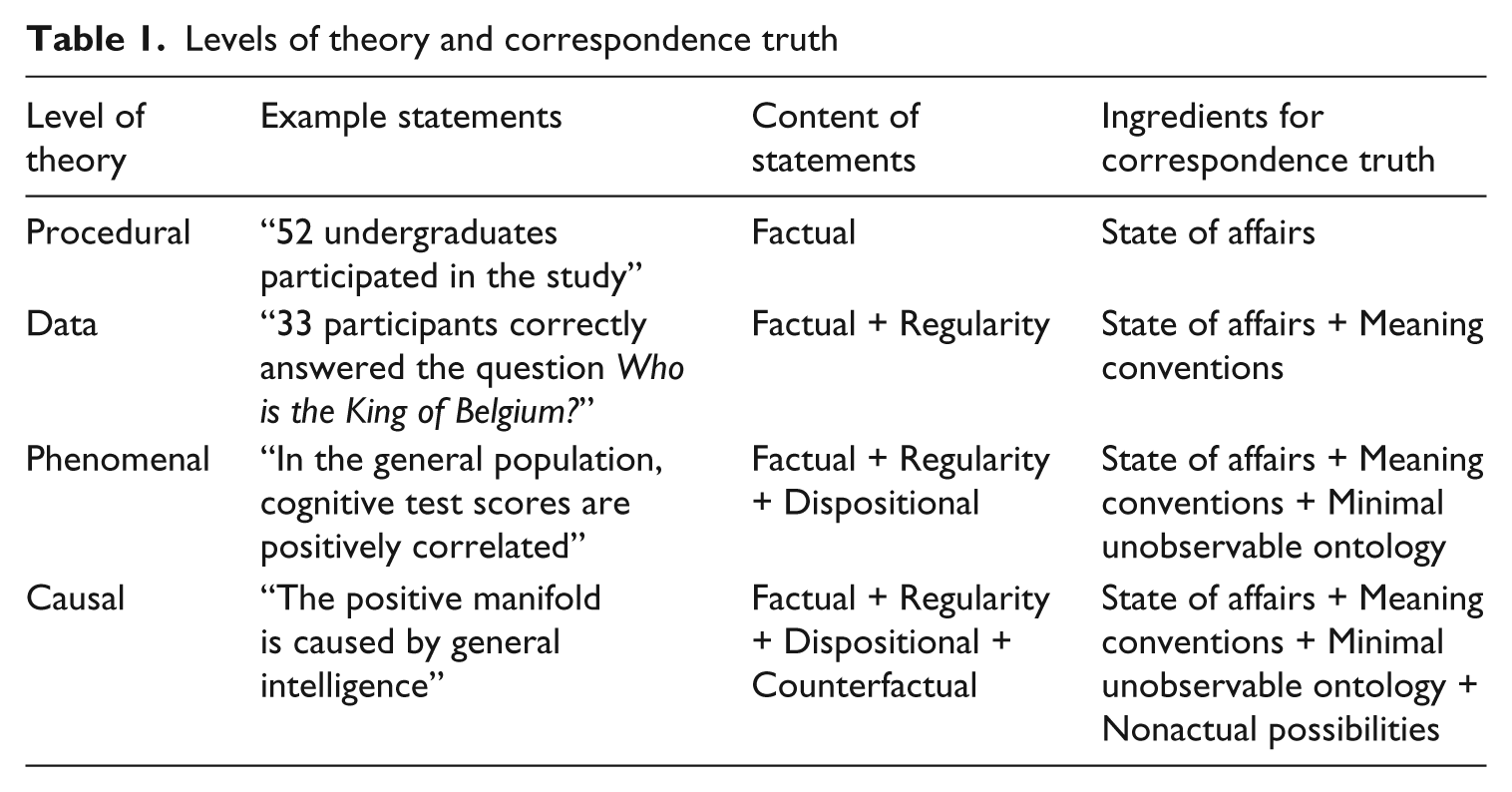
This becomes immediately clear when we consider what happens when a critic questions reports of this kind—that is, when a critic questions whether the research was carried out as reported, or indeed whether it was carried out at all. Several important episodes in scientific history actually involved such questioning: one of the most famous examples was the claim that Sir Cyril Burt had reported data on twins who did not exist (Kamin, 1974); another, more recent example involved the case of Hwang Woo-Suk, who reported data on the existence of cloned human stem cells which were largely fabricated (Kennedy, 2006). Denying the truth of claims made at the procedural level thus naturally gives rise to allegations of negligence or, in the extreme case, scientific fraud. It actually seems to us that in order to characterize scientific fraud at all, it is necessary to interpret procedural claims as correspondence claims. Of course, it is open to pragmatists and postmodernists to give an alternative characterization of scientific fraud without making use of the correspondence of propositions to facts. We think, however, that without appealing to the correspondence theory, such an account would be very difficult to substantiate.
The data level
At the data level, correspondence truth is also essential. At this level, the researcher requires the reader to accept the data under consideration. This does not involve the interpretation of data as (indirect) measures of more abstract theoretical attributes, like intelligence or personality traits, but merely the acceptance of the data themselves. That is, if the researcher reports that 33 of the 52 students correctly answered the question “Who is the King of Belgium?,” we take this to mean that 33 of them actually did mention King Albert II.
One may argue that the researcher could have miscounted or misinterpreted some of the responses, so that the statement might be false. This is indeed possible, but it merely underscores the importance of correspondence truth; for in asserting that the researcher may be wrong about the data, we assert that the world might have been such that the statement under consideration fails to correspond to it, which is only a meaningful assertion if there also exists a statement that does correspond to the world (e.g., “29 students mentioned King Albert II”). This underscores exactly the point of correspondence truth: the truthmaker is a relevant part of the world, rather than of the researcher. In this way, the data level also is intimately connected to the procedural level; in the cases of scientific fraud mentioned above, the incorrectness of procedural claims (that the data originated as described) often was based on unlikely aspects of the data themselves (as when Kamin, 1974, noted that Burt’s reported correlation matrices were identical, although they were claimed to arise from different samples).
It is important to note that, even though at the data level the researcher is not making theoretically intricate claims, correspondence relations may become quite involved. For instance, in scoring participants’ answers to the question “Who is the King of Belgium?” as correct or incorrect, the researcher is not delivering a simple fact about what the participants did, but reports an evaluation of their action. That is, it is not a physical fact about the world that, say, John answered the question under consideration correctly. It may be a physical fact about the world that John marked a certain box on a piece of paper, or that his vocal cords produced vibrations in the air that most people with the right linguistic background would interpret as “Albert,” but the assessment of this response as “correct” involves an additional evaluative act on part of the researcher, who assesses the response in terms of relevant accepted background knowledge. Now, this background knowledge contains purely conventional elements (i.e., that there exists an arbitrarily bordered piece of land that we call “Belgium,” and that one of the people living there is referred to as the “King of Belgium”). And conventions, by their nature, are not particularly promising candidates for truthmakers.
Although it is insightful to consider these issues, because it shows how much background assumptions are actually involved in the process that leads from John’s utterances to the occurrence of a “1” in the relevant position of the datafile, it is also important to consider the limitations of objections to external truthmakers that could be based on these issues. Generally, we think that the assumptions involved in getting from the world to a datafile should be viewed as regularity conditions. That is, they are important aspects of the research, but they do not generally influence the data. The reason for this is that the conditions do not vary over participants or researchers, since everybody understands how the terms “Belgium” and “King of …” are to be interpreted. What is important at the data level is not primarily how John came to have a “1” in the relevant position in the datafile, but that the procedure that puts John in the same class as other people who have a “1” at the relevant position is insensitive to the conventional and interpretative elements of the research procedure. The reason for this insensitivity is that the interpretative elements do not vary over people. Given such insensitivity, the causal factor that leads to the ones and zeros in the datafile is likely to be simply that people did or did not give the correct answer, where “correct” is defined conditional on all the conventional elements that are required to produce the valuation. This, then, is the admittedly unromantic external truthmaker for the statement that 33 participants answered the question correctly: they mentioned Albert.
The phenomenal level
Bogan and Woodward (1988; see also Haig, 2005) have argued that the objects of scientific explanations are not data themselves, but phenomena that are abstracted from the data. For instance, the researcher in our example may have administered a number of other questions and tests to the participants in his experiment. He may have found that people who answered one question correctly had a higher probability of answering a different question correctly, and also, on average, had higher scores on several other cognitive tests. That is, his variables form a positive manifold (i.e., all correlations between the variables are positive). He may conclude that he has detected a phenomenon—that is, a robust empirical fact about cognitive test scores—which is an appropriate object for scientific explanation. It is natural to express such phenomena as empirical generalizations: that is, as generalizations to a population on the basis of the properties of a sample. How does correspondence truth apply to such statements?
In the case of the positive manifold, one may be tempted to construe the relevant generalization as “in the general population, the correlations between all cognitive test scores are positive.” However, this is a rather naïve way of constructing the generalization since, as Rozeboom (1966) has correctly pointed out, it is plainly false. Most people in the general population do not have any cognitive test scores attached to them for the simple reason that they never were administered the tests in question, so the correlations between these test scores do not exist either. Hence, construed in this way, it is impossible in principle that the generalization has a truthmaker in the external world.
In order for generalizations like the above to have an external truthmaker at all, one has to reformulate them in dispositional terms. A dispositional analysis of a concept analyzes the meaning of that concept in terms of subjunctive conditionals (“if … then …” sentences). A dispositional property, then, is one we speak about in terms of subjunctive conditionals. Fragility is the standard example. When one says that a vase is fragile, one ascribes to the vase a property that makes the sentence “If the vase were to be dropped, then it would break” true. Dispositions are thus characterized in terms of the way that the bearers of the disposition react to certain situations.
For the present example, reformulation of the empirical generalization about the positive manifold in terms of dispositional sentences would have to proceed by first ascribing dispositionally defined test scores to the members of the population. So construed, “Each member i of the population has a score on test j” is replaced with “Each member i of the population would get a score x ij if he or she were administered test j.” The positive manifold as a general phenomenon is then reformulated as “The population correlation matrix of dispositional test scores x ij for people i ∈ P and tests j ∈ C contains only positive elements,” where P is the general population, and C is the class of cognitive tests. The fact that the generalization here involves currently non-existent entities (namely the hypothetical test scores) shows that, even in producing a basic generalization of this form, the researcher has already made an ontological commitment to the structure of the world, which is taken to sustain this dispositional sentence. This is the case even though the ontological commitment is weak, in the sense that it ascribes certain causal properties to the world (i.e., that the world is such that we get the positive manifold) without specifying the causal structure that produces the phenomenon in question.
In articulating an empirical generalization, then, the researcher commits to the existence of such a feature of the world, however loosely specified, and is claiming correspondence of his proposition to a (dispositionally defined) fact. Again, this becomes clear when we consider what the denial of such a claim amounts to. For instance, if a critic denies the presence of the positive manifold (without questioning the procedural or data level), that critic is arguing either that there are cognitive problem-solving assessments that fail to display a pattern of positive correlations, or that such assessments could be made. This is a good example of how a correspondence reading of scientific statements, even when they involve highly abstract dispositional claims, suggests refuting data and thus plays a fruitful role in the scientific process. In the present context, Thurstone’s search for the Primary Mental Abilities was an instance of such a (failed) search in the context of general intelligence. If Thurstone had succeeded, he would have broken the empirical regularity of the positive manifold, and thereby would have refuted the dispositional claim that all cognitive tests are positively correlated in the general population. We are sure that Thurstone would not have embarked on his search had he interpreted Spearman’s hypothesis on the positive manifold as merely pragmatic in character, or as a postmodern speech act. This shows how deeply the act of criticism, in this case through empirical refutation, is rooted in a correspondence reading of theoretical claims.
The causal level
Many philosophers and scientists take it as an aim of science to provide us not only with empirical generalizations, but also with explanations of these generalizations. Such explanations move from the loose ontological commitment “the world is such that generalization x will be confirmed for the as yet unobserved cases that it covers” to a more precise and deepened articulation of this ontological commitment of the form “generalization x is true because the structure of the world is such and so.” In moving to a more precise specification of the production of the established generalizations, the researcher will typically invoke unobserved structures that have causal relevance for the phenomena to be explained. This means that the researcher is now going beyond what has been observed in the past, or will be observed in the future, and starts making assumptions about unobservable features of reality that are deemed explanatorily relevant for the phenomena of interest. In the philosophy of science, the scientific function of, as well as the possible justification for, such a move is the primary topic of disagreement between scientific realists and empiricists (see Hacking, 1983; Van Fraassen, 1980).
In terms of our working example, a researcher may, for instance, explain the positive manifold by referring to a general factor of intelligence that pervades scores on many different cognitive tests (e.g., Jensen, 1999). Individual differences on this g factor are thus hypothesized as the common cause of individual differences in cognitive test scores. It is important to note that there is no number of conceivable observations, finite or infinite, that would ostensibly prove such a theory to be correct. When a researcher accepts g as an explanation of the positive manifold, thus moving beyond the available observations, an inference is made about the existence of g on the basis of the explanatory virtues of the theory of g. In the philosophical literature this form of reasoning is known as existential abduction. When a researcher subsequently accepts the theory of g on the grounds that it is a better explanatory theory than competing theories of intelligence, the abductive form of reasoning involved is called inference to the best explanation (Haig, 2009; Psillos, 2002). In contrast to a conclusion arrived at deductively, inference to the best explanation is subject to so-called defeaters: future observations may turn out to refute the conclusion arrived at, or future theories may provide a better explanation of the phenomenon of interest. Hence, the abductive generation of hypotheses invariably involves a speculative dimension.
In the present context, it is interesting to inquire what a researcher who takes g to be a possible causal explanation of the positive manifold is speculating about. What does it mean to say that g causes the positive manifold? It appears that a researcher who makes such a causal claim is committed to at least three propositions: (a) g exists; (b) there is a process p that connects g with the positive manifold; and (c), ceteris paribus, if either g or p had not existed, then we would not have found the positive manifold. Proposition (a) speculates on the existence of some latent attribute that induces a linear ordering in general intellectual ability, and proposition (b) says that the cognitive processes involved in IQ testing transferred individual differences in this ability into individual differences in test scores (i.e., it assumes the validity of cognitive tests for that attribute; Borsboom, Mellenbergh, & van Heerden, 2004). These two assumptions do not provide serious difficulties for truth ascriptions: although they involve a reference to unobservable entities and processes, these assumptions are intended to state how the world is—that is, their truth rests on a correspondence relation with the current state of affairs.
However, proposition (c) is different, for it says something about how the world is not. That is, it involves a counterfactual statement. In order to be clear about this problem, one needs to get rid of the ambiguities in the referential connection that the term “g” may bear to the world. Suppose, for this purpose, that the term “g” turns out to co-refer with some neurological term, say, “neural plasticity” (Garlick, 2002): that is, we suppose that individual differences in g are, in point of fact, individual differences in neural plasticity. If we assume that such an easy connection between the psychological and the neurological could be made, then our assumption (c) reads: “ceteris paribus, if people had not differed in their level of neural plasticity, then we would not have found the positive manifold.” It is evident that this sentence refers to what the state of affairs would have been in some possible, but not actual, world in which everybody had the same level of neural plasticity.
Thus, the content of a causal assertion or theory is essentially richer than the actual empirical state of affairs in the world. This provides a difficult problem for correspondence truth. The reason for this is that, if truth is correspondence to reality, and a counterfactual assertion places its truth conditions on states of affairs in non-actual worlds, then these non-actual worlds have to be viewed as part of reality if they are to be the external truthmakers of the assertion. In order to save correspondence truth, then, one requires a metaphysical explosion of reality in the sense that reality is taken to contain not only what exists, but also what does not exist but is possible. While some (most notably Lewis, 1973) have in fact chosen to bite the bullet and accept possibilities as part of reality, most philosophers view this as an absurdity that is to be avoided. Another possible response is to argue that conditional statements are not genuine propositions, so that either causal statements should not be read as conditionals or they should not be candidates for truth at all. A thorough treatment of this problem is beyond the scope of the paper. As far as we know, however, no agreed upon conceptualization of correspondence truth has been proposed that deals with this issue.
Perhaps, the social constructivist who reads this will think “Aha, there we have it! The correspondence theory is false!” However, that would be a premature reaction. First, literal readings of causal assertions spur a great deal of scientific research and are thus highly productive; it is quite hard to make sense of science without allowing at least the possibility of causal claims being correct, despite the philosophical problems of explicating what the truth of causal statements amounts to. Second, although the truthmakers for causal assertions are generally intricate, their falsifiers are not. The fact that A is, without exception, followed by B does not license an inference to the claim that A causes B, as Hume famously argued, because it provides no data to support the ampliative aspect of a causal inference (i.e., to establish what would have happened if A had not occurred). However, should B ceteris paribus fail to occur upon the occurrence of A, the causal claim is clearly falsified, as Popper equally famously pointed out. But of course, the observation “A and not-B” falsifies the causal claim only if that causal claim is taken to be a possible candidate for truth. Hence the falsification of causal claims is impossible without some form of semantic realism that naturally brings with it a correspondence reading of such claims. Third, if one takes the extreme position that causal statements are incapable of satisfying correspondence truth, then one is thereby challenging not correspondence truth as such, but the capacity of causal claims to have correspondence truth. That is, one is taking the position of a general skeptic with respect to the truth of causal assertions. However, one can only be a skeptic about such assertions if one is a semantic realist about them: that is, one admits that they could have a possible truth value and indeed should be interpreted as such. An influential philosopher who takes this position is Van Fraassen (1980). One who adheres to postmodernism or pragmatism could not be a skeptic in this way, since from these points of view no claims of correspondence are being made at all.
Thus, the perspective of correspondence truth underscores the problems in assigning truth values to causal assertions in a way that pragmatist, social constructionist, or postmodern perspectives cannot do. From the latter points of view, there is no essential difference between the propositions “52 undergraduate students participated in the research project” and “g causes the positive manifold.” But of course, there is an essential difference between these statements, and only by using the concept of correspondence truth can one elucidate this difference: the causal claim involves a complex truthmaker, which involves a reference to alternative states of affairs that could have been, whereas the procedural claim involves a simple truthmaker which only refers to the world as it is. Also, as was the case in the previous examples, the difference between these statements becomes clear once we imagine what is involved in their denial. When one denies the proposition “52 undergraduate students participated in the research project,” one is accusing the researcher either of negligence or of fraud; however, when one denies the proposition “g causes the positive manifold,” one is either raising a philosophical problem of causality, or putting forward an empirical criticism of the validity of the evidence for establishing such a claim.
Moreover, while the counterfactual interpretation may be troublesome, it does lead the way to possible refuting material. Should a researcher succeed in measuring g with very high precision and find that, in subgroups of people with the same value of g, the positive manifold still occurs, then something other than g must be causing the positive manifold, and the causal theory of g would be in trouble. Thus, correspondence truth can be seen to do important work in scientific research, even when it is philosophically troublesome, as it is in the case of causal statements. Alternative theories of truth cannot, as far as we can see, serve this role, but we do not have the space to argue this here.
What have we achieved in delineating these different claims and their interrelations by systematically asking what sort of facts should correspond to them? First, we are able to explain what the difference between fraud (denial of correspondence truth at the procedural or data level) and scientific disagreement (denial of correspondence truth at either of the higher levels) consists in. Second, we are able to make clear distinctions between unproblematic (e.g., procedural) and problematic (e.g., causal) claims, based on the difference in the complexity of their potential truthmakers (the required facts). Third, we are able to explain why researchers take a given course of action when trying to refute a theoretical claim (e.g., Thurstone’s search for the Primary Mental Abilities in response to Spearman’s claims on g and the positive manifold). And fourth, we are able to establish a hierarchy of implicated facts, which we believe is both insightful and useful in the evaluation of scientific claims, because it outlines all the facts that a theory can fail to correspond to, as well as the ways in which this may happen.
Whereas the first section of this paper adopted correspondence theory as a plausible theory of truth, this second section argued that correspondence theory has considerable utility for understanding science. We have briefly suggested that the correspondence theory is much more useful than any of its competitors in distinguishing between fraud and falsity, in explaining how scientists gather refuting material, and in outlining the hierarchical and complex structure of facts presumed in high-level causal theories. Thus, the correspondence theory outperforms the pragmatist theory on its own terms.
Conclusion
We think that there are a number of reasons why correspondence truth matters in the quest to undertake and to understand science. Correspondence truth provides scientists with an important orienting ideal for their research to approximate. Neither the fact that the ideal of truth cannot always be fully attained, nor the fact that we often do not have strong grounds for knowing how closely we have approximated the truth, counts against the importance of holding to correspondence truth. Ideals are maximally valued goals and are, therefore, important, even though they cannot be fully realized. At the same time, correspondence truth provides the appropriate contrast for which justificatory criteria are invoked in our knowledge-seeking endeavors. The various criteria we use to ground knowledge claims about empirical phenomena and explanatory theories should not be taken as proxies for truth. Instead, they are part and parcel of the quite different matter of justifying our knowledge claims.
Our contention is that it is essential, or at least desirable, to invoke the resources of a basic correspondence theory of truth in order to make good sense of the many and different aspects of psychological research. Although the correspondence theory of truth cannot be considered a highly developed theory, the modest conception of the theory employed in this paper turns out to be surprisingly resourceful. We have examined a number of different ways in which correspondence truth serves as a reasonable goal for research, and as a needed resource for understanding different parts of the scientific enterprise. We think that the range of the different parts of the research process that appeal in different ways to correspondence truth in order to further our understanding of those facets suggests that it is a theory with genuine explanatory merit. Although the degree of explanatory success of the theory of correspondence truth is not uniformly high across the different levels of theoreticity examined in the paper, its overall explanatory worth provides sufficient justification for invoking it in order to help us make good sense of psychological science. Even the modest account of correspondence truth used in this paper explains common features of scientific reasoning more easily than the common inflationary alternatives. Conclusions with respect to deflationary theory are less clear. It is possible that the deflationary account, which can utilize the full resources of realism, is able to play a similar role in explaining scientific practice. However, we leave it to the deflationary theorist to argue this.
Our final word is directed to theoretical psychologists, who have shown little interest in the relevance of theories of truth for understanding their discipline. Our paper begins to remedy this deficiency, but much more work is needed. We encourage theoretical psychologists to seriously engage the literature on truth and fathom its worth for psychological science. There are brief critiques by social constructionists of the relevance of correspondence truth for psychology that deserve fuller examination. There is the matter of how correspondence truth relates to the philosophy of scientific realism. And there is the challenge of showing how non-correspondence theories of truth are relevant to psychology. These are just some of the topics the investigation of which, we believe, would reveal the multifarious ways in which truth matters to psychology
Footnotes
Borsboom’s research was supported by NWO innovational research grant no. 451-03-068.
The authors contributed equally to this article.