



Abstract
Building on an emic conception of the self that William James articulated in his seminal chapter on the “Consciousness of Self” (1890/1950), this article defines the self as an object that the individual takes to be him- or herself. This object, which is subjectively identified by the individual, has an empirical dimension that constrains the subjective identification of the individual. As an emic object, the self is neither synonymous with the individual nor the equivalent of the individual’s self-concept; rather, it is the unity of the empirical existence of the individual and the individual’s perception of that existence. The self is an individual’s own person viewed from the standpoint of that individual, which may differ from what others perceive from their distinct standpoints. The implications of this new formulation for research and self-understanding are also discussed.
“Self” has become a slippery concept. The use of this concept in the literature has been marked with semantic ambiguity and inconsistency. The problem is not so much that “self” has been used to mean different things by different writers as that the same term has been used differently by the same writer within the same work. For example, a writer may start by stating that the self is a reflexive psychological process through which a human individual becomes an object to him- or herself; then describing the self as a self-concept and/or self-feeling, i.e., what an individual thinks and feels about him- or herself; and end by saying the self is in fact how an individual acts and presents him- or herself to others. In this case, the term “self” has been used to denote (a) a psychological process, (b) a self-concept, and (c) a presented self-image. In other instances, “self” may also be used to refer to “person,” “personality,” “individual agency,” and the like (see Gecas, 1982; Katzko, 2003; Leary, 2004; Strawson, 1994). Undoubtedly, these phenomena are all related to one another in some way, but they are by no means synonymous, and using the same term to refer to all of them only leads to conceptual ambiguity and semantic confusion.
This is not to suggest that semantic proliferation is necessarily an impediment to scientific development, as semantic disagreement can be a fertile ground for conceptual innovation and disciplinary progress (Kuhn, 1962). But semantic disagreement and semantic confusion are two different things: while terminological ambiguity and internal contradiction are the hallmark of semantic confusion, there can be conceptual clarity and consistency within each of the disagreeing arguments. Resolving internal inconsistency is an important step toward resolving semantic disagreements, for once semantic clarity and consistency are achieved within a conceptualization, it will then be possible to compare and evaluate the merits of different conceptualizations of the same phenomenon.
The main difficulty with the conceptualization of self lies in the reflexive nature of the self. There can be no self without self-reflexivity, but the self is not self-reflexivity per se; self-reflexivity presupposes an individual who is capable of reflecting upon him- or herself, but the self is not the same as an individual; self-reflection results in a self-concept, but the self is more than a self-concept; and the self-concept affects the way an individual presents him- or herself to others, but the self is not always identical to a presented image. What, then, is the self? One way out of this conundrum is to argue that the self is the combination of all these things, which has in fact been attempted by some (Seigel, 2005; Taylor, 1989), but the goal of this paper is to pursue a different approach that aims to bring clarity and consistency to the conception of self without reducing the multiple dimensionalities of this rich concept.
In a nutshell, the self is regarded as an emic object—the object that an entity takes to be itself. Unlike an etic object that exists outside of the perceiver, an emic object is inherently tied to the perceiver: the self is the object that a perceiver perceives to be itself. According to this definition, the self is not a person per se. The same person can be perceived from different angles by different people; the self is an individual perceived by the individual him- or herself as his or her own person. The self is not just a perception of the individual either. The perception of an object and the object of perception are not the same thing; the self is a perceived object, which is the unity of the empirical existence of an individual and the perception of that existence by the same individual. Finally, the self is not the perceiving subject. While no object can be perceived without a perceiver, the perceiving subject is not the perceived object; the self is what a perceiving subject identifies to be his or her own existence in the world.
This notion of self is not new. The idea of the self as one’s own person seen from one’s own perspective has been proposed elsewhere, particularly in philosophy (Flanagan, 1991; Jopling, 2000; McIntosh, 1995; Zahavi, 2005). The purpose of this article, however, is to argue that the crucial elements of this conception can also be found in William James’s original formulation of self, although this idea was considerably underdeveloped due to James’s concern with the issue of “objectivity.” I will show that an emic notion of self can be established on the basis of a revised version of James’s original formulation, and this new conception of self does not negate the principle of objectivity. I will start with a review of James’s theory of the self, focusing on his delineation of the “empirical self.” I will point out that the concept of self as “all that a person CAN call his or hers” (James, 1890/1950, p. 291) is similar to the notion of self as an emic object, except that there was a critical ambiguity in the use of the word “can” in James’s formulation. For example, what makes a person unable to call something his or hers? I will argue that an emic definition of self can be better constructed by removing the constraints of “can,” giving individuals the full capacity to identify themselves, and I will discuss in detail the epistemological implications of this new formulation for research and self-understanding.
James’s original formulation: Self is that which I CAN call mine
William James’s theory of the self can be succinctly summarized in terms of “one duality” and “two trichotomies”: the duality of “I” and “me,” and the trichotomies of the “history of me” and the “constituents of me” (James, 1890/1950). James’s theory is based on the assumption that human individuals have the capacity for being a thinking subject and the object of their thinking at the same time. As a thinking subject, human individuals are both conscious of their environment and self-conscious of their own existence. The continuous “stream of consciousness” inside an individual constitutes the “I” which does the thinking and makes awareness and self-awareness possible. Human individuals turn themselves into a “me” or self when they make themselves the object of their own thinking.
James breaks the “me” into smaller components. He divides the “me” into three temporal segments according to the “history” of its evolvement: constituents of me, self-feelings, and self-seeking; and he further divides the constituents of the “me” into three subcomponents: material, social, and spiritual. The “constituents of me” refers to an individual’s empirical existence in the world, “self-feelings” refers to the feelings and emotions that are aroused in the individual by one’s knowledge and appraisal of one’s empirical existence in the world, and “self-seeking” refers to an individual’s effort to preserve and better oneself based on one’s self-knowledge and resulting self-feelings. In brief, the self is an object an individual reflects upon, feels about, and acts toward as him- or herself.
James’s conception of self is distinguished by three important characteristics: first-person perspective, extracorporality, and temporality. According to the first-person perspective, the self is not an individual per se; rather, it is the individual viewed from the standpoint of that same individual. The concept of the duality of “I” and “me” provides the epistemological support for this argument. The “I” represents the constant succession of consciousness in one’s mind, which enables one to become aware of not only one’s environment but also one’s own existence. One’s presence in the world goes beyond one’s corporal existence. The “material me” consists of one’s body, clothes, family, home, and other possessions that one values and regards as one’s own. Among all those things, one’s body is the core of one’s material self, which one calls “me,” and the rest of it one calls “mine.” The “social me” consists of one’s images in the minds of others, which makes up one’s reputation in society. The social images that matter most to an individual are those carried in the minds of the people the individual values most. Finally, the “spiritual me” includes one’s psychological faculties and dispositions, as well as one’s thoughts, beliefs, and feelings. According to James, these three subcomponents of “me” are related to one another in a hierarchical way, with the material me at the bottom, the spiritual me at top, and the social me in between; together, they constitute what James calls one’s “empirical self.”
The empirical self has a history—the iterative evolution of the different parts of “me” in a temporal sequence. When one reflects on oneself at any given moment, one encounters not only one’s “present self” but also one’s “past selves” as well as one’s “possible selves” in the future. This temporal dimension of “me” gives rise to the trichotomy of the history of self: at any given point in time there exists a definite version of one’s “empirical self” (part one); and one’s appraisal of the status of one’s empirical self arouses certain “self-feelings” or attitudes towards oneself, such as pride, conceit, vanity, as well as modesty, shame, and mortification (part two); and such self-conscious emotions and attitudes mobilize the individual to engage in what James calls “self-seeking” activities to better his or her material, social, and spiritual selves (part three). This is an iterative process of going from the empirical self to self-feelings, to self-seeking behaviors, and back to the empirical self, and this recursive process constitutes the history of the enactment of one’s self.
James’s contributions to the conceptualization of self cannot be overestimated. He not only provided for the first time a formal and systematic delineation of the self phenomenon but also laid the conceptual foundation for the study of the self as a scientific discipline. However, as pointed out earlier, there was a crucial ambiguity in James’s definition of self, and that conceptual ambiguity has been a source of some of the semantic confusions that exist in the current scholarship on the self. In the remaining part of this section, I will address this problem.
James’s definition of self is clearly first-person based: the self is “me” seen from the standpoint of “I.” This first-person perspective implies a distinction between the empirical existence of an individual and the individual’s perception of his or her empirical existence, and to have a self is to have an empirical existence in the world that one recognizes to be one’s own. In James’s own words, In its widest possible sense, however, a man’s Self is the sum total of all that he CAN call his, not only his body and his psychic powers, but his clothes and his house, his wife and children, his ancestors and friends, his reputation and works, his lands and horses, and yacht and bank-account. All these things give him the same emotion. (1890/1950, p. 291)
According to this definition, the constituents of self are determined by what an individual can call his or hers: if one can regard something as oneself, that something becomes one’s self. However, James did not elaborate on the criterion by which an individual can decide whether or not it would be legitimate to regard something as his or hers. One plausible criterion is the individual’s own feelings and preferences. James has stated that the “central part of the Self is felt” (1890/1950, p. 298), so no matter what it is, as long as it can arouse in the individual a strong feeling of belonging, the individual can call it his or hers. This interpretation would lead to the conclusion that the self is whatever an individual thinks and feels to be his or hers, which is essentially the same argument made by the modern proponents of the first-person perspective on the self (e.g., Flanagan, 1991; Jopling, 2000; McIntosh, 1995; Zahavi, 2005).
However, there is indication that James did not want to go that route. Concerned about the solipsistic implications of such a first-person perspective, James sought to emphasize the objectivity of the self phenomenon. James pointed out that the emergence of self involves the conjunction of two distinct factors: “an objective person known by a passing subjective Thought and recognized as continuing in time” (1890/1950, p. 371). He noted that, while the “I,” the passing thought, is subjective, the “me,” the object of the passing thought, is objective, meaning that “this me is an empirical aggregate of things objectively known” (p. 292): Thus the identity found by the I in its me is only a loosely construed thing, and identity “on the whole,” just like that which any outside observer might find in the same assemblage of facts. We often say of a man “he is so changed one would not know him”; and so does a man, less often speak of himself. These changes in the me, recognized by the I, or by outside observers, may be grave or slight. (pp. 372–373)
Here, James attempted to derive the objectivity of the self from the objectivity of the “empirical person” in which the “I” finds its identity. The logic is that if something is an objective fact, that fact can be objectively known, i.e., the observation of that fact should be the same for every observer; since the empirical existence of an individual is an “assemblage of facts,” what the individual sees in those facts should not be different from what others find in those facts. In other words, the self is not a subjective phenomenon; rather, the self is fact-based and can therefore be objectively verified by others. Although this logic appears to be straightforward, there is a flaw in such an argument. The flaw lies in the assumption that the individual, an “inside observer,” and others, who are “outside observers,” have the same access to and concern about all the facts of the individual’s empirical existence. This assumption does not hold in reality.
Take an individual’s “spiritual self” as an example. James (1890/1950) defines the spiritual self of an individual as “a man’s inner or subjective being” (p. 296), which constitutes the “innermost center” of a person (p. 297), or the “central nucleus of the Self” (p. 298). In discussing the content of a person’s consciousness, James draws a distinction between thought as such and what the thought is “of” or “about”: Almost anyone will tell us that thought is a different sort of existence from things, because many sorts of thought are of no things—e.g., pleasures, pains, and emotions; others are of non-existent things—errors and fictions; others again of existent things, but in a form that is symbolic and does not resemble them—abstract ideas and concepts. (p. 297)
James notes that, given the “elusive” nature of thought, it is a rather “mysterious operation” (1890/1950, p. 296) through which an individual identifies him- or herself in the incessant stream of consciousness. James concludes that, no matter how it is actually done, it is a “reflective process,” “the result of our abandoning the outward-looking point of view, and of our having become able to think of subjectivity as such” (p. 296). Now, the question becomes whether this inner subjectivity of a person can be “objectively known,” that is, can outside observers gain the same access to the innermost subjective being of an individual and see the subjectivity in the same way as the individual does? If the answer is a “no,” how do outside observers come to see the same “me” as the “inside” individual does? And, if the inside individual and outside observers end up seeing different things, which is the correct “me”?
The same issue of objectivity arises when we look at the “social self” of an individual, but, in this case, it involves the inner subjectivity of outside observers rather than the given individual. James defines the social life of an individual as “the recognition which he gets from his mates” (1890/1950, p. 293): Properly speaking, a man has as many social selves as there are individuals who recognize him and carry an image of him in their mind [emphasis added]. To wound any one of these images is to wound him. (p. 294)
If one’s images in the minds of others constitute one’s social self, how can one get to know those images? This is basically the same question as how others can find out what is in the minds of the given individual. James was again reticent on this issue. This question was later raised and addressed by Charles Cooley (1902/1964), who introduced the concept of the “looking-glass self” defined explicitly as a person’s own imagination of others’ appraisal of him or her. In other words, it is not the actual images of oneself in the minds of others, but one’s imagined images of oneself in the minds of others, that constitute one’s social self. If Cooley is right, there is no guarantee that a person’s perceived social self necessarily matches others’ true appraisal of the individual. Then, again, where is the objectivity of the self?
Proposed reformulation: Self is that which I call mine
James’s approach to the self is essentially pragmatic in nature as it tolerates ambiguities and logical inconsistencies in the conceptualization. Attempts to resolve the internal conceptual inconsistencies have given rise to drastically different definitions of self (see Katzko, 2003; Raeff, 2010; Tesser, 2002). Arguably the most popular alternative to James’s formulation has been the reduction of self to self-concept. Rather than defining the self as “an object of perception,” i.e., the empirical existence of an individual, this approach defines the self as “perceptions of an object,” i.e., the individual’s thoughts and beliefs about him- or herself. The difference between the two is subtle, but nontrivial: in the first case, the self is an empirical entity existing outside of a person’s mind; in the second case, however, the self is an abstract construct existing inside a person’s mind. Ironically, the definition of self as self-concept has been traced by some to William James: The founder of American psychology, William James (1842–1910), described the basic duality of our perception of self. First, the self is composed of our thoughts and beliefs about ourselves, or what James (1890) called the “known,” or, more simply, the “me.” … In modern terms, we refer to the known aspect of the self as the self-concept, which is the content of the self (our knowledge about who we are). (Aronson, Wilson, & Akert, 2005, p. 132)
As can be seen, in this interpretation of James’s formulation, the self as my own person becomes the self as my concept of my own person, and this shift of focus from “person” to “concept” makes the self an entirely subjective phenomenon. This is definitely not a position James had in mind with his emphasis on the objectivity of the self, but this position does resolve the ambiguity and inconsistencies in James’s original formulation. The problem is that, without grounding it in something that exists outside of a person’s mind, the concept of self invariably slides down the slippery slope of solipsism that James fought hard to avoid.
As a matter of fact, the accusation of the self phenomenon as an “illusion” has already been made in the literature. In his book Being No One, for example, Metzinger (2004) describes the self-concept as a “transparent self-model,” pointing out that people constantly confuse the self-model with an empirically existing entity. He puts it bluntly in the opening of his book, “no such things as selves exist in the world: Nobody ever was or had a self. All that ever existed were conscious self-models that could not be recognized as models” (p. 1). However, the purge of the self as an empirical entity and equating it to a subjective construct makes the self “the ultimate private object … [that] depends on nothing but itself” (Nagel, 1986, p. 33).
Obviously, the self is more than a self-concept. For example, what does “self” mean in the common expression of “Be your best self”? “Self” here refers to a mode of one’s existence that one considers the best, and “Be my best self” means that one wants to become the best person one can possibly be. Two important points need to be stressed: first, “self” refers to the individual him- or herself as an empirical entity; second, “best” is defined by the individual according to his or her own standards. These two points together illustrate the essence of the self as an emic object. In the remaining part of this section, I will introduce an emic conception of self that preserves the core of James’s first-person perspective on the self while avoiding the ambiguities and logical inconsistencies in his original formulation.
Emic versus etic objects
Hypothetically, any object can be perceived from two different standpoints: (a) from the standpoint of an entity outside of the object and (b) from the standpoint of the object itself. In ethnography, the standpoint a researcher takes as an observer outside of the group being studied is called the “etic” point of view, and the standpoint a researcher takes as an inside member of the group is called the “emic” point of view (Harris, 1976). “Etic” and “emic” are two distinct perspectives, each having its own privileged perceptual access as well as blind sights. The emic standpoint has direct access to the properties of an object from inside but is blind-sighted by a lack of distance from other parts of the object; the etic standpoint, on the other hand, is not blind-sighted by a lack of distance, but has no direct access to the hidden properties inside the object.
An emic object is defined in this study as the object that is perceived from the standpoint of the object itself, whereas an etic object is defined as the object that is perceived from a standpoint outside of the object. Thus, an emic object and an etic object can actually be the same empirical entity, but they differ in terms of the angles from which the entity is perceived. Unlike the etic standpoint, which can be taken by different outside observers, the emic standpoint thus defined can be taken only by one particular observer, which is the object itself. As such, the emic object is a subjectively perceived object, a merger of an empirical entity with the entity’s perception of itself. Neither the empirical properties of the entity nor the entity’s own perceptions alone define an emic object; the emic object is the unity of these two aspects.
Self as an emic object
The self is defined here as an object that an entity takes itself to be. Not all emic objects are selves, though. To be a self, the object not only has to be perceived by the object itself but also needs to be recognized by the object as itself. A dog is able to perceive itself in the mirror, but the dog may not be able to recognize that the image it sees in the mirror is itself. In this case, the perceived dog is an emic object to the perceiving dog, but the object is not recognized by the perceiving dog as itself. In the animal kingdom, only a few species are known to have the ability to perceive and recognize themselves, and such abilities range from mere self-awareness to active self-enactment (Parker, Mitchell, & Boccia, 1994).
Humans are believed to possess the most advanced capabilities for self-enactment. To enact one’s self is to take one’s existence as an object of both reflection and action, recognizing that the object one perceives is oneself, that there is more to the object than what one can perceive, and that one can change the object in some way through one’s own action. A human self is, therefore, an object that a human individual reflects upon, feels about, and acts toward as him- or herself. Defined in this way, the self is not the individual per se, for “the individual is not a self in the reflexive sense unless he is an object to himself” (Mead, 1934, p. 142); the self is not a self-concept either, for the self-concept resides only in the individual’s consciousness. The self is instead the existence of an individual perceived by the individual as his or her own, namely, it is the unity of both the empirical existence of an individual and the individual’s perceptions of that existence.
Empirical existence of the individual
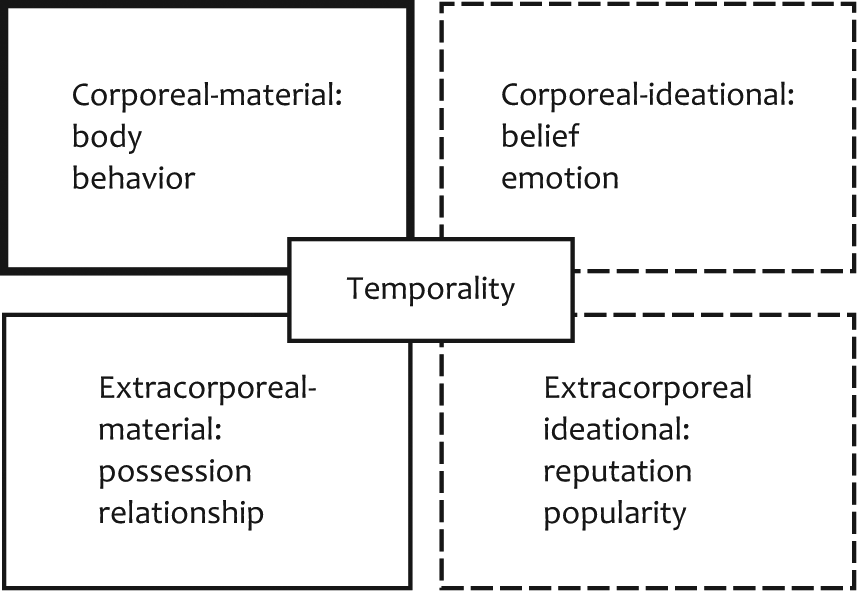
The empirical existence of an individual can be etically delineated from a third-person standpoint. In general, it comprises two parts: corporeal and extracorporeal, each of which consists of two dimensions: material and ideational. Figure 1 depicts the structure of an individual’s empirical existence, where the “material” dimension is represented by solid lines and the “ideational” dimension dotted lines.
Empirical existence of the individual.
The corporeal-material part is comprised of the biological body and the acts performed through the body. A broader notion of the body includes artifacts that are bodily related. Corrective bodily artifacts include various technological devices that are used to maintain and/or improve the functioning of the original body, such as pacemakers, artificial limbs, contact lenses, and dentures; and decorative bodily artifacts include cosmetic items that are used to enhance the aesthetic appearance of the body, such as breast-implants, make-up, necklaces, and earrings. Clothing falls in between these two categories, performing both corrective and decorative functions. Thoughts, feelings, and attitudes of the individual make up the corporeal-ideational part. The combination of these two parts—corporeal-material and corporeal-ideational—constitutes the narrow and restrictive form of an individual’s empirical existence.
An expanded form of an individual’s empirical existence includes an extracorporeal component. The extracorporeal-material component extends the individual’s corporeal-material existence to, among other things, the individual’s personal possessions and social relationships. Personal possessions include anything that belongs to the individual, such as houses and automobiles that the individual owns; and social relationships include people with whom the individual is closely associated, such as parents, spouse, children, and friends. Others’ judgments of and attitudes toward the individual constitute the individual’s extracorporeal-ideational existence. The combination of these two parts—extracorporeal-material and extracorporeal-ideational—constitutes an individual’s extracorporeal empirical existence.
There is a temporal dimension to an individual’s corporeal and extracorporeal existence, which constitutes the life of an individual or his or her “being-in-the-world” (Heidegger, 1927/1962). Birth marks the beginning of an individual’s empirical existence, but a newborn does not yet have a self; the self emerges over time as the individual develops the capability for self-reflection. After an individual is deceased, the self of the individual is gone, while part of the individual’s empirical existence (e.g., personal belongings and reputations) may continue to exist. An individual’s empirical existence in itself is, therefore, insufficient for the emergence of the self; the other essential component is the individual’s perceptions of his or her own empirical existence.
Perception of one’s own empirical existence
An individual’s empirical existence can be perceived either etically by others or emically by the individual him- or herself. When it is perceived etically, the existence is referred to by the perceiver as “other” or “other’s”; and when it is perceived emically, the existence is referred to by the perceiver as “me” or “mine.” The self is the empirical existence that one perceives to be oneself.
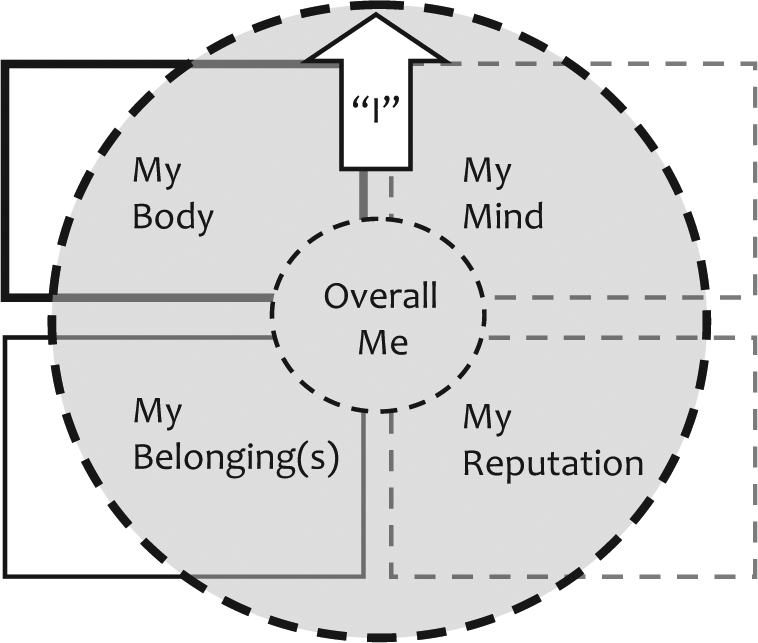
The perception of an object involves at least the following elements: (a) object of perception, (b) perceiving subject, (c) act of perceiving, and (d) output of perceiving. Figure 2 depicts the structure of self-perception, in which the object of perception is the perceiver’s own empirical existence. The upward arrow in the upper part of the dotted circle represents the perceiving subject or, in James’s terms, the “I.” The perceiving subject is the individual’s capability for reflecting upon him- or herself, which develops in the early years of an individual’s life through interacting with others (Mead, 1934).

Perception of one’s empirical existence.
Self-reflection involves three types of perceptual acts which occur in sequence: self-recognition, self-assessment, and self-feeling, each of which is related to a distinct perceptual outcome. Self-recognition is a cognitive process by which the individual recognizes the object of perception to be his or her own existence and the resulting perceptual output is self-identity (e.g., my face, my reputation); self-assessment is an evaluative process by which the individual assesses the desirability of the perceived self-existence and the perceptual outcome used as evaluative criteria is self-values (e.g., my desires and principles); and self-feeling is an affective process by which the individual experiences certain sentiments resulting from self-assessment and those self-referential sentiments are also known as self-conscious emotions (e.g., my pride or shame).
Self-reflectivity is indispensable for self formation, but the reflective process per se is not the self. Likewise, the perceptual outputs of self-reflection—self-identity, self-value, and self-emotion—are important constituents of the self, but they by themselves alone are not the self. The self is an emic object, the unity of the empirical existence of an individual and the individual’s perception of that empirical existence.
Unity of empirical existence and personal perception
The self is an object that entails both empirical and conceptual dimensions. The empirical dimension of the self comprises the empirical existence of an individual as depicted in Figure 1, and the perceptual dimension of the self comprises the individual’s reflections upon his or her empirical existence as depicted in Figure 2. In a way, this duality is true of all perceived objects. When I say I see a cat in front of me, I mean the following: (a) there is an empirical object in front of me and (b) I perceive that object to be what I know as a cat. So this cat I am talking about is not just a “cat-concept” that exists in my mind, nor is it a cat that exists out there in itself; rather, it is this particular cat that I see in front of me. Similarly, when I say I have a self I mean there exist “an assemblage of facts” that I take to be my own existence. It is the unity of the subjective perception and the empirical referent that defines a perceived object.
Figure 3 depicts the structure of the self thus defined. The four rectangles represent the four major realms of the empirical existence of an individual: the large dotted circle represents the individual’s perceptual acts and outputs; the upward arrow represents the individual’s “I” or the capacity for self-reflection; the shaded area covered by the large dotted circle represents the individual’s perceived existence of his or her own being, i.e., the self of the individual; and the small dotted circle at the center represents the “overall me”—the individual’s self-perceived overall “being-in-the-world.” Several points need to be made about this diagramed structure of the self. First, the large circle excludes some parts of the rectangles and includes areas that belong to none of the rectangles. This illustrates that an individual’s perceived own existence is not necessarily identical to the actual existence of the individual. Second, everything within the large circle is identified by the individual as “mine”: my body, my mind, my belonging(s), and my reputation. Once thus identified, the empirical entities become personal, emotionally charged, and intimately connected to the individual. Third, of the four realms of existence, the body proper is the most primordial and central. As James (1890/1950) pointed out, the body functions as the core of an individual’s existence in the world, the drives and needs of which are the “primitive object, instinctively determined, of [one’s] egoistic interests” (p. 324). However, the self also consists of an extracorporeal component, e.g., one’s perceived property, relationships, and reputation, which embeds the biological body in a larger social context. Finally, on top of all these different parts there is an “overall me” that provides the individual with an overall sense of being. It is through this unity of “sense” and “being” that an individual’s empirical existence in the world is transformed from an “in itself” existence to a “for itself” existence.
Structure of the self.
Another point to be stressed is that the self thus conceived is not a fixed entity. This is true for two main reasons. First, the individual’s empirical existence in the world changes over time. From birth to death the life of an individual undergoes considerable changes, both corporeally and extracorporeally. Second, the individual’s perceptual realm also changes over time. An individual does not have the perceptual faculty for engaging in self-reflection in the early years, and the conceptual schema (e.g., beliefs and values) the individual acquires later through interacting with others continues to evolve. However, the self is comprised of different parts. While certain elements of the self, such as self-feelings, may change from one moment to another, an individual’s overall sense of self can remain relatively stable for a long period of time.
Epistemic implications of the new formulation
The conception of self as an emic object is similar to James’s definition of self as the “me” seen by the “I.” However, unlike the position James took that regards the self as “an empirical aggregate of things objectively known” (1890/1950, p. 292), the revised position proposed here considers the self to be an empirical aggregate of things subjectively known. The knowing subject is the individual, the “aggregate of things” to be known is the empirical existence of the individual, and what is known by the individual as his or her own existence in the world is the self of the individual. This reformulation has important epistemic implications for research and self-understanding, which I will proceed to explicate in the remainder of this article.
First-personal givenness
As perceiving subjects, we all live in a changing world of experience; only a portion of this experiential world is consciously perceived, and the rest may be available to consciousness when they become the focus of our attention. As such, our “experiences constitute the ground of our perceptual field” (Rogers, 1951, p. 483). To have a common understanding of an object, we need to have a common experience with the object. To say that the cat in front of me can be known by both you and me is to say that we can obtain the same perceptual experience of the cat. The owner of the cat will know a lot more about the cat because the owner can gain more perceptual experience of the cat than you and I do. However, neither the owner nor you and I can know the cat as the cat knows itself because we cannot have the experience of the cat as the cat has it.
In the human world, mutual understanding is possible because we are equipped with the same instinctual needs and perceptual apparatus and can thus gain the same experiences under the same life conditions. As Schutz (1967) notes, a person’s mind can be known by the person’s “consociates,” i.e., people who grew up with the person in close proximity. By sharing the same life experiences or “meaning contexts” with the individual, consociates can perceive the individual’s empirical existence as the individual does. In this case, a person’s self is essentially knowable to the person’s consociates.
However, in most instances human life experiences differ significantly. Even identical twins reared together within the same family grow up to be different individuals. The unique life experiences each individual has, which give rise to a unique “first-person” perspective, are called the “first-personal givenness” by Zahavi (2005): This first-personal givenness of experiential phenomena is not something incidental to their being, a mere varnish that the experiences could lack without ceasing to be experiences. On the contrary, this first-personal givenness makes the experiences subjective. To put it another way, their first-personal givenness entails a built-in self-reference, a primitive experiential self-referentiality. (p. 122)
This by no means implies that individuals are invariably encapsulated in their own “first-personal givenness” and can never understand one another; rather, it suggests that to understand a person’s self it is necessary to understand the life the person has. In hermeneutical terms, as Taylor (1977) puts it, the valid response to “I don’t understand” is “not only ‘develop your intuitions,’ but more radically ‘change yourself’” (p. 127). That is, we need to broaden our own “first-personal givenness” to encompass the “first-personal givenness” of those whose selves we want to understand.
Avowed self-concepts
Lacking direct access to the “first-personal givenness” of their subjects, researchers can base their study of the selves of their subjects on the subjects’ disclosure of their own views of themselves, i.e., their self-concepts. A person’s self-concept is the person’s perception of his or her empirical existence in the world. It consists of “the totality of the individual’s thoughts and feelings having reference to himself as an object” (Rosenberg, 1986, p. 7), which means that the self-concept represents only the perceptual part of a person’s self. However, it should be noted that the self-concept one shares with others is mostly what Harter (1999, p. 3) calls “self-representations,” i.e., one’s verbal descriptions of the self-concept one carries in the mind. As it were, self-representations or avowed self-concepts may not represent an individual’s actual self-concept. One’s actual self-concept can be kept private, accessible only to oneself; self-representations, on the other hand, are public and accessible to others (Baumeister & Tice, 1986). As such, self-representations can be a form of self-presentation and may be deceptive.
Self-presentation is an individual’s effort to project to others a desired image of him- or herself. In James’s original formulation, the image others have of an individual and the image an individual intends to project to others were lumped together under the category of the “social self”: But as the individuals who carry the images fall naturally into classes, we may practically say that he has as many different social selves as there are different groups of persons about whose opinions he cares. He generally shows a different side of himself to each of these different groups [emphasis added] … From this there results what practically is a division of the man into several selves. (1890/1950, p. 294)
As can be seen, in this paragraph a person’s social self was being defined in two different ways: (a) one’s images carried in the minds of “distinct groups of persons” and (b) the different images one seeks to present to different groups of individuals. Clearly, these two types of images are not the same because what we intend to project to others may not necessarily be what others think of us. This conceptual ambiguity was later clarified by Goffman (1959) who introduced the concept of self-presentation which refers to an individual’s attempt to manipulate and influence others’ impressions of him or her. The image of oneself one seeks to present to others was defined as one’s “presented self” which might not reflect one’s actual self-concept.
In the sense that the presented self is mostly self-serving in nature, self-presentation belongs to the category of what James calls “self-seeking,” or “social self-seeking” to be more precise: Our social self-seeking, in turn, is carried on directly through our amativeness and friendliness, our desire to please and attract notice and admiration, our emulation and jealousy, our love of glory, influence, and power, and indirectly through whichever of the material self-seeking impulses prove serviceable as means to social ends. (1890/1950, p. 308)
Of course, not everything an individual does or says is self-presentational. Instinctive, reactive, and non-purposive behaviors are not part of self-presentation, but they become part of one’s empirical existence and are subject to one’s self-reflection and others’ etic examination.
Self-presentation can contribute to self-perception. One does not have direct access to all the realms of one’s own empirical existence. For example, one is not always sure of one’s images in the minds of others. By announcing one’s preferred identities in public, one can find out whether or not others endorse one’s self-announcement which in turn serves to confirm or reject one’s self-concept (Stone, 1981). In this case, self-presentation is a form of self-verification. Similarly, narrative representations of one’s self-concept through symbolic interaction with others constitute an important form of self-construction (Bamberg, 2011; Raeff, 2010). Self-construction is accomplished through different means, one of which is self-disclosure. By telling others what we think we are, we impose a sort of coherence on our articulations of ourselves, and, as Jourard (1964) observes, “I will know myself ‘for real’ at the exact moment that I have succeeded in making it known through my disclosure to another person” (p. 10). Throughout one’s life, one continuously weaves one’s life experiences into a coherent story that one recounts to others as well as oneself (McIntyre, 1985). Self-presentation and self-representations are, in this sense, both necessary for self-construction.
The “actual self”
It is probably true that individuals may not always want to reveal their true selves, but do individuals always know their true selves? The fact that they need others’ confirmation to verify their self-concept indicates that individuals do not always know who they “really” are. This has come to be known as the problem of the “actual self.” From the phenomenological standpoint, the actual or “noumenal” state of any object can never be known, although epistemic consensuses on the state of an object can be reached etically through intersubjective communication (Gadamer, 1975).
Self-understanding through interaction with others has been a major tenet of the sociology of the self (Mead, 1934). The self emerges in society and others serve as a mirror in which the individual gets to know him- or herself (Cooley, 1902/1964). However, this looking-glass self has been criticized by many as a socially over-determined “they-self” rather than an agentic “I”-based “me-self” (Denzin, 1988; Erickson, 1995; Gecas & Schwalbe, 1983). The debate over this issue essentially boils down to this question: is there a so-called “actual self” beyond what the “I” knows as “me” and “mine”? If the answer is a “yes,” what and where is this actual self?
One notion of the actual self is what Flanagan (1991) calls the “actual full identity” which is the totality of an individual’s empirical existence in the world viewed from an “ideally objective standpoint.” Assuming that there exists such a standpoint, can this “actual self” be known by the “I”? The answer is likely to be a “no.” First of all, one does not have perceptual access to the whole history and all aspects of one’s own existence. For example, one has no memory of the early days of one’s life, and one does not know everything about one’s current life either (e.g., one may have a hidden medical condition that one is not aware of). Second, one’s perception of an object is affected not only by the empirical characteristics of the object but also by the conceptual schema or the stock of preexisting knowledge one possesses (Markus, 1977). A conceptual self-schema consists of both descriptive self-knowledge (e.g., “what I am”) and prescriptive self-knowledge (e.g., “what I ought to be”), and together they enable an individual to organize and interpret incoming perceptual data pertaining to the self. So even if one is thin in terms of BMI, one may see oneself as being fat by one’s self-standards. Third, one’s perception of an object is also influenced by the relevance of that object to one’s interests. One pays more attention to the things in which one is interested and overlooks others one deems unimportant. In regard to self-perception, it has been shown that one tends to have a favorable view of oneself (see Taylor & Brown, 1988) and disregard information that contradicts one’s beliefs about oneself (see Higgins, 1987). Due to these reasons, it is unlikely that one will be able to know one’s “actual full identity.”
However, according to the emic argument advanced in this article, the “actual full identity,” or a person’s empirical existence viewed from an ideally objective standpoint, is not a person’s self, for the self is the object an individual takes him- or herself to be. Unlike the “ideally objective standpoint” which is by definition infallible, the reflective emic viewpoint can be wrong. From time to time an individual may question the validity of his or her own perceived existence, as reflected in such expressions as “That was not my true self!” or “I don’t know who I really am anymore!” In these instances, the individual suspects that his or her self-perception may be false and there is a need to double-check. Such self-doubts indicate that, as mature individuals, we are willing to accept the assumption that there is a reality of ourselves outside our own perception and we can be wrong about ourselves.
What is the reality of one’s self? It is argued here that one’s “actual self” is not so much the actual state of one’s past or present self as the possibility of one’s future self. When I ponder over who I really am, I mostly want to find out what I can be, and, more importantly, what I should be. If a person’s life were fully determined by fate, there would be no need for a reflective self. The self serves as a map for a life journey that the individual directs. In this regard, James (1890/1950, p. 315) divides the self into two types: “immediate and actual” versus “remote and potential,” of which the latter is said to be more important. James argues that the knowledge of the past and present self should be used to seek a “better possible” future self in one’s material, social, and spiritual existence. The actual self behind one’s perceived self is therefore one’s desired potential self—the best self that one can possibly be, and this, in James’ words, is “the true, the intimate, the ultimate, the permanent Me which I seek” (James, 1890/1950, p. 316).
How can one find out one’s best possible self? One’s best possible self lies partly in one’s hidden potentials that are yet to be tapped and partly in others with whom one is closely associated. The discovery of one’s actual self involves more than an effort of self-introspection, for it also requires a “reflective dialogue” with others which “gives persons a social and interpersonally constituted understanding of the shape of their character, life history, and the values that matter most to them” (Jopling, 2000, p. 166). It is primarily through interaction with others that one comes to understand one’s potentials as well as the opportunities for one’s future.
In conclusion, the new formulation of the self proposed in this article stresses the interconnections among individual existence, reflective inquiry, and social interaction in self-understanding and self-enactment. The self is the unity of one’s empirical existence in the world and one’s perception of that existence. One needs to be aware that one’s existence in the world goes beyond what one can perceive, that one’s evaluation of one’s own life may not correspond to others’ assessment of one’s existence, and that one can be wrong about oneself. This means that to have an adequate self one must be able to reflect upon critical aspects of one’s being in the world, to correctly gauge the discrepancies between self-concept and social appraisal, to insightfully imagine one’s best possible selves, and, finally, to actualize oneself by being with others.
Footnotes
Acknowledgements
I would like to thank the four anonymous reviewers for their constructive comments and helpful suggestions. I would also like to thank Dr. Hank Stam, editor of Theory & Psychology, for his understanding and support.
Funding
This research received no specific grant from any funding agency in the public, commercial, or not-for-profit sectors.