




Abstract
This commentary explores selected ideas presented in the special issue on language and the self and considers them in terms of reading. Bertau’s notions of the in-between and sharedness, Lipari’s description of the polychronic, polymodal, and polyphonic qualities of language events, and Karsten’s description of the cross chronotope relationships between self-positions during writing are discussed. Using a case analysis of a young child’s wordless picture book reading, this set of ideas is used to illuminate reading as a dialogic, relational event of the self, one that depends on the use of social imagination as a critical part of the meaning-making process.
“Wake up, Wake up sister!” Hunter (a pseudonym) narrates, as he reads the images of a wordless book. The scene in the fictional text depicts a child, apparently sick in bed, and a younger sibling trying to wake her. Hunter is a six-year-old kindergartner who has succeeded in a central task of fiction reading; he has entered a dialogue within the fictive world, assumed some set of shared meanings between himself and the text, and established an intersubjective relationship with a character through the use of social imagination—imagining that character’s thoughts and feelings. He has participated in reading as a relational event of the self.
In this special issue on language and the self (Bertau, 2014a), the authors theorize the ways in which language and self are intricately enmeshed in the experience of being human. As commentator, I will discuss a set of ideas presented in three articles of this issue from the perspective of a reading researcher, using Hunter’s wordless book reading as a context. Specifically, I am interested in how an exploration of these ideas, when applied to reading, might illuminate reading as an event of the self, 1 leading to a deeper, more person-centered view of what happens when children read. My discussion will draw upon Bertau’s “On Displacement” (2014b), Lipari’s “On Interlistening and the Idea of Dialogue” (2014), and Karsten’s “Writing: Movements of the Self” (2014). The core ideas that I attend to are: (a) the in-between and “sharedness” as a consequence of displacement; (b) the polychronic, polymodal, and polyphonic qualities of language activity; and (c) the cross-chronotope relation between self-positions within the individual as a consequence of encounters with written text.
The in-between, displacement, and sharedness
The overarching idea that will ground this commentary is that of the in-between and the phenomenon of sharedness made possible when displacement occurs. The in-between is described by Bertau (2014b) in terms of the “spacetime of language,” where language is viewed as performative, and where linguistic forms, chronotopes, and positions weave a complex temporally and spatially layered experience of relatedness. Shifting the Vygotskian (1934/1978) emphasis on language as tool, Bertau suggests that language is both means and medium through which self and other are and become, and hence language as in-between describes the quality of being human, always and already in languaged relation.
The consequences of relocating language activity from individuals to the in-between are particularly important. First, Bertau (2014b) argues, this shift makes language irreducible to individual single acts; language is “an autonomous gestalt” beyond individuals and the sum of their utterances. This decenters individuals and redefines the experience of language activity as a kind of co-being. The second and related consequence of situating language as the in-between is that it emphasizes the dialogicality—or relatedness—of the self (Bakhtin, 1935/1981; Hermans & Dimaggio, 2004; Hermans & Gieser, 2012). Bertau (2014b) extends this view with the specific delineation of self as “permeable to the other’s acts,” (p. 445). Such permeability, Bertau suggests, requires a view of self in which the person within language is at once agent and receiver. Hence, the person is simultaneously acting and being acted upon in a dialogic dance. This simultaneity draws attention to the constitutive power of the other and accounts for the transformative consequences of participation in language events. In other words, the reconceptualization of language as the in-between brings to the fore the enduring, dynamic presence and formative power of the other(s) within language.
Within the in-between, and through the representational and indicative functions of language (standing for and pointing to), displacement becomes possible; individuals may move out of their actual concrete “now” to meet and engage each other in a “common now” or sharedness. As Bertau (2014b) states, “So, by more abstract language displacement, the individuals come to share a common affective and cognitive world—more precisely: on the grounds of common social practices, they assume they share common meanings and concepts, common feelings and evaluations” (p. 450). Thus, though the individual is always related and in relation, displacement results in a heightened experience of shared meaning making. Sharedness as a meaning-making relational phenomena made possible by language, will become important when considering reading as an event of the self.
Three aspects of displacement seem of particular importance. First, is that displacement is not an inevitable result of language activity but occurs under particular conditions, when “interlocutors are not able to generate and hold affective and cognitive contact” (Bertau, 2014b, p. 450). In this way displacement depends upon qualities of the related selves caught up in language activity, such as “openness to the other’s ‘symbolic touch’” and a “willingness to follow … to change one’s perspective” (Bertau, 2014b, p. 450). Affective or dispositional aspects of who we and the other are, have become, and are becoming at the moment of participation within language effect, afford, or constrain displacement, and the possibility of sharedness. The second aspect of displacement that seems important is that displacement, as a potential part of the phenomenon of language activity is generated from the material and is thus realized in praxis. The present “now,” with its physical and material realties, is thus not neutral or generic, but always linked in its particularity to language activity and the movements of self that take place within it. Lastly, Bertau’s (2014b) notion of “shared presence-absence” generated by displacement points to the idea that multiplicity of both temporal (now and not now) and relational (together and absent) positions constitute the experience of sharedness within the in-between of language. Again, this will become useful when describing reading as an event of the self, with movement across fictional time and space.
Polychronic, polymodal, and polyphonic as qualities of the in-between
In my reading of Lipari (2014), the term interlistening describes a particular kind of in-between, that which occurs between speakers and listeners. 2 While Bertau (2014c) seems primarily interested in articulating the ways in which the in-between works for individuals in relation, Lipari’s work delineates its polychronic, polymodal, and polyphonic attributes, anointing them with a new and important value. Of particular interest is Lipari’s assertion that the non-linear activity of the self, moving flexibly between temporalities, is central to sense making; past, present, and future come together in the act of comprehension. This polychronic aspect of the in-between recognizes and accounts for the simultaneous present, past, and futureness of a relational, dialogic self as well as the time-layered activity of displacement, which necessitates movement from the “now” to the “not-now.” Lipari’s mention of the role of imagination, and the capacity to move in and out of verb tenses during language activity, highlights this movement of self in and out of actual and imagined realities. Moreover, she describes the movements of self across time as embodied, and enacted in multimodal ways through voices, words, gestures, gaze, and postures, and asserts that the polymodality of language activity is not an accompaniment to meaning making but is meaning making itself. Thus the rhythms of language and its bodily enactments become aspects of the fabric of sharedness when displacement occurs.
The polyphonic condition of the dialogic self is well articulated in dialogic self theory by Hermans and others (Hermans & Dimaggio, 2004; Lysaker & Lysaker, 2005). While Lipari (2014) focuses on the musicality of the voices, I am more interested in another point; the related self is constituted by the voices of characters real and imagined. Thus within the spacetime of language, individuals enact and respond to multiple characters in multiple voices creating an actual and imagined polyphony within and between voices and positions of the self. 3 From a dialogic perspective, such polyphony may be thought to constitute the nature of comprehension in fiction reading.
Micro-movements of self within a language event with written text
Karsten (2014) uses the method of auto-confrontation to examine three cases of individuals writing, and to describe and conceptualize writing as an event of the dialogic self. 4 In this method, she video-records individuals as they write, capturing their writing processes as they happen, as well as their spontaneous responses to these processes. The video of the writing becomes an artifact for reflection and conversation in which writers encounter (confront) themselves in the writing moment, yet simultaneously not in the writing moment. Karsten emphasizes the bi-directional movements of self that occur during writing: between positions—from author to reader, between modes—from writing to reading, and between locations—from the present, concrete writing situation, to the world created by the text. Thus, unlike Lipari (2014), who focuses on the language activity between individuals, Karsten delineates the language activity (inner speech and arguably, interlistening) within the self—the relatedness of the self as it occurs during writing. As such, Karsten describes and analyzes a particular form of the in-between, one that occurs intramentally. Sharedness within the self is experienced when displacement is set in motion through the activity of writing (and the inner speech that accompanies it), as writing necessitates movement between self-positions (reader, writer, discussant) across the spacetime (here and not here, now and not now) of writing. This multilayered sharedness results in writing’s “dialogic volume.”
Importantly, unlike speaking or listening, writing has the quality of permanence. The subjectivities of the author represented in the text have material substance in the physical world made possible by the use of concrete objects like computer, pen, and paper. This creates the possibility of encountering oneself as “other” in the written text, one who has an articulated identity situated in a particular time and place. 5 Karsten (2014) uses the method of auto-confrontation to gain access to this encounter between voices of the self by setting up conditions that create more dramatic spatial/temporal contrasts with the original writing event.
Beyond the relationships between the ideas of Bertau (2014b, 2014c), Lipari (2014), and Karsten (2014) already put forth, it seems logical and consistent with Bakhtinian (1935/1981) thought, that the qualities of interlistening, which Lipari describes—polychronic, polymodal, and polyphonic—are qualities of Bertau’s sharedness and are present in all kinds of dialogic encounters. Hence, taking this set of ideas together, the phenomena of sharedness that may result from language use—both between and among individuals as well as within an individual—has layers of spacetime, multiplicity of voices with and across those layers, all of which are expressed in multimodal ways.
Having laid out this set of ideas, I will now turn to a discussion of the ways in which they may be used to deepen and extend understandings of reading as a language event of the self. What can be learned about reading, particularly the reading of fictional texts, by taking up the ideas of the in-between, displacement, and sharedness, the polyphonic, polychronic, and polymodal qualities of this in-between, and the role of written language in prompting and illuminating movements of self?
In conversation with Bertau, Lipari, and Karsten: Hunter’s reading as a particular kind of sharedness
Taking into account Bertau’s (2014c) location of language activity as in-between, it seems evident that reading as a language event like interlistening, might be considered a particular kind of in-between. As such, it follows that the reading event will involve linguistic forms, chronotopes, and positions coming together in complex dynamic ways making displacement and sharedness possible. Consider what happens when an individual reads. The person reading engages in language activity with the “otherness” of text, 6 creating a spacetime of language inhabited and constituted by the voices in the meaning-making activity of the dialogic self and those of the author as represented in the voices of narrator and characters. This lively, relational meaning-making activity between and among voices of self and other, both immediate and transcendent, constitute the event of reading.
The notion of sharedness as a potential quality of reading as a language event is consistent with the transactional reading theory of Louise Rosenblatt (1938/1983) who asserts that reading is a dynamic merger of reader and text. In describing this phenomenon, Rosenblatt (2004) suggests that terms like “reader” are only “convenient fictions” since aspects of the reader and the text during a transaction are not separate entities, but parts of one holistic meaning-making event (p. 1363). Successful reading in Rosenblatt’s (2004) view involves deeply psychological processes in which the individual reading brings their “private iceberg of meaning” into transaction with the text, leading to transformations of both reader and text (p. 1373).
Though not specifically grounded in dialogic self theory, Rosenblatt’s dynamic view of reading suggests the possibility of sharedness as part of the reader/text transaction. Put dialogically, the reader (self who reads) and text (others) become speaking-and-listening partners who, as Bertau (2014b) suggests, “touch and affect each other in their common Now … shaped by the (dynamically changing) positions and kinds of address the partners enact” (p. 446). This sharedness is created between the person reading and the otherness of text by virtue of interpretation as the person reading and those encountered in the text come to share a common world. Or, in light of Bertau’s discussion of displacement, readers “assume” some commonality of meanings, between themselves and those encountered in the text in order to make an interpretation. These assumptions, about others (characters) represented in text, contribute to the construction of those characters. In this way, through interpretation, the reader affects the fictional common now. 7 In addition, reading, as a particular kind of in-between, has polychronic, polymodal, and polyvocal qualities, and as written language activity may create the possibility that the voices and positions of the self will encounter each other as part and parcel of reading. Hunter’s reading of I had Measles (Wright Group, 1987) will serve to explicate this set of ideas.
Case example
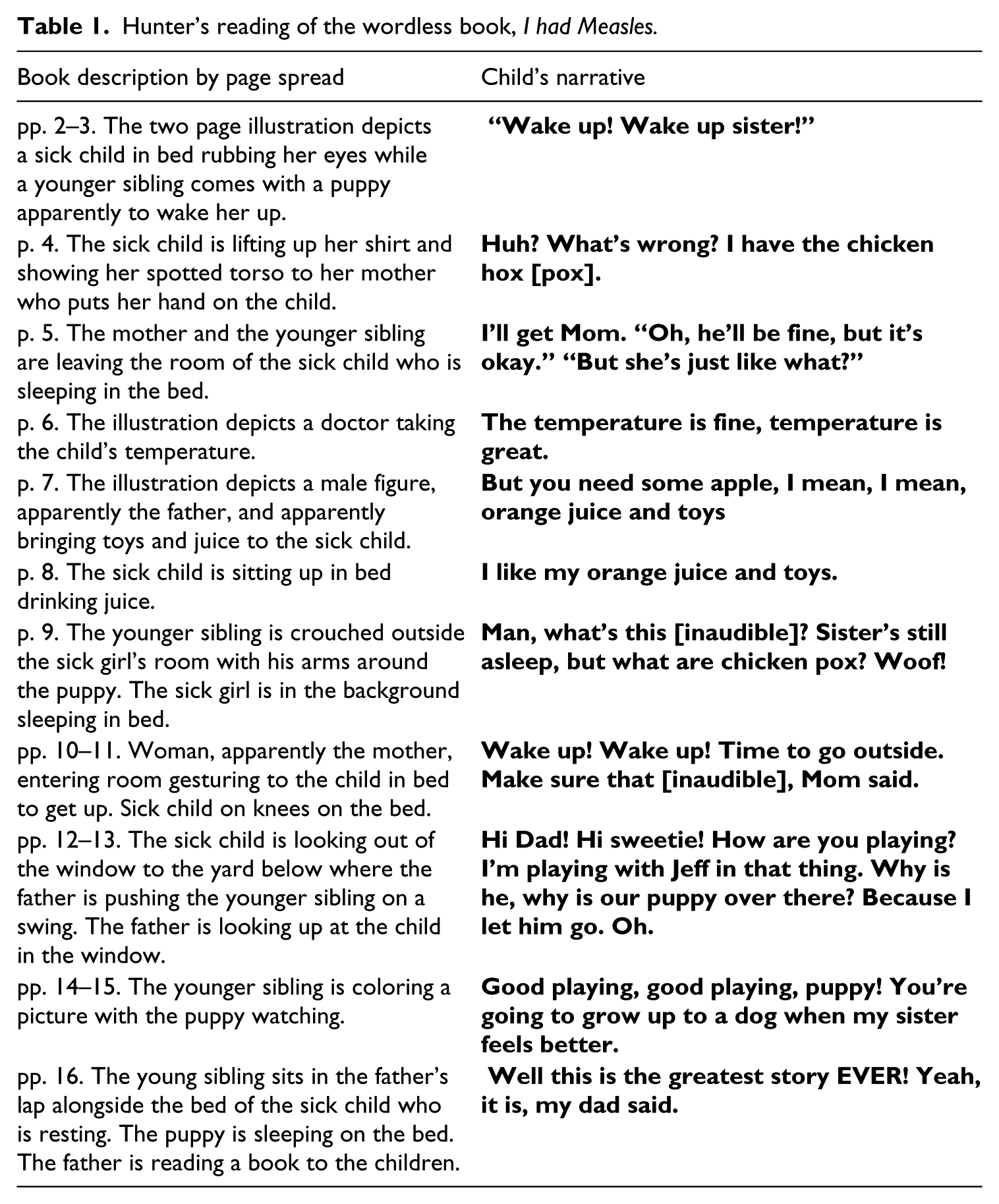
The reading presented here took place at the end of Hunter’s kindergarten year when he was six years old. Hunter was a typically developing child in terms of literacy as demonstrated by a range of assessments. The book, I had Measles, is the story of a child who gets sick with measles. There is no linguistic text except for the title; the story is presented in images only. The family depicted in the story consists of a mother, father, and younger brother as unnamed characters, along with a similarly unnamed dog and doctor. Hunter’s reading of this wordless book was video-recorded in a one-on-one session with the researcher in a quiet instructional space in his school. The transcript of Hunter’s reading with a brief description of the images in the book is provided in Table 1, as a context for this discussion. Like Karsten (2014), I will examine micro-movements of the self, in this case those that occur in Hunter’s reading, as a means of analyzing reading as a particular kind of in-between and event of the self.
Hunter’s reading of the wordless book, I had Measles.
In my discussion, I will suggest that social imagination, as an aspect of self activity, is necessary to the construction of reading as an in-between in which displacement and sharedness can occur, and as such is critical to accomplished reading comprehension and transformational reading experiences. Further, I will demonstrate that the intersubjective relationships constructed by the reader during the event of reading, in part constitute the sharedness of reading.
Reading as a particular kind of in-between
In the first seconds of the video Hunter’s eyes move across the page spread and back, as if he is “taking it all in” before choosing and vocalizing words for the narrative. Hunter doesn’t approach the page linearly, but searches the pages—left to right and right to left—as if gleaning an overall sense of the meaning of the images which, in this case, depict the sick child in bed and a smaller child alongside her. Hunter’s efforts appear focused on a holistic apprehension of meaning, reflecting Bertau’s (2014c) notion of the in-between as a “gestalt” of relatedness. Lipari’s (2014) discussion of interlistening fits here. She suggests, referring to Bhartrihari (1971) and Luria (1981), that “the initial stages of speech are an integrated gestalt without temporal sequence or differentiated parts … complex non-linguistic conceptual intuitions are gradually transformed into full blown, grammatically correct, speech” (Lipari, 2014, p. 515). Hunter’s meaning construction begins as gestalt and then is converted to specific utterances.
In the opening line, “Wake up, Wake up sister!” Hunter quickly locates himself in the fictional world of the story as the character of the younger sibling, moving into a new spacetime created by the material presence of the book and his response to it. Hunter has taken up, interpreted, and responded to the relational invitations offered by the “otherness” of text. He then constructs imaginative dialogue with and between the characters in the fictive world, thereby constructing a new reality. Hunter experiences the sharedness of reading as he actively assumes and participates in the affective and cognitive world of the characters. For example, on page 4, Hunter voices the thoughts of the sick girl by narrating, “Huh? What’s wrong? I have the chicken hox [pox],” and on page 5, he voices the thoughts of the mom by narrating, “Oh, he’ll be fine.” While actively involved in the “not-now” of the fictional world, Hunter also continues to experience the actual “here and now” as he sits in a chair and holds a book.
Hunter sustains this displacement throughout the reading. He moves readily from the actual position of a six-year-old boy to multiple character positions as he inhabits and imagines the realities of at least four different characters during his reading, shifting fluidly and flexibly from one to the other. As a part of this imagining, he constructs relationships between characters through dialogue. As seen in Table 2, these relationships include the boy and his sister (pp. 2–3, “Wake up! Wake up sister!”); the sister and herself (p. 4, “Huh? What’s wrong? I have the chicken hox”); the dad and the sister (p. 7, “But you need some app-, oh I mean I mean orange juice”); and the boy and the dog (pp. 14–15, “Good playing! Good playing puppy!”).
Intersubjective relationships during reading as the construction of sharedness.
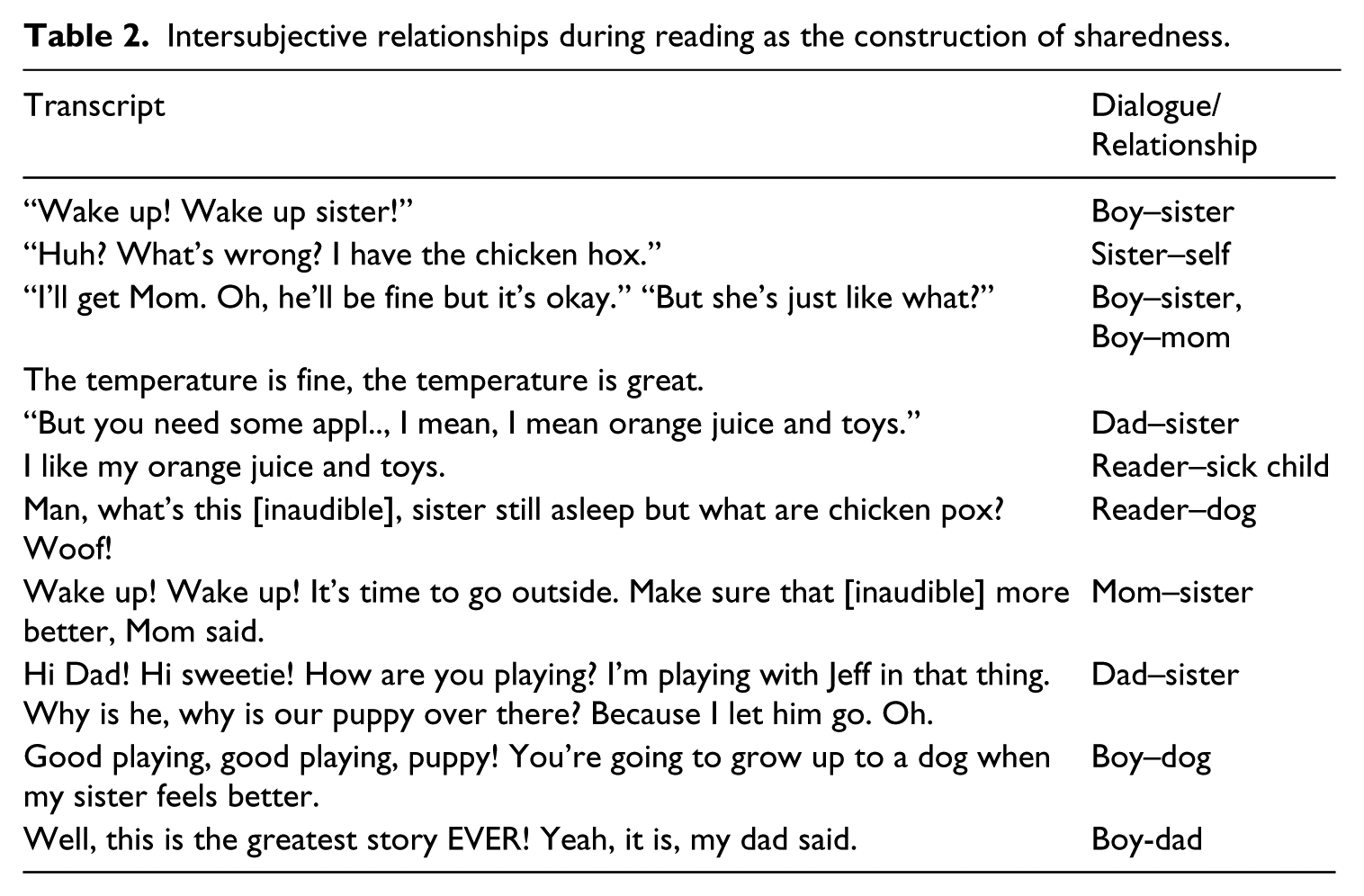
These imagined relationships might be thought of as a “web of intersubjectivities” (Lysaker, Arvelo-Alicea, & Miller, 2012); the subjectivities of the reader, and of the characters he imagines and voices, share meaning and affect with each other in the fictional world. In the current discussion, this web of intersubjectivities represents a set of particularities that contribute to sharedness made possible by displacement during this reading event. Hunter’s ability to construct and sustain these relationships throughout the story also provides potent evidence of the reader–text transaction and of comprehension.
Importantly, the relationships between characters that Hunter creates are the result of social imagination, 8 that is, his capacity for imagining and interpreting the thoughts, feelings, and intentions of the characters. I propose that it is the use of social imagination that affords movement of self positions within the reader across the spacetime of reading (chronotopes and landscapes) and leads to the displacement and sharedness of reading. Though the representational and indicative functions of language and image point to the “not here and now” and to representational others inhabiting this spacetime, it is the capacity to follow that pointing to that leads to sharing a common and affective world beyond the actual. I propose that it is by imagining the mind of the other as a response to the otherness of text during the in-between of reading that affords this following. In fact, the ability to assume commonality—even if based on commonly known social practices—is based on imagining what the other is thinking, feeling, and intending.
It is also useful to think about the ways in which social imagination might be implicated in the capacity and willingness of the reader to make connections to characters. If we accept that there is a human need and desire for connection to others (Stern, 2004), then this desire may prompt the willingness to know, and thus to imagine their realities. By this I mean to propose that social imagination—imagining the thoughts, feelings, and intentions of others— inspires and powers movements of self within sharedness. If in fact, sharedness is a phenomenological gestalt of meaning making between two “mutually oriented individuals” as Bertau (2014b) describes, then reading, as a particular kind of sharedness, is the phenomenological gestalt of meaning that occurs as the person reading is oriented toward the representations of others. 9 Through social imagination the person reading actively intuits, constructs, and makes sense of the orientation of those others. Hence, in reading, the construction of sharedness necessarily involves enactive imagining of the consciousness of represented others.
As a particular instance of the in-between, Hunter’s reading might be construed as a response to being “addressed” by the images of characters in dialogic combination with his continued response to his own narration; the text functions as a dialogic object. 10 The utterances Hunter creates in response to the otherness of the text become a new past “other” that is taken into consideration in subsequent utterances. This set of dialogues within the in-between—between self-positions within and outside of text, and with the polyphony of otherness represented in text across positions and chronotopes—results in a coherent narrative. Bertau’s (2014c) notion of the active/passive self makes sense here; positioning and repositioning oneself as agent and receiver is an important aspect of the in-between of language. Thus, the dance of reading as an event of the self involves moving in and out of receptive and responsive positions and requires flexibility of consciousness and acceptance of vulnerability. Hunter’s movement into the fictional landscape, the sharedness of reading inhabiting a “now” that is shared between him and the others as they “speak” to him, and as he voices characters, demonstrates his agentive and receptive stances within the new fictive now of story.
A closer look at the micro-movements of self positions that Hunter executes will afford a clearer view of social imagination and sharedness within the reading event, and highlight polychronic, polyphonic, and polymodal characteristics of these movements.
Polychronicity and polymodality of the reading event
While the polychronic aspects of Hunter’s reading have been demonstrated in some ways, these aspects deserve further attention, particularly in terms of the use of layered relational histories. As can be seen in the transcript, Hunter draws upon his own past; the remembered relationships, positions, accompanying emotions, and thoughts. This again demonstrates how reading is both “here and now” and “not here and now” as Hunter weaves a textured new reality between temporalities as part of meaning making, bringing present, past, and future together in the activity of comprehension (see Lipari, 2014).
For example, it seems likely that Hunter is remembering and appropriating language from past dialogues within his family as he narrates, drawing on what Rosenblatt (2004) calls his “linguistic and experiential reservoir” (p. 1370). Perhaps, the strongest example of appropriation is the use of the word “Sweetie” (pp. 12–13) in the dialogue he creates between the dad and the sister. He reads, “Hi Dad! Hi sweetie! How are you playing?” Even without viewing the video of Hunter’s reading, it is apparent that this is a lively, affectionate dialogue between father and child, likely experienced and available in memory to Hunter as he reads. Hunter not only inhabits the character of the dad, but arguably merges past and present realities as he “calls in” the remembered exchanges and the emotions between himself and his own father or mother as he voices the character.
Hunter’s use of the present and future tenses also indicates his imaginative movement across temporalities. On pages 14–15 he reads, “You’re going to grow up to a dog when my sister feels better.” Here he has positioned himself as the boy in the present “when my sister feels better” while simultaneously suggesting future realities “you’re going to grow up to a dog.” The in-between of reading has become a “landscape of consciousness and action” (Bruner, 1986, p. x) inhabited by a polyphony of voiced characters, a new “common now” with unique temporal–spatial layers. Thus, Hunter’s reading has rich dialogic volume and texture.
What is less obvious in the transcript, but readily observable in the video, is the polymodality of Hunter’s reading, which may be regarded as an expression of what Bertau (2014b) calls “sensitive contact.” Sensitive contact occurs when Hunter’s gaze lands on the eyes of the characters in the book. Though vicarious, I propose that this is sensitive contact nonetheless, and in fact is evidenced by observations of young children as they react bodily to such contact, through facial and non-linguistic emotive expressions (sighing, laughing, empathetic utterances) in response to contact with the represented subjectivities in the text. For example, in the video you can see Hunter smile, and hear his loving affirmative tone as he voices the character of the younger brother with the words, “Good playing! Good playing puppy! You’re going to grow up to a dog when my sister feels better.”
Vicarious sensitive contact is also illustrated in the video where Hunter is seen encountering the characters on the page by making eye contact. For example, on pages 2–3 his eyes move across the page and land on the face of the sibling trying to rouse his sister and then move back to the face of the sister in bed. His vocalization “Wake up, wake up!” is a response to actual contact with the representation of the faces on the page, and subsequent imagining of the other which results in movement of self position from outside narrator to the character of the younger sibling. In another example, sensitive contact is audible when Hunter intones “Sweetie” with familiar affection. It seems reasonable to hypothesize that Hunter is bringing forward and taking up voices and self-positions from past encounters that have, what Lipari (2014) calls, “self-similarity” in order to imagine the minds of characters. The complex, cross-chronotope use of the word “Sweetie” is a good illustration of reading as an in-between and an event of the self. Lipari’s description of the polychronic nature of interlistening supports this example: Our past lives inside us, nested like Mandelbrot fractals, where the seeming chaos of thoughts, reveries, and unconscious memories swirl in an unaccountably random fashion until deep structures of self-similarity are revealed. The accumulation of these past, present, and future voices blend and interact to make us who we are. (2014, pp. 509–510)
These performative aspects of Hunter’s narration demonstrate the significance of the polymodal in young children’s reading. It is not simply that polymodality exists, but that polymodality in part constitutes meaning making and is often overlooked as a significant part of young children’s reading. Beyond this, the polymodality of Hunter’s reading highlights the importance of embodiment in inspiring social imagination. That is to say that making sensitive contact—in this case eye contact with characters—opens up the possibility of knowing the other, just as this kind of physical connection affords knowing in actual relationships. These examples of the physicality of Hunter’s reading align with definitions of intersubjectivity as an embodied knowing of the other that may precede a languaged understanding—sharedness without language (Stern, 2004).
Encountering self as a consequence of literate activity
One aspect of reading as an event of the self not yet explored, is the way in which encounters with written text (in this case images) set up relations within the self. As Karsten’s (2014) work demonstrates, writers encounter representations of self in written text because a contrast is set up between self-positions of writer and reader. This cross-chronotope exchange between voices and positions of the self that occur in writing, and in reading one’s writing, are made visible and extended through the method of auto-confrontation. The act of writing as self-representation sets in motion, in a lively and concrete way, conversations within the self. When we encounter the text we have produced as an “other” we see ourselves again not simply in the representation but in our present interpretation of that representation as we encounter it (Lysaker, 2007). Moreover, in self-representations we see and thus reconstruct ourselves through the contrast created between the self we are presently experiencing and the self we encounter in our self-representational text. Karsten’s method of auto-confrontation affords a view of this contrast.
In reading something similar happens. The represented world of the wordless book provides a contrast between the actual present and the fictive present inviting cross-chronotope movements of the self. Even though the dialogic encounters in the wordless book reading occur with and within a text that is not self-authored, I propose that similar movements occur during reading, when during interpretive activity voices of self and text merge. The self, through the act of interpretation, is displaced beyond the actual into the fictive and yet of course remains an actual present self. Thus in the event of reading there is a relationship between the actual present reading subject (“I”), and the subject’s position as “in-between” in the interpretation of the text (“Me” + “text”). 11 Readers experience co-being with the otherness of text and as such regularly encounter themselves as part of otherness. Thus, as in Karsten’s (2014) work, engaging with written text puts self in relation to self in particular ways. Invoking Bertau, the reader has “joined in [his] community of selves, to become a public, an understandable self” (Bertau, 2014b, p. 454).
Consequences of considering reading as a particular kind of in-between
To conclude, I would like to briefly address some of the possible consequences that arise from regarding reading as a particular kind of in-between. First, delineating reading as an in-between necessarily decenters both reader and text resulting in an emphasis on the gestalt of reading, or, I would suggest, an emphasis on relationality—or the co-being—of reader and text during reading. In Rosenblatt’s (2004) terms, the meaning making of reading resides neither exclusively in the reader or text, nor in a literal sum of their interactions. Thus, relocating the activity of reading to the in-between challenges definitions of reading that give authorial dominance to the text and often reduce the reader to “decoder” of an author’s meaning. Viewing reading as a particular kind of in-between positions reading as relational experience, and helps to articulate relationality in terms of self activity across spacetime. Moreover, a relational definition of reading likens it to other relational experiences, which are known to profoundly influence development. Hence, the transformational powers of reading are brought front and center when considering reading as a particular kind of in-between.
In addition, following my interpretation of Lipari (2014), polyphonic, polychronic, and polymodal qualities of interlistening may be considered attributes of reading, providing a way to describe reading as an embodied experience of relational, dialogic self, which demands the “calling in” and responding to voices from both real and imagined pasts, presents and futures. A relational perspective on reading stands in sharp contrast to a text-dominated view involving “meaning extraction and construction” (RAND Reading Study Group, 2002).
Recasting reading as a particular kind of in-between has other consequences as well. The importance of sharedness and the role of displacement in transforming the in-between to sharedness makes the conditions under which displacement occurs critical. Bertau’s assertion that displacement occurs only when interlocutors are able “to generate and hold affective and cognitive contact,” (2014b, p. 450) suggests that sharedness during reading occurs under similar conditions. That is, during reading the individual must be open and willing to imagine and generate meaning with the personhood of narrator and characters. Like all human interactions, reading requires vulnerability and can be risky, as the person reading must decenter some aspect of the self in order to apprehend the other. In other work (Lysaker, 2002) I have suggested something similar drawing on Grumet (1988) who asserts that reading can be a dangerous journey: “If reading is a passage between public and private worlds the journey is fraught with danger” (p. 136).
While the riskiness of reading need not be overemphasized, it brings out the vulnerability of the reader within relatedness, something which is often disregarded in discussions of reading. If displacement is an “actively realized attachment” (Bertau, 2014b) it follows that the willingness to realize attachments through risk taking is necessary to meaning making. The presence of relational risk may help to explain the resistance and hesitancy seen in struggling or disengaged young readers. These readers may experience difficulties moving out and toward others, displacing some aspects of self to connect to others in deeply personal ways (Lysaker & Tonge, 2013).
The vulnerability of the self who reads is explained by the idea of permeability suggested by Bertau (2014b). Indeed, regarding reading as an in-between highlights the permeability (dialogicality), of the self as it is not only “in action,” but is “acted upon” during the reading event. In addition to providing a way of thinking about readers who struggle, the notion of permeability helps to account for how and why reading changes individuals who read—the vicarious social interactions that occur during the self activity of reading shape the contours of the individual. Thus, a focus on reading as a particular kind of in-between prompts careful consideration of the transformational power of reading and pushes conceptualizations of reading beyond what children need to do in order to read (decode, track print, etc.) to what it means for children to read (Lysaker et al., 2012).
In this commentary, I have set forth a set of related ideas presented in this issue and used them to consider the language event of reading. I have argued that reading might be thought of as a particular kind of in-between, in which an individual is engaged with others in a specific spacetime constructed by the person reading in dialogue with the otherness (represented subjectivities) of text. The in-between is constituted by the active bringing forth of the subjectivities of the reader, and the reception and interpretation of the particular otherness presented in the materiality of a text.
Through the use of a case example, I have demonstrated qualities of the sharedness that can occur and suggested that such sharedness may be, in part, constituted by the intersubjective relationships created by the reader during the reading event and thus, to some degree, define reading comprehension. I have used Lipari’s (2014) work to describe the construction and substance of these relationships as necessarily polymodal, polyphonic, and polychronic, part and parcel of the meaning making of reading, and Karsten’s (2014) work to note the relationship within the self that can occur in reading. I have suggested that social imagination—the capacity and willingness to imaging the thoughts, feelings, and intentions of others within a fictional environment—is integral to displacement, and thus to sharedness and deep understanding of the otherness of text. Reading comprehension is in this way dependent upon, and hence disrupted or truncated, if the capacity for entering the in-between and sharedness of reading is not enacted by the reader (Lysaker et al., 2012). Ultimately, an account of reading as a complex relational event has the potential to reclaim the selfhood of the reader, push against the valuing of reading solely as academic accomplishment, and lead to a deeper understanding of reading as transformative human activity.
Footnotes
Funding
This research received no specific grant from any funding agency in the public, commercial, or not-for-profit sectors.