



Abstract
Over the past decades, some historians have proposed that a “new history of psychology” emerged in symmetrical opposition to the “old.” This article presents a critique of this rhetoric. To this purpose, it first evaluates how proponents of the “new history” have misused dichotomies in light of criticisms raised against them. An analysis then follows of the implications thereof for the actual critical historiography and for the history of psychology as a whole. It is argued that this dichotomization presents inconsistencies and produces undesirable implications for both fields. It is also suggested that this rhetoric should be replaced by a more balanced view of dichotomies and an emphasis on critical reflection rather than on simple prescriptions and prohibitions.
Since the 1960s, significant changes have occurred in the field of the history of psychology. Narratives about psychology had existed long before that decade (e.g., Baldwin, 1913; Boring, 1929), but it was only then that historians of psychology established their first journals, graduate programs, and organizations (see, e.g., Watson, 1975). Only in 1965, for example, the American Psychological Association (APA) saw the founding of its Division 26 (History of Psychology), the Archives of the History of American Psychology were set up, and the Journal of the History of the Behavioral Sciences was published for the first time. Also during the 1960s, a thematic and methodological reorientation was being called for. Young (1966), for example, pointed out that narratives until then were usually a “history of problems of current interest” (p. 18), dominated by a concern with “great men …, great insights, and great dates” (p. 36). From the 1970s onward, traditional scholarship on important characters and events started to be critically reexamined and expanded with new data from archival sources, as seen in research on Wilhelm Wundt (e.g., Blumenthal, 1979; Danziger, 1979), on E. G. Boring (e.g., O’Donnell, 1979; Samelson, 1980a), and on J. B. Watson and the rise of behaviorism (e.g., Harris, 1979; O’Donnell, 1985). A vast range of previously neglected topics also began to be addressed, such as the contributions of women (e.g., Bernstein & Russo, 1974; Furumoto, 1979) and African American psychologists (e.g., Guthrie, 1976) or the organizations that psychologists created to face unemployment during the Great Depression (e.g., Finison, 1976, 1978). As a result, new approaches have emerged that, together with traditional narratives, make up the current diversity of histories of psychology.
Historians have also tried to explain these changes in their own specialty. There seems to be an agreement that these developments constituted the professionalization of the history of psychology (see, e.g., Ash, 1983; Hilgard, Leary, & McGuire, 1991; Vaughn-Blount, Rutherford, Baker, & Johnson, 2009; Watson, 1975) and, in the 1980s, some scholars realized what had changed in narratives since professionalization began. They noticed that new approaches were usually critical both of psychology and of its traditional history. While many called these approaches “critical history” or “critical historiography” (e.g., Harris, 1980; Samelson 1980b; Woodward, 1980), Furumoto (1989) and Leahey (1986) proposed that these narratives were, in fact, a “new history of psychology.”
Both “critical” and “new history” could be said to be umbrella terms and they are often treated as synonymous. Nevertheless, while “critical history” has usually been considered only as an umbrella term, the idea of “new history” has been theoretically refined since its inception. In order to account for changes in historical scholarship, proponents of “new history” took advantage of well-known historiographical dichotomies and built a point-by-point distinction between “new” and “old” histories. 1 As a result, “new” and “old history” came to represent opposite styles of history writing, each committed to a respective pole in dichotomies such as historicism and presentism and externalism and internalism. In other words, Leahey (1986) and Furumoto (1989) took a step further and developed a theoretical model of the differences between novel and traditional approaches. Perhaps this happened because the idea of “new history” was intended to inform psychologists teaching history about the recent historiography of psychology. The distinction, however, does not hold in practice. Histories of psychology have usually combined characteristics ascribed to both traditions and do not easily fit the diagnostic categories of “new” and “old history.” Even the archetypal narratives of the “new” (e.g., Danziger, 1990) and of the “old history” (e.g., Boring, 1950) present features of both styles (Lovett, 2006; see also Araujo, 2017).
Nonetheless, the idea of “new history” has been echoed as if it were synonymous with critical and professional practices (see, e.g., Lawson, Graham, & Baker, 2016; Pickren & Rutherford, 2010; Vaughn-Blount et al., 2009). Critiques of this rhetoric have been scarce and appear scattered across different historiographical debates (e.g., Araujo, 2017; Ball, 2012; Pettit & Davidson, 2014; Teo, 2013). Lovett (2006) seems to be one of the few—if not the first and only one so far—who produced a global critique of the “new history.” Expanding on these contributions, this work presents a critique of the uses of dichotomies in justifications of the “new history of psychology.” To this purpose, I first review how proponents of the “new history” misused dichotomies in light of the criticisms raised against them. Then, I evaluate some implications of this dichotomization both for the critical historiography and for the history of psychology as a whole. In this context, the “new history” should not be understood as the actual critical historiography, but rather as one particular conceptualization of the critical historiography. By implication, the sources analyzed in this work are not actual histories of psychology, but rather explicit justifications of the “new history.”
Dichotomies in the “new history of psychology”
Leahey (1986) was perhaps the first to suggest that there was a “new history of psychology” (p. 649) in a book review, alluding to then recent developments in the “new history of science” (see, e.g., Brush, 1974). The “new history,” however, gained its official manifesto in 1988 with Furumoto’s (1989) G. Stanley Hall Lecture at APA’s 96th Annual Convention in Atlanta, USA. Converted into a chapter in the following year, the lecture defined the approach in the most categorical terms: The new history tends to be critical rather than ceremonial, contextual rather than simply the history of ideas, and more inclusive, going beyond the study of “great men.” The new history utilizes primary sources and archival documents rather than relying on secondary sources, which can lead to the passing down of anecdotes and myths from one generation of textbook writers to the next. And finally, the new history tries to get inside the thought of a period to see issues as they appeared at the time, instead of looking for antecedents of current ideas or writing history backwards from the present content of the field. (p. 18)
With this wording, Furumoto (1989) made it clear that “new history” was not simply another name for critical narratives, but rather a coherent framework in which the new was defined by its symmetrical opposition to the old (see also Lovett, 2006). To make it possible, characteristics of new historical approaches were abstracted and ascribed to “the new history” as a whole, as if it were a single homogenous tradition. The same was done to “the old history.” A perfect contrast then emerged because features of “new” and “old” narratives were, in fact, poles of common historiographical dichotomies, such as historicism and presentism or externalism and internalism. Dichotomies became the device routinely used to define both historical traditions with a single blow. Table 1 demonstrates those pairs that have recurrently appeared in some justifications of this rhetoric. These same dichotomies, however, have been severely criticized. This section explores the issues they raise. Although they are all deeply interrelated, they will be analyzed separately for the sake of clarity. 2
“New” and “old” histories according to proponents of the “new history of psychology”.
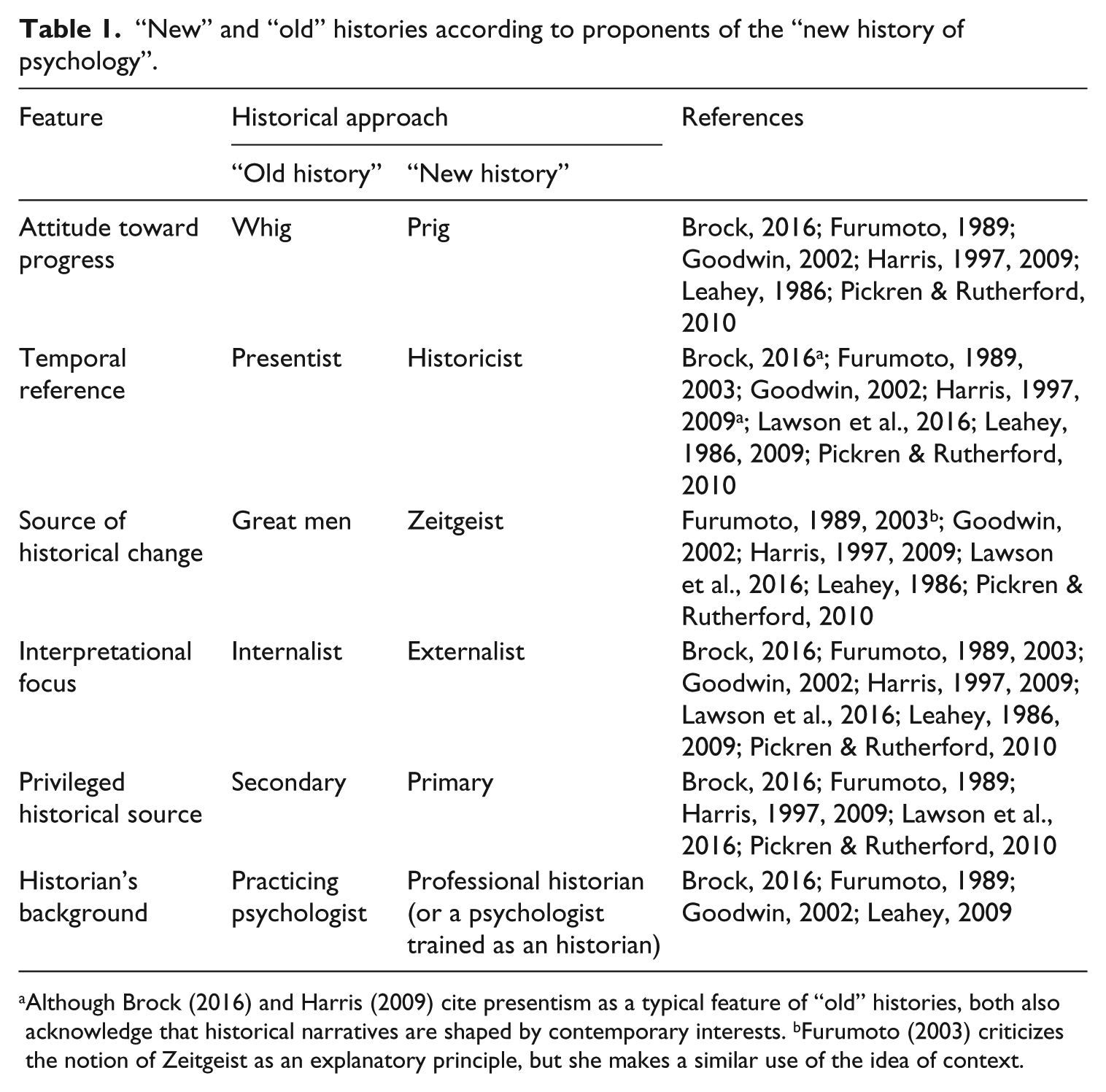
Although Brock (2016) and Harris (2009) cite presentism as a typical feature of “old” histories, both also acknowledge that historical narratives are shaped by contemporary interests. bFurumoto (2003) criticizes the notion of Zeitgeist as an explanatory principle, but she makes a similar use of the idea of context.
Whig and prig
The terms Whig and prig refer to the view of historical progress that is implicit in a narrative. Popularized by Butterfield (1931/1951) in the field of political history, Whig also became a pejorative term for histories that emphasize the progressive character of a scientific development (see, e.g., Brush, 1995; Harrison, 1987; Kragh, 1987; Russell, 1984). In the words of Butterfield (1931/1951), Whig narratives tend “to praise revolutions provided they have been successful, to emphasize certain principles of progress in the past and to produce a story which is the ratification if not the glorification of the present” (p. v). This is the view that old histories allegedly espouse. It is indeed an anachronistic view of history, since it is distorted by the perspective of the present and divides the world into “the friends and enemies of progress” (Butterfield, 1931/1951, p. 5).
Hence, new history is said to defend an anti-Whig attitude, rejecting narratives that construe psychology’s past as a march of progress toward the current state of affairs. This anti-Whiggism has been called “prig” (Harrison, 1987) and its weaknesses did not go unnoticed. In the words of Harrison (1987), this attitude “makes a virtue of ignorance and discards from the present what contributes nothing to the past” (p. 214). It thus implies a sense of “narrow-minded superiority” (p. 214) of historians who supposedly know how to avoid Whiggism toward scientists educated to believe in Whig stories. Precisely because of this sense of superiority, the prig attitude contains in itself the seeds of Whiggism. The rejection of Whig narratives usually entails the celebration of anti-Whig stories as a sort of progress among historians. As Lovett (2006) noted, the new history could be said to be Whiggish in a new way when it assumes that the development of critical narratives has led to a better way of writing the history of psychology. Therefore, there is little sense in combating Whiggism with its reverse, since anti-Whiggism paradoxically leads to a kind of Whiggism toward historiography itself.
Presentism and historicism
Presentism and historicism differ on the temporal reference adopted to understand the past (Stocking, 1965; but see also Brush, 1995). Old histories are said to be presentist because they are allegedly history written from the vantage point of the present. They try to understand the past through the eyes of the present. New history, by contrast, would be an attempt “to get inside the thought of a period to see issues as they appeared at the time” (Furumoto, 1989, p. 18). Thus, the new history is called historicist, for it tries to “understand the past for the sake of the past” (Butterfield, 1931/1951, p. 16). With this defense of historicism, presentism is usually portrayed as a kind of injustice to the past in justifications of the new history.
Nonetheless, because historians write from the present, it is difficult to imagine how they could escape from the perspectives that exist in the present (see, e.g., Carr, 1987; Hull, 1979; Lovett, 2006; Smith, 1988; Teo, 2005). Furthermore, an understanding of the past from the perspective of the present is different from an understanding of the past distorted by the perspective of the present 3 (Brush, 1995; see also Brock, 2016). For this reason, Teo and Goertzen (2004) see this distortion as a kind of naïve presentism and propose that the rigid dichotomy between presentism and historicism should be abandoned. Instead, they say, it seems to make more sense to talk of presentist historicism and historicist presentism, which refer respectively to the study of the past motivated by contemporary interests and to the study of the present informed by an understanding of the past. In this manner, the limits between presentism and historicism begin to blur once we understand that, “the past is intelligible to us only in the light of the present; and we can fully understand the present only in the light of the past” (Carr, 1987, p. 55).
Great men and the Zeitgeist
In the history of psychology, the source of historical change has typically been attributed either to “great men” or to “the Zeitgeist.” This dichotomy, which found its most clear expression with Boring (1950), has also played a role in the distinction between new and old histories. Old history has often been associated with great-men narratives, stories that portray the work of a few creative and brilliant psychologists as responsible for the progress toward contemporary psychology. In contrast, new history goes “beyond great men” (Furumoto, 2003, p. 113), since it “favors Zeitgeist interpretations” 4 (Leahey, 1986, p. 648). A German word for the “spirit of the time,” Zeitgeist refers to a set of contextual factors present in a given historical period. Thus, the Zeitgeist approach espoused by the new history emphasizes the role of historical context in shaping psychology’s development and it is usually held as a broader perspective.
Nevertheless, the study of individual psychologists—be they prominent or not—is not necessarily a narrow-minded and celebratory endeavor. Individuals are agents of the Zeitgeist (Richards, 1987). There is no reason for considering them apart from the context in which they live, because they do not exist alone in a vacuum. There is also no reason for considering the Zeitgeist alone and committing what Morison (1951) once called “the mass murder of historical characters” (p. 270). In this manner, the apparent antinomy between great men and the Zeitgeist disappears when we perceive that, “these two views of the development and emergence of thought are not mutually exclusive but obverse and reverse of every historical process” (Boring, 1950, p. xiii). As seen in critical historiography itself, it is perfectly possible to write histories about important psychologists in context, without necessarily venerating them (e.g., Blumenthal, 1979; O’Donnell, 1979; see also Ball, 2012).
Internalism and externalism
An extension of the debate about great men and the Zeitgeist, internalism and externalism differ on whether the forces that drive scientific development are to be found inside or outside science itself (Kuhn, 1968; see also Lakatos, 1970). Old history is considered internalist because its narratives typically show a succession of great psychologists, great ideas, and great events. In other words, they make relatively few references to factors beyond psychology’s boundaries, relying on what Hull (1990) called “the internalist trinity of reason, argument, and evidence” (p. 2). For this reason, old history is also considered a kind of intellectual history. New history, for its part, is usually associated with externalism because it emphasizes the role of political, economic, and cultural factors in shaping the development of psychology. By focusing on these “extradisciplinary” forces, new history could be said to be “concerned with the activity of scientists as a social group within a larger culture” (Kuhn, 1968, p. 76) and hence as a sort of social history.
On the whole, the externalist trend has been seen as one of the most influential developments both in the history of science and in the history of psychology, while internalism has conversely become a pejorative term. Nevertheless, some historians have recognized that internalism and externalism are separated by artificial boundaries and that even those factors that could surely be taken as internal or external interact in a constant and reciprocal way (see, e.g., Hull, 1990; Jones & Elcock, 2001; Richards, 1987; Watson, 1960). Consequently, as Lovett (2006) said, “a completely external history … is just as problematic as a completely internal history” (p. 33) and the two approaches could thus be viewed as complementary.
Primary and secondary sources
A common issue in historiography is the classification of primary and secondary sources (see, e.g., Kragh, 1987; Woodward, 1980). Usually produced in the period under study, primary sources are the original materials on which historical research is to be conducted. On the other hand, secondary sources are works on a given subject that are based on primary and sometimes on other secondary sources. In this sense, a methodological difference arises when advocates of the new history favor the use of primary rather than of secondary sources. Primary sources are privileged in new history to avoid the dangers of an indiscriminate use of secondary sources, namely, “the passing down of anecdotes and myths from one generation of textbook writers to the next” (Furumoto, 1989, p. 18). As one might expect, old history was charged with an almost exclusive reliance on secondary sources.
Indeed, history is impossible without primary sources. Thanks to new technologies, there is wider access to them and thus increasingly fewer excuses for not consulting this sort of material (Vaughn-Blount et al., 2009). What proponents of the new history have misunderstood is that to avoid the dangers of using secondary sources does not imply an exclusive reliance on primary sources. It is usually impossible to write a full historical account based solely on one kind of evidence (Lovett, 2006). The use of primary sources, however necessary, offers no protection against distortions in the source itself, nor against historians’ own biases (see also Harris, 1979). In addition, the use of secondary sources has value in its own right, for it constitutes a dialogue with historical scholarship. In this manner, what represents perhaps the best historical attitude is a balanced use of all kinds of sources (Woodward, 1980).
Practicing psychologists and professional historians
A final difference between new and old histories is that regarding the training of the historian. Old histories are assumed to be written by practicing psychologists. Because psychologists usually lack training in historical methods, they end up writing histories with traces of amateurism, which is usually defined by Whiggism, presentism, worship of great men, internalism, and a tendency to rely on secondary sources. On the other hand, new histories are assumed to be written by historians or by those psychologists who espouse the standards of professional history. This acquaintance with historical methods allegedly leads narratives to the opposite extreme of historiographical dichotomies, namely, to anti-Whiggism, historicism, focus on the Zeitgeist, externalism, and a reliance on primary sources. As a result, there seems to be irreconcilable differences between histories written by practicing psychologists and those penned by professional historians. Once psychologists and historians are ignorant of each other’s standards, it seems that psychologists should not dare to write history and that historians should avoid too much talking about psychological science.
Still, some authors have argued that precisely because of this mutual ignorance, historians and practitioners of a science have much to contribute to each other’s research (see, e.g., Brush, 1995; Harrison, 1987; Young, 1966). History of psychology is no exception. If historians can provide the methods, practicing psychologists can contribute with a direct experience with research and application of psychological knowledge. In the words of Danziger, psychologists “will know what it is like from the inside, sometimes through years of experience. They are in a position, at least potentially, to communicate with their fellow psychologists in a way that perhaps professional historians cannot do” (as cited in Brock, 2006, p. 5). Hence, psychologists themselves may well combine the commitment to psychological science with the critical attitude taught by professional historians (Danziger, 1994; see also Vaughn-Blount et al., 2009). Both psychologists and historians could thus benefit from each other’s works and write together the history of psychology.
The abuse of dichotomies and its implications
Proponents of the new history have constructed a discourse of difference between the new and the old, in which the new is portrayed as a critical and necessary approach and the old as a celebratory tradition that must be overcome. The device used to build this contrast is a collection of historiographical dichotomies. This division, however, is likely to be exaggerated both in theory and in practice.
In theory, as it has been argued, the dichotomies that underpin this broader distinction have been severely criticized. In fact, the poles of almost all dichotomies are complementary rather than mutually exclusive, making the antinomy between new and old histories collapse (see also Lovett, 2006).
In practice, historians have adopted a more balanced tone and have usually combined elements of new and old histories in the same narrative. So, although there are still old-fashioned, triumphalist stories like that of the cognitive revolution (e.g., Gardner, 1985), there are also narratives in which the development of psychological theories and practices relevant to the present has been described in context, with reference to both social and intellectual elements, as seen in works about Wundt’s psychology (e.g., Blumenthal, 1979), the origins of the psychological experiment (e.g., Danziger, 1985, 1990), or the emergence of humanistic approaches (e.g., DeCarvalho, 1990). Even proponents of the new history themselves do not follow their own prescriptions consistently nor does their work present as typical new histories (Araujo, 2017; Lovett, 2006). As a result, even though it is clear who the advocates of the new history are, it is not easy to determine which narratives are actual new histories or who the “true new historians” are, let alone the old histories and their respective authors. In fact, some scholars deemed to be new historians do not describe themselves as such nor fully commit themselves to the new history. Samelson (1999), for example, harshly criticized the cumulative product of the new history. Leahey (2000), for his part, said the following about his own textbook: It is true that I have been influenced by and have used the new history of psychology in writing my book, but it is not entirely of new history. I feel the greatest affinity for the traditional history of ideas and have not generally sought to find the causes of psychology’s development in the biographies of psychologists. (p. 49)
Therefore, there seems to be an inconsistency between what proponents of the new history say about their specialty and what historians effectively do in practice.
Despite these theoretical and practical inconsistencies, the rhetoric of new history persists since Leahey’s (1986) and Furumoto’s (1989) canonical statements. Given its dissemination, this dichotomizing perspective can certainly produce significant effects. This section explores the implications of this rhetoric for the actual critical historiography and for the history of psychology as a whole.
Implications for the critical historiography of psychology
(Misleading) sense of professional and historical identity
“New history” is not only a name. As seen in works of its proponents (e.g., Furumoto, 1989), it is also a narrative about the historical process experienced by the community of historians of psychology, especially by critical historians. In this story, different attempts to challenge traditional narratives developed almost simultaneously in the historiography of psychology. It seems to be no coincidence that new forms of intellectual and social histories began to systematically appear from the 1970s to the 1980s, such as those focusing on feminist (e.g., Furumoto, 1979) and African American (e.g., Guthrie, 1976) perspectives. In this context, historiographical dichotomies conveniently appeared as the device that could distinguish these critical narratives from traditional ones. Consequently, this dichotomization also contributed to identify common features of critical approaches and to overshadow their differences. The idea of a new history has thus provided a coherent view of the critical historiography of psychology, defining it as a single historiographical movement. In other words, its dichotomizing narrative has created a sense of historical and professional identity among the efforts of different critical historians.
This narrative, however, may be misleading precisely because it implies that critical approaches were all part of a common effort to react to a single historiographical tradition. Both “critical” and “new history” are generic labels for a group of disparate tendencies—let alone “old history” (Teo, 2005; see also Lovett, 2006). Furumoto (1989) herself acknowledged this fact by saying that, “the new history, known as ‘critical history’ to some of its advocates, would perhaps be more accurately called new or critical histories in that it has assumed a variety of forms within intellectual as well as social history” (p. 13). In this sense, it is unlikely that critical historians were working in concerted effort and, if they were, proponents of the new history must present additional evidence besides the simultaneous publication dates of critical narratives. Moreover, it is also possible that advocates of the new history exaggerate the degree of agreement among different critical approaches in order to make their case. These approaches indeed converge in challenging traditional styles of history writing, but whether they share other commitments beyond this point is an open issue. As a result, the idea of the new history may misleadingly conceal the heterogeneity that exists within critical historiography. If this is really the case, this idea would be rather a caricature of critical histories.
Uncritical attitude disguised as critical thinking
It is true that “new history” has been identified with “critical historiography,” but is it fair to use both terms as synonymous? As argued before, the idea of new history may certainly provide a coherent view of the critical historiography and of the latter’s historical process. Nevertheless, this idea is only one of the most recent conceptualizations of critical historiography, making it difficult to reduce the latter to the former (see also Harris, 1997, 2009; Teo, 2005). If both terms are equivalent, critical historians must pay attention to the kind of narrative and of critical thinking that new history’s rhetoric implies.
Once this rhetoric offers a narrative about the development of critical historiography, the new history cannot itself escape the critical scrutiny that it defends in the study of traditional approaches. In its narrative, dichotomies have not only pitted the new against the old, but have also justified the former at the expense of the latter. If features of new history are presented as standards of professional rigor, every characteristic ascribed to old history is dismissed as a sin or, at least, seen with distrust. Leahey, for example, condemned Kimble and Schlesinger’s (1985) volumes by saying that the narratives therein “commit every sin of the old, traditional history of science” (Leahey, 1986, p. 648), such as Whiggism, presentism, internalism, and worship of great men, and added that “errors the new historians of psychology have corrected are repeated” (p. 649). As a result of this kind of rhetoric, legitimization of critical histories has been produced at the expense of the contributions of traditional narratives, turning the idea of new history paradoxically into a celebration of critical histories.
Moreover, the critical thinking advocated by the new history of psychology seems to paradoxically produce an uncritical attitude toward its own assumptions. Dichotomies have been used as methodological guidelines, each implying one pole as a prescription and the other as a prohibition. This sort of critical thinking centers on rule-following rather than on methodological reflection. It does not encourage thinking on the assumptions on which the new history itself relies. As Yanchar, Slife, and Warne (2008) have pointed out, this form of critical reasoning is also common in psychology itself. These authors also explain that, Although the need for general rules designed to assess method use is clear, the exclusive use of such rules to evaluate research informed by the same (or similar) assumptions precludes any critical questioning of that method’s assumptive framework and its general mode of operation. (p. 267)
Perhaps this is the reason why critiques of the new history of psychology have been so scarce. As Pettit and Davidson (2014) noted, its assumptions are so much taken for granted that “many of the historiographic innovations of the new history (e.g., the rejection of presentism) have become totemic dogmas rather than the sharp analytic tools they once were” (p. 710). As a result, there has been little critical reflection on new history itself. Since Lovett’s (2006) first critique, few have refined new criticisms and it took 10 years for Brock’s (2016) first reply to appear. This relative silence may in part be due to historians’ traditional avoidance of theoretical discussions (see, e.g., Sewell, 2005). Nonetheless, this silence may also suggest an uncritical attitude toward the very rhetoric of new history.
Implications for the history of psychology as a whole
Legitimization of the field as a professional specialty
New history’s dichotomization has also legitimized history of psychology as a professional specialty. If the institutionalization of this field has been identified with the appearance of critical narratives, the contrast between new and old establishes a clear demarcation between histories written before and after professionalization. As a result, this rhetoric also consolidates the historical and professional identity of historians of psychology as a whole, even though it also misrepresents the importance of earlier historians. Applying the line of reasoning suggested by Ash (1983) to the very specialty of history of psychology, this sort of self-presentation may serve several legitimizing functions, whether outside or even inside the community of historians.
Outside this community, the idea of new history disseminates a coherent view of the history of psychology as a mature professional specialty. This self-presentation may be directed to other fields of knowledge—especially to sociologists and historians of science—but it might also be a method of attracting institutional and financial support for research, courses, and programs on the history of psychology.
Nevertheless, it is inside the community of historians that the most significant effects appear. New history’s dichotomization has served fundamentally as a form of self-assurance for historians of psychology because they see their practices as critical and professional in contrast to amateur history. But, more fundamentally, the idea of new history can also serve an important pedagogical function. Furumoto (1989) herself expressed her wish of “teaching a history that is more contextual, more critical, more archival, more inclusive, and more past-minded” (p. 30). Although the impact of this perspective on undergraduate syllabi was still insignificant in the late 1990s (see, e.g., Hogan, Goshtasbpour, Laufer, & Haswell, 1998), some textbooks have included explanations of the new history in their historiography sections (e.g., Lawson et al., 2016; Leahey, 2000; Pickren & Rutherford, 2010). In this sense, the question remains as to what type of teaching the new history stimulates. Teaching historiographical dichotomies, for example, may serve as a pedagogical tool for students to distinguish good from bad history, but not to teach these students to think carefully on narratives’ biases or on the very assumptions of historical methodology. Moreover, it seems unrealistic to expect a more nuanced understanding of the new history when students usually do not master fundamental disciplines such as philosophy, sociology, and history itself (Dewsbury, 1990). Thus, although proponents of the new history have so strenuously opposed textbook history for its simplicity and lack of rigor, the very idea of new history may end up as a sort of “textbook historiography,” a simplistic perspective disseminated in textbooks that is incapable of teaching anything more than prejudices against traditional histories of psychology.
Isolation from philosophy and psychology
Despite its attempts to present history of psychology as a professional specialty before other disciplines, new history’s dichotomization may also have impaired the relationship of historians of psychology with philosophy and with psychology itself.
The relationship with philosophy, for example, seems to have been degraded by new history’s disproportionate emphasis on context rather than on content, since the latter is associated with traditional histories of ideas. Teo (2013), for example, pointed out that this might well have happened “because historians of psychology were now compelled to look at historiography (their approaches, methods, and practices), rather than at philosophy or metatheory” (p. 842).
On the other hand, new history’s derogatory attitude toward psychological science seems to have damaged the relationship of the history of psychology with psychology itself. To use the words of Lovett (2006): Psychologists must suffer from low professional morale to enjoy reading history that makes out their intellectual forebears to be, at best, irrational and mere products of their times, and at worst, dangerous individuals who are responsible for America’s social problems. (p. 33)
But proponents of the new history have not only offered a negative view of psychology qua science, but also of psychologists qua historians. Although many proponents are psychologists themselves (Brock, 2016), they seem, as was argued before, to consider psychologists as ignorant of historiographical standards and of contextual aspects of the discipline’s history. Furumoto (1989), for instance, opened her lecture by saying that, “psychologists currently teaching the history of their discipline are unlikely to have had any instruction in the field other than a graduate level course introducing them to ‘great men’ and ‘great ideas’” (p. 9). As a result, new history’s dichotomization ultimately values the work of professional historians at the expense of the historical scholarship produced and consumed by practicing psychologists, thus reinforcing the division between psychology and the specialty concerned with its history (see also Pettit & Davidson, 2014).
This increase in the isolation from philosophy and from science itself is well-known by critics of the new history of science (e.g., Laudan, 1992). Advocates of the new history of psychology, however, seem incapable of perceiving the threat of their own assumptions to the dialogue with philosophy and with psychology itself. It is true that the relationship among these three fields may be permeated by conflict (see, e.g., Teo, 2013), but psychology and philosophy are precisely those disciplines that could best help historians to understand the content of their subject matter. Even so, the rhetoric of new history apparently supports a history of contexts without content. This instigates both philosophers and psychologists to move away from the history of psychology and thus strengthens the unhistorical attitude of these professionals that proponents of the new history so much criticize. But what makes this isolation even more worrisome is that it occurs when professional historians already occupy a very small place in undergraduate and graduate programs of psychology.
Threats to the field’s thematic and methodological scope
Although the history of psychology has been much more diverse since the appearance of critical approaches, new history’s dichotomization threatens the specialty’s thematic and methodological scope. By splitting the field into two opposite traditions, the new history affirms itself as the right way of writing history and denies a place for anything related to the old. As a result, themes and methodologies associated with traditional narratives become a sort of taboo to those who believe in new history’s rhetoric.
Thematic losses may result especially from the prejudices against great men, internalism, and presentism (see also Ball, 2012; Lovett, 2006). Though the criticisms raised against these biases are not without some reason, the mere interest for characters and internal developments relevant to the present does not automatically constitute a distortion. Yet proponents of the new history instigate the replacement of these themes with narratives about underrepresented groups and sociocultural contexts. Furumoto (2003), for instance, said that the new history explores the lives and work of women and others often omitted from the standard account, tries to understand psychology’s participation in particular sociocultural settings, and encourages students to question and to go beyond the traditional textbook version of psychology’s past. (p. 113)
Furumoto’s (2003) attitude thus seems prone to what Walsh, Teo, and Baydala (2014) called “overcompensation for marginalization” (p. 19), the intentional inflation of the contributions of marginalized groups as a compensation for traditional emphasis on prominent psychologists. Perhaps this focus on underrepresented groups, methods, and theories was better justified by Brock (2016), for whom these omissions in traditional narratives tell a great deal about how psychologists share the prejudices of their times and reproduce social marginalization practices in their science. However, this justification alone does not eliminate the value of studying prominent psychologists, methods, and theories with the same historical rigor applied in narratives about marginalized groups and ideas.
This excessive focus on sociocultural contexts and less-known characters has also led to a fragmentary history of psychology, with narratives focusing on increasingly narrow and apparently disconnected topics. Samelson (1999), for example, pointed out that “the collective product [of the new history of psychology] so far is an accumulation of disparate pieces rather than a coherent story” (p. 247), since historians “can always find another corner of the past to explore, one that may well hold some intrinsic, if limited, interest” (p. 249). In this sense, while the new history has rejected the thematic unity given by stories about great psychologists, insights, and events relevant to the present, it has also failed to provide any other thematic thread that could tie together disparate narratives about psychology. And, by rejecting grand narratives, historians may, as Smith (1998) once said, lose their capacity for seeing the “big picture” and of offering integrative and relevant views about psychology’s past. Brock (2016), on the other hand, defended new history’s attitude by arguing that “the only way that historians of psychology have been able to base their work on primary sources is to narrow its focus so that they become specialists on a limited subject, such as the work of a single psychologist” (p. 8). Although methodological accuracy is naturally desirable, the question remains: is it always necessary to sacrifice perspective in the name of methodology, especially if it is a distorted notion of methodology?
These distorted conceptions have also threatened the very methodological plurality of the history of psychology. New history’s disproportional emphasis on context rather than on content seems to have led to an overestimation of social histories to the exclusion of more intellectual, philosophical narratives and methods, which are, in turn, associated with the old history. Intellectual aspects of the history of psychology, however, are not reducible to social ones. Araujo (2017), for example, has shown that, however undoubtedly important, social approaches to Wundt’s psychological program cannot explain alone many of its conceptual developments, such as the abandonment of the unconscious.
Moreover, new history’s focus on the use of primary sources has also led some historians to underestimate the value of textbook history as a mere source of origin myths. This view ignores the fact that textbooks must present language and readability that ensure learning and that they thus constitute one of the most efficient ways of reaching psychologists in training and of stimulating their interest for history (Dewsbury, 1990). It is fortunate, however, that some advocates of the new history have overcome this prejudice and developed their own textbooks (e.g., Lawson et al., 2016; Leahey, 2000; Pickren & Rutherford, 2010).
In this manner, new history’s abuse of dichotomies has threatened the thematic and methodological breadth of the history of psychology. Dichotomies are used not only to establish standards, but also to condemn everyone and everything that did not fit these same standards. Nevertheless, by creating this Procrustean bed, the rhetoric of new history seems to be considerably restricting the sense of history of psychology, ruling out much of what is of interest both to historians and to psychologists themselves. After all, as Hull (1979) once said, “‘allowing’ or not ‘allowing’ someone to write history is incompatible with free inquiry” (p. 2).
Final remarks
Dichotomies have long proven to be a valuable resource for historians of psychology, either to interpret psychology’s past (e.g., Watson, 1967) or to study historical approaches (e.g., Hilgard et al., 1991). Since they play such valuable roles, dichotomies are not a problem per se. It is rather the abuse of dichotomies that is troublesome, that is, when they give room for a black-and-white view of history. This kind of abuse reached its zenith when some scholars suggested that recent changes in the historiography of psychology have led to the emergence of a “new history” that was symmetrically opposed to the “old.” The idea of a “new history” indeed provides a framework both for the critical historiography and for the history of psychology as a whole, creating a sense of historical and professional identity among historians. The coherence of this framework, however, has been built upon a collection of dichotomies that produces undesirable implications for both fields. This dichotomization can preclude a sufficiently broad critical thinking. It may have isolated historians of psychology from philosophy and from psychology itself. It threatens the thematic and methodological breadth of the history of psychology. Above all, this rhetoric has unnecessarily split the specialty into two antagonistic traditions that one does not easily find in actual histories of psychology.
This state of affairs illustrates the dangers of misusing an important theoretical tool such as dichotomies. By abusing them, proponents of the “new history” may have inadvertently endangered their own efforts of developing a critical and mature history of psychology. Nevertheless, the “new history” is just one particular perspective. It was developed by a particular group and it has been used to justify particular practices. Consequently, the “new history” is not the current perspective in the history of psychology, but rather one of the many possible ways of conceptualizing the critical historiography of psychology. Since it is fallible like any other idea, it is of small wonder that its dichotomization presents inconsistencies. What its undesirable implications suggest is the need to abandon this excessive emphasis on contrasts. After all, a critical attitude is more likely to be found beyond dichotomies, namely in the very reflection about what each narrative and methodology might imply for the understanding and writing of history. Proponents of the new history may thus reframe their rhetoric, replacing an emphasis on prescriptions and prohibitions with a defense of critical and careful reflection on implicit assumptions (see also Yanchar et al., 2008). Whether this shall appear as a revision of the “new history of psychology” or as a whole new framework is still open for debate. What is clear in any case is that such a change is more likely to preserve the breadth of the history of psychology without losing the critical attitude.
Footnotes
Declaration of conflicting interests
The author(s) declared no potential conflicts of interest with respect to the research, authorship, and/or publication of this article.
Funding
This research received no specific grant from any funding agency in the public, commercial, or not-for-profit sectors.