



Abstract
This article examines two conceptualizations of time—kairic and prophetic—to illustrate the semiotic multistability of time: the Gestalt-like switch between conceptualizations. We will use two well-known novellas about time and salvation (by Charles Dickens and C. S. Lewis) to explore how the features of these two schemata cluster together thereby creating these two different understandings of time, while simultaneously blocking the view to each other. Finally, we will explore how the tensions between these two schemata are of interest for the logic of psychological science. It will be argued that many of the classic tensions within psychology speak to the multistability of our conceptual schemata regarding time and causation, something that is particularly exemplified by the challenges posed by Peirce’s notion of abduction. As we opt for one vision of time, we occlude others, even as we remain aware of their presence just beyond our conceptual reach.
“Men’s courses will foreshadow certain ends, to which, if preserved in, they must lead,” said Scrooge. “But if the courses be departed from, the ends will change.” (Dickens, 1843/1993, p. 87) I think earth, if chosen instead of Heaven, will turn out to have been, all along, only a region of Hell: and earth, if put second to Heaven, to have been from the beginning a part of Heaven itself. (Lewis, 1946/1973, p. ix)
Every one of us is intimately aware of the philosophical puzzle that is time. It is perhaps the classic example of what St. Augustine described in the 4th century: “I know very well what it is, as long as nobody asks me; but if I am asked what it is and try to explain, I am baffled” (Confessions, Book XI, 14). Despite the confusion to which it can give rise, all of us necessarily think of time, and we tend to do so in a way that generally feels coherent. In other words, despite its many challenges, we are generally not baffled into paralysis by time, but rather, we more often feel that we have a fairly good grasp of what it is. While our lived reality is generally much messier than neat philosophical assertions would suggest, patterns do appear (constituting the subject of experimental philosophy; Knobe & Nichols, 2008). The current article examines two such patterns in our thinking about time; kairic time and prophetic time (Rayment-Pickard, 2004). It will be argued that as time takes on the shape of one understanding, it becomes difficult, if not impossible, to simultaneously perceive time through the lens of the other understanding—thus we see in these patterned understandings of time a degree of multistability, that is, the Gestalt-like switch between overlapping images that cannot be perceived at the same time (e.g., as in the “Necker cube”; Lehar, 2003). Recognizing literature as a valid source of data for the study of human psychology (Brinkmann, 2009; Holquist, 2002; Moghaddam, 2004; Valsiner, 2017), and working with the assumption that our dialogical utterances (including literature) are “more of the sentence than … of the sign” (more of the syntagmatic than the pragmatic; Holquist, 2002, p. 40), we will then use two well-known novellas about time and salvation (Dickens, 1843/1993; Lewis, 1946/1973) to explore how the features of these two schemata cluster together so as to create these two different understandings of time, while simultaneously blocking the view to each other. That our sense of time and space is influenced by our perceptions of the interworkings between self and other is a foundational assertion of dialogism (Holquist, 2002); thus the current study will examine how what Bakhtin (1981) called the “novelness” of our lives—the meaningful narratives we tell ourselves and others—takes particular, recognizable, and intelligible forms—in this case in reference to time. Finally, we will explore how the tensions between these two schemata are of particular interest for the logic of psychological science. It will be argued that the multistability exhibited by our conceptual schemata regarding time and causation speak to the challenges posed by Peirce’s notion of abduction (Peirce, 1958a, 1958b).
Kairic and prophetic time
Many classification schemata have been presented regarding our experience of time (Lewandowska-Tomaszczyk, 2016; Tateo & Valsiner, 2015), often with intellectual roots extending back to ancient Greece (Sipiora & Baumlin, 2002; Smith, 1969). Psychologists have been shown to use different conceptualizations of time and to do so when examining different phenomena, such as development or historical change (e.g., Doria & Simão, 2018). Of interest for our current study is the four-part classification scheme discussed by Rayment-Pickard (2004), two of which will concern us here.
In The Myths of Time (2004), Rayment-Pickard explains that while useful, “no scheme can ever do justice to the ambiguities and complexities of the ‘lived duration’ of human existence. Any reductive model should be treated like Wittgenstein’s ladder: once you’ve climbed it, you should push it away” (p. xv). In other words, the patterns we see in our conceptualizations of time are inherently impoverished—albeit useful—shadows of an infinitely more complex reality. However, such schemata are all the more interesting because, much like magnets, they not only attract but also repel. In other words, they are patterned ways in which we make sense out of a complex, complicated, and otherwise confusing reality, and their functionality is facilitated in part by the (temporary) occlusion of the other options. Their Gestalt-like psychological nature is linked with the fact that they take shape simultaneously on several levels (e.g., the individual, the intersubjective, the societal; Tateo & Valsiner, 2015). Thus, in all its conceptual complexity, any conceptualization of time can be understood as an expression of semiotic mediation of lived experience (Valsiner, 1999), not the result of an objective “fact,” but of a subjectively, dialogically co-created simultaneity, or “co-being” (Holquist, 2002). “Time is then a complex semiotic construction that links the individual experience to a societal construction” (Tateo & Valsiner, 2015). Thus, [t]he mistake we make when we think about time is to imagine that time is just an environment within which our thoughts and experience take place. So we think of time as happening outside us, as though we were standing in the middle of a busy road with time speeding past. But we are not inside time, we are time, our very thoughts and actions are not only an experience of time but the very happening of time itself. (Rayment-Pickard, 2004, p. x)
Kairic time
Let us look first at kairic time, which “refers to any view of history as a series of moments each potentially complete in itself” (Rayment-Pickard, 2004, p. 87). Within this understanding of time, each moment is pregnant with all possible possibilities. We are living in an eternal now, and as such, both the past and the future fold into the present allowing the causal flow to pass as easily from forward to back as from back to forward (as there really is no forward or back so to speak). In the language of literary scholarship, kairic time is both proleptic and analeptic at the same time in that it simultaneously contains both anticipations of the future and recollections of the past. This can be clearly seen in the quotation from Lewis at the start of the current article, where the symbolic or moral quality of the present characterizes the symbolic or moral quality of the past, and vice-versa. This vision of time is in some sense timeless, as it is not bound to linear causality. Liturgical calendars are often understood to represent this understanding of time, with religious celebrations spiritually understood to actually be the religious events in question. For example, Lent can be understood as a time in which believers anticipate events that happened in the past (Christ’s death and resurrection), just as the period of Advent is the anticipation of Christ’s birth on Christmas. The kairic notion of time is seen in the following Biblical statement: “One day with the Lord is as a thousand years, and a thousand years as one day” (2 Peter 3:8).
Yet another illustrative example of kairic time would be to say that something “was worth it” in the sense that the quality of the past matches the quality of the present. For example, to claim that past suffering “was worth it” means that the suffering has a righteous value to it, which is to say that it was and remains valuable in itself. In its timelessness and seemingly free-floating causality, kairic time can be said to have a magical, dream-like quality to it. The symbolic quality of our lives cannot be reduced to independent, quantifiable units, but rather it must be qualitatively explored. In this sense, it gobbles up the notion of independent and dependent variables: “The distinction of ‘independent’ and ‘dependent’ variables becomes impossible since the features designated as such transform into one another in the nonlinear process of development” (Tateo & Valsiner, 2015, p. 358).
In this sense, our lives are deeply personal and assessments of its qualities are intimately bound to our own unique experiences. Emerson (1841/1982) wrote that “all public facts are to be individualized, all private facts are to be generalized. Then at once History becomes fluid and true, and Biography deep and sublime” (p. 160). Rayment-Pickard (2004) writes that, “[i]ndeed our duty to the present must be so total […] that we should not ‘consider consequences, causes or reasons’. This is an ultimate deontological ethic, in which duty transcends all pragmatic considerations” (p. 93). Emerson (1841/1982) expresses this understanding of time as follows: Facts encumber them, tyrannize over them, and make the men of routine, the men of sense, in whom a literal obedience to facts has extinguished every spark of that light by which man is truly man. But if the man is true to his better instincts or sentiments, and refuses the domination of facts, as one that comes of a higher race; remains fast by the soul and sees the principle, then the facts fall aptly and supple into their places; they know their master, and the meanest of them glorifies him. (p. 168)
Ziff’s (1982) description of the philosophical style of Ralph Waldo Emerson nicely describes the kairic approach to time found in Lewis: “Once facts are apprehended as symbols rather than causes, man realizes himself as the maker rather than the effect of his circumstances” (p. 19) — “history is a lived present rather than a shaping past. It is not a chronology but an instantly available cosmos” (p. 20). As the assessments of our lives are bound to neither temporal linearity nor linear causality, it is never “too late” to change. In the religious language of Rayment-Pickard (2004), it is never too late to be saved and to find oneself among the righteous. The time of salvation is the eternal now.
Prophetic time
Years, months, weeks, and days pass by irrevocably within prophetic time. Prophetic time is a scheme within which time is understood to pass linearly and where what is done in the past cannot be undone (similar to the notion of chronos; Smith, 1969). As implied in the phrase “the fruits of one’s labor,” this understanding of time incorporates both the flow of time and the causal chains time encompasses. In this understanding of time, the measurement of quantifiably good and bad deeds is of central importance, as it is in this way that we can point to increasing or decreasing achievements, without which the notion of progress would not be possible. Within this version of time, we in effect add up all the “points” in our lives; all the symbolic “pluses” and “minuses,” and it is in this way that we arrive at a final “score” at the end of our days. A prophetic understanding of time understands the calendar as a representation of a linear progression of events in time, hence, the Lenten and Advent celebrations of this year are of a different nature than the Lenten and Advent celebrations of the past (let alone the first such periods). The prophetic notion of time is seen in the following Biblical statement: “You [God], however, have ordered all things by measure, number, and weight” (Wisdom 11:20).
Within prophetic time, the claim that something “was worth it” refers to the endpoint of a causal chain, the previous qualities of which do not themselves change. To claim that past suffering “was worth it” within prophetic time is to state that the suffering led to something good that outweighs the bad of the past suffering. Importantly, however, that negative quality of the past suffering remains. Within prophetic versions of time we see a tendency towards quantification, as we add up all the symbolic “points” on this and that side of the scales. This vision of time is deeply positivistic, as the qualities of any given point are intimately linked with the assessment of progress, which itself is rooted in notions of linearity and quantification. As Rayment-Pickard explains: Prophetic time is strongly end-oriented (eschatological) and has its centre of gravity in the future, pulling it forward. … Our sense of self is always of a future self—the person we will be when we have achieved this or that. (2004, p. 111)
When it comes to the “final assessment” of one’s life, once the counting stops, the final score is rendered. In this sense, at some point it can simply be too late to change the final calculation.
Since the period of the Enlightenment, the West has been increasingly wedded to the prophetic understanding of time; our increasing focus on quantifiable progress shifting our attention away from a repeating and meaningful past and onto the vision of a better tomorrow that is just over the horizon (Gay, 1995). The positivistic view of linear, quantifiable human progress has come to color all facets of human inquiry, even if the tensions between these two understandings of time are in fact ancient (for examples of this tension during the spread of Christianity in the Roman Empire, see Brown, 1995, p. 65). What is interesting to note is that when either of these two schemata appear, the other vanishes, much like in the Gestalt principle of multistability (Lehar, 2003). In other words, the contours of one vision of time make it difficult or even impossible to simultaneously perceive the contours of the other vision of time. We will now examine two examples of how the features of these two conceptualizations of time cluster together. Our analysis will be based on two well-known novellas, C. S. Lewis’s The Great Divorce (1946/1973), and Charles Dickens’s A Christmas Carol (1843/1993). Both deal with the same topics of time and salvation, however, they view these matters through different temporal lenses, one kairic and one prophetic.
Literature can provide insight into human psychology in as far as it illustrates what Bakhtin (1981) called “novelness”—our human ability to author a singular, intelligible narrative from among the heteroglossia of relations and meanings. Amidst the struggle between centripetal and centrifugal forces that tug respectively towards universality and particularity, a space is created in which they both exist together, and it is in this space that the texts of our lives emerge (Holquist, 2002). Importantly, these texts represent “novelness” only in as far as they take the shape of a socially recognizable pattern, or “genre” (rather than being idiosyncratic). Thus, in novelness we simultaneously see both particular stories and socially intelligible narratives. In the two literary works discussed below, we see singular stories emerge against the backdrop of the world’s heteroglossia (multiple possible meanings). Singular threads are singled out (from an infinite number) and (agentically) followed (by the particular character). In Bakhtin’s (1981) understanding, individual agency in dialogue is itself a form of text, wherein utterances make intelligible an otherwise chaotic and overwhelming world of possibilities. Therefore “opposition is not between something called literature and something called life that is not literature, but between different kinds of utterance” (Holquist, 2002, p. 83). The inability to form coherent narratives, the inherent invisibility of the singular “I-for-itself” outside dialogical relations, lies at the core of Sartre’s sense of existential “nausea”: “I wanted the moments of my life to follow each other and order themselves like those of a life remembered. I might as well try to catch time by the tail” (1938/1964, pp. 56–57). Thus, in literature we can find examples of what Bakhtin understood as “cognitive time/space”—the working assumption that a multiplicity of human perceptions is a necessary feature for any and all singular cases of meaningful “novelness,” in that it is only in multiplicity—not singularity—that we can find a meaningful point of comparison.
The Great Divorce (1946) and A Christmas Carol (1843)
In A Christmas Carol, Dickens (1843/1993) tells the story of an old miser, Ebenezer Scrooge, who is visited by the ghost of his former business partner, Jacob Marley. Marley warns Scrooge that unless he changes his ways, he too will end up wearing the chains of damnation. In order to convince Scrooge of the errors of his ways, three additional spirits were to visit him that night; the Ghosts of Christmas Past, Christmas Present, and Christmas Yet to Come. These ghosts allow Scrooge to not only see his shortcomings in the present, but also to trace the roots of these shortcomings in the past and to follow their consequences into the future. In this way, Scrooge is convinced of the need to change his miserly ways. This story remains very popular and has been turned into numerous movies, plays, TV shows, “spin-offs,” etc. There has also been, and continues to be, a considerable amount written about Dickens himself (e.g., Tomalin, 2012).
The Great Divorce is what Lewis (1946/1973, p. ix) called a work of “Scientifiction” (what we would today call science fiction). The story is a recollection of a dream in which the protagonist finds himself in a strange gray town waiting in line for a bus. We soon learn that the passengers, including the main character, are in fact ghosts. The bus takes the passengers to a dream-like land, where they are met by spirits. The spirits try to convince the ghosts to let go of worldly desires and attachments so that they might travel further to the Kingdom of Heaven. While some heed the spirits’ advice, the majority do not, choosing rather to return to the gray town. As with Dickens, there is also a considerable amount of scholarship on Lewis (Hooper, 1996), including his spirituality. His seven-book series, The Chronicles of Narnia, is a classic of fantasy literature that remains tremendously popular today.
On face value, the two stories of interest share a number of features. Both stories are fantastical narratives surrounding personal assessments of the value of one’s life and the possibility of salvation. The protagonist of both pieces embarks on a journey along which spirits from the afterlife illustrate to them the nature of salvation and perdition. At the start of both stories, the main characters are unsure of what is taking place, and the magical nature of the events needs to be spelled out to them. Both protagonists are surprised by what they encounter, and both are forced to rethink their understanding of their life, and ultimately of redemption and salvation. Both protagonists face the surprising and unsettling realization that something is symbolically, morally “problematic” about their lives.
While both stories present readers with an ultimately hopeful narrative, they paint two very different pictures of redemption and salvation. As will be argued, Dickens’s text represents a prophetic understanding of time and redemption (containing “bifurcation points”; Sato & Valsiner, 2010). This positivistic view is built on inductive and deductive arguments. Lewis’s tale represents a kairic understanding of salvation, and enacts the “paradox of abduction” by making broad, timeless generalizations on the basis of individual cases (Valsiner, 2017, p. xx). When examined in tandem, these two tales nicely illustrate the challenges, or even impossibility, of simultaneously holding different views of time and causality. It will be argued that despite initial similarities, these two stories part ways along fault lines that run through various debates in psychology and that have puzzled and fascinated generations of scholars. Just as we struggle to reconcile kairic and prophetic understandings of time, so too do we struggle to reconcile the linear causal chain of induction and deduction with the timelessness and generalization of abduction. Let us now look at the various elements in Table 1 as they are reflected in these two classics of English literature.
Some of the features—asymmetric dualisms—of kairic and prophetic time.
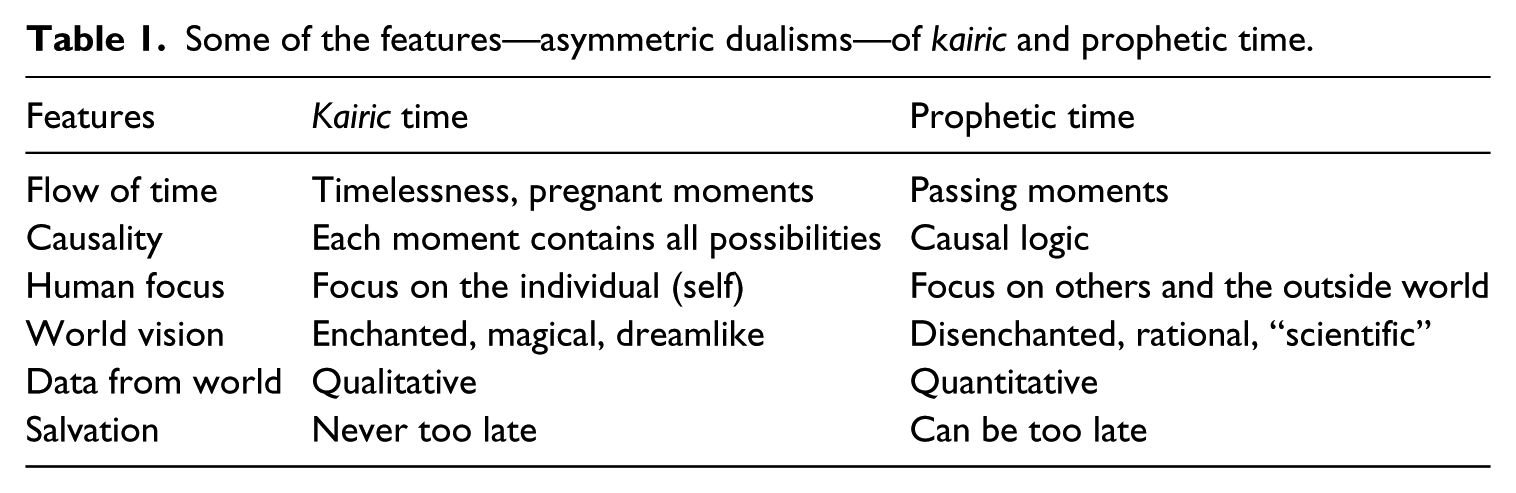
The flow of time
Time flows very differently in these two stories. For Dickens, time is linear and ultimately irreversible. Even though the story involves time travel, the chronological order of events is retained; what happened in the past cannot be changed even as part of this fantastical journey. Even the order of the ghosts’ visits retains this order: the Ghost of Christmas Past is followed by the Ghost of Christmas Present, who is in turn followed by the Ghost of Christmas Yet to Come. Scrooge cannot be seen or heard by the people he encounters on his magical journeys, precisely because the flow of time cannot be undone. As our time is limited and we will be called to give account of our choices when it ends, it is no wonder that numerous variations on the theme of time are mentioned in Dickens’s tale: the passing of months, days, and seasons, the frequent mention of clocks, etc. Scrooge is obsessed with time. While his repeated asking for the time speaks to his anticipation of the coming of each of the three Ghosts, he is really asking if there is still time—if there is still time enough to change his ways. His joy at learning it is still Christmas expresses exactly this sentiment—it is not yet too late!
As in Dickens, the characters in Lewis’s novella (1946/1973) cannot interact with the world while they are on their magical journey, although the reasons for this are different. Here, the characters have no substance, and they are thus unable to affect the world they encounter. The protagonist speaks several times of not even being able to pick up a leaf. For Lewis, time is secondary to the acts and beings in which it is embodied, and time can in effect be bent this way and that. In The Great Divorce (Lewis, 1946/1973), time is closer to the notion of kairos, deep moments that are pregnant with meaning, than to the notion of chronos, a chronological flow of moments into minutes, into hours, into days, etc. With a view to kairos, the protagonist focuses not on the flow of time, but on the possibilities that it represents. Here, we are not focused on the telos, the end-point of time, but rather on each moment as encapsulating the whole: “Not only is the future unimportant until it arrives, but a focus on the future may undermine K[airic] type existence by dislocating it from the present” (Rayment-Pickard, 2004, p. 90). “The present contains everything: the moment of the salvation history of the present, the anticipation of the completion of that history in the future (a future which may come at any moment), and a living-present window of opportunity for Christian existence” (Rayment-Pickard, 2004, pp. 90–91). The timelessness of kairic time that gives it a dream-like quality is already reflected in the subtitle of Lewis’s novella, The Great Divorce – A Dream. In the opening scene of the novella, the protagonist finds himself waiting in line at the time of day that is no longer day but is not yet night: “Time seemed to have paused on that dismal moment when only a few shops have lit up and it is not yet dark enough for their windows to look cheering… evening never advanced to night” (1946/1973, p. 1). The rest of the story continues in this dream-like quality, until we are finally made aware that the main character was in fact given access to this knowledge in a dream.
Within a kairic understanding of time, it is never too late for salvation; the moment of salvation is the eternal now. Since it is never too late, and because Goodness is eternal, the protagonist ponders the possibility that all people will ultimately be saved. However, in this vision we nevertheless remain free to “struggle … against joy” (Lewis, 1946/1973, p. 129). Ultimately, these ponderings are themselves rejected as attempts to solve the riddle of life in a positivistic manner, rather than working in the spirit of love, hope, and faith (discussed below). As Rayment-Pickard expands: If Proust is right, then the world can only be understood according to an artistic logic. The links that join up the moments of life are poetic or mythic rather than rational. … literature is the true theology and that the telling of its story knows no end. (2004, p. 106)
Causality
When warning Scrooge of the impending visit of the three ghosts, Scrooge’s long-dead business partner (who is visiting him as a spirit) states the following: “I wear the chain I forged in life,” replied the Ghost. “I made it link by link, and yard by yard; I girded it on of my own free will, and of my own free will I wore it. Is its pattern strange to you?” … “Or would you know,” pursued the Ghost, “the weight and length of the strong coil you bear yourself? It was full as heavy and as long as this seven Christmas Eves ago. You have laboured on it since. It is a ponderous chain.” (Dickens, 1843/1993, p. 25)
Here we see that causality occurs step-by-step in irreversible time. Scrooge is being warned that he is in effect digging his own eternal grave (building his own chains) by his morally reprehensible actions. Marley’s ghost states this point even clearer when explaining his current state of being deceased and in chains: “Ask me not who I am but who I was!” (p. 23). It is in recognizing the causal nature of salvation that Scrooge’s hope can be found: “In a changed nature; in an altered spirit; in another atmosphere of life; another Hope as its great end”— “‘Men’s courses will foreshadow certain ends, to which, if persevered in, they must lead,’ said Scrooge. ‘But if the courses be departed from, the ends will change’” (p. 44).
Lewis’s (1946/1973) vision of the relationship between salvation/the “good” life and causality could not be more different from those found in Dickens. This is precisely the meaning of the book’s title—The Great Divorce—as Lewis explains in the preface. Lewis is rejecting the notion that vice can be turned to virtue in time, or virtue into vice. Rather, he believes that the two are fundamentally opposites, hence “the great divorce”: A wrong sum can be put right: but only by going back till you find the error and working it afresh from that point, never by simply going on. Evil can be undone, but it cannot “develop” into good. Time does not heal it. The spell must be unwound, bit by bit, “with backward mutters of dissevering power”—or else not. (p. viii)
Self- or other-focus
A Christmas Carol is in large part about Scrooge coming to be more connected to the other people in his life, and to people around him in general. He comes to recognize his own selfishness as problematic and decides to dedicate himself to others. This message is initially literally yelled in his face by the spirit of Marley: “‘Business!’ Cried the Ghost, wringing its hands again. ‘Mankind was my business. The common welfare was my business; charity, mercy, forbearance, and benevolence were, all, my business’” (Dickens, 1843/1993, p. 23). While the story is often understood as one involving “a change of heart,” it more directly involves changing how we treat each other. This interconnectedness speaks directly to the prophetic nature of time and salvation in Dickens.
The “radical individualism” of Lewis’s kairic time finds expression throughout the novella (1946/1973), and exceptionally vividly in a conversation in Chapter 11 between a helpful spirit and a mother whose son had passed away before she did. Her grief at his loss was blocking her from the path of righteousness and true, all-encompassing love, and it is this that the spirit was attempting to help her overcome. Here, the love for another, while containing the love for God, is understood as a step on a longer, more rewarding journey at best—but one that can also serve as a hurdle should it not allow us to take that necessary step forward and upward. “Excess of love, did ye say? There was no excess, there was defect. She loved her son too little, not too much. If she had loved him more there’d be no difficulty” (p. 114).
The story’s protagonist encounters numerous ghosts who are unwilling to proceed further down the path towards the Kingdom of Heaven precisely because they are attached to various things in their lives: other people, material possessions, their own beauty and charms, knowledge of the world, artistic talents, political struggles, etc. This radical individualism is not egotistical thinking—quite the opposite: In fact, one of the spirits tells us that “there are no private affairs” (Lewis, 1946/1973, p. 30), meaning that all is known (to God). In this vision of time salvation is in the present moment, and an excessive focus on a telos, an end-goal, can pull us from it. Hence, we are to focus inwardly honestly, holistically, and inclusively, and we are to help others to do the same. However, within the dialogical perspective taken here, our individual centering, like that of a novel’s protagonist, does not imply ontological privilege, but should be understood in relative rather than absolute terms (Holquist, 2002).
Enchanted or disenchanted world
With its focus on calculability, measurement, and predictability, prophetic understandings of time and salvation are linked with a “scientific” understanding of the world and in our modern era with one that Charles Taylor (2007) would call a disenchanted vision of the world. To see the world as disenchanted means to see it as a string of causal connections, all of which could be potentially linked into a logical, rational pattern. Within such a vision of the world, elements of the world no longer speak to us as independent voices as they once did—their magic has been removed. Despite being both fantastical and Christian, Dickens’s story (1843/1993) reflects a consistent distancing from these elements. When met by the first spirit, that of his long-dead partner Marley, Scrooge humorously asserts that he must be hallucinating due to food poisoning: “You may be an undigested bit of beef, a blot of mustard, a crumb of cheese, a fragment of underdone potato. There’s more of gravy than of grave about you, whatever you are!” (p. 24). Marley’s response to this is particularly telling as part of a prophetic vision of time: “What evidence would you have of my reality beyond that of your own senses?” (p. 24; compare this to the Biblical story of “Doubting Thomas”; John 20: 24–29). Despite revolving around Christmas, the novella makes little mention of anything Christian. Scrooge does not recognize “the book” others are reading as the Bible, and some of the most well-known Biblical phrases about Christ’s birth sound vaguely familiar to the protagonist but cannot be placed (p. 84), something that is all the more telling given that the entire story is set around Christmas, the celebration of Christ’s birth. This point is made—perhaps a bit ironically—in the following passage where, after paying lip service to the Christian elements of Christmas, Scrooge’s nephew goes into greater depth about the “true” meaning of the season: But I am sure I have always thought of Christmastime, when it has come round—apart from the veneration due to its sacred name and origin, if anything belonging to it can be apart from that—as a good time; a kind, forgiving, charitable, pleasant time; the only time I know of, in the long calendar of the year, when men and women seem by one consent to open their shut-up hearts freely, and to think of people below them as if they really were fellow-passengers to the grave, and not another race of creatures bound on other journeys. (pp. 14–15)
This discomfort with the enchanted nature of the world finds more direct expression when the father of the handicapped and sickly Tiny Tim (the child is the only clearly religious person in the novella) is asked by his wife if their son behaved well in church: “As good as gold,” said Bob, “and better. Somehow, he gets thoughtful, sitting by himself so much, and thinks the strangest things you ever heard. He told me, coming home, that he hoped the people saw him in the church, because he was a cripple, and it might be pleasant to them to remember upon Christmas Day who made lame beggars walk and blind men see.” Bob’s voice was tremulous when he told them this, and trembled more when he said that Tiny Tim was growing strong and hearty. (p. 58)
The strong faith of Tiny Tim is contrasted with his father’s evident disbelief in the power of faith to heal his son. Tim’s return to health is ultimately only guaranteed by the better treatment that Scrooge’s financial support can procure (following his change of ways). This is clearly a prophetic, positivistic view of the world: “where measurable or demonstrable achievements cannot be found or produced, P[rophetic] type religion will feel insecure and defensive” (Rayment-Pickard, 2004, p. 110).
Lewis’s story (1946/1973) portrays an enchanted view of the world, one that is dreamlike and defies simple categorization. The protagonist is unable to completely determine whether the spirits are clothed or naked, a distinction that ultimately does not matter: “Some were naked, some robed. But the naked ones did not seem less adorned, and the robes did not disguise in those who wore them the massive grandeur of muscle and the radiant smoothness of flesh” (pp. 23–24). Elsewhere, a sprite is described as follows: I cannot now remember whether she was naked or clothed. If she were naked, then it must have been the almost visible penumbra of her courtesy and joy which produces in my memory the illusion of a great and shining train that followed her across the happy grass. If she were clothed, then the illusion of nakedness is doubtless due to the clarity with which her inmost spirit shone through the clothes. For clothes in that country are not a disguise: the spiritual body lives along each thread and turns them into living organs. A robe or a crown is there as much one of the wearer’s features as a lip or an eye. (p. 118)
Age was similarly unclear and immaterial: Some were bearded but no one in that company struck me as being of any particular age. One gets glimpses, even in our country, of that which is ageless—heavy thought in the face of an infant, and frolic childhood in that of a very old man. (p. 24)
In their lack of substance, the ghost travelers (of which the protagonist is one) are unable to engage with the surrounding world. The story is thoroughly allegorical, as the world it describes speaks to us symbolically: for example, the glowing city on the horizon is the Kingdom of Heaven, the lack of substance speaks to the emptiness of our worldly selves, the differences that concern us in life (e.g., age, nakedness) don’t matter in the afterlife.
Quantitative or qualitative data from the world
In line with the scientific and positivistic spirit of prophetic time, Dickens’s (1843/1993) tale on the passage of time and the hope for salvation is built around the quantification of the rights and wrongs one enacts in one’s life. Just as the chains of perdition are reported by Marley to be linked together piece by piece over the course of one’s life, so too can our salvation be accomplished by undoing that chain piece by piece. Time is not to be slavishly devoted to work, but it is to be freely given to others. Money is not made to be hoarded, but to be passed along to others voluntarily. In Marley’s words: “Humanity was my business!” The positivistic vision of life and salvation is presented in a tremendous and terrifyingly visual way in the following scene with the Ghost of Christmas Yet to Come: From the foldings of its robe it brought two children, wretched, abject, frightful, hideous, miserable. They knelt down at its feet, and clung upon the outside of its garment. … They were a boy and a girl. Yellow, meagre, ragged, scowling, wolfish, but prostrate, too, in their humility. Where graceful youth should have filled their features out, and touched them with its freshest tints, a stale and shriveled hand, like that of age, had pinched and twisted them, and pulled them into shreds. Where angels might have sat enthroned, devils lurked, and glared out menacing. No change, no degradation, no perversion of humanity in any grade, through all the mysteries of wonderful creation, has monsters half so horrible and dreadful. … “Spirit! are they yours?” Scrooge could say no more. “They are Man’s,” said the Spirit, looking down upon them. “And they cling to me, appealing from their fathers. This boy is Ignorance. This girl is Want. Beware of them both, and all of their degree, but most of all beware of this boy, for on his brow I see that written which is Doom, unless the writing be erased. Deny it!” cried the Spirit, stretching out his hand towards the city. “Slander those who tell it ye! Admit it for your factious purposes, and make it worse! And bide the end!” (pp. 72–73)
Here we see explicit reference not to “intangibles” such as faith, love, forgiveness, etc., but to ignorance and want, both of which we are to oppose on the path of righteousness. In this vision of time and salvation, it is knowledge that can free us from Want and save us from Doom. Rather than clinging ignorantly to visions of a frightening and unknown future, we are to get up off our knees and work for a better tomorrow.
The way we assess our lives within Lewis’s tale (1946/1973) is of a qualitatively different nature. Here, as imperfect beings, we are only able to catch fragments of an infinitely richer world, and the tools we use to do so, including the notion of time, while useful, are only that—tools. Not only are the questions we ask distorted, but any answer we could receive to them will in turn necessarily be equally distorted. While worldly knowledge can be helpful, it can also be distracting or even misleading. Just as we can be led astray by excessive attachment to our physical appearance, our possessions, or other people, excessive attachment to gaining knowledge can blind us to what ultimately leads us further down the path to the Kingdom—faith, hope, and love. This is why the first ghost that the protagonist encounters, the lover of knowledge, is called “the apostate” (p. 35)—one who rejects the faith. When describing their time at university, the spirit says to him: “You know that you and I were playing with loaded dice. We didn’t want the other to be true. We were afraid of crude salvationism, afraid of a breach with the spirit of the age, afraid of ridicule, afraid (above all) of real spiritual fears and hopes” (p. 37). Here we see a conflict with the positivism of the university. Here, salvation is not attained by working to reduce “ignorance” as in Dickens, but rather by striving to become one of the “solid people” (p. 25), one of the “bright people” (p. 33). The tension between knowledge and faith, or quantifiable growth and qualitative change, can be seen in the following passage that is worth quoting at length: Because all answers deceive. If ye put the question from within Time and are asking about possibilities, the answer is certain. The choice of ways is before you. Neither is closed. Any man may choose eternal death. Those who choose it will have it. But if ye are trying to leap on into eternity, if ye are trying to see the final state of all things as it will be (for so ye must speak) when there are no more possibilities left but only the Real, then ye ask what cannot be answered to mortal ears. Time is the very lens through which ye see—small and clear, as men see through the wrong end of a telescope—something that would otherwise be too big for ye to see at all. That thing is Freedom: the gift whereby ye most resemble your Maker and are yourselves parts of eternal reality. But ye can see it only through the lens of Time, in a little clear picture, through the inverted telescope. It is a picture of moments following one another and yourself in each moment making some choice that might have been otherwise. Neither the temporal succession nor the phantom of what ye might have chosen and didn’t is itself Freedom. They are a lens. The picture is a symbol: but it’s truer than any philosophical theorem (or, perhaps, than any mystic’s vision) that claims to go behind it. For every attempt to see the shape of eternity except through the lens of Time destroys your knowledge of Freedom. Witness the doctrine of Predestination which shows (truly enough) that eternal reality is not waiting for a future in which to be real; but at the price of removing Freedom which is the deeper truth of the two. (pp. 140–141)
The multistability of inferential logic and abduction
Rayment-Pickard’s (2004) classification of time is illustrative of how our semiotically mediated perception of the world (Valsiner, 1999), including time, leads to multistability. A similar process of multistability is found in the tension between abduction on the one hand, and induction and deduction on the other. As we look at the world through the lens of one form of logic, the other seems to slip through our fingers. Even Peirce, while convinced of their fundamental importance not only within scientific reasoning but also in human life more broadly, was puzzled by the relationship between these forms of logic (Fann, 1970). Abduction is not kairic time, nor is inferential logic prophetic time—the comparison is not one-to-one—but the comparison is helpful in illustrating how the multistability they similarly exhibit perennially challenges our attempts to unify them into a singular logic.
An inductive argument points to particular evidence as suggestive of broader, logical premises. In deductive reasoning, the statement logically entails certain conclusions. Peirce presented abductive logic as follows: The surprising fact C is observed, But if A were true, C would be a matter of course; Hence, there is reason to suspect that A is true. (Peirce, 1958a, Vol. 5, p. 189)
Abduction is an attempt to explain the creation of the theories and concepts that serve as the fundamental units of induction and deduction—which are themselves generally regarded not as creative products of the will, but as given in nature (Bertilsson, 2004). More succinctly: “Deduction proves that something must be; Induction shows that something actually is operative; Abduction merely suggests that something may be” (Peirce, 1958a, Vol. 5, p. 171). In other words, of these three forms of logic, it is the only one that is ampliative, that is, creating anything new (p. 171). In effect, it accounts for the creation of the hypotheses that induction and deduction attempt to verify, each in their own way (“every single item of scientific theory which stands established today has been due to Abduction,” p. 172). Similar to the notion of novelness discussed above, it has been argued that meaning in Peirce’s semiotics “cannot be divorced from notions of storytelling and fictionality … and is impossible without the notion of otherness” (Merrell, 1997, p. xii).
For Peirce, as part of logical reasoning, abduction is also supposed to be explicable—part of a rational process. A puzzling feature of abduction, however, concerns the apparent double jump in time that it entails: the surprising event happening in the present, C, is surprising by means of its comparison with other non-surprising events in the past (a shift to the past), while the assertion of A as the possible explanation of C implies a subsequent movement forward in time (back to the occurrence of C). Valsiner (2017) has described how abduction appears to speak to a process that steps out of time: “To generalize about generalizations—generalization abstracts a phenomenon in irreversible time into a state where irreversible time vanishes through the abstraction process. This is the mechanism—abstraction—that allows generalizations from single instances to be possible” (p. 83). According to Peirce, abduction was at the core of human creativity (Fann, 1970; Misak, 2006). Neither induction nor deduction necessarily reflect this temporal paradox, as both reflect the irreversibility of time.
Neither inductive logic nor deductive logic are ampliative, hence without any additional piece of the puzzle, we are left to ponder the source of any new hypothesis. In some ways, by positing abductive logic as the missing explanatory link, Peirce, arguably, simply begs the question; where does this new insight come from? Peirce himself was troubled by this challenge (Fann, 1970): “No reason whatsoever can be given for it, as far as I can discover; and it needs no reason, since it merely offers suggestions” (Peirce, 1958a, Vol. 5, p. 171). Because he was convinced of an underlying logical structure to scientific investigation, one that can be rationally explained, he was uncomfortable with any step outside the causal, logical chain in which deductive and inductive logic are embedded. For this reason, the timelessness of abduction and its apparent detachment from the deduction and induction it supports was, and remains, a challenge. Such a step “outside” is threatening because, in stopping the regression to earlier causes, it appears to stop the process of inquiry. It is one of those tired, barren parental answers to the eternal “whys” of children: “That’s just the way it is! Because I said so!” Peirce warns us against such a step, and he urges us to plaster the halls of learning with the slogan: “Do not block the way of inquiry” (1958a, Vol. 1, p. 135). Interestingly, similar to Bahktin’s thinking about the dialectical nature of self, within abduction there is no individual actor possessing ontological-interpretive primacy, because it “is that the word or sign which man uses is the man itself” (Peirce, 1958a, Vol. 5, p. 314). Rather, the “outsideness” of abduction, much like the “outsideness” of dialogical authoring (Holquist, 2002), provides a perspective on the “insideness” (both temporal and spatial) of lived experience. The shift back-and-forth between inside and outside speaks to the multistability of our psychological perception, not to an objective, logical relationship.
Despite Peirce’s best efforts, the magical quality of moments of abductive insight remains a challenge for the notion of abduction and for scientific logic more broadly. His attempt to answer this question was based in our everyday experience that despite our inability to identify the source for our hypotheses, we nevertheless function quite well in the world and workable hypotheses nevertheless seem to appear. In other words, we are not perplexed into paralysis: “one must trust one’s instincts through life or be content with a passivity that cannot content him” (Peirce, 2014, p. 238). Peirce explains this by means of “the hope that there is sufficient affinity between the reasoner’s mind and nature’s to render guessing not altogether hopeless” (1958a, Vol. 1, p. 121). He assumed there to be some sort of natural affiliation between the human mind and the larger rationale underlying all things: as for the validity of [abduction], there seems at first to be no room at all for the question of what supports it, … But there is a decided leaning to the affirmative side and the frequency with which that turns out to be an actual fact is to me quite the most surprising of all wonders of the universe. (1958b, Vol. 8, p. 238)
While many will find this and similar explanations sufficient, as a logical argument others, including Fann (1970), believe that “Peirce’s treatment of the validity of abduction is one of the most unsatisfactory features in his theory” (p. 54). Thus, in as far as we are wedded to rational causal chains that exist in irreversible time, the problem of abduction’s timelessness remains a challenge. However, rather than trying to resolve this challenge, it is suggested here that we work to better understand the psychological processes involved—including multistability—in the spirit of experimental philosophy, rather than formal logic.
Peirce himself wrote about the expression of abduction within the experience of multistability, particularly the case of the optical illusion known as “Schröder’s stairs” (1958b, Vol. 7, p. 647). In multistability we see the role of perception in giving “us the look of things by binding the configured elements together, resolving the ‘puzzling look of things’ by forming an interpretation that makes sense of them” (Innis, 2002, p. 35). Peirce even explores this directly within the framework of time, brushing aside attempts (then by psychologists) to determine where our perceptions of time “objectively” match the nature of time: “But let me tell you that all the psychology in the world will leave the logical problem just where it was. I might occupy hours in developing that point. I must pass it by” (1958a, Vol. 5, p. 172) and elsewhere, “I fear I shall not be able to follow them far into this deep and dark exploration” (1958b, Vol. 7, p. 648).
The slogan mentioned above—“Do not block the way of inquiry”—nicely matches the warning of The Ghost of Christmas Yet to Come (Dickens, 1843/1993) that in order to ward off Want and ultimately Doom, we need to fight Ignorance. However, his search for a truly ampliative element to the rational chain of deductive-inductive logic led Peirce to reject Comte’s solipsism of the present moment; in abduction Peirce was looking for something beyond our hereunto utilized field of vision. Peirce’s vision of the necessarily rational nature of abduction reflects in some ways, albeit unsuccessfully, Comte’s methodological neglect of causes, which takes “the terrestrial horizon as its boundary, without prejudice to what might lie beyond it. Abandoning too high a level of speculation, it retired to lowlier positions of more immediate interest” (de Lubac, 1995, p. 159). That which is perceived to lie outside the rational causal chain is treated with suspicion, if it is treated at all. Peirce mentions such notions as inspiration, flashes of insight, etc., but tries to distance himself from them in as far as they are beyond empirical testing. However, he cannot stray far from them, as both scientific epistemology and metaphysical insight are important parts of his thinking (Anderson, 2006), a point nicely illustrated by his rejection of a correspondence theory of truth (Misak, 2006).
Conclusion
Contrary to Smith’s (1969) assertion that while kairos necessarily contains chronos, chronos need not necessarily produce kairos, it is argued here—in line with a dialogical approach—that these two conceptualizations of time are, as psychological phenomena, mutually dependent on each other. However, while their dialogical dependency produces meaningful “novelness,” the clarity of those patterned perceptions involves multistability, whereby the perception of one pattern occludes the perception of others. While not removing other possibilities in any sort of absolute sense, multistability removes them from simultaneous perception. Importantly, multistability incorporates the notion of dialogical simultaneity. In this way, the perception of time (e.g., kairic or prophetic) is consistent across features (as explored above) and “levels” (in line with the time-as-context model; Tateo & Valsiner, 2015), while remaining dialogical in nature. Similar multistability is seen in the uncomfortable relationship between abduction and induction/deduction. While each side is necessary for the other (there would be no inferential logic without abduction, and vice-versa), it is psychologically difficult, if not impossible, to logically and perceptually entertain both at the same time.
This challenge is not new. Recognizing the apparently unbridgeable gap between our ethical responsibility to consequentialist reasoning (causal, logical, universal) and our ethical responsibility to deontological reasoning (based on “timeless” and “causeless” individual values), Max Weber did his best to advocate for a balancing act between the two, however precarious and ultimately untenable it may be (e.g., see his notions of adequate causality, Sektengesellschaften, and Führerdemokratie; Ringer, 2004). Similarly, Simmel (1907/1978) wrote about “the tendency to emphasize quantitative rather than qualitative factors in the social world” (p. 444). Simmel believed this larger process to reach new heights with the advent of money, as it increased quantification and calculability, and it is linked with an increasing value placed on (quantifiable) intellectuality (e.g., math over art). It is therefore not surprising that Dickens’s tale (1843/1993) also revolves around money, and how it could be put to morally just or unjust ends. Just as the adjective “mean” connotes both the characteristic of being interpersonally abrasive and financially stingy, the name of Dickens’s protagonist, Scrooge, has come to mean both a mean-spirited person and a miser. This process of quantification also involves an increasingly “outward” vision; one that turns from inner, subjective experiences to that which is “outside” and countable. Weber, like Simmel and others, was commenting on a split between the ostensible objectivity of “the sciences” and the ostensible subjectivity of “the arts” that arose in their era (Daston & Galison, 2010). They were also doing so in a period in which new fields of the social sciences (e.g., psychology, sociology) were struggling to become independent fields of study (Valsiner, 2012). However, these differing visions of the world are not themselves new, nor is the “conflict” between them. The inability to simultaneously hold differing understandings of time and causality appears to have deep, non-academic roots in our attempts to understand the world in which we live, and the meaning thereof. Even Emerson (1841/1982), in his ardent advocacy for a kairic version of time, admits that “along with the civil and metaphysical history of man, another history goes daily forward—that of the external world—in which he is not less strictly implicated” (p. 169). However, Emerson immediately slips back into a kairic understanding of time, a point to which he admits: “is it the fault of our rhetoric that we cannot strongly state one fact without seeming to belie some other” (p. 172).
Scholars have argued, and will continue to argue, various sides of these issues, with some trying to overcome such multistability (e.g., Valsiner’s, 2016, notions of hypergeneralization and the inherent heterogeneity of sign complexes) and others perceiving irreconcilable differences between the visions of the world that they present (e.g., Gould’s, 1999, notion of non-overlapping magisteria, or the teleological realism of Sehon’s, 2005, understanding of what he calls common-sense psychology). The number of such scholarly approaches to the question of semiotic multistability are too numerous to substantively explore here, and doing so would run the risk of over simplifying them. The point is that the roots of semiotic multistability appear to extend beyond academic debates on the topic and to begin much deeper in the basic processes of semiotic mediation: “We can’t get away from it: we do have a deep-down view about what time is. And in taking this view we have excluded the alternatives” (Rayment-Pickard, 2004, p. 126). The two classic texts discussed in this article nicely illustrate how thinking about time and salvation “naturally” cluster in very much the same way as in classic debates in the social sciences regarding inferential logic and abduction. In working to better understand how we understand our lived reality, we might do well to further explore such psychological processes as multistability (but also such concepts as addressivity and intertextuality). While such an attempt arguably falls shy of the loftier goals of a unifying formal logic (as sought after by Peirce), it might be well-suited to better reflect both the limitations and the richness of our lived experience.
Footnotes
Acknowledgements
The author would like to thank the editor and the anonymous reviewers for their very helpful feedback on an earlier draft.
Declaration of conflicting interests
The author declared no potential conflicts of interest with respect to the research, authorship, and/or publication of this article.
Funding
The author received no financial support for the research, authorship, and/or publication of this article.
