



Abstract
This article identifies a formal parallel between quantitative analysis of cognitive and biological development based on work by Georg Rasch in psychometrics and Julian Huxley in biology. The analysis and synthesis results in an interpretation of the parameters of Rasch’s item response model whereby increases in latent cognitive development manifest as exponential increases in performance odds. This relationship directly parallels a relationship between biological development and its manifestation in weight, termed simple allometry. Attainment data analysed by Rasch were shown to exhibit a simple allometry. It is shown that the formal theoretical parallel may have applications for formulating and testing theory regarding cognitive development. Such tests may have implications for establishing a substantive basis for the measurement of cognitive abilities.
The Rasch model is an item response model that is widely applied to attainment data and has a number of advantages over classical test theory (see, e.g., Alagumalai, Curtis, & Hungi, 2005). The Rasch model is frequently used to estimate student abilities as a basis for monitoring growth by examining changes in ability estimates over time. In such contexts, the model parameters are employed in a conventional manner and the focus is on the change in ability estimates during the passage of time. However, there is a lack of learning or developmental theory underpinning application of the model, which carries significant implications in practice. As Briggs (2017) states, “Ideally, when assessments have been intentionally designed according to a theory of learning, it provides researchers with a testable hypothesis for how cause (teaching approach) produces effect (student learning)” (p. 355).
Both Piaget and Chomsky maintained that parallels exist between cognitive and biological “structures.” This paper focuses on the possibility of corresponding quantitative manifestations of cognitive and biological growth. The article introduces an interpretation of the parameters of Rasch’s (1960/1980) measurement model for dichotomous responses that entails a relationship between the underlying cognitive capacity and cognitive development of an individual, in a given learning domain. The interpretation highlights direct parallels between methods used by Rasch to examine attainment data and by Sir Julian Huxley to analyse biological data when examining the growth of organs and organisms.
It is beyond the scope of the article to state and test specific hypotheses relating to particular domains of cognitive growth. Nonetheless, the article touches on implications for formulating such hypotheses in a manner that is complementary to standard applications of Rasch’s models and draws upon conceptions of cumulative development, such as hierarchical integration as described in Dawson-Tunik, Commons, Wilson, and Fischer (2005).
The article is pertinent to the ongoing debate in Theory & Psychology and other outlets regarding measurement in psychology, particularly the need for substantive theory to underpin measurement (Borsboom & Mellenbergh, 2004; Humphry, 2017; Michell, 1999; Sijtsma, 2012; Sijtsma & Emons, 2013). The article develops and explores a framework within which it may be possible to develop and test hypotheses regarding a substantive basis for measurement based on item response models.
The structure of the article is as follows: beginning with background about psychometrics and parallels between cognitive and biological development, it then canvasses the ubiquitous law of practice in psychology. It introduces formal interpretations of terms in Rasch’s model and connects these to Huxley’s research on biological growth. It is shown that the same relationship is implied in Rasch’s model as in Huxley’s work, referred to by the latter as simple allometry and taking the form of a log-log linear relationship. This relationship is shown formally and graphically using an example from Rasch’s original work. The article shows that given stated interpretations of terms, a relationship referred to as simple allometry would involve an individual multiplicatively building cognitive capacity upon existing capacity. The formal and conceptual developments are considered a meta-theoretical framework for research using item response models in combination with substantive hypotheses regarding the performance of related tasks by individuals. Potential implications for measurement in psychology are also briefly discussed.
Background and rationale
Potential parallels between biological and cognitive growth
Rasch came to the social sciences after having conducted research in biology. Indeed, Rasch met Huxley and was familiar with Huxley’s work on allometric growth (Olsen, 2003). Relevant features of Huxley’s work on allometric growth are briefly outlined in later sections of this article.
Huxley (1972) said of the biological development of most organs, “the increments of new material produced by growth are alive, and themselves grow and produce new material in their turn, so that growth is a multiplicative process” (p. 149). Similarly, it is feasible that individuals actively recruit already developed cognitive capacity in the process of generating further cognitive capacity through learning. To the degree this is applicable, cognitive development would also be a “multiplicative” process. Such a proposition is consistent with the parallel that Piaget and Chomsky maintained exists between cognitive and biological structures.
With respect to cognitive development, a multiplicative process implies that when an individual is early in the developmental process, small incremental gains are expected with increments in cognitive development. On the other hand, when an individual’s cognitive capacity is more highly advanced, more substantial gains in cognitive capacity are expected with incremental development as an individual builds upon a more substantial foundation.
There is a body of empirical evidence that educational and other data relevant to cognitive development conform reasonably well to item response models (see, e.g., Alagumalai et al., 2005; Bond & Fox, 2001; Embretson & Reise, 2000). It will be shown that given a specific interpretation of its terms, the form/structure of the models implies an underlying exponential process that may be significant for investigating and understanding the nature of cognitive development due to its cumulative and exponential nature (see also Humphry, 2011, 2013).
Item response models are generally treated simply as useful technical models rather than as models of a substantive process (Humphry, 2017). By interpreting the model in terms of a synthesis of biological and psychological work, the analysis to follow indicates the quantitative sense in which item response models might be used to model and investigate substantive developmental processes. Should this be possible, the approach could also provide a substantive basis for psychological measurement of cognitive abilities.
However, the aim of the article is not to analyse the substantive cognitive basis of processes; rather it is to outline a theoretical interpretation of models that enables investigation of cognitive development, including the potential to empirically test specific hypotheses.
For the sake of clarity it is stressed that the focus of the article is not on processes of development as a function of time per se. For this reason, the exposition is only indirectly related to growth modelling of attainment levels over time. As will be discussed, consistent with Huxley’s (1932) original analysis of biological development, the passage of time is taken to have the same global effect on different organs within an individual organism, with this effect modified by a general factor. In educational contexts, relative cognitive development may be reflected in the relative increase in an individual’s capacity to accomplish different but theoretically related tasks in a common domain. Consistent with this, Rasch analysed data from attainment tests in a manner directly analogous to Huxley’s analysis of biological data. Later in the article, an example of such an analysis is presented that illustrates this parallel.
The law of practice
Another name for the formal relationship known as simple allometry is the “power law,” which has received significant attention in psychology and other disciplines. In a key book chapter, Newell and Rosenbloom (1981) observed the following: There exists a ubiquitous quantitative law of practice: It appears to follow a power law. That is, plotting the logarithm of the time to perform a task against the logarithm of the trial number always yields a straight line, more or less. (p. 2)
The law of practice explicitly incorporates time as a variable. In this work, Newell and Rosenbloom focused almost exclusively on reaction time subsequent to practice, although they observe some other instances of the power law, including time on target in a task and numbers of correct responses in tasks such as learning a maze. As these authors note, “it has long been known in industrial engineering that the so-called learning curve for production of manufactured projects was log-log linear” (p. 15). In industrial engineering and other commercial contexts, this is reflected as diminishing costs of unit production.
Newell and Rosenbloom (1981) observed that despite the ubiquity of the power law of practice being widely recognised, at the time it had “captured little attention, especially theoretical [emphasis added] attention, in basic cognitive or experimental psychology, though it is sometimes used as the basis for displaying data” (p. 2). There has been some attention since. For example, there has been an attempt to develop theory that goes beyond curve fitting to inferences in terms of a dynamical systems theoretical approach to motor learning (Liu, Mayer-Kress, & Newell, 2003; Liu & Newell, 2012; Newell, Liu, & Mayer-Kress, 2001). However, the attention to a theoretical explanation of the power law remains limited and may or may not be conducive to the generation and application of substantive theory regarding cognitive development. Liu, Mayer-Kress, and Newell (2004) stated the view that: if there is any tilting of emphasis in the top-down/bottom-up analysis of learning curves, it should be in favour of theory-driven postulations rather than data-driven observations. The study of learning, after all, is based upon inferences drawn from the change in performance over time. Learning, as traditionally interpreted, is an unobservable construct. (p. 233)
Item response theory
Item response theory is also known as latent trait theory. The concept of a latent trait is consistent in the sense that task performances are the observed manifestations of learning. A hierarchy of tasks may be implied by evidence across individuals that performance of specific tasks is a necessary precursor to the performance of others. In addition, it is possible to set up studies in which the execution of lower-order tasks is changed, particularly through practice, to examine the effects on higher-order task performance.
Similarly, where there is a strict Guttman response pattern for a set of items, a person who accomplishes a more difficult item necessarily accomplishes an easier item. The Rasch model implies a probabilistic Guttman pattern, in the sense that the Guttman pattern is theoretically the most likely pattern and data need only tend toward the pattern.
Parallels between biological and cognitive structures and development
Parallels between biological and cognitive structures have long been proposed in the literature. A common theme in the writings of Noam Chomsky and Jean Piaget is that processes of cognitive development parallel those of biological development. Despite differences between the views of Chomsky and Piaget, both believed there were fundamental similarities between cognitive and biological structures. Chomsky was critical of extreme behaviourist approaches to the study of language acquisition. He argued that the study of language should be approached in a manner more akin to the study of biological structure. He made the following remarks on this matter: Human cognitive systems, when seriously investigated, prove to be no less marvelous and intricate than the physical structures that develop in the life of the organism. Why, then, should we not study the acquisition of a cognitive structure such as language more or less as we study some complex bodily organ? (1975, pp. 9–11)
In a similar vein, Piaget’s epistemology was founded in biology, and particularly genetics, as reflected in the following comment: To say that intelligence is a particular instance of biological adaptation is thus to suppose that it is essentially an organization and that its function is to structure the universe just as the organism structures its immediate environment. (1963, pp. 3–4)
Piaget (1930) theorised that cognitive and sensorimotor growth stem from a cycle of “action, assimilation, and adaptation” (p. 269), by which increasingly complex cognitive structures develop hierarchically from lower order structures, just as increasingly complex biological structures, such as organs and circulatory systems, develop from lower order structures such as cells.
A general feature of the concept of development is that it is a process by which an individual builds upon previous learning in a progressive fashion. For example, Piaget (1971) characterised development as a process in which cognitive “structures offer a process of integration such that each one is prepared by the preceding one and integrated into the one that follows” (p. 17).
The concept of building upon current cognitive capacity is inherent in the interpretation of the parameters of the Rasch model put forth in this article. In addition, the proposed interpretation implies that cognitive capacity builds upon itself at a rate proportional to current capacity, rather than at a rate that is independent of current capacity. Change as a function of current magnitude is characteristic of biological development and its manifestation in such things as the dimensions and weight of organs.
Dawson-Tunik et al. (2005) essentially provide a similar conceptual rationale, and elaborate upon this rationale in terms of chunking, as follows: Hierarchical order of abstraction is observable in texts because new concepts are formed at each complexity level as the operations of the previous complexity level are hierarchically integrated into single constructs. Halford (1999) suggests that this integration or “chunking” makes advanced forms of thought possible by reducing the number of elements that must be simultaneously co-ordinated, freeing up processing space and making it possible to produce an argument or conceptualization at a higher complexity level. (p. 168)
This represents a potential basis for multiplicative gains based on cognitive development, whereby automated thought processes make new thought processes building upon those possible for an individual. It also provides a possible connection to the so-called power law of practice because it has been posited that time to perform tasks decreases with practice for the same reason. Dawson-Tunik et al. (2005) outline various considerations pertinent to the current article, particularly whether patterns of performance are consistent with a specified sequence.
Huxley’s formulation of biological growth
Huxley (1972) observed in relation to biological growth or development: One essential fact about growth is that it is a process of self-multiplication of living substance – i.e. that the rate of growth of an organism growing equally in all its parts is at any moment proportional to the size of the organism. A second fundamental fact about growth is that the rate of self-multiplication slows down with increasing age (size); a third is that it is much affected by the external environment, e.g. by temperature and nutrition. The two latter considerations affect all parts of the body equally, so that we may suppose that the growth-rate of any particular organ is proportional simultaneously (a) to the specific constant characteristic of the organ in question, (b) to the size of the organ at any instant, and (c) to a general factor dependent on age and environment which is the same for all parts of the body. (p. 6)
The term “development” is favoured where possible in this article to focus on the processes rather than the manifestations of the processes. However, of necessity, the terms are occasionally used interchangeably to enable connections with Huxley’s work in which he generally referred to growth.
The manifestation of biological development is exponential in the sense that the number of cells increases at a rate proportional to the current number of cells under optimal conditions. The intrinsic rate of proportionality as a function of time is referred to as the biotic potential of a given organism (e.g., Moore, 2007), which is customarily defined in terms of optimal conditions in which there are no substantial limits on the rate of development, such as finite resources and predation.
Huxley (1972) formulated a relationship between the weight of an organ and general conditions of development in a manner such that the weights of two organs were related through the general quantitative developmental factor. The relationship is formulated here in a manner that is consistent with Huxley’s formulation, though it proceeds from a somewhat different starting point, as will be explained. The relationship was referred to by Huxley as simple allometry.
It has not been universally accepted that Huxley’s formulation has a substantive theoretical foundation and specific issues have been observed that limit the generality of application; nevertheless, it has been recognised there are circumstances in which the formulation does have a legitimate foundation in cellular processes of growth and development (Strauss, 1993). Raerinne (2013) observes three roles of allometries and scaling relationships, these being explanatory, predictive, and heuristic, and argues that these roles often elucidate patterns and have the potential to progress the discipline. Studies detailed in Larson et al. (2018) and Stillwell, Shingleton, Dworkin, and Frankino (2016) constitute recent examples of empirical applications of allometric scaling, focusing respectively on: (a) human facial shape and (b) organ (wing) and body size in Drosophila. Nijhout and German (2012) observe that allometry is treated mainly as an empirical equation without studying the biological (theoretical) foundation, which suggests that, despite utility, Huxley’s original theoretical justification has received relatively little attention. I would argue that in relation to item response models, no substantive theoretical rationale at all has been advanced for the precise form of any of the models.
As noted, this article proceeds from a different starting point than Huxley’s; nevertheless it rests on the same underlying principle of multiplicative growth as a function of time but modulated by external factors and age. Formally, let

and

where
To incorporate a unit of development using quantity calculus in Equation (1) above would be straightforward provided the formally stated hypotheses hold, as detailed by Humphry (2011, 2013).
In the case of weight of an organism, a hypothetical example of weight increase as a function of development is illustrated in Figure 1. Development is not measured directly like weight and time.
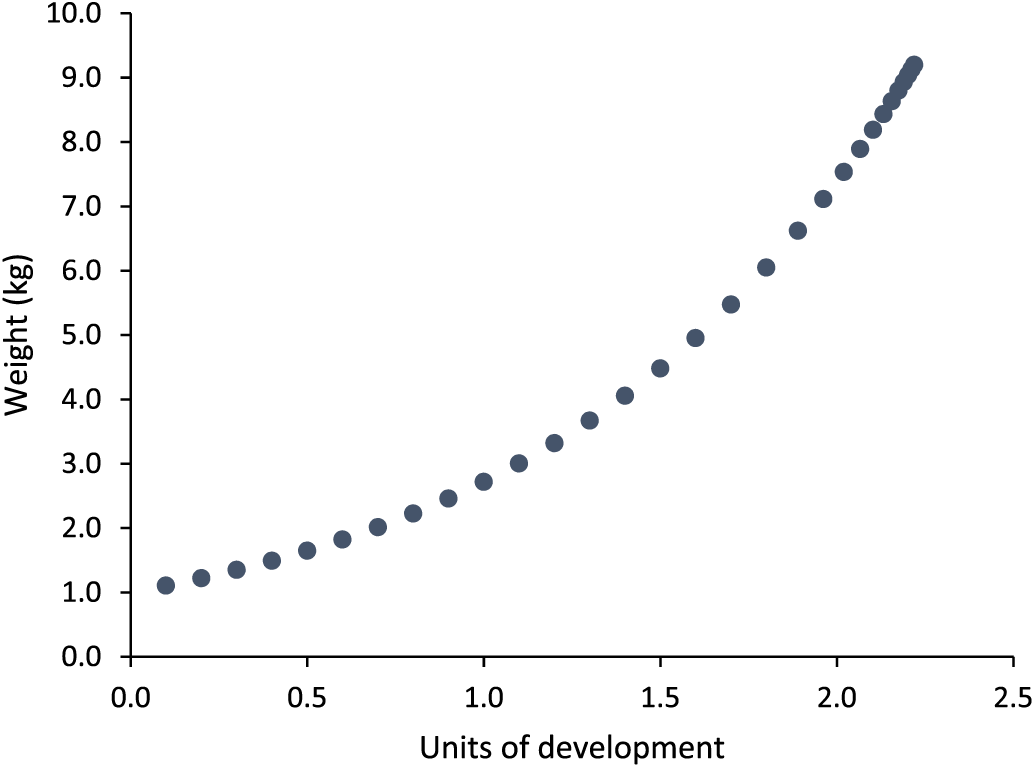
The weight increase of an organism as a function of development.
Huxley eliminated time in the study of growth through the common growth factor G observing that “we know nothing of the actual rates of [development], for since the organ and the body have both existed for the same length of time when we measure them, the time-factor cancels out” (1972, p. 8). Thus, although time must pass for the individual’s stage of development to change, the change in the weight of the organ and organism are directly related to each other through a general developmental factor.
Given the definitions, the exponential increase in weight proportional to current weight as a function of a development factor does not imply an exponential increase in weight as a function of time throughout the development of an organism. Figures 2 and 3 show graphically why this is the case. Figure 2 shows development continuing at a constant rate until approximately 20 months of age, then slowing and essentially stopping. This is consistent with the expectation that development itself tends to slow and, in the case of most mammals, eventually stop altogether. Development is conceived as being dependent on both the passage of time as well as Huxley’s growth factor, which results, for example, in slowing of growth with the age of an organism. Mapping development as a function of time is akin to mapping distance travelled as a function of time, where distance is a function of time in that it depends on velocity.

The underlying development of an organism as a function of time.

The weight of an organism as a function of time.
Figure 3 shows the resulting plot of weight of an organism as a function of time in months. This follows the expectation that the size, dimensions, and weight of organisms (including humans) tend to increase rapidly until a point, then begin to decline and eventually reach an asymptote.
Now from Equation (1), the weight of organ s for individual n is

where
Simple allometry
Simple allometry applies to the weights of any two organs and is a specific form such that the logarithms of weights have an approximately linear relationship with each other as an organism develops. Formally, from Equation (2), it follows that for any two organs s and t
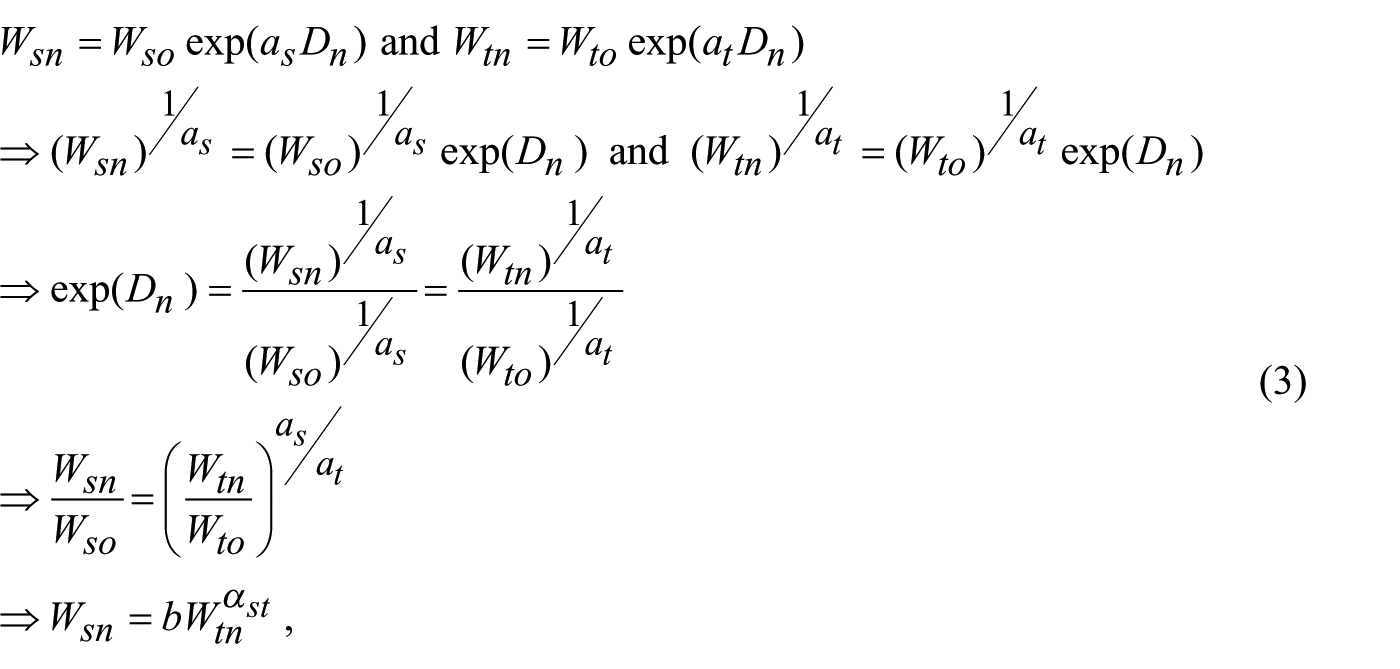
where
Huxley (1972) stated that development “is said to follow simple allometry when the formula

Although beginning with a different starting point, the result in Equation (3) is the same as that obtained by Huxley (1972, p. 7), showing that the formulation of the relationship between weight and growth in Equations (1) and (1a) gives rise to the relationship given in Equations (3) and (3a), referred to as simple allometry. Stated differently, there is a linear relationship when the logarithms of the weights of the two organs are obtained.
Comparison of the weights of organs in different organisms
For the purpose of making explicit the parallel between analyses by Rasch and Huxley, it is possible to make explicit a consequence of Equation (2) for the comparison of the weights of organs in different organisms. Provided the same initial weight
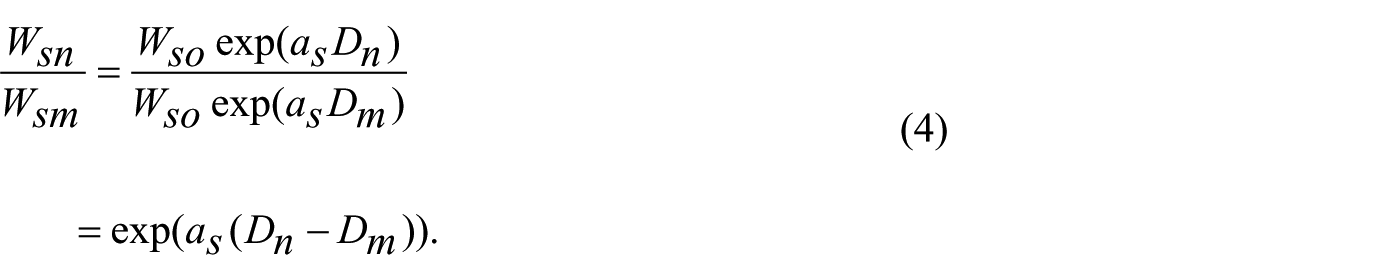
As will be shown, the Rasch item response model leads to a relationship that has the same form as Equation (4). This basic connection was also shown in Humphry (2013) in relation to exponential decay rather than growth.
Theoretical interpretation of the Rasch model parameters
It is possible now to follow the reasoning used by Huxley in relation to biological development as a basis for proposing a parallel interpretation of the parameters of the Rasch item response model. The interpretation of the parameters is formulated based on two hypotheses that may be stated in a given context.
The hypothesis is that, provided assessments of learning in a specified domain are well designed, performance odds on items are a direct manifestation of cognitive capacity, as weight is a manifestation of biological extent after development. That is, cognitive capacity is analogous to weight and represents the full capacity of an individual to solve problems, etc. at a given point in time. The first hypothesis implies performance odds vary in direct proportion to cognitive capacity, given appropriate tasks and assessment processes.
The second hypothesis is that the change in an individual’s cognitive capacity, as a function of cognitive development, is proportional to the individual’s current cognitive capacity. Cognitive development is a process that is analogous to the cellular and other processes that constitute biological development and result in an increase in total biological weight. Using the definitions adopted, the following statements are directly analogous: (a) cognitive capacity increases, as a function of cognitive development, at a rate proportional to current cognitive capacity and (b) the weight of an organ increases, as a function of biological development, at a rate proportional to current weight.
The hypotheses are stated in formal terms to follow. It is then shown that if and where the two hypotheses are substantiated in a particular context, cognitive capacity changes exponentially as a function of cognitive growth/development (but not time).
It will be shown that the two hypotheses are analogous to Rasch’s (1961, 1960/1980) measurement model for dichotomous data. They are also analogous with the way Rasch originally analysed data using log-log plots of estimates of the odds of success on items for different groups of persons. In turn, Rasch’s approach is consistent with the manner in which Huxley analysed data obtained by weighing biological organs.
Terms
Before considering Rasch’s model, it is necessary to interpret terms in a specific manner by defining the concepts of cognitive development and performance odds in relation to a task, such as an item on a test. For simplicity in the exposition of the theory, the focus here is confined to tasks that have correct and incorrect responses, such as conventional items on tests.
Let

In stating the two hypotheses, the term
The odds shown in Equation (5) are referred to as performance odds for a specified item, meaning the odds that an individual successfully accomplishes a task. Stated in terms of Equation (5), the first theoretical proposition involved in the interpretation of the model is that performance odds are directly proportional to the ratio
Next, let

where ρ is the constant of proportionality. Equation (6) implies a person’s total cognitive capacity (analogous to the weight of an organ) in some domain of learning changes with cognitive development (analogous to biological growth) at a rate proportional to current cognitive capacity.
As stated in the introduction, the theoretical rationale for proposing the interpretation is that an individual’s current cognitive capacity is active in generating further cognitive capacity, with incremental growth. If this is true, it is plausible that cognitive capacity in relation to a defined set of tasks would grow at a rate that is proportional to current capacity. The term rate does not pertain to time alone and there is no time parameter in Equation (2). Nevertheless, in practice, there will also be an observable rate over time.
From Equation (6) it follows that

where
In relation to item response models, the magnitude of
The Rasch model also contains a parameter referred to as an item parameter. In the case of attainment tests, the item parameter is posited to be a location on the same developmental continuum as the person parameters. Specifically, any given person at the location of the item parameter has theoretical odds of 1:1 of success or failure on the relevant item. Consistent with the earlier definition of the task capacity, let the location of the item be

Here
The Rasch model
With the definitions given in Equations (7) and (8), Rasch’s model in Equation (5) may be stated as follows:

The interpretation of the parameters outlined here is therefore compatible, in a clearly defined manner, with the form of Rasch’s model for dichotomous responses.
The Rasch model requires that ρ is uniform for all person–item interactions. The definition
Rationale for the exponential form of the model
It is evident from Equation (9) that the model entails an exponential relationship between
Let

Equation (10) is directly analogous to Equation (4) (Humphry, 2013). Equation (4) arises from Huxley’s formulation of the relationship between the weight of an organ and a measurement of general development for an individual. Equation (10) arises from Rasch’s model for dichotomous data. The ratio of weights of an organ s for two individuals in Equation (4) is treated as being analogous to the ratio of performance odds on an item i for two individuals in Equation (10). There is an exponential relationship between organ weight and the difference between the levels of development of the two individuals in Equation (4). Analogously, there is an exponential relationship between the performance odds and the differences between the levels of development of the two individuals in Equation (10).
The parallel between data analyses by Rasch and Huxley
Consistent with the common form of Equations (3) and (9), there is a direct parallel between data analyses undertaken by Rasch and Huxley. Whereas Rasch focused on the odds of success on an item, Huxley focused on the physical weight of organs. Huxley made extensive use of plots of the log weight of one organ compared with the log weight of another organ based on a relationship that follows from his analysis of growth. As mentioned above, he referred to the relationship as simple allometry.
Log-log plots used by Rasch
Similarly, as a basis for data analysis, Rasch (1960/1980) grouped persons by their raw scores r, referring to these as r-groups. Thus, let

Therefore, for any two score groups r and s,

where
Rasch made a number of plots based on the allometric relation using odds of success for person groups on items. An illustrative example is to follow in which Rasch (1960/1980, p. 80) plotted the relationship
It is instructive to emphasise that Rasch’s data actually involve different groups and thus focused on inter-individual changes rather than intra-individual changes. Rigorous tests of developmental hypotheses would require an appropriate focus on intra-individual changes in odds over time with practice and learning. Borsboom (2008) observes the general lack of correspondence between models for inter-individual variation and intra-individual processes, which is a highly pertinent consideration to development. The multiplicative process is an intra-individual one—occurring within an individual—whereas Rasch’s model is almost always used to model between-individual variation as in his original examples.
To make the connection between Huxley’s and Rasch’s work tangible, it is possible to employ an analysis of the data analysed by Rasch that is different but directly compatible with Rasch’s analysis. The chosen analysis of Rasch’s data highlights the conceptual parallel with Huxley’s analyses because it focuses on the relationship between growth and the observable manifestation of growth in a parallel manner. Huxley focused on increasing weight during the development of an organism as a manifestation of biological growth. Analogously, it is reasonable to propose that in some domains, cognitive growth may manifest as increasing performance odds on well-designed tasks.
In order to highlight the analogy let us plot the log odds of success on an item i against the log odds of success on an item j for different raw score groups. The raw score groups are taken to represent varying levels of overall cognitive growth. This is directly analogous to plots by Huxley of the log weight of one organ against the logarithm of the measurement of weight of another organ (for different organisms with varying levels of growth). In this way, the odds of success on an item for a group with a relatively homogenous level of cognitive growth, is treated as analogous to the weight of an organ in an organism with a specific level of biological growth.
From Rasch’s model of Equation (8), with

and therefore, for two items i and j

which has the form of Huxley’s simple allometric formula. The mean estimate of the difference between item locations is

where
In the illustrative case selected from Rasch (1960/1980, p. 80), the estimate

Log-log plot of performance odds for five groups on two items using data reported by Rasch.
As shown in Figure 4, the log-log of performance odds lies close to the theoretically obtained line
The log-log plot shown in Figure 4 parallels the various log-log plots of the weights of organs in Huxley (1932). That is, Rasch’s analysis of attainment data examined whether the data exhibit simple allometry in the same way as Huxley’s analyses examined whether biological data exhibit simple allometry. Thus, there is a direct parallel between the data analyses employed by Rasch and Huxley that reflects the parallel shown earlier between the formulation of the relationship between (a) biological development and its manifestation in weight and (b) cognitive development and its manifestation in performance on tasks.
General considerations related to formulating and testing hypotheses
The theoretical parallels between biological and cognitive development that have been outlined imply that the ability to perform tasks at a lower level of development is actively used in the process of generating and acquiring the ability to perform increasingly difficult tasks. Thus, the quantitative analysis provides a rationale for using item response models to test theories regarding the nature of exponential and hierarchical development, in which an individual builds cognitive capacity from and upon existing cognitive capacity. This can be achieved by developing specific assessment items to reflect specific hypotheses about the process of cognitive development.
It is possible to posit on specific grounds which skills and abilities are necessary for acquiring other specific skills. For example, for most individuals the ability to count is presumably necessary to the ability to add numbers; and in developing the ability to add numbers an individual builds on the ability to count numbers.
Briggs and Peck (2015) describe precisely this form of hypothesis, stating: “A learning progression constitutes a hypothesis about growth, and as longitudinal evidence is collected over time, the hypotheses can be proven wrong and at a minimum is likely to evolve” (p. 96). The same authors also state: “At a minimum, tests designed according to a learning progression would seem to be more likely to fit the Rasch family of IRT models” (p. 94).
With the interpretations given in this article, the model predicts an allometric relationship between the log odds of performances on tasks. As a result, the framework developed in this article provides a basis for predicting the precise form of relationships between performances on related tasks that fit Rasch models. To date, no substantive theoretical basis has been offered that predicts this specific and precise form. Descriptively, the basis is that an individual’s active recruitment of existing cognitive capacity to solve problems acts as a basis for building further cognitive capacity to solve problems, which is a self-multiplicative process as described by Huxley. Considerable qualitative and quantitative research could be involved in understanding how this may work in particular cases in order to formulate and test specific hypotheses.
Consistent with the parallels detailed here, and also consistent with the conceptual exposition in Briggs and Peck (2015), the following kind of hypothesis may be formulated. Suppose it is posited that the skill required to perform task B depends substantively on the prior development of a skill required to perform task A. It may then be posited that: (a) task B is more difficult than task A and (b) the odds of successful performance of task B varies as an exponential function of the odds of successful performance of task A, consistent with Equation (14) above focusing on two items. The second point (b) rests on the fundamental concept of learning having a cumulative and progressive nature, and implies a more specific prediction about the relationship of the odds of performing related tasks. Consistent with Briggs and Peck (2015), the process of formulating and testing such hypotheses in specific domains would likely involve iteration, refinement, and manipulation of key variables, including those that define tasks to be performed. The relation of odds of success is predicted by the Rasch model, but tests of fit to the model rarely focus on this prediction for particular pairs or chains comprising a progression that is hypothesised.
The approach outlined involves examination of response patterns for individuals to ascertain the relative frequency with which a student accomplishes task B with and without accomplishing task A. Even if accomplishment of A is considered necessary to accomplishment of B, this substantive dependence may not hold strictly due to the influence of factors other than the skill itself on task accomplishment—factors such as concentration and contextual specifics of a task. (Substantive dependence does not imply technical violation of local independence.)
Informal hypotheses regarding the relative difficulties of items are frequently made, particularly where related skills are involved, but they are not systematically tested for pre-specified pairs or chains of items based on hypotheses. Focusing on multiple chains of tasks within one assessment inherently implies differentiating associations within and between such chains.
There is a large body of data using item response models that indicates responses conform to Rasch’s model to varying degrees for sets of items. For any given assessment, it is possible to examine response patterns for pairs of items, and for chains of three or more items. Such analyses can be used to test whether specific skills are requisite for subsequently developed skills. Further, it may be hypothesised that multiple fundamental skills are requisite to the development of a given subsequent skill, and that a given fundamental skill is requisite to the development of more than one subsequently acquired skill. Analyses focusing on chains of theoretically related tasks are not required to evaluate whether data fit the model using standard techniques; nonetheless, it is possible to conduct a pre-specified analysis of this kind in conjunction with the use of item response models to test specific hypotheses.
It is beyond the scope of this article to develop specific formal procedures along these lines, let alone to actually state or test specific hypotheses. The purpose is to point toward avenues for employing theory to generate and test specific hypotheses of this kind.
Discussion
Allometric relationships and the study of cognitive development
As touched upon above, allometric relationships are often referred to as power laws. These relationships are found in a range of contexts, including economics and geology. The relevance to cognitive growth could carry substantial implications for research related to cognition and cognitive growth. Most directly, the relationship may have implications for quantitative approaches to studying development given the non-linear nature of allometric relationships. For example, regression models that require homogeneous variance and linear relationships are not appropriate when Huxley’s allometric relationship exists. The interpretation of the parameters of Rasch’s model implies that the same consideration is pertinent to the analysis of attainment data when those data fit the Rasch item response model. There are also potential implications for research on cognitive processes to which such quantitative approaches are relevant.
Performance odds and the measure of growth
Performance odds have been treated as analogous to weight. A question that arises is whether weight or log-weight is most apt as a measure of development. Given the definitions above, this question concerns whether
Referring to the use of the terms in his model for ability and item difficulty, Rasch (1960/1980) observed in relation to a specific empirical data set that “the degree of ability of a person with r = 15 is estimated as 1000 times as great as that of one with r = 3. And between items 1–2 and 14–16 is enlarged by 10,000 times!” (p. 107). He went on to say “from this exposition of the meaning of the concepts it does not follow that we have to accept them as a practical way of expressing comparisons between persons or between test items” (p. 108). Rasch therefore seemed incredulous about the implications of using
Item response theory and the logistic function
Lord (1980) briefly discussed whether there exists a rationale for using a logistic function such as the 3PL rather than an item response model based on the cumulative normal distribution. Lord (1980) stated that “no convincing a priori justification exists” for using either model, and “the model must be justified on the basis of the results obtained, not on a priori grounds” (p. 15). The logistic function is often used on the basis that it is a close approximation to the cumulative normal, but Lord’s point is that there is no a priori justification for the normal distribution in this context. While there may be no a priori case for using either model, the point here is to suggest a general kind of theoretical case for consideration. This has important implications because no substantive rationale has been advanced as yet for the widespread utility of the logistic function in applications of item response theory. It might carry implications if it leads to fruitful insights regarding the specific nature of development of skills in particular areas of learning. Similarly, assumptions about skills depending on prior skills may be refuted, which is potentially of equal importance.
Conclusion
Conceptual parallels between biological and cognitive structures have long been proposed. In this article, a well-defined theoretical and quantitative correspondence between biological and cognitive development has been formally stated. Specifically, an interpretation of the parameters of the Rasch measurement model has been stated that entails an exponential relationship between development and performance odds. Expressed in this way, the relationship directly parallels the relationship between biological growth and the weight of organs noted by Huxley. The theoretical rationale for the interpretation is that cognitive capacity builds upon itself at a rate proportional to existing capacity as a function of cognitive development.
It was shown that models for analyses of attainment data by Rasch directly parallel forms of analysis of biological data by Huxley. The parallel is not surprising given Rasch and Huxley had direct interaction and each was familiar with the other’s work. Both Rasch and Huxley examined empirical data for evidence of simple allometric relationships by plotting log-log relationships that closely approximate a linear relationship. The nature of the relationship could carry implications for both the interpretation of item response models and, more generally, for quantitative research on cognitive development. In particular, the general form of the relationship provides a meta-theoretical framework that can guide investigations of cognitive development in specific domains. Should this approach lead to empirical confirmation, it could provide a substantive theoretical basis for measurement according to the criteria discussed by Humphry (2017).
In light of the ongoing debate about measurement in psychology, however, it is vital not to overstate claims. This article does not claim that simply by virtue of formal parallels, item response models may already be considered to be based upon substantive theory about cognitive development. Nothing is intended to imply that measurement theory, absent of any connection with substantive theory, is likely to provide a foundation for successful measurement of psychological attributes. It is instructive to observe that in the physical sciences, successful measurement is founded on substantive theory and often takes substantial periods of time. As Sherry (2011) stated: The history of temperature suggests a middle path between embracing a research program dictated by measurement theory and simply abandoning the scientific task of quantification. It is open to psychologists to be encouraged or discouraged in their attempts to quantify mental attributes by comparing their accomplishments with Black’s. (pp. 523–524)
Nevertheless, the article shows that given the theoretical parallel between biological and cognitive development and given data often fit the models reasonably well, it may be productive to generate specific hypotheses that capitalise on the parallels in order to test such substantive hypotheses. Researchers may be able to draw on and complement applications of item response models for this purpose.
Outlining the parallels between the work of Huxley and Rasch effectively provides a meta-theoretical framework that may guide the development of more specific theory in given domains or novel ways of testing existing theories such as Piagetian and other developmental theories. Such theories have been tested using Rasch models with respect to progressions. The article provides an indication of how more specific hypotheses may be formulated in which there are allometric relationships between performances on related tasks of varying difficulties. Such hypotheses are consistent with the precise quantitative form of the Rasch model. If evidence is found to support relationships with this specific form for tasks that are substantively related, such a finding is consistent with the existence of an underlying multiplicative process through which existing cognitive capacity is actively recruited in the development of further cognitive capacity. Tests of such hypotheses can employ the existing and well-developed technical framework of item response models. Specific learning theories and specific hypothesised chains of related tasks of the kind referred to by Briggs (2017) and Briggs and Peck (2015) are also needed in this respect, whether this involves developing new theory or revisiting old theory.
Footnotes
Declaration of conflicting interests
The author declared no potential conflicts of interest with respect to the research, authorship, and/or publication of this article.
Funding
The author disclosed receipt of the following financial support for the research, authorship, and/or publication of this article: This work was supported by an Australian Research Council Linkage grant (LP140100567) with the Australian Curriculum and Standards Authority (ACARA), the School Curriculum and Standards Authority (SCSA), and the Board of Studies (NSW) as Partner Organisations.