




Abstract
In psychological research, conspiracy theories are often defined as explanations of events involving the hidden action of a malevolent group. Such a definition raises a false negative problem, as it does not capture conspiracy theories that are not about events. It also raises a false positive problem because it categorises any conspiracy-based explanation as a conspiracy theory, even though distinguishing conspiracy theories from other conspiracy claims is at the core of many attempts to define this notion. Based on more elaborated definitions and a conceptual reengineering approach, we propose that conspiracy theories can be defined as claims that the public is being pervasively lied to regarding some aspect(s) of reality, to allow some group(s) to enact a harmful, self-serving agenda. Compared to other definitions, ours has the advantage of not taking a position regarding the truth value of conspiracy theories, making it highly operative for psychological research.
Keywords
In common language, the label conspiracy theory is derogatory (Douglas et al., 2021; Nera et al., 2020), and labelling a belief as such usually equates disqualifying it as a legitimate explanation (Douglas et al., 2021; Husting & Orr, 2007). Since there are numerous instances of real conspiracies (e.g., conspiracies whose existence is acknowledged by historians; Bale, 2007), many authors have attempted to identify the features that make conspiracy theories different from other conspiracy claims, and specifically, what makes them epistemologically unwarranted (e.g., Bale, 2007; Brotherton, 2013; Cassam, 2019; Guillon, 2018; Keeley, 1999; Wagner-Egger, 2021).
However, the distinction between conspiracy theories and other conspiracy claims is mostly absent from psychological research. In this article, we first examine and characterise definitions of conspiracy theories that are the most commonly mobilised in the psychological literature. These definitions typically construe conspiracy theories as explanations of events centred on the deliberate action of a group acting in secrecy (e.g., Keeley, 1999)—namely, a conspiracy. We argue that there are two problems with this approach to defining conspiracy theories. First, its reliance on the assumption that conspiracy theories ought to be explanations of events raises a false negative problem (i.e., these definitions fail to categorise as conspiracy theories commonly accepted examples of conspiracy theories). Second, this approach equates conspiracy theory and conspiracy claim, which raises a false positive problem (i.e., these definitions erroneously categorise as conspiracy theories conspiracy claims that are not conspiracy theories). Since psychological research on belief in conspiracy theories tends to focus on conspiracy theories researchers deem irrational (e.g., because they contradict scientific evidence), mobilising such a generic definition may lead to erroneous theoretical inference. It may also fuel controversies about the weaponisation of the label conspiracy theory (Hagen, 2018; Husting & Orr, 2007; Räikkä & Ritola, 2020) and disrupt interdisciplinary discussions (Butter & Knight, 2015).
Finally, we propose a new definition of conspiracy theories that addresses the problems raised by previous definitions and is operative for psychological research. To do so, we mobilise definitions of conspiracy theories that attempt to distinguish conspiracy theories from other conspiracy claims on an epistemological ground (e.g., Brotherton, 2013; Guillon, 2018; Keeley, 1999), and a conceptual reengineering approach (Brun, 2016).
Defining conspiracy theories in psychological research
In psychology, we are interested in belief in conspiracy theories rather than conspiracy theories per se. Thus, before examining definitions, we may need to disambiguate these notions. Conspiracy theories may be viewed as hypotheses (e.g., proposed explanations; Keeley, 1999) regarding some aspects of reality (e.g., a significant historical event). As such, conspiracy theories can be studied as abstract representations (Sperber, 1996) without considering who believes in them or communicates about them. For instance, epistemological essays examining the argumentative structure or empirical substantiation of conspiracy theories adopt such a position (e.g., Guillon, 2018; Keeley, 1999). By contrast, psychologists are interested in whether individuals believe in conspiracy theories or not. Hence, they are interested in whether people are willing to endorse conspiracy theories as true. The same distinction may be made between conspiracy claims and conspiracy beliefs.
In psychological research, one of the most popular definitions of conspiracy theories was provided by Keeley (1999), who defined a conspiracy theory as a “proposed explanation of some historical event (or events) in terms of the significant causal agency of a relatively small group of persons—the conspirators—acting in secret” (p. 116). Douglas et al. (2019) provided a rather similar definition, according to which conspiracy theories are “attempts to explain the ultimate causes of significant social and political events and circumstances with claims of secret plots by two or more powerful actors” (p. 4). In a similar vein, some authors rely on Zonis and Joseph’s (1994) definition of the notion of conspiracy to define conspiracy theories. They propose that beliefs in conspiracy theories are beliefs that a group of actors join in secret agreement to achieve a hidden and unlawful goal (e.g., van Prooijen & van Lange, 2014; van Prooijen & van Vugt, 2018).
A consequence of such definitions is that they equate conspiracy belief with belief in a conspiracy theory. Indeed, these definitions identify as a conspiracy theory any claim combining the four features of a conspiracy: (a) a collective nature (i.e., conspiracy theories are about the actions of a group rather than the actions of isolated individuals, and have collective outcomes); (b) intentionality (i.e., conspiracy theories involve deliberate acts); (c) secrecy (i.e., the conspirators act in secret); and (d) malevolence (i.e., the conspirators have ill intent towards other groups).
Another central element of these definitions is that they do not take a position regarding the truth value, or epistemological validity, of conspiracy theories (e.g., by considering conspiracy theories as intrinsically unsubstantiated or unwarranted). For instance, Douglas et al. (2019) proposed that “while a conspiracy refers to a true causal chain of events, a conspiracy theory refers to an allegation of conspiracy that may or may not be true [emphasis added]” (p. 4). On their end, Imhoff and Lamberty (2020) argued that “Whether an allegation of a conspiracy turns out to be truthful does not change its epistemic status of being a conspiracy theory, nor does its empirical refutation” (p. 192). Even more straightforward, Uscinski et al. (2016) asserted that, “Because we are interested in how underlying predispositions drive beliefs, issues of veracity are peripheral to our analysis . . . and we stake no claim on whether any conspiracy theory is true” (p. 58). Following Harambam (2020), who argued that social scientists ought to adopt an agnostic stance regarding the truth value of conspiracy theory, we propose to qualify these definitions of conspiracy theories as epistemologically agnostic. These definitions may be distinguished from epistemologically normative definitions of conspiracy theories, that is, definitions taking a stand regarding the epistemological validity of conspiracy theories (e.g., Brotherton, 2013; Cassam, 2019; Guillon, 2018).
Problems raised by the current approach to defining conspiracy theories
In the following, to distinguish what does and what does not count as a conspiracy theory, we rely on more elaborate definitions of conspiracy theories (e.g., Brotherton, 2013; Cassam, 2019; Guillon, 2018, see under heading “Addressing the false positive problem”), which themselves map onto the intuitive notion that conspiracy theories differ from other conspiracy claims. Since the distinction criteria are debated (e.g., Duetz, 2022; Napolitano, 2021; Uscinski & Enders, 2022), our rationale will rely on nonambiguous (i.e., prototypical) examples of conspiracy theories (e.g., about the Illuminati, flat Earth, 9/11; see Leveaux et al., 2022) and conspiracy claims that do not qualify as conspiracy theories (e.g., the claim that Al Qaeda caused the 9/11 attacks, that Julius Caesar was assassinated in 44 B.C.E., or that Hitler had his political opponents murdered in 1934).
With that in mind, a sound psychological definition of conspiracy theories should neither be too narrow (i.e., it should apply to all prototypical conspiracy theories) nor too broad (i.e., it should not include conspiracy claims that are clearly not conspiracy theories, Räikkä, 2018). The current approach is problematic in both aspects.
The false negative problem
First, some prototypical examples of conspiracy theories do not qualify as conspiracy theories based on these definitions. We propose to call this issue the false negative problem: if a definition is a test aiming at correctly detecting conspiracy theories, current definitions fail to identify some conspiracy theories as such (see Table 1 for a visualisation). It is especially true for definitions considering conspiracy theories as explanations of specific events (Keeley, 1999). 1 For instance, the claim that the Earth is flat and that this truth is hidden from the public does not attempt to explain a specific event, nor circumstances experienced by individuals. Rather, it consists in an alternative understanding of reality. Similarly, it is not clear that the claim that the dangers of vaccines are deliberately concealed by pharmaceutical companies to maximise profits consists, in and of itself, in an explanation of events or circumstances. While many conspiracy theories are tied to specific historical events (e.g., 9/11, the death of JFK, Princess Diana, the Moon landing, the outbreak of a worldwide pandemic) or circumstances (e.g., economic inequalities), many question other aspects of reality, such as the nature of a social group (e.g., Jewish people, Kofta & Sedek, 2005; Muslims, Uenal et al., 2020), or the very nature of reality (e.g., the idea that we live in an illusory world controlled by evil forces; Franks et al., 2017).
Visualising the false negative and false positive problems.
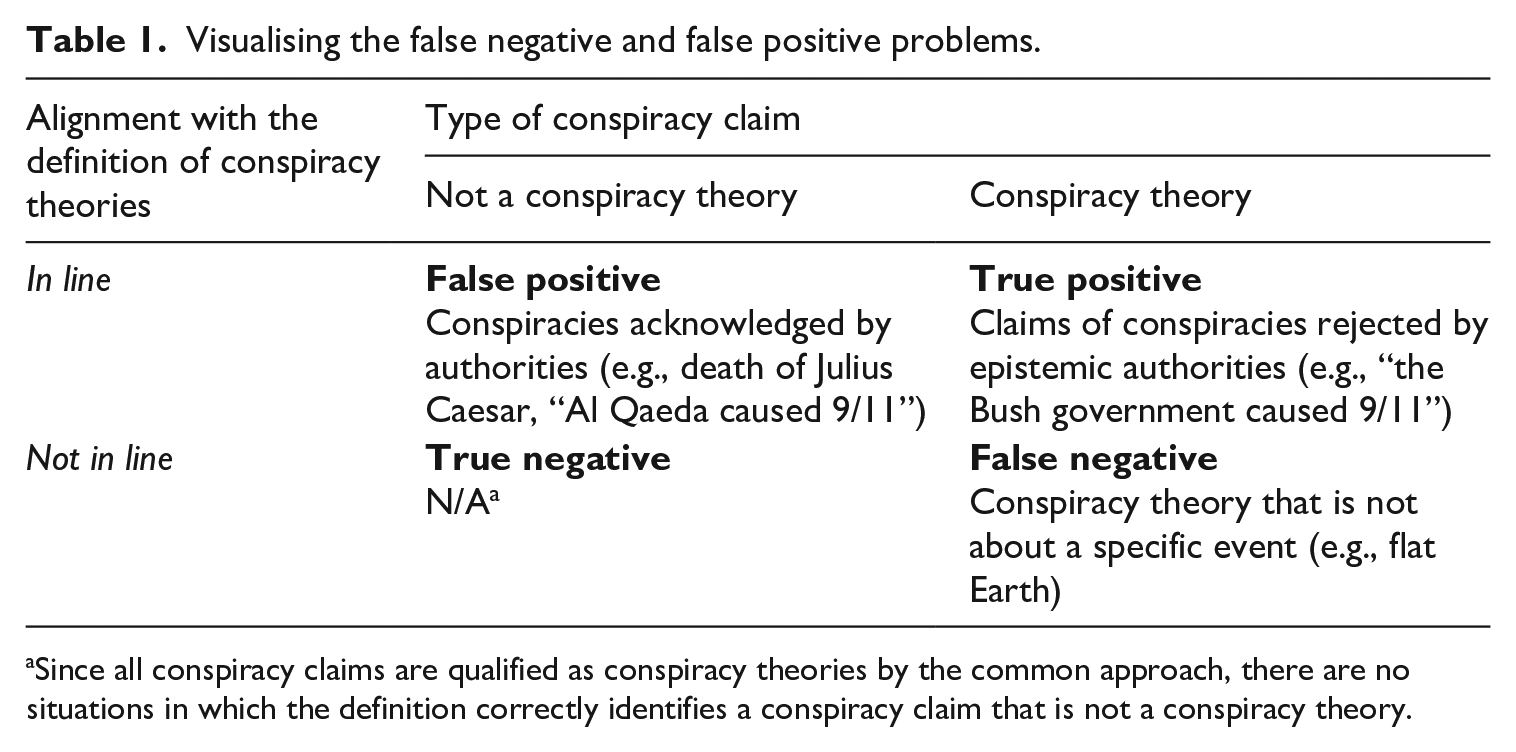
Since all conspiracy claims are qualified as conspiracy theories by the common approach, there are no situations in which the definition correctly identifies a conspiracy claim that is not a conspiracy theory.
Similarly, while conspiracy theories postulate that some events occurred (or are currently occurring, or expected to occur), such events are not necessarily something that conspiracy theories seek to explain. Even if conspiracy theories may ultimately allow individuals to explain some events (e.g., the profits of pharmaceutical companies), it is not clear that they primarily consist of explanations for said events. Thus, it appears that some of the current definitions of conspiracy theories are too narrow, as they do not apply to many prototypical conspiracy theories.
The false positive problem
Conversely, the current approach categorises as conspiracy theories many conspiracy claims that are clearly not conspiracy theories—by more refined definitions and the common understanding of the term (Räikkä, 2018). We propose to call this issue the false positive problem. For instance, if one relies on the aforementioned definitions, the claim that Al Qaeda caused the 9/11 attacks, or that Julius Caesar was assassinated in 44 B.C.E., qualify as conspiracy theories (see Table 1). Indeed, these are proposed explanations of significant social events relying on the causal role of a small group of actors acting in secret (Keeley, 1999). These two examples, however, are narratives accepted by epistemic authorities, which goes against the common understanding of the notion of conspiracy theory (Räikkä, 2018). Nonetheless, by the aforementioned definitions, any conspiracy-based explanation qualifies as a conspiracy theory. This may be considered as particularly problematic, considering that distinguishing conspiracy theories from other conspiracy claims is arguably the main challenge when it comes to defining conspiracy theories (Bale, 2007; Cassam, 2019; Guillon, 2018; Keeley, 1999; Räikkä, 2018).
The necessity of a refined approach to defining conspiracy theories in psychology
Now, a potential way to address these issues would be to emphasise the fact that conspiracy theories as defined by social scientists substantially differ from the common understanding of the notion. Indeed, it is very common that the scientific meaning of a notion (e.g., psychosis) substantially differs from its lay understanding (social representation theory extensively investigated these discrepancies; see Moscovici, 1961). However, we believe that proposing a refined definition of the notion of conspiracy theory would benefit the field for both conceptual and political reasons.
On the conceptual level, current definitions may lead to erroneous theoretical inference from empirical data. Indeed, even though researchers endorse very broad definitions of conspiracy theories—that encompass all claims about the existence of a conspiracy—they tend to investigate a subset of these claims (e.g., Duetz & Dentith, 2022). Specifically, they tend to study conspiracy theories in the common—and normative—sense of the term: conspiracy theories about the dangers of vaccines (Bertin et al., 2020; Jolley & Douglas, 2014), anthropogenic climate change (Uscinski et al., 2017), the origin of AIDS (Bogart & Thorburn, 2005; Jolley & Jaspal, 2020), COVID-19 (Imhoff et al., 2020), and so on. All these conspiracy theories are not merely claims regarding the existence of conspiracies, as they have a number of additional features that are not captured by the aforementioned definitions (see next sections). Thus, in current psychological research, there seems to be a mismatch between what is claimed to be under investigation (i.e., conspiracy theories defined as claims about the existence of a conspiracy) and what is actually under investigation (i.e., belief in conspiracy theories, set apart from other conspiracy claims). It is plausible that conclusions drawn from research mostly apply to unwarranted conspiracy theories (see Keeley, 1999) and not to conspiracy claims that are sanctioned by authorities, even though the latter are also encompassed in the definition. Mobilising more precise definitions of the notion of conspiracy theory may allow us to address this mismatch, and to draw more precise theoretical inference from empirical research. It may also improve the generation of hypotheses regarding the causes and consequences of conspiracy theories (Douglas & Sutton, 2023). Finally, it may facilitate interdisciplinary discussions with disciplines that have already formulated criticisms against psychologists’ approach to conspiracy theories (e.g., Butter & Knight, 2015; Harambam, 2020; see also Butter & Knight, 2020), and help with “bridging the great divide” between social sciences studying conspiracy theories (e.g., Butter & Knight, 2015, p. 17).
On the political level, by relying on a definition of conspiracy theories that successfully includes conspiracy theories and excludes other (potentially more legitimate) conspiracy claims, psychologists would be less likely to be accused of conveying the message that believing that conspiracies exist is irrational (e.g., Basham & Dentith, 2016; Dentith & Keeley, 2018). Relatedly, since lay people already have evaluative opinions on the topic (Douglas et al., 2021; Leveaux et al., 2022; Nera et al., 2020), they may find academic definitions inoperative. All in all, a refined definition of conspiracy theories may facilitate communication with the public, by defusing some recurring objections against the study of conspiracy theories in psychology (Basham, 2003; Buenting & Taylor, 2010; Hagen, 2018).
Towards a refined psychological definition of conspiracy theories
In the next sections, we propose ways to address the false negative and false positive problems identified above. Our goal is to propose a definition of conspiracy theories that addresses these issues by grasping the psychological specificities of conspiracy theory beliefs compared to other conspiracy beliefs.
Moreover, to guide us in our attempt to redefine the notion of conspiracy theory, we adopt the philosophical methodology of conceptual re-engineering 2 (Brun, 2016). According to this approach, a new definition must meet two criteria of adequacy, namely, similarity and theoretical usefulness.
According to the criterion of similarity, the newly defined notion must be part of a research field and should therefore correspond to the definitions that researchers have already proposed. Thus, with regard to the study of conspiracy theories in psychology, a new definition should apply to past research on the topic and build upon past attempts to define conspiracy theories.
The second criterion is theoretical usefulness. This criterion means that a sound scientific definition of conspiracy theories—or any phenomenon—should be precise enough to bring clarification (i.e., it should solve issues raised by previous definitions). We could also add a subcondition called practical usefulness, considering that the suggested definition should be operationalisable in empirical research. With regard to social psychology research on conspiracy theories, practical usefulness may be viewed as the possibility to easily implement the new definition in rating scales.
Addressing the false negative problem
A major limitation of current definitions of conspiracy theories is that they fail to capture some prominent conspiracy theories. This is especially true for definitions construing conspiracy theories as explanations of events. A quick examination of existing conspiracy theories is indeed enough to realise that conspiracy theories need not be about specific events or circumstances, nor—relatedly—that they necessarily consist in explanations. Rather, it appears that conspiracy theories can question any aspect of reality, as they can be about virtually any topic: a socially significant event, a scientific consensus, the nature of a social group, the very nature of reality, and so on. To address the false negative problem, we propose to acknowledge that conspiracy theories question some aspect(s) of reality—rather than specific events.
We moreover propose to abandon the idea that conspiracy theories ought to consist in explanations. Indeed, such an idea implicitly carries the assumption that conspiracy theories fulfil an epistemic function (i.e., explaining something; see Douglas et al., 2017). While such an assumption may be appealing when analysing some conspiracy theories (see Douglas et al., 2017; Sternisko et al., 2020), it may be an overstatement to consider this assumption as a definitional feature of conspiracy theories.
Addressing the false positive problem
Current definitions of conspiracy theories used in psychology apply to all conspiracy claims—even those that are not conspiracy theories by more refined definitions (e.g., conspiracies whose existence is acknowledged by authorities; see Räikkä, 2018). This shows that definitions currently used in psychology fail to address the question of the delineation between conspiracy theories and other conspiracy claims.
In this section, we will first review existing solutions to the false positive problems, namely, epistemologically normative definitions of conspiracy theories. We will highlight some caveats regarding the adoption of an epistemologically normative approach in psychological research. Finally, we will propose an epistemologically agnostic response to the false positive problem.
The epistemologically normative response to the false positive problem (and its limitations)
The false positive problem is arguably a consequence of the epistemologically agnostic approach adopted by psychologists to define conspiracy theories. Indeed, authors who proposed to distinguish conspiracy theories from other conspiracy claims mostly did so on epistemological grounds. For instance, Keeley (1999) proposed that unwarranted conspiracy theories have five additional characteristics compared to other accusations of conspiracy: (a) they run counter to “some received, official, or obvious account” (pp. 116–117); (b) they depict the intentions of the conspirators as deeply malevolent; (c) they assume hidden linkages between events that are seemingly unrelated; (d) the conspiracy is viewed as a “well-guarded secret” (p. 117), often involving public figures; and (e) they are mostly built on “errant data” (i.e., anomalies in the “official account” that potentially question its validity if no satisfactory explanation is provided).
Similarly, Guillon (2018), building on Keeley’s definition, proposed that conspiracy theories have three features that distinguish them from other conspiracy claims: (a) they run counter to a version accepted by relevant epistemic authorities (e.g., a scientific consensus in the relevant research field); (b) they rely on anomalies (i.e., errant data) in publicly available information, which means that the conspiracy theory believer does not have a privileged access to information (e.g., access to classified information); and (c) they establish connections between these anomalies, by postulating the existence of a conspiracy—presented as the best plausible explanation to account for these anomalies.
These two definitions were proposed by philosophers. Social psychologists have also proposed epistemologically normative definitions of conspiracy theories. For example, Brotherton (2013) proposed a definition encompassing five criteria to qualify conspiracy theories: (a) they run counter to the version of events accepted by epistemological authorities; (b) they are less plausible than other explanations (i.e., they lack conceptual parsimony); (c) they rely on poor evidence; (d) they construe conspirators as preternaturally competent and malevolent; and (d) they are ultimately unfalsifiable.
As one can see, these epistemologically normative definitions of conspiracy theories largely overlap. 3 All definitions include the fact that conspiracy theories run counter to a narrative accepted by authorities and/or relevant experts (e.g., journalists, historians, or scientists). As such, a feature that distinguishes conspiracy theories from other conspiracy claims is that they are defined by their opposition to a competing narrative. Another distinctive feature of conspiracy theories highlighted by these definitions is the lack of evidence in favour of the existence of the conspiracy. 4 Rather, conspiracy theories mostly rely on the alleged flaws of the “official” version.
A seemingly straightforward way to address the false positive problem would be to endorse one of the existing epistemologically normative definitions of conspiracy theories, or to propose a new epistemologically normative definition (see, for instance, Wagner-Egger, 2021). However, adopting an epistemologically agnostic approach to define conspiracy theories in psychological research has many benefits. After all, as psychologists, we are first and foremost interested in what people believe, rather than in some external, objective truth (i.e., whether there is an actual conspiracy going on). Besides, directly mobilising epistemologically normative definitions when one attempts to investigate the causes of belief in conspiracy theories may raise a number of issues (Imhoff & Lamberty, 2020). For instance, if one seeks to explain why some people believe in conspiracy theories, assuming that conspiracy theories are intrinsically flawed beliefs may embed a normative conclusion (i.e., the idea that conspiracy theories are irrational) within the definition, which should be ideally the starting point of research.
Second, adopting a normative approach to defining conspiracy theories may restrict the study of conspiracy theory beliefs to conspiracy theories whose unwarrantedness can be firmly established. This results in two issues. First, researchers would find themselves in a situation in which they have to assess the evidential strength of every conspiracy theory they want to investigate. This may be difficult, considering the quantity and diversity of arguments conspiracy theories tend to mobilise (Bronner, 2013). Second, it would prevent the study of conspiracy theories that spread directly after traumatic events (van Prooijen & Douglas, 2017) before any investigation has allowed reasonably ruling out the hypothesis of a conspiracy. Indeed, the irrationality of conspiracy theories is to a large extent a function of how many people should be involved to keep the conspiracy a secret (Grimes, 2016; Keeley, 1999), and this number grows as time passes (Keeley, 1999).
Finally, one may question the relevance of mobilising some of the aforementioned epistemological characteristics to define a phenomenon that is investigated at the psychological level. For instance, the fact that conspiracy theories are poorly substantiated by evidence compared to competing narratives is difficult to translate at the individual, psychological level. Indeed, only specialists (e.g., vaccine scientists) are able to assess the evidential strength of conspiracy theories and their nonconspiracist counterparts.
An epistemologically agnostic response to the false positive problem
Hence, there are good reasons to adopt an epistemologically agnostic approach to conspiracy theories in psychological research. However, by giving up the epistemological characterisation of conspiracy theories, psychologists have also given up the distinction between conspiracy theories and other conspiracy claims. As we analyse it, the conceptual challenge we are facing is therefore to identify the specificities of conspiracy theories while still endorsing an epistemologically agnostic position. To do so, we ought to define conspiracy theories based on what believers consider to be true, rather than on the congruence between the conspiracy claim and external reality (i.e., the plausibility that there is a conspiracy actually going on).
As a starting point, we will rely on a recurring feature of epistemologically normative definitions that has an expression at the psychological level, namely, the opposition to competing narratives sanctioned by authorities (i.e., “official versions,” Brotherton, 2013; Cassam, 2019; Guillon, 2018; Keeley, 1999). However, instead of adopting an epistemological approach to this issue, we propose to adopt a psychological approach. Hence, rather than comparing competing versions in terms of relative plausibility (e.g., an implausible “conspiracy theory” vs. a more plausible “official version”), we take the perspective of the conspiracy theory believer on these competing versions. At the psychological level, we propose that conspiracy theories are characterised by their opposition to what is claimed to be deceptive narratives sanctioned by authorities. 5 Specifically, we propose that the specificity of conspiracy theories compared to other conspiracy claims lies in the assumption that the public is being intentionally and pervasively exposed to deceptive narratives aimed at concealing the truth (i.e., a conspiracy). Put more simply, according to conspiracy theory believers, “We” are being lied to regarding some topic, these lies are everywhere, and it allows “Them” (i.e., the conspirators) to pursue secret and harmful agendas.
The intentionality of deception refers to the notion that according to conspiracy theory advocates, “official narratives” are not only deceptive—they are deceptive by design (Franks et al., 2017; Moscovici, 2020; Taguieff, 2005). This does not necessarily mean that people disseminating these narratives (e.g., journalists, government officials) are viewed as fully aware that they mislead the public (e.g., they may be only viewed as thoughtless cogs in a propaganda machine), but that these narratives are parts of deliberate efforts to divert the public’s attention from some important truth (Franks et al., 2017).
The pervasiveness of deception refers to the notion that conspiracy theories ascribe a remarkable magnitude to the dissemination of “official narratives.” Indeed, any ongoing conspiracy supposes some degree of deception to remain secret. However, in conspiracy theories, “official narratives” are viewed as pervasive in the public’s environment (e.g., in newspapers, television, political discourses, etc.). In addition, conspiracy theory advocates believe that alternatives to “official narratives” are being actively silenced, typically by being ridiculed as “conspiracy theories” (Nera et al., 2020). The best illustration of the pervasiveness of the deception is to be found in the recurring metaphor of the awakening among conspiracy theory believers (Franks et al., 2017): endorsing conspiracy theories is viewed as a way to wake up from a generalised sedative state induced by official narratives.
In summary, we propose that compared to other conspiracy claims, conspiracy theories involve the perception that the public is being pervasively deceived by “official narratives.” Note that in our approach, “official narratives” encompass both the promotion of “official versions,” and the silencing of alternative narratives. As such, conspiracy theories are at their core propositions to reveal some actively silenced truth, by calling out deceptive appearances.
We are being deceived . . . but by whom?
We may wonder about the actors responsible for this generalised deception. In this regard, conspiracy theory believers tend to accuse various groups such as political authorities, scientists, institutional experts, journalists, and so on (Franks et al., 2017; Harambam & Aupers, 2014). These groups tend to be conflated into broad overarching categories with blurry boundaries (e.g., “the Elites,” “the System,” “Them,” etc., see Franks et al., 2017). Given the vagueness of these categories and the potential heterogeneity in believers’ representations, we believe that it is not useful to clearly identify the groups that are considered responsible for the deception of the public. Rather, we propose that conspiracy theories can be characterised by assumptions pertaining to the visibility and accessibility of information in one’s environment. Indeed, regardless of the various groups allegedly involved in the deception, conspiracy theory believers claim that deceptive narratives are easily accessible in their environment (e.g., because they are massively promoted in the media), and that other, truthful narratives are more difficult to access (e.g., because they are being silenced). In short, conspiracy theories claim that there is a differential visibility of deceptive and truthful narratives in one’s environment, and that this asymmetry is purposely in favour of deceptive narratives.
In the representation of conspiracy theory believers, actors shaping the visibility of information are, for instance, mainstream media and government officials (Franks et al., 2017) because their word is viewed as highly visible in the public space. Epistemic institutions such as universities may also be viewed as weighing on the differential visibility of information, to the extent that their word is considered visible in one’s environment (e.g., because governments use the word of scientists to legitimise “official narratives”). As such, the notion of differential visibility of information does not clearly distinguish between epistemic and institutional authorities. While this distinction is an important one (Bouvier, 2014; Guillon, 2018), we believe that when it comes to analysing the perception of conspiracy theory believers, it is mostly inoperative. Indeed, epistemic and institutional authorities are often conflated in the scientific literature (Bouvier, 2014), let alone in the general public and among conspiracy believers. Indeed, as documented by Harambam and Aupers (2014), “when alternative understandings of ‘how things work’ are expressed by conspiracy theorists, they do not just question the knowledge of scientific experts, but also the institutional and social position on which their authority is based” (p. 471).
Towards a psychological definition of conspiracy theories
The false negative problem can be solved by acknowledging that conspiracy theories may question any aspect(s) of reality, rather than merely explain some specific events. As for the false positive problem, it may be addressed by considering that a conspiracy theory entails the perception that the public is being intentionally and pervasively deceived to cover up the conspiracy. A conspiracy theory can therefore be briefly defined as a claim that the public is being pervasively lied to regarding some aspect(s) of reality, to allow some group(s) to enact a harmful, self-serving agenda. This definition may be further unpacked into the following set of assumptions endorsed by the conspiracy theory believer: (a) the truth about some aspect of reality is hidden from the public; (b) “They” (the conspirators) want the public to believe a deceptive “official narrative”; (c) this “official narrative” is pervasively promoted in the public’s environment, through the dissemination of “official versions” and the silencing of truthful alternatives; and (d) this allows “Them” to secretly enact a harmful agenda without being uncovered.
This definition fulfils the two criteria of the conceptual re-engineering approach (Brun, 2016). With regard to the similarity criterion, the proposed definition builds on past conceptual efforts to define (belief in) conspiracy theories, and applies to most past research. Indeed, as argued earlier, conspiracy beliefs about the dangers of vaccines (e.g., Bertin et al., 2020; Jolley & Douglas, 2014), climate change (Uscinski et al., 2017), AIDS being a human-made weapon (Bogart & Thorburn, 2005; Jolley & Jaspal, 2020), Muslims’ desire to invade Western countries (Uenal et al., 2020), or Jewish people’s desire to dominate the world (Bilewicz et al., 2013)—all of these are conspiracy theory beliefs, by the proposed definition. Indeed, these conspiracy beliefs all imply that the public is being pervasively lied to regarding some aspects of reality.
Besides, also in line with the similarity criterion, this new definition allows one to distinguish conspiracy theory beliefs from a closely related concept, namely, conspiracy beliefs. In fact, as they involve groups acting in secret to achieve a malevolent goal, conspiracy theory beliefs may be viewed as a subset of conspiracy beliefs (see Figure 1). In this approach, all conspiracy theory beliefs are conspiracy beliefs, but not all conspiracy beliefs are conspiracy theory beliefs. For instance, the belief that Al Qaeda caused the 9/11 attacks is a conspiracy belief, but not a conspiracy theory belief. By contrast, the belief that the Bush administration caused the 9/11 attacks is a conspiracy theory belief, and therefore a conspiracy belief as well. Finally, somehow extending the similarity criterion, the new definition is more in line with the common understanding of the expression than previous definitions, as it applies to beliefs which are labelled as conspiracy theories by nonexperts (Räikkä, 2018).
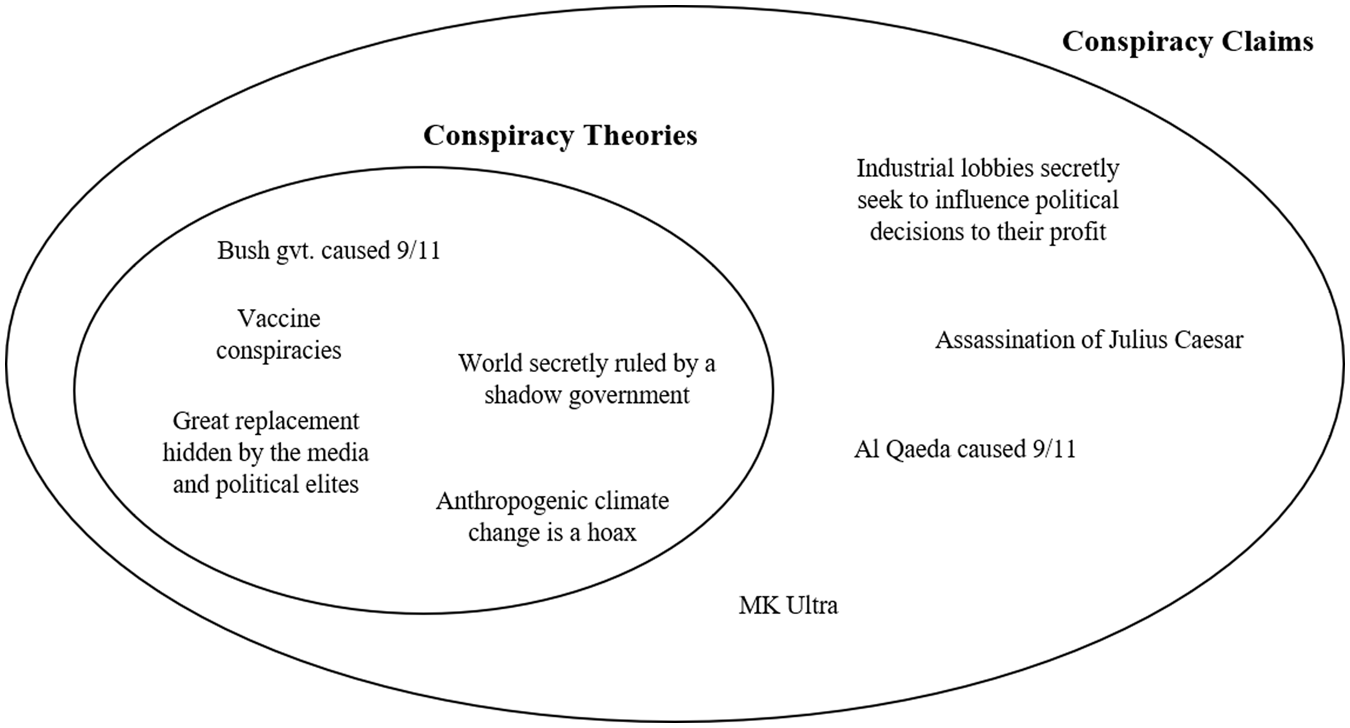
Conspiracy theories as a subset of conspiracy claims.
Another consequence of our definition is that when one accuses some group of conspiring, this may or may not result in a conspiracy theory, depending on whether believers also consider that the truth about the conspiracy is being pervasively silenced. For instance, by our definition, the belief that industrial lobbies are secretly seeking to influence political decisions to maximise profits is not a conspiracy theory belief. However, believing that these attempts to influence political decisions are kept secret by mainstream media and authorities would be categorised as a conspiracy theory belief.
As for practical usefulness, the new definition is highly operative for social psychological research, as it does not include aspects that would be hard to capture with the methodological tools of the discipline (e.g., rating scales). Relatedly, it remains relatively simple and does not significantly narrow the scope of research on belief in conspiracy theories. Furthermore, this definition is theoretically useful as it addresses issues raised by previous definitions (see Table 2 for a comparison between the different definitions), thus addressing the clarification criterion.
Comparing conspiracy definitions of conspiracy theories in relation to the issues identified above.
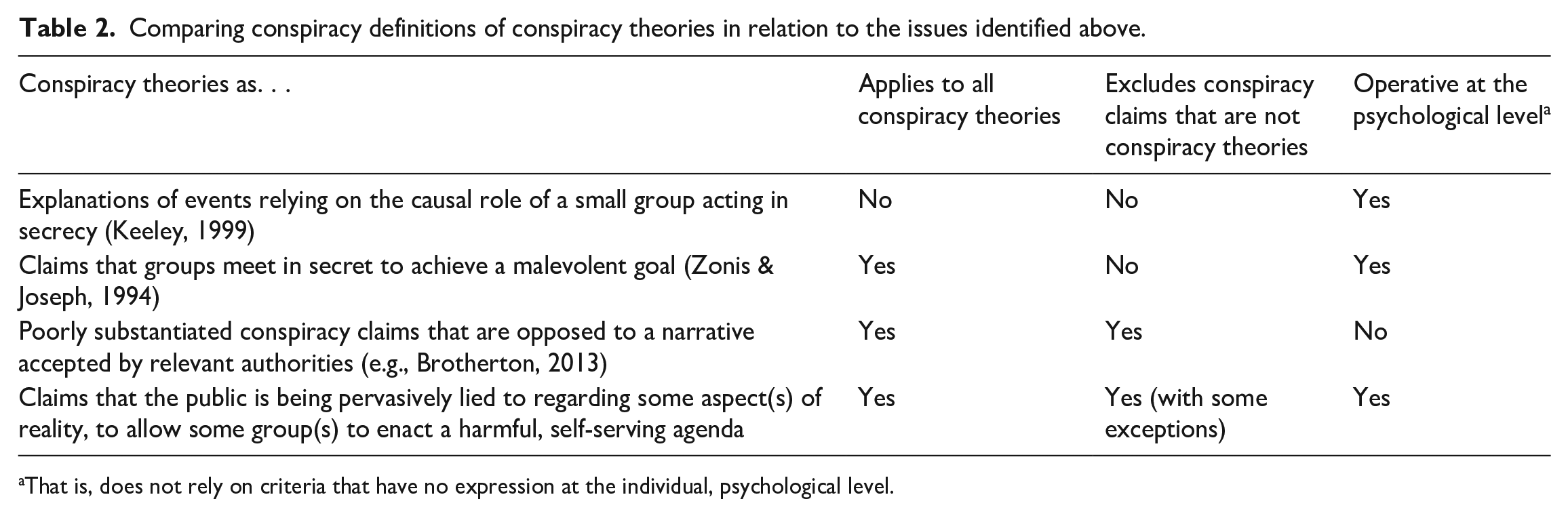
That is, does not rely on criteria that have no expression at the individual, psychological level.
Theoretical and practical implications for psychological research
A first theoretical implication of our definition pertains to the terminology used in research. Since under our definition, “conspiracy theory beliefs” and “conspiracy beliefs” designate distinct constructs, these terms should not be used interchangeably—as is often the case. Our definition also somewhat restrains the generalisability of research on conspiracy theories, by inviting researchers to more cautious—and conceptually precise—theoretical inference regarding the processes underpinning belief in the existence of conspiracies.
On the methodological ground, our definition does not require any radical changes to be implemented in future contributions. Indeed, it is highly plausible that when researchers ask participants if they believe that climate change is a hoax or that vaccines are harmful, the assumption that the public is being pervasively lied to on these topics is implicitly inferred. Therefore, in most cases, the fact that our definition encompasses the perception that the public is being pervasively lied to does not disqualify previous measurements of belief in conspiracy theories. That being said, multi-items measurements may be useful to capture both components of conspiracy theories—the existence of the conspiracy, and the pervasive deception of the public.
Limitations, future perspectives, and conclusion
While we believe that the proposed definition constitutes an improvement compared to previous definitions of conspiracy theories, it has limitations. Notably, our willingness to endorse an epistemologically agnostic stance does not allow us to exclude from our definition situations in which individuals have good reasons to believe that the public is being pervasively lied to (e.g., in a totalitarian regime in which information is entirely controlled by the government). Hence, in our approach, a conspiracy theory that turns out to be true is not necessarily an oxymoron. For researchers endorsing an epistemologically normative definition of conspiracy theories or someone endorsing the common understanding of the notion, such situations would constitute a false positive. Thus, our approach does not entirely settle the false positive problem.
Moreover, our definition raises questions in situations in which one’s environment is viewed as promoting a “classic” conspiracy theory. Let us consider, for instance, a society in which the media would endorse the idea that the 9/11 attacks were caused by the Bush administration. In such a society, by our definition, this “classic” conspiracy theory may be endorsed as a mere conspiracy claim. Indeed, believers may not have the sense that the truth about 9/11 is being actively silenced in their environment. However, they may have the sense that it is the case at a broader, international level, shifting the perception that one’s environment promotes deceptive narratives at the intergroup level. In any case, our definition was inspired by conspiracy theories that are widely known and considered as such in contemporary Western societies (i.e., Western Europe and the U.S.). Our definition may be an improvement compared to previous definitions in terms of conceptual precision, but it may have lost transferability to other cultural contexts. Thus, its relevance in different cultural and historical contexts needs to be theoretically and empirically examined.
Finally, while we believe that there are good reasons to conceptually distinguish conspiracy theory beliefs from other conspiracy beliefs, the question of whether the two are empirically distinct at the psychological level remains to be investigated. It is plausible that these two forms of conspiracy beliefs are to some extent underpinned by similar psychological mechanisms.
Despite these limitations, we believe that we have identified issues with the definitions of conspiracy theories currently used in research, and that our definition constitutes an improvement in this regard. This operative definition may allow researchers to distinguish between conspiracy theory beliefs and conspiracy beliefs, and to reflect on the articulation between these two related—but distinct—constructs.
Of course, other definitions may also adequately address issues raised by current definitions, and we do not expect every researcher to endorse our approach, nor to entirely approve our rationale. Some authors may prefer endorsing epistemologically normative definitions, for instance. However, we believe that engaging in conceptual efforts to refine the definitions that are used in psychological research on conspiracy theory beliefs is necessary.
Footnotes
Acknowledgements
We wish to warmly thank Olivier Klein, Robbie Sutton, and Florian Cova for their feedback on the manuscript.
Declaration of conflicting interests
The authors declared no potential conflicts of interest with respect to the research, authorship, and/or publication of this article.
Funding
The authors received no financial support for the research, authorship, and/or publication of this article.
