



Abstract
This article analyses the impact of the economic crisis on the public sector in Denmark. It first examines the overall public sector responses and presents local case studies, before offering a comparative perspective with other Nordic countries. The article concludes that responses to the crisis in Denmark mostly involve ‘resetting recent reform’. The crisis has affected on job levels and employment relations, but other drivers are also important. Analysis at the local level reveals that the reduction in job levels is as much an expression of the implementation of pre-crisis reforms and demographic change as a manifestation of a direct crisis impact. The moderate impact of the crises on public sector reforms is also found in Norway, Finland and Sweden.
Introduction
Denmark, like many other EU countries, has been hard hit by the financial and economic crisis. Unemployment more than doubled from 2007 to 2009, although from a very low level. The austerity measures and other responses to the crisis have been implemented through a public sector employment relations system characterized by relatively limited legislation, bipartite collective agreements at all levels with high coverage rates, (ad hoc) tripartite social dialogue, an extensive system for employee involvement and relatively strong trade unions. This is a system in which the social partners could be expected to play a more than marginal role in responses to the crisis.
The aim of this article is to analyse the impact of the crisis on the public sector. In line with the general focus of this special issue, we discuss, first, the extent to which responses to the crisis have affected job levels and employment relations in the Danish public sector; second, the types of crisis-related policies applied and the role of the social partners; and third, whether these policies have been the only important drivers of recent changes in public sector employment relations. We address these issues through analysis of the overall public sector responses as well as presenting local case studies.
In examining the crisis-related policies we apply the typology of public sector reforms proposed by Hood (2010: 8). The most modest type of response is ‘resetting recent reforms’ without major policy changes. These reforms merely involve quantitative cutbacks, aiming to ‘re-engineer well-known measures for a significantly colder climate’. The second type, ‘system redesign’, includes qualitative structural changes to create incentives for service providers to improve economic effectiveness. The third type, ‘East of Suez moments’, entails withdrawal of the state from areas of welfare service.
We argue that crisis responses in Denmark have been mostly of the first type. There has been an impact on job levels and employment relations, but the job cuts are as much an expression of pre-crisis reforms and demographic change as a direct effect of the crisis. Finally, we illustrate the different socio-economic paths into and out of the economic crisis in the Nordic countries, yet emphasizing how they all have pursued very similar strategies. None of the measures taken so far in any of the Nordic countries show major qualitative changes in the structures of their public sector employment relations. Hence, reactions to the crisis have mainly involved ‘resetting recent reforms’. However, we will demonstrate that the Danish case displays some tendencies towards ‘system redesign’ because of the significant strengthening of the employers’ position.
The next section presents the main characteristics of Danish public sector employment relations. We then briefly present the austerity measures and other crisis-related labour market policy initiatives taken since 2008. We analyse the social partners’ responses to the crisis and the austerity measures at both national and local levels. After a brief comparison of Danish experience with that in Sweden, Norway and Finland, we conclude by discussing questions of causality – the role of the crisis as against other drivers of change – and the issue of change versus continuity.
Public sector employment relations in Denmark
The Danish public sector is closer to the ‘model employer’ than the continental ‘sovereign employer’ industrial relations model (Bach and Bordogna, 2011). In the latter, employment relations are unilaterally determined by the government, and collective bargaining is absent or severely restricted. In the former, the public sector is less isolated from conventional processes of employment relations, such as collective bargaining; rather, the state poses an example to other employers. Denmark, like the other Scandinavian countries, has also been described as a variant of a neo-Weberian welfare state that has adopted their modernization efforts earlier and more rapidly than continental European countries (Pollitt, 2007). Research on the public sector before the crisis (Ejersbo and Greve, 2005; Ibsen et al., 2011; Pedersen, 2000) has found that ‘new public management’ (NPM) reforms had been introduced, but these were ‘moderate’ and did not bypass or sideline trade unions. The basic features of the public sector industrial relations system remained unchanged; rather, this system shaped the type of NPM introduced.
About 32 percent of the Danish workforce (full-time equivalent) is employed in the public sector (Statistics Denmark, 2011). This share has remained relatively stable over the past 20 years, despite increasing privatization and outsourcing of public services. The employment figures include a larger proportion of part-time employees than in the private sector. Thus, the share of individuals working in the public sector is probably larger than the 32 percent (Ibsen et al., 2011). Public employment has a three-tier structure: state, regions and municipalities. The large majority of employees work within the municipalities.
Collective agreements cover wages and all issues of working and employment conditions, and there is a system of codetermination councils for occupational groups and at local level. The social partners determine general wage scales and terms and conditions at each level (state, region or municipality), which are then integrated into agreements for different occupations. However, wage reforms since the 1990s have introduced a two-tier structure, with local wage bargaining allowing individual or group supplements at the administrative unit or workplace. Legislation is limited, but plays a role, most importantly through the Salaried Employees’ Act (Funktionærloven), which prescribes a minimum three-month notice period for public employees after three months’ probation. An important feature of the Danish system (as in the other Nordic countries) is a declining number of civil servants with special statutory employment protection (Due and Madsen, 2009; Ibsen et al., 2011).
Crisis-related policies and their impact
Policy initiatives
The liberal-conservative government in power between November 2001 and September 2011 initially responded to the crisis in 2008 by introducing stimulus packages. These packages were followed by budget cuts and welfare reforms, combining austerity measures with others to increase the long-term labour supply. The most important policy responses to the crisis included:
A tax reform reducing marginal income tax rates from 2009, particularly for high- and middle-income groups: the top marginal tax rate was reduced from 63 to 56 percent. The reform was intended to stimulate the economy, and reduced tax income by a total of DKK 28 billion (€3.7 billion).
Stimulus packages in 2009 and 2010, including a special stimulus for the construction sector. The aim was to increase public investment by 30 percent in 2009–2010, but only a third of this was achieved (Politiken, 23 August 2011). In August 2011, the government announced a growth package of DKK 10 billion (€1.3 billion), but after their election defeat the plan was abandoned.
The recovery plan of 2010 (including unemployment benefit reform), to be implemented partly through the annual budgets for 2010 and 2011, was the first real austerity measure. Among other things, it postponed some of the tax reduction included in the 2009 reform; cut 0.5 percent of all ministerial budgets; introduced a ceiling on tax concessions for unemployment insurance contributions; and reduced the maximum period of unemployment benefit from four to two years.
Reform of the early retirement scheme (efterløn) in 2010. Until then employees and self-employed aged 60–64 had the opportunity to take early retirement on transfer income that was mainly tax-financed. The reform entailed a gradual abolition of the scheme, with an annual budget saving of DKK 16 billion (€2.1 billion) when fully implemented. This was expected to increase labour market participation and employment rates, but could also lead to increasing unemployment if the economic situation did not improve.
Reform of disability pensions and the flex-job scheme ended entitlement to disability pensions for those under 40 years of age. Changes to the flex-job scheme – introduced in 1998 to encourage labour market participation by disabled people working reduced hours – introduced new paths to support reintegration in the ordinary labour market and limited wage subsidies to high-income flexi-jobbers. In 2011, 70,000 persons were employed in flex-jobs, half of these in the public sector. Estimated annual savings were DKK 2 billion (€0.3 billion) when fully implemented.
The centre-left government that took office in September 2011 has continued budget cuts, but has also planned some initiatives that are more employee- and union-friendly. The most important – many of which are included in their ‘2020-plan’ (Regeringen, 2012) – are:
A stimulus package (‘Kickstart’), part of the annual budget for 2012–2013, aims to stimulate the economy by investing DKK 17 billion (€2.3 billion) in public infrastructure and other public investment.
The social partners and the government commenced tripartite negotiations in May 2012 in order to reach agreement on improving competitiveness, growth and employment. Many issues were on the bargaining agenda, but the key aim was to create 20,000 new jobs and improve public finances by DKK 4 billion (€0.5 billion). The talks broke down in mid-June, mainly because the unions found it difficult to explain to their members why the labour supply should be increased in times of relatively high unemployment (which had increased from 2.5 percent in 2007 to 6.9 percent in 2012).
The tax reform of 2012 reduces taxes on employment and on high-level incomes. The net cost is reduced by reduced tax deductions for capital income and changes in the automatic indexation of unemployment benefits and other transfer incomes.
A reform of disability pensions and the flex-job scheme along the lines proposed by the previous government.
Impact
The impact of these measures on public sector industrial relations is limited but varied. There is a direct impact on income security from the unemployment benefit reform and that of the efterløn, and on pay and conditions for those receiving disability pensions and flex-jobbers. The impact of the other measures on public is more indirect and less severe. It is important to note that since all reforms are economy-wide, they have as much (or as little) impact in the private sector as in the public.
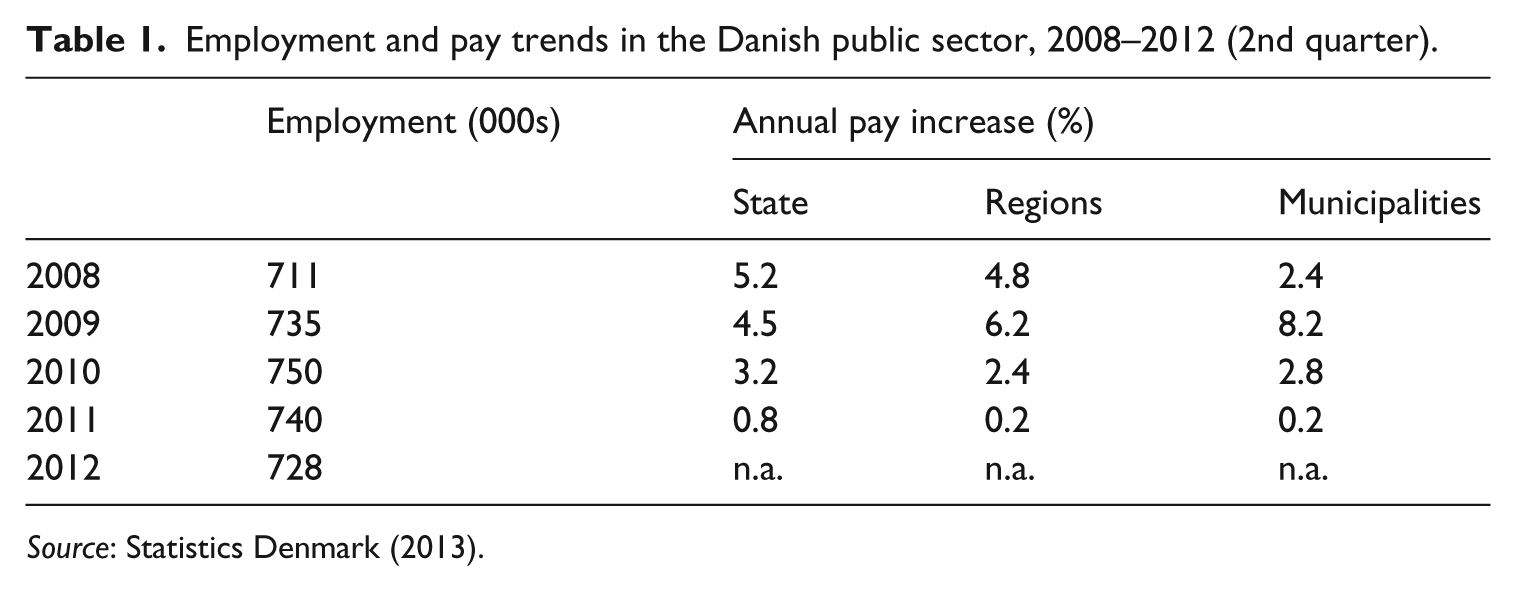
In terms of impact on employment levels, the crisis-related policies have undoubtedly contributed to a decline in jobs in the public sector, as Table 1 illustrates. In 2011, the municipalities’ overall budget was cut by DKK 4 billion (€0.6 billion). The national organization for the municipalities, Kommunernes Landsforening (KL), conducted a study showing the unequal distribution of the budget cuts: 20 percent of the municipalities have experienced a budget reduction of 4 percent or more from 2009–2011 (KL, 2011). This has affected job level: while public sector employment peaked in Q2 2010 at 750,000 employees, the net job loss reached 22,000 (2.9%) in Q3 2012, bringing public sector employment down to 728,000 – though it increased slightly to 729,000 in Q1 2013 (Statistics Denmark, 2013). This is a substantial decline in public sector employment, but limited compared to similar developments in many other EU countries, and does not alter the fact that a little more than 30 percent of all employees are still to be found in the public sector. However, when estimating the consequences of crisis-related policies, it is difficult to separate their consequences from other factors, as will be discussed later.
Employment and pay trends in the Danish public sector, 2008–2012 (2nd quarter).
Source: Statistics Denmark (2013).
Responses of the social partners
It could be argued that crisis-related policies have also had an indirect impact on wage increases, which have decreased since 2010. We now discuss the social partners’ reaction to crisis and the austerity measures, and how their responses have had a direct impact on wage movements and working conditions. To provide a full picture, we consider reactions at both national and local levels.
The national and sectoral levels
In terms of government policies, the tripartite negotiations in 2012 under the new centre-left government were the only occasion when the social partners have been more than superficially involved. Other policies – not least the reforms of unemployment benefit and the early retirement scheme – were introduced by the previous liberal-conservative government despite strong protests by the trade unions. This government also failed to involve trade unions and ignored their positions in relation to other initiatives affecting work and employment, such as active labour market policies, but this was not necessarily part of a long-term trend since it followed a three-year period with some involvement of the social partners by the same government (Mailand, 2011; Mailand and Ibsen, 2010).
The Danish trade unions voiced protests in the media and undertook some mobilizations of their membership, including a large one-day demonstration in June 2010 against the government’s austerity measures, organized by the largest trade union confederation (LO) and a number of its member organizations. However, in general such protests have been few in number, and no general strikes have been called. Given the failure to involve the social partners in policy responses to the crisis, stronger reactions might have been expected. Several explanations are possible. First, as we describe below, the role of the social partners in addressing the crisis has been much stronger at sectoral than at national level. Second, austerity measures have been relatively modest, and although unemployment has increased, it remains below the EU average. Third, strike action is in general relatively rare in Denmark: the most recent large-scale strikes took place in 1998 and 2008 in connection with deadlock in collective bargaining.
Apart from direct opposition to the government’s austerity measures and other crisis-related policies, reaction has also been linked to national public sector collective bargaining (Mailand, 2012). The outcome of the two-year public sector collective bargaining round in 2011, which took place when lay-offs were expected but had not in general been implemented, were very modest. Wages were frozen for 2011, and a very limited increase was agreed for 2012 in all three main sub-sectors (state, regional and municipal). As a result, wages will probably have fallen in real terms. To some extent this was expected because of the economic context and the ‘regulation mechanism’ (reguleringsordningen) that ties public sector wages to movements in the private sector, although with some lag. The existence of this mechanism implied that public sector employees ‘owed’ their employers money when the negotiations began. In a rare situation, as the present, when economic conditions changed rapidly from very favourable to very unfavourable, the regulation mechanism works as a hidden austerity measure.
Apart from the agreement on wages (which also implied that no central resources would be allocated for local wage increases), the main bargaining result included more flexible rules concerning the agenda of the central codetermination committees, increased protection for shop stewards and initiatives to increase employment security. Most trade unions had expected some kind of compensation for wage restraint, in the form of job, employment or income security or other benefits. But all the union demands on job security (such as extended periods of notice and increased redundancy payments) were rejected. These demands were clearly related to the crisis and the increasing number of redundancies in the public sector, and they were encouraged by similar agreements from the 2010 collective bargaining round in the private sector. However, in the municipal sector the employers (KL) proposed at the very end of the negotiation process a ‘security fund’ to finance further training for workers made redundant, as a kind of compensation for rejecting all the other demands. This was financed from surplus pension funds, and could therefore be seen as cost-free for the employers.
Nevertheless, it can be argued that the unions succeeded in blocking some of the employers’ main objectives, such as increase in the proportion of wages set at local level, increased working time and a move from collective to individual bargaining at the local level. The extent to which this can be regarded as victories for trade unions depends on two factors. The first is whether these employer demands should be seen as short-term or long-term objectives. Almost certainly they were part of a long term strategy, and might be seen as setting a marker for the future bargaining agenda rather than as immediate expectations. Second, at least one of the issues – an increased role for wage determination at local level – is supported by some of the unions. Both factors should be taken into account in evaluating the results of the 2011 collective bargaining round.
Overall, the outcome was not very dramatic. Although the state, regional and municipal employers took advantages of their stronger power position and took a tougher than usual stance, to the confusion of the trade unions, there were no radical changes in wages, working conditions, employee rights or any other basic qualitative features of the public sector employment regulation system.
Thus the crisis and austerity policies have not so far led to important qualitative changes in public sector industrial relations, although both the process and the outcome of the 2011 bargaining round reflect a change in power relations between employers and unions. Hence our assessment that, in Hood’s terms, the outcome involved ‘resetting recent reforms’ rather than ‘system redesign’. However, since the 2011 bargaining round there have been developments that could be part of more substantial changes. Despite a more intense, although non-binding, social dialogue in the public sector than is normally the case between bargaining rounds, the uncompromising attitude of the public employers at national level has intensified. There has been increasing pressure on KL from the Ministry of Finance to adopt a ‘tougher’ stance and put increased emphasis on management prerogative. Judged by the 2013 bargaining round, both the state and municipal employers are following this approach, including an attempt to move working time issues from collective bargaining to unilateral regulation for some groups of employees, and terminating the ‘regulation mechanism’ with the aim of reducing public sector wages.
The local level
One direct response to the crisis is increased central government control of municipal budgets. The annual budget negotiations between central government and KL have become subject to increasing uncertainty. Local municipalities have become very aware that they are subject to budget restraints during economic recession; in May 2012, spending on municipal services was DKK 5.7 billion (€0.8 billion) below the original 2011 budget (KL, 2012). The tight budgets together with the meagre results of the 2011 bargaining round severely restrained local wage increases, though local bargaining took place to a limited extent during 2012. However, other factors must also be considered in order fully to understand the responses at local level.
Below we present four municipal case studies to highlight how the crisis has interacted with other structural factors affecting the local employment situation and responses of the social partners. These other factors include pre-crisis reform measures and the changing demographic environment in terms of an ageing population. One major reform initiative introduced by the liberal-conservative government in 2004–2007 set the scene: the ‘Structural Reform’ which reduced the number of municipalities from 271 to 98 and replaced 13 counties with five regions. The aim was to improve quality in service provision and benefit from economies of scale.
The four cases all involve municipalities merged as a result of this reform, but are from two different studies. The first two involved municipalities which are in some respects similar but facing very different budget regimes. The ‘West’ municipalities suffered the third highest cut in the period 2009–2012 in its budget for municipal services (9.2%), while the ‘East’ municipality is among those with the smallest reductions (under 2%) (Momentum, 14 February 2012). The other two cases also involved municipalities where the crisis had a severe impact, and the social partners played important roles in addressing the issue. Silkeborg municipality suffered a 7.1 percent budget cut in 2009–2012, whereas in Mariagerfjord municipality the figure was 4.8 percent.
Despite their contrasting budget regimes, the first two municipalities pursued similar approaches for handling budget cuts in terms of the efficiency measures adopted. These included restructuring the school area, reorganizing central management, digitalization, outsourcing of specific services and experiments with new ways of working.
Restructuring of the school area involved reducing the number of school units, yielding immediate budget savings, but is also related to the economies of scales made possible by the merging of municipalities under the Structural Reform. Also, it should be understood as part of a long-term reorientation of municipal services towards the ageing population, with less demand for child education in the future. In terms of the impact on the employment relations, school restructuring reduced the number of employees but also emphasized the need for close local codetermination between political and administrative leaders and the local union representatives. Similarly, the restructuring of central management also produced immediate reductions in spending, but was equally about realizing the economies of scale made possible through the Structural Reform.
The specific measures of digitalization of the system of public benefits and of marketization of some services (such as cleaning and domiciliary care) are both integral parts of a public sector reform process already long in place, and were planned in both municipalities in accordance with central government demands. Both digitalization and marketization will without doubt severely affect employment relations, as large groups of employees are repositioned or transferred to private employment. Finally, the focus on new ways of working – with the aim of providing similar or better services for less money – is very much in line with the general modernization agenda in the public sector dating back to the early 1980s (Ejersbo and Greve, 2005).
In addressing all these issues, the local cooperation committees were engaged in an attempt to enhance trust between management and employees and ease implementation. Cooperation was better in the ‘East’ municipality, where budget constraints were less serious, than in the ‘West’ municipality, which had experienced far more extensive lay-offs. In this municipality, two job banks had been agreed upon, one for school and kindergarten teachers, the second for all other personnel.
Experience in the other two municipalities was in line with the picture described so far. Although austerity measures were one cause of the tighter budget regime in both municipalities, they were neither the sole nor the most important driver behind the cutbacks. The Structural Reform, demographic change (in Mariagerfjord municipality) and unforeseen outcomes of privatization (Silkeborg municipality) were also important drivers.
In sum, these four case studies demonstrate that the impact of the crisis at local level combines with others causal factors, such as reform initiatives previously adopted and local political dynamics. Furthermore, irrespective of the measures involved and their rationale, they all have had an impact on bargaining and codetermination processes. The codetermination system is activated in situations of restructuring and reform because of the strong local trade union representation in Denmark. Moreover, local negotiations on working time and the working environment are emphasized during these processes, but can become strained. In terms of assessing the direct impact of the crisis on employment relations, the limited local wage growth seems to be the most straightforward indicator in the Danish case.
Comparative perspective: The other Nordic countries
Denmark’s three main Nordic neighbours, Sweden, Norway and Finland, have fared better in relation to the crisis than Denmark, but in different ways. The Swedish and Finnish economies were both affected by the crisis, but the relative increase in unemployment from 2008 was less dramatic and they recovered more quickly than Denmark. In Norway, the impact of the crisis on employment was very limited during the whole period from 2008 onwards.
In Norway, unemployment peaked at the beginning of 2010 at only 3.6 percent and has since decreased slightly. The number of job losses caused by the crisis has been small. In autumn 2008, financial measures introduced by the national authorities focused on relief efforts for the banking and financial services sector; support for the municipal sector; and the need for loans and credit for export industries. These were followed up in February 2009 by a package to sustain and create employment, adjusted in parliament partly as a result of calls from the social partners. Overall, the value of the package amounted to about NKK 18 billion (€2.3 billion). The measures included initiatives to safeguard the construction industry; tax cuts; new rules for temporary lay-offs as an alternative to dismissals; increased funds for apprenticeships; and further measures to make it easier for businesses and households to obtain loans and hence to stabilize the financial markets (Alsos, 2009).
The 2010 bargaining round in the public sector was expected to be difficult, as unions were pressing for a special salary rise for female-dominated groups. In addition, pay increases in the private sector had been moderate, and the government stated that it would not fund significant increases in the public sector. In the central government sector, an agreement was reached for an increase averaging 3.3 percent. Some of the funds to pay for this increase were set aside for female-dominated occupational groups, and were distributed in subsequent ‘adjustment negotiations’. In all municipalities except Oslo, which bargains independently, the parties failed to agree, and the unions called a strike in May 2010; this lasted for nearly two weeks and involved around 44,000 workers. The parties eventually agreed an increase of around 3.4 percent. This was significantly more than the employers had originally offered. Strikes also took place in public hospitals, mainly involving nurses, resulting in increases of about 3.5 percent (Nergaard, 2011).
Unemployment in Finland rose from 6.2 percent in April 2008 and peaked in late 2009 at 9 percent. As a response to the crisis, the government announced in January 2009 a stimulus package of €45 billion. This was aimed primarily at the banks, and the hope was that it would stimulate the credit market and provide resources for other parts of the economy. During 2010, the government followed the trend set in many other countries, tightening its fiscal regime and reducing its economic stimulus programmes, with the aim of reducing the national debt (Jokivuori et al., 2011).
The social partners have been involved in some of the crisis-related policies which have been more oriented towards growth stimulation than austerity. A tripartite framework for a new centralized national agreement on wages and conditions was agreed in October 2011, providing a pay increase of 4.3 percent spread over 25 months. An additional lump sum of €150 was also agreed. The government for its part agreed to provide temporary lay-off pay and reduce corporate taxation. The objective was to strengthen the Finnish economy, improve productivity and competitiveness, and safeguard employment and the welfare system (Jokivuori, 2012).
The 2011 bargaining round in the public sector took place in the context of slowly declining unemployment rates, but also against the background of relatively high pay increases between 2007 and 2010 which had put the competitiveness of the Finnish economy into question. Thus the recovery of the Finnish economy was uneven: while some sectors recovered quickly, others were still affected by the crisis in 2010. Public sector pay bargaining did not yield any increases in real terms. In the municipal sector, a one-year pay deal reached in February 2011 combined a general pay increase of 1.2 percent with an additional 0.8 percent to be distributed in local negotiations. In the central government sector, a general 1.3 percent increase was agreed, with an additional 0.5 percent to be allocated in local negotiations and a 0.2 percent ‘equality component’. It was also agreed that where employees’ responsibilities were downgraded, their pay would be protected for 24 months. However, the financial situation in both national government and the municipalities remains precarious (Jokivuori, 2011).
In Sweden, before the crisis there had been a redistribution of jobs from the public to the private sector: the number of private sector employees rose by 17 percent from 1995 to 2010, as against a fall in the public sector of about 9 percent among state employees and 5 percent among regional and municipal employees (Medlingsinstitutet, 2010).
Unemployment increased from 5.9 percent in May 2008 to 9.0 percent in May 2009 (Statistics Sweden, n.d.). The export sector was initially hit hard by the crisis, but during 2010 employment began to recover. During 2010 GDP rose by about 5.5 percent, more than in most other European countries at that time (Medlingsinstitutet, 2010). The resilience of the Swedish economy reflected a more regulated banking sector and the reforms which had already been implemented as an effect of the economic crisis in the early 1990s. These consisted of a general tightening of public spending, including reform of the unemployment insurance system, liberalization of temporary contracts and the introduction in 2006 of tax credits for low-income groups (Holmlund, 2011).
At the beginning of the financial crisis the krona fell significantly in value, to the benefit of general Swedish competitiveness, but from the spring of 2009 it began to regain its strength. The government continued a relatively tight fiscal policy in the aftermath of the crisis, with the aim of maintaining a budgetary surplus; but it incorporated some stimulus initiatives, mainly targeted at preventing labour market exclusion, investing in education and promoting growth. In autumn 2011, tripartite negotiations took place over a jobs pact to reduce youth unemployment: this included a reduction of working hours and wages for young people under 25, improved opportunities to combine employment and education, and a reduction in the high and differentiated unemployment insurance fund payments (SVT Nyhetar, 2012). The budget for 2013 suggests a slightly more expansionist policy including tax reforms, continued initiatives to reduce youth unemployment and various public investments in infrastructure and education and research (Borg, 2012).
Two major changes in the industrial relations system affected the public sector during the 1990s. These included strengthening the norm-setting mechanism for private industry, which set the benchmark for public sector negotiations, and extended decentralization of wage determination. However, despite these changes the overall conclusion has been that ‘social partnership and collective bargaining has largely survived the ideological changes’ in the public sector (Thörnqvist, 2007: 16). In 2010, collective bargaining rounds took place in both the private and the public sector, following debates over the length of the agreement period and the need for pay restraint (Medlingsinstitutet, 2010). Though real wages are estimated to have increased by 1 percent during 2010, wage restraint was the norm set for all sectors by private industry. The public sector bargaining round followed this rather strict norm, resulting in a slowing down of pay increases as well as further decentralization. In particular, guarantees of individual wage increases were removed for state, regional and some municipal employees. However, the agreement with the Kommunal, which represents most municipal employees, still maintained individual guarantees (Medlingsinstitutet, 2010).
In 2012, a new bargaining round ensued with wage restraint as the continued norm. A one-year agreement for a 2.6 percent increase was reached for 100,000 white-collar state employees. In addition, a 3.6 percent wage increase over three years, but without individual guarantees, was agreed for police officers, among others. For state-employed graduates, the agreement contained no specific percentages and no end date. Tough negotiations also took place with the main teachers’ unions, which sought wage rises above the norm because teachers’ real wages had fallen behind other comparable groups. A four-year agreement was reached, giving a rise of 4.2 percent, the highest figure for any sector during the 2012 round (Johansson and Eriksson, 2012).
On the agenda for the bargaining round of 2013 was concern over the increasing use of fixed-term contracts among municipal workers, while public employers focused on continued wage restraint and removal of the remaining individual guarantees. The possibility of extending the collective agreement period was also an issue.
Discussion and conclusions
Regarding the type of responses to the crisis, we can conclude that responses to the crisis in Denmark have taken the form of ‘cutback management’ (Pollitt and Bouckaert, 2011) affecting wage and job levels rather than the institutional framework. Applying Hood’s typology, the crisis-related policies and the social partners’ responses mostly involve ‘resetting recent reforms’, in that they have not so far included any attempts at ‘system redesign’ or ‘East-of-Suez moments’ (withdrawal of state provision).
In relation to the question of the extent to which responses to the crisis have affected job levels and employment relations, we conclude that the impact has been relatively modest. At national level, with the exception of the disability pension and flex-job reform, none of the crisis-related policies has directly affected employment relations for future generations. Although the reform of the unemployment insurance benefit system as part of the 2010 Recovery Plan and the reform of the early retirement scheme have important implications, neither can be termed model changes (Kvist and Greve, 2011). However, both the process and the outcome of the bipartite collective bargaining round in 2011 have been affected by the crisis, and power relations have significantly shifted in favour of the public employers, which the 2013 bargaining round confirmed. At local level, stronger government control of municipal spending has clearly pushed austerity measures through to the local level, but the actual approaches taken to reach the economic aims mainly draw on pre-crisis reform initiatives and processes.
This finding is relevant also for the question of the importance of the economic crisis as against other drivers. The analysis of the local level in particular revealed that the reduction in number of employees is as much an expression of the implementation of pre-crisis changes (the Structural Reform) and demographic trends as a manifestation of the direct impact of the crisis. Thus, job cuts are a product of ‘institutional restructuring’ (Pedersen, 2000). Furthermore, this underlines the often encountered problem in comparative welfare retrenchment research of identifying the crucial dependant variable (Pedersen, 2000; Starke, 2006). Introducing a dual-level analysis of the impact of reform at local as well as national level can be one way of strengthening the understanding of change and continuity in public sector employment relations.
In general, the answers to these research questions indicate a certain degree of path dependency. This applies also to the role of the social partners. Their general lack of involvement in the crisis-related political initiatives cannot be seen as path-breaking, as their role in economic policies has traditionally been limited. Further, the social partners have played a strong role in addressing the crisis through the industrial relations system, at national, sectoral and local levels. Path-dependence is also reflected in the content of the social partners’ responses, by and large still dedicated to the modernization agenda of the early 1980s (Ejersbo and Greve, 2005). Hence, the specific nature of change spurred by the economic crisis in the public sector continues to take place predominantly within the established institutional framework of public sector industrial relations and the wider Danish model of labour market regulation (Due et al., 1993).
Thus considering the strength of adaptive measures in comparison with the exogenous crisis shock, change in the Danish case mainly involves incremental adjustment (Starke, 2006). A vital part of the mechanism underpinning the reproduction of the Danish industrial relations system is its very ability to restrain wage demands during economic slumps – as was also proved during the public sector collective bargaining round in 2011 – and the continued involvement of strong public sector trade unions in the restructuring efforts of the welfare services at local level.
Signs of future deeper incremental change are however present. In the collective bargaining rounds of 2011 and 2013 these signs are related to the continued tight economic environment and the skewed power balance in favour of the employers, as is demonstrated by the public employers’ emphasis on more unilateral regulation and managerial prerogative at the expense of bargained solutions, and more budget control. More specifically, the state employers’ demands in the 2013 bargaining round included the termination of the ‘regulation mechanism’ in order to decouple public from private sector wage determination, and link it to productivity trends in the public sector instead. The trade unions feared that this could lead to reductions in nominal wages. However, the abolition of the regulation mechanism was not agreed – at this time.
Another remarkable demand was for the annulment of all existing local agreements on working time for teachers: by the municipal employers in the case of primary and secondary schools, and by the state employers in the case of post-15 education institutions; the aim was to strengthen management prerogative and facilitate the implementation of large-scale school reforms. Only after failed arbitration, a lock-out before any strike call, and – finally – government legislative intervention did the employers obtain their objective. Some public sector trade unions described this process as violating the self-governing principle in the Danish model of industrial relations; it caused concern for the coming public sector collective bargaining rounds. In combination with the lack of willingness at national level to allocate financial resources for decentralized wage increases, these events represent a challenge for a further development of the Nordic version of NPM. Hence several trade union representatives believe that the state employer – the Ministry of Finance – is gradually abandoning its aim of decentralizing wages. The official policy of the state employers is however still to pursue decentralization, including a partial shift from local trade union negotiations to individual bargaining. This could intensify the development of a Nordic version of NPM. No matter what direction the changes will take – but depending on how far the employers are willing and able to go – they might approach Hood’s ‘system redesign’, as the changes include new balances between bargained and unilateral regulation.
Norway, Finland and Sweden show different socio-economic paths into and out of the economic crisis than does Denmark. Norway has been affected only to a very limited extent. In Finland, stimulus to growth was given priority over austerity measures, whereas Sweden had already undergone important reforms prior to the crisis and (as in Denmark) continues to rely on the traditional industrial relations model to restrain wages. However, important similarities can also be identified. All countries have pursued a mix of stimulus packages and limited cutbacks in order to deal with the crisis; and through the collective bargaining rounds, employers have strived to limit wage rises so as to strengthen international competitiveness, and in some cases have sought ways to increase flexibility in hiring and firing for the individual company. Nevertheless, none of the measures taken so far in the Nordic countries shows any indication of major qualitative changes in the structures of their industrial relations systems or their public sector employment relations. Hence the reaction to the economic crisis in all Nordic countries has mainly involved ‘resetting recent reforms’.
The moderate and path-dependent changes to the Nordic models are due to a combination of factors, among which two are particularly notable. Prior to the crisis all four countries had moderate budget deficits compared to many other European countries. Second, the Nordic countries have continually modernized their public sectors since the beginning of the 1980s, introducing a form of filtered and modified NPM. Thus, a tradition of introducing change within the frame of conserving the basic Nordic models has long been in place.
Footnotes
Acknowledgements
We thank Stephen Bach and Lorenzo Bordogna for organizing this special issue and the Special Symposium at the ILERA World Congress 2012, and two anonymous reviewers for their helpful comments on an earlier draft of the article. We are also grateful to Anders Kjellberg for his generous help with the Swedish case. The usual disclaimers apply.
Funding
The first two local government case studies were part of a PhD project financed by the employers’ organization KL and the union consortium KTO. The other two cases were part of an EU-financed project ‘Social Dialogue and the Public Services in the Aftermath of the Economic Crisis: Strengthening Partnerships in an Era of Austerity’ (grant no. VS-2011-0412).