



Abstract
This article presents an empirical analysis of the factors associated with trends in labour standards, in EU accession countries, using a new dataset of labour rights. It focuses on ratification of the ILO’s fundamental conventions, EU monitoring and ILO monitoring. It describes the similarities and differences between the two monitoring schemes and evaluates their roles in shaping labour rights. Generalized estimating equation analysis shows that EU monitoring is positively associated with improved labour rights while ILO monitoring is not. The results further indicate that ratification of ILO fundamental Conventions is positively associated with labour rights protection. The article returns to the notion of external governance to suggest possible explanations for these findings.
Introduction
This article presents new data on labour rights protection in EU accession countries in Central and Eastern Europe (CEE). The data show a general trend of improvement, or at least maintenance, of standards, though the degree and resilience of this trend differs across countries. This is striking because during this period labour rights have been deteriorating across the globe (Mosley and Uno, 2007). This trend is associated with ILO fundamental treaty ratification and with EU pre-accession monitoring.
The failure of the WTO to agree a social clause left two supranational actors to mitigate the negative effects of market liberalization on workers: the ILO and the EU (Orbie and Kerremans, 2009; Standing, 2008; Taylor, 2002). Thus ‘the EU and the ILO constitute the most important rule-makers in social policy beyond the nation-state, and an exploration of their powers to ensure implementation of these rules is particularly relevant’ (Hartlapp, 2007: 654). I examine the work of these two international organizations in EU accession states, focusing on fundamental treaty ratification and on labour rights monitoring. I conceptualize these instruments as forms of external governance.
I first review the development of labour rights in CEE since the collapse of communism. I then present the concept of external governance, and provide overviews of EU and ILO monitoring activity. After describing the data and method used, I compare the scores and trends in the 10 CEE accession countries in 1998–2004, pointing out notable changes. I then present findings of a regression analysis of the relationship between ILO and EU instruments and labour rights trends; this shows that labour standards in CEE are positively associated with EU monitoring and with ratification of the ILO Conventions. Finally, I discuss these findings from an external governance perspective.
Labour rights in EU accession countries
Prior to the overthrow of communism, the management of industrial relations in CEE was centralized and government-controlled. Trade unions were organized by the state and membership was mandatory (Cazes and Nesprova, 2003; Ferge and Juhász, 2004). In the immediate aftermath of political transformation, the issue of labour protection was marginalized as market liberalization and privatization assumed priority. International financial institutions such as the World Bank and the IMF were central agents in the transition process, focusing their attention on liberalization and neglecting the need for market-compatible industrial relations institutions. It was therefore left to the EU and the ILO to address this issue (Novitz, 2009).
Research on labour rights in post-communist CEE shows that in comparison to other regions, CEE countries are highly ranked on de jure labour standards; but in practice, workers’ rights are not sufficiently observed (Crowley, 2004; Ost, 2009; Stallings, 2010). In other words there is a gap between legal protection and practical implementation (Meardi, 2007; Woolfson, 2006). Furthermore, a study comparing labour rights protection in post-communist countries in 2006 found that EU accession countries afforded higher levels of protection than non-acceding countries, and those joining in 2004 scored higher than the 2007 entrants. This was true of both de jure and de facto protection, but the differences were more striking regarding de jure rights (Cook, 2010). The study found no association between ratification of ILO Conventions and labour rights scores. It was therefore concluded that the relatively high labour rights in the region should be attributed to the influence of the EU accession conditionality and pre-accession monitoring. Another important conclusion, supported by other studies, was that the adoption of labour rights norms also depends upon domestic forces: an empowered modernized state and committed to implementation. The more democratized and modernized were the state institutions, the higher the degree of protection which labour enjoyed, in law and in practice (Ost, 2009; Wagener, 2002).
While most studies of labour rights in CEE focus on specific points in time, Mosley and Uno (2007) adopted a more dynamic approach; they found that in contrast to trends in other developing regions, labour rights in CEE improve over time. However, their study used a somewhat crude binary variable, designating in each year whether or not there was a de facto labour rights violation, without taking the degree or number of violations into account and without regard to the degree of legal protection. In addition, studies of labour rights trends in CEE have not examined the effects of other ILO instruments, such as monitoring. Thus important questions remain open regarding the labour rights dynamic in law and in practice, and regarding the factors which shape labour rights trends in the region. This article therefore presents new time-series panel data, and the results of an estimation of the association between ILO and EU actions and labour protection in legislation and in practice.
Rules, external governance and monitoring
The concept of external governance assumes a linkage between the internal modes of operation in international organizations and their external action. It highlights the institutional, methodological and substantive links between internal and external policies, conceptualizing these as ‘rule export’ (Filtenborg et al., 2002). There are strong conceptual and substantive ties between external and internal modes of governance, but they are not identical: the key difference is that the former concerns rule-making and implementation, while the latter involves the export and dissemination of rules. There are two senses in which the concept of external governance is used in the literature, and these should be distinguished: external governance can mean what is exported or the method by which it is exported (Schimmelfennig and Sedelmeier, 2005). I adopt the latter meaning.
The external governance literature insists that international organizations do not match the unitary state actor model (Lavenx, 2004); hence we should replace the conception of ‘international actors’ with that of ‘international presence’. This notion captures the way in which international organizations can generate and exercise political, economic and legal influence, without possessing the characteristics of a unitary international actor or a clear hierarchical control over their counterparts. The fundamental channels through which their international presence is realized are resource exchange, collaborative policy formulation and argumentation, through which actors acquire renewed empirical and moral perspectives (Filtenborg et al., 2002; Risse, 2004).
We may speak of monitoring as a form of external governance to the extent that it ‘exports’, ‘transfers’ or ‘externalizes’ rules through resource exchange and communication. Thus monitoring is defined here as an instrument which aims to export and disseminate the rules of the monitoring organization. It has three distinctive features: systematic and comparative collection of information on existing practices in the target countries; categorization of this information on the basis of a formal structure; and publication of this information. Both the ILO and the EU labour rights monitoring schemes comprise these features (Moran, 2002; Tulmets, 2005).
Monitoring can facilitate norm diffusion through external governance in two ways which are theoretically distinct yet practically intertwined: it constructs a relationship in which international organizations externalize their technical and normative expertise, through constant recursive communication. In addition, it casts a ‘shadow of hierarchy’ (Börzel, 2010) over the relationship: regardless of the degree of formal authority, the international organization reinforces its position as an authoritative source of norms, in other words as the determinant of appropriate behaviour. External governance through monitoring thus constructs and expresses the position of international organizations as gatekeepers of normative international identities (Farrell, 2005). Because states comply with norms for reasons that relate to their identities as members of an international society (Finnemore and Sikkink, 1998), and given the precariousness of international identities of CEE countries (in the period studied) and their consequent desire for international approval, this gate-keeping function is particularly important in the case of ILO and EU monitoring: insecurity of international identity serves as an important rule-export and rule-adoption catalyst (Gurowitz, 2006).
EU pre-accession labour rights monitoring as external governance
EU accession conditionality and pre-accession monitoring constituted one of the pathways of procedural diffusion which facilitated rule transfer to CEE (Manners, 2002). This conditionality was ‘a strategy of reinforcement used. . . to bring about and stabilize political change at the state level’ (Schimmelfennig, 2007: 127). It promoted certain norms through an incentive scheme, culminating in, but not limited to the reward of accession (Towns, 2012). Annual reports were issued to examine the degree of candidate countries’ compliance with the accession criteria; these formed the basis for decisions on priorities for assistance and ultimately on accession. Thus the rewards incorporated into accession conditionality were both material (resource allocation), and symbolic (approval), culminating, symbolically and materially, in the reward of accession (Grabbe, 2002; Pridham, 2008).
Accession conditionality was based on the 1993 Copenhagen criteria. These specified ‘stable institutions guaranteeing democracy, the rule of law, human rights and respect for and protection of minorities; a functioning market economy and the capacity to cope with competition and market forces in the EU; the ability to take on and implement effectively the obligations of membership, including adherence to the aims of political, economic and monetary union’. They do not explicitly mention labour rights. However, the latter were prominent in the 1997 enlargement strategy (Agenda 2000), with a strong emphasis on the institutional aspects of labour rights protection. Labour rights were also included in the objectives of the first PHARE programme to assist CEE countries. This entailed, inter alia, financial assistance towards labour rights promotion (Ferge and Juhász, 2004). The performance of candidate countries in relation to the accession criteria were evaluated by the Commission through the monitoring reports, which formed the basis for the accession negotiations and further assistance (Tulmets, 2005). This required the breakdown of the general criteria and priorities into practical requirements. Those related to labour rights were addressed in the reports in the political section (freedom of association, the right to form trade unions), the economic section (employment policy) and the social acquis section (European Commission, 2012). Although the political requirements were officially deemed satisfied when candidate status was granted, and although the negotiations over the social chapter were relatively smooth and brief (Meardi, 2007), the reports continued to address labour rights issues in all these sections until accession. There is a strong methodological link between the EU’s internal governance modes and its external governance through monitoring: the enlargement policy in general, and the public monitoring instrument (naming and shaming) in particular, were inspired by the open method coordination (OMC). Likewise, the incorporation of positive reinforcement by rewards originated from past ‘experiments’. In addition, the monitoring of candidate countries’ compliance by small specialized committees, was designed on the basis of EU ‘comitology’ (Tulmets, 2005). EU labour rights monitoring was also substantively linked to European social-economic values, particularly regarding social dialogue, quality of employment and working conditions and industrial relations (Copeland, 2012; Jepsen and Serrano, 2005; Kleinman, 2002; O’Connor, 2005; Wincott, 2003). EU social policy is expressed in minimum standards which must then be implemented in member states by legislation, collective agreements or through the OMC (O’Connor, 2005). The soft approach results on the one hand from relatively highly institutionalized industrial relations and consensus on the importance of social dialogue; on the other, from disagreement on the more specific modes of labour protection (Tomka, 2006; Waddington, 2005; Woolfson, 2006).
In sum, the features of EU pre-accession labour rights monitoring included: attempted externalization of internal experiences; an institutional approach to labour protection; a focus on social dialogue; continuous attention to labour rights throughout the accession process, supported by the use of intermediate, material (financial assistance) and symbolic (ranking and shaming) incentives to compliance. However, labour rights conditionality regarding the ultimate reward of accession was rather weak: negotiation chapters were closed, and accession was ultimately granted, despite instances of insufficient labour protection. For this reason, the concept of conditionality alone may not be sufficient to interpret EU actions in this specific case. With its relative strengths focused on the intermediate, regulative and procedural aspects, the impact over labour rights in candidate countries was strongly akin to the external governance model of influence. It is important to acknowledge that this impact took place within asymmetrical power relations between insiders and outsiders (Lavenx, 2004; Schimmelfennig and Sedelmeier, 2005).
ILO labour rights monitoring as external governance
One of the most important functions of the ILO is to formulate Conventions and Recommendations. Conventions are treaties that, once adopted by the International Labour Conference (ILC), are open to ratification by member states, which creates a legal obligation to apply the provisions in domestic legislation. The ILO Committee of Experts on the Application of Conventions and Recommendations (CEACR) supervises implementation on the basis of government questionnaires and reports by trade unions and employers’ organizations. Where non-implementation is found, the CEACR uses direct requests for further explanation, or issues an observation in cases of serious and ongoing violations. The reports are then examined by the ILC, which may decide on sanctions against non-compliant countries. Only once in the history of the organization was such a decision taken (Hartlapp, 2007).
Throughout its history the ILO has informally expanded its action and authority, with the acquiescence or approval of member states. This soft governance path has been preferable to both member states and the ILO as a way of circumventing the cumbersome and politically laden process of international norm codification (Helfer, 2008). The ILO has thus functioned as a rule-setting international organization, exporting its rules through soft instruments in the absence, or weakness, of traditional enforcement mechanisms (Charnovitz, 2000). It has thereby sketched out an agenda for global governance that gives higher priority to workers’ rights and social justice than does the neoliberal model promulgated by other international organizations (Taylor, 2002). ILO Conventions provide normative guidance and technical expertise for other labour rights actors (Bookman, 2010; Chigara, 2007; Vosko, 2007; Wonik, 2010), making it a source of international rules. The global labour standards debate of the late 1990s further strengthened the international presence of the ILO (Charnovitz, 2000; Elliott and Freeman, 2003).
In 1998 the ILO issued a declaration, adopted unanimously, designating eight ‘Fundamental’ Conventions which formulate ‘core labour standards’, binding even where not ratified. The declaration named six core norms: trade union freedom, collective bargaining freedom, the right to strike, non-discrimination, abolition of forced labour and eradication of child labour; and celebrated promotional techniques rather than sanctions as a means for supporting their adoption (Alston, 2004). The declaration originated from the view that the body of ILO conventions needed prioritizing if it was to be effective (Standing, 2008). The norms contained in the declaration were supposedly chosen for their special function as procedural prerequisites to other rights, and for their exceptional importance as embodiments of freedom of choice in the context of work (Eren, 2008; Maupain, 2009).
In assessing the strengths and weaknesses of the ILOs monitoring scheme, a number of features can be indicated. The purpose of the ILO supervisory mechanisms is to shine a spotlight on labour rights practices, to direct attention to violations, and thereby to improve compliance (Elliot and Freeman, 2003). Apart from this symbolic stick, the reports are also taken into account in prioritizing technical assistance, linking them, to a certain degree, with potential material carrots. While the ILO does possess the ability to use material sticks (sanctions), it seldom exercises this ability (Moran, 2002). The 1998 declaration supports both the material and symbolic leverages in that it streamlines the sheer volume of information flowing in and out of the ILO, thereby making it more effective in directing attention to violations. On the other hand, the ILO monitoring scheme is weakened by the fact that countries can sometimes bargain their way out of direct requests and observations (Elliot and Freeman, 2003).
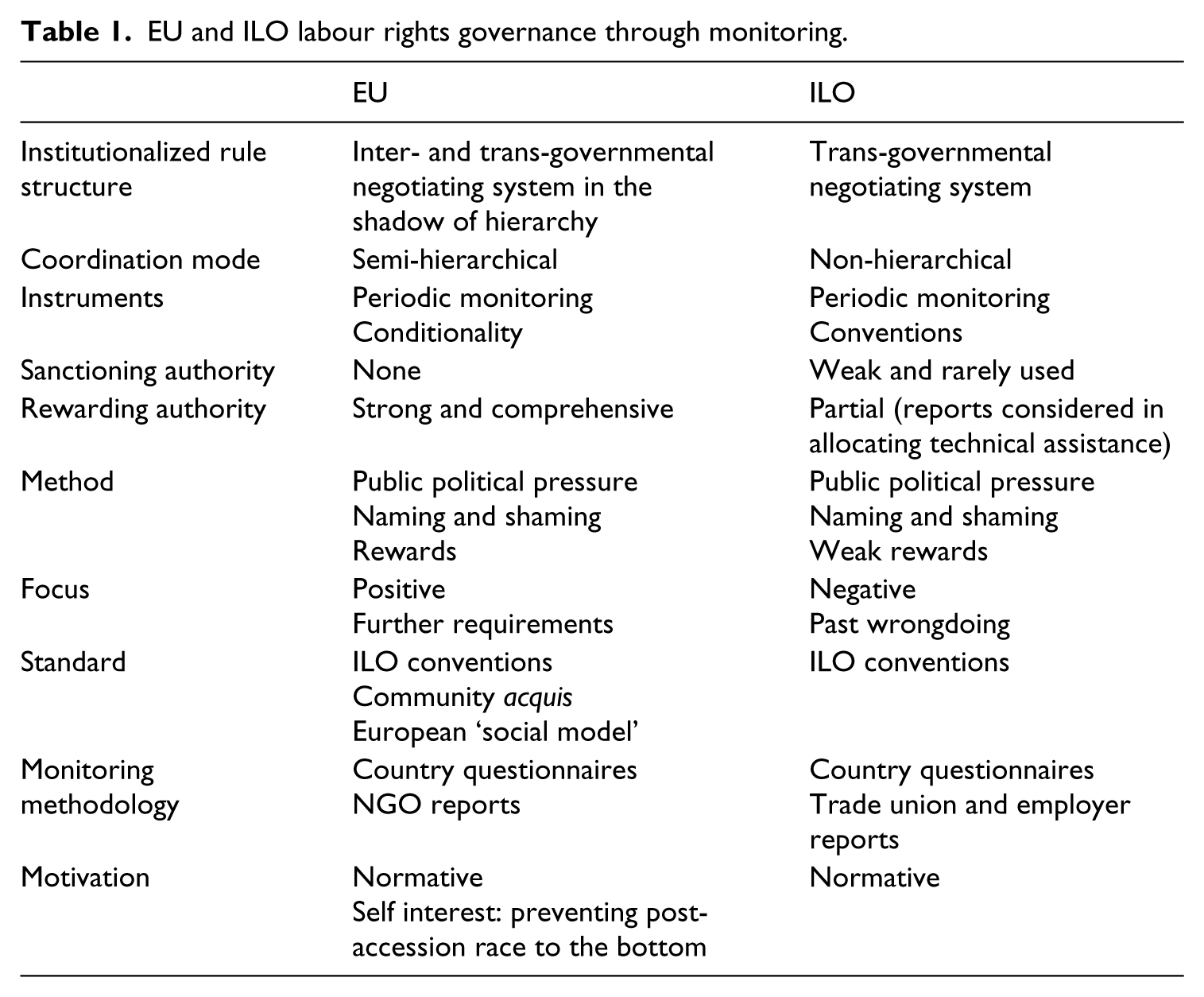
Table 1 summarizes the similarities and differences between the EU and ILO labour rights monitoring schemes as forms of external governance. It shows how conceptualizing monitoring as external governance enables a systematic comparison between the monitoring mechanisms in the two organizations.
EU and ILO labour rights governance through monitoring.
Data and methods
In reviewing the established wisdom regarding the association between the ILO and EU promotion of labour rights and trends in CEE countries, I concluded that there are open questions regarding ILO monitoring. I also concluded that a more refined and dynamic analysis was required of the association between ILO Conventions and EU monitoring of these trends. This forms the basis for the following research hypotheses: H1: The higher the number of ratifications of ILO fundamental Conventions, the higher a country’s labour rights score. H2: The higher the degree of ILO monitoring, the higher the labour rights score. H3: The higher the degree of EU monitoring, the higher the labour rights score.
In order to test these hypotheses a longitudinal labour rights measurement was needed, to capture both legal and practical trends in rights. The CIRI (Cingranelli-Richards) human rights database offers a fine starting point, as this is widely regarded as a rigorous and reliable source of data from 195 countries over a period of 29 years. One of the variables in this database is workers’ rights, measured on a scale of 0 (severe violations) to 2 (full protection). However, the CIRI score emphasizes practices rather than legislation (Cingranelli and Richards, 2010); thus an additional measurement of labour rights legislation was needed. I measured labour rights legislation focusing on trade union freedom, the right to strike and the right to collective bargaining. The level of legal protection for each of these rights was measured on a scale of 0 (absolutely no legal guarantee) to 3 (complete and unrestricted legal guarantee), with a 1 score indicating extensive restriction (sweeping denial of the right in question from whole sectors which do not provide essential services), and a 2 score indicating moderate restrictions (infringement of the right only under specific circumstances). This scale is based on Tajgman and Curtis (2000), who review and rank restrictions on the right to form trade unions, to strike and to bargain collectively. This coding method is similar to previous coding methods (Böhning, 2005; Cuyvers and Van den Bulcke, 2007), but differs in that it separates ratification and implementation of Conventions (since ratification is an independent variable, as explained below). The scale is preferable to a simple binary approach because the severity of restrictions of rights can vary substantially (Kucera, 2007). Information regarding legislation was derived from the US State Department annual human rights reports and the International Confederation of Free Trade Unions (ICFTU) annual reports. These sources (along with ILO reports, which were not used to avoid endogeneity) are considered the most reliable sources of information on labour rights (Kucera, 2007). The information from the two sources was crossed-checked. The information was gathered at the national level, to enable cross-country comparison following the approach of Block and Roberts (2000). This scheme resulted in an 11-point scale of the labour rights situation in each country (the score on each right plus the CIRI score). This represents the dependent variable.
The Normlex database (ILO, 2012) documents ratification of ILO Conventions in each year since 1919. For the purpose of the present analysis I measure the proportion of fundamental Conventions ratified; this ratio is preferable to the absolute number of ratified treaties because one of the Conventions was formulated during the period studied, in 1999.
Next I measured ILO and EU monitoring. Despite evidence of the effect of conditionality, we do not yet know whether the comprehensiveness of monitoring (the number of issues monitored each year) has any effect on candidate countries’ compliance with the accession criteria. According to the theory of external governance, the impact of international organizations is determined by their status as authoritative rule makers (see above). Thus the rigour of the reporting scheme, its ability to identify problematic issues and communicate them to the target countries is an essential determinant of effectiveness. In order to examine whether this was the case, I mapped the collective core labour standard issues in the monitoring reports (European Commission, 2012); counted for each country how many of these potential issues were actually mentioned in each national report, and thus arrived at a measure of the degree of monitoring.
The same strategy was applied to measure ILO monitoring through the annual reports of the CEACR. While we must bear in mind that these reports are different in their scope and aim from those of the EU, these differences of ‘monitoring rationales’ are what make the comparison interesting. This is the reason why the same measurement method was applied to both.
The data were collected on a country-year unit of analysis, in the period from 1998 to 2004. It included the 10 post-communist countries which participated in the EU pre-accession monitoring scheme: Bulgaria, Czech Republic, Estonia, Hungary, Latvia, Lithuania, Poland, Romania, Slovakia and Slovenia, with a total of 49 observations. Subsequent to the collection of data, generalized estimating equation (GEE) was used to estimate the model. GEE was developed specifically for repeated-measurement panel datasets, and, when used with robust standard error is a highly reliable method for such datasets (Zorn, 2001).
Building on previous research, the estimation controlled for national regime type, the number of years elapsed since the beginning of transition and the levels of economic development. Polity scores (Marshal and Jaggers, 2010) were used as an operationalization of regime type; these measure the level of democracy on a scale where -10 denotes pure totalitarianism and 10 pure democracy. Polity was also used to identify the year in which transition began. The United Nations Human Development Index (UN, 2013) was used to control for levels of development.
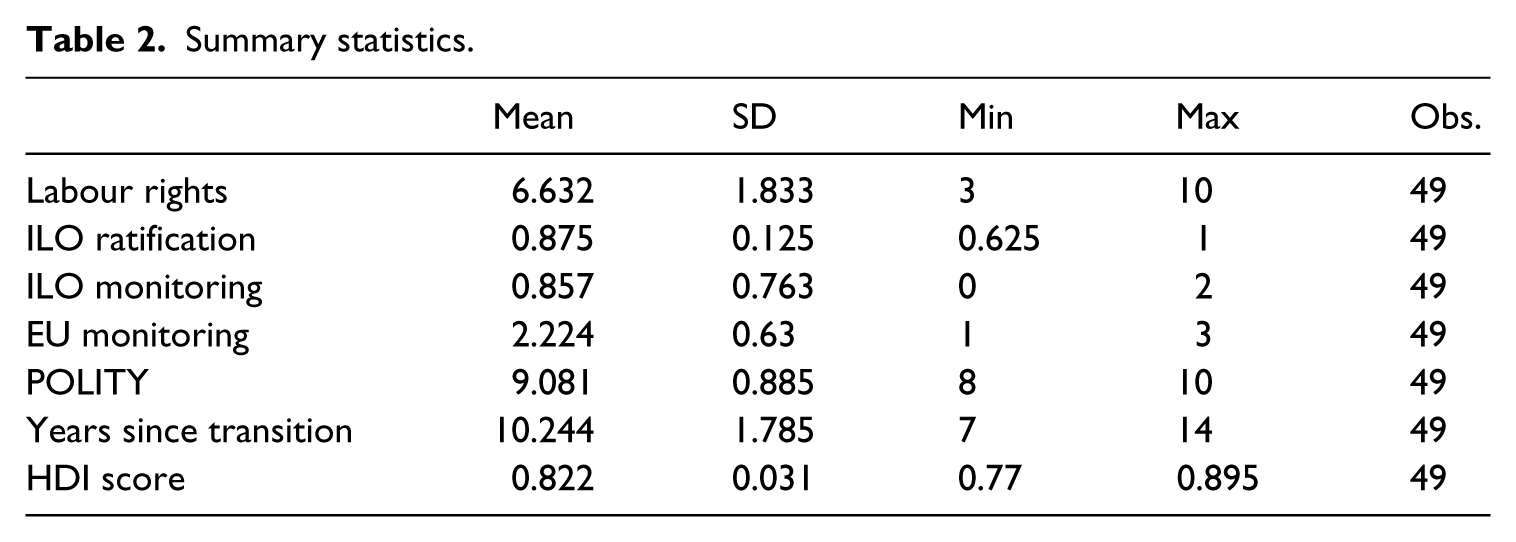
The models were estimated with a two-year time lag between observations of the explanatory variables and those of the dependent variable, since some of the independent variables may themselves be influenced by countries’ labour rights practices (the dependent variable). For example, the degrees of ILO and EU monitoring are probably influenced by a country’s degree of compliance in the year monitored. The time lag breaks this simultaneity cycle. Table 2 contains summary statistics of the variables described above.
Summary statistics.
Identifying labour rights trends in accession countries
The overall trend in the countries studied between 1998 and 2004 is of sustained or improved labour rights protection, though the degree of improvement and its resilience varies across countries. As described below, there were 38 instances of improvement or of continuing full protection of a specific right (a 3 score), as against 10 instances of decline in the protection of a specific right or of non-recognition of a right in the law (0 score).
In Bulgaria the rights to strike and bargain collectively, although recognized by law, were restricted and denied from sectors such as energy and communications. The scores on these rights were therefore 1 for the entire period. Trade unions of some sectors were government-imposed (US Department of State, 2012), resulting in a 1 score on trade union freedom. There was a brief period of anticipated improvement in 2001, following a legislative amendment (ICFTU, 2011: 202) and the score was then improved to 2. However, a year later it became clear that the law did not improve trade union freedom for dentists and doctors, and unions were required by the new law to carry out periodic censuses (US Department of State, 2012). The score was therefore reduced to 1, where it remained for the entire period.
The Czech republic denied the public sector the rights to strike and bargain collectively (US Department of State, 2012), and these restrictions were maintained resulting in a 1 score on both rights for the entire period. These restrictions did not apply to the right to form trade unions and the score on this was 3.
In Estonia a cumbersome trade union registration procedure resulted in a 2 score on trade union freedom; this was amended in 2000, raising the score to 3. However, that same year the reports mentioned a new concern regarding the denial of strike rights for all public sector employees (ICFTU, 2001: 143), which reduced this score to 1.
A Hungarian supreme court ruling in 2000 confirmed employers’ right to hire strike-breakers, under certain conditions, curbing the effectiveness of strikes (ICFTU, 2001: 145); the country’s score was therefore reduced from 3 to 2. Limitations on public sector collective bargaining (US Department of State, 2012) resulted in a 2 score on this right in 1998–2000. However, legislation in 2000 authorized works councils to sign collective agreements, bypassing trade unions (ICFTU, 2001: 145), reducing the score to 1.
In Latvia, strikes required a quorum of votes by law in order to be considered legal; the score was thus 2 for the entire period. Minimum membership levels which exceeded ILO standards were required to establish trade unions (ICFTU, 2011: 211). This resulted in a stable 2 score on this right. Collective bargaining procedures for all workers paid from state budgets were considered hollow, since their employment conditions were determined by the law and the state budget (ICFTU, 2011: 211). This resulted in a 1 score for this right for the entire period.
In Lithuania a law came into force in January 2003 prohibiting the then widespread practice of employers ‘negotiating’ with labour bodies they themselves formed. The new law made trade unions the mandatory partner in managing worker-employer relations (US Department of State, 2012). This improved the trade union freedom score to 3.
Poland was the only country which maintained severe and constant restriction on all three rights for the entire period; the law denied the core rights from sectors providing essential services, broadly defined, and exceeding ILO standards. Thus its scores on all three rights were 1 for the whole period.
In Romania there were excessive requirements for registering trade unions, and the procedures for calling a strike were described as ‘lengthy and cumbersome’ (US Department of State, 2012). This remained unchanged, resulting in a 2 score on both the rights throughout the period. In 2000 new legislation allowed the government to suspend collective agreements in publicly owned companies (ICFTU, 2001: 149), reducing the score on this right from 3 to 2.
In Slovakia a 2001 amendment to the strike law removed many previous restrictions, but the right to strike could still be restricted under ‘exceptional circumstances’ (ICFTU, 2011: 221). Thus the score on this right improved from 1 to 2. The labour code adopted in 2002 finally established the right to collective bargaining, which was not previously recognized by law (ICFTU, 2011: 221), improving the score on this right from 0 to 3.
Slovenia provided adequate protection of both the right to bargain collectively and trade union freedom, and was not mentioned in the ICFTU reviews of rights violations throughout the period. However, public sector employees were denied the right to strike throughout (US Department of State, 2012). Therefore the scores for trade union freedom and collective bargaining were 3 in 1998–2004, and the score for the right to strike was 1.
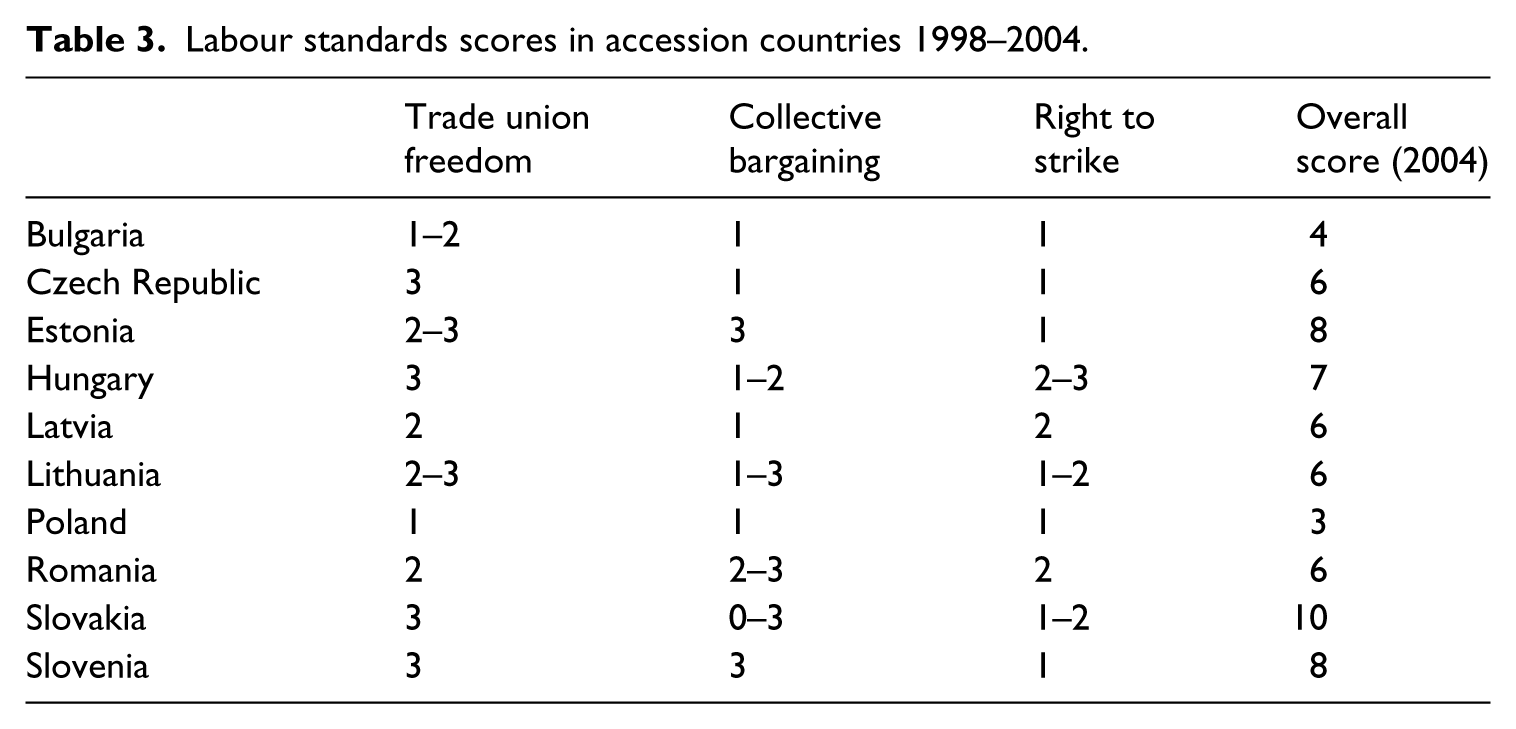
Having described the country-specific trends on each of the three core rights, some less dynamic, yet important findings should also be noted. These include the maintenance of complete, or near-complete, de jure trade union freedom throughout the period in the Czech Republic, Hungary, Slovakia and Slovenia, as well as in Estonia as of 2000 and in Lithuania as of 2002. The right to collective bargaining has remained unrestricted by law in Estonia and Slovenia in the entire studied period and in Slovakia as of 2001. The right to strike is the most commonly restricted, with such restrictions observed in every country-year unit included in the study. However, it is notable that these restrictions have, for the most part, remained static and have not worsened. Table 3 summarizes minimum and maximum scores on each of the rights in each country and the total score in 2004.
Labour standards scores in accession countries 1998–2004.
The CIRI scores for de facto rights were predictably less static, fluctuating in most countries between 2 and 1, except in Slovakia where the score was a stable 2, and in Poland where the score steadily deteriorated to 0 in 2001. I now turn to the analysis to suggest possible explanations for the identified trends.
The results summarized in Table 4 indicate that Hypotheses 1 and 3 were supported by the data: ratification of ILO Conventions and EU monitoring are both positively associated with trends in labour rights scores. A one-unit increase in the proportion of ILO Convention ratifications is associated with a 3.401 unit increase in the labour rights score, holding constant regime type, years since the beginning of transition and development levels, and this finding is highly significant. Likewise, a one-unit increase in the degree of EU monitoring results in a 0.401 unit increase in the labour rights score. However, Hypothesis 2 regarding ILO monitoring was not supported by the data. ILO monitoring is not significantly associated with labour rights scores.
Ratification, monitoring and labour rights.
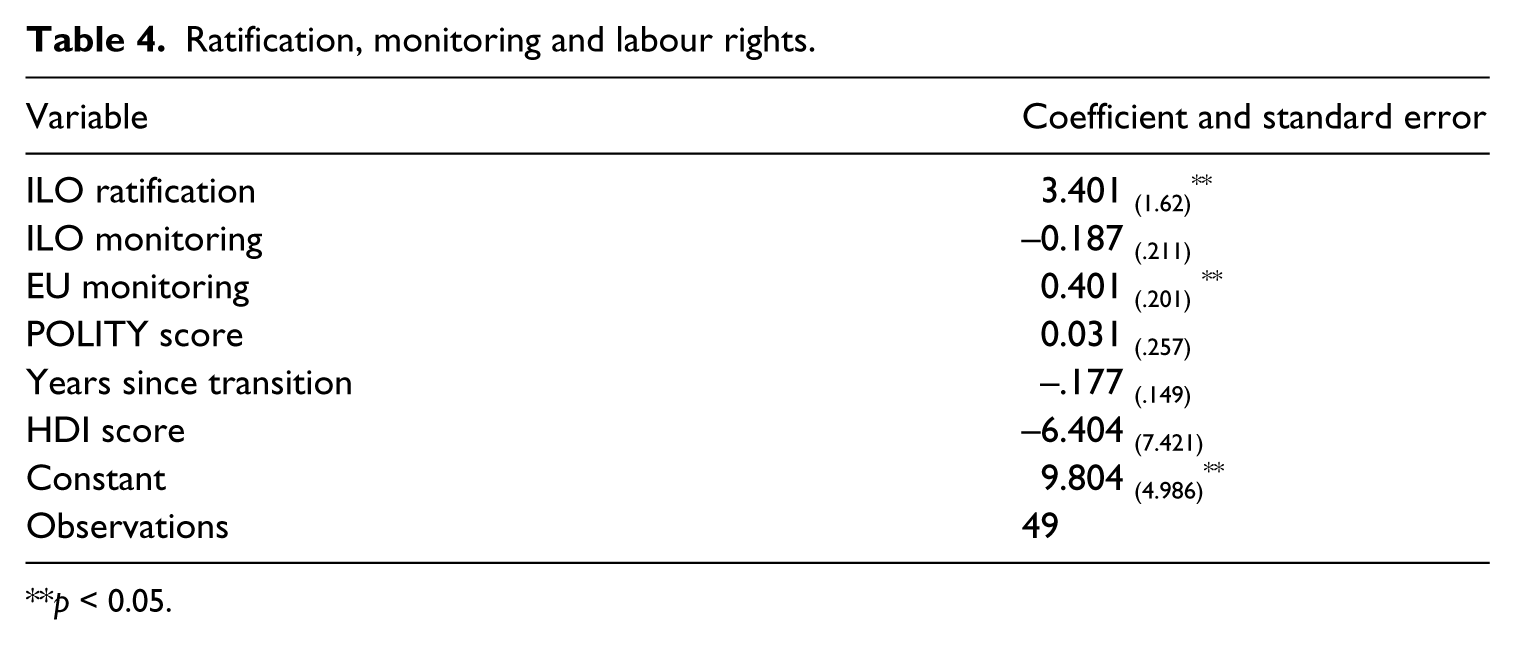
p < 0.05.
Discussion and conclusions
As Table 1 suggested, there are a number of possible reasons for the findings in this study. For example, EU monitoring was strongly linked to rewards, culminating in accession but not limited to this. ILO monitoring by contrast has no sanctions analogous to the instrument of accession conditionality. Though both organizations make decisions regarding the allocation of technical assistance on the basis of their monitoring reports, the role of these reports in shaping decisions is more direct and more clearly stated in the case of the EU. The more explicit standards guiding EU monitoring, and the externalization of its internal methods of action (OMC, comitology, social dialogue) may also help explain the stronger link to subsequent trends. EU monitoring (like that of the ILO itself) is guided by ILO Conventions, but also by its distinctive acquis and social model; this may have enabled better adapted monitoring. In addition the EU relies on NGOs for information while the ILO does not; these may have constituted more efficient and reliable sources of information. Indeed some studies of the ILO monitoring scheme have suggested that stronger cooperation with NGOs would increase its effectiveness (Moran, 2002). Related to this is the highly politicized nature of the ILO monitoring scheme: countries sometimes act to block the CEACR from criticizing their labour policies (Elliot and Freeman, 2003). This may have undermined the linkage between the contents of ILO reports and subsequent labour rights practices in target countries. These are all tenable reasons which are captured by the interpretation of monitoring as a form of external governance which exports systematized internal rules.
Another significant finding is the positive association between ILO Convention ratification and labour rights scores in CEE. This empirically corroborates the presupposition of global governance research, that the ILO role as norm entrepreneur supported the EU work in the promotion of labour rights in the accession countries (Alston, 2005; Novitz, 2009; Orbie and Kerremans, 2009; Vaughan-Whitehead, 2003; Visskirchen, 2005). This resulted, among other factors, from sociological and normative European identity of the ILO, which embodies a European view of welfare capitalism. Tripartism, which is arguably the guiding principle of the ILO, is a European tradition (Standing, 2008). Furthermore, European countries have been found to be more likely to ratify its Conventions, and have exhibited a stronger tendency to comply, than other Western countries (Biffl and Isaac, 2005). In addition the reservation of senior posts in the ILO for representatives from the most industrialized countries also contributes to this Western European identity (Strang and Chang, 1993).
EU-ILO cooperation and its apparent contribution to the adoption labour rights norms supports previous research on the contribution of Conventions to norm advocacy. The findings presented here also strengthen the argument that international norm adoption is associated with countries’ ties with international society, and particularly with their membership in international organizations. To conclude, the findings presented in this article bear promising implications as to the cooperation between international organizations in norm dissemination through external governance. It provides empirical support for the argument that international organizations can compensate for each others’ weaknesses and combine their efforts to promote common norms.
Footnotes
Funding
The research towards this article was partially funded by a grant from the Open University of Israel’s Research Authority, grant number 47335.