




Abstract
This article distinguishes between two logics of union renewal: accommodation and transformation. It examines the functioning and potential of these logics in two industrial unions in Germany and Canada, exploring factors that influence decisions to give priority to one renewal logic. The findings suggest that the two logics can coexist, and that unions are able to alternate between them. Of particular relevance in comparative perspective are some similarities and differences in the renewal processes and strategies pursued by the two unions.
Keywords
Introduction
The growing body of literature on union renewal (or revitalization) mainly focuses on strategies at the national level rather than the approaches of individual unions. There is also ambiguity on the very definition of union renewal and its underlying logic. What is union renewal? What drives unions to embrace the goal of renewal? Is there a unique logic of union renewal in any given context; or if there are alternative logics, which factors influence a union’s adoption of a specific approach? This article attempts to contribute to the union renewal literature by engaging with these questions.
In doing so, I posit three hypotheses.
H1: In any union, two logics of renewal, accommodation and transformation, coexist precariously. The dominance of one logic does not preclude the existence of the other. H2: The coexistence of two logics of union renewal suggests that unions are capable of alternating between them. H3: While structural changes and national institutional arrangements influence the adoption of a particular logic of union renewal, trade union actors, particularly leaders, also influence the processes, direction and strategy of renewal.
To address these hypotheses, I present two case studies of the renewal processes and strategies of two industrial unions in different political economies.
The article is organized into four sections. First, I provide a reconceptualization of union renewal, the theoretical bases of the two logics and the methodology used. Then I present the two case studies, involving IG Metall in Germany and the Canadian Auto Workers (CAW, which in August 2013 merged with the Communications, Energy and Paperworkers Union to form Unifor). I go on to identify the institutional change processes and outcomes related to union renewal. Finally, I relate the case studies to the three hypotheses.
Union renewal: Definition and logics
There are many definitions of union renewal. For Frege and Kelly (2003: 9), it involves ‘a variety of attempts to tackle and potentially reverse’ problems facing union movements. These attempts include organizing, restructuring, coalition-building (with social movements), partnership with employers, political action and international links. Along with other authors (Hyman, 1999; Ross, 2008; Turner, 2005; Voss and Sherman, 2000; Waterman, 1997), Frege and Kelly emphasize a social movement (unionism) model. For some authors, union renewal is about member activism and internal union democracy (Bronfenbrenner and Juravich, 1998; Fairbrother, 2005; Ross, 2008; Voss and Sherman, 2000), representation beyond the traditional union membership base (Haiven, 2006; Wever, 1998), or organizational change and institutional vitality (Behrens et al., 2004; Orfald, 2006).
(Re)Defining union renewal
Building on these approaches, I define union renewal as a gradual, continuing and purposive process of maintaining, re-establishing, rebuilding and reconfiguring the institutional and organizational sources of union power and strength in a changing environment. This suggests that renewal involves union actors in constant experimentation and learning with framing processes, organizing, bargaining, membership activation, mobilization, building support networks outside the union, political action and other spheres of activity. This definition also ascribes an institutional dimension to union renewal.
I make three underlying assumptions. First, renewal involves defending and maintaining the institutional and organizational sources of union power and strength, which are under attack. This may mean attempting to regain or reinforce institutional and organizational anchors of power and influence that are under threat of erosion. Second, renewal also means reconfiguring and transforming the institutional and organizational sources of union power and strength. This likewise suggests that renewal may require changes in existing institutions and organizational arrangements and relations within and outside the union. Finally, the proposed definition implies institutional change within and outside the organization.
The two logics of union renewal
As the varieties of capitalism (VoC) approach (Hall and Soskice, 2001) suggests, different political economies lead to different industrial relations systems which, in turn, influence various facets of union activity. Hence they are likely to shape the objectives and strategies of renewal pursued by unions, encouraging different logics of renewal.
In coordinated market economies (CMEs), unions are integral to the functioning of institutional non-market coordination (incomes policy, social pacts) and deeply integrated and assimilated into the political-economic system. Union renewal strategies are thus unlikely to challenge existing relations, but rather aim to maintain existing institutional anchors of strength if under attack. Hall and Soskice (2001) argue that the impact of globalization in CMEs may encourage cross-class coalitions rather than class conflict. This suggests that responses to union decline are likely to centre on ‘accommodation’.
In liberal market economies (LMEs), by contrast, workers and trade unions are directly exposed to the vicissitudes of the market. Labour markets are flexible, and employers can easily lay off workers in the event of economic shocks (Hall and Soskice, 2001: 16). Because of the importance of market competition, business interests are likely to pressure governments for deregulation. This tilts the power toward employers and weakens organized labour. Trade unions in LMEs do not wield the degree of economic and political power as their counterparts in CMEs; unions are less cohesive and encompassing, and collective bargaining tends to occur at enterprise level if at all. This hostile environment tends to push unions to take on a more militant, activist (and social movement) approach to renewal. In some cases, this involves challenges to existing institutional arrangements that undermine union strength and influence. This suggests that responses to union decline are likely to be ‘transformative’.
Offe and Wiesenthal emphasize that labour organizations are always a ‘mixed case’ of monological and dialogical logics. The former entails bureaucratic and individualistic forms of activity; the latter, a common and collective concept of workers’ interests and the pursuit of united action among the membership. According to these authors, the precarious coexistence of these two logics of collective action ‘leads to an ongoing contradiction between bureaucracy and internal democracy, aggregation of individual interests and formation of a collective identity’ (1980: 97–98).
Similarly, I suggest that there are two contending logics of union renewal, of accommodation and of transformation, which coexist in any union. While a given institutional regime or context may impose a dominant logic of union renewal, the other typically exists in subordinate form. The precarious coexistence of these two logics means that incoherence rather than coherence often defines a union’s renewal strategy. Moreover, unions are quite capable of operating simultaneously in institutional contexts governed by different logics, oscillating between them depending on prevailing circumstances. This suggests that the interaction between these two logics is fluid rather than fixed.
What are the distinguishing characteristics of these logics? The logic of accommodation is deeply embedded and constrained by the external environment of a union. It seeks short-term solutions to problems confronting unions (such as declining membership and influence) within existing economic and social relations, and often involves ‘fire-fighting’ mechanisms. This logic implies measures that mainly defend the existing institutional sources of union influence and power (centralized bargaining, works councils or political party linkages). They do not challenge or seek to alter the dominant social and power relations. Unions pursuing this logic have been said to root their actions in the ‘complete fulfilment of actually existing unionism . . . They are not critical, in the sense of not applying a critique of the dominant social order to the unions or networks that they are describing – and promoting’ (Waterman, 2004: 224). Unions following this logic may indeed utilize other strategies beyond the traditional repertoire to enhance their strategic leverage or organizational capacity (coalition-building with other social movements, strategic partnership with employers) but without altering substantially their identity and organizational structures. They avoid militant and confrontational tactics and instead prefer collaborative relations with employers and the state.
On the other hand, the logic of transformation seeks to challenge existing institutional regimes or the dominant political economy. It is both militant and radical, as it seeks to address the roots of the crisis of trade unionism. Likewise, the logic of transformation seeks to ‘build democracy by mobilizing the workers themselves to challenge directly authority and hierarchy at work’ (Friedman, 2009: 142). Several authors associate the transformative aspect of union renewal with social movement unionism. For Waterman (2004: 249), this surpasses existing models of economic, political or political-economic unionism ‘by addressing itself to all forms of work, by taking on socio-cultural forms, and addressing itself to civil society’. The increased use of a social movement repertoire in organizing campaigns and political actions, particularly in LMEs, has been highlighted by numerous studies (Frege and Kelly, 2003; Turner, 2006; Waterman, 2004; Wever, 1998). Methods include the combination of bargaining with political action, community-based organizing, deepening membership involvement and participation in union activities and in decision-making and militant tactics.
Factors influencing the choice of renewal logic
There are exogenous and endogenous variables that influence decisions on which logic of union renewal to embrace, as Figure 1 shows. Here I focus on three: the politico-economic environment, the industrial relations context (including employer attitudes) and support from labour-oriented political parties and social movements. The endogenous variables include union identity, scope of representation, structures for membership involvement and internal democracy bargaining strategies and the role of union leadership in change processes. Schmitter and Streeck (1999) distinguish between a logic of membership and a logic of influence in interest associations. I develop a parallel analysis as regards the variables that affect the two logics of union renewal. Arguably, the logic of membership approximates the endogenous variables enumerated above; while the logic of influence corresponds to the exogenous variables.
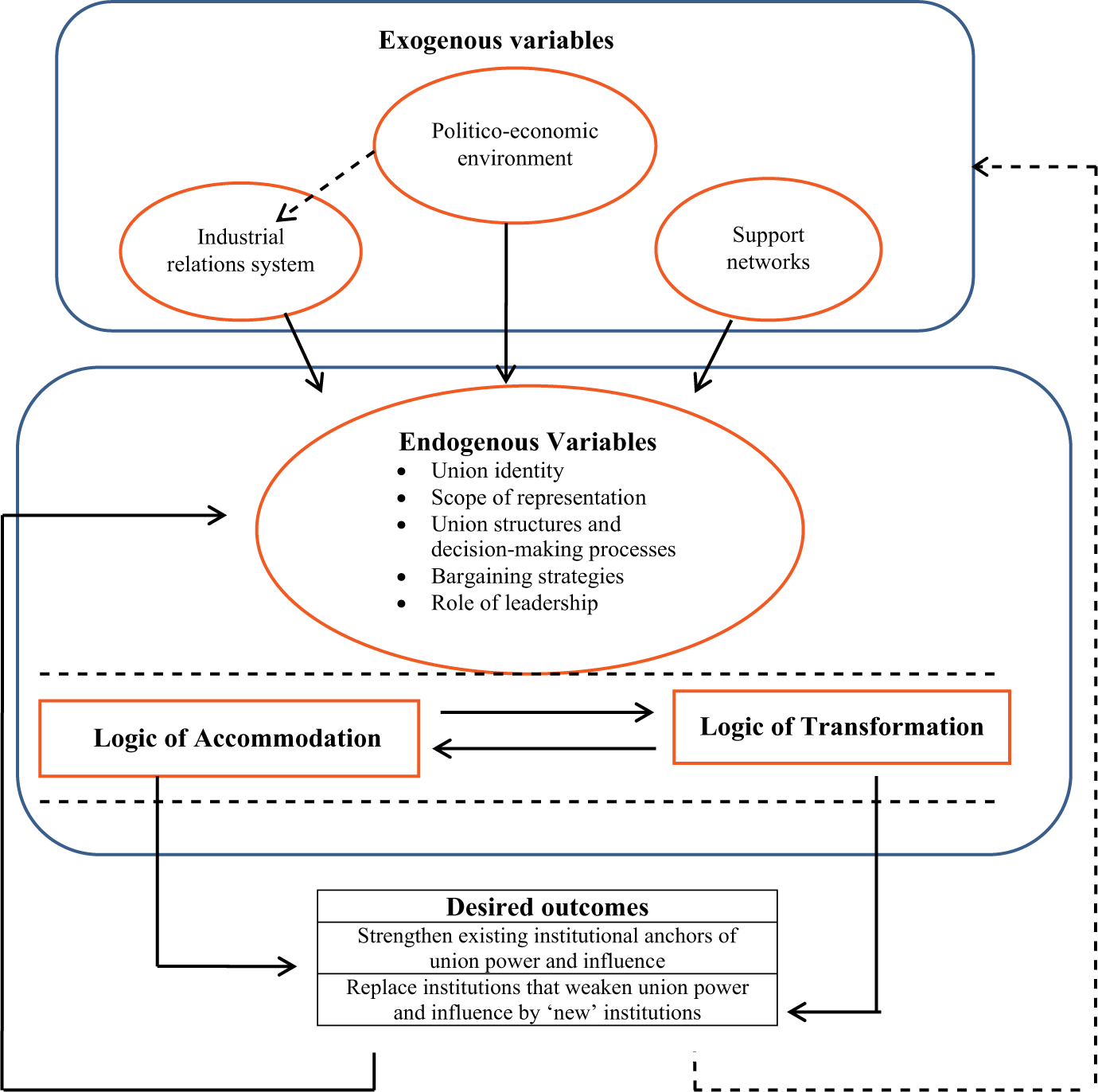
Analytical framework.
Change processes may be either abrupt or incremental and either exogenously or endogenously generated. As Streeck and Thelen (2005) note, even incremental processes of change which appear to support institutional continuity may cause gradual transformations that over time add up to major institutional discontinuities. The logic of accommodation aims at gradual changes in any (not necessarily all) of the internal variables mentioned above. A change in one element does not always necessitate corresponding changes in all the others. In contrast, the logic of transformation necessitates changes in all the internal variables, as within this logic of union renewal they are considered interdependent: changing one variable necessitates concomitant changes in all the others. For example, enlarging the sphere of union representation to include atypical workers would necessarily involve the redefinition of trade union purpose and identity (a shift to social movement unionism). Reorganizing union structures, enhancing capacities to represent and service the new members and modifying decision-making processes must also follow, to provide space and voice for this type of worker. Concomitantly, the union’s framing and legitimization processes and mobilization actions need to involve these workers. The interdependence of these internal variables distinguishes the logic of transformation as a union renewal project.
Relating outcomes to institutional change lends to a more concrete description and accounting of the consequences of a specific logic of union renewal. The desired outcome of the logic of accommodation is continuity of the existing institutional sources of union strength and influence by adapting to and reconfiguring institutional changes. Conversely, the desired outcome of the logic of transformation is discontinuity of institutions that weaken union power and influence (such as enterprise-based unionism and bargaining or legislation that limits the right to organize and bargain collectively) and the creation of ‘new’ institutions that strengthen union power and influence (such as pattern, coordinated or sectoral bargaining or legislation that facilitates union organization in establishments).
The desired effects of each logic, if realized, will influence on some of the endogenous variables, since certain union structures, processes and strategies may have to be changed to sustain the outcomes. The desired outcomes may likewise affect the exogenous variables. For example, if unions are able to implement pattern bargaining with some of the major players in an industry where enterprise bargaining is the norm, this may lead to a reconfiguration of some aspects of the industrial relations system.
In describing the categories of processes of change involved in the two logics of union renewal, I utilize the five broad types of gradual transformative change suggested by Streeck and Thelen (2005: 31): displacement, layering, drift, conversion and exhaustion. These are relevant to the analysis of renewal strategies and processes aimed at defending and taking back institutions as well as fighting back or changing institutions. In examining how the two logics of union renewal are expressed and how they operate within various spheres of union activity, I focus on changes in the five union endogenous variables outlined in Figure 1.
Research design and methods
To examine the potential and functioning of the two logics of union renewal in different political economies, I undertook comparative qualitative case studies of IG Metall in Germany and the CAW in Canada. Germany is often considered the exemplar of a CME, while Canada represents an LME. IG Metall, with 2.2 million members, is the largest German trade union while CAW was the largest private sector union in Canada even before its merger, with some 250,000 members. The research focused on the automobile industry, which in recent years has experienced massive restructuring with increased insecurity and job losses. It is against this backdrop that both unions formally embarked on renewal projects.
Field research was undertaken from March to August 2010 in Canada, and September 2010 to October 2011 in Germany. This involved, first, gathering and analysing documents such as annual and congress reports, internal memoranda, collective agreements, executive meeting reports, union journals and press releases. Second, I conducted 21 taped interviews with union officials, representatives and members. I used these sources to compare and contrast how union renewal in each union has been expressed in terms of union identity articulation, structures for membership involvement and internal democracy, scope of representation, bargaining strategies and the role of union leadership in change processes. Using elements of the two logics of union renewal identified above, I explored which had more salience in the various dimensions of renewal pursued by the two unions. My initial assumption was that union renewal in IG Metall would involve a logic of accommodation and in CAW a logic of transformation. The following section provides the key results of the case studies.
Union renewal in IG Metall and CAW: A comparative analysis
Despite their contrasting political economies, a neoliberal trajectory is a common trend in industrial relations in both Germany and Canada (Bacarro and Howell, 2011). Unions in both countries have been seriously affected by the restructuring of the global automotive industry and the neoliberal policies pursued (albeit to varying degrees) by their governments, throwing both IG Metall and the CAW on the defensive. Both have lost membership over a considerable period (although for the first time in 20 years, IG Metall achieved an increase in 2011), with a loss of membership morale. The welfare state in both countries has been the subject of retrenchment, and labour market reforms have threatened job security, union security and worker solidarity. Many of these reforms undermine the institutional anchors of union power and influence. In Germany, for example, Greer (2008) observes a growing trend of vertical disintegration of corporate structures in the motor industry, mainly through the establishment of new subsidiaries and joint ventures, outsourcing and the use of temporary agency work. Focusing on the latter, Holst (2013: 14) argues that vertical disintegration ‘serves as a powerful control mechanism subjugating collective bargaining and workplace co-determination, as well as firms’ labour law utilization to the economic calculations of individual firms’.
In the case of IG Metall, while employers continue to press for wage moderation, flexible working hours, decentralization of bargaining and reforms of pensions and the welfare state, the 2008 financial crisis demonstrated their willingness to cooperate and coordinate with trade unions and the government. Social dialogue and social partnership remain intact. Moreover, the active role played by the German government in ‘tempering’ adjustment strategies during the crisis (such as subsidies for short-time working), involving accommodation with trade unions and employers’ organizations alike, demonstrates the continuing importance of non-market coordination in Germany.
The CAW, by contrast, has faced the intensification of employer resistance and union avoidance. Such employer antagonism is typical of LMEs like Canada where, from the late 1980s and in particular under a Conservative government, anti-labour legislation has facilitated union avoidance by employers.
Framing union renewal
For both unions, renewal was both a survival strategy and an intentional change process. For IG Metall, renewal meant addressing union decline and revitalizing the union organization. This was done by involving existing members in union activities, particularly in company-level bargaining and in membership recruitment. Renewal also meant revitalizing the union organization and activating the membership to become a force in society, capable of ‘shaping political development in order to achieve fair working and living conditions’. For the CAW, renewal meant arresting membership decline and building the union in the context of a changing environment. It meant continuously challenging the union with new ideas and new ways of doing things. It also meant strengthening its commitment to social unionism by being sensitive to broader concerns, building coalitions with communities and supporting them in fighting for social issues and getting involved in politics (for example, campaigning for pensions and public health care).
It is notable that both unions embarked on some form of ‘self-critique’ and direction-setting initiatives as the first step towards reversing decline. These initiatives involved debating the future direction of the union and the changes necessary to attain desired outcomes. More importantly, this served as a channel for membership involvement and participation in building a renewal strategy. IG Metall embarked on a Zukunftsdebatte (debate on the future) between 2000 and 2003. This involved a survey covering 120,000 members and non-members, and an active dialogue, within and outside the union, on the future of unions, the economy and society in general. This debate, considered unprecedented and innovative in the German context, showed the union’s openness to new ideas and to more inclusive and democratic debate and consultation. In 2007, the reform-oriented Berthold Huber and Detlef Wetzel, the architect of organizing success in Nordrhein-Westfalen (NRW), were elected president and vice-president of IG Metall; they restructured the head office and re-assigned to districts and localities. In 2009, the leadership issued a discussion paper, Sich ändern, um erfolgreich zu sein (‘Change to Achieve Success’), which adapted many of the features of the US organizing model and identified key dimensions for a successful turnaround strategy: strengthened membership participation, more resources for recruitment and more effective services for members.
Along similar lines, the CAW convened task forces in 1993–1994 and 1999–2000 that privileged participatory consultative schemes. In particular, the task force on working-class politics in 1999–2000 involved a series of focus group discussions with members and officials, and a survey of 5000 members on their political views, asking what kind of politics union members would want to become involved in.
Emphasis on organizing
As part of its organizing strategy, IG Metall has focused on recruitment in selected sectors where union density is very low, such as renewable energy, temporary agency work and among young workers. There are several ‘new’ elements in its organizing approach: having dedicated organizing teams, coordinated actions, rank-and-file involvement in negotiations and organizing and the joint organizing efforts between works councillors and members. The new organizing involves rank-and-file members in active recruitment at their plant or company, using many of the tactics employed by unions in the USA and Canada (building rank-and-file organizing teams, home visits, focused recruitment campaigns, conversations with non-members within or outside the workplace, leaflets on company notice boards, distribution of union material). This marked shift to a more activist and grassroots-oriented organizing strategy as the centrepiece of a renewal strategy is ostensibly an example of the logic of transformation. It is transformational because it has the long-term potential to remedy union bureaucratization, organizational inertia and membership passivity.
It is to be noted that since the 1990s there has been a trend in Germany towards the decentralization of collective bargaining and declining coverage of agreements. This trend is underscored by the spread of ‘opening clauses’ (Öffnungklauseln) which permit derogation from sectoral agreements. The works council surveys undertaken by the Wirtschafts- und Sozialwissenschaftliches Institut (Institute of Economic and Social Research) of the Hans-Böckler-Stiftung noted a massive rise in the number of establishments with 20 or more employees that utilized such clauses: from 22 percent in 1999–2000 (Schulten, 2001) to 75 percent in 2004–2005 (Dribbusch, 2005). At the same time, there is also declining coverage of works councils: in 2006, some 13 percent of private establishments, covering about 51 percent of all employees had a works council (Hans-Böckler-Stiftung, 2011) but by 2011 this dropped to about 10 percent of firms, covering 44 percent of employees (EIROnline, 2013). This decline has serious implications for union membership, since councils serve as an entry point for unions in organizing smaller workplaces. Behrens (2009: 282) stresses that works councils undertake the bulk of membership recruitment on behalf of unions; in 2004–2005 about 48 percent reported that they were active in the recruitment of union members. Works council presence rises with firm size, and recruitment activities were highest (85%) in establishments with more than 2000 employees and lowest (32%) in those with 50–99 employees. Meanwhile, employers’ associations, themselves faced by declining membership, have introduced and expanded structures to represent the interests of companies that choose not to be covered by collective agreements. According to IG Metall (2009), all regional employers’ associations in the automotive and metal industry have established such structures.
In short, IG Metall has faced a gradual erosion of its external institutional anchors of power and influence. For this reason, regaining and strengthening its internal sources of power – a motivated membership, solidarity and ‘willingness to act’ – becomes the natural logic. Nonetheless, the logic of transformation is visible only in respect of organizing to maintain or increase membership density and, in parallel, trigger institutional vitality. In the other dimensions of union activity (collective bargaining, political influence), the focus is still on coordination, social partnership and social dialogue, where the logic of accommodation appears to predominate. As IG Metall is arguably still structurally embedded in the German corporatist framework, the logic of accommodation acquires greater salience. Indeed, the 2001 Zukunftsdebatte survey found out that 82 percent of members saw the importance of the government, employers’ associations and trade unions working together. Commitment to cooperation among the social partners was doubtless reinforced by Germany’s success in averting massive job losses during the 2008–2009 financial crisis.
The CAW organizing strategy was both enterprise- and community-based. It involved a team of organizers comprising members of a rank-and-file organizing committee, staff officials and volunteer community-based organizers. Members or potential members were directly involved in organizing, not only to recruit new members, but as a way of developing activism among existing members. There was an additional emphasis on movement-building, on creating coalitions with community organizations and social movements, given the fact that CAW was not a large and encompassing union (organizing and collective bargaining are predominantly enterprise-based). Moreover, CAW had historically been built on the model of social unionism – one reason why it broke away from the US-based United Auto Workers (UAW) in 1985. Also, there are many militant and anti-capitalist community-based organizations and social movements in Canada that advocate and fight for labour rights. Mobilizing support from these external resources of strength was thus vital to CAW’s renewal.
To sustain organizing, both IG Metall and CAW developed specific schemes to fund their initiatives. Since 2012, IG Metall has earmarked an investment fund of €20 million annually to fund organizing initiatives undertaken by its districts and local offices. CAW had a cost-sharing scheme for new organizing, whereby a local union provided organizers and shared half the cost of the project with the national union. IG Metall provides the more substantial resources for new organizing. This is understandable because it has huge resources, and its recent organizational restructuring has generated savings that are now reallocated to organizing.
Union restructuring and new union structures of representation
One expression of renewal in IG Metall in recent years was the reorganization of its headquarters in 2009, cutting national office staff by a third and redeploying staff to districts and localities where union activity and organizing take place. To institutionalize an adapted version of the Anglo-American organizing model, IG Metall created a membership development and campaigns department and within it the strategic organizing division which develops a strategic organizing plan, trains organizers and coordinates initiatives in all districts and localities.
IG Metall membership is relatively homogeneous, comprising workers from the automotive and metalworking sector, iron and steel, electronics, information technology, textiles and garments and wood and plastics. More than half (1.4 million) come from the metalworking and automotive sector. There are specific structures that serve as venues for specific types of non-traditional workers (youth, women, workers in the renewable energy sector, retired workers). Moreover, the campaign to intensify organizing will eventually necessitate the creation of new structures of representation, particularly for temporary agency workers. Already, there are signs that point to this direction. The intensive organizing drive in the wind turbine (renewable energy) sector, for example, is spearheaded by the strategic organizing division.
Regalia (2008) identifies four types of union attitude on representing non-traditional types of worker. The first is indifference, ignoring or underestimating the difference between the interests of such workers and those of traditional core workers. The second is opposition and resistance, exhibited by unions which are well aware of the different interests of such workers but refuse to represent them, perhaps because they fear that these informal and atypical workers constitute a threat because they may compete unfairly against existing members. Instead they seek restrictive legislation to limit the entry of such workers to the labour market. The third attitude, imitative extension of protection, prevails when a union seeks to extend to these workers the same standards and protections enjoyed by core workers; unions endeavour to expand their capacity for representation while underestimating the diversity of the interests at stake. The fourth attitude, specialization of protection and reconfiguration of representation, seeks new solutions to the problems of representation through experimentation; the union appreciate the diversity of workers’ interests and is willing to change its representation model.
In these terms, IG Metall may be moving towards ‘specialization of protection’ and ‘reconfiguration of representation’. As regards temporary agency workers, it represents their interests mainly through forging collective agreements with employers’ associations in the sector. These agreements, to date, have put wages on a par with workers on regular contracts.
The CAW had experimented with new local structures that take better account of the changing nature of the workplace; an example was the creation of ‘union in politics’ committees (UPCs) and youth committees in every local. The union shifted to a general union model after its split from UAW in response to structural shifts and labour market changes in the Canadian economy. As a result, CAW covered 18 different sectors, but mostly from services. This heterogeneity naturally posed a continuing challenge to the union to innovate its representation models. It set up sectoral councils to represent the distinct interests and demands of the various sectors it covered, as venues to debate and map out industry-specific strategies and develop political activities and campaigns. These structures provided a sectoral focus for the union’s organizing work.
All CAW local unions had permanent structures for special groups of workers, such as women’s committees and youth committees. In addition, the UPCs involved members in various political and community activities. Where a retirees’ chapter existed, retired members were entitled to a seat on local executive boards. Local unions also convened monthly membership meetings.
Applying Regalia’s typology, CAW’s organizing strategy and the variety of structures it established, as well as processes of interest identification and aggregation it tried to reconfigure, indicated its willingness to innovate and experiment on new forms of representation. In this respect, ‘specialization of protection’ and ‘reconfiguration of representation’ describes CAW’s representational model. Two factors may have pushed CAW to embrace this model: being a general union that espouses social (movement) unionism and the highly heterogeneous nature of its membership base.
Repertoires of action
IG Metall’s renewal strategy remains pragmatic, combining institutional renewal (for example, unionizing works councils to undertake membership recruitment) with membership activism. While it remains steadfast on its commitment to coordination and accommodation, it has in recent years been focusing on a member-centred organizing strategy akin to the Anglo-American model, and engaging in various campaigns (‘equal pay for equal work’ for temporary agency workers, the minimum wage campaign, its campaign to stop the increase of the pension age from 65 to 67). Moreover, it attempts to generalize throughout the union the NRW organizing strategy, where rank-and-file members are involved in firm-level bargaining, directly voting for or against bargaining proposals from both the union and management, and mobilizing protest actions when needed. In this regard, both logics of renewal are evident in its repertoires of action.
The CAW renewal strategy was framed along the revival of the social movement dimensions of unionism. As such, a number of its strategies were militant in nature. Its social movement repertoire involved actions beyond collective bargaining: leading campaigns on public health care and protection of public services, pensions, employment and pay equity, minimum wages, human rights and employment standards; campaigning against free trade and US–Canada military interventions; campaigning to free political prisoners and labour leaders from all over the world; organizing in communities; undertaking community work (providing material and human resources to women’s shelters, donating and participating in running food banks); building stronger links with community organizations and social movements; sending ‘flying squads’ to strikes and pickets; ‘brief’ plant occupations; organizing and participating in mass protests and mobilizations (as at the G20/G8 summit in June 2010); and participating in electoral politics (e.g. supporting labour-friendly candidates, leafleting, door-to-door campaigning).
Shifts in bargaining logic
While strongly committed to the principle of sectoral collective bargaining, IG Metall has become increasingly engaged in enterprise-level bargaining. Restructuring in the automotive industry and increasing demand for flexibility from employers have increased the importance of the company level as an arena of regulation and representation, meaning that the union must strengthen its power resources at the plant and company level. This calls for the local embedding of collective skills and solidarity among shop-floor members. It was against this backdrop that the NRW initiative developed a bargaining strategy with three components: membership involvement in bargaining, a focus on raising product quality and productivity (besser statt billiger) and membership growth. IG Metall now tries to generalize this three-pronged member-centred offensive strategy throughout the organization. This approach involves elected workforce committees of rank-and-file members in negotiations at the firm level. Members are asked whether to accept or reject ‘opening clauses’ or deviations from a sectoral collective agreement. By combining worker participation, aggressive negotiations, job preservation and new training opportunities in this new bargaining approach, the union aims to secure and strengthen membership loyalty.
While IG Metall has developed strategies to come to terms with the decentralization of collective bargaining, the CAW had been pursuing master or pattern bargaining in the automotive and health sectors, to take wages and working conditions out of competition. By focusing on democracy, wage solidarity, generational solidarity, opposition to two-tier wages and opposition to concessions, it embraced a bargaining philosophy and strategy which followed the logic of transformation. However, since the turn of the century its anti-concession philosophy had been undermined by a series of concession bargains, particularly in the wake of the financial crisis. Many critics predicted the demise of union militancy and the transformational vision of the CAW. However, although its bargaining logic appeared to be predominantly oriented towards accommodation, this was mediated by militant political initiatives to strengthen bargaining power. As the CAW espoused social unionism, bargaining was complemented by political action in the form of plant occupations, mobilization of community support and campaigns for legislation strengthening workers’ rights.
Role of leadership in union renewal
In IG Metall, embracing union renewal as intentional change visibly came from the top leadership. Its commitment to new organizing, expressed in the creation of new union structures and the investment of massive resources, may have accounted for the widespread acceptance by union functionaries of the implementation of change-oriented processes. As noted, the new approach brought an increase in membership after two decades of decline.
In the CAW, renewal was also clearly articulated by the union leadership. However, the leadership was less visibly linked to the renewal processes. Indeed, the idea of convening the task forces in the 1990s and early 2000s did not come from the leadership but from among the socialist activists who were part of the headquarters staff. The fact that the creation of UPCs was not accompanied by the allocation of resources (both human and monetary) implies ambivalence on the part of the leadership, despite the apparent commitment to union renewal articulated at the 2003 and 2009 conventions. This ambivalence may in part account for the limited gains achieved by renewal initiative.
Institutional change processes and outcomes
In terms of the Streeck and Thelen (2005) typology of institutional change, in the case of IG Metall there was a process of conversion in the institutional function of works councils in terms of membership recruitment. The rise of a ‘new’ organizing approach, coupled with the establishment of new structures of organizing within the union and the allocation of an organizing fund, represents a process of layering traditional practices of organizing, also apparent in the new approach to firm-level bargaining.
Union renewal in the CAW involved all five forms of institutional change. The union’s shift from an industrial to a general type of union can be viewed as exhaustion (the gradual breakdown of the industrial unionism over time). Layering was reflected in such initiatives as complementing full-time staff organizers with rank-and-file organizers and community-based volunteers, the shift to pattern and coordinated bargaining, and engaging in new forms of political action coordinated by UPCs. The increased salience accorded to rank-and-file organizing (‘organizing local’) over traditional staff organizing involved a process of displacement, which also took place when new forms of union politics supplanted the old priority of electoral politics. Drift took place when the union recognized that the UPCs failed to develop a new political culture to engage members on social and political issues, because of the failure to provide real opportunities and required resources for the political training of members; the CAW failed to nurture and support UPCs.
In terms of outcomes, IG Metall achieved initial success from its renewal strategy in terms of halting membership decline and actually increasing membership. The union tries to shape the type of firm-level bargaining that has been spreading in Germany, and may in the longer term alter the bargaining landscape in the country. Its initiative to use company bargaining as an opportunity for intensive member participation on the shop floor may yield two contradictory outcomes. On the one hand, it may further legitimize derogations from sectoral agreements, as members have a say at this level of activity. On the other hand, it may further prevent derogation as activist members are more empowered and capacitated to resist further erosion of the terms and conditions of their employment. At the moment, IG Metall tries to ensure the latter. The successful conclusion of agreements since 2010 with employers’ organizations in the temporary agency work sector may be considered another institutional success of the union’s renewal strategy. By managing to conclude an agreement (even if limited in scope) covering temporary agency workers who are scattered across various enterprises, IG Metall has been able to take wages out of competition while at the same time being able to organize temporary agency workers. The way it has been organizing these workers may correspond to the type of representation which Regalia (2008) labels ‘specialization of protection’ or ‘reconfiguration of representation’.
For the CAW, the initial outcomes of its renewal initiative were the creation of structures to democratize decision-making in the organization, to address representational and participation issues of a highly diverse membership base and to develop new forms of political engagement by members. It gained some degree of success in pursuing pattern and coordinated bargaining in several sectors: car assembly, components manufacturing, health sector (nursing homes) and some big retail chain stores such as Metro. As it espoused social unionism, the CAW actively participated and supported the campaign by community-based organizations on minimum wages in the province of Ontario, which led to the enactment of an hourly minimum wage of C$10.25. The 13-year struggle of the CAW women’s committee to change the Ontario Occupational Health and Safety Act bore fruit, as the law was amended to make workplace violence and harassment grounds for refusing to work.
Conclusion
The cases of union renewal in IG Metall and the CAW provide empirical support for Hypothesis 1 (in any union, two logics of renewal, accommodation and transformation, coexist precariously; the dominance of one logic does not preclude the existence of the other). The continuing dilemmas of unions struggling for survival and success hint at the coexistence of these two contending logics. They are visibly at work in the various dimensions and facets of renewal pursued by both unions. Nonetheless, while a particular logic of renewal may acquire salience in one dimension of each union’s initiatives, given the multi-dimensionality of union renewal and the extent of influence of the external variables, in practice it is difficult to pinpoint which logic predominates overall. In short, it is difficult to generalize the dominance of a particular logic of union renewal in any union organization.
The cases also indicate that depending on specific conditions, there may be a sequential link between the two logics of union renewal, indicating that union organizations may be capable of shifting from logic to another in addressing their dilemmas of survival and success. This then provides support to Hypothesis 2 (the coexistence of two logics of union renewal suggests that unions are capable of alternating between them).
The case of IG Metall provides support for, but at the same time modifies, Hypothesis 3 (while structural changes and national institutional arrangements influence the adoption of a particular logic of union renewal, trade union actors, particularly leaders, also influence the processes, direction and strategy of renewal). Under the dual system of German industrial relations, unions derive important power resources from institutions. The push for union renewal and change came from the union’s top leadership. However, in building its strategic organizing strategy, the leadership not only internalized local experience (notably the NRW organizing success) but also ‘borrowed’ some elements of the Anglo-American organizing model and transformed existing institutions (works councils) to become vehicles of organizing and recruitment. Thus existing institutions (such as sectoral bargaining and workplace codetermination) and membership activism are the two important pillars of the union’s organizing and renewal strategy.
In the case of CAW, national industrial relations institutions mediated strategic choices on union renewal. Inter-union competition, differences in provincial labour relations laws, intensified union avoidance by employers, anti-labour legislation and the withdrawal of pro-labour legislation in various Canadian provinces, continued to challenge the renewal processes and strategies. Unlike IG Metall, the CAW lacked the benefit of common national institutions as sources of power and influence. In addition, it had to address the varying interests of its very diverse membership, which mostly work in the services sector where job security, wages, working conditions and unionization are more problematic. Interest aggregation of a highly heterogeneous membership indeed proved to be a major challenge in pursuing a common renewal strategy. All these may have accounted for the limited gains of its initiatives.
There are other interesting results from the case studies. One is how IG Metall reconfigured the works councils to address declining membership density and membership inactivity. Here its renewal strategy focused on ‘converting’ works councils into ‘organizing agents’, defending sectoral collective bargaining by controlling its deregulation at the firm level and to address this effectively, activating members at the shop floor by involving them in workplace negotiations and in the recruitment of new members. In effect, its renewal and organizing strategy is a combination of institutional revitalization and membership activism, the latter being a characteristic of Anglo-American union renewal strategy. The study of IG Metall also suggests that union ‘encompassingness’ is important for any union renewal undertaking: the larger and more encompassing it is, the greater the impact of renewal in terms of achieving the desired outcomes. If increasing membership density was the primary goal and dimension of union renewal, this renewal initiative attained some level of success. In this regard, it is possible that large encompassing unions in CMEs which pursue some elements of the logic of transformation may obtain better outcomes than those that solely pursue the logic of accommodation.
In the case of the CAW, its evolution to general unionism compensated for its shrinking membership in manufacturing. To increase membership, it focused on intensive organizing at the workplace and in the community. As it espoused social unionism, part of its renewal strategy was its continued engagement with and involvement in social movements, through which it tried to gain strategic leverage to mount campaigns, lobby and fight for labour-friendly legislation at the provincial level and to project its legitimacy with the Canadian public.
In conclusion, I have attempted to contribute to the growing body of literature on union renewal by positing the coexistence of two logics of union renewal. This proposition provides a better and a more nuanced understanding of why unions embark on different renewal initiatives at different points in time. The study also highlighted how two national unions tackle the challenge of intentional change, through strategies of renewal, both internally and externally. Finally, and of particular relevance in comparative perspective, are the similarities and differences in the various renewal processes and strategies pursued by the two unions. Although the findings from the case studies may not be generalizable, the key insights they offer are important today, as renewal is a common agenda item among unions all over the world.
Footnotes
Acknowledgements
This article is based on the author’s doctoral dissertation, ‘Between Accommodation and Transformation: The Contending Logics of Union Renewal in CAW and IG Metall’ at the Università degli Studi di Milano. The author is indebted to Ida Regalia for her invaluable comments and suggestions throughout the research. Special thanks too to Richard Hyman, Maarten Keune and Peter Leisink for their insightful comments and suggestions on the first version of this article which was presented in the 10th European Conference of the International Labour and Employment Relations Association (ILERA), University of Amsterdam, June 2013. Part of the research was carried out when the author was a visiting researcher at the Centre for Research on Work and Society of York University in Toronto and at the Department of Political Science at the Freie Universität Berlin.
Funding
This research was made possible through a doctoral fellowship awarded to the author by the Università degli Studi di Milano.