




Abstract
This article discusses three theoretical approaches to the study of coordinated collective bargaining, each positing different causal mechanisms: rational choice, rationalist institutionalism and discursive institutionalism. Each approach involves a different view of the exercise of power and distributional consequences. The three approaches are applied to the critical cases of Sweden and Denmark. The conclusion drawn is that coordination is not purely cooperative, and that cooperation is itself conditioned by power relations. Thus power must be placed at the heart of coordination studies.
Keywords
Introduction
Bargaining coordination across industries has been a key research issue in industrial relations and comparative political economy in recent decades. Research on coordination has focused, on the one hand, on the interdependence of bargaining units as a source of wage moderation and employment and, on the other, on supporting solidarity by reducing wage differentials. Hence Traxler (2003a: 195) argues that ‘when actors face a high degree of interdependence of their goals, then coordinated action generally makes all of them better off than self-interested behaviour’. By balancing efficiency with equity, coordinated collective bargaining is often regarded as a fundamental pillar in the European social model (Jepsen and Serrano Pascual, 2005). Moreover, empirical studies have suggested that coordinated bargaining is conducive to wage moderation and compressed wage structures, and thus reduces inflation while avoiding inequality (Calmfors and Driffil, 1988; Traxler and Brandl, 2012; Wallerstein, 1999).
Yet are all actors really better off with coordinated bargaining? Or if some are worse off, why do they accept bargaining coordination? Traxler asserts the positive-sum nature of coordination in situations of high interdependence, but this could obscure power relations and uneven distributive consequences of coordination. Indeed, there are good reasons to believe that coordinated bargaining systems currently entail winners and losers, with rising wage inequality (Baccaro and Howell, 2011; OECD, 2011; Palier and Thelen, 2010). Accordingly, we must critically explore coordination as a political practice with potential distributional consequences. In other words, we need a concept of power in order to identify the causal mechanisms behind bargaining coordination.
One strand of literature argues that bargaining coordination rests on power relations between unions and employers: the relative resources available to actors with an interest in coordination and those with no such interest determine the fate of coordination. Often these resources are market-based or organizational. Another strand of literature stresses how institutions mediate interests: the rules of the game primarily explain the occurrence and sustainability of coordination and its variation across countries. These institutions are often, but not exclusively, statutory supports for collective bargaining. Finally, some scholars claim that coordination can be explained by discourses, or structures of meaning, that are intersubjectively shared by bargaining parties and lead them to coordinate across industries. Discourses define what is desirable and how to achieve it, and thus mould the interests of actors. All three approaches share a focus on power, but they differ in their view of the causal mechanisms underlying bargaining coordination.
My aim is to review these three approaches and to test their applicability to bargaining coordination in Sweden and Denmark. I make three main contributions. First, I rectify an often excessive focus on the structure and level of bargaining as indicators of coordination (Wallerstein and Golden, 2000). Structures and levels, while analytically very useful, ignore the politics of coordination (Thelen and Kume, 2006); we must put power back into studies of coordination by asking the fundamental question: whose interests prevail? Second, a focus on strategic interaction can indicate that coordination brings mutual benefits to all parties; but this may obscure mobilization of bias and ideological power (Lukes, 2005); we must appreciate these forms of power to avoid reifying the mutual gains of coordination (Hyman, 1974; Moe, 2005). Third, coordination and changes in coordination are often explained in terms of material transformations (market internationalization, structural occupational changes and transitions to flexible production systems), which reorder actors’ preference for coordination (Iversen, 1996), but there has been little research on how actors make sense of these structural changes (Blyth, 2003). Hence I propose paying closer attention to the role of discourse and ideology in studies of bargaining coordination.
Below I first review three approaches to bargaining coordination: rational choice theory, rationalist institutionalism and discursive institutionalism. These differ in their perceptions of the causal mechanisms behind coordination, and also in their views of power. I then apply the three approaches to bargaining coordination in Sweden and Denmark, both of which are commonly viewed as having consensual coordinated bargaining systems with mutual benefits for capital and labour (Pontusson, 2011). As such, they constitute crucial cases for assessing the relative importance of power and cooperation (Eckstein, 1975): they are least likely cases for a coercive basis for coordination. This allows for so-called ‘Sinatra inference’ (Gerring, 2007): if theories stressing power and negative distributional consequences can explain coordination in Sweden and Denmark, they can do so anywhere.
Approaches to coordinated bargaining
I focus on horizontal cross-industry bargaining coordination. Traxler et al. (2008: 40) note that this form of coordination is particularly interesting because of potential conflicts of interest and therefore collective action problems. In open economies, the objective of horizontal coordination is to align bargaining results across sectors around the exposed sector, typically manufacturing. This in turn produces wage moderation and potential positive effects on employment in general, creating a positive-sum game. However, there are important collective action problems, given the risk of defection by unions in sheltered sectors that can pass on labour cost increases to consumers, resulting in negative cost externalities in the economy. Conversely, in sectors with low skill requirements and a high supply of labour, employers may be tempted to force down wages in an uncoordinated manner. Given these differing interests in coordination, and opportunities to free-ride on wage moderation (Olson, 1965), it may be difficult to establish and sustain coordination. How are the obstacles overcome? I elaborate below on causal mechanisms and the different views of power implied by the three approaches mentioned above. In particular, are the approaches competing or complementary explanations?
Rational choice
Rational choice theory is pervasive in social sciences and is at the ontological core for economists (Elster, 1989). Actors are assumed to behave rationally to maximize their material interests (Parsons, 2007) and to interact strategically to realise these interests, partly in response to the actions of others. It follows that the logic of action is instrumentality; what varies are positions in material structures and the nature of interaction. How can we use rational choice to explain coordination?
One approach comes from cross-class alliance theory, which attributes interest in coordination to skill requirements and product market competition (Swenson, 2002). Three constellations of interest can be identified. First, in tight product markets with low skill requirements, ‘cartelist’ employers are interested in taking wages out of competition while unions seek standardized rates. Coordination between bargaining units can achieve this. Second, in slack product markets with high skill requirements, ‘segmentalist’ companies wish to pay above market-clearance to attract the best and brightest workers through decentralized agreements with occupational unions. Coordination between bargaining units is only desirable for this group if it creates a ceiling for others. Finally, in tight product markets with high skill requirements, ‘solidaristic’ companies desire flexible wages but without high costs, and thus prefer cross-industry coordination to enforce wage ceilings. Unions in these markets will try to control those in other sectors to avoid negative cost externalities. In open economies, ‘solidaristic’ industries are typically exposed to international competition, while ‘segmentalist’ industries are typically sheltered domestic sectors. Finally, ‘cartelist’ industries can be either exposed or sheltered, but in both instances, product markets are tight.
In rational choice approaches, the initiative for bargaining coordination comes from exposed-sector companies and their unions. Conversely, the sheltered sector parties accept coordination despite their interest in free-riding on wage moderation by other industries. The role of power is made explicit in rational choice accounts and others building on it (Hall and Soskice, 2001; Swenson, 1991). I suggest that social exchange theory underlies the power concept in rational choice accounts of coordination. A yields power over B, if B depends more on resources that A possesses, than A depends on resources that B possesses (Molm, 1997: 31). In the ‘solidaristic’ case, for example, employers depend on unions to enforce ceilings on wages, thus increasing unions’ power in their relationship with employers (Swenson, 2002). Conversely, in times of high unemployment and capital mobility, markets can ensure wage moderation, thus eliminating the dependence on unions (Traxler et al., 2008).
In cross-industry coordination, what matters is therefore the extent of interdependencies between bargaining units. This can be deduced from material structures, for example the openness of the economy, the size of the exposed sectors and skill composition in labour markets. If interdependencies are weak, the sheltered sectors will not depend on wealth creation by the exposed sectors. Conversely, employers in exposed sectors will have little need for coordination if the sheltered sectors possess slack labour markets and low wage pressures (Traxler et al., 2008: 37). The power to oblige sheltered sectors to comply arises from their dependence on resources that the exposed sector possesses, or rather, the resources it produces through exports. Institutions are viewed as instrumental for powerful actors to realize the benefits from coordination because they regularize coordination, but they have no independent causal impact, being viewed as reflections of underlying resource dependencies (Parsons, 2007).
In sum, rational choice suggests that strategies based on interdependencies in material structures explain the creation and sustainability of bargaining coordination. As a corollary, moving away from coordination should also be explained by structural changes and the rational power-contingent responses by capital and labour. Indeed, factors such as structural unemployment, capital mobility, product market deregulation and flexible production systems have been used as explanations for employers moving to decentralize bargaining or abandon bargaining coordination (Katz, 1993). But as many scholars have shown, such structural changes have not resulted in convergence to a ‘one size fits all’ bargaining model (Ferner and Hyman, 1998). Moreover, as already indicated in the cross-class alliance theory, organizational capacities of actors influence power relations between sectors (Iversen, 1996). This brings us into the institutionalist approach and a different concept of power.
Rationalist institutionalism
Institutionalist arguments focus social constraints, such as rules, conventions and standard operating procedures (North, 1990). Rationalist institutionalism maintains that interests are exogenously given by material structures but that they are mediated by institutions (Hall and Taylor, 1996), which create incentives and disincentives and can therefore solve collective action problems, such as defection from bargaining coordination (Traxler, 2003b). Moreover, institutions are path-dependent: once created in a moment of indeterminacy (a critical juncture) (Thelen, 1999), they are hard to change. This distinguishes institutionalism from rational choice approaches which often include institutions but argue that these can be changed if they do not perform the intended functions (Parsons, 2007). The sources of path dependency include ‘sunk costs’ of creating an institution, increasing returns to the institution and transaction costs of changing it (Thelen, 1999).
Which institutions foster bargaining coordination? I focus here only on industrial relations institutions, whereas political economy scholars often focus on complementarities between wage bargaining and other sets of institutions such as skill development systems (Hall and Soskice, 2001). An obvious candidate is the bargaining structure itself: as Clegg (1976) showed in his comparative analysis of unions under collective bargaining, the internal organization of class representation follows the external organization of inter-class bargaining relations. In other words, the institutional level of bargaining determines the locus of power in unions and employers’ associations, and once established is hard to change. As a corollary, fixing bargaining authority in centralized multi-employer bargaining also means centralization of power in confederations. Corporatists (Lembruch and Schmitter, 1982) focus on how centralization of actors in few organizations facilitates bargaining coordination by eradicating veto-points and internalizing the inflationary effects of pay increases (Calmfors and Driffil, 1988). Conversely, fragmented organizations lead to opportunism and collective action problems. Concentration of power effectively compresses different interests into singular decisions. As Traxler et al. (2008) and Iversen (1996) note, mergers within manufacturing between high-skill and low-skill unions facilitate coordination by consolidating organizational power over other unions. This is especially the case when confederations provide mechanisms for collective ratification of agreements.
Also important is statutory regulation of bargaining (Sisson, 1987). Lax regulation of the right to strike may be conducive to employer preference for coordination, whereas peace obligations reinforce managerial prerogatives during agreements, reducing employers’ fear of shop-floor conflict and wage drift. Extension clauses support multi-employer bargaining and therefore reduce competition between companies covered by collective agreements and those not covered (Traxler, 2003b). Ghent systems of union-run unemployment insurance increase worker propensity to join unions, which in turn reduces competition between regulatory modes (Traxler, 2003b). Again, these institutions are all highly path-dependent.
A key disagreement among institutionalists is whether institutions help actors realize mutual gains through cooperation or cement unequal power relations (Moe, 2005). The former is a benign view of institutions as solutions to collective action problems with positive-sum outcomes, the varieties of capitalism approach often being seen as an example of this view, despite its reference to power. The latter is more aligned with a focus on non-decisions and mobilization of bias: what Bachrach and Baratz (1962) call ‘the second face of power’. This approach stresses how institutions shape power relations by excluding certain issues from decision-making – in the present case, the decision to defect from coordination. As a result, coordination can involve a covert exercise of power by removing the question of whether or not to coordinate from the agenda.
Historical institutionalism explicitly recognizes how institutions constitute power unequally among actors (Thelen, 1999). If strong unions are necessary to force employers into their second-best option of bargaining coordination, as power resource theory suggests, then statutory frameworks supportive of unions affect the outcome. Conversely, unsupportive frameworks which weaken unions reduce the incentive for employers to coordinate. Arguably, strong unions do not follow from market structures alone, but to a large extent from past political mobilization and institutionalized, path-dependent opportunity structures (Crouch, 1993; Hyman, 2001). Coalitions that create institutions and support them matter, but institutions have an independent effect on behaviour.
Rationalist institutionalism has been subject to many criticisms (Campbell, 2004); institutionalist scholars have begun to show that actors can change institutions from within (Streeck and Thelen, 2005). This breaks with a strict notion of path dependency. Some scholars also question the assumption that interests are exogenously given; Thelen (1999) remarks that historical institutionalists differ from many rational choice accounts on exactly this point, since ideational elements of institutions, not merely material structures, shape interests. This brings us to the third approach and a different causal mechanism behind coordination.
Discursive institutionalism
Discursive institutionalism focuses on ideas, understood as social structures of meaning (Schmidt, 2008). This may involve normative or cognitive conceptions of ideas. The former views action according to a ‘logic of appropriateness’ (March and Olsen, 1989), the latter according to a ‘logic of causal narratives’ (March, 2010: 42). Normative ideas define what is desirable and good, while cognitive ideas are ways of thinking about how the world works. Parsons (2007) distinguishes the discursive approach from rationalist institutionalism by arguing that ideas are independent of institutions, because actors internalize them and act according to the meaning they convey (Weick, 1995). As Blyth (2003) notes, ‘structures do not come with an instruction sheet’: we need ideas to make sense of material structures and thus what our interests are. Moreover, ideas are robust: acting contrary to something that is meaningful makes little sense.
What is institutional about this approach is that ideas are intersubjectively recognized and therefore create common expectations about action and interaction (Schmidt, 2010). As such, they can be instilled formally in rules and procedures – but the formalization is a reflection of the underlying meaning structure. Discursive approaches have been explicitly embraced in industrial relations studies (Frege, 2005; Stringfellow, 2012); indeed they have long been familiar under the somewhat different heading of ideology (Hyman, 1974).
Scandinavian political scientists have pointed out how economic discourses affect bargaining coordination. In the ‘negotiation economy’, strategic interaction among organized actors is conditioned by discourse that provides a common understanding of socio-economic problems (Pedersen, 2006: 248). According to welfare economics, all political decisions, including collective bargaining, are assessed according to their contribution to the economy. This discourse defines both what is desirable and how to achieve it. Historically, the discourse arises from the small state/open economy trajectory (Katzenstein, 1985); it provides great scope for government collectivization of risks through the welfare state, while accepting ordered voluntarist industrial relations. In turn, it becomes extremely difficult for actors to ‘argue’ for opportunistic policies: it simply makes no sense. In times of economic crisis, actors will eventually rally around new prescripts that can restore the economy through collective action; this is why centralized bargaining was replaced by a competitive pattern-bargaining system that permitted flexible pay and wage moderation while securing social standards and autonomous bargaining. Negotiation (not markets), coordination (not unilateral action) and collective adaptation (not stasis) are the key regulatory processes through which society as a whole prospers (Pedersen, 2006: 250).
Culpepper’s account of changes in wage bargaining in Ireland and Italy also exemplifies a cognitive discursive approach, even though he wishes to retain a rationalist ontology. He attributes the adoption of social partnership in Ireland and the end of scala mobile wage indexation in Italy to crucial common knowledge events in which actors realized new ways of pursuing their exogenously given interests. This is what March (2010) refers to as high-tech learning through reflective use of new causal narratives. By mimicking the logic of wage bargaining in small open economies like Austria and Norway, Ireland could restore cost competitiveness and secure workers’ income. In Italy, credible inflation forecasts paved the way for coordinated industry-level bargaining. Events changed the preference order of social partners because they were endowed with new common knowledge which reset mutual expectations of each other’s actions (Culpepper, 2008: 8).
The crucial point for most discursive approaches is the construction of interests (Schmidt, 2010). In the ‘third face of power’, the question of interests becomes one of power exercise: A exercises power over B by obscuring B’s real or objective interests (Lukes, 2005). In contrast to the mobilization of bias in rationalist institutionalism, where interests are unalterable but excluded from decision-making, the third face of power creates a disjuncture between subjective and objective interests. This approach radically departs from that of some constructivists, for whom reality is entirely constructed. For Lukes, objective interests do exist but they can be manipulated. Ontology aside, the affinity between the discursive approach and the third face of power is that ideas become constitutive of actors who make sense of the situation through normative and cognitive structures. For example, neoliberal ideology (Campbell and Pedersen, 2001) and discourses of globalization (Fairclough, 2003) have the potential to change the identities and thus interests of bargaining parties. As a case in point, the interests of low-skilled workers in sheltered sectors become aligned with high-skilled workers in manufacturing through the idea that wage restraint will improve competitiveness –even though the former lose out through increased skill differentials. Wage restraint driven by concerns for competitiveness (rather than equality) becomes the game; and once the game changes, so do the players (Amable and Palombarini, 2009).
In competitive coordination, cost increases in bargaining are aligned with the relevant competitors, usually manufacturing companies in neighbouring countries, and sheltered sectors become pattern-followers. Moreover, to increase flexibility, bargaining competence is delegated to company level through framework agreements, to increase flexibility (Sisson and Marginson, 2002). After the demise of hierarchical centralized bargaining, self-regulation by actors is necessary (Dean, 1999). Especially in countries with voluntarist traditions, coordination across industries around this cost norm is better achieved if all bargaining units internalize the rationality of moderation. Arguably, the materiality of interdependencies is very real when companies shed labour to reduce costs in tight product markets. Nonetheless, it is the framing of this materiality (Campbell, 2004) and the resulting balance between wage moderation, flexibility, equality and voluntarism that matters for a discursive approach. There are many ways of coordinating bargaining, and the details of coordination techniques indicate the actual power exercises (Dean, 1999).
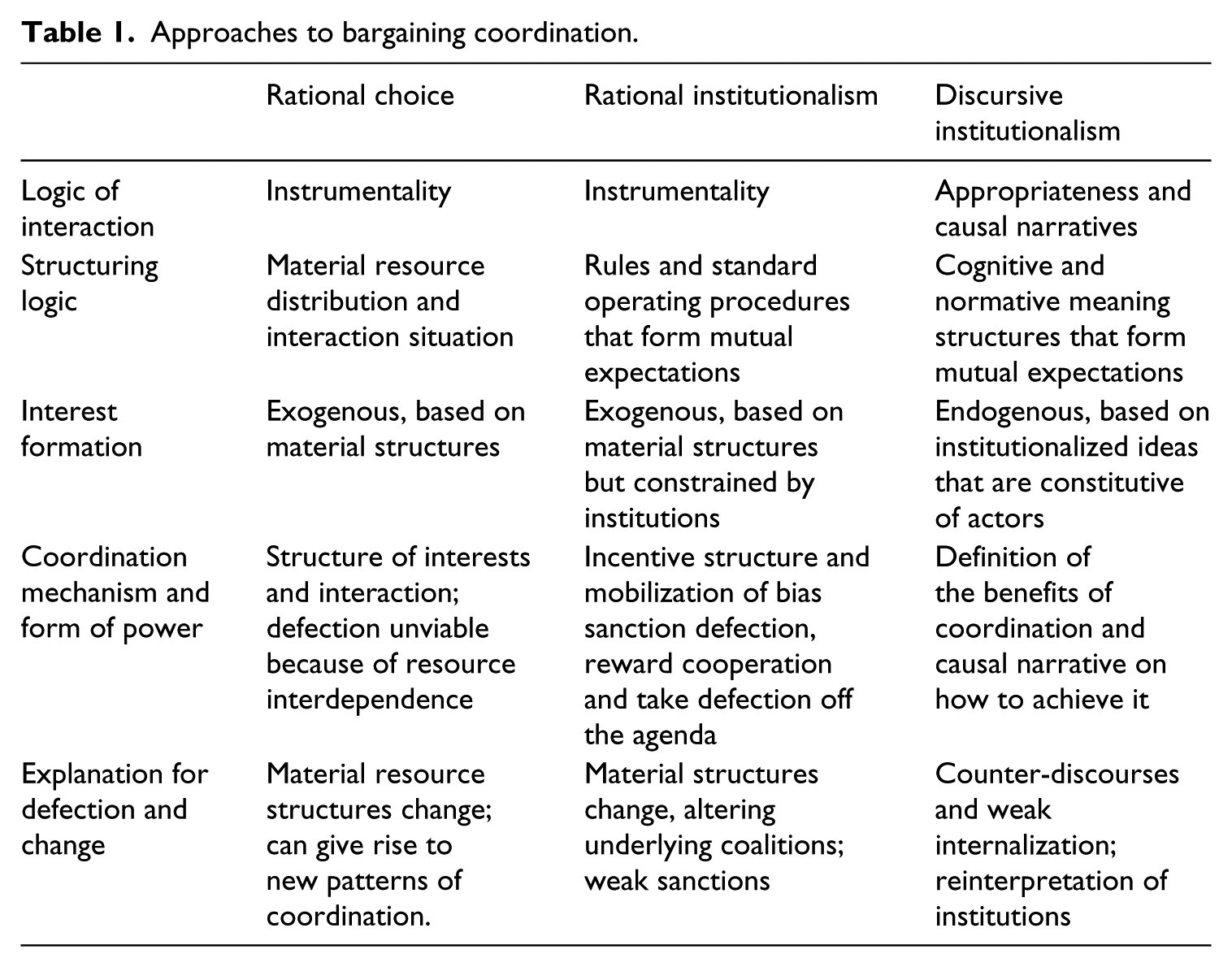
Table 1 summarizes the three approaches and their main theoretical implications for bargaining coordination. On this basis, I apply the approaches to Sweden and Denmark.
Approaches to bargaining coordination.
Coordination in Sweden and Denmark
Sweden and Denmark are regarded as highly coordinated market economies, with tightly coordinated bargaining, which have produced efficient and egalitarian outcomes. Both countries have, however, seen significant changes to their bargaining systems, from peak-level bargaining to coordinated industry-level bargaining. Coordination is nevertheless ubiquitous and seemingly consensual, both horizontally and vertically. Bargaining coverage is around 75 percent in Denmark (DA, 2013; Larsen et al., 2010) and 88 percent in Sweden (Medlingsinstitutet, 2012) and income equality is still high, although slightly decreasing (OECD, 2011). They are therefore ‘least-likely’ cases for theories that stress power and uneven resource distribution as explanations.
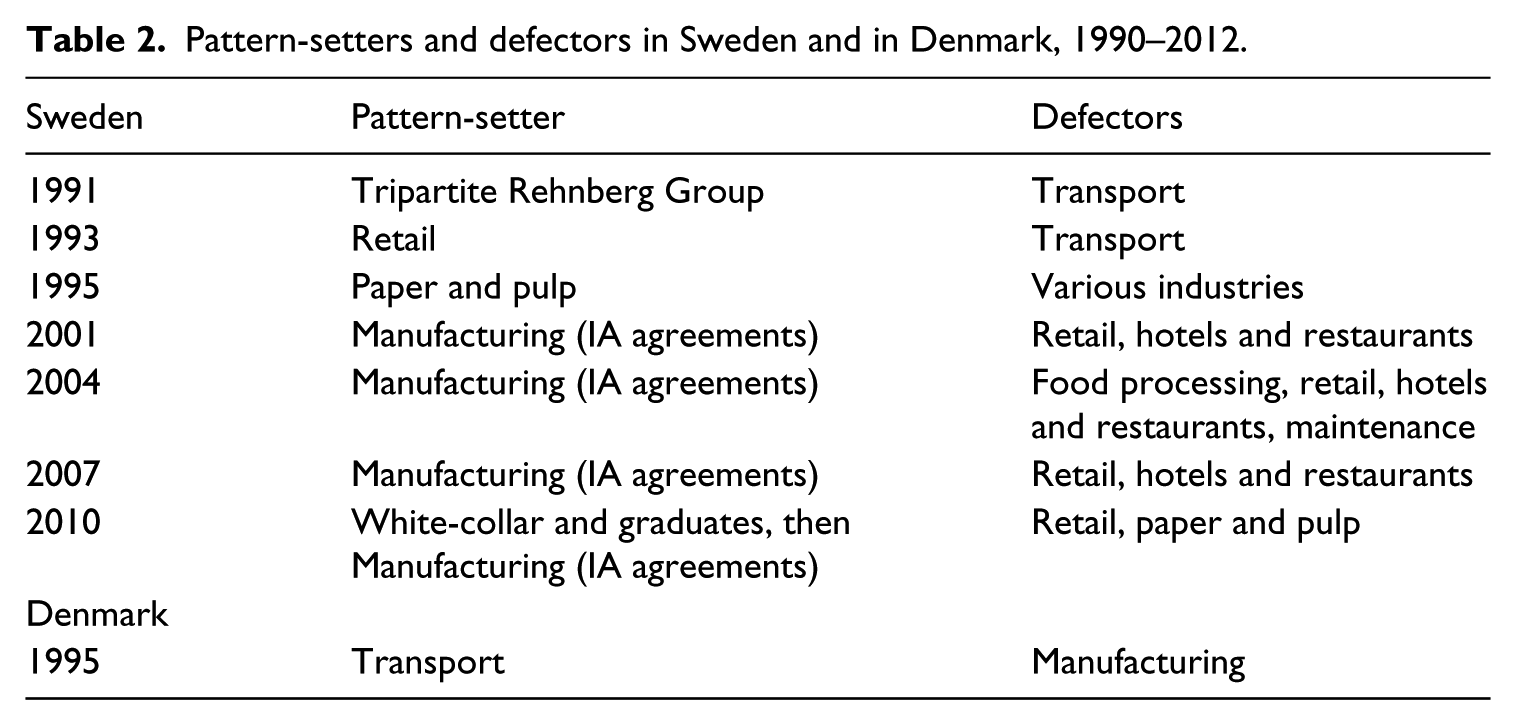
Both countries have converged on a pattern-bargaining system in which manufacturing sets a labour cost norm, usually a percentage increase, which other industries follow. However, in Sweden numerous industries have defected by negotiating higher increases: in the nine bargaining rounds between 1990 and 2012, this occurred seven times. This has not happened in Denmark, where defection occurred only in 1995 (when, exceptionally, the pattern bargain was set in the transport sector) (see Table 2).While coordination in Sweden has by no means broken down, defections present an interesting puzzle for the three approaches.
Pattern-setters and defectors in Sweden and in Denmark, 1990–2012.
The comparison begins with brief descriptions of the material circumstances of each country, since material structures clearly matter, but I show that they are indeterminate with reference to the different bargaining processes. I argue that institutions and ideas enter this indeterminacy to coerce certain actors into specific forms and outcomes of coordination. In other words, the approaches can be complementary.
Rational choice
According to rational choice, material structures should be able to account for differences in bargaining coordination. In this respect, however, Sweden and Denmark are very similar. According to the World Bank (2013), the manufacturing share of GDP is around 20 percent in both countries, while the employment share of manufacturing fell from around 30 percent in 1980 to around 15 percent in 2011. Both countries have developed flexible production systems, and employment is increasing in the service sector. Export shares of GDP increased from around 30 percent in 1980 to over 50 percent in 2011. Swedish manufacturing companies have traditionally been very large, competing in global markets with increasingly tight profit margins, for example in automotive production, whereas the somewhat smaller Danish companies have produced for niche markets (Kristensen and Lilja, 2012). Here indeed we see a difference, but from this we would expect stronger coordination in Sweden than in Denmark. Both countries have large welfare states, relatively high taxation and high female labour market participation, together with generally high employment rates.
Counter-inflationary economic policies assumed priority in the 1980s in Denmark, but not until the 1990s in Sweden (Iversen and Pontusson, 2000). Union densities remain relatively high, around 65–70 percent, despite recent changes to the Ghent systems (Due et al., 2010; Kjellberg, 2009). Employer association density (in both public and private sectors) is also high, though less in Denmark than in Sweden (71 and 86%, respectively) (DA, 2013; Medlingsinstitutet, 2012). In recent years, the traditional formal links between unions and social democracy have been weakened in both countries, but informal links remain strong. Despite these similarities, as we have seen, coordination outcomes have been very different. It seems rational choice approaches cannot readily explain this without reference to factors other than material structures.
Rationalist institutionalism
Rationalist institutionalism suggests the following explanations. First, there are significant differences in the organizational structures of unions and employers. In 1992, employers’ organizations in Danish manufacturing merged to form Dansk Industri (DI), which now represents 60 percent of employment within the private-sector employers’ confederation Dansk Arbejdsgiverforening (DA). This was the culmination of a reorganization of DA, which reduced the number of member associations from 150 to 50. The process has continued: there are now only 13 member associations of DA. Also in 1992, manufacturing trade unions created a bargaining ‘cartel’ with unified decision-making, CO-industri. This provided the basis for a strong cross-class alliance in manufacturing, with concentrated actors on both sides (Due et al., 1994; Scheuer, 1993). Swedish manufacturing, conversely, has seen no analogous concentration process. The engineering employers’ association, Teknikföretagen, has an important role, but represents only some 16 percent of the membership of the central confederation, Svenskt Näringsliv (SN). With 49 affiliates, SN is more fragmented than DA. On the union side, a new bargaining structure, Facken inom Industrin (FI), was established in 1996; it brings together the main LO unions for manual workers in manufacturing with their white-collar counterparts in TCO and the SACO union for professional engineers (Sveriges Ingenjörer). This new structure certainly strengthened coordination but did not create a bargaining cartel like CO-industri. (However, the mergers which created IF Metall for manual workers in 2006 and Unionen for white-collar workers in 2008 further concentrated Swedish manufacturing trade unionism.) Greater concentration of decision-making power in Denmark could explain fewer defections from coordination.
We also need to consider differences in agreement ratification procedures. In Denmark, the DA executive ratifies sectoral agreements; since DI holds a voting majority, it has a veto over other bargaining units. No such procedure exists in SN; the only sanctions against defections are ‘naming and shaming’ and symbolic fines. On the union side, neither LO-Sweden nor LO-Denmark can veto agreements. However, the powers of mediation systems significantly alter this. In Denmark, the government Forligsinsti-tutionen has the power to link bargaining units into a single union ballot; potential defectors that have not yet reached an agreement can thus be outvoted by the parties to the DI and CO-industri agreement. Conversely, Swedish mediators – the government Medlingsinstitutet and the private mediators (Opartiska Ordföranda) established by the 1997 ‘Industry Agreement’ (Industriavtal, IA) – have no such powers. Even though official mediators are formally restricted to proposing settlements in line with the manufacturing agreements, each agreement is ratified or rejected by competent assemblies of the direct bargaining parties. Defection is therefore possible, albeit conditioned by the weak available sanctions. Therefore, different institutions distribute decision-making power unequally.
The two institutional examples shed light on different conditions for coordination and can potentially explain defections. Swedish collective bargaining is more voluntarist, since the parties to agreements can decide their own fate; coercion is weaker than in Denmark, where smaller bargaining areas are reined in by the ballot and mediation procedures. Together with a more concentrated bargaining structure, opposing interests to the specific outcome of coordination are excluded from decision-making. While these institutional differences suggest that Swedish coordination is chaotic and Danish is stable, this is too simplistic. Swedish bargaining since the 1980s has been relatively stable, save for the defections mentioned. More often than not, bargaining actually follows the manufacturing norm, even though defections involving higher wage increases are institutionally possible. Indeed, many union officials from low-wage industries explicitly argue in favour of wage moderation based on the manufacturing norm, even though this entails gradually increasing wage differentials. I now turn to the discursive approach to investigate the indeterminacy that rationalist accounts omit.
Discursive institutionalism
I consider two examples: macro-causal narratives about international competitiveness and the need for coordination based on wage moderation, and the micro-techniques of coordination which tell us about specific balances between wage moderation, flexibility, equality and voluntarism.
As Swenson (1991) and Due et al. (1994) have shown for Sweden and Denmark, the key idea in collective bargaining coordination is the primacy of exports for the economy and therefore interdependencies between the exposed and sheltered sectors. This is based on two logics: first, the welfare state and home markets depend on wealth generation from exports, as reflected in high export shares of GDP. Second, cost increases in sheltered sectors spill over into higher costs for exposed sectors, involving negative externalities. Hence there is a need for cross-sectoral bargaining coordination. Such ideas were formally announced in 1987 in Denmark, when LO pledged wage moderation in return for real wage stability, higher employment and increased private savings through occupational pension schemes (Due et al., 1994). This resulted in the current bargaining system in which manufacturing goes first and mediation constrains potential defectors. The big issue is thus the level at which the economy will remain competitive; ‘campaign institutions’ such as think-tanks, social partner secretariats and government economic councils analyse and discuss economic conditions by comparing labour cost developments of neighbouring countries (Pedersen, 2006). Notably in Denmark, a tripartite committee, Statistikudvalget, produces reports on the margin for wage increases before each bargaining round. Common causal narratives and common knowledge create mutual expectations for bargaining (Culpepper, 2008).
Likewise, various reports analysed the ‘Swedish problem’ in the 1980s, in part castigating low governance capacity in wage bargaining (Ahlén, 1989; Blyth, 2002). Incomes policies were attempted (Elvander, 1989) but without compliance: compensatory wage claims at company level hollowed out their effectiveness. The breakthrough came with the Rehnberg Commission in 1991, resulting in structured mediation, from 1995 subject to the ‘Edin-norm’ of wage moderation, which aligned increases to foreign competitors. The analysis of causes of structural unemployment – wage rigidities and wage spirals caused by union rivalry – was accepted by the metalworking unions and then by other manufacturing unions. They established bargaining cooperation after a chaotic bargaining round in 1995, proposing the institutionalization of pattern-bargaining around manufacturing. In 1997, employers in manufacturing signed the IA, which set a procedural framework for bargaining and a declared goal of competitive wage movements. Concomitantly, the Opartiska Ordföranda group was established to mediate in bargaining on the basis of their own analysis of the economic situation and labour costs in neighbouring countries.
How do actors translate common ideas of competitive bargaining coordination into specific techniques? First, coordination can be based on either nominal or percentage increases. This choice is obviously non-trivial. Second, it can use various metrics: productivity increases, inflation forecasts, unemployment forecasts, profit forecasts or a combination. Hence coordination is a techno-political issue with distributive consequences. Again, the importance of campaign institutions in setting the frame for bargaining coordination becomes pivotal by defining the scope for cost increases. This is not a mechanical procedure. For example, which competitors are relevant? In 2010, Danish unions argued for inclusion of Chinese wage movements on the grounds that Danish companies were in direct competition with China; percentage wage increases were higher in China than in Germany. By decontextualizing bargaining and setting it in relation to other bargaining systems, actors can frame coordination according to their own interests (Fairclough, 2003).
In Sweden, the role of counter-discourses is illuminating (Schmidt, 2010). For example, service sector unions repeatedly challenge the primacy of manufacturing as pattern-setter. They argue that services are also exposed to international competition and far outnumber employment in manufacturing, hence meriting the pattern-setting role (Medlingsinstitutet, 2009). Such counter-discourse does not exist in Denmark, partly because DI also covers many service sector companies. For low-skilled Swedish LO unions, discourses of solidaristic wage policies and wage levelling also challenge manufacturing primacy. In 2012, this led IF Metall to leave the LO bargaining platform following disagreements with low-skilled unions over the design of solidaristic wage claims. In Denmark, such solidaristic counter-discourse does not exist, even though low-skilled workers in retail, cleaning and food processing are clearly losing out in company-level wage deals. This difference is accentuated by the level of control in industry agreements: 85 percent of Danish agreements merely prescribe minima, not actual pay increases, whereas Swedish agreements usually include fall-back provisions and individual guarantees together with wage pools, ensuring that increases are generalized (DA, 2013; Medlingsinstitutet, 2012).
The difference between discourses on low wages in Sweden and Denmark highlights the issue of real interests proposed by Lukes (2005: 154). The problem is that we need counterfactual analysis through comparison to realise actual power exercise. As an illustration, I use KLEMS data (2009a, 2009b) on average wage ratios between low-skilled workers in retail, hotels and restaurants as against high-skilled manufacturing workers, to illustrate subjective versus real interests (see Figure 1). During the 1970s and until the late 1980s, wage differences were stable in Denmark and shrinking in Sweden. However, since decentralization and the use of framework agreements of wages in the early 1990s, differentials have soared in Denmark while only increasing modestly in Sweden.
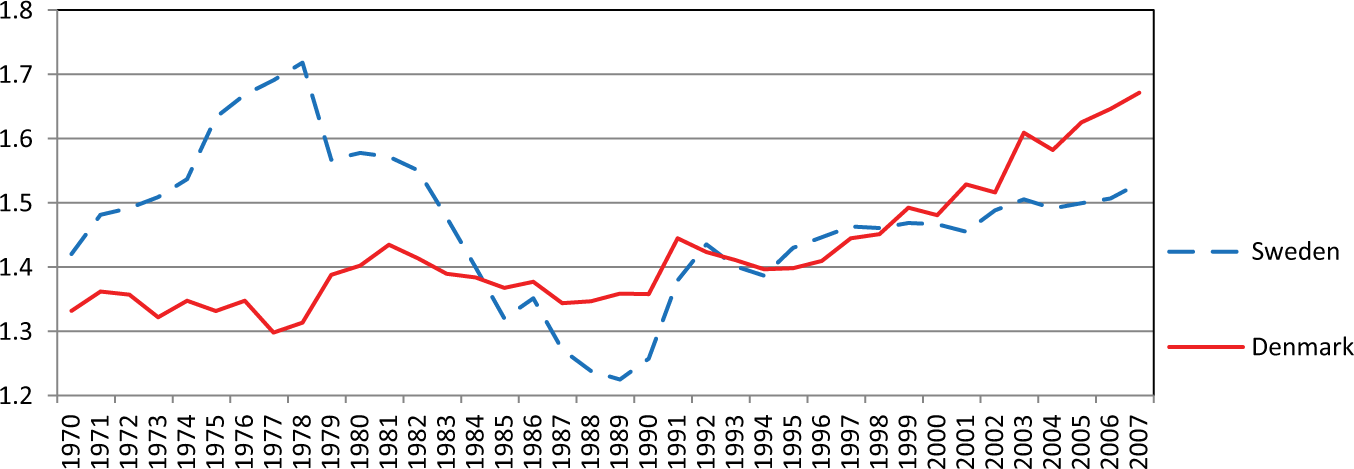
Average wage ratios between low-skilled workers in retail, hotels and restaurants vs. high-skilled manufacturing workers in Sweden and Denmark 1970-2007.
Under the current system of bargaining coordination, why do Danish low-skilled unions, despite relatively high membership density, accept larger wage differentials than their Swedish colleagues? Structuralist accounts would stress that they have no choice because of low demand for low-skilled workers or labour migration depressing wages. This may be true, but are structural differences between Sweden and Denmark really that significant? An alternative explanation could be that growing wage differentials in both countries are legitimized through collective memories of the ‘bad old days’ (March, 2010): we need wage moderation and flexibility to ensure that the unrestrained inflation, loss of competitiveness and high unemployment of the 1980s and early 1990s will not return. In Denmark, the discursive battles over the primacy of manufacturing are thwarted by ‘heavy institutionalization’ of bias through the creation of DI and the linkage of agreement areas by the mediation system. Combined with loose framework agreements at industry level, wage differentiation is hard for low-wage unions to escape, both institutionally and discursively. In Sweden, however, counter-discourses of solidarity and distributive equality are still strong, and institutions allow defections by low-wage unions because of a relatively fragmented bargaining structure and relatively weak mediation institutions. Moreover, unions retain more control over wages in industry agreements by using fall-back guarantees and designated wage pools, ensuring relatively even distribution in local wage bargaining (Medlingsinstitutet, 2012).
Against the backdrop of material structures, rationalist and discursive institutionalisms can therefore complement each other by showing how meaning structures frame interests in material structures and how this framing serve some actors better than others (Carstensen, 2010). And we can indicate how the formalization of these meaning structures in concrete institutions produces power relations and mobilization of bias with negative distributive consequences for some actors.
Concluding remarks
The article has reviewed three different theoretical approaches to the study of coordinated collective bargaining which posit different causal mechanisms. Rational choice focuses on power relations based on resource dependence; rationalist institutionalism on rules of the game and mobilization of bias; and discursive institutionalism on shared meaning structures and moulding of interests. I argue that each approach is based on different views of coordination involving exercise of power, where some actors make others do what they would not otherwise have done. The examples of Sweden and Denmark indicate that approaches stressing power in bargaining coordination are accurate. This allows for a ‘Sinatra inference’: if these theories can apply in consensual and egalitarian countries, they can (probably) do so anywhere. Accordingly, I reject the notion that coordination is purely cooperative, and instead follow Traxler et al. (2008), who put power at the heart of coordination studies – a proposition that can be transferred beyond collective bargaining. This does not preclude elements of cooperation in coordination, but shows that cooperation is conditioned by power relations.
Are the three approaches competing or complementary? First, rational choice and rationalist institutionalism share the logic of instrumentality and exogenous interests in bargaining coordination, but the latter introduces mediating institutions and, as argued by Moe (2005), for example, mobilization of bias. Indeterminacy of material structures and path dependency of institutions create another layer to the explanation of bargaining coordination which transcends rational choice. This warrants institutionalist explanations. Nevertheless, as a point of departure, rational choice makes a useful contribution to understanding ideal typical interest configurations between bargaining actors. Second, at the outset, rationalist and discursive institutionalisms are ontologically incompatible given their diverging views on interest formation and thus concepts of power. If the assumption of exogenous interests is relaxed, however, and we accept that interests depend on how actors ‘filter, interpret and act – or not – upon the constraints they face’ (Murray et al., 2010: 327), then we need not discard strategic behaviour based on material structures. Instead, we must appreciate the normative and cognitive processes inherent in strategies leading to coordination.
Although I stress the power effect of discourses, those concerning coordination should not be viewed too deterministically. Like Carstensen (2010), I see signs in Sweden and Denmark of how the ideas of wage moderation, flexibility, solidarity and voluntarism are moulded by unions and employers’ associations that are under continuous pressure from structural changes in markets and technology. Flexibility is framed as something that collective bargaining allows but also controls. Wage moderation is framed as a win-win solution that increases competitiveness and employment, although gradually increasing wage differentials. Solidarity in Denmark no longer means equal wages for all work but equal wages for similar jobs and equal opportunities (Baccaro and Locke, 1998; Pontusson, 2011). Finally, voluntarism is no longer merely non-interference by the state (Kahn-Freund, 1954) but also bargaining autonomy vis-à-vis manufacturing. This dynamic interpretation of recent developments goes beyond bargaining structures and levels and puts power back into studies of coordination by asking the fundamental question: whose interests prevail in coordinated bargaining?
Footnotes
Funding
This research received no specific grant from any funding agency in the public, commercial, or not-for-profit sectors.