



Abstract
The viability of coordinated, multi-employer bargaining arrangements as a cornerstone of labour market regulation in Western Europe has come under further threat following the crisis. Already, pressure for decentralization had corroded the capacity of sector agreements to specify universal standards applicable at company level. Procedural mechanisms articulating the two levels had become looser and more open-ended. This process has intensified in Northern European countries, whilst in Southern Europe, under pressure from the European institutions, a frontal assault on multi-employer bargaining arrangements is now underway. Reinforced European economic governance intensifies the need for coordination of bargaining across borders, but the capacity for achieving this is significantly reduced by the erosion of capacities for effective coordination within national bargaining systems.
Introduction
Sectoral, multi-employer bargaining has formed a cornerstone of labour market regulation in Western Europe but in the context of economic crisis is targeted by national and international public authorities as a source of labour market rigidity. Particularly in the Southern EU countries, labour market ‘reforms’ are a central plank of the internal devaluation policies imposed directly by, or under considerable pressure from, international institutions including the European Commission, the European Central Bank (ECB) and the International Monetary Fund (IMF). One policy objective has been to undermine the governance capacity of sectoral (and cross-sectoral) agreements in favour of those concluded at company level. Although wage determination and collective bargaining are excluded from EU competence under Article 153 of the Treaty, the ‘Six Pack’ of regulations on economic governance adopted by the Council in October 2011 provides for surveillance of wages policy and wage-setting across the EU, and refers to reform of wage-setting arrangements amongst possible measures to correct macro-economic imbalances (Erne, 2012).
Yet multi-employer bargaining arrangements bring benefits for the state, as well as advantages for the bargaining parties (Sisson, 1987), delegating the regulation of key terms and conditions of employment to private actors and the maintenance of social peace. As Crouch (1993: 7) observed, amongst the nine Western European countries which he regarded as neo-corporatist, ‘in exchange for having certain of their private arrangements virtually acquire the status of public authority’, employers’ associations and trade unions ‘help bear the burdens of the state’. Many states have supported multi-employer bargaining through extension mechanisms which legally extend the coverage of agreements to all firms (and workers) in a sector or territory and through legislating the ‘favourability’ principle whereby agreements at lower levels cannot undercut the standards set at higher levels.
A key condition of the effectiveness of multi-employer bargaining arrangements is their articulation (Crouch, 1993) or coordination (Traxler et al., 2001) vertically across levels and horizontally between bargaining units. On the vertical plane, effective coordination gives the peak or sectoral organizations of employers and trade unions the capacity to act strategically and commit their memberships to a course of action. In sectors dominated by large firms, employers’ strength lies both at associational and company levels. Crouch (1993: 54–55), focusing on the union side, stresses the two-way nature of the interdependency involved: scope for autonomous action at local level is recognized, but it is bounded by rules of delegation established centrally. Since the term ‘articulation’ better captures the idea of a two-way relationship, it is used here when referring to the vertical plane of coordination. The state has influence too: legal underpinning for the favourability principle and for the extension of collective agreements reinforces articulation between levels. Coordination on the horizontal plane can be realized by the peak organizations of employers and trade unions, as in the Netherlands or Spain; through pattern bargaining across sectors, led by a well-organized exposed sector such as metalworking, as in Germany and nowadays Sweden; on a state-led basis, as in France; or through the conclusion of central agreements as in Belgium or Sweden (until the early 1990s).
Traxler et al. (2001) demonstrate that differences in coordination arrangements across countries, on both planes, have implications for economic outcomes. In particular, they establish the effectiveness of pattern bargaining arrangements, as a horizontal coordination mechanism in sector-based bargaining regimes, in generating labour cost and wage outcomes consistent with economic competitiveness. They also find that outcomes consistent with competitiveness are more likely to arise where vertical arrangements articulating different levels are well defined (Traxler and Brandl, 2012). In this respect, there is an important difference between Central Western and Nordic Europe, and also Italy and Slovenia, where articulation mechanisms are well specified, and the Mediterranean countries (except Italy) and Central Eastern European (CEE) countries such as Romania, where they are not.
The trend over the past quarter-century towards greater decentralization (Marginson and Sisson, 2004; Traxler, 1995), reflecting sustained pressure from employers, poses major challenges for articulation between levels. It has shifted the centre of gravity in collective bargaining towards lower levels, from cross-sectoral towards sectoral level in countries with central agreements and, above all, from the sector towards the company. Traxler differentiates between ‘organized’ decentralization which takes place within parameters established at higher levels, and ‘disorganized’ decentralization whereby multi-employer bargaining is swept away. In Western Europe, with the important exception of the UK, the first has predominated. Scope for negotiation at company and workplace level has been increased, and higher-level agreements have become less prescriptive. As the weight of the company level increases relative to the sector, effective articulation between the two levels becomes an increasingly pressing issue for the continued viability of multi-employer bargaining systems.
In this article I develop three main arguments. First, even before the onset of the crisis the pressure for decentralization had led to corrosion or reconfiguration of articulation mechanisms, reducing the capacity of higher-level employer and trade union organizations to act strategically and deliver comprehensive regulation of wages and conditions. There are important differences between countries in the nature and extent of these changes. Second, the crisis represents a critical moment in the evolution of articulation between levels, and in multi-employer arrangements more generally. I differentiate between countries where changes have resulted from concerted action between employers and trade unions, and those where they have been more contested or imposed by governments, frequently at the behest of international institutions. In the latter, which include several countries where articulation mechanisms were historically weak, there is now evidence of a frontal assault on multi-employer bargaining. Third, European economic and market integration creates pressure for new forms of wage coordination across national borders: these have intensified as a consequence of the crisis. Yet, far from adopting policies supportive of cross-border coordination, European and national public authorities have embraced prescriptions which are driving in the opposite direction. Below I draw on secondary data to illustrate each of these arguments, and then conclude.
I focus primarily on continental Western and Nordic Europe, where multi-employer bargaining arrangements predominate. The UK and Ireland are excluded because multi-employer bargaining at sector level is not prevalent, although in Ireland peak-level agreements were important from 1986 to 2009. Amongst CEE countries only Romania and Slovenia have multi-employer bargaining arrangements with extensive workforce coverage, so I cover these two countries.
Corrosion and reconfiguration
The relationship between levels within multi-employer bargaining has been underpinned, either legally in continental Western Europe or by peak-level agreements in the Nordic countries, by the favourability principle. Until the onset of the crisis, formal change in the hierarchy implied by the favourability principle was the exception rather than the rule. The exception was France, where the 2004 loi Fillon inverted the principle to give precedence on a range of issues to standards set in company agreements over those specified at sector level, with the important exceptions of minimum wages and job classifications. German employers pressed for changes in the favourability principle to allow a trade-off between maintaining employment and concessions on wages or working conditions (Ilsøe et al., 2007), but without securing a change in the law. In practice, however, in Germany and other countries the favourability principle has been blurred as employment becomes a more prominent bargaining issue (Léonard, 2001): pay and working time concessions and changes in working practices are traded off against employment. As a prominent example, the watershed 2004 Pforzheim agreement in German metalworking introduced a fundamental ambiguity in the application of the favourability principle, permitting company agreements allowing a proportion of the workforce to work longer hours, if this maintains or promotes employment through employer commitments to sustain production levels or undertake investment (Bispinck and Dribbusch, 2011).
The trend since the 1990s has been to scale back the substantive content of higher-level agreements, which have become increasingly confined to establishing standards (frequently minimum ones) or parameters for core terms and conditions; variation within these and the details and modalities of implementation are then negotiated at company level (Keune, 2011; Marginson and Sisson, 2004). Since articulation involves a two-way interdependency between levels, decentralization has involved two interconnected dynamics. Unauthorized developments at company level are subsequently accommodated by changes to sectoral agreements (‘pull down’), while sectoral agreements open up new issues for company negotiation (‘push down’). Examples of the former include Italy’s 1993 cross-sectoral agreement adopting the two-tier bargaining structure: competence allocated to the company level to determine the performance-related part of wage increases consolidated already existing practice. The provisions on employment-maintaining concessions in the 2004 Pforzheim agreement also codified a practice that was already widespread amongst larger firms, while re-establishing union control over company agreements, thereby constraining any negotiating role for works councils.
The procedural mechanisms whereby this process of decentralization has been ‘organized’ (Traxler, 1995) differ across a spectrum in the extent to which they maintain the principle of universally applicable standards and in the extent to which they prescribe the parameters of subsequent company negotiations. First, some sectoral framework agreements specify the main substantive standards but provide scope for variation in their implementation in company negotiations. For example, agreements on working time in several countries specify normal working hours on a weekly, monthly or annual basis, holidays and maximum overtime hours, with actual working time arrangements delegated to negotiation at company level. Second, opening clauses which provide for variation on the basis of equivalence, for example in the implementation of variable payments schemes, occupy a similar position on the spectrum. Third, the principle of universally applicability is partially breached under two-tier bargaining arrangements which distribute competence between levels according to issue. Thus in Italy, though company bargaining is governed by the procedures of the 1993 cross-sector agreement and its 2011 successor, matters dealt with at company level negotiations are not subject to a higher-level substantive framework. Fourth, the principle is breached in a different way by clauses variously termed ‘opt-out’, ‘hardship’ and ‘discount’, which expressly provide for derogation by individual companies from the universal sectoral standard. Their proliferation in the 2000s in some countries, Germany and the Netherlands in particular (Keune, 2011), has rendered sectoral standards increasingly perforated. Fifth, incomplete framework agreements mean a departure from universal standards since they are predicated on substantive variation between companies. The parameters of key issues, such as pay or working time, are no longer fully specified and neither is the scope of company negotiations. For example, only an increase in minimum wages is specified rather than a general increase, as in many French sectoral agreements (Howell, 2009).
Not all countries with multi-employer bargaining arrangements have embarked along this trajectory of organized decentralization. Spain, Greece and Portugal stand out since they lack well-defined mechanisms articulating bargaining across levels (Traxler et al., 2001). Spain has seen growth in the incidence and scope of company bargaining, in a manner rather autonomous from the provisions of sectoral agreements. In Greece and Portugal, bargaining until recently largely remained cross-sectoral or sectoral, with relatively little negotiation at company level.
Recent comparative studies of collective bargaining over variable payments systems and flexible working hours illustrate the extent of cross-country variation in articulation mechanisms. The growth of variable payments systems poses a critical test for articulation mechanisms, because they simultaneously challenge the deeply-entrenched convention of the common rule, or ‘going rate’ of wages for workers doing similar jobs. Further, since these systems usually operate at company and workplace level, sectoral agreements must be opened up to allow company negotiation over pay. Nergaard et al. (2009) focused on three countries with multi-employer bargaining arrangements, and also the UK, and identified two types of difference: between countries with well-defined articulation mechanisms and those lacking them; and amongst countries with well-designed mechanisms. In Austria and Norway, the capacity of works councils and local trade union organizations to regulate the implementation and operation of variable payments schemes was extensive: the implementation of these schemes is underpinned by substantive or procedural provisions in the metalworking sectoral agreement. In Spain, by contrast, the provisions in provincial agreements for the sector are unspecific on the issue; hence the capacity to exercise influence over the schemes rested largely on local union strength, a situation resembling that under single-employer bargaining in the UK.
Between Austria and Norway, the distinction between dual- and single-channel representation schemes shaped the degree of influence exercised over the schemes at company level. In Austria, the union was determined to frame a sector-wide scheme based on organizational performance, given that it is not the main employee-side interlocutor at company level, and succeeded in doing so in the 2005 sectoral agreement. However, it could not prevent the spread of individually-based, performance schemes which were outside the scope of the sectoral agreement. In Norway, the sectoral agreement leaves scope for local negotiation over variable pay schemes and their implementation, providing these are consistent with the prescribed wage principles. Trade unions can articulate the process through the strong ties which exist between their officials and company representatives. The studies by Ilsøe et al. (2007) and Ilsøe (2010) of wage-setting and flexible working time arrangements in Denmark and Germany likewise shows that whilst sectoral agreements in both countries permit company negotiation over working time, the scope is considerably greater in the Danish than German agreements. This is attributed to the two-way relationship between sectoral and local trade union organizations in Denmark, as against the reluctance of German unions to delegate responsibility to formally independent works councils over which they exercise only indirect influence.
Over time, the general trend has been from agreements that are consistent with universally applicable standards and comprehensive towards looser agreements that permit deviation from sectoral standards. For example, in Germany decentralization initially took the first form in the spectrum but the weight of the fourth has grown progressively. Until recently, Italy was an instance of the third pattern, but crisis-induced changes, discussed below, have introduced the fourth. Since 2000, many sectoral agreements in France have been transformed from the first to the fifth type.
Crisis-induced changes: Concerted, contested and imposed
As in earlier periods of economic crisis (Brandl and Traxler, 2011), the present crisis stands as a critical moment in the evolution of multi-employer bargaining arrangements, including the articulation mechanisms under which recent decentralization has been organized. Across countries, two differing patterns of change are evident. In one group, including Germany, Austria, the Nordic countries and also France and Slovenia, changes have been concerted between employers and trade unions. 1 In a second group, including the Southern European countries which have either been subject to financial bail-outs by the ‘Troika’ of international institutions (European Commission, ECB, IMF) or come under pressure from these institutions because of the scale of their public deficits, changes have been contested and/or imposed by governments. Contestation has involved differences amongst as well as between employers and unions. The first group comprises countries where multi-employer bargaining entails well-specified mechanisms to articulate the sector and company levels; the second group (with the exception of Italy), those where such articulation mechanisms are weak or non-existent.
Amongst the first group, two crisis-induced developments are notable, both negotiated on a concerted basis between employers and trade unions. The first is further movement along the spectrum of different procedural mechanisms articulating the sector and company levels, identified above, with the (further) opening-up of scope for company-level negotiation over the crucial issue of wages (Glassner et al., 2011). For example, 2009 sectoral agreements in German manufacturing, including metalworking, chemicals and textiles, introduced opening clauses providing for flexibility in the timing and amounts of payments, requiring a company agreement to trigger their implementation. The conclusion of a path-breaking agreement in Swedish manufacturing introducing a compensated short-time working scheme, modelled on Germany’s successful Kurzarbeit scheme, required local company negotiations to trigger implementation. More radically, multi-annual agreements in the technology sectors in Finland and Sweden (for professional staff), concluded in 2009–10, moved pay bargaining down to company level with no general, sector-wide, increase set beyond the first year. In Slovenia, derogation clauses have been introduced in the important sector agreements for metalworking and banking, allowing deviation from the minimum standards specified, including on pay.
Collective bargaining in Slovenia has been decentralized in another respect: there is no longer a ‘fall-back’ cross-sectoral agreement establishing substantive standards for workers not covered by a sectoral agreement, following failure to agree a renewed agreement in 2009 (Stanojević and Klarič, 2013). In Austria, bargaining in the pattern-setting metalworking sector has undergone a measure of decentralization in response to employer demands, moving in 2012 from a single agreement to separate agreements for each of six sub-sectors (Allinger, 2013). Finland, however, has seen movement in the opposite direction with the conclusion in late 2011 of a two-year cross-sectoral wage agreement providing a framework for sectoral and company negotiations; the previous central agreement had lapsed 2007 (Jokivuori, 2011). In France, the influence of the state in promoting further decentralization is apparent. Responding to a government initiative, employers and three of the five union confederations concluded a wide-ranging agreement on labour market reform in January 2013, including the possibility of company-level agreements derogating from wage and working time provisions in order to preserve employment (Turlan and Cette, 2013). Employers and unions have also increasingly drawn on the possibilities opened up during the 2000s, the loi Fillon and the 2005 law providing scope for more flexible procedural agreements to handle restructuring (accords de méthode), to extend the agenda of company-level negotiations in response to the exigencies of the crisis. 2
The second development is to extend or reinforce the reach of multi-employer bargaining arrangements. In Germany, competition from companies not covered by collective agreements, including growing numbers employing low-paid workers, has prompted the negotiation of legally binding minimum wage standards in a few sectors, including social care services and temporary agency work (Stettes, 2012). Although state support is crucial to their implementation, a prerequisite was the ability of employers’ organizations and trade unions to negotiate an agreement. Responding also to competitive pressures, measures to activate the use of extension mechanisms seem likely (Schulten and Bispinck, 2013). In Denmark, unions in manufacturing and transport successfully pressed in 2010 for measures to combat the employment of workers, usually migrant, on terms and conditions which breached those of the sectoral agreement, through improvements to enforcement and wage inspection (Ibsen et al., 2011). In Norway, union pressure has led to the activation of the previously dormant extension mechanism in sectors with high concentrations of posted or migrant workers such as construction, shipyards and cleaning (Alsos, 2011).
In the second group of countries, stark changes to multi-employer bargaining arrangements have been imposed in Greece, Portugal and Romania as a result of the direct intervention of the Troika and the conditions accompanying the financial rescue packages. In addition, external pressures on Italy and Spain from the European authorities, in particular the ECB, have exerted noticeable influence over recent developments. Six main changes have occurred, summarized in Table 1, which divide into two broad types. As with the first group of countries, these concern decentralization of bargaining and the procedural mechanisms articulating the sector (or cross-sector) and company levels; and measures affecting the reach of multi-employer bargaining. The character of the changes is, however, very different. Changes involving decentralization and procedural mechanisms, shown in the first four rows of the table, include abolition of national, cross-sector agreements, according precedence to agreements concluded at company level and/or suspension of the favourability principle, introducing new possibilities for company agreements to derogate from higher-level prescriptions, and weakening trade unions’ prerogative to act as sole bargaining agent for workers (and thereby weakening articulation between the sector, where the union remains the bargaining agent, and the company levels). The second type of change, shown in the fifth and sixth rows, has the effect of reducing or undermining the reach of multi-employer bargaining arrangements, including restricting extension mechanisms and curtailing the period for which agreements remain valid after expiry (and imposing minimum standards thereafter). Abolition of national, cross-sector agreements is also likely to have an impact on reach, insofar as there are sectors without agreements. Changes to one or both of the crucial state supports for multi-employer bargaining and its coordination capacity, extension mechanisms and the favourability principle, have been imposed in the three countries in which international institutions have directly intervened. Even in Ireland, conditions specified by the Troika have resulted in government-imposed changes to legally underpinned arrangements for wage-setting, including extension, in the few sectors with multi-employer bargaining.
Changes to coordinated collective bargaining imposed in Southern Europe.
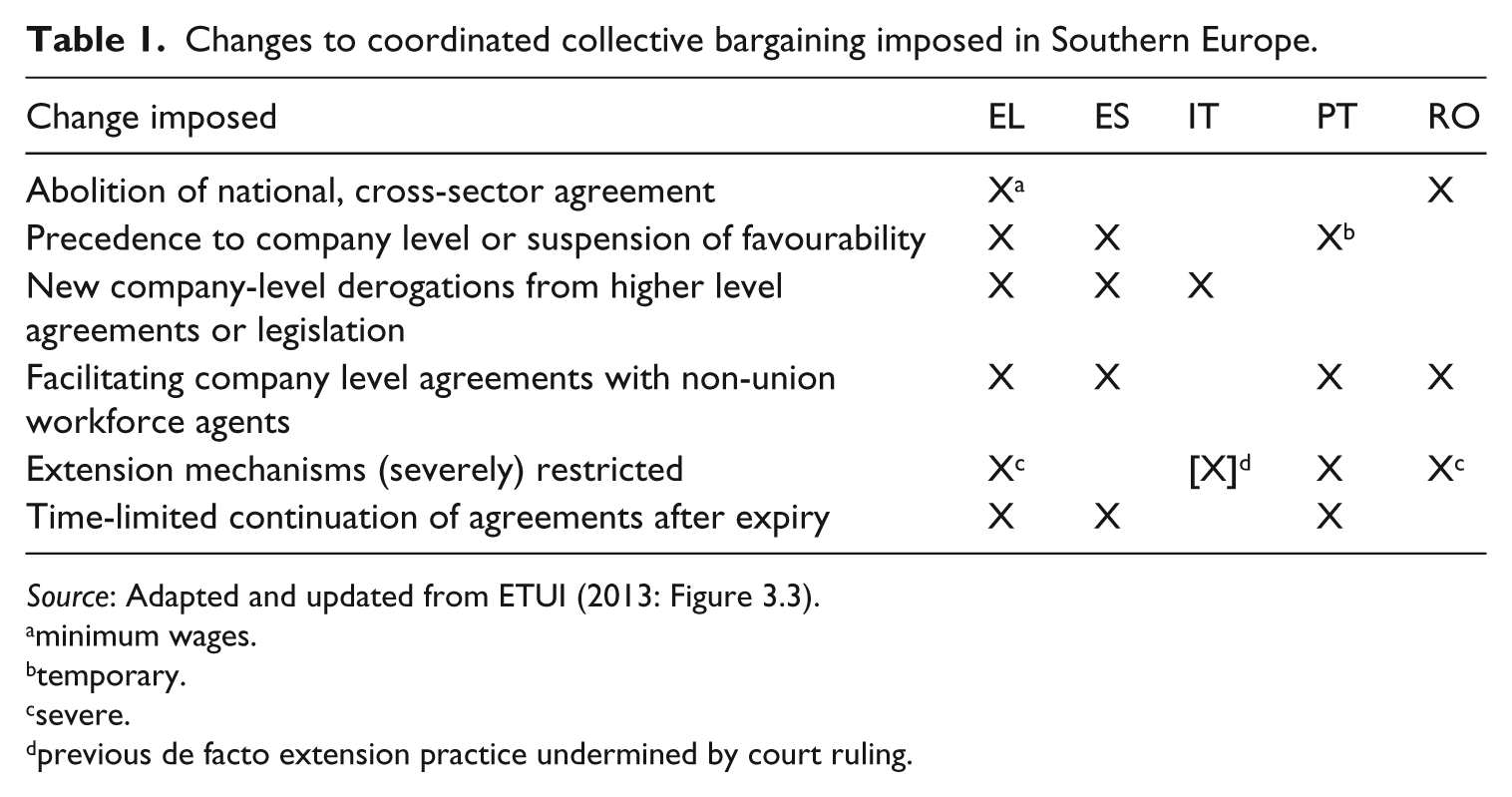
Source: Adapted and updated from ETUI (2013: Figure 3.3).
minimum wages.
temporary.
severe.
previous de facto extension practice undermined by court ruling.
In Greece, the Troika has required radical changes to bargaining arrangements as a mandatory condition of financial assistance. Accordingly, 2010 legislation introduced scope for company agreements to derogate from the wage and working time provisions of higher agreements in cases of financial hardship. Further legislation enacted in 2011, in the face of fierce union opposition, inverted the existing hierarchy of agreements to give precedence to those concluded at company level, even if the standards specified are inferior. It also enabled companies to negotiate with their workforce where unions are not present. The measure is of particular relevance to small enterprises hitherto covered by sectoral agreements though extension provisions, and has been rapidly taken up. Further legislation in 2012 introduced a three-month limit to the time that collective agreements remain in force following their expiry, after which pay rates fall to the basic minima until a new agreement is concluded, and drastically curtailed possibilities for extension by exempting companies which are not members of an employers’ organization from any obligation to observe agreements. It also removed negotiation of the minimum wage from the competence of the cross-sector agreement in favour of legislative determination. As well as attracting continuing opposition from trade unions, differences have emerged amongst employers’ organization, with those representing small companies increasingly concerned at the disruptive effects of undermining multi-employer bargaining (Georgiadou, 2012, 2013; Koukiadaki and Kretsos, 2012).
In Portugal, the Troika has also required the government to effect a series of reforms to collective bargaining. Legislation enacted during 2012 unilaterally introduced a new Labour Code, and for a period of two years prohibited the conclusion through collective bargaining of more favourable conditions. The legislation was the focus of major protests by the two main union confederations, which despite historic differences have, since 2010, participated in several joint actions including three general strikes. Two further measures echo those in Greece, although less stringently. The period during which collective agreements remain in force following their expiry became subject to a 12-month time limit, and rules on extension provision were substantially tightened to apply only where the membership of an employers’ organization covers a majority of the workforce. At the time of writing, not all anticipated legislative proposals have been brought forward, including one extending the negotiating competence of works councils at the expense of sectoral agreements and their trade union signatories (Campos Lima, 2011, 2012, 2013).
The Romanian financial assistance package took the form of a stand-by arrangement with the IMF, which also required far-reaching labour market reforms, including changes in multi-employer bargaining arrangements. This resulted in the 2011 Social Dialogue Act, unilaterally imposed by the government, which abolished the national cross-sector agreement, hitherto the point of reference for collective negotiations at all other levels. It also replaced previous agreements applicable to all companies (and workers) in each ‘branch’ of the economy with newly-defined sectoral agreements applicable only to those companies which are members of the relevant employers’ organization, thereby curbing the use of extension. More stringent representativeness criteria were introduced as preconditions for trade unions to negotiate legally valid agreements at sector and company levels. Where unions do not meet these at company level, agreements can now be negotiated with unspecified elected employee representatives. As well as concerted opposition mounted by trade unions, sustained criticism has come from some employers’ organizations (Ciutacu, 2011, 2012, 2013; Trif, 2013).
Changes to collective bargaining in Italy and Spain have also, in important part, been imposed by governments under pressure from the two European institutions. In particular, the ECB insisted on commitments to specific labour market reforms as a condition for intervening in financial markets to purchase government bonds (Meardi, 2014). But there has also been relatively more space for changes to be fashioned by, and contested between (and amongst), employers and trade unions. In Spain, a condition of financial assistance to its banking sector required the government to implement reforms in labour market regulation, including collective bargaining, promulgated under the new EU economic governance arrangements (see below). Responding to these pressures, the government introduced a measure in June 2010 widening the scope for derogation from wage clauses in sectoral agreements, in the face of union opposition and with employer support. During the first half of 2011, employers and trade unions commenced protracted negotiations on a package of labour market measures, including augmenting the scope for company bargaining, but were ultimately unable to agree. The government responded by imposing a second set of reforms, in July 2011, further extending the scope for derogation and weakening the hierarchy of agreements to favour the company level (López, 2011).
Following elections in November 2011, and despite a cross-sectoral agreement on wages policy and reforms to collective bargaining within the existing framework of sectoral and provincial agreements (including temporary suspension of wage revision provisions in such agreements), the incoming government brought forward fresh legislative measures (Vincent, 2013). Vigorously opposed by the two main union confederations, these include fully inverting the hierarchy of agreements to privilege company over sectoral and provincial agreements, making this obligatory even if the parties should desire otherwise, enlarging the scope for derogations from higher-level agreements and introducing the possibility for company agreements to be signed by non-union representatives where there is no trade union presence. The measures also time-limit the period for which agreements remain valid following expiry (as required by the Troika in Greece and Portugal). As in Greece and Italy, tensions have emerged amongst employers: in contrast to large companies, medium- and small-sized employers are reluctant to become exposed to company negotiations, preferring instead the protection afforded by multi-employer agreements. Division between the two main union confederations has not, however, surfaced.
In sum, in a context where articulation mechanisms across levels were already poorly specified, a series of largely imposed changes have progressively detached the company level from multi-employer bargaining arrangements, and most recently cemented the priority of company agreements, thereby overturning the favourability principle.
In Italy, in response to employer pressure for further decentralization in wage setting and the emerging exigencies of the crisis, the 1993 cross-sectoral agreement defining the competences of the sector and company bargaining levels was recast in 2009. However, the agreement, which had the support of the government, was concluded without CGIL, which opposed erosion of the sectoral mandate over wage negotiations. Its contested nature complicated implementation, with separate (‘new’ and ‘old’) agreements in force in several sectors including metalworking. In 2010 Fiat, the leading metalworking employer, unilaterally imposed new, local agreements at two of its plants, under threat of relocation unless the workforce agreed to radical changes in working practices and to limit their right to strike. In effect the two plants were withdrawn from the sectoral agreement. Again union division was apparent, over whether to accede to the exercise of force majeure by Fiat (Cella, 2011). At the end of 2011, Fiat withdrew all of its remaining plants from the sectoral agreement, having left Confindustria, the employers’ confederation.
Meanwhile in June 2011 Confindustria reached a new agreement with the unions, this time including CGIL, reforming the two-tier bargaining system and introducing the possibility of derogation from sectoral agreements on grounds of economic difficulties. The agreement was, however, overtaken by emergency reforms introduced by the government in mid-August under pressure from the European institutions. As a condition of intervening in bond markets, the ECB specifically demanded changes to collective bargaining arrangements to make wages more responsive to firm-level conditions (Meardi, 2014). The emergency reforms also allowed company derogation for economic reasons from statutory protection against dismissal. A further agreement in September reaffirmed the employers’ commitment to refrain from utilizing the additional dismissal-related derogation. This triggered the Fiat decision to leave Confindustria, demonstrating the differing position of medium- and small-sized employers, which continue to prefer the protection of a sectoral agreement. In November 2012, another cross-sectoral agreement (not signed by CGIL) opened up further possibilities for company negotiations, including allocating part of the sector-determined wage increase to local productivity-related negotiation.
In sum, the balance between the sector and company levels has shifted, with significant new possibilities for company negotiations, and attendant challenges for articulation between levels. Moreover, the system of multi-employer bargaining has been undermined by the exit of its largest industrial employer. This extends to the long-established practice, based on court decisions, of the de facto, ‘quasi-legal’ extension of the wage and working time provisions of sectoral agreements. This widely upheld convention has been thrown into question by legal rulings endorsing the substantive validity of Fiat’s new plant agreements. Although a further cross-sectoral agreement signed by all three union confederations in May 2013 establishes new representativeness criteria to underpin and stabilize sectoral bargaining arrangements, uncertainty surrounds the future of coordinated, multi-employer bargaining in Italy (Carrieri and Leonardi, 2013).
The contrast in the trajectory of multi-employer bargaining arrangements between the two groups of countries is sharp. In the first, the crisis has prompted further movement in the balance between the sector and company levels, and further diminution in the capacity of sectoral agreements to set universally applicable standards, extending the previous trajectory of corrosion. But these changes have stemmed from concerted action involving solutions negotiated between employers’ organizations and trade unions with no direct government intervention. They have also been accompanied by some strengthening of the reach of multi-employer bargaining arrangements, with supportive public policy measures.
In the second group, pressures emanating from the heightened scale of the crisis in Southern Europe have resulted in reforms imposed by governments in the face of trade union opposition or sharply contested between employers and trade unions. In addition, tensions and, in some cases, open disagreements between trade unions and between small-firm and large-company interests are apparent. These pressures, coupled with more and less explicit demands from the Troika, have led governments to impose measures which largely run in the opposite direction to the changes in the first group of countries. These measures greatly enhance the weight of company bargaining (or, particularly amongst smaller firms, unilateral employer imposition) at the expense of higher levels; reduce the governance capacity of well-established procedural mechanisms for articulating bargaining at different levels (in the case of Italy) or severely impair the already weak procedural mechanisms (in the other four countries); and reduce the reach of multi-employer bargaining arrangements (with Italy a partial exception). It is in these countries that a frontal assault on multi-employer bargaining is apparent.
Pressures from the European level
If there is an industrial relations dimension to the (normative) concept of the European social model, it has three key features (Marginson and Sisson, 2004; Visser and Hemerjick, 1997): a high degree of interest organization on the part of employers and workers; regulation of the labour market through comprehensive, coordinated collective bargaining; and universal workforce rights to representation and consultation within the enterprise. Whilst the first and third of these are refracted at the EU level, the second is absent: there are no European-wide structures for collective bargaining over wages and core conditions between employers’ organizations and trade unions. As noted earlier, the EU Treaty specifies that competence over wage determination and collective bargaining remains at the national level. At first sight, then, the issue of coordination between the European and national levels would seem not to arise.
Yet it has long been recognized that economic and market integration within the EU, and monetary union within the eurozone in particular, creates pressure on national labour market actors to deliver collectively agreed wage levels and increases consistent with maintaining, or improving, competitiveness. Within the eurozone, with exchange rates fixed and a uniform monetary policy, the labour market – including wages, working time and employment – has to bear a greater burden of any macroeconomic adjustment. Confronted by the prospect of downward wage competition across borders, the response widely advocated by European and national trade unions has been horizontal cross-border coordination of bargaining objectives and outcomes (Glassner and Pochet, 2011). At the same time, the ETUC has pushed for an enhanced role in the EU macroeconomic dialogue, given the integral role of wages policy in its agenda.
The various trade union coordination initiatives, in which wages are a principal focus, have had limited success in realizing their substantive objectives. According to Erne’s analysis (2008) of European initiatives in metalworking and construction, national parameters remain uppermost although unions are increasingly aware that national negotiations take place within a European context. Nonetheless, for a sub-group of neighbouring countries (Austria, the Netherlands and the Nordic countries) whose economies, and exposed sectors, are closely linked to the German economy, pattern-setting by German metalworking employers and trade unions seems to offer a viable mechanism for horizontal coordination of wage bargaining (Traxler and Brandl, 2009; Traxler et al., 2008). Given its leading role both as an export sector and as a focus of employer and trade union organizational strength, the implication is that metalworking could act as pattern-setter for other sectors, and therefore provide the basis for horizontally coordinated wage bargaining across a significant group of EU countries.
Recent developments in economic governance in the eurozone add to the pressures from economic integration for cross-border coordination of wage bargaining. Successive initiatives through 2011 and 2012 saw the European Council and Commission intervening to an unprecedented extent in wage movements, and also wage-setting mechanisms, thereby bringing coordination of wage policy firmly onto the agenda. On wage movements, the emphasis is on linking increases to productivity. For wage-setting mechanisms, stress is placed on decentralized arrangements which are sensitive to firms’ competitive circumstances. These developments mark a ‘paradigm shift’ (Schulten and Müller, 2013) on the part of the European authorities from respect for the Treaty provisions designating collective (wage) bargaining as outwith the EU’s competence to explicit intervention in its procedures and outcomes.
The introduction in 2011 of the new ‘European semester’ macroeconomic planning regime resulted in the Council and the Commission issuing recommendations in July 2011 to eight member states concerning wage movements or reform of wage-setting mechanisms. Recommendations included changes to indexation arrangements and to sectoral bargaining arrangements, by loosening the conditions for firms to opt out temporarily and enhancing the scope for company negotiation (Carley, 2011). By the 2012 and 2013 semesters, the number of countries receiving such recommendations had increased to seventeen (Schulten and Müller, 2013). Recipients of recommendations on reforming wage-setting mechanisms included not only the southern member states but also Belgium and Luxembourg.
In March 2011 the governments of the 17 eurozone countries agreed a ‘Euro-plus pact’ which included commitments to ensure that wages increase only in line with productivity and to monitor and benchmark trends in unit labour costs. Whilst formally respecting the autonomy of member states in respect of wage-setting, it was also decided to review mechanisms including the degree to which bargaining is centralized and the effects of wage indexation mechanisms (Broughton, 2011). The ‘Six Pack’ of regulations on economic governance adopted by the Council in October 2011, which took effect in 2012, further strengthens EU economic governance mechanisms, and amongst eurozone countries introduces possible sanctions against countries with persistent macroeconomic imbalances (Erne, 2012). The regulations reinforce the powers of the Commission in relation to surveillance of wages policy and unit labour costs, and refer to reform of wage-setting arrangements amongst possible corrective measures that can be required.
Yet the prospects of these top-down pressures on wage-setting arrangements prompting a renewal of initiatives for cross-border coordination have receded, rather than improved. This is a direct consequence of interventions by the European institutions, which have negatively affected well-established collective bargaining arrangements at national level, and hence undermined the preconditions for cross-border coordination. First, the Laval quartet of European Court judgments (Dølvik and Visser, 2009) diminished the established capacity of some national systems to generalize the wages and conditions established in multi-employer agreements through either custom (Sweden) or public procurement rules (Germany). Second, direct intervention or coercive pressure on governments in Southern Europe by the ECB and the Commission, as elaborated above, has been predicated on the policy prescriptions driving the new economic governance regime. Introducing greater scope for company negotiation has not been accompanied by recommendations to strengthen articulation across levels, but rather has been translated into measures weakening or inverting established hierarchical arrangements, to give primary weight to the company level. Towards the end of 2012 the Commission commended ‘the steps taken [in several member states] to enhance flexibility in wage determination, such as easing the conditions for firms to opt-out of higher level collective bargaining agreements and the review [sic] of sectoral wage agreements’ (European Commission, 2012: 10). As articulation capacities within national systems of collective bargaining are undermined, realizing cross-border coordination becomes less feasible.
Conclusions
The viability of multi-employer bargaining arrangements as a cornerstone of labour market regulation in Western Europe has rested on several features, including a high degree of employer and (less crucially) union organization, the capacity to coordinate bargaining across different units and articulate different levels, and supportive state policies including the favourability principle and mechanisms for legal extension of agreements. I have particularly focused on the latter.
Since the 1980s, in the face of continuing employer pressure, collective bargaining has undergone a process of organized decentralization involving progressively greater scope for company-level variation within the substantive parameters specified by higher-level agreements. A variety of procedural mechanisms articulating different levels have been invoked as organizing devices. Reviewing these, two main findings have been established. First, over time there has been movement along a spectrum: from procedural mechanisms which, whilst opening up scope for variation, nonetheless remained consistent with the principle of universal sector-wide standards, to mechanisms which qualify or perforate the standards set, or convert them into a minimum floor or safety net. As a result, there has been an incremental corrosion of the standard-setting capacity of sectoral agreements: the mechanisms articulating the multi-employer and company levels have become looser and more open-ended. As Visser (2005: 24) puts it: ‘the sectoral agreement may survive. . . but only by denying itself most of the characteristics that have defined [it]’. Second, countries vary considerably in whether such mechanisms prevail, and if so which, and in whether their effect is reinforced or impaired by dual- or single-channel representative arrangements.
The impact of the current crisis has been to accelerate this movement along the spectrum of procedural alternatives away from mechanisms which provide substantive equivalence of sectoral standards at company level. However, the nature of the changes, and the processes through which they occur, differ sharply between two groups of countries. Amongst the first group, which embraces mainly ‘Northern’ countries with multi-employer bargaining arrangements, the capacity of higher-level agreements to set universally applicable standards has been incrementally corroded over the past two decades. The impact of the crisis has been to prompt employers’ organizations and trade unions to extend this trajectory even further, including opening further scope for company-level variation on the core issue of wage-setting. But multi-employer bargaining has also demonstrated some resilience, as in its capacity through 2009 and 2010 to deliver agreements which maintained employment in exchange for compensated short-time working arrangements, often with public policy support (Glassner et al., 2011). There are other indications that public authorities continue to recognize the benefits they can derive from effectively coordinated multi-employer bargaining arrangements, for example by measures making collectively agreed minimum standards legally binding in some low paid sectors in Germany.
Amongst the Southern countries which constitute the second group, movement to open greater scope for bargaining at company level has been abruptly accelerated by intervention from governments under pressure from, or imposition by, the European authorities and the IMF. Under a concerted push to foster market-based determination of wages and conditions through company bargaining, imposed or induced reforms are curtailing the capacity of higher-level bargaining arrangements to deliver agreements with comprehensive coverage. The hierarchy of agreements has been inverted in favour of the company level, as in Greece, Spain and Romania, and the application of the favourability principle abandoned or, as in Portugal, suspended. Extension practice has been curtailed in all these countries. The overall effect amounts to a frontal assault on existing multi-employer bargaining arrangements. Looking ahead, it may only be a matter of time before there is feedback from these drastic developments amongst the Southern member states to the seemingly more stable multi-employer bargaining arrangements in Northern countries: their employers may come to covet the ability to negotiate arrangements entirely at company level now available to their counterparts in Southern countries, whilst their governments may themselves come to embrace the policy mantra promoting market-based determination of wages and conditions.
More generally, growing perforation of the substantive standards established by higher-level agreements would seem to render them increasingly unable to fulfil their former role of placing pressure on employers, through the universal wage and working time standards that they imposed, to seek productivity-enhancing improvements in work organization and workforce skills. The weakening of this ‘beneficial constraint’ (Streeck, 1992) has potentially profound implications for the relationship between collective bargaining structures and macroeconomic performance (Traxler and Brandl, 2012; Traxler et al., 2001). A concerted response is needed from organized industrial relations actors and the public authorities, to reverse the hollowing out of tried and tested institutional arrangements. Without this, the further challenge of establishing effective European-level coordination of collective bargaining in the face of the strengthened economic governance capability of the European authorities is rendered all the more daunting. Yet, far from embracing measures which might facilitate cross-border coordination of collective bargaining, the European institutions, and the national governments which have responded to external pressure, are actively intervening to undermine a crucial precondition, namely effective articulation within national collective bargaining systems. They are doing so in the misguided belief that this will facilitate the internal devaluation deemed necessary to secure economic adjustment. Conversely, they wilfully disregard the substantial evidence on the macroeconomic benefits which flow from well-coordinated multi-employer bargaining arrangements.
Footnotes
Acknowledgements
The article started as a presentation at a symposium at the University of Warwick in November 2011, marking the retirement of Colin Crouch. Written versions were presented at IDHE-CNRS, ENS Cachan in October 2012 and at the IREC conference in Bucharest in September 2013. Helpful comments came from participants at all three events.
Funding
This work was supported by the European Commission’s 7th Framework Programme project ‘The Governance of Uncertainty and Sustainability: Tensions and Opportunities’ (GUSTO), Award 225301.