



Abstract
Despite intense policy debate over labour market dualization, research on cross-country differences in the ‘outsider penalty’ is still in its infancy. In this article, we assess two explanations for cross-national variation in the disadvantages affecting temporary workers (‘outsiders’), measured by the chances of regular employment and risk of unemployment: their socio-economic composition and the effect of labour market institutions (employment protection regulation and the strength of unions). Our findings suggest that variation in the outsider penalty is not caused by the socio-economic composition of the outsider group, but rather by the institutional setting of a country. Outsiders are more disadvantaged in countries with strong employment protection legislation. In contrast, strong unions do not reinforce but mitigate insider/outsider divides in at least some dimensions, a finding that adds to recent research about unions’ reorientation towards mobilizing outsiders.
Introduction
After years of relative equality, economic inequality and social exclusion are on the rise in most advanced industrial economies. New inequalities in the labour market itself are among the reasons for this development: we observe an increasing dualization of the labour force between well-protected ‘insiders’ and a marginalized group of ‘outsiders’ with less stable labour market attachment (see Emmenegger et al., 2012b; Palier and Thelen, 2010; Rueda, 2007; Schwander, 2012).
Labour market dualization is problematic because it entails a differentiation of labour market opportunities and social rights. The literature has consistently confirmed that outsiders experience disadvantages in a number of dimensions: They receive lower wages (Autor and Houseman, 2010; Kalleberg, 2009), express lower satisfaction with their jobs (Booth et al., 2002) and their lives (Giesecke, 2009; Wulfgramm, 2011) have lower chances of being promoted and reduced access to advanced training (Boeri, 2011). Often they have fewer social rights, with access restricted to means-tested social assistance schemes, while insiders benefit from more generous earning-related social insurance systems (Clasen and Clegg, 2006; Palier and Thelen, 2010). Yet, while outsiders’ disadvantages have been of interest to many theoretical approaches, so far they have not been empirically investigated from a cross-national perspective.
Our contribution is to ask whether outsiders are equally disadvantaged in different countries. Outsiders are typically defined as those with weak labour market integration involving non-standard employment forms (involuntary part-time work, temporary work, unemployment, spurious self-employment) or at risk of one of these new employment forms (see Rueda, 2007; Schwander and Häusermann, 2013). We focus on temporary employment as one specific form of atypical employment that has steadily increased in recent decades (Eichhorst and Marx, 2012; Kalleberg, 2009). Hence, throughout the article, we use the term outsider to refer to temporary workers. From the range of possible economic disadvantages experienced by outsiders in the labour market, we specifically consider two. As employment buffers, temporary workers are the first to be laid off in times of recession. Hence, we examine their higher unemployment risks. Similarly, they may desire to move to regular permanent employment. We therefore also analyse their opportunities for regular employment.
Our theoretical framework draws on three strands of literature. From labour market sociology and labour economics, we know that temporary workers are a heterogeneous group with varying socio-economic characteristics in terms of age, gender, skill levels and migrant background (Esping-Andersen, 2000; Kahn, 2007; Ranci, 2010; Schwander and Häusermann, 2013). These socio-economic determinants, in turn, affect an individual’s prospects in the labour market. We therefore hypothesize that the socio-economic composition of temporary workers in each country affects the extent of any outsider penalty. At the macro-level, variations in institutions – in particular, employment protection legislation (EPL) and the strength of trade unions – are also suggested explanations for differences in the extent of dualization (Esping-Andersen, 1999; Häusermann and Schwander, 2012; Palier and Thelen, 2010; Polavieja, 2005), and we examine their effect. Moreover, we test whether these institutions have different effects on the employment prospects of younger workers compared to their older counterparts. Given arguments that temporary employment is part of the ‘normal’ transition from school to work, the outsider penalty might be lower for younger than for older outsiders. To test our hypotheses, we use data from the European Union Statistics on Income and Living Conditions (EU-SILC) rotating module 2005–2008, complemented with macro-data from Organisation for Economic Co-operation and Development (OECD) databases. To do justice to the data structure and the binary nature of our dependent variable, we employ logistic hierarchical regression analysis.
In the next section, we discuss the two sets of theoretical explanations for cross-national variation in the outsider penalty. We then describe our methodological approach, data and operationalizations, and go on to present the results from logistic hierarchical regression analyses. The final section concludes.
Theoretical framework
In recent decades, labour markets have become less stable and more insecure in all advanced industrial societies (Emmenegger et al., 2012a). Unemployment has increased, and most job growth takes the form of precarious employment. This causes growing concerns about the economic and social exclusion of outsiders. Temporary workers, for example, receive lower wages than permanent workers and express lower levels of job satisfaction (Autor and Houseman, 2010; Kalleberg, 2000; Schwander and Häusermann, 2013). The literature offers three explanations for their disadvantaged position. The first lies in the very nature of temporary employment: a major incentive for firms to employ workers temporarily is the lower cost of dismissal; hence, the risk of unemployment is naturally higher. Their insecurity translates into limited individual bargaining power and low unionization, which is the second explanation for their weaker position. The third explanation refers to the impact of temporary work on human capital accumulation. Not only do most temporary work agencies offer unstable and low-skilled jobs with few opportunities to invest in human capital (Benner et al., 2007; Jorgensen and Riemer, 2000), but employers are equally disinclined to offer advanced training to temporary workers (Boeri, 2011; Booth et al., 2002). Finally, temporary employment leads to more frequent job changes, resulting in lower tenure rates, which in turn limits the ability to accumulate firm-specific human capital.
We conclude that there are compelling reasons to expect temporary workers to be more disadvantaged than permanent workers. Yet to date, there has been no empirical investigation of the extent of this disadvantage in a cross-national perspective. Below, we develop our theoretical argument for expecting the outsider penalty to vary across countries.
Why outsiders are more disadvantaged in some countries: the socio-economic composition of outsiders
Cross-national research on the socio-economic background of outsiders has shown that this group is very heterogeneous in terms of skills, age, gender and migrant background, and these socio-economic characteristics affect their labour markets prospects. First, post-industrial labour markets hold different prospects for men and women, but are more strongly gendered in Continental and Southern Europe than in the Nordic and Liberal countries (Ranci, 2010; Schwander and Häusermann, 2013). The most prevalent form of female atypical employment is part-time, but temporary work is gendered as well (Fellini and Migliavacca, 2010). Furthermore, post-industrial labour markets hold different employment prospects for younger cohorts than for prime-age employees (Chauvel, 2009; Esping-Andersen, 2000). Young adults have always worked more often on non-permanent contracts, because temporary employment has served as a bridge to permanent work for young adults leaving school, but in recent times, the transition from education to work has become prolonged and young adults face greater difficulties in gaining a permanent position (Couppié and Mansuy, 2003; Müller and Gangl, 2003). Again, the labour market position of young adults is most precarious in Southern Europe, which is often attributed to strong employment protection in these countries (Bernardi et al., 2000; Gangl, 2003; Schwander and Häusermann, 2013).
Being low skilled is also associated with worse labour market prospects, as demand for low-skilled labour has decreased with skill-biased technological change, de-industrialization and globalization (Autor et al., 2003; Goos and Manning, 2007; Wren and Iversen, 1998). Depending on a country’s wage institutions, lower demand results in either higher unemployment among the low-skilled or higher wage inequality to correspond to their lower productivity (Wren, 2013; Wren and Iversen, 1998). Lately, many countries – particularly in Continental Europe – have resorted to increasing the flexibility of the labour market for low-skilled workers, as a way out of the ‘trilemma of service economies’. Hence, the share of low-skilled temporary workers should differ between countries. As a distinct group, immigrants are also likely to earn less (Adserà and Chiswick, 2006), to be overqualified and to work in temporary employment (Emmenegger and Careja, 2012: 128; Kahn, 2007).
In sum, younger cohorts, women, low-skilled workers and workers with a migrant background suffer from weaker labour market integration. At the same time, national labour market and welfare state institutions affect the social groups that are most likely to be involved in atypical work (Kahn, 2010). For example, women are overrepresented among outsiders in Continental Europe while low-skilled workers are in a more difficult labour market position in Liberal countries (Esping-Andersen, 1999; Wren et al., 2013). We argue that the socio-economic background of the outsider group matters for the extent to which they are disadvantaged compared to insiders, as these socio-economic determinants have a direct effect on labour market (dis)advantages (Kahn, 2007; Schwander and Häusermann, 2013). If the group of temporary workers is mainly composed of reasonably qualified young adults in the transition from education to work, we might expect temporary employed to be less of a disadvantage than if temporary work affects mainly low-skilled migrants. Our first, compositional hypothesis is thus:
H1. The economic disadvantages of outsiders vary between countries depending on the composition of the outsider group.
Why outsiders are more disadvantaged in some countries: labour market and welfare state institutions
The position of outsiders relative to insiders depends not only on the socio-economic composition of the outsider group but also on macro-level institutions, which either protect insiders at the expense of outsiders, or help to integrate outsiders. Spain (as well as other Southern and Continental European countries), for example, is considered one of the most dualized countries in Europe (Fernández-Albertos and Manzano, 2014; Polavieja, 2006). Most scholars relate this to the institutional design of welfare states and the labour market, which conditions the outcomes of the economic changes brought about by post-industrialization and globalization. Corporatist bargaining increased job security for core workers, when trade unions traded productivity and wage moderation against security. Unintentionally, this raised barriers to labour market entry for outsiders (Esping-Andersen, 1999, 2000). Furthermore, since labour market participation among women was traditionally low in Continental and Southern Europe, unions negotiated for ‘male breadwinner’ wages, high enough to support an entire family, which in turn caused labour costs to rise (Esping-Andersen, 1990). Although the steadily increasing payroll taxes to fund the social insurance systems of Continental and Southern European states have their share in contributing to insider/outsider divides, we focus on labour market institutions: EPL and trade union strength as determinants of cross-national variation in the outsider penalty. We discuss the specific mechanisms by which these institutional settings affect the economic disadvantage of outsiders in turn.
Institutionalized employment protection for regular employment is one of the most obvious institutions when it comes to the extent of dualization. In traditional labour economics, insiders are defined in terms of their institutionally secured labour market position (Lindbeck and Snower, 1988, 1998; Piore, 1983, 1994). Although EPL was not designed to dualize the labour force, but rather to protect the jobs of all workers, it makes insiders less vulnerable to unemployment while hindering outsiders from entry to the (primary) labour market. Most analysts agree that EPL increases the incentives for firms to resort to temporary employment to gain more workforce flexibility (Booth et al., 2002; Kahn, 2007). At the same time, employers will be more reluctant to extend temporary contracts to permanent contracts if permanently employed workers cannot be fired. Similarly, employment protection disproportionately increases the wage-bargaining power of insiders. Hence, our first institutional hypothesis assumes the following:
H2a. The stricter is EPL for standard employment, the greater the unemployment risk for outsiders and the lower their chances are of obtaining a regular contract.
A second mediating institution is the bargaining system and the strength of trade unions. The original economic insider/outsider model assumes that trade unions have a strong insider orientation (Holmlund and Zetterberg, 1991; Lindbeck and Snower, 1998, 2001). Accordingly, in a strongly unionized labour market, increased demand for labour leads to higher wages for insiders rather than increased employment, because insiders have little incentive to let outsiders enter (Oswald, 1984; Solow, 1985). Therefore, unions might defend the interests of their members by accepting policies that enhance dualization and worsen the position of outsiders (Lindbeck and Snower, 1988). It is important to note that unions are not necessarily in favour of dualization. Rather, insider–outsider policies are an indirect and largely unintended consequence of corporatist strategies to save industrial production through the protection of the core workforce (Lindbeck and Snower, 2001; Palier and Thelen, 2010).
Yet more recent arguments reject the simple idea of unions as representatives of insiders. Recent studies of union revitalization have shown that unions increasingly attempt to mobilize temporary workers (Holgate, 2005; Pernicka and Aust, 2007). According to Benassi and Vlandas (2013), unions are likely to follow such an inclusive strategy under two different sets of conditions: either a combination of high levels of union density, union coverage and union authority (‘Nordic path’) or the ‘Southern path’ of high levels of union fragmentation, union authority and bargaining coverage. Unions with a diverse membership of insiders and outsiders are unlikely to accept dualizing reforms. Besides the structure of their membership, unions oppose dualization for fear of losing their bargaining power. A large segment of unorganized temporary workers, susceptible to employers’ pressure because of their precarious position, might undermine their bargaining power. Hence, unions have incentives to limit the size of temporary employment and speed up the sorting process of temporary workers into either regular employment or unemployment. In our view, these arguments are a more convincing explanation of union strategies of in the context of increased international competitiveness, declining numbers of insiders and declining membership rates. Thus, our second institutional hypothesis expects the following:
H2b: Strong unions increase not only the unemployment risks for outsiders but also their likelihood of obtaining regular employment.
Up to now, our argument has implicitly assumed that the effect of temporary work is equal for all workers. Yet, one might argue that it has a different effect on young workers, since temporary work might here function as a sorting mechanism and stepping stone to entry into the labour market. Hence, temporary employment might not be related as strongly to negative labour market prospects if the labour market is reasonably flexible. Yet if EPL protects (older) insiders at the expense of (younger) outsiders and interrupts the transition from education to work, young workers might become stuck in temporary employment or alternatively between spells of unemployment and temporary work. By contrast, and following our previous reasoning, we expect unions to speed up the sorting process for younger workers as well. Hence, our interaction hypothesis expects
H3. The outsider penalty in terms of unemployment risk and opportunities for regular employment is particularly pronounced for younger workers given rigid EPL. Strong trade unions, by contrast, reduce the outsider penalty for younger workers.
Empirical analysis
To test these hypotheses, we rely on a two-step research design, in which we combine comparative micro- and macro-data. We start by describing our data.
Data and variables
The comparative micro-data for our analysis are provided by the European Survey on Income and Living Conditions (EU-SILC), a rotational panel which covers the EU-27 (except Germany and Malta) plus Norway and Iceland. The decisive advantage of this dataset is that it provides monthly information on employment status, allowing a detailed operationalization of outsider status. We use the dataset for the years 2005–2008, before the crisis, since temporary workers face stronger disadvantages in times of economic recession and the differential impact of the crisis from 2008 onwards could overwhelm the institutional effects on labour market disadvantage.
Our main independent variable is the relative disadvantage of outsiders compared to insiders. The variable is coded 1 if a respondent is employed temporarily during the whole second half of the year 2005, 0 if in regular employment. Since our hypotheses point to future labour market outcomes (the risk of future unemployment and likelihood of regular employment), for dependent variables we calculate two dummy variables which indicate job loss and obtaining a regular contract within a period of 2 years, respectively. In turn, job loss is coded 1 if a respondent has been unemployed for at least 1 month during the two subsequent years, and likewise for becoming regularly employed. The choice of the time span is arbitrary, but our empirical analysis shows that relative disadvantage hardly changes when the period is shortened or extended. For reasons of varying data availability, we end up with 16–23 countries, depending on model specification. We include a range of commonly used socio-demographic variables in our regressions, sex, age, marital status, state of health and occupational group.
For the macro-data, we rely on different OECD databases: Employment and Labour Market Statistics (http://www.oecd-ilibrary.org/employment/data/oecd-employment-and-labour-market-statistics_lfs-data-en) and Main Economic Indicators (http://www.oecd-ilibrary.org/economics/data/main-economic-indicators_mei-data-en). Union strength is measured by union density, provided by the Employment and Labour Market database, since this straightforward indicator is calculated and is available for most countries. To measure EPL, we use the OECD sub-index of employment protection for regular employees. Since the institutional variables are likely to have a cumulative effect over time, we calculate averages for the past 5 years (2000–2005). A complete list of the control variables (including their means and standard deviations) is given in an Appendix, which for reasons of space is not included here but is available from the authors (see Table A.6). In addition, the Appendix presents bar graphs of the share of temporary work, union density and EPL (Figures A.2 and A.3). These will be of particular interest for the interpretation of marginal effects, since it is essential to see which values of the variable represent meaningful points at which the marginal effects should be evaluated.
Research design and estimation technique
In the first step, we first show the marginal effects of temporary work by country on our two dependent variables to establish that the outsider penalty varies between countries. We then test whether these differences can be explained by the socio-economic characteristics of the outsider group. The idea behind the approach is simple: if cross-country differences in the outsider penalty are caused by cross-national differences in the composition of the outsider group, the differences should vanish if we control for the socio-economic characteristics of outsiders. In other words, the relative position of the countries regarding the outsider penalty would change. Therefore, we begin by running country-wise bivariate regressions with future unemployment and future regular contract as dependent variables and temporary employment as a single independent variable, to obtain the marginal effects of temporary employment. Subsequently, we repeat the same procedure, but include a set of variables to control for differences in the composition of temporary and regular workers. To examine whether the relative position of the countries changes we calculate a simple bivariate correlation between the marginal effects of temporary work with and without control variables. If the relative positions of the countries change, the correlation should be close to zero. For sake of robustness, we calculate this correlation with different sets of control variables (available upon request).
As a second step, we examine the effect of labour market institutions on the individual outsider penalty. We therefore run regressions for all countries with micro- and macro-variables and insert a cross-level interaction term between temporary employment and the institutional variables in the equation. These cross-level interactions indicate whether the effect of temporary work is contingent on the value of the institution. Our basic estimation technique is a random effect multi-level logistic regression, which takes into account the intra-cluster correlation of the observations. In this regression, we include the dummy variable for temporary employment and the micro- and macro-control variables mentioned above. The low number of observations at the macro-level (the number of countries ranges between 16 and 20) complicates the analysis. This implies that we have to interpret non-significant results with caution, while robust and significant findings are particularly encouraging. Finally, we restrict the sample to younger workers (below the age of 25) to test our interaction hypothesis.
Empirical results
As a first step, we want to establish whether the outsider penalty varies between countries. As expected, we find considerable variation across countries in the outsider penalty. This cross-national variation is particularly pronounced regarding the likelihood of regular employment, where the marginal effect varies between −2.5 percentage points in Estonia and −28 percentage points in Spain. The cross-national variation in the marginal effect of temporary employment on unemployment risk is less distinct, ranging between 0 in Austria and 11 percentage points in Spain. Second, the ranking of the countries varies between the two measures, suggesting potentially divergent mechanisms for the two forms of outsider penalty. Temporary workers have only a slightly lower probability of finding regular employment than regularly employed workers in Estonia, Ireland and Great Britain (−2.2, −5.3 and −4.3 percentage points). By contrast, they are strongly disadvantaged in Greece, Spain and Poland (−24.4, −28 and −24 percentage points). Similarly, outsiders face the strongest additional risk of unemployment in Southern countries like Spain and Greece. Outsiders also experience a substantially higher risk for unemployment in Scandinavian countries: the increased risk for temporary workers in Finland (10 percent points) and Sweden (7.9 percent points) is similar to that in Spain and Greece (results are summarized in Graph A.1).
Compositional effects
To discover whether compositional effects can explain these cross-country differences, we re-run the regressions with the control variables (gender, age, education, health status and marital status). Figure A.2 shows the resulting correlations. There is an almost perfect correlation between the raw marginal effects and the marginal effects with control variables (0.94 for likelihood of regular employment, 0.96 for risk of unemployment, see Figure A.2 in the Appendix), indicating a complete absence of compositional effects. The cross-country differences in the composition of the outsiders clearly do not explain cross-country differences in economic disadvantage, leading us to reject the compositional hypothesis. There are some noticeable exceptions to this general pattern: in Ireland, the outsider penalty on the likelihood of regular employment is higher if we do not control for the socio-demographic structure of temporary workers. Equally, controlling for the composition of temporary employed reduces the penalty in Greece and Spain. Controlling for the socio-demographic structure of temporary workers increases the penalty in Finland regarding unemployment risks. In these countries, a part of the negative effect of temporary employment on labour market outcomes is explained by the socio-economic characteristics of temporary workers.
To test the validity of this surprising result, we employ different sets of control variables. For example, we include the incidence of time in employment since first entry in the labour market as a measure of past employment history. The variable not only accounts for past work experience but is also a powerful measure to control for other unobservable differences between individuals. In addition, we control for chronic illness. We originally excluded these variables because of irregular data availability across countries, but the empirical results remain essentially identical (see Figure A.3).
The absence of compositional effects has another important methodological implication. Since we cannot exclude a priori unobserved differences between regularly and temporary employed workers, our results might be biased because of neglected cross-national variation in these unobserved differences. Given that controlling for observable characteristics does not change the relative position of the countries at all, we are confident in assuming that unobservable differences do not affect the results either.
Labour market institutions
The results from the first stage of our analysis make it clear that it is crucial to examine the institutional hypothesis. For both dependent variables, we present five models: Model 1 shows the estimates for temporary employment, including only the micro-level control variables. Model 2 adds a cross-level interaction term between temporary employment and the level of institutionalized employment protection for regular employment, and Model 3 shows the estimates for the interaction between temporary employment and union strength. Models 4 and 5 repeat Models 2 and 3, respectively, with the sample restricted to workers below the age of 25. They thus test if temporary employment acts as a ‘stepping stone’ in the transition from education to work and hence if it has a different effect for younger workers than for older workers.
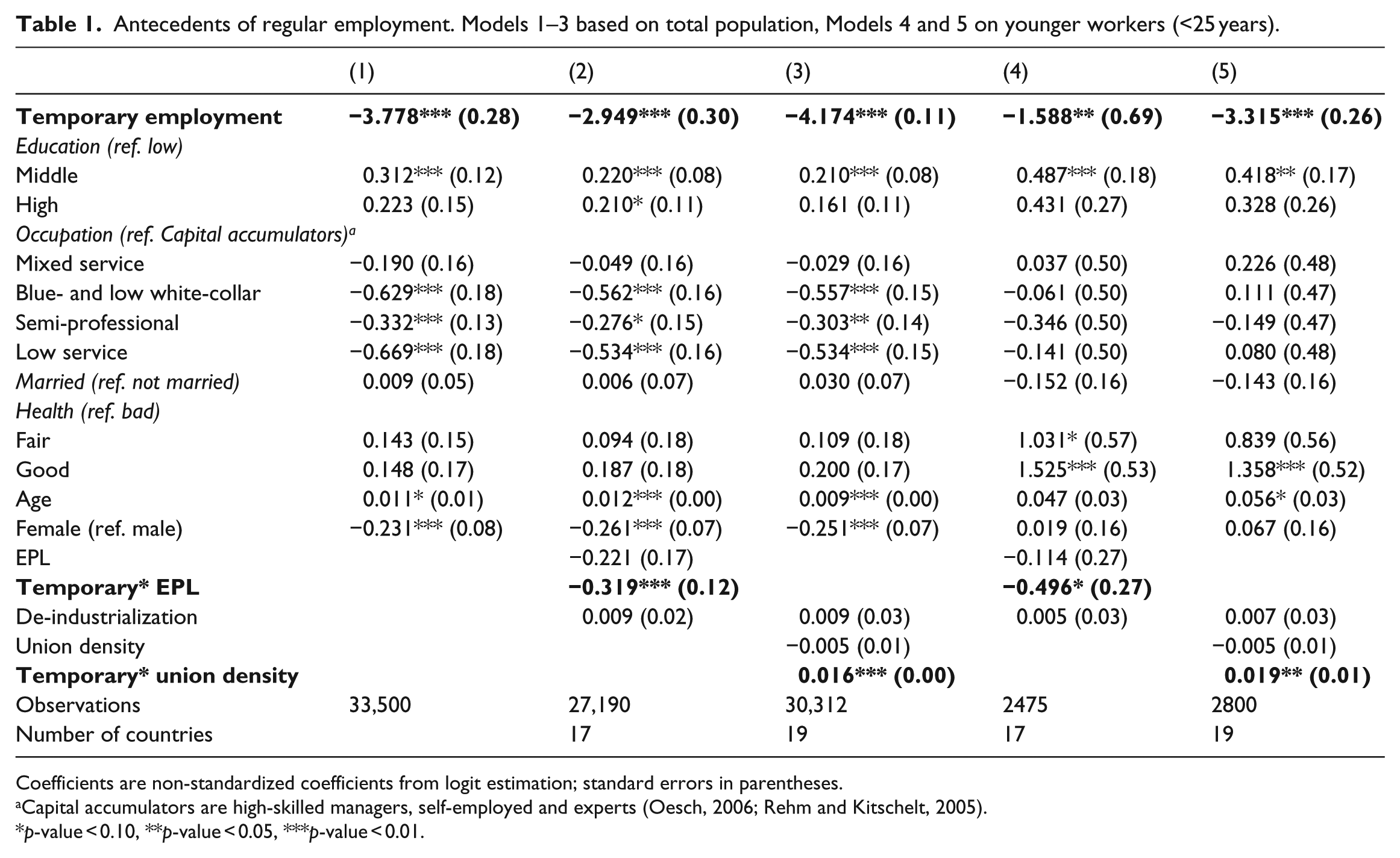
Table 1 displays the estimates for the probability of obtaining regular employment as a dependent variable. Model 1 confirms that temporary employment reduces the likelihood of working with a regular contract in the two subsequent years. More substantial are the results for Model 2: As expected, the stricter the EPL for regular employment, the lower are the chances of temporary workers being regularly employed in the following years, as indicated by the negative cross-level interaction term between temporary employment and EPL. By contrast – and corresponding to our expectations – strong unions mitigate the negative effect of temporary employment, as the positive interaction term between temporary employment and union density in Model 3 suggests. Apparently, powerful unions also defend the interests of temporary workers and facilitate their transition from temporary to permanent employment. This result confirms the expectation that the structure of unions’ membership affects their strategies. In highly organized countries (the ‘Northern path’ according to Benassi and Vlandas, 2013), unions also organize outsiders and hence defend their interests.
Antecedents of regular employment. Models 1–3 based on total population, Models 4 and 5 on younger workers (<25 years).
Coefficients are non-standardized coefficients from logit estimation; standard errors in parentheses.
Capital accumulators are high-skilled managers, self-employed and experts (Oesch, 2006; Rehm and Kitschelt, 2005).
p-value < 0.10, **p-value < 0.05, ***p-value < 0.01.
In all models, the control variables affect the probability of regular employment as expected: individuals with higher education, higher-level occupations, higher age and men have a higher chance of regular employment. A bad state of health reduces the likelihood of regular employment, while employment structure (share of service jobs) has no impact.
To substantiate these findings, Figure 1 shows marginal effects of temporary employment on the probability of regular employment contingent on EPL and on union density for the entire workforce. The lower part of the figure shows the effect for workers below the age of 25, while the upper part displays the same for older workers. The substantive impact of the interaction effects is considerable. Moving from the bottom (1.2) to the top (4.5) of the distribution of EPL increases the negative effect of temporary employment from around 30 to 45 percent. Correspondingly, moving from 30 to 77 percent union density reduces the negative effect from around 40 to less than 30 percent.
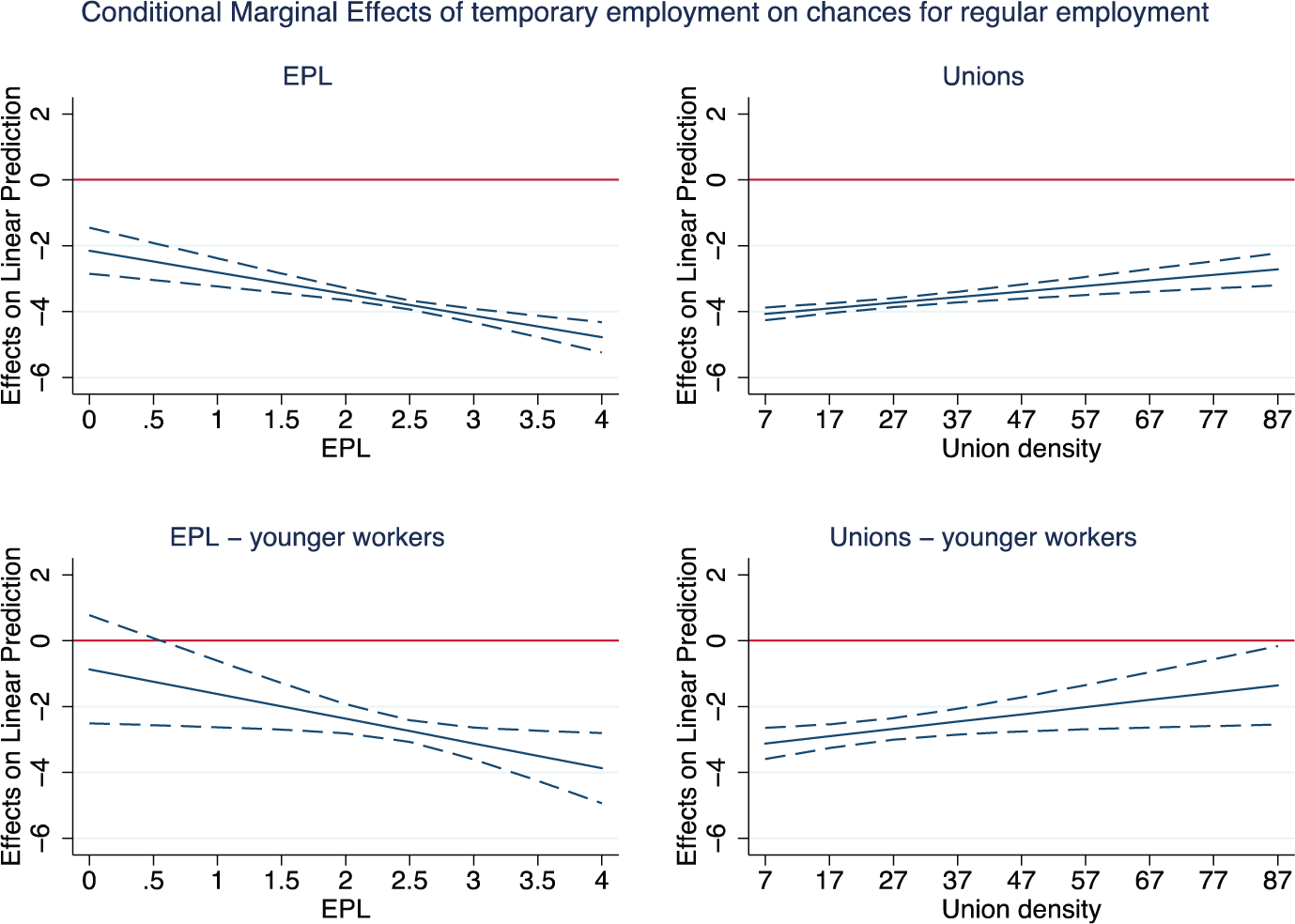
Marginal effect of temporary employment on changes for regular employment at varying levels of pro-insider institutions.
Turning to the effects of institutions on the labour market prospects of young temporary workers, Figure 1 suggests that the institutional setup is particularly relevant for younger workers: the higher the level of EPL, the stronger the marginal effect of temporary employment on regular employment for younger workers. It seems that in liberal labour markets, temporary work might indeed act as a stepping stone for younger labour market participants, but if labour markets are highly regulated and hiring and firing are costly, younger workers are more likely to remain stuck in temporary employment and become permanently disadvantaged. By contrast, the mitigating effect of union density on the disadvantage of temporary workers is largely comparable for younger and older workers. Only very highly organized unions render the negative effect of temporary work obsolete for younger workers.
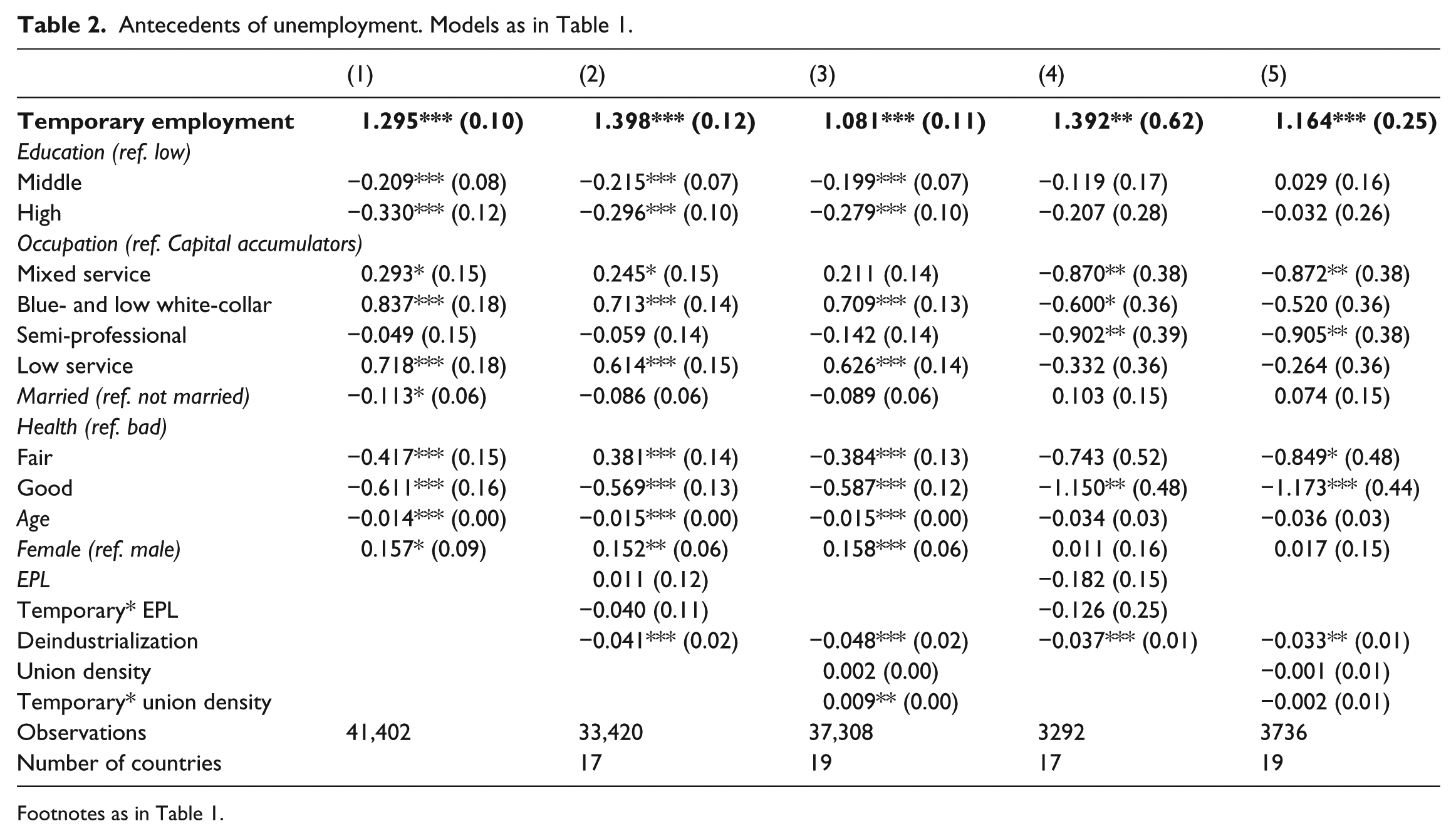
Table 2 presents the results of an identical analysis for unemployment risks. As expected, being in temporary employment significantly increases the risk of becoming unemployed in the next 2 years. Again, the control variables correspond to the theoretical expectations. Yet in contrast to the probability of regular employment, the institutional setting is of lesser importance for unemployment risk, as the insignificant interaction term between temporary employment and EPL in Model 2 indicates.
Antecedents of unemployment. Models as in Table 1.
Footnotes as in Table 1.
Figure 2 shows the marginal effects of temporary employment at different levels of EPL and union density. The effect on unemployment risk is significant, regardless of the level of EPL. Nevertheless, the lower part of Figure 2 shows an effect on the outsider penalty for younger workers, although small in substantive terms. Temporary employment is associated with a significantly higher unemployment risk for younger workers only if EPL exceeds 1.3. This critical value is not reached by Great Britain and only slightly exceeded by Ireland; hence, younger workers do not face a higher risk of unemployment in these countries. Regarding opportunities for regular employment, young workers with temporary contracts are only disadvantaged if regular employment is protected.
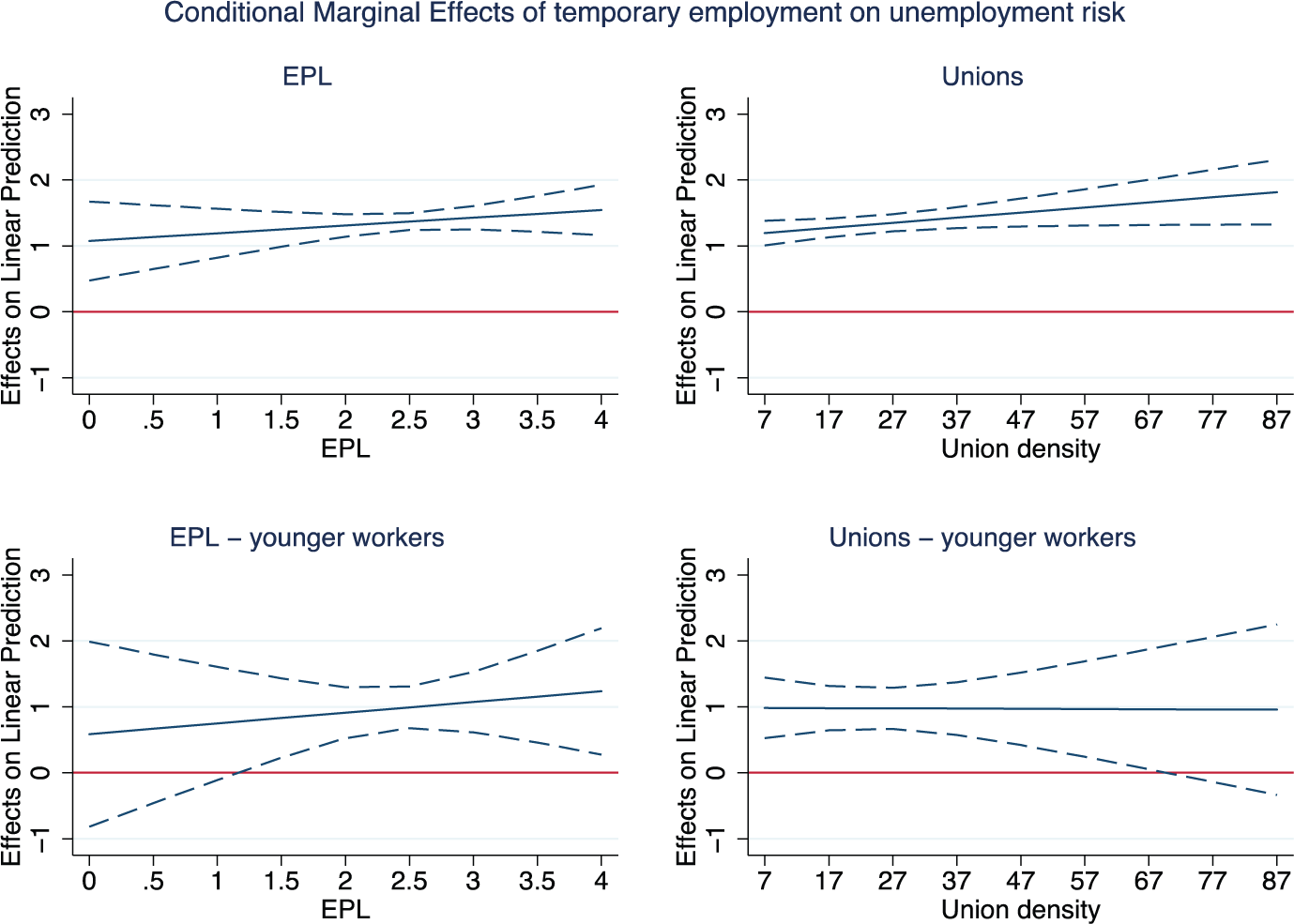
Marginal effects of temporary employment on unemployment risks at varying levels of pro-insider institutions.
The effect of union density is less consistent across the two dependent variables. In line with our expectations, unions tend to increase the outsider penalty with regard to risk of unemployment for older workers. For younger workers, by contrast, union strength does not alter the extent of disadvantage. Hence, our findings do not corroborate the idea of unions as protectors of insiders: strong unions seem to speed up the sorting process of temporary workers into either regular employment or unemployment. Yet, this reduction of temporary employment has the unintended side effect of faster dismissals. More research is needed in order to explain union strategies in the face of a dualized workforce; the work of Benassi and Vlandas (2013) on the conditions under which unions pursue an inclusive strategy toward outsiders is a promising start in this direction.
Robustness tests
Since cross-country analyses can be volatile, we perform various robustness checks (available upon request). First, we use a wide range of micro- and macro-control variables. Given the rather low number of observations at the macro-level, this is particularly important for the macro-variables since fully specified models might be criticized as over-parameterized. To begin, we replace deindustrialization (share of service sector employment) with gross domestic product (GDP) per capita and/or unemployment rate to control for the macroeconomic situation. We repeat this procedure with the first differences of these variables, since it is possible that changes rather than the level of macroeconomic conditions are important for labour market dynamics. In addition, we include the share of agricultural employment in the analysis because strong seasonal fluctuations of labour demand in this sector are likely to contribute to higher chances of unemployment and lower chances of regular employment. Finally, we control for the share of temporary employment and the share of part-time employment (as another type of non-standard employment). If the share of temporary employment is high, the likelihood of obtaining a regular contract is lower for a small segment of temporary employment because employers rely more heavily on non-regular employment (with the effect on becoming unemployed being less clear). We include two additional micro-control variables, chronic illness and job ratio, described above. In addition, we follow the standard procedure in labour market analyses to split the sample into males and females. Finally, we run the regression for prime-age and older worker (between 25 and 54 years and above the age of 55, respectively).
Our findings are robust to the different model specifications and alternative operationalizations. Including unemployment rate and GDP per capita, or the corresponding first differences, neither changes the results nor has a direct effect on unemployment risks and regular employment opportunities. GDP is significant for unemployment risk but the coefficient is negligible. The same holds true for changes in the set of micro-control variables and construction of sub-samples (men, women, prime-age and older worker only). The other macro-variables considered (share of temporary employment, part-time employment or the share of agricultural employment) do not change the results either. The effects of temporary employment and the institutional variables are sometimes higher and sometimes smaller than in our main specifications, but there is no clear pattern. Confidence intervals overlap in most cases, which implies that they are not significantly different.
The robustness tests for unemployment risk as dependent variable reveal a similar picture. Once again, EPL is of little relevance and the reinforcing effect of unions regarding the increased risk of unemployment is robust to alternative model specifications and alternative measurements, while the state of the economy does not alter our results either.
Finally, we included two additional micro-variables in the regressions (past employment history and a dummy variable that indicates chronic illness). Specifically, we calculate the incidence of time in employment since first entry in the labour market. While this variable is a good means of accounting for work experience, it is also a powerful measure to control for other unobservable differences between individuals. We initially excluded these variables because they are not available for all countries and thus lead to a loss of observations (a third of all respondents). However, the results remain substantially unchanged if included in the analyses (not shown, available upon request).
Conclusion
This article has analysed the cross-country variation in the unemployment risk of temporary workers compared to permanently employed workers, and their likelihood of obtaining regular employment. While labour economists and sociologists have shown that temporary workers suffer from economic disadvantages, comparative welfare state research has identified EPL and union strength as two institutional factors that affect the dualization between workers with temporary contracts and those in stable, permanent employment relationships. Building on this literature, we have proposed two explanations for cross-country variations in the extent of outsider disadvantage. First, we have tested the effect of the socio-economic composition of the outsider group on cross-country differences in outsider disadvantage; second, we have tested the effect of the two labour market institutions on outsiders’ disadvantages in attaining a stable employment situation. We expected the outsider penalty to be higher if the outsider group is composed of individuals with socio-economic characteristics that are negatively related to labour market success. In addition, we expected outsiders to be more disadvantaged in countries with strong EPL and weak unions. Our last expectation also concerned the effect of institutions on employment prospects of younger workers, as it is often argued that temporary work fulfils the function of a ‘stepping stone’ for younger workers during the transition from education to work.
Our micro- and multi-level logistic regression analysis of EU-SILC data leads to three main findings. Outsiders’ penalties vary between countries; in Spain and Greece, for example, temporary workers have a much higher additional risk of unemployment than in Austria or the United Kingdom. This cross-country variation is not, however, explained by the socio-economic composition of the outsider group but rather by the extent by which institutions protect insiders. We find that high EPL reinforces outsider disadvantages, increasing unemployment risks and reducing the likelihood of regular employment. With regard to union strength, our findings disconfirm the image of unions as insider organizations. Strong unions reduce the gap between insiders and outsiders in terms of probability of regular employment, but have slightly reinforcing effect on the higher risks of temporary workers becoming unemployed. We interpret these findings as evidence that unions speed up the sorting process of temporary workers to either regular employment or unemployment. The rationale behind this strategy by unions lies in the potential threat of a large group of temporary workers to their bargaining power. In this regard, our study contributes to the debate on the relationship between unions and labour market dualization. Our last finding relates to the effect of temporary work on employment prospects for younger workers. Our results suggest that temporary work is associated with lower opportunities for regular employment and higher unemployment risks for younger workers only in labour markets with a moderate to high level of EPL. In liberal labour markets, by contrast, temporary work indeed functions as a ‘stepping stone’ between education and work.
While our analysis has shed light on the reasons why outsiders are not equally disadvantaged, and in that sense on the extent of dualization, in different countries, it is obvious that many questions warrant further research. At the methodological level, this calls especially for improvements in cross-national micro-data, in particular data that would allow examining the wage penalty from a cross-national perspective. In terms of policy implications, our findings show that the intention of protecting workers from dismissals goes along with the unintended side effect of raising barriers for groups outside the core workforce. As a consequence, researchers and policy-makers should seek finer-grained regulations, to protect workers without creating new cleavages between them. Similarly, the question of how unions foster or resist labour market dualization merits more research. Another open question refers to the effect of the crisis on the outsider penalty. We have deliberately chosen pre-crisis data in order not to conflate the composition or institutional effects with the effects of the crisis. Yet one wonders whether the crisis has contributed to a widening of the outsider penalty in the crisis-hit countries or whether the extent of the employment crisis was so severe that even previously protected insiders have had to confront the vagaries of post-industrial labour markets.
Footnotes
Acknowledgements
We thank Marius Busemeyer, Aurélien Abrassart, Julian Garritzmann, Susanne Münn, Janis Vossiek, Roula Nezi, Erik Neimanns, Tobias Tober and two anonymous reviewers for valuable comments on previous versions of this article. In addition, we thank Lisa Tarzia for English language editing.
Declaration of Conflicting Interests
The author(s) declared no potential conflicts of interest with respect to the research, authorship, and/or publication of this article.
Funding
The author(s) disclosed receipt of the following financial support for the research, authorship, and/ or publication of this article: Our research was generously supported by the University of Bremen Collaborative Research Center 597, ‘Transformation of the State’.