



Abstract
Transformations of European labour markets and welfare systems have deepened the problem of precarious work, leading trade unions to develop strategies to represent and organize the workers affected. We focus on Italy and Spain, two of the countries with the most precarious labour markets in Europe, and address the specificity and variety of union responses. We relate these responses to the different institutional contexts, including employment and welfare regulation, and the power resources unions can draw upon.
Keywords
Introduction
Precarious work involves a combination of atypical employment contracts, limited or no social benefits and statutory entitlements, low wages and risks of occupational injury and disease (Evans and Gibb, 2009). Jobs in Italy and Spain are among the most precarious in Europe, and we investigate the variety and specificity of union practices and strategies to represent precarious workers’ interests, paying special attention to the institutional contexts and unions’ power resources.
Our analysis is based on 34 semi-structured interviews (15 in Italy and 19 in Spain), undertaken during 2011–2012 (with a follow-up in October 2014). We interviewed officers of federations representing atypical workers, where these existed, and of the self-employed and youth associations. We also analysed documentary data. In the Spanish case, we focused on Catalonia, one of the largest industrial regions and one of the main strongholds of Spanish unionism, and prototypical of practices to be later found in other regions of Spain (Fishman, 2004).
Union responses to precarious work in Europe
The growth of precarious work presents a dilemma for trade unions. On one hand, they can reject atypical work, insisting that jobs should be stable, with a clear relationship between employers and employees, and should guarantee a sufficient wage for workers and their families. On the other hand, they may recognize the existence of atypical work and adopt strategies aimed at improving the working conditions, social rights and wages of such workers.
Policies towards atypical workers and their specific interests are directly influenced by their general attitude towards atypical work. Heery (2009) illustrates four strategies that unions can adopt: their ‘exclusion’, the ‘subordination’ of their interests to those of ‘standard’ workers, their ‘inclusion’ and active ‘engagement’ in defending their interests. Trade union power resources (structural, associational, organizational, institutional, discursive and strategic) are as important as the unions’ general attitude towards atypical work, in understanding how they respond to the challenges of precarious work (Gumbrell-McCormick and Hyman, 2013). Considerations about strategies towards precarious workers are linked to debates about whether unions should abandon the ‘servicing model’ based on the provision of individual representation and collective bargaining and embrace an ‘organizing model’, where members are actively engaged and take responsibility in union activities (Fiorito and Jarley, 2009).
Given that there is little evidence of attitudinal differences towards union affiliation between typical and atypical workers (Kretsos, 2011), the lower union density among the latter is explained mainly by structural factors within labour markets, such as their weaker link to a single workplace and their higher tendency to be employed in sectors such as private services where union presence is weaker (Carré et al., 2000).
However, analyses based on a variety of institutional contexts bring diverse recommendations. Studies in the United Kingdom, for example, suggest that collective bargaining is ineffective because of the lack of a clear employer counterpart (Heery, 2009). Kretsos (2011), in an analysis of precarious work in Greece, advocates stronger organizing strategies to affiliate and mobilize atypical workers at the workplace. Similarly, Vandaele and Leschke (2010) conclude that the adoption of a simple organizing model is not sufficient to represent the interests of precarious workers; a well-designed mix of servicing and organizing is necessary.
Some studies have also raised the question of unions adapting their organizational structures to address precarious work. Gumbrell-McCormick (2010), for example, notes that in Italy, and to some extent in the Netherlands, unions form specific structures to represent atypical workers, while in other European countries unions rely on existing structures. The variation in union strategies towards precarious work points to the complex interaction between strategies and structures. The outcome is strongly influenced by the institutional environment in which unions are embedded and from which they derive their resources (Boxall, 2009). By drawing on this literature, we locate the responses of Spanish and Italian unions to precarious work in their institutional context and consider the resources they can use to protect precarious employees. We also consider the main features that shape what ‘precarious jobs’ mean in each national context.
Case selection
Italy and Spain have the highest incidence of precarious work and in-work risk of poverty in Europe (Keune, 2013: 6). The latter index increased between 2005 and 2010 from 8.8 to 9.4 percent in Italy and from 10.4 to 12.7 percent in Spain.
There are both differences and similarities between the countries. While self-employment is the dominant form of non-standard work in Italy, in Spain temporary employment is more common (Hipp et al., 2015). Although fixed-term employment has declined in Spain during the recession, it has always been exceptionally high in European terms, and substantially higher than in Italy, where the percentage of fixed-term contracts in 2001 was close to the European Union (EU) average. The incidence of youth employees (between 15 and 29 years) with a temporary contract became higher in Spain (49.3%) than in Italy (39.6%) in 2013 (Eurostat, 2013). Between 2005 and 2013, youth unemployment increased in Italy by almost 10 percent, while it remained relatively stable in Spain. Similarly, although employment protection legislation (EPL) has been reduced for both temporary and permanent employment in both countries since the mid-1990s, the decrease has been steeper in Italy, also resulting in some convergence (Table 1).
Labour market indicators.
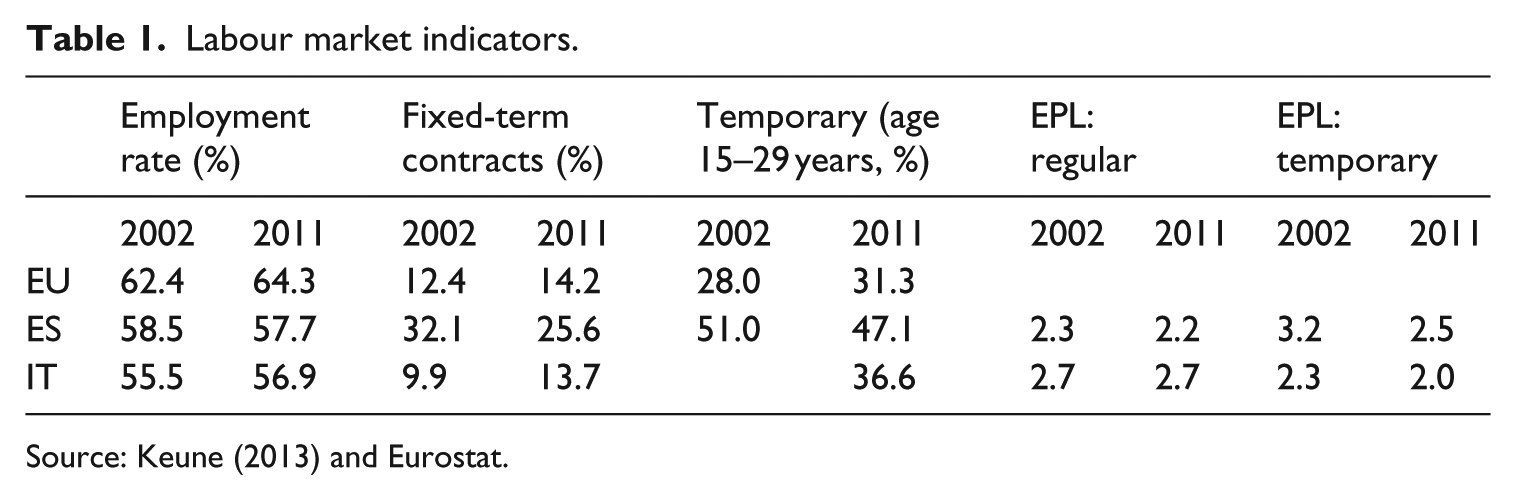
Source: Keune (2013) and Eurostat.
Union power in both countries depends more on the results of works council elections than on the number of members, but elections are more important in Spain than in Italy, where bargaining power at the workplace is traditionally strictly related to the capacity of the union to recruit and mobilize members (Terry, 1993). Italian trade unionism depends on a capacity to adapt to an inclusive range of actions, whereby representation is not simply understood as protection of members (Regalia, 2012). Spanish unions, by contrast, remain largely independent of membership levels, which are lower than in Italy. In both countries, as in most of Europe, young people are considerably less unionized than older workers.
Changing labour market regulation and precariousness
Italy
Labour market protection in Italy is not higher than in many other European countries (Burroni and Carrieri, 2013), but since the 1980s, the labour market has been made more flexible, with the introduction of work-and-training-contracts followed by a weakening of the strict rules on fixed-term contracts. New forms of self-employment, sub-contracting and false self-employment became more accessible for firms willing to compete on labour costs. However, the big change was made in 1997 by the centre-left government with the Treu Law, which aimed to increase employment by introducing agency work, liberalizing the job placement market and extending other forms of atypical work. The Berlusconi government in 2001 proceeded further with its White Paper (Libro Bianco) on the labour market, which was followed by the 2002 ‘Pact for Italy’ signed by Confindustria, the main employers’ organization, and two of the three main union confederations – but not the largest, CGIL. The Biagi Law of 2003 implemented many of the elements of the Pact, creating several new forms of atypical contracts. After this legislation, there have been more than 40 different types of employment relationships counted (Ballarino, 2005), of which only one (contratto di inserimento or access-to-work-contract) was abolished by the 2012 reform (Rymkevich, 2013).
Labour market deregulation went in parallel with the creation of less protected jobs, fostering labour market segmentation, more markedly in the 2000s (OECD, 2002). Overall, the result has been the creation of a form of precariousness tied to short job tenure, little or no social protection and the lack of basic rights such as sick-leave, maternity leave and paid vacations (Barbieri, 2011).
Although Italy is more or less in line with the EU average as regards the use of part-time and fixed-term work, it is remarkably above the EU average in the use of dependent and independent self-employment as well as informal and undeclared jobs (Altieri, 2009). Leonardi (2009) reports that self-employed workers represent 17 percent of national employment, and most of these comprise the so-called collaboratori coordinati e continuativi (co.co.co, or coordinated and continuous assistants), a semi-subordinate worker, legally autonomous but economically dependent. Together with ‘undeclared employees’, self-employment represents a peculiarly Italian way to flexibility and precariousness since unlike other atypical work they fall outside labour law protections. They include freelance coordinated workers, occasional freelance coordinated workers, occasional autonomous workers and project workers.
Although temporary agency workers have the same formal rights (particularly pay rates) as employees of the user firm, they have weaker income security for the periods of unemployment. This is one of the biggest problems faced by Italian atypical workers in general. Since the mid-2000s, several reforms were introduced to strengthen the duration and quantity of unemployment benefits, and the unions were actively engaged in their negotiation. However, the social security system remained largely unchanged, that is, tailored to the needs and characteristics of standard workers.
The lack of a fair and inclusive system of social protection in case of unemployment increases the precariousness felt by Italian atypical workers (Accornero, 2006). In addition, temporary workers are likely to receive lower wages than workers with standard contracts, independently of their level of qualification or seniority (IRES, 2010). In addition, expenditure on labour market policies, measured as a percentage of gross domestic product (GDP), is lower in Italy than in many European countries (including Spain). Although efforts have been made to extend social security guarantees to atypical employees, non-standard employment is still disadvantaged in comparison with standard employment. According to Berton et al. (2009), for example, around 90 percent of standard employment carries entitlement to unemployment benefits, but only 40 percent of temporary contracts and 30 percent of agency work. Similarly, welfare rights, particularly pensions, maternity and sick pay, are ‘weakly attainable’ (Kay et al., 2012). This may explain the pressing need for Italian trade unions to defend atypical workers by negotiating different reforms from the beginning of the 1990s, aimed at increasing the funds for social shock absorbers and extending these to workers previously excluded (fixed-term workers, apprentices and agency workers).
Spain
The current democratic regime in Spain was born at the height of the oil crises of the 1970s. The international competitiveness of Spanish companies was low, while Spain aspired to join the European Common Market. Confronted with unemployment as a major economic and political challenge, employment creation was a priority for the Partido Socialista Obrero Español (PSOE) when it won the 1982 general elections, but the new government viewed labour market deregulation as the primary way of achieving this goal. Employers’ interests focused on reducing dismissal costs, regarding these as an obstacle for employment creation. Conversely, the two main trade union confederations (CCOO and UGT) wanted to preserve the rights they had fought for at the end of Francoist dictatorship at the beginning of the democratic regime.
Not surprisingly, the brunt of the bargaining process between government, employers and unions was borne by those still to enter into the labour market (Fernández Macías, 2003). In 1984, the first labour market reform was agreed by PSOE, the employers’ association (CEOE) and the UGT, although it was rejected by the CCOO. The reform allowed an almost indiscriminate use of a new contrato temporal de fomento del empleo (CTFE, employment-promotion fixed-term contract), leaving severance payments for permanent contracts almost untouched. Temporary employment subsequently grew at a steep pace, leading to a reform in 1994, which virtually eliminated the CTFE.
The reforms of the 1980s and 1990s brought about a dramatic process of labour market segmentation. Labour market entrants in the next upward economic cycle were mostly hired with temporary contracts, which covered 73 percent of the new contracts in 1985–1993 (Conde-Ruiz et al., 2010). None of the reforms eliminated the problem of unemployment, and temporary employment proved to be a trap rather than a stepping stone towards permanent employment (García Polavieja, 2005).
It was not until 1997 that a new labour market reform explicitly addressed the problem generated by the growth of temporary employment. In return for gaining some ground lost in the decentralization of collective bargaining in the previous reform, the unions accepted less stringent rules on dismissal for a new type of permanent contract with lower severance payments (Molina, 2007). The reform also established stricter conditions for the use of temporary employment.
Although the 1997 reform was intended to reduce the rate of temporary employment, little was achieved. There was indeed a decrease in the use of temporary contracts by the private sector, but this was largely offset by an increase in the public sector, triggered in part by fiscal consolidation pursued by the Spanish government after the Maastricht Treaty (Dolado et al., 2002). Hence, the proportion of temporary contracts in the private sector fell from 41 to 26 percent between 1995 and 2009, but in the public sector there was an increase from 16 to 24 percent in the same period.
Union responses to precariousness
Italy
Despite the initial attempts of the Prodi government in 2007 to implement measures to improve unemployment benefit for young people, particularly entrapped in forms of precarious work, the very poor income when they are not working is still a key problem for Italian precarious workers, along with their inferior rights and labour conditions. This is a central factor in understanding how the Italian unions have responded to the challenge of precarious work, which is the protection of atypical workers through the creation of specific structures for the representation of those workers. According to the president of the CGIL federation for atypical workers, NIdiL (Nuove Identità di Lavoro), established in 1998, after the 1997 Treu reform, Italian unions have strategically chosen to represent workers by creating non-standard dedicated federations inside the confederations … this is in line with the Italian tradition of confederalismo … The aim is to promote the rights of atypical workers. We wanted to confer ‘dignity’ on atypical workers while setting up structures able to overcome the growing labour market segmentation based on the persistence of different social provisions between atypical and typical workers. (Interview, October 2014)
Also in 1998, CISL set up an association called Alai (Associazione Lavoratori Atipici e Interinali) since 2009 assigned the status of a federation, FeLSA (Federazione Lavoratori Somministrati Autonomi ed Atipici). In the same year, UIL created CPO (Comitati per l’Occupazione), from 2010 called Tem.p@.
The process that led to the creation of these structures started in the mid-1990s, when self-organized associations and networks were set up by groups of freelancers, such as the association Collaboratori e Consulenti Associati (Ballarino, 2005). For example, the creation of NIdiL was not just a top-down decision by CGIL; it was also supported by the self-organized precarious workers (Choi and Mattoni, 2010).
The organizational solution of separate structures for atypical workers is innovative since the common basis of representation in Italian unions has always been the sector or occupation. It is also quite different from the traditionally locally based offices or specialized work groups created by the unions to improve the organization and representation of women and immigrants (Cella, 2012). The new federations for atypical workers aim explicitly to increase the protection afforded to self-employed or semi-autonomous work (co.co.co.) and temporary workers through collective bargaining and shop-floor representation. NIdiL, for example, describes itself as a union that gives voice and representation to atypical workers without social protection. It claims to pursue two main goals: raising awareness of the issue of precarious work and the problems and realities of precarious workers, and improving working conditions for precarious workers through re-regulation and organizing at multiple levels in industrial sectors, in society and at the workplace.
Although the atypical federations represent a small proportion of the total precarious workforce, overall it looks more impressive than parallel efforts in other countries in Europe (Gumbrell-McCormick and Hyman, 2013). Membership in NIdiL increased from 16,800 in 2003 to 67,000 in 2012 and in FeLSA from 21,500 in 2003 to 44,300 in 2011. Tem.p@ does not publish membership data, but we were told that the figure was 20,100 in 2009 and 22,200 in 2010.
The new federations show clear differences as far as general strategy towards atypical work is concerned. For example, FeLSA and Temp.p@ tend to embrace an individual ‘servicing’ model to target atypical workers with different contractual situations and needs. By contrast, NIdiL stresses a labour law reform which would restrict the number of contractual options available to companies and strongly opposes the use of certain contracts, such as staff-leasing. Political bargaining is also a strategy directed at reducing the economic incentive to use atypical contracts, by increasing the contributions required to use them and hence discourage ‘contractual dumping’ by companies. An example of these differences is the attitude towards ‘bogus’ autonomous workers who in fact depend on a single company and are not covered by collective agreements. Italian atypical union federations tend to work at a decentralized level to regularize these situations, both through collective bargaining and by reporting illegal cases.
The new federations represent atypical workers in the political arena through national and company-level bargaining, political and legal action, campaigning and collective mobilization in order to harmonize the employment and social conditions (including wages) of typical and atypical workers and also to negotiate agreements (particularly within companies) to transform non-standard contracts into standard ones (Ballarino, 2005). In 2009, CGIL created a Youth Policies Department to raise awareness about youth policies at both national and regional levels, including all the different sectoral federations. In 2009, it launched a campaign, in conjunction with NIdiL, with the slogan Giovani non più disposti a tutto (young people no longer available for everything). As the president of the department explained, the campaign aimed at underlining that young people should not accept the current humiliating conditions to access the labour market, and the precarious jobs that are offered to them, and which do not allow them to build their own present and future. (Interview, October 2014)
The campaign was addressed to CGIL itself and to union representatives and delegates at all levels, in order to increase awareness inside the confederation but also to the general public. This is why several actions followed the launch of the campaign, which dominated the media, virtual networks and blogs. An example was the national assembly in July 2010 under the slogan Santa Impazienza! Lavoro e Diritti Ora! (Saint Impatience: Work and Rights Now!), followed national demonstrations in Rome in November 2010 and April 2011. This followed the San Precario movement launched in 2004, named after the ‘patron saint’ of temporary workers (Hyman, 2015).
Federations for atypical workers each develop their work within the framework of their individual confederations. This may raise concerns that these structures could become forms of segregation, and thereby further marginalization, for those workers inside the union (Murgia and Selmi, 2012). Yet as the president of NIdiL explained to us in an interview, the existence of federations for atypical workers allows the unions to coordinate their action with the sectoral federations, and thereby to promote a more general and encompassing agenda that gives space to the needs of atypical workers. On the other hand, although NIdiL follows the main political guidelines of the confederation to which it belongs to, it maintains its bargaining autonomy, which potentially strengthens the capacity of the federation to protect atypical workers through collective negotiation. In this respect, the president of NIdiL reported that by November 2014 they had already negotiated 15 company-level agreements under the contrattazione aziendale inclusiva (inclusive company-level bargaining) procedure, which reflects a union policy. The aim is to overcome workforce segmentation and the marginalization of the atypical workers by extending bargaining coverage and fostering transitions from atypical towards typical contracts.
In addition, the atypical workers’ federations have offered various services, particularly by disseminating of information on social protection, employment rights and the legal framework. For example, in 2008, a Sportello Orientamento al Lavoro Unificato (NIdiL-SOL, an integrated office for the job orientation of precarious young people) was created within the CGIL Camera del Lavoro in Milan to strengthen the organizational ties of the unions with the territorial level while helping precarious workers searching for ‘good quality jobs’. Unions intend to use these structures as a means to increase awareness of the ‘legal’ national labour market framework among precarious workers, thus acting as providers of education and learning activities to young workers.
For a long time, some sectoral federations felt threatened by the functioning and the existence of these new structures (Leonardi, 2010). In the case of CISL, Alai was not a federation until 2009, when its delegates acquired voting rights. Even now, all atypical federations complain of resistance of other (sectoral) federations to allowing their delegates approach workers or bargain with employers. The fundamental conflict is representational. As a representative from Alai explained, sectoral federations in Italy consider that there is no basic conflict of interest between typical and atypical workers and that the representation and defence of atypical workers should naturally be their task: ‘workers in the same workplace share all the same issues and interests’ (interview, February 2011).
In the case of CGIL, another reason is that sectoral unions oppose the fragmentation of the representation of workers and hence their representation on an individual basis. Federations of atypical workers, by contrast, consider that the sectoral unions may want to keep atypical workers in a precarious condition to protect workers on standard contracts. The dialogue between federations seems, however, to have improved in recent years. Industrial federations have acknowledged the important role and the success in recruitment played by atypical federations, while they appear themselves more inclined to include precarious workers’ issues on their agendas.
Specific strategies vary according to the workers’ contractual status and tend to adopt a ‘top-down’ approach in order to deal with the recruitment of atypical workers. As mentioned above, atypical federations signed a multi-employer collective agreement with the federation of employment agencies (Assolavoro) to cover agency workers. This was possible because of the existence of an employer organization comprising all temporary agencies and functioning as a bargaining counterpart. This contract makes the use of agency work quite expensive for companies but also ensures some flexibility for its use.
Resources for vocational training, health and safety and other welfare provisions are also jointly managed by Italian unions and the employers’ organization through the use of ‘bilateral’ structures which receive a generally positive evaluation by union officers. Another example is the collective agreement covering the so-called ‘Tagesmutter’ (day-care mothers) signed by FeLSA and Tem.p@ and the employer organization AssociazioneDomus. These strategies are adapted to the different sectors insofar as different sectors have different types of atypical workers.
The measures taken by the atypical workers’ federations to target precarious workers depend also on the relations with sectoral organizations and are intertwined with their specific strategies. There are cases where these strategies collide. The public sector is a clear example since the increasing use of atypical workers threatens the condition of permanent workers. Public sector unions place a strong emphasis on political pressure in order to limit the use of atypical workers, while atypical unions try to mobilize them in order to improve their working conditions.
Spain
Spanish unions have not created specific federations for the representation of temporary workers. As with other challenges faced throughout the 1980s and 1990s, they showed a preference for dealing with temporary employment at the top level, rather involving the rank-and-file, that is, responding to it politically, rather than organizationally. Despite (or perhaps because) their low membership rates, Spanish trade unions have always relied on institutions that reinforce their role, not so much at the base, but at higher levels in the national system of industrial relations (Ortiz, 1999).
At a broad political level, both UGT and CCOO initially acquiesced in the deregulation of temporary employment ‘at the margin’ of the labour market. But important distinctions in this respect should be made between these two confederations. The UGT, which was closely associated with the PSOE, supported the measures introduced by that party in government, but CCOO strongly opposed them, arguing that they undermined the employment security Spanish workers had previously enjoyed. One of our interviewees, a former general secretary of CCOO, reminded us that the first step in the deregulation of the Spanish labour market, the reforms adopted in 1984, came after an agreement between PSOE and UGT that was rejected by CCOO. And a general strike called by CCOO not long after, in 1985, did not obtain the support of UGT.
Despite its initial reluctance, such partial deregulation of the labour market was later assessed by CCOO as a minor loss, by comparison with deregulation of permanent work (Fernández Macías, 2003). Permanent workers were the core of trade union membership, and Spanish unions reacted accordingly. As a result, youth was to bear the brunt of the precarious employment that increased massively in the Spanish labour market in the following years. This may well be a reason why Juventud sin Futuro (Youth without a Future), a movement that denounced the precarious situation of young people in the labour market and arose at the same time as the Indignados in 2011, explicitly rejected links with any political party or, even more importantly, with any major trade union confederation. ‘They do not represent us’ was one of their slogans, referring to traditional political parties and trade unions alike (Flesher Fominaya, 2014, 2015; Hyman, 2015).
Yet, the priority that both CCOO and UGT gave towards their own members with standard contracts did not mean that they abandoned any attempt at combating temporary employment. On the contrary, according to Cerviño (2003), they were increasingly concerned with the alarming levels that temporary employment was reaching throughout the 1990s. For obvious reasons, given their short tenure in any workplace, temporary workers were less prone to become union members. In the long run, temporary employment could lead to an increasing ageing of union membership, a detachment of the unions from the Spanish working class and a loss of legitimacy among the public opinion as a whole. Hence, if only at a political level, the unions put the fight ‘for stable employment’ (por un empleo estable) at the forefront. The political struggle reached the point of calling a general strike in 1988 in opposition to the Plan de Empleo Juvenil (Youth Employment Plan), introduced by the PSOE government to facilitate temporary employment to an even greater extent than in 1984. The unions also fiercely opposed the introduction of private employment agencies (Empresas de Trabajo Temporal or ETTs) that served to generate another form of atypical employment (Cerviño, 2003).
The reduction in the costs of dismissing permanent workers, imposed in 1997, which reduced the incentive to hire temporary workers, can be seen as an additional sign of compromise by the Spanish trade unions, but here again the positions of the two confederations differed. In our interview, the CCOO former general secretary presented his union as primarily responsible for the concession, which in his view proved that the CCOO was more committed to eliminating the inequality between permanent and temporary work in Spain than was the UGT.
The increase in temporary employment in the public sector from 1997 onwards, though, reveals that such a measure was not enough to remove the strong segmentation of the Spanish labour market. Although the unions denounced the abusive resort to temporary employment by employers and the state, insiders’ job security was largely preserved and the flexibility of companies to deal with changes in product market demand was systematically attained using temporary employment as a buffer. The fight against temporary employment never crossed the line of making temporary and permanent workers’ employment conditions converge. Recent labour markets reforms in Spain have reduced the difference in protection between permanent and temporary contracts and were strongly opposed by the unions, which tried to defend the rights associated with open-ended contracts (Sanz de Miguel, 2011).
An organizational response to temporary employment such as that seen for Italy was in Spain more the exception than the rule. Yet, there were two organizational developments inside Spanish union confederations which resemble the role played by atypical workers’ federations in Italy: youth associations and, more importantly, specific organizations for the representation of self-employed workers. In the first case, Catalonia has been the pioneer. In 1997, the UGT created its youth organization Avalot, while in the following year the CCOO established Acció Jove (Youth Action). All members of UGT and CCOO aged under 30 years in Catalonia belong automatically to their respective youth association. The general aim of these associations is to give young union members advice about issues which specially affect them, such as housing and maternity leave. More generally, Acció Jove states on its website that its objective is ‘to transform the working and living conditions of Catalan youth’ and to advance their ‘civic and social rights’. Although it mentions that the employment status of young workers is ‘very often precarious’, the high incidence of temporary employment is not a priority for either association.
When we mentioned that in Italy the confederations have specific federations for atypical workers, one of the members of Acció Jove rejected the idea: ‘it makes no sense to set up a specific organization for that purpose. Temporary workers should not be represented according to the nature of their contract, but according to work they carry out’ (Interview, May 2011). A sign of the lower internal importance of Avalot and Acció Jove is the fact that they are associations, not federations, as in the Italian case. Both associations resemble youth associations in political parties, aimed at training cadres who will later be leading those federations: ‘the association was set up with the aim of becoming a school of cadres for the union’ (CCOO interview).
There are signs that the youth associations in Spain could develop a role in specifically representing atypical workers’ interests inside the structure of the union. According to some CCOO officials interviewed, Acció Jove did indeed serve a function defending atypical workers’ interests, in the same way that the secretariat for immigrant workers did. Conversely, interviewees in both associations mentioned the reluctance of the most powerful federations inside their union to accept the creation of Avalot and Acció Jove. The general secretary of UGT-Catalunya had to overcome the resistance of some federations, such as the metalworkers. Moreover, despite a general discourse of harmony between youth associations and federations, there seemed to be situations when a conflict of interest arose, as in the arrangement of lists for trade union elections at the workplace: if members of the youth associations were included there, there would be less room to accommodate older members.
Such a conflict of interests could overlap with that between temporary and permanent workers: in a workplace of the Iberia airline, luggage porters, overwhelmingly hired on a temporary basis, had been advised by the older union members to take their claims to Avalot. ‘Go to Avalot; here we will deal with all the important issues at the workplace. These workers soon realised they were not being properly represented by the trade union branch’ (interview, May 2011). Led by Avalot, these workers managed to call a workplace assembly and forced a change in the branch executive committee.
Despite these indications that youth associations might eventually become the embryo of future organizational units specifically aimed at representing atypical workers’ interests, it must be acknowledged that they were nothing equivalent to the atypical workers’ federations in Italy. They only defended atypical workers’ interests in a subsidiary way; they had not been set up to defend young workers because of the higher precariousness associated with youth in Spain.
More similar to the Italian atypical workers’ federations are the organizations for the self-employed workers set up inside CCOO and UGT. Again, Catalonia was the pioneer: CCOO-Catalunya established TRADE (Trabajadores Autónomos Dependientes or Treballadors Autònoms Dependents in Catalan) in its VII congress, in 2000. It represents self-employed who work primarily (at least 75%) for a single client, where the relationship can be regarded as bogus self-employment and analogous to other types of atypical work. In 2008, the CCOO Congress at the state level decided to upgrade such representation to the level of the whole confederation and to stimulate similar changes in the other regional federations. But TRADE never became more than a secretariat, and with the budget restrictions following the recession, it was downgraded to a department within the secretariat for Social Protection and Public Policies.
The representation of dependent self-employed was contested inside CCOO. A minority advocated the creation of a separate union federation; an opposing position (also a minority) rejected any separate representation for such workers; the intermediate one was the compromise that prevailed. Some interviewees were aware that Italian trade unions confederations had conferred a much more important representation to these interests, but they were critical of the strategy followed by their Italian counterparts. Conversely, the UGT did decide to create a separate structure for the self-employed, the Unión de Profesionales y Trabajadores Autónomos, but this is mainly oriented to genuine autonomous and professional workers.
Our account raises two questions: why was Catalonia a pioneer in these organizational developments; and why were self-employed workers able to attain a specific representation that other atypical workers did not. One of the leading regional officials of TRADE explained that half its membership comprised former standard employees whose services had been outsourced by the companies for which they still worked; previously, they had been union members in these companies. The other main group were workers who had become unemployed and were obliged to become self-employed because of the lack of standard jobs; many such workers would also have been previously unionized. Many interviewees described a high concentration of dependent self-employment in a number of occupations: lorry and van drivers were frequently described as paradigms of the member of TRADE. Such an occupational and sectoral concentration may also have favoured a higher degree of organizational representation inside CCOO.
As regards the pioneering role of Catalonia, several explanations were provided by the interviewees. Catalonia has traditionally been one of the leading industrial territories in Spain and, thus, one of the main strongholds of its labour movement: ‘considering that many dependent self-employed workers have industrial companies as their “customers,” it is not strange that TRADE was first established in Catalonia’ (former general secretary of CCOO). This interview also referred to the more ‘mature’ character of trade unionism in Catalonia, compared to other regional federations.
Explaining Italian and Spanish union response to precarious workers
Although some writers consider that unions protect insiders against outsiders (Lindbeck and Snower, 1986), in neither country did unions develop strategies of exclusion. However, we find diversity in the unions’ responses. This reflects the specific labour market, social welfare and industrial relations contexts and traditions, which confronted unions with different challenges and also provided diverse resources that they could deploy to respond to precarious work.
One of the biggest problems in Italy is the absence of a coherent reform of social security provision to cushion the social effects of labour market deregulation. Although trilateral social negotiations during the 1990s aimed at increasing the financial sustainability of the Italian pension system, they neglected another important pillar of the welfare system, unemployment protection for atypical workers and measures to support social rights (sick pay, maternity leave) for non-standard workers. Italian unions used their strong bargaining position at sector and company levels, as well as their horizontal and vertical organizational logic, to create structures for the representation of atypical workers in the political and social arena through national and company bargaining. Moreover, because of their strong bargaining activity in workplaces and sectors, they also used political action and campaigning to defend the interests of atypical workers. Although the Spanish unions gave the same importance as Italian unions to reducing precarious work, their initiatives have focused on the national level, as their organizational resources at the workplace are limited, reflecting their weaker bargaining position at local and sectoral levels. The resources Spanish unions can draw from union elections at the national or regional level undoubtedly shaped their strategic approach to precarious work.
In Spain, organizing has received less priority than in Italy, which nevertheless seems to share with Spain the focus on the revival of tripartite agreements in the political sphere. The strategies of the Spanish unions have been influenced by the incentives established by the system of workplace representation established by the 1980 Workers’ Statute (Estatuto de los Trabajadores) and the 1985 Union Rights Act (Ley Orgánica de Libertad Sindical, LOLS). LOLS created the status of ‘most representative union’ for unions that obtained at least 10 percent of votes in elections at national level (or 15% regionally); this entitles unions to participate in collective bargaining at sectoral, regional or national level and sign collective agreements that (through erga omnes extension clauses) apply to all workers in a given domain, regardless of union membership (Martinez Lucio, 1998).
In addition, state financial support also comes partly as a result of the number of representatives obtained at the union elections (Milner and Nombela, 1995). Although Spanish union finances are obscure, Escobar (1993) estimated for UGT that 41 percent of the annual income in 1986–1989 came from state subsidies. In relative terms, Spanish trade unions thus focus on workplace elections, and are less interested in recruiting new members insofar as these do not have the capacity to express their vote. As Malo (2006) shows, temporary workers have a lower propensity to participate in union elections because they are more likely to be unemployed at the moment of the election or to move to a different company and sector. As a result, macro-political pressure and nation-wide campaigns may be the most viable strategies for defending precarious workers’ interests within the Spanish context.
Although the two main trade union confederations have attempted to counteract declining membership by recruiting women, young workers and the large proportion of employees engaged in temporary contracts (Heery and Adler, 2004), initiatives of this kind have tended to remain rather symbolic as actual resources dedicated to this task are often meagre (Keune, 2013). Moreover, these activities were mostly coordinated centrally by the confederations, and the linkage with the workplace remained weak.
Conversely, Italian unions, besides their traditional activities of collective bargaining at industry and company levels, political initiatives directed at governments and the provision of advice and assistance to members and workers in general, developed a wide range of further actions which extends into other levels and in other directions. Notable are the inclusive company-level agreements concluded with employers for the protection of employment, but also services offered to precarious workers (as by NIdiL-SOL) and social and welfare schemes for the local population. Besides the traditional distributive and productive functions of the Italian unions, therefore, one may now also speak of them as the largest and most ubiquitous organizations in civil society (Regalia, 2012). They operate according to different logics, at various levels and in numerous arenas, and their organizational strength and influence in this respect are as great as their memberships.
In addition, Italian unions have historically relied on membership mobilization as the basic source of their power. It may be argued that the fall in union membership, particularly from the 1990s to the mid-2000s, pushed them to elaborate strategies aimed not only at macro-level labour market and welfare reforms but also at the recruitment, defence at the workplace and mobilization of precarious workers.
The fact that the strategies followed by trade unions in Italy and Spain reveal a clear national pattern explains why those of CGIL and CSIL, on one hand, are closer to each other than those strategies of UGT or CCOO, on the other. But important nuances or differences need to be noted, at least in the Spanish case. The difference between UGT and CCOO both at the political level (the CCOO stance on partial deregulation, when it was first introduced, and on precarious employment during the negotiation of the 1997 labour market reform) and at the organizational level (higher salience or importance of organizational developments such as TRADE) calls attention to the role of ideology in explaining different strategies for the representation of atypical workers’ interests.
Conclusion
Italian and Spanish unions have given different responses to a common challenge of rising precarious employment. Trade unions in Spain and Italy are embedded within distinctive institutional settings where precarious work originated and where unions could rely on specific resources in shaping their own responses.
In the context of weak unemployment insurance coverage for atypical workers, Italian unions have used their strong bargaining position at sector and company levels, as well as their horizontal and vertical organizational logics, to set up specific federations to recruit and represent atypical workers. It was a way to improve health and safety practices, promote forms of enhanced security and deliver additional benefits and welfare measures for precarious workers. Italian unions have also been active in organizing campaigns against the abuse of certain types of atypical contract. By contrast, given their weaker organizational and collaborative resources at workplace level, Spanish unions have not set up specific federations for atypical workers. Youth associations have indeed played a role in defending atypical workers’ interests, but they were not explicitly created for this purpose. The units set up to represent the dependent self-employed are closer to the role played by the Italian federations of atypical workers, but they do not have the same status within their confederations.
The different responses in the two countries reflect the reliance of Italian unions on micro-level membership compared to the stronger emphasis of Spanish unions on macro-level political dialogue and pressure. For Italian unions, atypical workers may provide a way to sustain membership levels and power at the micro level. The main Spanish confederations can instead rely on their status as ‘most representative unions’ to maintain their influence and gain legitimacy to engage in macro-level tripartite social dialogue. Further research on the differences in strategies across sectors, the internal process of structural changes (or attempts to achieve these) for the representation of atypical workers, and on experiences in other countries would help further verify this argument.
Despite clear national patterns in union responses to atypical work, there are differences within the Spanish case that allow us to conclude that ideological reasons also play an important role. Even if constrained by the same institutional environment, the two main confederations in Spain display meaningful differences: the strategic reaction of the CCOO is closer to that seen in Italy and closer therefore to an organizing model.
Footnotes
Acknowledgements
We are much grateful to both the Editor and the three reviewers for their insightful comments on an earlier version of this article.
Declaration of Conflicting Interests
The author(s) declared no potential conflicts of interest with respect to the research, authorship, and/or publication of this article.
Funding
The author(s) disclosed receipt of the following financial support for the research, authorship, and/or publication of this article: The Italian part of the research was supported by finance under the Dutch Onderzoektoelage OT/10/015.