



Abstract
This article focuses on changes in collective bargaining in Spain during the current phase of austerity. We evaluate how the decentralization and transformation of collective bargaining have affected industrial relations and forms of work and suggest that the policy reforms have led to a deterioration in working conditions and a weakening in collective regulation and trade unions. However, we emphasize the contradictory outcomes, which appear to be drawing the state into new more direct roles, bringing new actors (such as legal firms) into the deregulation of employment. This situation also raises a range of concerns among managers and employers at the repoliticization of industrial relations and generates further challenges to the ability of management and unions to sustain consensual forms of social dialogue.
Introduction
This article outlines some of the key industrial relations issues in Spain in light of the major legal reforms that have taken place since the start of the crisis in 2008. We examine how collective regulation is changing and the impact on the major actors, including ironically, those initiating the reforms. In our view, most of the ‘social partners’ are becoming aware that the Spanish labour market is now more dualist and fractured, and there are growing concerns about the risk of a politicization of labour relations, undermining the institutional progress of the past 40 years. There is a growing awareness that the role of the state needs to be enhanced in the context of decentralization, but there are doubts whether it is fit for this new deregulatory role.
Since the crisis began in 2008, there have been major transformations in industrial relations regulation in EU countries, especially in the South. Marginson and Welz (2014: 38) argue that Spain has been affected by changes in four of the five dimensions they examine: in the main levels of bargaining, in coordination mechanisms across bargaining units, in linkages between levels and in procedures for continuation of agreements beyond expiry. This represents a major change in the manner in which collective bargaining operates and provides ample space for employers to opt out of collective regulation. Curtarelli et al. (2014) argue that such changes – and austerity measures, in general – have affected a range of working conditions, creating greater job insecurity and also, to a lesser degree, affecting not only working hours arrangements but also health and safety.
The impact of the crisis is both quantitative and qualitative, and evaluating the latter is not straightforward. At a time of depression and recession, access to work is difficult and, hence, problems at work (real and perceived) may be suppressed. In Spain, the 25 percent unemployment rate means that fewer people will be willing to express grievances at work.
In a summary of the contradictions and issues emerging from the crisis, Broughton and Welz (2013) point out, however, that the general decline in joint regulation and negotiation has not necessarily meant a decline in the readiness of social partners to resolve issues and prescribe ways ahead. Yet, Marginson (2014) sounds a note of caution, arguing that the dismembering of collective regulation at the multi-employer level may have long-term consequences, and that there is a real challenge in terms of the capacities and abilities of industrial relations actors to deliver on the challenges of long-term planning and regulation. Such concerns are, indeed, expressed by leading officials of the Spanish employers’ organizations, trade unions and individual employers and managers.
While the crisis and austerity measures have contradictory effects in terms of work and employment, and social dialogue has not disappeared, we nevertheless see that the capacity to organize and to engage around a more qualitative employment agenda is being eroded. Rocha (2014) has shown how this is giving Spanish industrial relations a more authoritarian character. Our aim is to assess the qualitative changes and developments in terms of organizations and their concerns. How are these changes in the level, reach and content of collective bargaining understood, and with what effects? We suggest that the risks of these changes are recognized by many industrial relations actors, including managers themselves.
Our research is based on interviews at different levels in Spanish industrial relations. All 28 interviews, which were conducted during 2014, were carried out by the three authors and were audio-recorded and transcribed. They comprise two main categories: experts and social actors engaged with collective bargaining processes at sectoral and company levels. The former were a former Minister of Labour, two key academics linked to trade unions, the ex-director of labour relations of an employers’ association, one academic linked to a neoliberal think-tank and one specialist from a leading law firm. The social actors were six representatives, at varying levels, from the main trade unions and three leaders of employers’ associations, plus individuals involved in six case study companies. Two of these were from the automobile industry, three from the broader metal manufacturing industry and one from the chemical sector. In addition, we invited some interviewees to a national workshop, which led to discussion around various views of the reforms. In line with the requests of some of the interviewees, we have kept identities anonymous.
Our research had a different focus from other studies of crisis-induced changes because we were primarily concerned with how the reforms were understood by key experts and participants. We examined how the outcomes were understood and what kinds of risks and challenges were seen to emerge from these developments. How does the decentralization of collective bargaining, with decreasing reliance on the sectoral level, and the challenges to local management and trade unionists implied by such changes, for example, affect labour relations? And what is the effect in terms of the culture of social dialogue and the consensus that had been steadily developing within the Spanish system of industrial relations over the last four decades?
The Spanish system of labour relations
Before the crisis, the coverage of collective bargaining in Spain was among the highest in Europe, although its implementation was problematic. Since the development of a liberal democratic political system in the late 1970s, after the end of the Franco dictatorship, there was a continuous extension of collective bargaining (Martínez Lucio and Hamann, 2009). In addition, the steady emergence of a sectoral level of bargaining – for example, in the chemical industry – provided a basis for a more articulated structure of bargaining, with minima being established for specific sets of workers (Hamann, 2012: 150–154). While national agreements and pacts of a tripartite nature were high in number and varied according to scope, there was also, according to some, a continuous dialogue at peak level which ideologically or strategically framed the local practice of social dialogue (González Begega et al., 2015; Guillén Rodríguez and Gutiérrez Palacios, 2008). Encarnación (2003) argues that ‘Spain is deservedly regarded as the paradigmatic model of a pacted transition … Every kind of pact has been attempted in Spain: from secretive gentlemen’s agreements to grand social and economic accords enjoying tremendous public fanfare’ (p. 8).
In addition, the impact of coordinated national bargaining and political exchanges has ensured wage increases over time, suggesting continuing national dialogue – even if the forums are not always transparent, continuous and concrete (Martínez Lucio and Hamann, 2009). Collective bargaining covered issues at different levels, such as wage regulation, health and safety, training and measures to curb the dualization of the labour market. During the 1980s and up to 2010, collective bargaining covered over 80 percent of the workforce. In 2005, for example, 4647 collective agreements were signed covering 8,745,700 workers (Consejo Económico y Social, 2005: 330). From 1997 to 2004, there were between 3700 and 4200 agreements annually. Underpinning this, relative stability and consistency were the role of the two major trade union confederations, Comisiones Obreras (CCOO; Workers’ Commissions) and the Unión General de Trabajadores (UGT; General Union of Workers) which, since the late 1980s, had begun to work more closely together in their strategies on the development of collective bargaining. These unions receive the large part of the vote in the trade union elections which, every 4 years, determine the composition of works councils and individual workplace representatives. These competitive elections have tended to see these unions increase their share of delegates on such bodies from around 55 percent in 1978 to 75 percent in 2007 (Beneyto, 2008). The basic principles of the system can be summarized in three points: legitimacy of the ‘most representative unions’ to participate, which depends on support in the works council elections, rather than the number of members; the principle of statutory extension, which establishes that any collective agreement higher than the company level must be applied to all companies and to all workers forming part of the geographical and sectoral constituency; and ultractividad, which means that a formally expiring collective agreement remains valid if it is not renewed or renegotiated.
However, from the 1990s onwards, there emerged a discourse on the political right and in neoliberal-inclined sections of the Partido Socialista Obrero Español (PSOE) that questioned the effectiveness of existing structures of collective bargaining and labour market regulation and their perceived ‘rigidities’, especially in regard to employment termination. This narrative built on the market-centred politics of the PSOE government under González in the 1980s and early 1990s, which tended to favour privatization and limited social regulation and investment (Smith, 1998). Throughout the 1990s, a series of reforms to features of employment relations were enacted, partly through social pacts, and the cost to employers of dismissals was steadily decreased through reforms (Sola et al., 2013). Even so, there was a sense that the Spanish system was not as articulated and coordinated as generally assumed as discussed by Molina (2007).
The process of reform
The election of the conservative Partido Popular (PP) government in 2011 brought a politics of austerity, partly backed by the EU Commission, involving public sector expenditure cuts, reductions in public sector incomes and the containment of future public expenditure projects through privatization, especially in the health sector and parts of the public media. This involved the systematic deployment of coercive state responses to social and economic conflicts, limiting a number of social and political rights (redefining the nature of assemblies in public spaces and limiting the locations of mobilizations and demonstrations).
Governments responded to the crisis with several measures, particularly labour market reforms. Three were launched in little more than 18 months by the two cabinets that ran the country during the crisis, largely bypassing social partnership, particularly in the case of the PP government (Molina and Miguélez, 2013). The first reform, in June 2010, complemented the first austerity measures announced the previous month by the PSOE government under Zapatero (Sola et al., 2013). It was justified by stressing that the negative economic indicators reflected not only the financial crisis but also the outcome of imbalances in the Spanish labour market and industrial relations (a diagnosis shared by the Bank of Spain and various employers’ associations). This reform involved many changes, most significantly, the reduction of dismissal costs and the broadening of ‘objective causes’ by which firms could justify redundancies and opening the possibility for companies and employees to reach agreements derogating from sectoral collective agreements. This was attacked by the trade unions, who called a general strike in September 2010. However, this did not change the direction of government policies. By September 2011, a new reform was passed in response to external pressures; this led to a constitutional reform (agreed between the PSOE and PP) in order to give priority to external debt payments in the national budget and thus appease the international financial markets. Under the new PP government, the most profound reform took place in February 2012, provoking a general strike in March. This reform can be considered a landmark in Spanish industrial relations, reshaping the balance of power. Meardi (2014) summarizes its main points. The law enabled employers to introduce ‘internal flexibility’ without the need for trade union or works council consent; created a new form of employment contract, the contrato de apoyo a los emprendedores, with 1 year’s probation without employment security; reduced compensation for dismissals; increased the priority of a company over multi-employer agreements; and enabled employers in certain cases to reduce wages without union consent, subject to arbitration. These major changes also included the removal of ultra-actividad in collective agreements that are limited to a maximum of 2 years if they are not renewed.
The employers’ associations raised the demand to limit this ultra-actividad arrangement, particularly after 2010 when economic difficulties increased. The PSOE government responded, at the end of its period of office, with a reform which attempted to end the arrangements regarding whether agreements remain valid even after their expiry by imposing arbitration when employers and workers failed to reach a new agreement. However, this reform was immediately denounced as unconstitutional: an attempt to impose agreements on the social partners could be seen as violating the fundamental rights of a free market economy. When we interviewed Valeriano Gómez, the former Minister of Labour and one of the authors of this reform, he argued that a major weakness of the industrial relations system had been the inability to develop institutions of mediation and arbitration. Such institutions could impose agreements at a level appropriate to each dispute and on terms that would be mutually acceptable in terms of the balance of power between employers and employees. Under the existing system in Spain, however, in the absence of an agreement, the final resolution of the conflict normally takes place by resorting to the courts for their interpretation of the law.
The impact at the macro level: social dialogue in a fragmented context
These reforms have involved a range of legislative changes and innovations, designed to ‘modernize’ collective bargaining and link its process and outcomes to a greater focus on economic competitiveness. The aim has been to allow companies to reduce salary costs and achieve greater flexibility in the deployment of labour with regard to contracts, internal organization and dismissals. This has been almost mythologized through a discourse which emphasizes a vision of an intransigent and inflexible workforce (Fernández Rodríguez and Martínez Lucio, 2013). Second, the government believed that the only possible response to the level of unemployment – already high before 2008, but reaching 26 percent by 2012 – was to reduce wages and the cost of dismissal, which required legislation on reforming (decentralizing) collective bargaining. Third, the reforms come in the context of pressure by EU institutions to reduce the public deficit and debt in Spain (in great part caused by the banking crisis), which has focused on the need to reduce labour costs.
We should appreciate that, in some cases, the reforms had a specific effect in changing the nature of bargaining and a more general impact in modifying the actors’ expectations and calculations. The latter is important because the threat of using the legislation may itself affect the dynamics of industrial relations. One large metal company, for example, was able to achieve a significant reduction in wages on the grounds that other elements of terms and conditions of employment had not been reformed, thus sustaining the general processes of industrial relations.
Social dialogue continues to take place, but increasingly on the employers’ terms. According to an economist from the UGT,
The crisis makes negotiations difficult. The year with the most bargaining coverage in Spain was 2008, indeed, and since then it has gone downhill. It was logical, with the labour market changes, that coverage would be a little lower. However, since the reform of February 2012 … the loss of coverage has been brutal. This is because, among other things, the reform of 2012 made it possible to avoid ‘ultra-activity’ … This has made part of the process more troublesome, because when there was an expectation that collective agreements might cease to have an effect, then collective bargaining slowed down notably.
The legislative changes enable employers facing difficult organizational and economic circumstances to opt out of collective agreements and set the conditions of work unilaterally. Whether they do so depends not only on whether the firm still sees social dialogue as of value but also on political sensitivities in the regions where the firm is located; for instance, in the Basque country. It appears to be more commonly a case of employers threatening the use of the legislation in order to gain significant changes, especially pay reductions.
Restricting ultractividad has been considered a key issue in the reforms. According to the representative interviewed from the employers’ confederation Confederación Española de Organizaciones Empresariales (CEOE), this has been a long-term goal for the employers. In her view, trade unions always started from the position that the only option was to improve on previously agreed conditions, since they had no incentive to agree to anything they saw as a deterioration. Therefore, the reform would help to rebalance employment relations, according to her:
For example, regarding the issue of ultra-actividad, what we see is that it has been rebalanced as before there was no real balance whatsoever because, well, you knew that you would negotiate on the basis of what you had in the previous agreement. Therefore unions always started from a bottom line in the negotiations which was the earlier agreement, and simply demanded more wages, more free time, more holidays, more paid leave and so on. Hence there was not an equilibrium in the bargaining. What we understand then is that the reform of issues such as ultra-actividad have contributed to rebalance the imbalance that existed before. However, and logically, different social partners have completely different positions about this.
For the trade unions, the reform was part of a new opting-out strategy for firms. However, in practice and in order not to disrupt industrial relations seriously, employers often agreed with unions to preserve the contents of the previous agreements for several years. As a former CEOE official made clear: ‘trade unions and employers are equally fearful of not keeping the ultra-activity. That is, there are times when employers themselves are the ones who want to keep their ultra-activity agreement. … You can see many reasons for agreement between the two parties’. So, while employers as a whole appeared to support the reforms, on the ground and in key organizations, operationally they would attempt in many cases to make or extend agreements. This suggests that there was unease in various cases about the possible political impact of the legislation, as such. In addition, the employers’ side appears to be more fragmented in terms of interests and views than a superficial analysis would suggest.
Changes at the micro level: the risks of fragmentation
One of the main concerns relates to smaller firms, which depend for their industrial relations processes on higher levels of agreements which set a framework for local company bargaining. Trade unions involved in bargaining with small and medium-sized enterprises and the negotiation of provincial agreements have noted that firms are attempting to opt out of higher level agreements, or to downgrade negotiated conditions of employment, and are beginning to test the resolve and capacity of a union and its local representatives to counter this. Unions see a significant change in attitude, but there are some sectors where dialogue and informal relations remain strong.
There has been a clear downwards trend in the number of collective agreements in force, as Table 1 shows. The figures include both new agreements and those continuing in force; most agreements last for 1 year, but some for 2 years or more. It seems to be taking much longer than in the past to reach agreement because of the more difficult negotiating climate. There is also evidence of concession bargaining, with representatives accepting wage reductions so as to retain some semblance of a collective agreement and bargaining process.
New and continuing collective agreements and workers covered, 2008–2014.
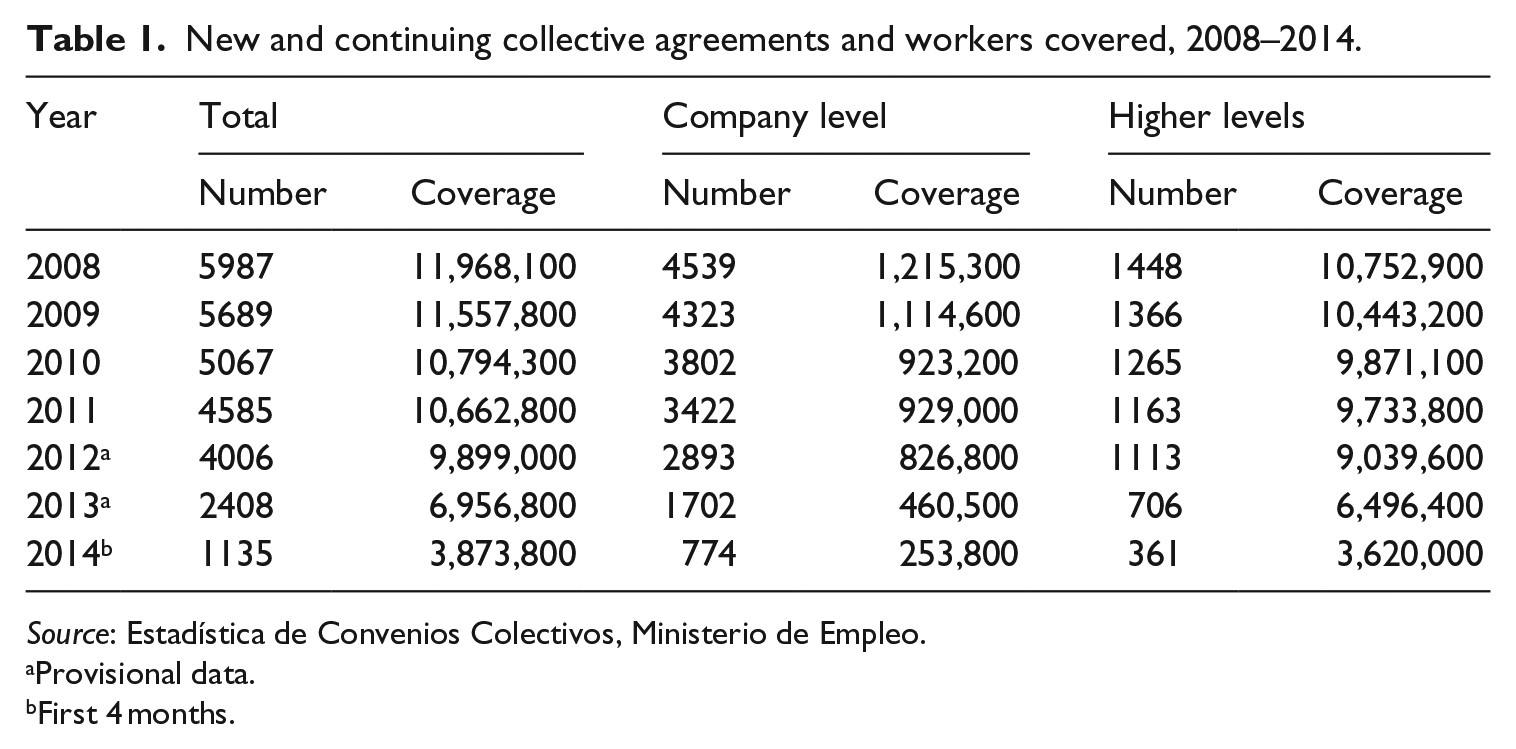
Source: Estadística de Convenios Colectivos, Ministerio de Empleo.
Provisional data.
First 4 months.
There has been a growth in the number of legal consultancies, which are establishing a network whereby companies can bypass established agreements. Smaller firms are turning to such legal firms and consultancies to steer through changes to company agreements and to undermine provincial agreements. Model agreements are circulated as a way to rethink the process of social dialogue. The trade unions at the regional and provincial levels had previously been able to use the 4-yearly trade union and works council elections to raise their representation within such workplaces, which are normally harder to reach because of their size and location. It was their practice to enter such workplaces ‘armed’ with the relevant provincial collective agreement which provided a point of legitimacy for the union as terms and conditions could be explained. The problem is that as companies opt out or bypass such agreements, their legitimacy become less significant. Thus, the issue of reaching smaller firms, especially during such workplace representative elections, has been an increasing challenge for the unions. There is evidence of greater difficulty in reaching such firms and communicating with workers as employers begin to opt out from the processes of social dialogue.
Nevertheless, divisions among employers over the perceived importance of social dialogue were apparent throughout the discussions held in our national workshop and in many interviews. Tensions between metal and chemical manufacturers trying to sustain dialogue ran up against the almost evangelically neoliberal organizations hostile to the established institutions. The more neoliberal positions seemed to have a simplistic and naïve view that industrial relations can be reformed by the state through legislation and had no real understanding of the way industrial relations systems have been constructed historically.
Various human resource and labour relations managers have become aware of a growing pressure on the majority unions which inhibits their ability or willingness to negotiate agreements that involve significant changes to working conditions. In one petrochemicals multinational, there were signs that more radical and militant minority unions were winning ground in relation to the majority unions. The fragmentation of the works councils in such firms, and any fissure between the majority unions, would make agreements in the future much more difficult. The majority unions were seen as being responsible or passive in the face of the reforms, and the new agreements that emerged could damage them in future works council elections.
One metal manufacturing multinational, which had decided not to engage fully with the reforms in collective bargaining in order to sustain the commitment to social dialogue central to its corporate identity, was seeing health and safety and workplace stress issues emerge as a new area of concern for trade unionists, especially those in more radical minority unions. The fear expressed, even in such cases where the reforms were not being fully implemented and traditional forms of bargaining were being sustained, was that the growing strain on the workforce of longer working hours or more ‘flexible’ forms of deployment in the organization would lead to greater emphasis and conflict around social and health-related issues at work. It might also result in a fragmentation of the focus of collective bargaining and labour relations more generally. While general mobilizations in the form of 24-hour strikes against the reforms and related public policy changes have been less apparent in the past year or so, there is a realization that the challenge will not be solely political tensions with management, but rather a growing fracturing in social dialogue. This confirms important insights by Fairbrother (1994) of the way decentralization can repoliticize industrial relations.
In the case of the national chemical sector agreement, many firms build their local and firm-specific negotiations on the back of this highly regarded agreement through implementation pacts. These allow firms to remove or underplay contentious and possibly conflict-generating agendas from their local bargaining and to focus on specific local issues. This was very important to those firms in regions with a more radical or unstable labour relations profile. Their concern was that any decentralization of bargaining and any systematic move to make the firm central to the regulation of employment could create a more politicized climate, according to the employers in such sectors, in relation to issues such as pay and working hours. The previous system had, to some extent, structured dialogue in ways that avoided conflict and a politicization of workplace issues. We need to recall that the tradition of a more radical unionism in Spain was strong and could well return to certain workplaces (Fernández Rodríguez et al., 2014).
Various managers who were interviewed pointed to the need to recognize the contribution of organized labour to Spanish economic and social progress and expressed concerns at the public discourse of the political right. Positive informal relations and good peak-level tripartite regulation are considered important in sustaining continuity, and this is more apparent for larger firms. They feared that this tradition could be lost in key sectors. A leading manager from a steel multinational argued that, even if it were accepted that some rebalancing of collective bargaining relations was essential, the failure to recall the sacrifices of trade unions in assisting the restructuring of the sector since the early 1980s meant that social dialogue could be undermined.
The consequences of hurried and fractured changes in collective bargaining processes may have even wider implications. The impact on equality within the firm may be serious, as the crisis and shortage of resources available to the social partners, especially unions, mean that there is less ability to provide training on equality-related issues at a time when state funding for training and social dialogue has been reduced. Recent Spanish legislation on equality expects firms to develop equality plans through their bargaining and social dialogue mechanisms. However, union experts responsible for equality argue that the pressures on their unions may lead to an emphasis on defending ‘core’ conditions, making them less proactive than in the past in monitoring equality plans. The fact that the interests of the Spanish economy and companies are visualized in terms of regulatory opt-outs by management, unilateral changes to working conditions, greater management prerogative in the deployment of labour and short-cuts in setting wage levels means that a deeper culture of dialogue on questions of equality for disadvantaged groups may be adversely affected. This is particularly important in Spain, where the equality agenda is, in comparative terms, at an embryonic stage. The broad trade union project of renewal and modernization since the 1990s was based on broadening the collective bargaining agenda, addressing new themes and deepening attention to issues such as health and safety. By default, this project has been undermined because of the pressures of sustaining collective bargaining and of salvaging agreements in smaller firms.
Moreover, the societal impact of the deregulation of collective bargaining has been extensive. The anxiety and fear expressed by Spaniards when interviewed about their future (Alonso et al., 2015) were strong when the crisis began but, following the reforms, the perception of growing inequality has become stronger. This is linked to a debate about salaries, sometimes difficult to grasp because of the complexity of the calculations and the different approaches taken by social and political actors regarding this issue. While surveys by the Instituto Nacional de Estadística show little change in aggregate income levels (a 1% decline), the Bank of Spain has suggested that the fall in wages may be greater (Romero, 2014). The annual survey of salaries (Encuesta Anual de Estructura Salarial) shows decreases since 2012, particularly in the more deregulated sectors of the economy, such as hospitality. Other researchers, such as the Colectivo Ioé (2015), highlight statistics from the Spanish Tax Agency (Agencia Estatal de Administración Tributaria (AEAT)) which imply that the average annual salary experienced a decrease of 10.4 percent between 2011 and 2014 (18.2% for people aged under 35 years). Finally, the inflation rate has been higher than the pay increases agreed through collective bargaining, reducing the purchasing power of employees. In sum, the collective bargaining reforms may well have encouraged an internal devaluation of wages.
Whither the state?
The irony of the deregulatory reforms is that the role of the state is, in some senses, expanded. In theory, it has to approve the unilateral actions of employers, which are being systematically challenged in the courts. This requires detailed scrutiny of individual cases, as recently with Coca-Cola and its redundancy programmes, which were not approved by the courts because of the lack of information provided to the works councils. In the case of Fnac, the French retail firm, the economic arguments prevented were seen as spurious grounds for restructuring. Hence, the reforms have the potential to politicize company restructuring, inhibiting negotiated agreement on changes to terms and conditions of employment.
The labour relations coordinator of the Federación Empresarial de la Industria Química Española (FEIQUE), the chemical employers’ organization, made the following point:
You always need an agreement with the workers’ representatives. That is, a company cannot opt out because it is necessary that workers’ representatives sign the agreement, unless there are real causes of economic crisis in the company. … Therefore opting out only works in those companies that are doing really badly [and where] workers understand what is going on and sign, because they know that either they sign the conditions of the opting out or the company simply goes bankrupt tomorrow. However, those other companies where causes are not as real,… well, they cannot opt out because they are unable to settle a deal with the workers’ representatives. And that is for me a problem that the reform leaves unresolved: what happens when there is no agreement in the opting out and in the derogations?
The problem, however, is that state agencies are not consistently intervening to resolve matters as intended, and not setting rates of pay and terms of conditions where there is no agreement. The courts and judicial processes are very slow in dealing with cases and appeals, and this creates a further regulatory vacuum, with employers acting unilaterally where they feel that they can. This feature of the Spanish labour courts has long been a challenge (Martínez Lucio, 1998). Courts play the role of facilitator of deregulation by default. Similar issues exist in relation to labour inspection, which, because of cuts driven by austerity policies, is unable to undertake the workplace inspections needed to monitor whether agreements are being honoured and general labour relations legislation applied.
In this sense, procedures that deserve greater attention are, without doubt, those related to mediation and arbitration, which many of the interviewees consider underdeveloped and in need of reform. Currently, when different interpretations arise regarding collective agreements, there is an advisory body in charge of finding solutions to resolve the conflict. It is a foundation with representatives from both trade unions and business organizations, known as Servicio Interconfederal de Mediación y Arbitraje (SIMA). If differences are not resolved with the assistance of SIMA, they may be directed to external arbitration. In this case, an arbitrator can be proposed by SIMA, usually an expert with experience in public administration or academia. However, while the advisory committee of SIMA has mediated successfully in thousands of cases, some of the experts interviewed claimed that there is room to improve the image, role and resources of the external arbitrator. According to a former leading official of CEOE, ‘the system, right now, has been focused on mediation and has not made the leap forward to arbitration. Why? Because there is still mistrust’.
Furthermore, there appear to be legal anomalies, especially in relation to the general rights of trade unions: the reforms are clearly undermining constitutionally based rights regarding voice and representation. In particular, during the last 2 years, 81 lawsuits have been brought against more than 300 strikers, of which over 260 are union representatives, several with regional executive positions within their unions. These lawsuits are based on a section of the Penal Code adopted in 1995 but never previously used, which opens the possibility of 6 months to 3 years imprisonment for ‘coercing others to start or continue a strike’. This is now used to target those involved in so-called ‘informational picketing’; in June 2014, two trade unionists were sentenced to 3 years in prison because of their participation in a picket during the general strike of 29 March 2012. They were accused, paradoxically, of crimes against the rights of workers. The exceptional nature of these lawsuits is that they have mostly been initiated at the request of public authorities and not by individual complainants.
Conclusion
One could question whether or not the reforms are successful and whether they are creating a broad shift in the culture and practices of the Spanish labour relations system (Rocha, 2014). From our point of view, the breadth and depth of joint regulation are in decline and the impact on working conditions has been negative. Not only have Spanish salaries suffered a decline, but there have been additional consequences. For instance, there has been an increase in the working poor, who account for 14.8 percent of the workers (Fundación FOESSA, 2014). Labour market reforms have brought wider options for individual and collective dismissals, and the financial costs are now substantially lower for firms but higher socially for workers (Fernández Rodríguez and Martínez Lucio, 2013). There is also a general trend of increasing vulnerability in the workplace and reduced job quality (Prieto, 2014). For Rocha (2014), the consequences are significant:
the new legal frame of the collective bargaining system has caused a rupture of the characteristic balance of power between employers and employees that lies in the roots of labour law. It can be affirmed that the 2012 legal reform has launched a radical change towards the consolidation of an authoritarian model of industrial relations, which exalts unilateral employer decision in working regulation as a principle of new labour law, impacting information, consultation and negotiation rights. (p. 205)
This raises broader concerns as to the social and economic effects of deregulation. However, we have focused on some more specific sets of issues. The first is that many organizations and individuals in key employer bodies express concern at the impact of the changes on social dialogue and consensus. There is a worry that these changes can undermine the voice of trade unions and their role in working alongside employers and the state in resolving major challenges to the economy. The fabric of social partners is under great stress. Then there is the problem that many organizations – and their managements – will be under enormous pressure, even if they appear to have gained a wider space for manoeuvre and greater powers in terms of their prerogative. They will be more open to litigation and less able to seek support from the workforce for their decisions. In the course of our research, we noted a real tension between different employer and management traditions: those who tend to support social dialogue and mutual collective bargaining are concerned for the long-term stability of the labour relations system.
What is more, it appears that the state, which is itself undergoing tremendous restructuring, is not able to service and support labour relations and social partners as effectively as in the past, at a time when individuals and organizations are increasingly turning to the state judicial and mediation services (as well as arbitration) for more assistance and intervention. The current changes in the role of the state run in parallel with a slowing up and overloading of the judiciary, which is confronted by increasing demands for litigation. Thus, greater decentralization means that the state is brought back into labour relations more directly, but without the necessary capacity to support social dialogue. The objective of the reforms was to push labour relations closer to the market, away from the political (or so goes the official rhetoric), but the outcomes seem more complex and contradictory. The irony is that the regulatory patchwork of the new labour relations could have an impact on the capacity of the social partners to regulate: the question is whether the political elites consider this to be a relevant issue in a Spain unable to generate basic employment.
Footnotes
Declaration of Conflicting Interests
The author(s) declared no potential conflicts of interest with respect to the research, authorship, and/or publication of this article.
Funding
The author(s) disclosed receipt of the following financial support for the research, authorship, and/or publication of this article: Our research was supported by the European Commission (Project number VS/2013/0409).