



Abstract
Over the last two decades, trade union membership in Central and Eastern Europe has been in continuous decline, and unions in the region are generally considered weak. However, little is known about the actual relevance of trade unions for individual workers in the post-socialist world. We explore the role that unions played in protecting their members from the negative effects of the global economic crisis. Using data for 21 post-socialist countries from the Life in Transition-2 survey, we find that union members were less likely than comparable non-members to lose their jobs during the crisis. This beneficial effect of union membership was particularly pronounced in countries which were hardest hit by the crisis. At the same time, union members were more likely to experience wage reductions, suggesting that unions were engaged in concession bargaining. Overall, our results challenge the common view that unions in the post-socialist countries are irrelevant.
Introduction
‘What unions do’ (Freeman and Medoff, 1984) has been a central question in the industrial relations and labour economics literature. The focus, however, has been limited in its geographical scope. Although extensive knowledge has been accumulated on the impact of trade union structures and practices on labour markets and individual workers in Western Europe, North America and Australasia (Bennett and Kaufman, 2007; Booth, 1995, for extensive reviews), much less is known for other market economies around the world. A major reason is the lack of suitable data, which has hindered detailed quantitative analyses of this kind. Moreover, the specific question of how unions protect their members in times of economic crisis has been overshadowed by investigations which rarely stress the specific time dimension as a relevant variable in the analysis. This is apparent in the vast literature examining the impact of unions on individual earnings (or ‘the union wage premium’: Bryson, 2014), a detailed reading of which reveals only a limited concern with the business cycle.
We address both these gaps by examining the relationship between individual trade union status and the probability of being affected by the recent economic crisis in the post-socialist countries of Central and Eastern Europe (CEE). Most of the literature studying industrial relations in the post-socialist world records the relative weakness of trade unions in these countries (Crowley, 2004; Kallaste and Woolfson, 2009; Ost, 2009; Visser, 2009). Our main objective is to assess this widely acknowledged weakness of CEE trade unions. To do this, we examine the relevance of union membership for individual workers during the global economic crisis and pose the following questions: Have union members been less likely to experience job loss, reduced working hours and salary reductions compared to their non-union counterparts? Have unions played a greater role in protecting their members in countries which were hit by the crisis harder? And what type of bargaining, if any, did unions undertake?
To answer these questions, we use data from a large survey (Life in Transition-2 survey (LITS-2)), conducted by the European Bank for Reconstruction and Development (EBRD) and the World Bank in 2010. 1 The survey contains rich information on how crisis affected individual and household labour market outcomes, respondents’ trade union membership status and a broad set of socio-demographic and job characteristics. This information allows us to examine the relationship between union membership status and the probability of experiencing a crisis-related job loss, a reduction in working hours and wages, and delayed or suspended wages. As we have information on a variety of ways in which crisis affected individuals and households, we are able to test for the incidence of insider and/or concession bargaining (Tijdens et al., 2014). Moreover, with data from virtually all post-socialist economies, we can test for a differential role of trade union membership depending on the severity of the crisis.
We find that union members in CEE countries have been less likely than non-members to lose their jobs, which is consistent with the role of trade unions as protective institutions that can shield their members from the adverse effects of the crisis. At the same time, union members have been more likely to experience a reduction in their working hours and overall wages. Taken together, these results point to the existence of some form of concession bargaining (where reductions in earnings are exchanged for job security). We also find that the negative relationship between membership and the probability of job loss appears to be stronger in the countries experiencing a steeper decline in their gross domestic product (GDP).
These results contribute to the literature on ‘what unions do’ in various ways. First, they provide empirical evidence that improves our understanding of ‘what unions do’ for workers in CEE, a part of the world where such evidence is lacking. Second, they challenge the common perception that trade unions in the post-socialist countries are weak and irrelevant. Third, they go beyond standard analyses of the union wage premium or the union effect on other labour market outcomes and explicitly consider the business cycle as a relevant factor in the analysis.
In the next section, we present a background to the research questions and outline the hypotheses we test. The following section describes in detail the data and variables we use, as well as our empirical methodology. Next, we present the results of our quantitative analysis. The final section concludes.
Background and hypotheses
Background
Despite sharing a common communist past, the 21 CEE countries on which we focus in this article have diverged in their development of political, social and economic institutions (Bohle and Greskovits, 2007; Feldmann, 2006; Glassner, 2013; Kahancová, 2013; Kubicek, 2002). The three Baltic States followed the neoliberal model (Bohle and Greskovits, 2007), with market-based coordination of economic relations and, in reference to industrial relations, low trade union density, low strike activity and fragmented bargaining that takes place mostly at the firm level. Similar features are observed in the Visegrád countries (the ‘embedded neoliberalism model’, according to Bohle and Greskovits, 2007), although sectoral bargaining is more widespread in Hungary, the Czech Republic and, especially, Slovakia. At the other extreme, Slovenia can be described as a coordinated market economy, with high union density, high mobilization power, centralized wage bargaining and social dialogue. Industrial relations in the former Soviet Union countries – Russia, Belarus, Ukraine and Moldova – display aspects of the former socialist model, with limited opportunities for the development of independent trade unions. These differences across the region can be explained by historical factors: for example, before the fall of socialism trade unions were more independent from political interference in former Yugoslavia (Grdešić, 2008), while the EU integration process has required the acceding countries to guarantee the freedom of trade union organization.
Although union membership has declined in the last three decades in almost all capitalist countries (Schnabel, 2013), this has been particularly pronounced in the CEE countries since their transition to democracy (Crowley, 2004; Ost, 2009). A recent overview of industrial relations systems in EU member states by Kahancová (2013: 60) reports that union density in EU-15 declined from 33 percent in 1990 to 24 percent in 2008. In the 10 CEE countries which joined the EU in 2004 and 2007, the figures were 59 percent in 1990 and 19 percent in 2008. Similar declines have been documented for almost all post-socialist countries of the CEE region: see Kubicek (2002) for evidence for Russia and Ukraine. Much of this decline is attributed to the passage from a system where union membership was de facto compulsory to a system of voluntary membership and to the concomitant rise of the non-unionized private sector (Crowley, 2004; Kubicek, 2002).
Irrespective of the country differences described at the outset of this section, there seems to exist a consensus that trade unions in CEE countries are weak, especially when compared to unions in Western Europe. They have been struggling to adapt to their radically different role within the new capitalist economies. Anecdotal and survey evidence suggests that people consider unions ineffective, irrelevant and ‘toothless’ (Blanchflower and Freeman, 1997; Kubicek, 2002), most likely associating them with the Soviet-era institution which was mainly responsible for the distribution of (important at the time) social benefits such as subsidized vacations, cultural activities, housing and childcare (Kubicek, 2002). Moreover, decentralized bargaining that mainly takes place at the level of the company, along with low overall union coverage and thus a large uncovered sector (Magda et al., 2012), are additional indications of union weakness.
Notwithstanding these broad accounts of the evolution and practices of trade unions and collective bargaining systems in CEE countries, much less is known about what unions do for their members and whether they still matter for individual workers. While declining union membership and disorganized, decentralized bargaining regimes may be an indication of overall union weakness and limited representativeness, this does not necessarily imply that in sectors and firms where unions still remain active their actions are irrelevant for individual union members (Blanchflower and Bryson, 2008). Moreover, apart from the fact that little empirical evidence is available on these issues, recent literature portrays a more complex picture. While earlier studies from post-socialist countries found a very weak impact of unions on wages (Neumann, 2002), more recent studies challenge this view. Magda et al. (2012) study the impact on wages of industry and company collective bargaining in the Czech Republic, Hungary and Poland and find significant positive effects. Croucher and Rizov (2012) report important differences among the post-socialist countries in union influence at enterprise level and a positive correlation between union influence and union density (where influence is proxied by subjective evaluations given by managers).
In theory, trade unions should also protect their members through their bargaining function from the adverse effects of economic crises by trying to secure members’ wages and jobs. As noted above, evidence from Western economies mainly focuses on the union wage premium while the role of the business cycle is rarely touched upon. This may be the result of the way union preferences are represented in the standard bargaining models of economic theory, which assume that unions have constant preferences and place greater weight on their members’ wages (Gahan, 2002; Tijdens et al., 2014). This is essentially a form of ‘insider’ bargaining, where unions secure the wages of their members. In this model, employers adjust profits or employment (through the use of ‘outsiders’, such as temporary workers). Consistent with this theoretical framework, there is evidence for the existence of a counter-cyclical wage premium in the United States and the United Kingdom (Bryson, 2014), while Tijdens et al. (2014) report that in the context of the recent economic crisis, employees covered by a collective agreement in Germany and the Netherlands more often reported workforce adjustments than wage adjustments.
The view that unions mainly care about the wages of their members is, however, a very restrictive conceptualization of union preferences and practices. In fact, insider bargaining should also ensure that not only the wages, but also the jobs of union members are secured. Survey evidence has shown that trade unions have multiple goals and bargain over a range of different issues, and they very often negotiate with employers when the issue at stake is employment reductions (Gahan, 2002). Consistent with this, evidence from Western countries indicates that unions protect their members from job losses: union members in Germany are less likely to be dismissed from their jobs than comparable non-members (Goerke and Pannenberg, 2011), and in Britain the rate of dismissals is lower in workplaces with higher union density (Antcliff and Saundry, 2009).
Much less is known about union behaviour during the recent economic crisis and its effects on individual workers. Tijdens et al. (2014) do not find evidence for ‘concession bargaining’ (where reductions in wages and/or working hours are exchanged for job security) in Germany and the Netherlands during the crisis. On the other hand, there is some empirical evidence that unions in post-socialist countries may have played an important role during the crisis period. First, Croucher and Rizov find that union influence in post-socialist countries is stronger during the downturn of the business cycle; such a relationship is not confirmed in their data for the United Kingdom. They explain this finding by referring to the historical legacy of communist industrial relations. The welfare (administration and allocation of benefits) and ‘legal watchdog’ functions of unions in these countries during the communist period remain significant today, and ‘demands for these services … will likely be higher when enterprises are in difficulty’ (Croucher and Rizov, 2012: 645). Second, Glassner (2013) reports examples of concession bargaining in some sectors and companies in Slovakia, the Czech Republic, Poland and Hungary. Job security for their members may have thus been a prime aim of unions in CEE countries during the recent crisis.
Hypotheses
Based on the above discussion, we formulate a set of hypotheses concerning the relationship between trade union membership and the probability of being affected by the recent economic crisis in the CEE countries.
First, a set of four hypotheses corresponds to the ‘insider bargaining’ role of trade unions. In this perspective, unions should have as their main aim to protect their members from job loss, a reduction in working hours or in overall wages, as well as from instances of wage arrears:
H1. Trade union members are less likely than non-members to lose their job during the crisis.
H2. Trade union members are less likely than non-members to experience a reduction in their working hours during the crisis.
H3. Trade union members are less likely than non-members to have their wages delayed or suspended during the crisis.
H4. Trade union members are less likely than non-members to have their wages reduced during the crisis.
Second, a different conceptualization of union behaviour assumes the existence of some form of ‘concession bargaining’. Here, a reduction in labour income (either through reduced working hours or reduced, delayed or suspended wages) is exchanged for job security:
H5. Trade union members are less likely than non-members to lose their jobs, but more likely to experience a reduction in working hours or reduced, delayed or suspended wages during the crisis.
A final hypothesis concerns the expectation that the union impact on individual workers will be larger in countries that were hit harder by the recent economic crisis:
H6. Trade unions play a more important role in shielding workers against the adverse effects of crisis in countries which are more strongly hit by the economic crisis.
These hypotheses are tested in the empirical analysis that follows.
Data, variables and estimation strategy
Description of survey data
Data for the empirical analysis come from the LITS-2, conducted by the EBRD and the World Bank in autumn 2010. A total of 28 post-socialist economies in CEE and Central Asia, together with Turkey, Mongolia and five Western European countries (France, Germany, Italy, Sweden and the United Kingdom), participated in the survey. The nationally representative samples consist of 1000 respondents per country (1500 respondents in the case of Russia, Ukraine, Uzbekistan, Serbia, Poland and the United Kingdom). In each country, households were selected according to a two-stage clustered stratified sampling procedure. In the first stage, the frame of primary sampling units was established using information on geo-administrative or electoral units. In the second stage, a random walk fieldwork procedure was used to select households within primary sampling units. Respondents within households were selected randomly using a selection grid. The number of households approached was based on the final sample target (1000 or 1500 depending on the country) and an estimated response rate. If the interviewer did not manage to interview a selected household (e.g. because no one opened the door) or a respondent within it (because s/he was not at home), repeat visits were conducted to ensure that the respondent took part in the survey. If the non-response rate was higher than expected, additional primary sample units and addresses were issued to achieve the target sample size. Steves (2011) provides further information on the survey design and implementation methodology.
Given the regional focus of the study, we concentrate on 21 CEE countries, which can be grouped into three blocs: (1) the new EU member states which joined the EU in 2004 (Czech Republic, Estonia, Hungary, Latvia, Lithuania, Poland, Slovakia and Slovenia) and 2007 (Bulgaria and Romania); (2) countries which have started accession negotiations or aspire to join the EU in the foreseeable future (Albania, Bosnia and Herzegovina, Croatia (which joined the EU after the survey, in 2013), former Yugoslav Republic (FYR) of Macedonia, Kosovo, Montenegro and Serbia); and (3) countries in the European periphery (Belarus, Moldova, Russia and Ukraine).
Dependent variables: the effect of crisis on individual workers
In line with our research hypotheses, we create several variables to capture the adverse effects of the crisis on individual labour market outcomes. These variables draw on the extensive information on the respondents’ labour market status available in the survey, as well as a separate section aimed at ascertaining the effects of the crisis at the household level.
Our first dependent variable is based on two consecutive questions from the labour market section of the survey. First, ‘did you work for income in the last 12 months?’ If the answer was affirmative, respondents were then asked, ‘Are you still working in this job?’ We create an indicator variable no longer working in the main job, which equals 1 if the respondent worked at some point in the 12 months prior to the interview but was not working in that job at the time of the interview, and 0 if the respondent was still working in the job. As in most countries of the region the crisis started in 2009 and the unemployment rate was rising in 2009 and 2010, we believe that much of the job loss captured by this variable will be crisis-related. Moreover, the survey also contains information about the reasons behind any job termination. In particular, respondents were asked to choose one of the five reasons: (1) was fired or made redundant, (2) quitted, (3) the job was seasonal, (4) was temporarily absent from job and (5) temporary closure (of the employing firm or workplace). We use this information to create a second indicator variable was fired or made redundant, which is a subset of no longer working in the main job, and captures the crisis-related job loss more closely.
Next, we make use of the survey section containing information on the household-level effects of the crisis. Respondents were asked, ‘how much, if at all, has the economic crisis affected your household in the last 2 years?’ Possible answers are ‘not at all’, ‘just a little’, ‘a fair amount’ and ‘a great deal’. For all answers except ‘not at all’, a follow-up question was asked: ‘how has the economic crisis affected you or other household members in the past two years?’ Possible answers included the following: head of household lost job, someone else in the household lost job, family business closed, working hours reduced, wages delayed or suspended, wages reduced, reduced flow of remittances, family members returned from abroad, someone who was working took a second job or additional work, increased hours in existing job and someone who was not working before found a new job. We concentrate on adverse labour market outcomes and create four indicator variables: head of household lost job, 2 working hours reduced, wages delayed or suspended and wages reduced.
Trade union membership
The indicator variable trade union member draws on the following question: ‘are you a member of a trade union?’ Possible answers are ‘yes, an active member’, ‘yes, a passive member’ and ‘no’. As people could interpret active and passive membership differently, we merge the two ‘yes’ answers. Thus, trade union member equals 1 if the respondent is a member (active or passive) of a trade union and 0 otherwise. 3
Control variables
In all our estimations, we include a range of socio-demographic and job-related control variables which might affect both the probability of being affected by the crisis and trade union membership status. At the individual level, we control for gender, six age groups and three education levels. At the household level, we control for the household position on a 10-step income ladder (as reported by the respondent), as well as a household wealth index, which is based on the information on whether the household has a car, secondary residence, bank account, credit card, debit card, mobile phone, computer and Internet access. 4
The survey also contains rich information about job characteristics for those who worked in the 12 months prior to the interview, regardless of whether they were working or not at the time of the interview. We include controls for firm sector and ownership (state-owned, private domestic, foreign), firm size, industry, occupation (8, 13 and 8 indicator variables, respectively) and an indicator variable for working informally (without a contract or labour book). 5
Finally, to control for all country-specific factors which might influence both trade union membership and the likelihood of being affected by crisis, country indicator variables are included in all estimations. This ensures that the relationship between the variables of interest is captured at the within-country level and is not driven by differences between countries.
Estimation strategy
The model explaining the likelihood of an individual being affected by the crisis (experiencing a job loss, reduction of working hours, wage cut or wage delay) can be expressed as follows
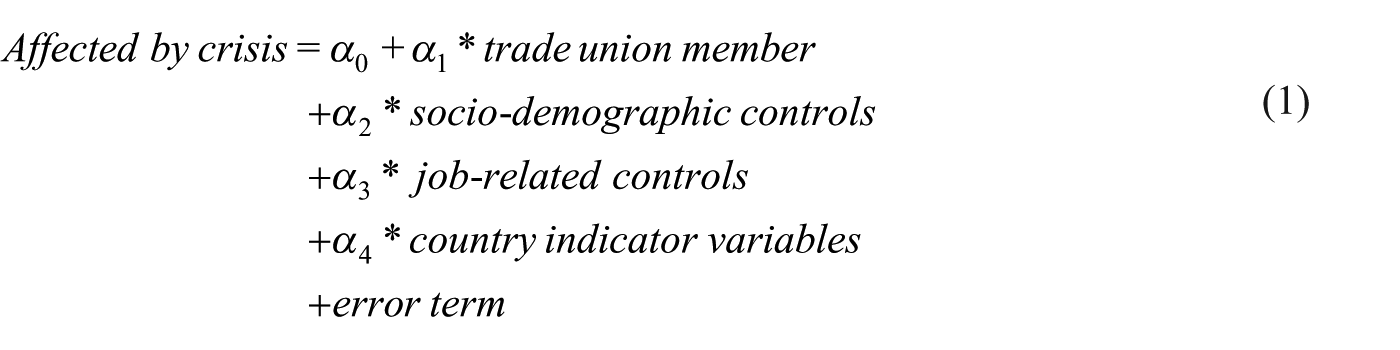
where α0–α4 are the parameters to be estimated through regression analysis.
As the variants of the dependent variable (job loss etc.) are binary, all model specifications are estimated with binary probit. We keep only the wage-employed (employees) in our final sample and exclude farmers, the self-employed and those who had not been working in the 12 months prior to the interview.
Our objective is to link the probability of being affected by the crisis with trade union membership. As information on both union membership and labour market participation (no longer working in the main job and fired or redundant) is available at the individual respondent level, no sample restrictions are necessary. However, for the questions asking about the effects of the crisis at the level of the household, information is only available for the head of household (head of household lost job) or for any, unspecified, household member (working hours reduced, wages delayed or suspended and wages reduced). To make sure that the estimations capture the relationship between the effects of the crisis and trade union membership for the same people, we restrict the sample for the head of household lost job specification to heads of households only. 6 For the working hours and the two wages specifications, we restrict the sample to one-person households only. While these restrictions result in a considerably smaller sample size for these models, they are necessary in order to ensure that the relationship between trade union membership and individual labour market outcomes are estimated in a meaningful way.
To test the hypothesis that trade unions played a more important role in countries which were hit harder by the crisis, we estimate a second set of specifications where an interaction term between trade union membership and the country GDP growth rate in 2009 is included alongside the trade union membership dummy. Given the difficulty in interpreting interaction effects in non-linear models, such as the binary probit (Ai and Norton, 2003), we estimate these models with the ordinary least squares (OLS) method.
Finally, as a robustness check, we estimate our models for three country groups: the new EU member states, the countries aspiring to join the EU and the countries in the EU periphery.
Results
Table 1 presents the results of the models estimated for all CEE countries combined in the same sample. For each regression, we report the result for the trade union membership variable only (the regressor of interest); the full set of estimates is available from the authors on request. To facilitate interpretation, we report probit marginal effects: the percentage change in the probability of being affected by the crisis when the regressor changes by one unit, that is, changing from 0 to 1 in the case of the union membership variable.
Trade union membership and the effects of the crisis: probit marginal effects.
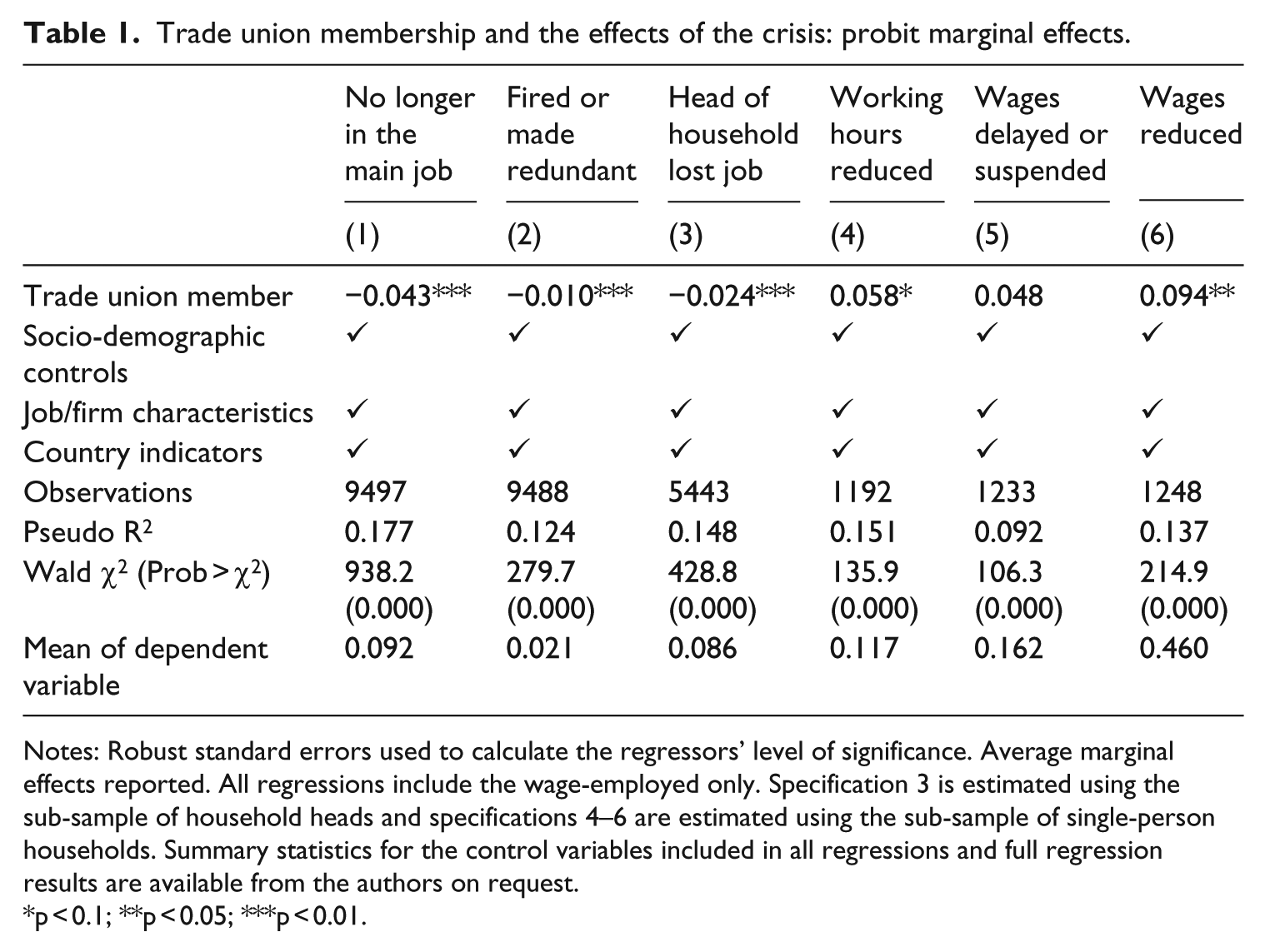
Notes: Robust standard errors used to calculate the regressors’ level of significance. Average marginal effects reported. All regressions include the wage-employed only. Specification 3 is estimated using the sub-sample of household heads and specifications 4–6 are estimated using the sub-sample of single-person households. Summary statistics for the control variables included in all regressions and full regression results are available from the authors on request.
p < 0.1; **p < 0.05; ***p < 0.01.
Column 1 reports the results for the model explaining the probability of no longer working in the main job. The marginal effect of trade union membership is negative and statistically significant. Keeping other factors constant, trade union membership decreases the probability of no longer working in the main job by 4.3 percentage points. This is a substantial effect, given that the probability of no longer working in the main job is 9.2 percent on average (see the last row of Table 1).
The results explaining the probability of having been fired or made redundant are reported in Column 2. The effect estimated for the trade union membership variable is again negative and statistically significant. Trade union members are 1 percentage point less likely to be fired or made redundant than similar non-members: again, a large effect relative to the average incidence of being fired or made redundant (2.1%).
The positive effect of trade union membership on retaining a job is further confirmed by specification 3, which explains the probability of crisis-induced job loss for heads of households (Column 3 of Table 1). Keeping other factors constant, heads of households who are members of a trade union are 2.4 percentage points less likely to report losing their job because of the crisis than their non-member counterparts. Again, relative to the mean of the dependent variable (8.6%), this effect is substantial, although somewhat smaller in relative terms than the effects for the first two job-loss-related variables.
Overall, the results for the three job-loss-related specifications provide strong support for hypothesis H1: trade union members were less likely than non-members to lose their jobs during the crisis in the CEE countries. This finding is consistent with the interpretation that trade union membership has been an effective protective mechanism for CEE workers during the recent downturn of the business cycle. It is also in line with evidence from Western Europe (Antcliff and Saundry, 2009; Goerke and Pannenberg, 2011) relating to the pre-crisis period.
Looking at the effects of crisis on other labour market outcomes, trade union members were 5.8 percentage points more likely to have their working hours reduced compared with non-members (Column 4). This effect is less precisely estimated than those associated with the job-loss specifications (only significant at the 0.10 level), but it is large relative to the average incidence of experiencing reduced working hours in our sample (11.7%). In contrast, the marginal effect of trade union membership is positive but statistically insignificant in the delayed or suspended wages specification (Column 5). This implies that union members were as likely to see their wages delayed or suspended as non-members. Finally, union members were 9.4 percentage points more likely than non-members to see their wages reduced (Column 6). This effect, significant at the 0.05 level, is equivalent to approximately one-fifth of the average incidence of receiving reduced wages during the crisis in the CEE countries (46%).
These results thus reject hypotheses H2, H3 and H4. Trade union membership does not seem to have protected employees in the CEE countries from reduced working hours and delayed, suspended or reduced wages. However, taken together, the results lend support to hypothesis H5. The evidence provided is consistent with the hypothesis that trade unions engaged in ‘concession bargaining’: relative to non-members, union members were less likely to lose their jobs, but more likely to experience reduced working hours and wages.
Next, we turn to testing the hypothesis that unions played a more important role in countries which were hit by the crisis to a greater extent. The results of the estimations which include the union membership and GDP growth interaction term are reported in Table 2. In specification 1, which explains the probability of no longer working in the main job, the coefficient of the trade union membership is negative, the interaction term is positive and both are statistically significant. This means that the positive relationship between trade union membership and the probability of keeping one’s job was amplified by a country’s GDP fall in 2009: unions appear more effective in countries which were harder hit by the crisis. For example, the model predicts that in Latvia, the country in our sample that was hardest hit by the crisis (GDP fell by 18% in 2009), union members were 7.6 percentage points less likely (and significantly so) to report that they stopped working relative to non-members. 7 This difference becomes smaller as a country’s GDP growth rate in 2009 becomes higher. Albania recorded the highest GDP growth rate in 2009 (3.3%) among the countries in our sample, and union members were as likely as non-members to report that they were no longer working in their main job (the difference of −0.6 percentage points is statistically insignificant).
Trade union membership, the effects of the crisis and GDP growth in 2009: OLS coefficients.

See Table 1 for notes.
A positive and statistically significant interaction term, along with a statistically insignificant coefficient of trade union membership, is found in the model which explains the probability of the crisis-induced job loss of the head of household (Column 3). This further confirms that trade unions were more instrumental in saving their members’ jobs in countries which were affected by the crisis to a greater extent. However, the interaction term is statistically insignificant in the model explaining the likelihood of being fired or made redundant (Column 2). In conjunction with a negative and significant coefficient of the union membership dummy, this result suggests that members of trade unions were less likely to be fired or made redundant than non-members regardless of the extent to which the country was affected by the economic crisis.
The interaction terms are also insignificant in the models explaining the probability of experiencing reduced working hours and reduced wages, while the union membership dummy in both cases is positive and statistically significant (Columns 4 and 6). This means that, regardless of GDP growth (or decline) in 2009, union members were more likely than non-members to work fewer hours and receive lower wages than before the crisis, leaving our conclusions derived from the baseline specifications in Table 1 unchanged.
An interesting result emerges in the model explaining the likelihood of experiencing delayed or suspended wages. Recall that in the baseline specification, the coefficient of trade union membership was statistically insignificant (Column 5 of Table 1), meaning that, on average, union members were as likely as non-members to experience delayed and/or suspended wages. However, including the interaction term reveals an effect of union membership that depends on the depth of the crisis experienced by each country. Both the trade union dummy and the interaction term are positive and statistically significant (Column 5), with the final effect of union membership shifting from positive to negative as the extent by which a country was hit by the crisis increases. Specifically, relative to non-members, union members were around 18 percentage points more likely than non-members to see their wages delayed or reduced in the country with the highest GDP growth in our sample (Albania) and 8.2 percentage points less likely to do so in the country with the lowest GDP growth (Latvia); both differences are statistically significant at the 0.10 level.
Taken together, the above results provide only partial support for H6. The evidence presented is consistent with the hypothesis that trade unions played a greater role in shielding against job losses and delayed or suspended wages in countries affected by the crisis to a greater extent. However, the baseline result of a positive relationship between union membership and experiencing reduced working hours or reduced wages appears to be independent of the depth of the crisis in CEE countries.
Robustness checks
Up to now, all our models were estimated for the full set of 21 CEE countries included together in the same sample. To examine the robustness of our baseline results, our final set of regressions separately estimates the baseline models for three geopolitical blocs: existing EU member states, countries that aspire to join the EU in the foreseeable future and the countries in the EU periphery. The results, reported in Table 3, suggest that in all three country groupings trade union membership is correlated with a reduced probability of no longer working in the main job (Column 1). However, union members were less likely than non-members to be fired or made redundant only in the EU periphery; the marginal effects in the two other groups are negative but statistically insignificant (Column 2). Conversely, in the model explaining job loss of the head of household, the marginal effect of union membership is negative and significant in the current and aspiring EU countries, but statistically insignificant (although also negative) in the EU periphery (Column 3). Taken together, it appears that, for some measure or another, the result of a reduced probability of losing one’s job among trade union members holds for all three geopolitical blocs.
Trade union membership and the effects of the crisis by geopolitical bloc: probit marginal effects.
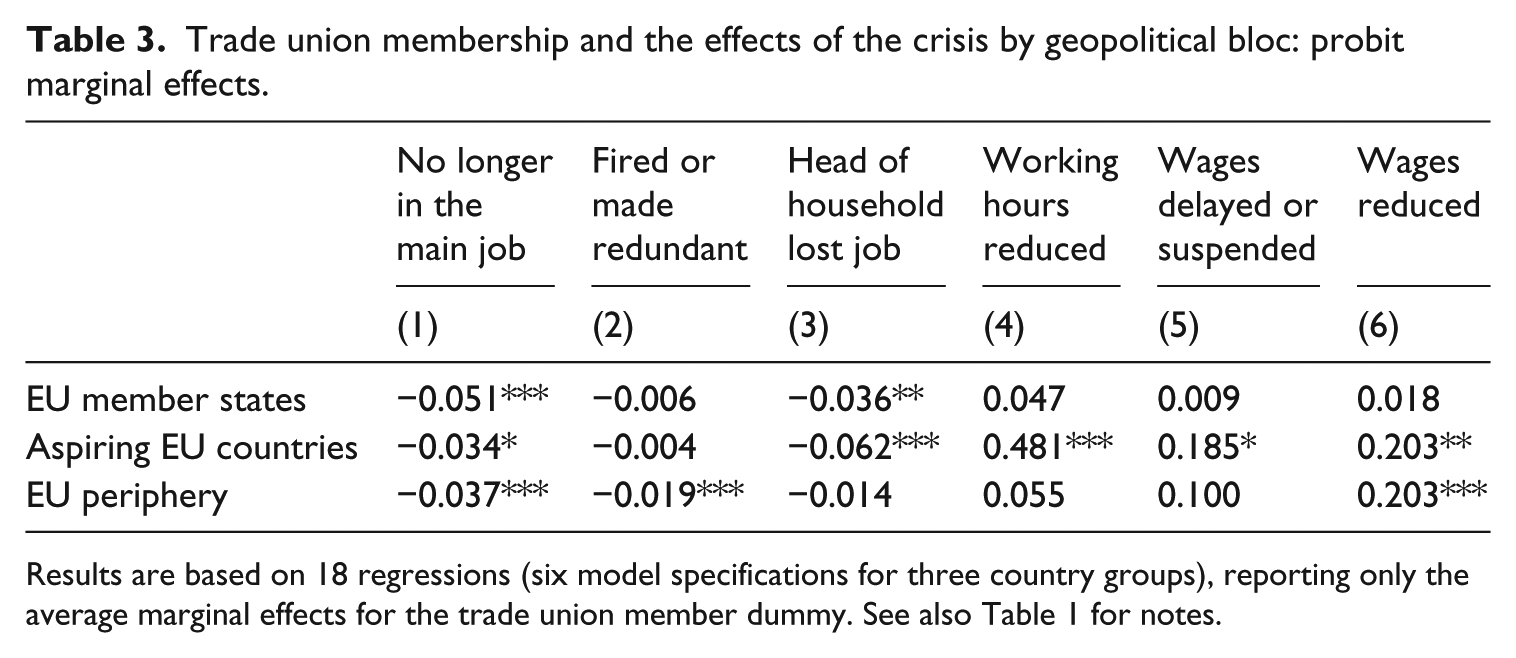
Results are based on 18 regressions (six model specifications for three country groups), reporting only the average marginal effects for the trade union member dummy. See also Table 1 for notes.
More prominent country-group differences are obtained in the models explaining the other three individual labour market outcomes (Columns 4–6). For the existing EU member states, the marginal effect of the union membership variable is insignificant in all three specifications, meaning that union members are equally likely as non-members to experience reduced working hours, delayed or suspended wages or reduced wages. In contrast, the marginal effect is positive, statistically significant and substantively large in all three models for the countries aspiring to join the EU. In the EU periphery, trade union members are more likely than non-members to have experienced a wage reduction because of the crisis, but experienced neither reduced working hours nor delayed or suspended wages.
To sum up, union members were less likely than comparable non-members to lose their jobs across the whole CEE region. However, a positive relationship between union membership and working reduced working hours, as well as experiencing delayed or suspended wages, is observed only for the aspiring EU states of Western Balkans. Finally, the positive association between union membership and reduced wages observed in the pooled sample is driven by the Western Balkans and the countries of the EU periphery. These differences across the three geopolitical groups are intriguing and require further analysis which is beyond the scope of this article.
Conclusion
We have examined whether trade unions protected their members from the adverse effects of the global economic crisis in the post-socialist CEE countries. In doing so, we addressed two gaps in the literature: first, we examined the relevance of trade unions for individual workers in an under-explored part of the world, the post-socialist European economies, and, second, we dealt explicitly with a specific time period, the recent global economic crisis, and investigated whether and how trade unions protected their members from its adverse effects. The regression analysis of the relationship between individual trade union membership and the probability of being affected by the crisis was based on data from a large representative survey conducted in 21 CEE countries.
Our results indicate that union members in the post-socialist countries were less likely than similar non-members to lose their jobs during the crisis, but more likely to experience a reduction in their working hours and salary. These findings are consistent with the existence of concession bargaining during the crisis, with unions exchanging a reduction in their members’ overall pay for job security. We also find that the larger the decline in a country’s GDP, the less likely union members are to lose their jobs. Considering regional differences, we find that union members were less likely than non-members to lose their jobs across the whole region: in the countries which have joined the EU, in the aspiring member states and in the countries on the European periphery. However, a greater probability of receiving a salary reduction among members was only observed in the aspiring EU states and on the European periphery.
Taken together, our results challenge the general view that CEE trade unions are weak and irrelevant. Corroborating the conclusions from recent empirical research in this area (Magda et al., 2012), it appears that unions in the post-socialist countries have been successful in protecting their members from job losses during the crisis and that they have done so more effectively in countries that experienced worse economic conditions. One implication is that the crisis may have increased the relevance of union membership in the eyes of individual workers; this could eventually convince more workers to join a union. Kallaste and Woolfson (2009) have recently pointed out that a sizable group of workers in the post-socialist countries are undecided about joining a union since they do not know what role unions play and whether they can effectively represent their members’ interests. Our results indicate that unions do matter for individual workers and that, with appropriate organizing drives, the large decline in membership observed in the last two decades could be reversed. This opens new questions: Have workers become better informed after the crisis about what trade unions do? Has trust in unions increased? Has actual membership increased, especially in the countries and sectors which suffered most from the crisis? These questions are left for future research.
Finally, we should note that our work is not without limitations. First, the evidence we provide can only be suggestive for the hypotheses we test. Exact causal effects of union membership on the probability of being affected by the crisis cannot be identified with cross-sectional data. This is an endemic problem in the literature studying the union impact on labour market outcomes (Bryson, 2014) since the process of becoming a union member is not random and there could be unobserved worker characteristics which drive both the selection into union membership and the likelihood of being affected by the crisis. Future research would need to make use of richer (preferably longitudinal) data, which would allow controlling for such confounding effects.
Second, our study looks at the overall relationship between union membership and specific labour market outcomes across 21 CEE countries. A focus on such a broad region does not enable a more detailed investigation of the specific ways in which trade unions and the overall industrial relations systems function in each of these countries. Although we have identified some similarities and differences in the relationships of interest between the three geopolitical blocs of the region, more work, both quantitative and qualitative, is necessary to explain these results and uncover any differences between individual countries.
Footnotes
Declaration of Conflicting Interests
The author(s) declared no potential conflicts of interest with respect to the research, authorship, and/or publication of this article.
Funding
The author(s) received no financial support for the research, authorship and/or publication of this article.