



Abstract
Do political attitudes influence the likelihood of employees being members of a trade union, and to what extent is this the case in the Nordic countries with their high aggregate levels of membership? In this article, I address these questions using European Social Survey data from 2012. The results show that left-wing political attitudes have the most impact on the likelihood of trade union membership in Sweden and to a lesser extent in Denmark. In Norway and Finland, there is no statistically significant impact. I argue that the impact of left-wing political attitudes on unionization in Sweden and Denmark reflects a conception among employees that trade unions are normative organizations.
Introduction
In international studies of industrial relations and unionization, the Nordic countries are often viewed as very similar. They all possess highly organized labour markets, high levels of unionization and well-functioning systems of industrial relations, but they also display differences. In this article, I discuss some of the key differences in unionization among four Nordic countries, Denmark, Sweden, Norway and Finland. I focus on the importance of political attitudes for membership of a trade union and examine whether and to what extent left-wing political orientations influence the likelihood of employees becoming members of a trade union and how far the patterns differ across the Nordic countries.
In the literature, political attitudes are among a number of attitudinal factors that have been shown to affect employees’ motivation to become and/or remain trade union members (Riley, 1997; Schnabel and Wagner, 2007). Trade union membership is often understood within an interest-based framework, focusing on how membership ensures higher wages, shorter working hours and similar benefits. However, attitudes towards broader issues of overall societal equality, solidarity, political attitudes and the like have also been shown to affect motives for becoming a member of a trade union (Ebbinghaus et al., 2011).
The analysis presented in this article is based on European Social Survey (ESS) and uses the 2012 data set. This data set contains information about trade union affiliation, political attitudes and a number of other areas. It has been widely used for comparative analysis of trade unions and unionization (Ebbinghaus et al., 2011; Schnabel, 2013).
Below I provide a brief description of theories regarding unionization and motivation for becoming or being a member of a trade union. I then present some observations about the trade unions and systems of industrial relations in the Nordic countries. Following this, I introduce the data set and the variables used and then present the statistical analysis. I go on to discuss the statistical results and present my conclusions.
Understanding unionization
Unionization and differences in density between countries or industries are traditionally understood within different types of theoretical and empirical frameworks (Hyman, 2001; Riley, 1997; Visser, 2006; Western, 1997). One theoretical framework highlights the importance of macro-level, structural and institutional determinants that govern the overall degree of unionization or changes in density (Checchi and Visser, 2005). Other frameworks focus more on the micro-level and on how and why individual employees choose to join or not to join a trade union (Olson, 1965; Scheuer, 2011; Schnabel, 2013; Schnabel and Wagner, 2007).
Analysis focusing on the more structural influences stresses the importance of factors such as industrial sector, gender distribution (Ebbinghaus and Visser, 1999), full-time versus part-time employment, globalization (Scruggs and Lange, 2002) and similar characteristics of the labour market in explaining the extent of or changes in unionization. Expansion of the services sector and decline in the industrial sector tend to lead to lower aggregate levels of unionization because service sector employees generally tend to be less unionized. Changes in the composition of employment in different sectors are thus regarded as structural determinants of changes in levels of unionization (Schmitt and Mitukiewicz, 2012). Similarly, institutional characteristics of the labour market can affect levels of unionization (Western, 1997). If employees in one country can obtain a tax deduction for union membership subscriptions, while those in another cannot, this may explain part of the difference in levels of unionization between countries (Kjellberg, 2011). The effects of institutional characteristics on trade unions and trade union support are also highlighted within the ‘varieties of capitalism’ literature, such as in studies of employer attitudes towards trade unions (Hall and Soskice, 2001; Rueda and Pontusson, 2000). A classical institutional characteristic used to explain differences in levels of unionization between countries is the ‘Ghent system’, whereby trade unions have responsibility for administering a voluntary unemployment benefit system. Studies show that countries with such a system generally have higher levels of unionization (Ebbinghaus et al., 2011; Van Rie et al., 2011).
Theoretical frameworks focusing on the individual employee often use a micro-oriented, rational-choice perspective. Membership of a trade union is explained as a consequence of calculative decisions by individual employees, who choose to become a member of a trade union if they expect to gain more from membership (e.g. through higher wages, better working conditions or greater security) than the costs. The classical text developing this perspective is by Olson (1965), who applies a rational-choice perspective to discuss positive and negative incentives for joining a trade union.
Micro-oriented explanations are sometimes used within a rather broad understanding of rational-choice theory that includes types of rationality that are not only instrumental. For example, Ebbinghaus et al. (2011) argue for the use of a Weberian conceptualization of rationality, which besides ‘instrumental rationality’ includes ‘value rationality’, ‘traditional rationality’ and ‘emotional rationality’ (Weber, 1968). Membership motivations embedded in value rationality would relate to factors such as political attitudes and identity formation. Emotional and traditional forms of rationality dominate when union membership is tied to belonging in a union community (emotional attachment to a union) or family tradition of union membership.
In this article, I focus on the impact of political attitudes, understood as a motivation for being (or not being) a member of a trade union that relates to a rationality based on values. If we examine the research literature on trade unions, it is possible to find some support for the impact of political attitudes on unionization (Frangi and Barisione, 2015). For example, Schnabel and Wagner (2007) argue that left-wing orientations could be expected to indicate a value orientation that has a positive effect on employees’ motivation to join a trade union. However, they also indicate that it depends on the specific characteristics of a given trade union movement: the socialist roots of the labour movement in many countries suggest that left-wing views should be associated with a higher probability of union membership …, but in other countries (parts of) union movements have different political affiliations, so that the outcome is really an empirical matter.
The study of unionization in Europe by Ebbinghaus et al. (2011: 118) also confirms the possible impact of political attitudes on unionization: they show that left-wing political attitudes generally increase the likelihood of being member of a trade union (controlled for a number of other variables).
However, studies show that the importance of socialist values as a motivation for trade union membership diminishes as societies become post-industrial. Some conclude that changes in the social structure influence the impact of political values on unionization (Curtice and Mair, 2005). A traditional explanation for this diminishing impact focuses on changes in the social structure, which cause political attitudes to be generally less significant for trade union membership. Some scholars have argued that as industrial societies are replaced by post-industrial, traditional class policies become less important not only in the political system but also among the trade unions (Curtice and Mair, 2005). This implies that left-wing policy orientations lose ground as a motivational factor for employees when they consider whether to join a trade union. Trade unions no longer represent predominantly working-class positions and left-wing views: they have a broader political attitude, representing both ‘left-wing’ and ‘right wing’ points of view.
Another factor affecting the likelihood of employees joining a trade union for political reasons relates to the organizational strategies and behaviour of the trade unions themselves. Over 50 years ago, Etzioni (1961) argued that organizations can be described in relation to their strategies for establishing compliance and integration of their members; he distinguished between normative, remunerative and coercive motivations. Windolf and Haas (1989) have elaborated this analysis as follows: the normative organization tries to attract members by offering normative orientations, belief systems, and a solidary community (e.g. churches). Remunerative organizations attract members by economic rewards (e.g. firms). Coercive organizations are able to use force (e.g. prisons) or to impose heavy sanctions (military). (p. 149)
Etzioni described trade unions as ‘mixed types’ of organizations that use all three types of strategies when recruiting members (Windolf and Haas, 1989). Which strategy dominates depends, among a number of factors, on the overall position of the trade union in the society and on the system of industrial relations. Windolf and Haas argue that trade unions that have the power to establish collective agreements with employers will tend to behave as remunerative organizations, while weaker trade unions that are not capable of establishing collective agreements will tend to behave more as normative organizations, trying to recruit members using normative arguments.
Following this argument, it could be assumed that since trade unions in the Nordic countries are very much involved in collective bargaining and that they are central political actors, they would not act as attitudinal and normative organizations. This factor would reduce the significance of political attitudes as an indicator of trade union membership because trade unions would be able to use remunerative arguments in the process of recruiting members. It should be noted that this does not imply that trade unions involved in collective bargaining would not try to develop, for example, ‘solidaristic’ wage policies, although this could be seen as a kind of political demand.
To what extent political attitudes influence union membership in the Nordic countries will be discussed in connection with the statistical analysis of ESS data. Let me first present a brief overview of trade unionism and industrial relations in these countries.
Understanding unionization in the Nordic countries
As is well described in the trade union literature, the Nordic countries have the world’s the highest level of trade union membership among employees. According to the ICTWSS database (Visser, 2015), the net union membership rate is 66.8 percent in Denmark (2013), 69 percent in Finland (2013), 52.1 percent in Norway (2013) and 67.7 percent in Sweden (2012). Although a tendency towards decreasing unionization can be observed in the Nordic countries, density is still very high compared to other European countries.
The high level of unionization in the Nordic countries is usually explained using a combination of structural, institutional and micro-oriented factors. At the structural level, a large public sector covering around one-third of the labour market is cited as one factor that can explain high union density. Public sector employees are generally better organized than those in the private sector. Similarly, a high proportion of regular, full-time and permanent jobs in the Nordic countries contribute to the high level of unionization. Full-time employees are more likely to become members of a trade union than part-time employees. This is especially important in relation to the increasing number of women on the labour market. Compared to other countries, the level of unionization among female employees in the Nordic countries is very high because of the high proportion of women who work full time. In Denmark, for example, the number of female members of the traditional blue-collar labour confederation (LO) actually exceeds the number of male members.
A number of institutional factors relating to characteristics of the systems of industrial relations in the Nordic countries are often invoked to explain the high level of Nordic trade union membership. One is the tradition of peak-level agreements between the main employers’ and trade union confederations. These agreements have historically supported the collective bargaining structures, sustained the importance of employers’ associations and trade unions and contributed to the high level of unionization. In Denmark, the September compromise was concluded in 1899; in Norway, a similar agreement was established in 1935; and the Swedish Saltsjöbaden agreement dates from 1938 (Berge et al., 2009). In Finland, the history of industrial relations was historically more conflictual, and it was not until 1944 that employers accepted trade unions and collective bargaining as part of the labour market (Kettunen, 2001). These agreements have framed the labour markets in the four countries and have been vital for the legitimation of both trade unions and employers’ associations.
Another institutional factor influencing the high level of unionization relates to the organizational structure of the trade unions. Although all the Nordic countries have a number of different confederations, typically representing distinct segments of the labour market, the level of competition and conflicts between them is not as prevalent as in the ideologically divided movements in the southern part of Europe. At the confederation level, trade unions in the Nordic countries are divided into confederations representing ‘manual, routine white-collar, and professional employees’ (Gumbrell-McCormick and Hyman, 2013: 84), which have largely divided the labour market between themselves with regard to member recruitment. And although new types of conflict can be observed between the so-called yellow trade unions and the traditional unions, especially in Denmark (Ibsen et al., 2013), the traditional organizational structures remain dominant.
The final institutional factor contributing to the high level of unionization is the Ghent effect. In Denmark, Sweden and Finland, the trade unions are responsible for the administration of the unemployment benefit system. In the literature, it is well recognized that this system contributes to the high union density in these three countries. The lack of a Ghent system in Norway is used to explain its lower level of unionization (Kjellberg, 2009).
At micro-level, social custom theory also contributes to the understanding of the high level of unionization in the Nordic countries: existing high levels of unionization at workplace level make it attractive and rational for newly employed workers to become members of a trade union. This has been illustrated in the case of Denmark by Toubøl and Jensen (2014). With regard to the impact of political attitudes on trade union membership, this has not been analysed systematically in relation to unionization in the Nordic countries. This aspect will be addressed in the rest of this article.
Data and variables
The following statistical analysis is based on data from the 2012 ESS (2016). The survey covers 29 mostly European countries and is especially useful for comparative studies. The data used here focus on four of the Nordic countries: Denmark, Sweden, Norway and Finland. Iceland is not included in the analysis because of the low number of respondents there. The respondents included in the statistical analysis are between 18 and 70 years of age and registered as having paid employment. This yields a gross population of 3500 respondents, of whom 788 come from Denmark, 911 from Finland, 947 from Norway and 843 from Sweden. With regard to representativeness, that part of the population with low levels of education tends to be underrepresented in the ESS.
The dependent variable used in the statistical analysis is ‘(current) membership of trade union’. It is based on the question, ‘Are you or have you ever been a member of a trade union or similar organization? If yes, is that currently or previously?’. Only current members of a trade union or similar organization are included as union members in the statistical analysis, those who have previously been members but are no longer are coded as non-members. The focal and primary independent variable used is political attitudes measured through a question situating respondents on a ‘right–left scale’ going from 0 (right) to 10 (left).
A number of control variables are used. These include various standard control variables used in the literature on membership of trade unions. Some are demographic variables such as gender (male as a reference) and age. Traditionally, women have been less likely than men to be members of a trade union, although that has changed over the last 20 years, especially in the Nordic countries. Age also influences the likelihood of being a trade union member. Generally, younger employees are less likely to be members. Age2 is also included in the statistical analysis because of an expected curvilinear relationship between age and likelihood of membership. Educational background and individual working time are also included in the analysis. Usually, employees at both ends of the skill spectrum, unskilled employees and those with higher education, tend to be less organized than skilled employees. Similarly, full-time employees tend to be better organized than part-time employees. In the statistical analysis, educational background is measured in years of education, while working time is measured in hours per week (contracted hours).
More general characteristics relating to company size, sector and occupational position (white-collar or blue-collar, managerial or non-managerial position) are also expected to influence the likelihood of employees being members of a trade union. Levels of unionization are higher in companies with many employees than in those with few employees. In the literature, it is argued that this tendency reflects the lower cost of organizing in companies with many employees. In the statistical analysis, a variable measuring establishment size constructed as a binary variable (0 as ‘99 employees or fewer’ and 1 as ‘100 employees or more’) is used to control for this factor.
Sector of employment is highly correlated with levels of unionization. Employees in the private service sector, for example, are usually less organized than those in manufacturing. Sector is controlled for using a variable based on a nomenclature statistique des activités économiques dans la Communauté européenne (NACE) coding of the respondent’s industry. The variable is constructed using a 10-group NACE coding. Occupational position also affects the likelihood of membership of a trade union. This is controlled for using an International Standard Classification of Occupations (ISCO)-based variable. The variable is constructed using a 10-group ISCO coding.
Statistical analysis
As the dependent variable, member or non-member of a trade union is a binary variable, the statistical analysis is performed as a logistic regression analysis (Hosmer and Lemeshow, 2000). The data were analysed using the Stata 13 statistical program. The statistical model has ‘political attitude’ as the focal and primary explanatory variable. A number of variables are used as control variables, see above. These include gender (binary, categorical, reference: male), age (continuous), length of education (continuous), working time per week (continuous), establishment size (binary, categorical, reference: below 99 employees), occupational position (categorical) and sector (categorical).
The statistical model is used separately for each of the four Nordic countries analysed. The results are presented in Table 1. Only the final results of the statistical analysis are presented, including the control variables. The model was developed by including the different control variables successively. The results are presented for each of the four countries. The output is presented as odds ratios. An odds ratio below 1 indicates a negative correlation between the variables, while odds ratios above 1 indicate a positive correlation (Rabe-Hesketh et al., 2006).
Logistic regression: member of trade union and political attitudes, including control variables; expressed as odds ratios.
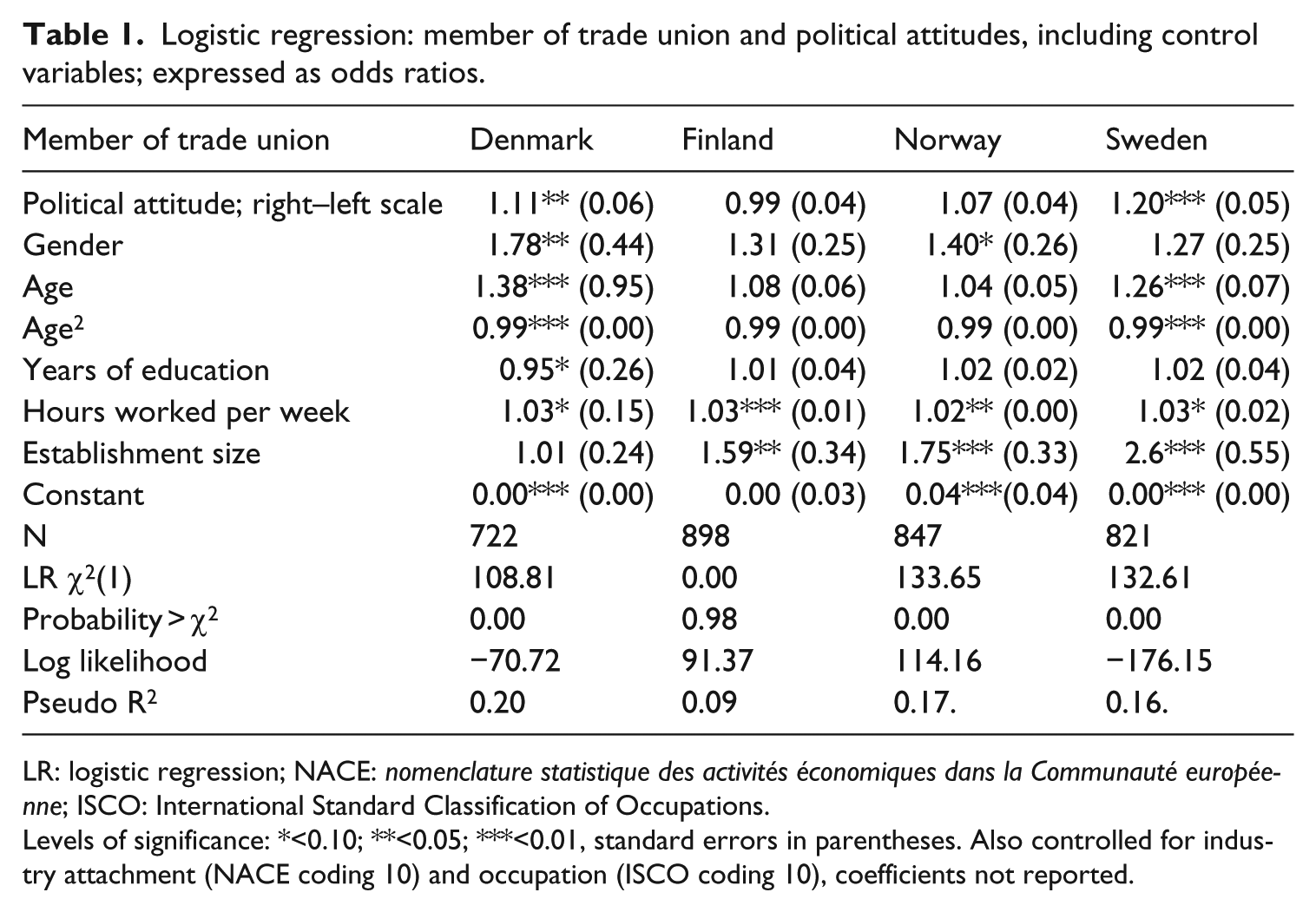
LR: logistic regression; NACE: nomenclature statistique des activités économiques dans la Communauté européenne; ISCO: International Standard Classification of Occupations.
Levels of significance: *<0.10; **<0.05; ***<0.01, standard errors in parentheses. Also controlled for industry attachment (NACE coding 10) and occupation (ISCO coding 10), coefficients not reported.
These results indicate that political attitude is a significant variable explaining membership likelihood in Denmark and Sweden. However, in Finland and Norway, the variable is not significant, indicating that political attitudes do not influence the likelihood of unionization among employees. In Denmark and Sweden, the results show that ‘left-wing’ political attitudes increase the likelihood of membership in a trade union. This is not the case in Finland and Norway.
The statistical analysis also offers other interesting results. However, I will only comment briefly on some of these results because of my focus on the impact of the variable ‘political attitudes’. ‘Working hours’ and ‘establishment size’ are the two variables that generally are statistically significant in all four countries (except ‘establishment size’ in the case of Denmark). This is in line with observations in the literature. That ‘establishment size’ is not significant in Denmark could (perhaps) be related to the construction of the variable. It is binary, only distinguishing between establishments under and over 100 employees. Given that companies in Denmark generally have relatively few employees, we might have seen a statistically significant result with a more differentiated breakdown of establishment size. The fact that ‘years of education’ is insignificant in the statistical analysis in three of the four Nordic countries confirms the observation in many studies that trade unionism in the Nordic countries is not only for blue-collar employees but also for white-collar employees. It could (perhaps) be related to the organizational structure of the main unions, with dedicated organizations for white-collar and professional employees (Gumbrell-McCormick and Hyman, 2013). This could increase both the instrumental and value-oriented incentives to join a trade union among employees with higher educational qualifications.
Odds ratios can be difficult to interpret. Therefore, some post-estimations are used to present the results of the logistic regression analysis with regard to ‘political attitude’. Margins are used to identify the average likelihood that an employee with specific political attitudes (e.g. those who described themselves as in the middle (5) of the right-left scale) will be a member of a trade union, taking into account all the control variables. In Table 2, margins are presented for Denmark and Sweden. Margins are presented for employees who evaluated their right-left attitudes as, respectively, 0, 5 and 10.
Margins: the likelihood of membership of trade union and political attitudes, Denmark and Sweden.
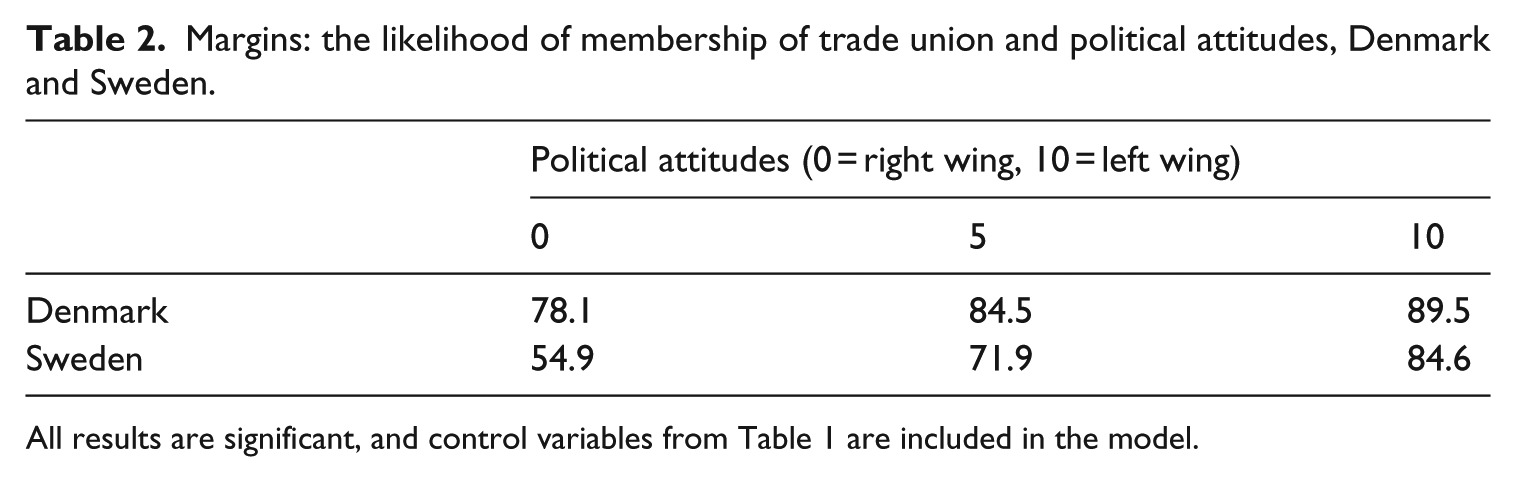
All results are significant, and control variables from Table 1 are included in the model.
In Denmark, the likelihood that an employee who describes himself or herself as having a political attitude corresponding to very right wing (0) will be a member of a trade union is 78.1 percent. For an employee self-rated in the middle of the right-left scale (5), the likelihood is 84.5 % for those self-rated as very left wing (10), the likelihood of trade union membership rises to 89.5 percent. In Sweden, the corresponding probabilities are 54.9, 71.9 and 84.6 percent. It should be noted that the average level of membership in a trade union in the data set is higher in Denmark (84.0 percent) than in Sweden (71.1 percent). As the figures show, the impact of political attitudes on the likelihood of trade union membership is higher in Sweden than in Denmark. As shown in Table 2, the difference in the level of unionization between the ‘middle-of-the-road’ employee and the very left wing or very right wing is relatively higher in Sweden than in Denmark. These results are discussed further below.
Discussion
As observed in the previous section, left-wing political attitudes increase the likelihood of employees being members of a trade union in Denmark and Sweden, while this is not the case in Finland and Norway. The four Nordic countries differ with regard to the importance of political attitudes for trade union membership.
I now discuss the observed differences between the Nordic countries. The intention is to discuss some possible explanations, especially as concerns Denmark and Sweden, where ‘left-wing political attitudes’ influence membership motivation. However, it should be stressed that the explanations are tentative and that it is not possible to make any final explanatory conclusions.
Whether employees’ political attitudes influence the likelihood of their joining a trade union depends on a number of factors. The likelihood of membership of a trade union correlates with political attitudes only if there is a dual understanding of motivation among employees with regard to union membership. First, it implies that left-wing employees to a certain degree choose to join a trade union because it corresponds to their (left-wing) political ideology. But it also implies that those with a right-wing orientation choose to a certain degree not to join a trade union because it does not correspond to their political ideology. If employees conceptualize trade unions (at least partly) as ‘political and value-oriented’ organizations, then we can expect that political attitudes will influence their likelihood of becoming a member of a trade union.
If we return to the typology advanced by Etzioni, that organizations can act as in a remunerative, normative or coercive fashion, an examination of the behaviour and strategies of the trade unions themselves in the Nordic countries and their relations to political parties can be a signifier for unions self-promotion. Trade unions can also be political actors in their own right and not simply actors within the industrial relations system (Gumbrell-McCormick and Hyman, 2013; Hyman and Gumbrell-McCormick, 2010). Close relations with political parties – and in the Nordic countries this usually means with the social-democratic parties – indicate that promoting certain normative values is part of the trade unions’ organizational strategy.
In Sweden, Denmark and Norway, there has historically been a close relationship between the blue-collar trade union movements (LO) and the social-democratic parties. However, in Sweden and Denmark, these links weakened during the latter part of the 20th century. In Denmark, the formal link between LO and the Socialdemokraterne ended in 2003; in Sweden, the affiliation between the LO and the Socialdemokratiska Arbetarepartiet (SAP) formally ended in 1987 (Hyman and Gumbrell-McCormick, 2010: 323), although they continued to work together for a number of years. In Norway, the links between LO and the Arbeiderpartiet are still close and have not changed in the same way. In Finland, the links between the trade unions and the political parties seem more diverse. The three main confederations in Finland have different relations with the left-wing parties and the more conservative parties. The blue-collar Suomen Ammattiliittojen Keskusjärjestö (SAK, Central Organization of Finnish Trade Unions) has close relations with the Finnish Social Democrats, while AKAVA (Confederation of Unions for Professional and Managerial Staff in Finland) is considered a conservative union. STTK (Finnish Confederation of Professionals) supports both social democrats and conservative political parties (Bergholm, 2012). However, there are no formal relations between any of the confederations and the political parties, as there are in the other Nordic countries.
If we examine Denmark and Sweden, it is possible to identify factors that can help explain why left-wing political attitudes increase the likelihood of becoming a trade union member. The explanations relate to why trade unions are (partly) conceptualized by employees as ‘political’ or normative organizations. In the case of Sweden, a central development among the trade unions (especially LO) relates to their recent history. Especially in the 1980s and 1990s, Swedish trade unions promoted a number of proposals that were considered very ‘political’ compared to their earlier practices. The trade unions moved to the left (Aylott, 2003). Proposals for ‘economic democracy’ and development of ‘wage-earner funds’ were very controversial. In part, some of these proposals and the orientation towards left-wing political positions led to a break with the SAP (Aylott, 2003). This normative orientation towards left-wing policies also led for a period to a breakdown of the Swedish model of industrial relations. The Svenska Arbetsgivareföreningen (SAF, Swedish Employers’ Confederation) withdrew from all tripartite commissions as a consequence of dissatisfaction with the political development among the trade unions. The model was eventually re-established when a new agreement was made in 1997 that allowed for decentralization of the collective bargaining process. The main private sector labour market confederations transferred bargaining power to their member organizations.
It can be argued that the recent history of the LO trade unions has contributed to developing a strong perception among Swedish employees that trade unions have a specific left-wing normative orientation. This might explain why left-wing political attitudes increase the likelihood of employees joining a trade union and why a right-wing political attitude has the opposite effect. However, it should be stressed that the white-collar unions in Sweden, represented by Tjänstemännens centralorganisation (TCO) and Sveriges Akademikers Centralorganisation (SACO), have historically presented themselves as ‘non-political unions’. They have deliberately avoided having formal connections to political parties in order to distinguish themselves from LO. However, the member organizations of both TCO and SACO represent, to a high degree, public employees and women. Around half the TCO membership are employed in the public sector, and more than half the SACO membership (Kjellberg, 2013). So, even though TCO and SACO are formally ‘non-political’ unions, this can help explain the importance of political attitudes in Sweden because public sector employees and women in the public sector generally tend to be more left-oriented than employees (and men) in the private sector (Hugrée et al., 2015).
In the case of Denmark, trade unions have been less oriented towards left-wing politics. Nevertheless, a number of Danish trade unions have given financial support to the Socialdemokraterne. This relative moderation has meant that the Danish system of industrial relations and union cooperation with the employers have not been challenged to the same extent as in Sweden (Due and Madsen, 2008). In this respect, we cannot explain the impact of political attitudes on trade union membership in the same ways as in Sweden. One factor that could help explain the impact of political attitudes on union membership, however, relates to the increasing competition between different types of trade unions. During the last 10–15 years, a number of so-called yellow or alternative trade unions have played a more significant role in the Danish labour market. They have increased their share of unionized employees and have also attracted many employees to their own unemployment benefit funds (Ibsen, 2012; Ibsen et al., 2013). Members of these unions are also included in the statistical analysis, but because of lack of data, we cannot identify to what extent they are more or less ‘right-wing’ than the members of the traditional unions. ‘Yellow’ trade unions tend not to negotiate collective agreements, and they compete with the traditional LO union movement by offering lower membership dues. Some researchers describe a veritable marketization of trade union offers in Denmark, as different unions compete with each other on a more or less open market, advertising benefits such as lower monthly dues or better service. Cost of membership seems to be the primary factor that employees give when they explain why they have left the established trade unions within the LO family for the newer unions, but many employees also say that they no longer want to be a member of a LO union because of LO support for specific leftist political parties (especially the Socialdemokraterne; Ibsen et al., 2013). As one of their competitive tools, the ‘yellow’ trade unions try to attract new members (both to the union and to their associated unemployment benefits fund) by arguing that they are non-political organizations and that they do not support ‘left-wing political parties’.
The increased competition between different types of trade unions in Denmark has led to increased awareness of the support that some trade unions give to political parties. In this respect, union practices have been politicized, and employees’ awareness of trade union normativity has increased. To a certain degree, the trade unions have been increasingly viewed as normative and political because of the increased competition between the ‘old’ and the ‘new’ trade unions. This has been the case even though the traditional trade unions have, in fact, reduced their support for and interactions with various political parties.
In both Sweden and Denmark, it is also possible to suggest other types of explanation for the relative impact of political attitudes for trade union membership. Decreasing levels of unionization since the late 1990s could be one explanation because former members who have left the unions have felt less politically attached than those who have preferred to stay. If that is the case, it could contribute to the understanding of why political attitudes matter in Denmark and Sweden. It might be that right-wing employees have tended to leave the trade unions more than left-wing employees.
In the cases of Norway and Finland, political attitudes turned out to be insignificant in the statistical analysis. This is may be understandable with regard to Finland, considering the structure of the Finnish trade unions as presented above. The trade unions possess a variety of relationships with different political parties. However, there are no formal links between the confederations and the political parties. In Norway, the findings are perhaps more surprising. The fact that there is no ‘Ghent model’ in Norway could lead us to expect that union members in Norway would be more motivated to join (or stay in) a trade union if they had a left-wing political attitude.
Further elaboration of the statistical analysis (not presented in the previous discussion) shows that the lack of a significant relationship is not so straightforward in Norway as in Finland. The statistical analysis was performed including the control variables successively. In Finland, the result was insignificant from the beginning when ‘political attitude’ was included in the statistical analysis (without any control variables). However, in the case of Norway, the lack of significance appeared later in the process of including control variables. ‘Political attitude’ shows statistical significance in Norway as long as gender, age, length of education, working time, establishment size and occupational position are included in the statistical analysis. However, when sector (the NACE variable) is included in the analysis, ‘political attitude’ becomes insignificant. At the same time, the statistical analysis shows that when included, the NACE variable becomes statistical significant with regard to 1 of the 10 industries or sectors that compose the variable (not presented in the previous section). This specific category contains mainly employees in the public sector (public administration, education, health and care services).
The fact that the statistical analysis shows lack of significance with regard to ‘political attitude’ and significance with regard to ‘public sector employment’, when the NACE variable is included in the statistical model, indicates a close relationship between left-wing political attitudes, public sector employment and membership of a trade union. Left-wing political attitudes and public sector employment ‘go together’ with trade union membership. However, in the statistical analysis, being ‘employed in the public sector’ is statistically stronger than ‘having a left-wing political attitude’ and this makes ‘political attitudes’ insignificant in the overall statistical analysis with regard to Norway. One way of explaining the specific results regarding Norway is to look at the sectoral distribution of trade union members in Norway. As described earlier, the overall level of unionization is lower than in the three other Nordic countries. However, this is not the only difference between Norway and the other countries. According to Nergaard and Stokke (2007), the sectoral distribution of trade union density is very similar in Norway, Denmark and Sweden: very high in the public sector, high in manufacturing and low in the private service sector. However, the gap between density levels in the different sectors is much higher in Norway than in other Nordic countries. In 2003, the gap between state employees and the private service sector was 58 percentage points in Norway, 23 percentage points in Sweden and 26 percentage points in Denmark (Nergaard and Stokke, 2007: 657). This means that the public sector is much more important with regard to union density and union member characteristics in Norway than in Denmark and Sweden.
This can also partly explain why ‘political attitudes’ become insignificant in the statistical analysis of Norway but not in Denmark and Sweden. In Norway, employment in the public sector increases the overall likelihood of trade union membership much more than in Denmark and Sweden, and it decreases the effects of other variables, such as ‘political attitudes’. All in all, this indicates that left-wing political attitudes also have some impact on trade union membership in Norway. However, it is not so strong as in Denmark and Sweden, though it is not so weak as in Finland.
Conclusion
This article has had two objectives. First, I sought to determine whether employees’ political attitudes influence the likelihood of their joining a trade union. Trade union membership is usually analysed within different types of explanatory framework. In this article, the focus has been on attitudinal factors and on how far political ideology, especially left-wing political ideology, affects employees’ decisions to join (or not to join) a trade union. My second focus has been on trade unionism in four Nordic countries. In the industrial relations literature, these countries are often assumed to be very similar. This is indeed true of their highly organized labour markets, both with regard to their industrial relations institutions and their generally high levels of unionization. My purpose, however, has also been to discuss some of the differences that can be observed between the countries.
The article uses ESS data from 2012, and the analysis is based on a logistic regression analysis that uses ‘membership of a trade union’ as the dependent variable and self-placement on a ‘right-left political scale’ as the focal independent variable. The results of the statistical analysis are quite clear. Left-wing political attitudes increase the likelihood of joining a trade union in Denmark and Sweden but not in Finland and Norway (once we consider a number of control variables). However, in Norway, the picture is less straightforward than in Finland. Left-wing attitudes and trade union membership are related, but the association is embedded in public sector employment. And left-wing political orientation is more important among Swedish than Danish employees when it comes to predicting their union membership.
The results reveal key differences among the Nordic countries, despite general similarities in their systems of industrial relations and their trade unions. The results are also significant because some similar analyses have shown that political attitudes have only a limited influence on unionization (Schnabel and Wagner, 2007), while others indicate that political attitudes are an important factor (Ebbinghaus et al., 2011). In Denmark and Sweden, politics matter when it comes to identifying why employees do or do not join a trade union. The fact that political attitudes matter in Denmark and Sweden also partly disconfirms the argument in the literature that political attitudes are generally less important in post-industrial societies because of the reduced importance of traditional class-based policies and that strong trade unions will be more likely than weak ones to focus on remunerative rather than normative strategies when they recruit (or try to recruit) new members. However, left-wing political attitudes might have different meanings in a post-industrial society. Especially in the Nordic countries, left-wing policies in post-industrial societies very often imply support for the public sector. This also explains the different types of interactions between public employment, trade union membership and left-wing attitudes.
Footnotes
Acknowledgements
My thanks to the two anonymous reviewers for very helpful comments on an earlier version of this article.
Declaration of Conflicting Interests
The author(s) declared no potential conflicts of interest with respect to the research, authorship, and/or publication of this article.
Funding
The author(s) received no financial support for the research, authorship and/or publication of this article.