




Abstract
Works councils were introduced in Poland in 2006, changing the system of employee representation from a single-channel model to a dual-channel model. However, they have not succeeded in promoting social dialogue and creating a strong institution for employee participation. I draw on a quantitative study to analyse why their role in Polish industrial relations is so marginal. I focus on the relationship between trade unions and the new ‘democratic’ councils and information and consultation process itself.
Keywords
Introduction
Works councils are a common form of employee participation in Europe, giving access to information, consultation with the employer and, in some countries, influence on the decisions taken within the enterprise. They represent all employees in the workplace, whether or not they are union members. In many European countries, declining union membership has brought a ‘representation gap’, leading to discussion of alternative forms of representation, in particular works councils. Some consider councils as an institution through which the unions could strengthen their presence in the workplace and resolve the representation crisis. However, others regard the introduction of councils as part of a union avoidance tactic (Brewster et al., 2007; Donaghey et al., 2012; Tóth, 1997; Wratny, 2002).
Interest in works councils increased significantly following the introduction of the 2002 EU Directive on procedures for informing and consulting employees in all member states. Its implementation was particularly important for many countries of Central and Eastern Europe (CEE), which lacked a general, statutory system of works councils. Industrial relations in the post-socialist countries were marked by poorly organized trade unions and employers and the marginal presence of alternative forms of employee representation (Meardi, 2007).
In 2006, an Act on Informing and Consulting Employees (Ustawa o informowaniu pracowników i przeprowadzaniu z nimi konsultacji) introduced works councils in Polish enterprises. Councils were to be introduced at the written request of at least 10 percent of employees in a ballot or on the initiative of trade unions if present in a company. However, the Act violated the provisions of both the Directive and the Polish Constitution since it did not ensure all workers the same right to be informed and consulted, and a revised law in 2009 eliminated the union-based mode of appointment. My study updates previous research (Okraska, 2007; Wratny and Bednarski, 2010) by examining the relationship between unions and the new ‘democratic’ councils in unionized companies.
Below, I first present an overview of ‘ideal-type’ works councils in Germany, the obstacles to the creation of councils in CEE countries and the experiences of the early years of their functioning in Poland. Next, I describe the research design and methods and subsequently discuss the empirical findings in terms of the institutional, legal and organizational dimensions of Polish councils. In the discussion and conclusions, I emphasize the sources of continuing weakness of Polish works councils.
‘Non-union’ employee representation in Europe
The German model
The system of ‘non-union’ employee representation in Germany has deep historical roots reaching back to the 19th century, but current works councils stem from the Betriebsverfassungsgesetz (BetrVG, Works Constitution Act) of 1952 (Waas, 2014). They possess not only information and consultation rights but also extensive codetermination rights on social and personnel matters and, in specific cases, veto rights (Rogers and Streeck, 1995). They can negotiate works agreements with employers, but these agreements must not deal with remuneration and other conditions of employment which are normally fixed by collective bargaining. Councils should be elected in all establishments with five or more permanent employees.
This dual model of employee representation in Germany has for a long time had ‘a unique status in international comparative studies’ (Hassel, 1999: 485) because of the clear division of tasks between works councils and trade unions. However, according to Hyman and Gumbrell-McCormick (2013: 62), the notion of a dual system is in many respects a misnomer because, in practice, councils and unions are mutually reinforcing and interdependent.
However, this stable coalition has recently come under strain (Behrens, 2013). The ‘erosion of the German system of industrial relations’ (Hassel, 1999) is reflected in declining collective bargaining coverage, bargaining decentralization, falling density in unions and employers’ associations, weakening of labour standards and an increase in precarious labour contracts (Haipeter, 2013). ‘Opening clauses’ in sectoral agreements have given councils a collective bargaining role over such issues as pay and working time, allowing agreements with local management inferior to the terms reached by a union and employers’ association at industry level (Fulton, 2015; Meardi, 2012: 32).
In 2013, only 9 percent of workplaces in the private sector with five or more employees had a works council in West Germany (10% in the East Germany). However, the share of employment covered was significantly higher, 43 percent in West Germany and 35 percent in East Germany, as against 50 and 41 percent in 2000. The amended BetrVG of 2001, which simplified the voting procedures for councils in small- and medium-sized enterprises (SMEs), mitigated but did not stop the decrease in works council coverage (Kraemer, 2015; Vogel, 2010; Waas, 2014).
Works councils in Central and Eastern Europe
It was expected that the 2002 Directive would affect the CEE countries more than those in the west because most lacked a general statutory system of information and consultation (Donaghey et al., 2013: 17; Meardi, 2012: 32). Tholen (2007: 27, 55) expected that this would entail a considerable improvement in employees’ rights and could also be beneficial for German works councils by facilitating collaboration with worker representatives in subsidiary enterprises of German multinationals.
From the outset, however, the new works councils encountered obstacles. In most CEE countries, trade unions regarded them as competitors, as shown in research by Tholen (2007) in the Czech Republic, Poland and Slovakia. The duplication of functions of unions and councils, common in many countries (Estonia, Latvia, Lithuania, Bulgaria, Poland and Slovenia) weakens the position of the latter. Over time, this negative attitude began to soften in some countries, albeit to a differing extent across countries (Skorupińska, 2018).
In the CEE countries, the rights of works councils are limited to information and consultation, although minor elements of codetermination on social issues can be found in the Slovenian and Hungarian regulations. Another problem is that in these countries, the statutory powers of works councils are not fully enforced. Often the law does not precisely specify the procedures for information and consultation (as in Poland, Bulgaria and Slovakia); the rules for establishing councils may be overly complex (Bulgaria, Czech Republic); the penalties on employers for non-compliance are often very low (Lithuania); sometimes there is little monitoring of actual practice (Estonia). The low dissemination of information and consultation rights is compounded by a lack of trust in this new institution (Muda, 2014; Meardi, 2012). Another obstacle is employer resistance or indifference. The study by Meardi et al. (2013) showed that most managers at subsidiaries in the Czech Republic which had headquarters in Austria, Germany, the UK and the USA had explicit reservations about indirect participation practices at the sites and opposed their introduction.
Unfortunately, there are no systematic data on the incidence of works councils in the CEE countries. It appears that they were established in only 4 percent of Lithuanian enterprises in 2006 (Blažiene and Petrylaitė, 2010), 11 percent of Estonian enterprises in 2009 (Muda, 2014) and about 7–8 percent of Bulgarian companies covered by the legislation in 2010 (Donaghey et al., 2013). A slightly greater presence (in approximately 20 percent of enterprises) was found in Slovenia and Slovakia (Cziria, 2011; Plachtej, 2011), whereas in Romania, there are practically no councils at all.
Works councils in Poland
Under the Act on Workers’ Self-Management of State-Owned Enterprises (Ustawa o samorządzie załogi przedsiębiorstwa państwowego) of 1981, ‘employee councils’ were forerunners of representative participation in Poland. However, with economic and political transformation, it was argued that they caused paralysis in company decision-making (Wratny, 2002). Solidarność opposed these councils (Weinstein, 2000: 58), and with privatization their importance weakened significantly as they were almost totally dissolved in the privatized state-owned enterprises. The works councils introduced by the 2006 legislation were perceived as a chance to improve the representation of workers’ interests given the rapid decline in unionization. However, these expectations were not met and the amended Act of 2009 further reduced the already limited coverage of works councils.
In 2009, when the amended legislation was adopted, there were 3034 works councils registered in the MRPiPS (Ministerstwo Rodziny, Pracy i Polityki Społecznej) database or approximately 9 percent of the workplaces covered by the Act. But in the following year, the number of functioning councils fell by almost half, as a large percentage of first-term councils did not continue into a second term. By the end of 2015, the number of active councils was only 720, roughly 2 percent of workplaces covered by the law.
The marginal role of Polish works councils results from a range of institutional, legal, organizational and structural factors: the fragmentation of union movements and their structural weaknesses, the underdevelopment of autonomous dialogue and individualized employment relations (Skorupińska, 2018). Employers were afraid that councils would interfere in their management of the enterprise or even lead to disclosure of business secrets. According to Doktór (2010: 24), another limiting factor was the negative stereotype of the excessively ‘political’ representation of employee interest organizations. Although some employers have become less negative towards councils (Wratny and Bednarski, 2010), most are still averse to all types of formalized mechanisms of participation. At the same time, trade unions initially feared competition from the works councils but over time have become involved in their establishment in unionized enterprises, recognizing the potential benefits from the existence of these institutions, which permit access to the information which employers do not have to provide to the unions. Moreover, by nominating their members as candidates for election, unions can increase the number of persons covered by protection against dismissal (Florek, 2006).
In Poland, relations between employees and management often take the form of ‘enlightened paternalism’ (Gardawski et al., 1999: 255), with the respect of subordinates for their superiors. Often there is an authoritarian management style and a lack of initiative and creativity on the part of employees. This is further aggravated by employees’ lack of experience and the fear of reprisal from employers (Górski, 2015) and by the ambiguous attitude of the state, which has adopted ‘the role of a neutral midwife’ in this matter, failing to carry out any promotional campaign for councils (Ciompa, 2007: 5). Works councils do not benefit from the international support networks which trade unions possess (Czarzasty et al., 2014) – though in 2009, the two main union confederations initiated a project, co-financed with EU funds, which resulted in the establishment of 16 Regional Consultants for works councils. Structural factors limiting the operation of works councils include the declining average size of enterprises (Męcina, 2009) and the growth of non-standard forms of employment.
Another obstacle is the weakness of the powers which the Act assigns to works councils. Consultations are carried out on the basis of information provided by the employer and can result in ‘a consultation agreement’ (Stelina, 2008), but unlike collective agreements between employers and trade unions, agreements with works council lack a legally enforceable character (Wagner, 2008). Moreover, many researchers (Ciompa, 2007; Górski, 2015; Wratny, 2010) regard the clause requiring 10 percent of workers to sign a request for the establishment of a works council as a major obstacle.
Research design and method
Why were so few works councils established in Poland, and why did their numbers decline further after the amendment of the Act? These are my main research questions, and I focus in particular on the relationships between the trade unions and the new ‘democratic’ councils. After the 2009 amendment, the unions lost confidence regarding the election of their candidates and their control over them. Moreover, as studies have shown (Okraska, 2007; Wratny and Bednarski, 2010), councils do not play a significant role in companies and have limited competences. All these factors probably reduced unions’ motivation to promote councils in unionized companies. At the same time, however, works councils have become consolidated in Poland for almost 10 years. This means that the initial ignorance regarding the rules by which these institutions function and the lack of experience of councillors no longer represent a significant barrier. Furthermore, as in several other CEE countries (Muda, 2014), in Poland the negative attitude of unions and employers towards works councils has begun to change. Therefore, my research explores three hypotheses: first, that Polish works councils are currently less dominated by trade unions than before the amendment of the Act; second, that the current weak position of councils in Polish companies reflects deficiencies in the legal provisions; and third, that the functions of the councils are largely restricted to obtaining information from the employer and passing it on to employees.
My investigation was carried out in 2015, as part of a research project on the role, position and range of functioning of works councils in Polish industrial relations. The names and addresses of companies and institutions participating in the study were derived from the Polish MRPiPS database. The study was conducted by means of a questionnaire addressed to works council chairpersons. Additional sources were companies’ internal regulations and individual agreements.
Questionnaires were sent to 3429 works councils, but attention was focused on obtaining maximum responses from active councils, resulting in 253 completed questionnaires. Of these, 242 were verified for further processing, which means that the results covered some 35 percent of all active councils registered in the MPiPS database as of 31 December 2014.
There were 32 questionnaires returned by works councils which were not already active in the period under study and which operated only one or two terms. Almost all of these operated in unionized organizations; as a reason for not establishing councils for a further term, they mainly stated that there was no need since trade unions were operating in the organization. Also, the lack of candidates for council membership was frequently mentioned and, in some cases, organizational problems or the limited competences of works councils. There were also several responses from enterprises where the council had ceased to operate or where former council members were no longer employed.
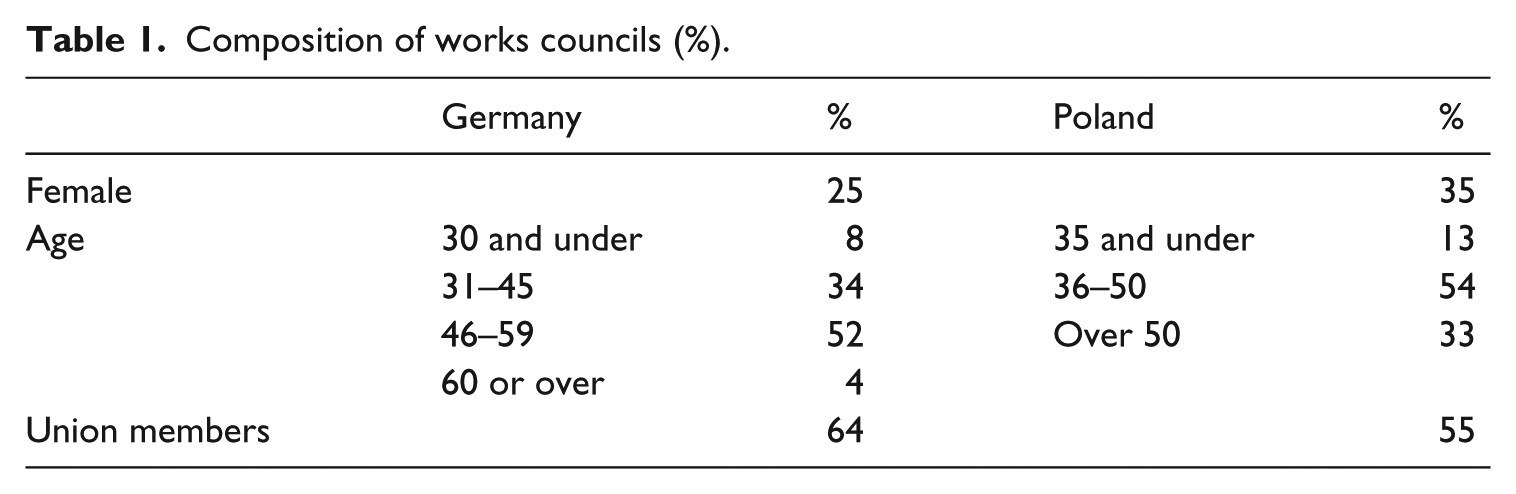
Only a small percentage of the works councils analysed in the study were new; the vast majority were in their second or third terms. They generally operated in unionized organizations (80%) and almost all of these had trade union members in their composition. Most seats went to male candidates, with only 35 percent being won by women. The largest group were aged 36–50 years and with over 15 years seniority in the company, hence with a good knowledge of the plant and its problems. Comparing these results with the latest research into works council elections in Germany (Vogel, 2015), Polish councils are somewhat more feminized, and the proportion of unionized councillors is lower. In both countries, they are largely older employees with considerable seniority (see Table 1).
Composition of works councils (%).
Relations with unions and employers
Almost all the works councils operating in unionized organizations cooperated with trade unions. In half the cases, this cooperation involved consultation with the unions, taking advantage of their background and experience. In a third of the cases, the unions recommended candidates for election. In several cases, cooperation was limited to a loose exchange of information. However, only a small percentage of works council chairs reported that the unions had a significant impact on their decisions. In those works councils which did not cooperate with the unions, this did not mean that relations between the two representative bodies were hostile or strained. Indeed, in none of these cases did the unions oppose the establishment of the council. According to the opinions of a majority of chairs of such councils, unions and councils were simply independent of each other. Only a few councils believed that the trade unions in their enterprise treated them as competitors.
Councils operating in unionized organizations but without union members in their composition deserve closer examination. These councils operate in organizations with a significantly lower level of unionization than other unionized companies having councils. The lack of union members may indicate that the councils are to a certain degree independent (at least formally) from the trade unions. It should be noted that the unions did not in any of these cases recommend their members for election. Despite this, almost all of these councils cooperate with unions. The study also confirmed the lack of a clear division of competences between works councils and unions, an issue raised in studies of other CEE countries as well.
The process of electing works councils ran quite smoothly and according to the rules. In almost half of these cases, employers encouraged employees to establish councils and developed the rules for the elections. In only a small number of cases was it claimed that the employer treated the election of a works council as a ‘necessary evil’. There were no reported instances of employers making it difficult to establish a council, for example by providing incorrect information about the number of employees. Councils were generally given a room for their meetings, and councillors encountered few problems as a result of their membership in the council. In several cases, the chair of the council stated that the employer maintained a significant degree of influence on the attitudes of council members.
Generally, the works councillors were surprisingly positive about their collaboration with the employer. In almost 70 percent of cases, this was rated ‘good’ or ‘very good’. A highly positive relationship between works councils and employers was also demonstrated in a survey in Lithuania, where 24 percent of respondents described the relations as ‘warm and friendly’, and another 71 percent as ‘normal and constructive’ (Petrylaité, 2014). However, in 30 percent Polish works councils, their activities are marginalized, and the institution is not a partner for employer.
The information and consultation process
The frequency of council meetings affects the quality of the information and consultation process. Fewer than a third hold meetings at least once a month, and some only once or twice a year. By contrast, German works councils usually meet twice a month and once a month with management. Most Polish councils signed individual agreements with the employers establishing the rules for providing information and conducting consultation. Such agreements offer a ‘timetable’ for the councils and are crucial for their effectiveness. Where no agreement existed, the most common explanation was that the council did not want this or saw no need; but some councils, especially in larger private companies, had no agreement because the employer refused. Organization-specific agreements for information and consultation can also be found in most other CEE countries (Hall and Purcell, 2011).
On the whole, works councils in Poland considered the information provided by the employer as sufficient or extensive. The scope of information was slightly larger in councils operating in companies without trade unions than in unionized companies. This probably reflects the higher expectations of union members and their experience in negotiations with management. In 85 percent of cases, the councils received information on the current financial situation of company. This is also the most regularly provided information in Slovakia, Slovenia and Hungary. Quite often the works councils in CEE countries also receive information on the company’s development and activity and on changes in wages and employment (see Table 2).
Main types of information provided to works councils.
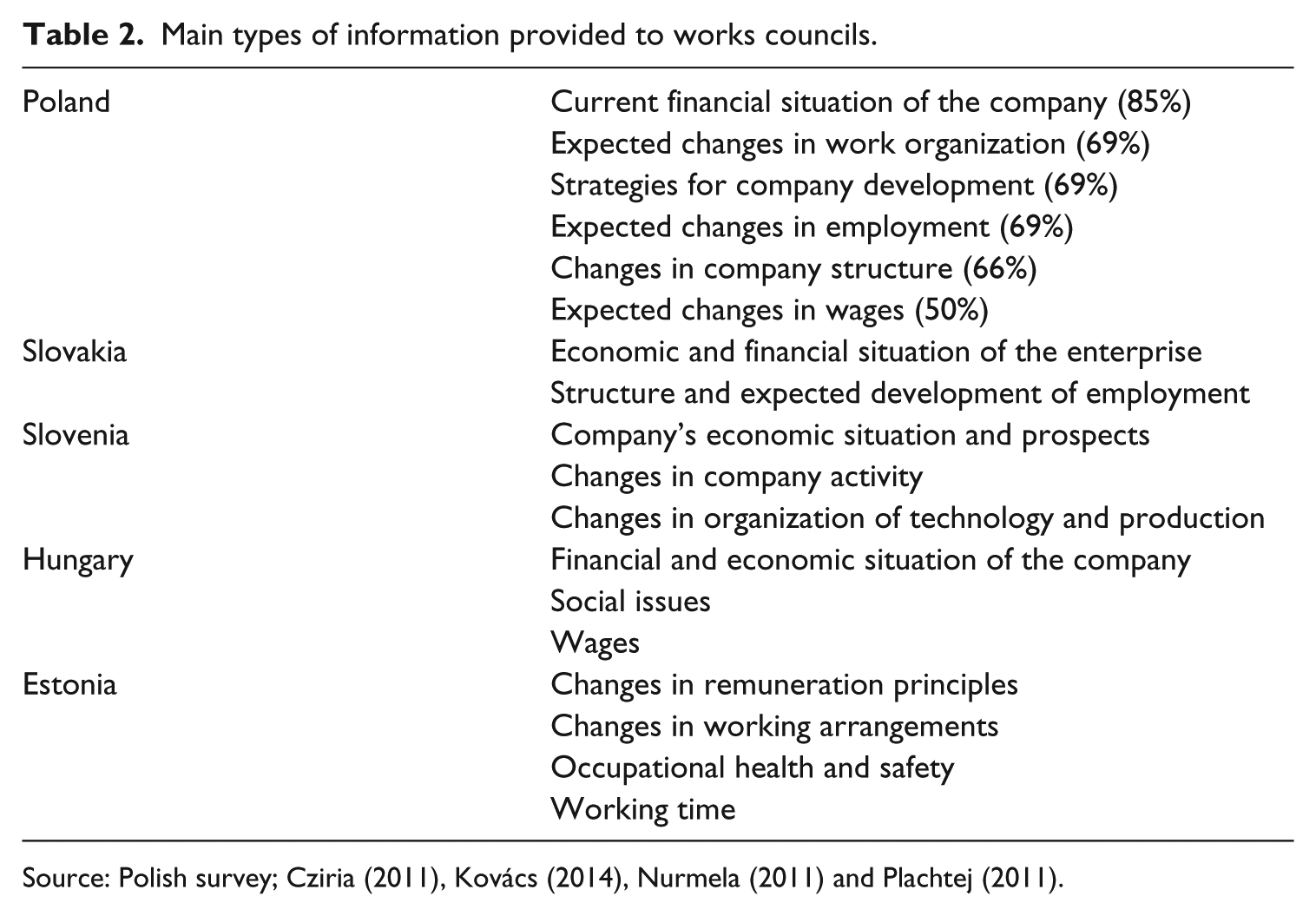
Source: Polish survey; Cziria (2011), Kovács (2014), Nurmela (2011) and Plachtej (2011).
Most employers never refused to provide information. It should be noted, however, that the councils did not often ask for information: in general, at most four times over the previous year, while a significant number, primarily in the public sector, never asked the employer for information. Where employers did refuse to provide information, this was primarily because they treated it as confidential. Given the imprecise provisions of the legislation, many employers argued that they had no obligation to provide the requested information. However, 75 percent of councils received information early enough to prepare for consultations. This is far better than in Hungary, for example, where 77 percent of chairs complained that they did not get enough background information prior to the meeting (Kovács, 2014). The Polish works councils almost always passed the information on to workers, mainly through meetings or by e-mail.
In most cases, consultations were held by employers sporadically or did not take place at all. However, when these did take place, councils generally reached a ‘consultation agreement’ with the employer, although usually this was an oral agreement rather than specified in writing. The most common issues related to changes in work organization or planned changes in employment. However, these consultations involved only about half of the Polish works councils. Consultation was rare on the rules governing the remuneration of employees, changes in the structure of the company or its development strategy. A similar pattern is found in Slovakia, Slovenia, Hungary and Estonia (see Table 3).
Main subjects of consultation.
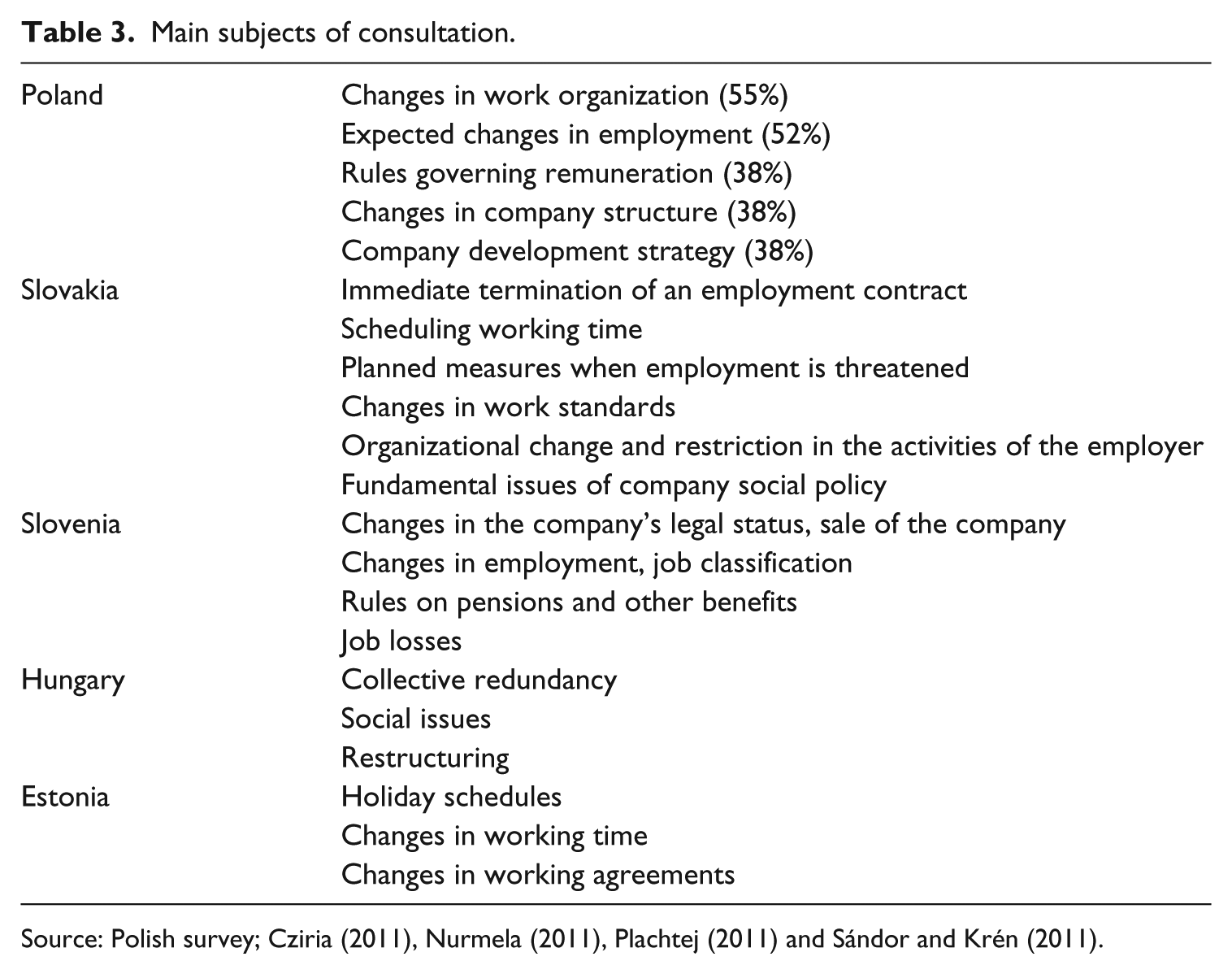
Source: Polish survey; Cziria (2011), Nurmela (2011), Plachtej (2011) and Sándor and Krén (2011).
Although some employers refused to provide information or to undertake consultation, Polish councils did not generally report such cases to the Państwowa Inspekcja Pracy (PIP, National Labour Inspectorate). Works councils generally saw no point, which may indicate that they do not believe in the effectiveness of the Inspectorate. In addition, many wanted to settle the matter amicably, arguing that the involvement of PIP or a court would adversely affect dialogue with the employer. Labour inspectorates or equivalent institutions in other CEE countries also receive few complaints regarding breaches of information and consultation rights (Donaghey et al., 2013). For example, in Slovenia, there are only four such complaint cases per year on average (Plachtej, 2011).
Organizational context
Among the most important organizational resources facilitating the activity of works councils are access to training and external experts, finance, substantive support from trade unions and cooperation with other councils. In Poland, these resources are particularly important, given that the councillors themselves in most cases defined their level of preparation for work as ‘average’ or ‘poor’. However, only a quarter of them participated in training aimed at preparing them for their responsibilities. Such training was typically organized by an independent non-governmental organization, the Instytut Spraw Obywatelskich (INSPRO, Institute of Civil Affairs), by external training companies or by trade unions. The councils which did not participate in training sometimes attributed this to shortage of funds; however, many were not interested in such training. In contrast, works councillors in Germany have the right to take part in training that is closely connected with their activities, and they are also entitled to educational courses for a total of 3 weeks during their membership of the council (Fulton, 2015).
Even less frequently do Polish works councils make use of experts and consultants. In most such cases, it was external advice and rules for the use and financing of expert assistance had been included in individual agreements between the councils and the employers. It is interesting that in the case of councils which did not take advantage of such assistance, the main reason given was not the lack of consent on part of the employer, nor limited funds, but the lack of a need for such assistance. According to Mihaylova (2011), in Bulgaria, similarly employee representatives do not seek external advice. Hungarian works councils, as in Poland, also rarely use external experts, but this is due to high costs and the fact that a special agreement is needed for this (Sándor and Krén, 2011). In several CEE countries, such external advice is provided by union federations (Hall and Purcell, 2011).
The financing of Polish works councils usually involved the employer covering out-of-pocket costs or reimbursing expenses incurred by the council. Otherwise councils often obtained funds from the unions operating in the company. Some works councils cooperated with others in the same industry and (in one case in a transnational company) with councils in other countries. Although this is not a general trend and concerns only a dozen or so councils, this practice is noteworthy. The lack of higher organizational support structures for works councils was raised during the Warsaw National Forum of Works Councils in June 2016. In Germany, companies with more than one establishment have central works council, and it is possible to set up councils at the group level, although such structures are relatively rare (Fulton, 2015).
Discussion and conclusion
The findings confirm that councils functioning after the amendment of the Act have a significantly lower percentage of unionized members. At the end of 2008, 72 percent of councils functioned in unionized organizations, while union members constituted 75 percent of all councillors. An even higher percentage of works councils examined in 2015 were in unionized organizations, but only 55 percent of councillors were union members.
In terms of the impact of unions on the functioning of works councils, the evidence is not so clear cut. My research method, a questionnaire addressed only to works council chairs, does not make it possible fully to explore the relationships between councils and unions. However, the results do permit certain observations. Unions, through their members in works councils, still affect the functioning of these institutions, albeit to a varying degree. However, they do not make strenuous efforts to have their members elected to councils, and only some chairs claimed that the unions had a significant impact.
The Constitutional Court in 2008 rejected the principle of trade union priority in determining the composition of works councils in unionized companies and thus broke a strong union–council link in Polish companies. According to the Court, a procedure whereby workers who were not union members had no impact on the election and operation of councils was contrary to the principle of ‘negative union freedom’ contained in the Constitution. This principle means that employees’ union membership status cannot affect their rights at the workplace. A second objection to the provisions of the 2006 Act was that these infringed the principle of equality expressed in the Constitution. The 2009 amendment to the Act introduced a single democratic method for electing the councils, in elections open to all employees. Trade unions thus have no special privileges with respect to the election of councillors, although just as other employees they can recommend their candidates.
By contrast, strong union–council links still exist in many countries, where participatory structures in the workplace are closely integrated with union structures. For example, trade union delegates (shop stewards) in Denmark have priority in the composition of cooperation committees, and they represent the trade unions as well as the employees (Jørgensen, 2011). This reflects both union pressure for more impact on employers’ decisions and employers’ interest in creating support among workers for changes in the company (Knudsen, 2006). In Italy, unions have the dominant role in the membership of the main employee representative body at company level, the rappresentanza sindacale unitaria (RSU). The members are elected by all workers, but only trade unions can nominate the candidates (Fulton, 2015). In Poland, the previous statutory relationship between trade unions and works councils sustained the trade unions’ interest in the new institutions of participation and strengthened the position of councils in enterprises. Breaking this relationship meant that the councils, without strong union support, have lost some of their ‘leverage’ in dealing with the employer. Although councils in Poland still generally maintain good relationships with trade unions, the impact of unions on councils seems to be reduced.
The findings do not confirm my hypothesis that defects in the amended Polish legislation are the main reason for the weak position of works councils in Polish enterprises. My research confirmed the weaknesses of the Act, mainly resulting from its lack of specificity, as other studies have previously noted (Męcina, 2009; Okraska, 2007), but this is not the predominant factor. A more significant reason for the weak position of these institutions is the low-level activity of works councillors. Council meetings are held infrequently, councils rarely ask the employer for information and they do not see the need to inform the PIP in cases of violation of the information and consultation provisions. Moreover, many works councils were not interested in establishing well-defined principles of cooperation with the employer by signing individual agreements. This passive attitude is also reflected in the fact that councils were frequently not interested in participating in training or using the help of consultants. It is true that weaknesses of the Acts have led to situations where employers refuse to provide information or consult on relevant issues, and the financing of councils is sometimes clear. However, the works councils themselves did not make full use of the opportunities offered to them by the Act.
Moreover, even were the Polish legislation improved through clarification and by broadening the scope of works council rights, this would not necessarily increase the efficiency of these institutions. In two other CEE countries, there is much more detailed legislation to determine the transfer of information to councils and the conduct of consultations, with provisions for codetermination over the appropriation of welfare funds (Hungary) or arrangements for annual leave, performance assessment criteria and the use of social funds (Slovenia). In Slovenia, for example, the employer is obliged to give works councils necessary information at least 30 days before taking decisions and to organize consultative meeting at least 15 days before taking decisions (Plachtej, 2011). In Hungary, the employer is obliged to inform the council of the reasons and economic, legal and social consequences for workers in the case of the transfer of the enterprise, at least 15 days in advance, and the 2012 Labour Code enables works councils to conclude binding agreements with the employer if the company is not covered by the collective agreement, and there is no trade union in the enterprise with entitlement to conclude such agreements (Fulton, 2015). However, these stronger legal rights do not translate into a significantly better position for works councils than in Poland. According to Kovács (2014), works councils in Hungary are personally and financially directly dependent on the employer and have serious problems in carrying out their tasks effectively. Because of this dependence, and without the right to undertake strikes, it is very difficult for councils to enforce the employees’ interests in the bargaining process. In Slovenia also, the system of works councils does not work as intended (Končar, 2014), and sometimes dispute resolution proceedings are the only means to persuade the employer to undertake consultation (Plachtej, 2011). Hence, stronger statutory rights for councils in Poland would not necessarily strengthen their position in the company because so much depends on the attitude of the employers. For example, the far-reaching rights of German works councils are reinforced by the generally positive attitude of employers and trade unions to these institutions (Waas, 2014).
The results confirm that works councils perform a mainly informational function. Studies have shown that in general their statutory rights to information were respected by employers, and in almost all cases, the councils passed the information to employees in the workplace. However, councillors faced greater difficulties in achieving effective consultation. In most Polish companies, the legal obligation to consult over many important matters was not respected by the employer. Nonetheless, most councils assessed the cooperation with the employer as ‘good’ or ‘very good’. This may mean that councillors still do not fully understand the tasks and roles of this new institution of participation.
Furthermore, my survey showed that despite the fact that the works councils I examined performed a mainly informational function, in the majority of cases their activity was highly regarded by the employees, who in almost all cases were interested in the functioning of this institution. For example, they frequently reported their problems and proposals to the council members. The benefits of councils were also recognized by some employers, according to the results of another survey I conducted in private companies with works councils. They reported that councils contribute to the maintenance of social peace in the company. In addition, these institutions as a form of employee ‘voice’ facilitate the flow of information and hence provide support for management activities. However, according to a large part of employers, works councils are passive and inactive.
Although the total number of works councils in Poland has decreased dramatically following the 2009 amendment, they continue to operate, primarily in unionized organizations, and almost all councils have union members in their composition. However, the relationship between councils and unions seems to have become looser. In Poland, the unions have their own problems and focus on their own organization rather than on strengthening their position through closer cooperation with a potential ally, the works councils. The positive effects of an integrative strategy (Tholen, 2007: 59) are not fully utilized by the Polish trade unions.
While my results show a low level of activity on the part of works councils, their weak position in Polish industrial relations and their minor presence in companies is not only the fault of employees. In part, this passivity and ‘employee silence’ may reflect perception that the actions they undertake are futile and doomed to failure (Donaghey et al., 2011: 54). Indeed, works councils in Poland can do little to affect employers’ decisions. They may present their opinions, but according to the Act, the employers are not obliged to follow them (although they should respond to them). The relatively weak statutory powers of councils and the imprecise provisions of the Act cause great confusion in everyday practice. The fault lies also with employers, whose reservations towards works councils are manifested, for example, in the lack of financing for their activities and in not providing information on their own initiative. Employers in Poland often manipulate the ambiguities in the Act and interpret its provisions to their own advantage. While they do not create major obstacles at the stage of the creation of councils, they often inhibit the efficiency of their operations. By refusing to provide certain information and thereby reducing the consultation process, employers restrict the voice of workers to non-threatening issues (Donaghey et al., 2011: 63).
In June 2016, after consultations with works councils, INSPRO presented a draft amendment to the 2009 Act. A large part of these proposals were in line with proposed reforms in the United Kingdom aimed at improving the take up and practice of consultation there (Adam et al., 2015). In particular, they involved abolishing the requirement that employees must obtain the support of 10 percent of the workforce to initiate appropriate statutory procedures, as well as extending the scope of issues covered by consultation and providing easier access to training. In addition, the period of protection for councillors would be extended for 1 year after the expiry of their mandate (INSPRO, 2016). The improvement in the enforcement of information and consultation provisions in the United Kingdom proposed by Adam et al. (2015) could also benefit Polish councils. According to the PIP data, only three fines a year were imposed on Polish employers between 2007 and 2015, and their total amount was only PLN 6000 (€1500). This means that the financial sanctions are not effective or dissuasive. Also in Hungary and Slovenia, the countries with broader statutory powers for councils, in practice, there are no real sanctions against employers for violations of these rights. In contrast to the INSPRO draft amendment, a government bill to amend the Act on trade unions was presented in August 2016 after public consultation; its primary objective is to extend the scope of the right to form and join trade unions.
To conclude, the idea of introducing works councils in Polish companies has generally been a fiasco, but it should be noted that they have not taken root in other CEE countries either (Muda, 2014). In contrast to the long tradition of works councils in Germany, the establishment of councils in most CEE countries was to some extent imposed by the guidelines of the 2002 EU Directive. As Wratny and Bednarski (2010) argue, ‘the law will not substitute the good will and willingness to cooperate’ (p. 287). The improvement of the position of works councils in CEE countries, therefore, requires profound changes in many fields: in the law, in the attitudes of trade unions and employers towards these institutions of participation and also in the activity of the council members themselves.
Footnotes
Acknowledgements
The author thanks the editor and anonymous reviewers for their useful criticism and remarks, which helped to improve earlier version of this article considerably.
Funding
The author(s) disclosed receipt of the following financial support for the research, authorship, and/or publication of this article: This work was supported by the Narodowe Centrum Nauki (Polish National Science Centre) under decision no. DEC-2013/11/B/HS4/00474.