



Abstract
This article examines the impact of the economic crisis and its aftermath on collective bargaining, by comparing reactions to austerity policies of trade unions in healthcare and education in Romania. We develop an encompassing theoretical framework that links strategies used by trade unions with power resources, costs and union democracy. In a tight labour market generated by the massive emigration of doctors, unions in healthcare have successfully deployed their resources to advance their interests and obtain significant wage increases and better working conditions. We also show that in the aftermath of the crisis, healthcare trade unions have redefined their strategies and adopted a more militant stance based on a combination of local strikes, strike threats and temporary alliances with various stakeholders. By comparison, we find that unions in the education sector have adopted less effective strategies built around negotiations with governments combined with national-level militancy.
Keywords
Introduction
Industrial relations systems in Central and Eastern Europe (CEE) have undergone numerous structural changes both before and after EU accession. These changes weakened the position of organized labour, and as some of the literature suggests, transformed it into a ‘strange case of non-death’ of a still existent but largely irrelevant collective actor (Crowley, 2004; Meardi, 2011; Ost, 2000). Yet, mounting empirical evidence on trade union revitalization strategies shows that labour organizations in the region are not uniformly weak. Rather, CEE trade unions have used the opportunities provided by institutional and economic changes to regroup and rebuild organizational resources, devise new strategies, develop their power resources and defend the interests of their constituents (Bernaciak and Kahancová, 2017; Kaminska and Kahancová, 2011).
We contribute to the developing literature on trade union strategies by exploring the factors that have contributed to the strategic successes and failures of unions in the Romanian public sector. Using a power resource theoretical framework, we analyse the repertoire of strategies employed by union federations in two sectors, healthcare and education, between 2008 and 2018. We show that although unions in both sectors have faced similar structural pressures, healthcare unions such as Sanitas have been more successful in delivering benefits to their members. We argue that its success can be explained both by its diversified strategy that makes use of targeted strikes and protests creating a sense of constant militancy, and by its use of emigration and labour shortages in the sector as an additional source of pressure for pushing for pay increases.
By contrast, unions in the education sector such as the Federaţia Sindicatelor Libere din Învăţământ (FSLI, Federation of Free Trade Unions in Education) have relied primarily on direct negotiations with government representatives. However, as Romania’s multi-party political system has become increasingly volatile, with 16 cabinets in place between January 2007 and April 2018, this strategy has become less effective in promoting better wages and working conditions. Furthermore, it has failed to frame the interests of workers in the education sector as a broader societal issue, contributing to the marginalization of the unions. To illuminate this contrast, we draw on 10 interviews with trade unionists in the two sectors and on secondary data such as collective agreements, official statistics, newspaper articles and legal texts.
In broader terms, we show that trade unions can be successful even in contexts where governments openly promote anti-union legislation. However, success remains localized and the building of cross-sectoral coalitions is hampered by the framing of public sector reforms in terms of a zero-sum game. Even more, as our empirical account will show, a key problem for public sector trade unions remains the articulation of common interests and the building of within-sector solidarities in the context of increasing pay inequalities.
The next section makes the case for taking into account union agency in order to explain variation in collective bargaining outcomes. We argue that the analysis of trade union power should be contextualized by examining how unions use resources, devise strategies and how these are affected by economic, institutional and ideological factors. A close scrutiny of the relative position of unions within the public sector reveals a heterogeneous picture in terms both of what unions do and what they manage to achieve. We describe the situation in healthcare and education in Romania and the reforms that have been adopted since the onset of the economic crisis. The following two sections discuss the strategies adopted by healthcare and education unions during the crisis and in its aftermath. We place particular emphasis on the gains in terms of pay and working conditions obtained by unions in each sector. The last section concludes with a summary of our argument.
Power resources and trade union strategies
The power of trade unions is mediated by institutional and economic contexts and is derived from various resources that unions can deploy to advance their interests (Gumbrell-McCormick and Hyman, 2013). The literature distinguishes between several broad sources of trade union power: associational, organizational, collaborative, structural, discursive and logistical (Frege and Kelly, 2004; Ganz, 2000; Gumbrell-McCormick and Hyman, 2013; Heller, 1999; Jarley, 2005; Lévesque and Murray, 2003; Offe and Wiesenthal, 1980; Silver, 2003).
Associational power stems from the organization of workers as a collective. It refers to the resources and capabilities developed by trade unions in order to recruit and represent workers and serves as a signalling mechanism that can increase the credibility of strike threats. Since membership alone does not necessarily mean active engagement by union members, associational power can be low even when trade unions boast large membership. On the other hand, in the case of national unions, associational power is linked to their degree of engagement at the local level, and is low when local unions feel that the national leadership does not defend their interests. The use of associational power resources has low costs for trade unions since it is usually mobilized in order to indicate the existence of a conflict through strike threats.
Structural power results from workers’ position in the economic system. Silver (2003) distinguishes two subtypes: marketplace bargaining power and workplace bargaining power. The first results ‘directly from tight labour markets’ (Silver, 2003: 13). The second derives from how workers are integrated into the production process. Workers whose location is vital for production will be more likely to obtain concessions from employers because disruptions such as protests or work stoppages will disrupt large segments of the economy. High structural power can be used to extract rapid concessions from employers and therefore involve limited costs for trade unions.
Organizational power denotes the capacity of trade unions to cultivate their social capital and create a sense of unity among the rank and file (Gumbrell-McCormick and Hyman, 2013). The use of organizational power involves high costs for trade unions because it requires the coordination and mobilization of the membership and can backfire in cases when mobilization fails to bring the desired outcome. However, it can also enhance union solidarity while also possibly generating confrontational behaviours from other actors or interest groups. This power resource is fundamental for union deployment of adversarial strategies such as strikes and ultimately for the success of strike actions.
Union power can also be augmented by cultivating relationships with other actors through formal coalitions or by creating similar agendas. This type of power relies extensively on the union leadership’s capacity to identify trustworthy partners and maintain coalitions once these are established. Collaborative power is also costly for the trade unions because it involves investment of time, resources and social capital in building coalitions. It also usually requires unions to moderate their policy position, a strategy that can be costly in the long run by decreasing the internal legitimacy of the leadership. As argued below, healthcare trade unions are more likely to generate coalitions because fragmentation levels in the sector are lower. Table 1 sets out the costs and benefits of these different power resources.
The relationship between trade union power resources and bargaining strategies.
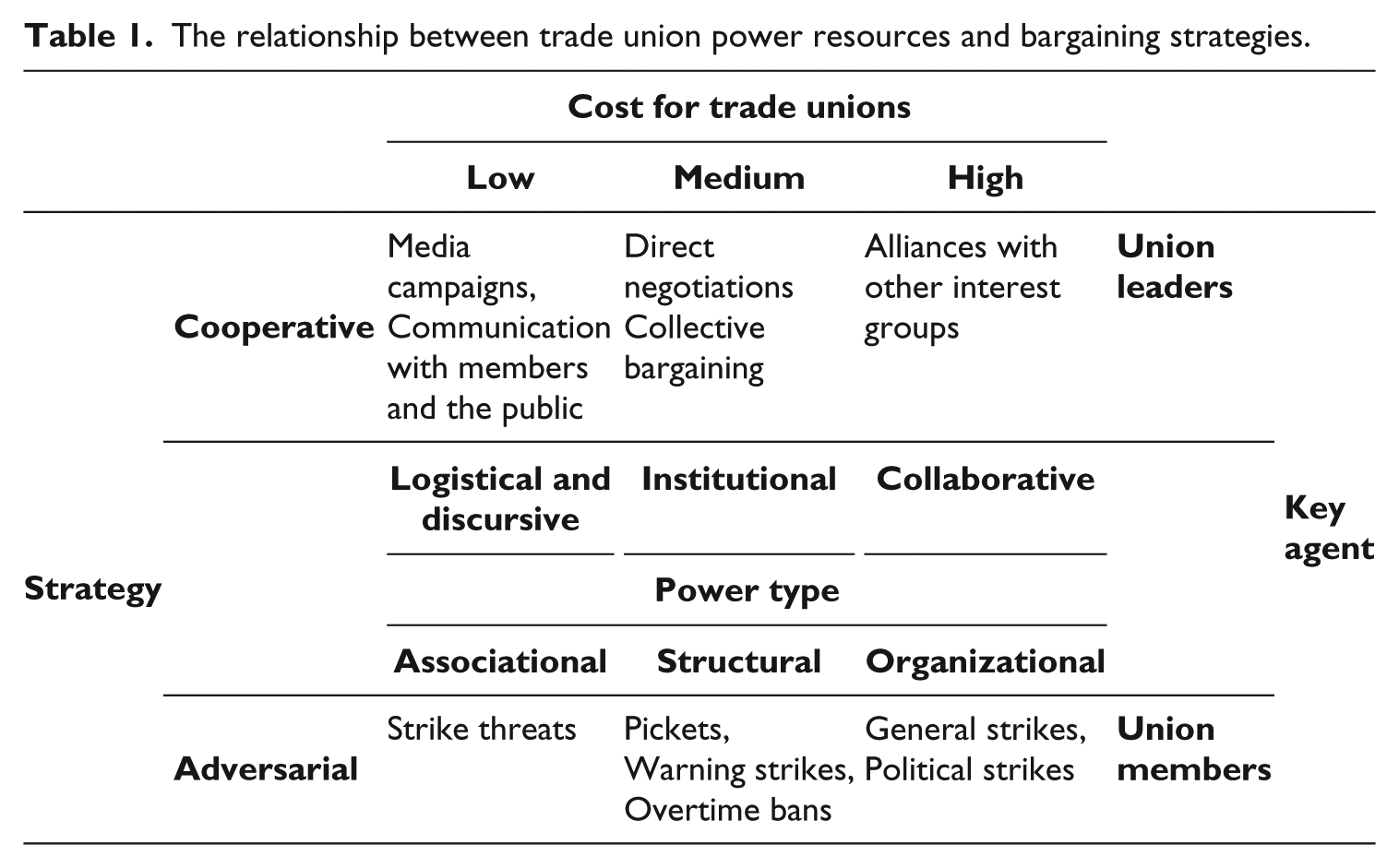
According to these dimensions, unions in the Romanian education and healthcare sectors possess different levels of associational and structural power. As Table 2 shows, in the healthcare sector the largest union organizes around 40 percent of the labour force, while the largest trade union in education claims to represent 56 percent of workers in the sector. Structural power also varies between the two sectors. As Silver (2003: 114–118) notes, teachers have low levels of workplace bargaining power, mainly because of their spatial distribution which makes striking difficult. However, teachers usually have high levels of marketplace bargaining power due to their location in the social division of labour.
Trade union fragmentation and concentration in the health care and education sectors.

Notes: Collective bargaining in groups of units allows for the signing of collective bargaining agreements in various units within the same sector. The legal representativeness certified by court is valid for a four-year period.
Percentage of employees in sector.
Laakso-Taagepera (1979) and Rae-Taylor (1971: 55–56) indices of effective number of parties.
Herfindahl-Hirschman index of concentration (Hirschman 1945, 160–62) computed on the total number of union members.
By comparison, healthcare workers have high levels of workplace bargaining power. Disruption in the operations of a single hospital has immediate effects on patient care. Doctors’ protests are visible events that put the government in a bad light. In CEE, doctors have high marketplace bargaining power because of mass emigration (Szabo, 2013), which affects union power directly by reducing unemployment and generating labour shortages. This enhances their position in collective bargaining (Kaminska and Kahancová, 2011). Furthermore, healthcare workers have a high level of marketplace bargaining power given the availability of jobs in the private sector. As the next section will show, there has been growing internal migration from public to private healthcare sector, which has damaged the quality of care that the Romanian public hospitals currently provide.
Logistical and discursive power denotes the capacity of unions to make use of their resources efficiently and the ability to voice their positions in a convincing manner by articulating a coherent vision of societal change. The use of these resources involves low costs for the unions but can have important consequences for the success of union actions.
Institutional power reflects the capacity of trade unions to use statutory rights, legislative support or membership in public bodies to advance their interests. It is path-dependent in that is ‘derived from former struggles or conceded by the state’ (Schmidt et al., 2019). In the aftermath of the crisis, the institutional power of Romanian trade unions has been practically eliminated by a new social dialogue law which removed the possibility of signing cross-sectoral collective agreements, a crucial mechanism for setting minimum wages (Adăscăliței and Guga, 2016; Muntean, 2011: 36–37). To be recognized as legitimate partners in social dialogue, unions had to reapply for representative status, a requirement that has increased the costs of using institutional power resources. At the same time, the costs associated with using institutional channels are relatively large because they require a good knowledge of the rules of the game.
To summarize, given the similar institutional power resources but different levels of associational, structural, discursive and logistical power, we expect unions in healthcare to fare better in defending the rights of the workers they represent. We argue that the structural power advantages possessed by healthcare unions were used to devise strategies of disruption that minimized costs for the unions while maximizing the political consequences for the government. This optimization strategy was especially visible in the aftermath of the crisis, when healthcare professionals shifted their protest behaviour from nation-wide calls for general strikes to sustaining strikes in key hospitals around the country for longer periods. Ironically, while in the short term the pay cuts passed in response to the crisis did hurt healthcare workers, in the medium term they provided the basis for increased mobilization.
The public sector in the aftermath of the crisis
In Romania, public sector reform has been a constant on the agenda of successive governments (Vasile, 2013). Both healthcare and education have undergone numerous and often contradictory reforms, causing frustration among workers in the two sectors and creating an unpredictable institutional environment. However, there was one constant: both systems remained heavily underfunded, with healthcare somewhat better off. As Figure 1 shows, between 2009 and 2017 healthcare spending was on average around 4.1 percent of GDP while education spending amounted to around 3.3 percent. These levels situate Romania among the lowest welfare spenders within the EU, together with Bulgaria and the Baltic States. Figure 1 also shows that the crisis was a turning point for the budgets allocated to the two sectors. Whereas before the crisis the budgetary allocations to education clearly surpassed those for healthcare, after 2008 this was reversed, with the gap between health and education expenditures widening, especially after 2013.

Expenditure on health and education as percentage of GDP, 2000–2017.
The underfunding of the two sectors translated into low average wages, especially before the economic crisis. As Figure 2 shows, before the crisis, wage increases in both sectors did not fully compensate for increased living costs (Stan, 2012: 68). Furthermore, the problem of low wages has been compounded by large pay inequalities between groups of workers; surprisingly, wage inequality in Romania is larger in the public than in the private sector (Vasile, 2013). The most recent available data show that the earnings of a majority of workers in both sectors are above the minimum wage but below the average wage, with 8 percent of workers in healthcare and 4 percent of workers in education being paid minimum wages.
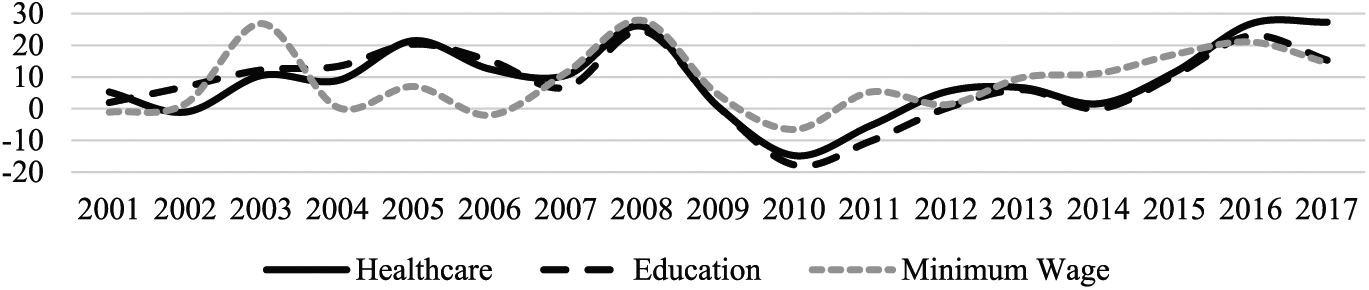
Annual changes in net real wages in the health and education sectors and in national minimum wages, 2000–2017.
However, for many workers in healthcare wages are supplemented by informal payments and by a relatively generous system of bonuses; reports claim that an average of 41 percent of out-of-pocket health expenditure exists in the system (Moldovan and Van de Walle, 2013). Although governments cited these informal payments as an argument for the privatization of healthcare (Stan, 2012), they remained a mechanism for socializing wages for health workers. Government proposals in 2015 for a code of practice for informal payments were resisted both by the unions and by individual workers (Ziare.com, 2015).
These factors helped make Romania one of the most important exporters of healthcare professionals (Dornescu and Manea, 2013). For example, Galan et al. (2011) report that around 3 percent of medical doctors left the country in 2007 and around 9 percent applied for a diploma verification, which would allow them to practise medicine in other EU member states. Media reports also point towards a massive emigration of doctors, with around 5000 (over 10% of the total) leaving the country between 2005 and 2010 (Realitatea.net, 2010), and around 17,000 doctors (48% of the total number) applying for recognition of their certificates of practice abroad between 2010 and 2017. These numbers are corroborated by official statistics. Even after accounting for new entrants in the system, between 2007 and 2016 the country lost around 14.5 percent of its doctors and around 23.5 percent of its medical assistants. By comparison, between 2008 and 2016, the education sector lost 10.5 percent of its employees (see Table 3).
Number of doctors and medical assistants in Romania (‘000) 1990 – 2016.

Source: Romanian National Institute of Statistics.
Austerity measures have further contributed to emigration and to the worsening of pay and working conditions for those remaining in the public system. The crisis response package passed by the Boc government in 2010 was among the harshest in Europe, with its main target as the public sector. Amid protests from the trade unions both in education and health, it introduced a 25 percent wage cut that slashed the already low wages (see Figure 2). At the same time, a hiring freeze affected all public sector institutions in order to further curtail public expenditures and keep the wage bill under control. Promoted as a temporary measure (for up to 1 year), it took more than 2 years and three governments to adopt policies that would gradually unfreeze the public sector jobs market. The government also planned numerous public sector retrenchment reforms through privatization and the decentralization of services. Proposed reforms in the health system envisioned the closing of many hospital units as well as the privatization of services, including emergency ones. In 2011, 67 hospitals were shut down and a draft bill proposed the full privatization of healthcare (Stoiciu, 2012). However, the government backed down on the privatization plans as both trade unions and the civil society actors protested the reform.
These changes took place against the backdrop of a radical labour market reform that eliminated the institutional power of trade union confederations by ending national-level collective agreements while raising the threshold of representativeness, making striking more difficult and requiring trade unions to re-register in order to be recognized as social partners (Guga, 2015). Union resistance did little to prevent the reform from being adopted; it received praise from international institutions which applauded it as a necessary step for eliminating labour market ‘rigidities’ and bringing public sector expenditures under control by removing inflationary pressures generated through centralized collective bargaining (Adăscăliței and Guga, 2018). As Table 4 shows, in the aftermath of the reform labour conflicts in both sectors have almost disappeared.
Industrial disputes in the health and education sectors, 1993 – 2016.
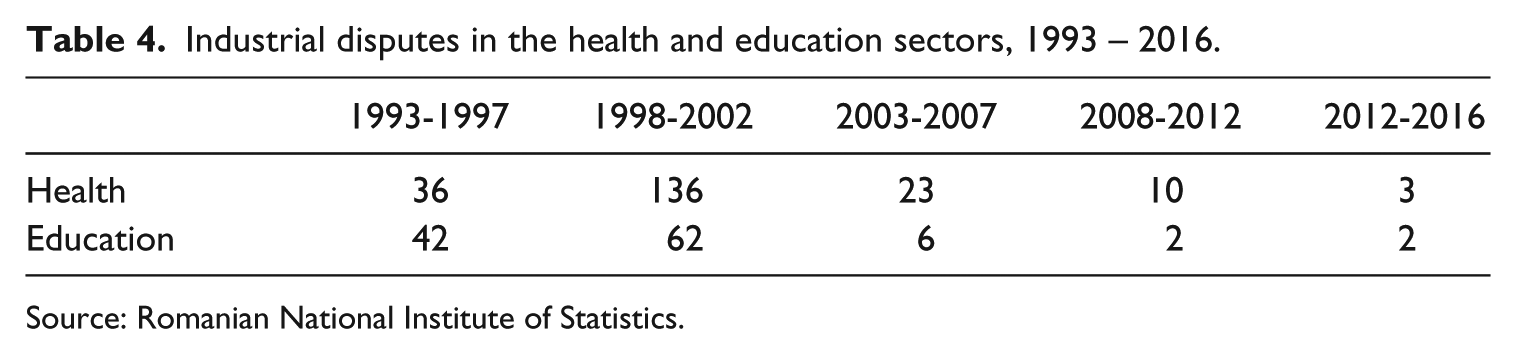
Source: Romanian National Institute of Statistics.
However, as we discuss below, this does not mean that industrial conflict has completely disappeared. On the contrary, austerity measures and the changing labour market conditions in the public sector have forced trade unions to rethink their strategies and devise alternative means to exert pressure on governments.
Trade union strategies in the healthcare sector
There are three representative union federations in the Romanian healthcare sector. Sanitas is by far the largest, with over 90,000 members (see Table 2); it combines elements from the servicing model of trade unionism with an organizing approach. Besides differences in associational power resources, healthcare unions have also followed different discursive strategies towards austerity and sectoral reforms. In the aftermath of the crisis, Sanitas has consistently argued for a fairer distribution of wages across the sector and demanded wage increases for low-paid workers, but Solidaritatea Sanitara has followed a more individualistic agenda, emphasizing performance-based pay and reflecting the narrower interests of its constituency, which consists primarily of doctors (Stan and Erne, 2016). However, this cleavage now seems to be less evident as Solidaritatea Sanitara has gradually shifted its position, especially on the contentious issue of capping bonus levels.
In the context of radical changes in legislation that slashed collective bargaining rights, unions had to re-establish themselves as legitimate actors and rebuild their institutional resources by rekindling social dialogue in the sector and signing collective agreements. The task proved daunting since both the new institutional arrangements as well as the austerity measures implemented in response to the crisis made sectoral and cross-sectoral collective bargaining almost impossible to sustain. As a result, in 2011 and 2012 Sanitas signed two collective agreements, covering only the group of units under the administration of the Ministry of Health, thus leaving the private sector outside their scope. Both documents reflected the narrow scope of the new collective bargaining rules and did not include provisions on pay, overtime or annual leave (Ciutacu, 2012; Stan and Erne, 2016).
A year later, in 2013, Sanitas joined other actors in the healthcare sector, including the Colegiul Medicilor din România (College of Physicians), to form a coalition of healthcare professionals, in a bid to frame the existing problems in the sector in terms of a systemic crisis. Its agenda reflected the various interests of its constituents and included both very broad and very specific demands, including the allocation of 6 percent of GDP to healthcare a wage law unique to the sector, the defence of the dignity of healthcare professionals and better conditions for patients in public hospitals. This broad agenda was accompanied by specific demands for its members, among which Sanitas sought higher wages for all personnel in the sector as well as a sectoral collective agreement.
To push for a sectoral agreement, Sanitas used its associational and organizational resources to threaten a national strike that could contribute to closing down the entire healthcare system while also inflicting substantial political damage on the government. In preparation for the strike, the unions gathered signatures in support of industrial action while also mobilizing members for a warning strike; this took place in November 2013 and involved 100,000 employees (Mediafax.ro, 2013). This served as a credible threat of further industrial action and aimed to force the government to enter negotiations; it also brought into the public agenda the impact of austerity on the sector, giving it a political dimension ahead of forthcoming elections in 2014. Furthermore, government threats to sue the union were defused by calling members to take holidays en masse should hospitals apply wage penalties for the strike days (Gândul.info, 2013).
While the general strike was cancelled because the government agreed to negotiate, the industrial action had several outcomes. First, it resulted in the signing of the first sectoral collective bargaining agreement after the crisis, which restored some of the rights lost by workers as a result of austerity policies. Unlike the agreements signed for the groups of hospitals, the sectoral agreement included provisions on pay, bonuses, shift work, holidays and working conditions. It also secured a series of short-term concessions, including the restoration of a thousand jobs in public hospitals, an agreement to increase the budget allocated to healthcare in 2014 and the doubling of pay for doctors during official holidays (Mediafax.ro, 2013). However, it also revealed the weakness of maintaining coalitions between trade unions and non-union actors even in the context of a common interest. The coalition collapsed immediately in the aftermath of the sectoral agreement, although many of its demands were not met.
Yet for Sanitas, the 2013 victory allowed it to re-establish itself as the most important confederation in the healthcare sector and regain the legitimacy it had lost following the arrest of its leader, Marius Petcu, on corruption charges (Varga and Freyberg-Inan, 2015). In consequence, Sanitas gradually became the most vocal opponent of the privatization of healthcare and advocate of better wages and working conditions. Using a combination of strikes and strike threats targeted across key hospitals around the country, together with pickets of public institutions, the union succeeded in resisting further privatization of hospitals in 2013 and 2014, while also negotiating substantial wage increases in 2014–2016 (see Figure 1).
Conflict over pay levels re-emerged in 2016, against the background of negotiations for a new law on unitary payment; the union organized a general strike to push for higher wages but also for the reduction of wage inequalities in the sector. The use of wage inequality and fair pay as a central framing mechanism for demanding better wages allowed Sanitas to gather support for industrial action among both skilled and unskilled workers. The union stressed the need to increase wages, especially for low-paid workers, who were among the lowest paid in the public sector (Mediafax.ro, 2016b). The migration argument, which in the aftermath of the crisis has gradually gained public and political attention (Stan and Erne, 2016) was used intensively in framing the need for better wages. This came at a time when discussion of the impact of emigration figured prominently on the public agenda, with the Ministry of Labour emphasizing the need to address the labour deficit across a variety of sectors (Gândul.info, 2016). After a warning strike and a series of pickets and work-to-rule actions between September and November 2016, the union organized a strike which mobilized 80,000 healthcare workers across the country.
Despite opposition from a technocratic government, the parliament agreed to the demands put forward by Sanitas and approved increases in both basic pay and bonuses (Mediafax.ro, 2016a). The strike also paved the way for further negotiations in 2017 and 2018 between Sanitas and the newly formed government led by the social democrats (Partidul Social Democrat, PSD). Direct negotiations were facilitated by the linkages between the Sanitas leadership and the PSD; for example, Marius Sepi, the union’s vice-president, is a former member of PSD and was offered a state secretary position in one of the governments. The negotiations continued to focus on wages in the sector, with the new government committing to double the level of wages in 2018 in order to address the issue of emigration. These unprecedented increases seemed to confirm that the strategy adopted by Sanitas, combining extensive mobilization with high-level negotiations in a context of a tight labour market, was successful.
However, at the time of writing (March 2018), the impact of these wage increases is mixed. On one hand, the shift of all the social security contributions from employers to employees has inflated gross wages in Romania while having no impact on net incomes. On the other, the significant increases in the level of wages have been accompanied by a capping of bonuses in the sector to 30 percent of basic pay. The measure led to a decrease in net incomes, especially for low-paid workers, and has triggered yet another wave of protests over the issues of fairness and wage inequalities. It remains to be seen how far this latter wave of protests will be successful in altering the effects of the recently adopted changes in pay legislation. As the government does not have the fiscal space to accommodate further increases in expenditure, it is likely that Sanitas will continue to use its associational resources to mobilize its members.
Trade union strategies in the education sector
Attempts to introduce managerialism and market mechanisms have also affected the education sector. However, in contrast to healthcare education unions have unequivocally backed these measures. In October 2008, only months before the onset of the economic crisis, the unions supported a set of reforms that aimed to decentralize decision-making regarding curricula and school management, introduce performance criteria to differentiate schools as well as a system of performance pay that would link teachers’ wages to their ‘performance in class rather than to their seniority or certification level’ (Presidential Committee, 2008: 74). The PSD presented this as a reform that would legitimize a 50 percent wage increase promised ahead of elections and received broad parliamentary support, but it ultimately served as a mechanism to pacify the unions while allowing political actors to capture the public discourse around the need for a better education system.
The weakness of alliances with political actors became evident only a year later, when the optimism generated by planned wage increases was destroyed by one of the harshest austerity packages in Europe (Ban, 2016). In January 2010 the unions reacted with a threat of strikes, although months earlier they had insisted that these were ineffective as a mechanism for achieving wage increases in a context of austerity (HotNews.ro, 2009). Joined by other public sector unions, they formed the Alianța Bugetarilor (Alliance of Public Sector Employees) to coordinate actions against the austerity reforms.
In addition, the FSLI leadership announced an internal consultation of members in order to decide whether to launch a general strike in the state schools, while also calling on teachers to protest by not grading assignments. Both strategies failed: the general strike did not receive majority support, while teachers refused to carry out the grading ban. Further calls to oppose austerity through a general strike in the public sector also failed, thus giving the government a green light to proceed with its planned reforms. Under 20 percent of teachers joined a boycott of the end-of-year exams, signalling that in spite of substantial associational resources, trade unions in the education sector lacked organizational power to mobilize the rank and file.
Besides the 25 percent cut in wages which affected all public sector workers (see above), the education sector was affected by additional cuts including a hiring freeze, as well as the removal of 10,000 workers the majority of whom worked on atypical contracts, including untenured and substitute teaching positions and support staff (Ziare.com, 2010). The response of the trade unions to the cuts was ambivalent. On one hand, they entered negotiations with the Ministry of Education, opposing the measures but ultimately seeking to ensure that the impact on tenured jobs and wage levels would be minimized. On the other, they accepted the logic of ‘optimization and efficiency in spending the public money’ put forward by the Ministry (HotNews.ro, 2010).
Several strikes and protests ensued in 2010 but these could not prevent the government from implementing its programme. In October 2010, FSLI organized a protest in Bucharest calling for a larger budget for the sector; the message was a general opposition to austerity and underfinancing of the sector, but the unions failed to present a clear alternative to the position of the government, and the protest gathered only 5000 teachers,
Following the change in labour regulation in 2011, the unions had to resubmit requests for the courts to certify their representativeness. The new regulations stalled bipartite negotiations over the signing of a new sectoral agreement, while also cancelling the national collective agreement. However, in November 2012 the unions signed two new sectoral agreements covering workers in primary and higher education. Signed by all three representative federations in the sector, the agreement was presented as a major success for the unions. It set rules on pay and working conditions, added several days of annual holiday for workers while also introducing rules on resolving labour conflicts (Apostolul, 2012). Yet the two sectoral agreements did not end the conflict between the Ministry and the unions. In a direct attempt to reduce union resources, the Ministry eliminated the possibility to deduct union contributions from salaries (Iamandei, 2012). It would take a change in government and the appointment of a Minister from the trade union ranks to restore the check-off in June 2012 (DCNews.ro, 2012).
The return of the PSD to office was also reflected in the strategies adopted by the unions, which began to rely even more on direct negotiations in order to push issues on the policy agenda. From 2012, the unions used almost exclusively cooperation mechanisms which favoured negotiation, consultation and lobbying for legislative change rather than adversarial stances based on mobilization. According to one union official we interviewed, ‘dialogue and negotiations are the tools of trade unions. The protests are only for show. … We have good relations with the current government’. This cooperative stance was also institutionalized through an agreement signed with the Ministry of Education by all the representative unions in January 2013 (HotNews.ro, 2013), committing them to cooperate in future changes to the education law. Cooperation was also the preferred strategy when dealing with the 2013 and 2014 budget negotiations. Although these depended on the political decisions and the ‘personal availability and options of ministers’, according to another union official, making outcomes unpredictable, union leaders preferred to adopt adversarial strategies and mobilize the rank and file only as a measure of last resort.
Mobilization was also hampered by the political pacts supported by all union federations in the sector. Ahead of the 2014 presidential elections, the unions signed an agreement with the PSD candidate establishing a calendar of wage increases between 2015 and 2017 in the event of a PSD victory (HotNews.ro, 2014).
However, the outcomes of a cooperative stance have been disastrous for the sector. Whereas before the crisis the education budget reached 4.4 percent of GDP, in 2013 it was merely 2.8 percent, the lowest level since 2000 (see Figure 1) and one of the lowest expenditure levels in the EU. At the same time, real wages in the sector fell, even though the real national minimum wage increased in 2014 (see Figure 2).
Negotiations over wage increases ensued in 2015 and 2016, with the unions relying almost exclusively on agreement with the government. Arguing that teachers’ pay had fallen too far behind doctors’ salaries, the unions sought similar increases in the education sector. As Figure 2 shows, although the negotiations were relatively successful in bringing pay increases in the sector, these did not match the pace of increases in healthcare. For example, whereas healthcare workers obtained a 25 percent increase at the end of 2015, in education the increase was 10 percent lower.
Conclusion
We have argued that in the aftermath of the crisis, Romanian trade unions in the education and healthcare sectors have used different strategies to defend their interests, ultimately leading to different outcomes for workers. We show that mobilization and adversarial strategies remain the most effective means to defend workers’ interests, especially within a tight labour market. In contrast, cooperative strategies proved less effective and ultimately resulted in welfare losses for workers in the education sector.
Building on a power resource approach, we have also shown that unions have been successful only when they combine different types of resources to push for their agenda. In this sense, we show that associational power is relevant only in so far as unions manage to mobilize it together with organizational and discursive resources. We demonstrate that austerity policies have generated the space to enhance unions’ coalitional power, but that coalitions have proved either to be difficult to sustain in the long term or to have a demobilizing effect on the unions. Indeed, we show that whereas in the healthcare sector the coalition between trade unions and doctors’ associations has ultimately failed to sustain the test of time, in the education sector political pacts have demobilized trade unions and ultimately delegitimized the union leadership. Political pacts have also proved unpredictable even in the short term and have limited union options to push their agenda.
These findings are relevant for wider debate about public sector reforms in the aftermath of the crisis in CEE. Romania provides a critical case in which the de-institutionalization of industrial relations has forced unions to rebuild their power resources. Ultimately, we show that unions in the public sector have approached the task of rebuilding their resources in different ways, by either opposing or accepting the dominant discourses about austerity and public sector reform; and that an uncritical embrace of marketization and individualization has decreased union power resources.
Footnotes
Acknowledgements
The authors would like to thank the editor Richard Hyman and the two anonymous reviewers for their constructive comments.
Funding
The author(s) received no financial support for the research, authorship, and/or publication of this article.