



Abstract
I analyse the incidence of trust between employee representatives and management at the firm level in EU member states. Most previous analyses focus primarily on employees’ trust in the employer, but I consider both sides. The analysis confirms, but generalizes, some known stylized facts such as that trust is relatively high in Scandinavian countries but relatively low in Mediterranean countries. My analysis also reveals a number of novel stylized facts, including a high degree of variability in Central and Eastern Europe. Furthermore, strong mutual trust is very rare throughout Europe and the trust relationship is systematically asymmetric, as employers’ trust in the employee side is systematically higher than the reverse relationship.
Introduction
An established academic literature considers that trust between employees and their representatives (the employee side) and management (the employer side) usually improves the efficacy of their interaction, for several reasons. If each side has trust in the other, the quality and quantity of communication are intensified (Taylor, 1989), encouraging both sides to share relevant information (Butler, 1995). This in turn fosters problem-solving behaviour and willingness to compromise, enabling bargaining outcomes in their long-term mutual interest (Purcell, 1974). Thus, not only trust in general but also mutual trust in particular can be considered pivotal for the efficacy of the employment relationship and decisive for the ‘success’ or ‘failure’ of companies. Therefore, it is important not only to know the level of trust in the employment relationship, but also to understand which factors affect and facilitate this relationship.
Although there is a reasonable amount of theoretical and empirical research on the influences on trust in general, as well as in the employment relationship, and on variations in trust between companies and countries (Delhey and Newton, 2005), relatively few stylized and generalizable facts have emerged regarding trust at the company or establishment level. This lack of generalizability is because most analyses are based on single company or country cases (Bryson, 2001; Dietz, 2004; Guest et al., 2008). Furthermore, previous literature took a largely one-sided view of the trust relationship, concentrating mainly on employee trust in the employer (Holland et al., 2012; Morgan and Zeffane, 2003; Searle et al., 2011). There is comparatively very little research on trust in the other direction. Empirical information and research on the incidence of mutual trust in the employment relationship are even more exceptional: a significant research gap, which this article addresses.
In this article, I provide an overview of how trust between the two sides varies in different firms in different European countries and a cross-sectional analysis of the factors, which determine trust. I use a unique, large and comprehensively matched employee/employer data set, which covers trust relationships at the company or establishment level. This not only gives an overview of how trust between the two sides varies in different firms in different European countries, but also provides a cross-sectional analysis of the factors, which determine trust.
In the next section, I review the role of trust in the employment relationship, then outline my conceptualization of trust and provide information on the empirical methodology used. Next, I provide an overview of trust between the two sides in the employment relationship and explore differences and similarities between countries. On this basis, I investigate the determinants of trust, beginning with an outline of the hypotheses and then their testing. I conclude by summarizing the main results and highlighting the identified stylized facts, before outlining the relevance of the analyses for further academic discussion.
The employment relationship and trust
The work of Fox (1974) still forms the basis for current discussion of the role of trust in the employment relationship. He developed one of the first systematic analyses of this topic, even though, as he noted, its importance had been recognized previously in the academic literature. Inspired by the theoretical work of Marx, Spencer and in particular Durkheim (Roche, 1991), he argued that much of the employment relationship is beyond the scope of a formal contract. In his theory of trust dynamics, he argued that a central problem of industrial advance is the decline in discretion at the workplace level, which leads to a loss of trust and increasing conflict between employees and employers. He further proposed that this development can be impeded or even reversed by establishing a partnership or bargaining relationship between the two sides (Wood, 1977): what would now be termed social dialogue.
This seminal contribution on the role of trust became an integral part of subsequent debates in the fields of sociology of work and labour and political economy (Kelly, 1999). His work also became an essential element in the HRM literature on workplace partnerships (Guest, 2016; Johnstone and Wilkinson, 2017; Saridakis et al., 2017). Nevertheless, apart from the psychological contract literature, the role of trust has never gained strong momentum within the subsequent employment relationship literature (Dietz, 2004; Roche, 1991).
This neglect of the role of trust is particularly noticeable in the comparative industrial relations literature. Some studies have analysed different concepts of trust in the employment relationship, including institutional and system trust (Lange, 2015), while others have explored intra-organizational trust. Within this literature, research has analysed the role of trust between employees, management and trade unions in the implementation and efficacy of various HRM policies and practices (Dietz, 2004; Frangi et al., 2017; Guest et al., 2008; Holland et al., 2012); others have investigated the impact of organizational change on trust relationships (Laplante and Harrisson, 2008). Another research strand analyses the determinants of trust in the employment relationship by focussing on the factors that explain employee trust in the employer (Bryson, 2001; Holland et al., 2012; Morgan and Zeffane, 2003; Searle et al., 2011). Yet far less attention has been paid to either the role of trust by employers in employees, or to mutual trust.
Lack of attention to mutual trust in the employment relationship, particularly in terms of empirical analysis, is undoubtedly a research gap because it is precisely the incidence of mutual trust that is important for the efficacy of social dialogue in general and collective bargaining in particular. The significance of mutual trust is supported by its centrality to negotiation and bargaining situations in general (Axelrod, 1984). Trust between two parties reinforces an efficient interaction as it reduces uncertainty and complexity (Luhmann, 1979), encourages risk-taking behaviour (Ross and LaCroix, 1996) and reduces transaction costs (Fukuyama, 1996). Thus, it is reasonable to expect that mutual trust between employees and employers can also reinforce integrative and cooperative negotiations in social dialogue and collective bargaining (Walton and McKersie, 1965). If trust intensifies the quality and quantity of communication (Taylor, 1989), this encourages the sharing of necessary information and provides the basis for deals which could lead to long-term mutually beneficial outcomes (Butler, 1995; Ilsøe et al., 2018; Nienhueser and Hossfeld, 2011; Purcell, 1974) even if this involves compromises and short-term losses for one side.
Given the lack of research on the incidence and role of trust from and in both sides and in particular of mutual trust, I analyse the trust relationship of each party in the other and assess its levels and determinants across Europe.
Conceptualization and data
I conceptualize trust in the employment relationship on the basis of Dietz (2004), as a willingness to render oneself vulnerable to another party on the expectation that the other party will not exploit that vulnerability. In order to assess the incidence of trust, I use data from the European Company Survey (ECS) 2013, which collected representative establishment-level data for establishments with 10 or more employees. I use the term ‘firms’ throughout, as is more common in the academic literature. The survey is based on interviews with managers and employee representatives in 6548 firms in the 28 EU member states (at the time of writing) on employment relations and HRM issues. As regards the operationalization of trust, the ECS asked, ‘please tell me … based on your experiences with the [employee representation or management, respectively] at this establishment … whether you agree or disagree?’. As in many previous studies (Brown et al., 2015), the answer categories were as follows: ‘strongly agree’, ‘agree’, ‘disagree’, ‘strongly disagree’, ‘don’t know’, ‘no answer’, allowing a graduated categorization of high- to low-trust relationships (Fulmer and Gelfand, 2012).
As the domain of analysis is the firm level, trust here refers to the intra-organizational relationship between representatives of employees’ representation in the firm and management. Trust here refers to the institution of employee representation and management and not to any other form of trust, such as, for example, institutional or system trust (Bachmann and Inkpen, 2011; Luhmann, 1979; Wicks et al., 1999). However, depending upon the institutional context of countries in which the firm is embedded, employee representation could be (formally or informally) linked to a (national, sectoral or company) trade union, could be formed and initiated (voluntarily) by the employer side or could be legally mandated (a works council). Thus, dependent upon the firm and country context, trust in and of the employee side captures a wide range of different forms of employee representation.
I refer to strong trust if the answer was ‘strongly agree’ and to some trust if the answer was ‘agree’ and use the term trust alone to cover both responses. I use the term mutual trust if trust is present on both sides. Given that I differentiate between ‘some’ and ‘strong’ trust, I also differentiate between some and strong mutual trust. Although there is discussion in the literature on the advantages and disadvantages of analysing distrust (Saunders et al., 2014), I concentrate on trust rather than on distrust, not only for reasons of space but also because distrust was rarely found in the sample. On the question of trust in employee representation, only 9 percent of managers answered that they ‘disagree’ or ‘strongly disagree’ and only 18 percent of employee representatives answered the question on trust in management that they ‘disagree’ or ‘strongly disagree’.
Symmetries and asymmetries in the trust relationship and country variations
As outlined above, a range of literature addresses why trust in management is high or low, but little is known about how much of this trust is reciprocated, meaning that the extent of mutual trust in the employment relationship is largely unknown. Below I examine the employment relationship and investigate trust of and in both sides. Table 1 provides an overview of the share of firms in which the employee representation has trust in the management and vice versa, relative to all firms in all EU member states.
Trust in employee/employer counterpart, EU averages of firms (%).

In the vast majority of firms, management has either some or strong trust in the employee representation. In 83 percent, the employee representation has either some or strong trust in management. However, from a methodological perspective, the category ‘some trust’ captures answers in the survey, which were potentially affected by social desirability. Anonymity and confidentiality concerns, which might cause a social desirability bias, are certainly mitigated in the data collection process but might not have been dispelled completely. Therefore, it is reasonable to argue that ‘some’ trust in the other side should only be interpreted as an expression of a (very) weak form of trust, but that this is distinct from distrust and can be interpreted to reflect at least a ‘good’ or ‘normal’ (working) relationship which is characterized neither by serious conflict nor by harmony. Trust in the other side is certainly different, and stronger, if the answer ‘strongly agree’ was given. As can be seen in Table 1, strong trust in the other side is much less frequent.
It is also striking that management has more trust in the employee side than the other way round. This stylized fact holds for all indicators and forms of trust. Thus, trust between the two sides is not symmetric on an aggregate level. In order to investigate this asymmetry further, Figure 1 shows a comparison of trust by one side in the other for each country separately. This shows, with only one exception (Lithuania), that trust in employee representatives is consistently higher than trust in management. While for some countries, the gap is relatively narrow (Cyprus, Luxembourg, Romania), in others, it is comparatively large. The gap in the UK is particularly wide: management trust in employee representatives is in line with the EU average, but employee trust in management is exceptionally low (64 percent).
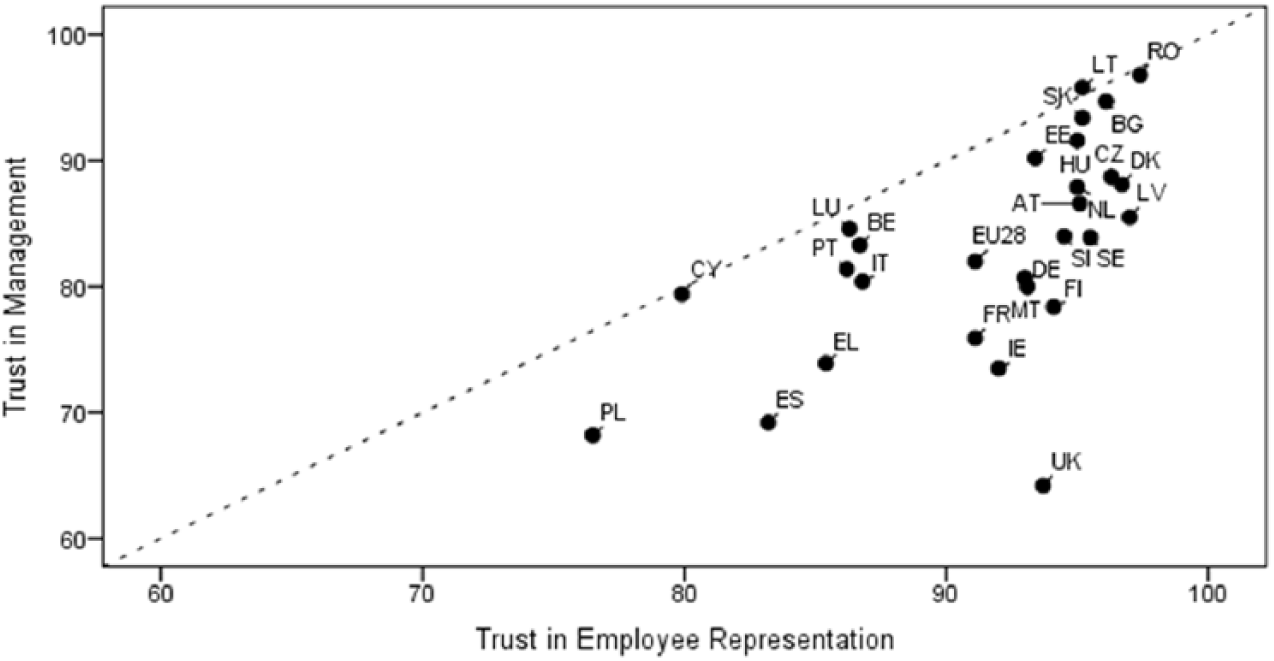
Country comparisons (%).
The variations may reflect differences in the legal status of employee representation. In some countries, this has a statutory basis giving formalized rights, but in others is predominantly voluntary and representation rights depend upon management discretion. However, no such pattern emerges in Figure 1: there is no consistent clustering by statutory or voluntary basis. Regardless of the reasons for its extent, the empirical evidence clearly confirms the stylized fact that there is a consistent asymmetry in trust between the two sides. This asymmetry is evident both in countries, such as Cyprus, Greece, Poland and Spain where the share of firms, in which either side trusts the other side is generally lower, as well as in those states, such as Bulgaria, Lithuania, Romania and Slovakia, in which trust in the other side is generally higher.
Below, I investigate country differences in trust further by looking at mutual trust between the two sides. Figure 2 provides an overview of the incidence of mutual trust in all EU countries. The employment relationship is characterized by mutual trust in 77 percent of all EU member states, but there is a noticeable country variation: mutual trust is lowest in Poland (57 percent) and highest in Romania (95 percent). Again, there are no clear patterns in the ranking of countries. However, in countries where the employment relationship is often described as (relatively) harmonious, such as Sweden and Denmark in particular and also Germany (Delhey and Newton, 2005; Ilsøe, 2010), there is a higher incidence of mutual trust than where the relationship is usually seen as conflictual, for example, Cyprus, Greece and Spain. By examining the ranking of countries on the basis of the incidence of strong mutual trust, the same weak pattern arises, with Scandinavian countries having (relatively) higher incidences of strong mutual trust and Mediterranean countries having lower incidences.
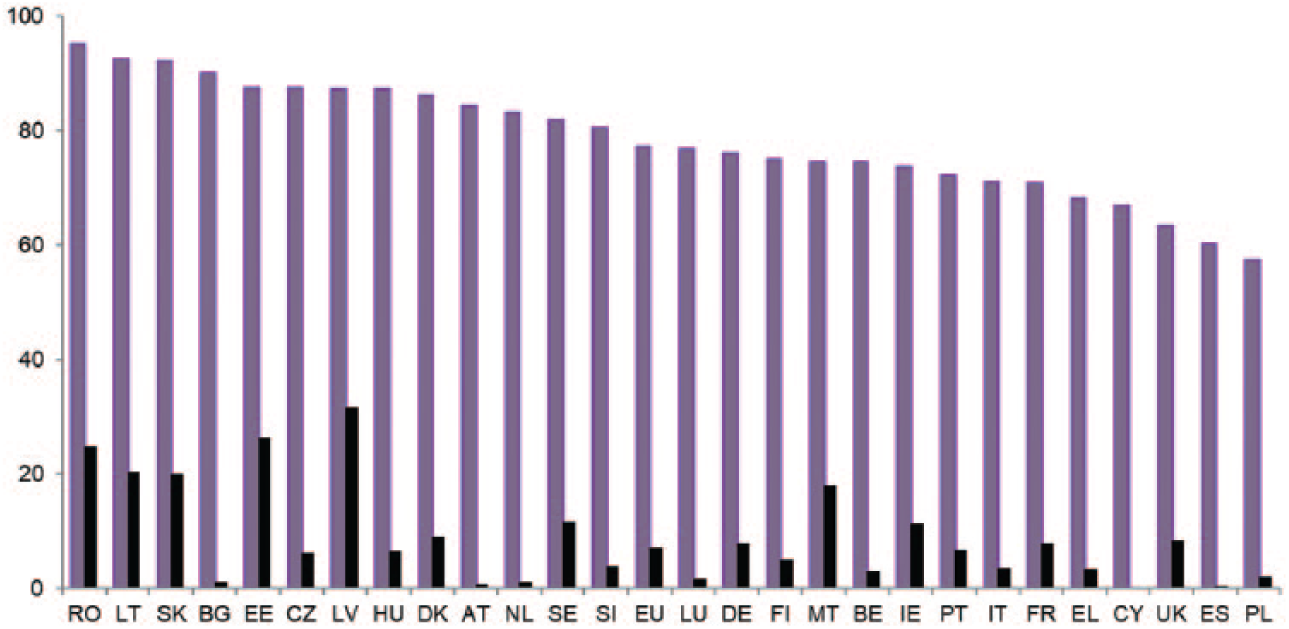
Mutual trust between employees and employers by country (%).
The countries with the highest incidences of mutual and strong mutual trust are Estonia, Latvia, Romania and Slovakia. This is not only somewhat puzzling, but also very revealing. The employment relationship in these countries, together with (almost) all other Central and Eastern European (CEE) countries, is contradictory. On one hand, it is generally described as conflictual, but on the other hand, as ‘acquiescent’ (European Commission, 2009), which suggests that conflict is not expressed though immanently present. The results here clearly put this general characterization in perspective and point towards the presence of a far more complex picture of the trust relationship in CEE countries. The analysis shows that if (and only if) employee representation exists, trust between the two sides can be exceptionally high. However, the ECS only captures trust between the employee and employer side if employee representation formally exists. This means that we cannot rule out the possibility that if there is no employee representation, the relationship between employees and employers involves low or no trust and therefore is potentially in line with the previous general perception. Nevertheless, the results show that trust building often overcame initial challenges in many CEE countries (Bernaciak, 2010; Frege, 2002) and even led to the formation of an employee representation based on high mutual trust. Furthermore, without being able to go into further details here with respect to country classifications, my results provide evidence that trust relationships are certainly very heterogeneous across CEE countries and potentially also within countries. Finally, Figure 2 also shows that strong mutual trust is at a very low level across the EU, though there are national differences.
The determinants of mutual trust
Above I compared the incidence of trust in the employment relationship across countries and identified (a)symmetries between the two sides. I now address explanations, concentrating on mutual trust. Our data have a hierarchical structure since firms are clustered in different countries and sectors, so I base the analysis on a multilevel regression approach (Gelman and Hill, 2007). The modelling approach not only allows differentiation between the effects of different levels but also enables consideration of a number of potential determinants and can control for the effects of potential confounders.
More precisely, my analysis investigates the reasons for differences in the incidence of mutual trust in different firms, which are embedded in different country-specific institutional and socio-economic contexts, following the methodology applied by Blunsdon and Reed (2003), Brown et al. (2015) and Bryson (2001). Furthermore, I investigate differences in the incidence of mutual (models 1) and strong mutual trust (models 2). Given that strong mutual trust is very rare, I expect differences in the relevance of factors, which explain trust. In general, some factors or variables, which can explain mutual trust between employees and employers, might not be sufficient to explain strong mutual trust, as it may be more difficult to establish a strong trust relationship.
As regards firm-level factors, I expect that size in terms of the number of employees affects the incidence of mutual trust, given findings that in smaller organizations, trust building between all factors is easier (Lane and Bachmann, 1998). I also expect that firm performance matters and that mutual trust is facilitated by a well-performing company and vice versa (Mishra and Mishra, 1994). As firm performance is multidimensional, I use a number of indicators, including the financial situation, the development of labour productivity and the growth/or decline in the number of employees. Given that (potential) job loss is the most severe performance indicator for employees, this variable can be regarded as the most indicative for this category. As a further potential factor explaining mutual trust (Morgan and Zeffane, 2003), I consider the stability of the workplace, by looking at the role of a number of organizational/operational changes, including those in organizational structure, products and services and production processes. In addition, I consider if a change in company ownership has an effect (Laplante and Harrisson, 2008), this is often an indicator of fundamental change and transition within a firm. Even though I do not expect all such changes to have a (similar) effect, I hypothesize that because of the uncertainty, which is induced into the relationship (Wicks et al., 1999), any change has a negative effect on mutual trust. As another firm-level factor, I control for a number of work and employee characteristics which are mentioned in the literature (Blunsdon and Reed, 2003; Brown et al., 2015) that potentially influence differences between firms in the incidence of mutual trust. These employee characteristics include the extent of teamwork, the number of hierarchical levels, and tenure practices as well as gender (proxied by the share of female employees) and age (proxied by the share of employees older than 50). Among these variables, the number of hierarchical levels is considered highly indicative, since hierarchies are often substitutes for trust (Mintzberg, 1979). Furthermore, the level at which collective bargaining takes place also potentially matters, because if collective bargaining takes place at a higher level (outside the firm), the role of a trustworthy employment relationship at firm level is different (Brandl and Ibsen, 2018) compared to where bargaining occurs at company level. I, therefore, include relevant controls in our models.
As trust in general and therefore also between employees and employers differs across countries, not least because of country-specific traditions and socio-economic and cultural differences (Clegg, 1976; Crouch, 1993; Delhey and Newton, 2005; Ferner and Hyman, 1998; Fox, 1974; Möllering et al., 2004; Uslaner, 2002), I apply a multilevel analysis with the country level first. In addition, in order to investigate the role of the country level further, I estimate a country fixed effects model. Furthermore, in order to capture the effects of any sector-specific differences in which firms are embedded, I analyse the effect of sector dummies, so as to capture any further differences in the socio-economic environment. However, given that some sector characteristics partially coincide with firm characteristics (for instance, in some sectors, the share of female employees is high) and that some variables reflect the same factor and therefore (potentially) cause multicollinearity problems in the estimation, I estimate the models in two versions. In versions (a), a parsimonious set of variables is estimated which includes only the most indicative variables for each determining factor; in versions (b), the wider set of variables outlined earlier including sector dummies is estimated. Please note that for reasons of space the sector estimates are not included in the following tables but are available in the online supplemental material. The results of the estimations are shown in Table 2 and the results presented are confirmed by further robustness checks, which are available in the online supplemental material.
Determinants of trust.

Panel corrected standard errors in parentheses. For reasons of space sector estimates are not presented here but available in the online appendix.
Statistically significant at the 10%; **5%; ***1% level.
As can be seen, the size of the firm affects mutual trust as the magnitude of the significant coefficients increases with size. The effect is robust over all different models. Thus, the higher the number of employees, the lower the incidence of mutual trust, which confirms the hypothesis that mutual trust is more likely in smaller firms.
The hypothesis that firm performance affects the incidence of trust is confirmed over all models in terms of financial performance, but not in terms of labour productivity. As regards changes in the number of employees as an indicative performance indicator, which is also used in the parsimonious models, there is a robust relationship for mutual trust but not for strong mutual trust. However, even though not all performance indicators are significant, the magnitude of the financial performance coefficient clearly shows that financial performance matters and different performance indicators have differing importance for the relationship between employees and employers and for mutual and strong mutual trust. Moreover, the results show that financial performance and mutual trust are positively associated and stimulate each other.
As argued earlier, organizational and operational changes in the firm induce uncertainty in the employment relationship and such changes can be expected to be associated with lower incidences of mutual trust, even though different changes may have different effects. As can be seen in Table 2, this hypothesis is only confirmed in the case of a change in company ownership, as the likelihood of mutual trust, but not strong mutual trust, decreases significantly if ownership changes. However, changes in organizational structure, in the products and services provided, as well as any change in production processes do not significantly matter for the incidence of mutual and strong mutual trust.
Table 2 also shows that only a few other factors which we control for affect the incidence of mutual trust. If collective bargaining takes place at the firm level, mutual trust (but not strong mutual trust) is significantly lower compared to no collective bargaining. However, this relationship is also not fully robust. As regards work and employee characteristics, the extent of teamwork and the number of hierarchical levels in the firm do not significantly influence mutual trust. Furthermore, the share of employees with open-ended contracts and who are older than 50 does not seem to affect the incidence of mutual trust. However, there is weak but not robust evidence that the share of female employees affects the incidence of strong mutual trust, but not mutual trust more generally.
I argued that trust in the employment relationship is also influenced by idiosyncratic country differences and characteristics. These differences were also reflected and discussed in Figures 1 and 2. However, these country differences are unconditional and do not control for differences among firms in these countries. I, therefore, investigate conditional differences in the incidence of mutual trust by estimating the previous models (1b) and (2b) using country fixed effects. By introducing dummies for all countries, I can identify the conditional differences in the level of mutual trust between all countries in our sample. The results are shown in Table 3 by models 1c and 2c.
Determinants of trust (country effects).

Notes and references as in Table 2.
The country dummy estimates show that mutual trust is generally very high and reflects similar country differences as shown in Figure 2; but the level of strong mutual trust is low, again with similar country differences as in Figure 2. The country estimates also confirm that in countries with ‘conflictual’ industrial relations traditions (such as Cyprus, France, Greece, Italy and Spain), mutual trust is lower than in other countries. Conversely, in countries with traditionally ‘harmonious’ employment relations (such as Denmark and Sweden), mutual trust is relatively high. Although these results are generally in line with previous literature, in contrast to some expectations in the literature, in many CEE countries, there is a high incidence of mutual trust between management and employee representatives, if the latter exist at firm level. This result points towards two reconsiderations of common views of the employment relationship in CEE countries. First, this is not a homogeneous ‘bloc’ or ‘regime’: trust relationships in countries, such as Poland and Slovenia are completely different from other CEE countries. Second, in contrast to previous characterizations (European Commission, 2009), the employment relationship in some of these countries is not generally conflictual but is marked by exceptionally strong mutual trust.
Furthermore, the conditional and unconditional country differences in the level of mutual trust mimic each other almost completely in terms of relative differences between countries, as well as in the country-specific levels. This suggests that differences in trust in the employment relationship are mainly explained by long-term path-dependent country traditions and cultures rather than short-term and firm-specific characteristics.
Conclusion: some stylized facts
Given that the academic literature considers mutual trust between employees and employers to be important for a well-functioning employment relationship and social dialogue, I investigated the trust relationship at the company level in all member states of the EU. Using a matched employee and employer data set, I could generalize single-country and case study evidences as well as identify a number of novel stylized facts, which challenged some previous accounts and reasoning on trust in the employment relationship. As regards some facts for which case or country evidences existed before, I could show that the levels of trust between employers and employees, and of mutual trust, varies significantly across countries. I provide the first systematic and comprehensive comparison and picture of trust in all EU member states: in general, (mutual) trust is higher in Scandinavia and Northern Europe and lower in Mediterranean countries. As regards the determinants of mutual trust, I confirm previous studies: first, trust in the employment relationship is higher in small companies than in larger companies; second, mutual trust between employee and employer and firm performance are mutually reinforcing.
As regards novel stylized facts, I show that the incidence of (mutual) trust in firms can largely be traced back to idiosyncratic country factors. Conversely, firm, employee and workplace characteristics as well as organizational and firm-specific changes are largely irrelevant in explaining trust in the employment relationship; instead it is the larger socio-political context that matters.
Furthermore, trust relations between employee and employers in CEE countries are heterogeneous: (mutual) trust is relatively high in some but low in others. This result not only sheds new light into the nature of ‘acquiescent’ employment relations in CEE countries, but also challenges previous assumptions of low-trust employment relationships in CEE countries.
Another key result is that I show that trust between the employees and employers is not symmetrical: trust by management in employee representatives is consistently higher than that of employee representatives in management. Even though the extent of the asymmetry varies across countries, its existence and direction clearly emerge as a robust stylized fact. Given that, previous studies did not possess the empirical basis to identify this systematic asymmetry, there has been little (or no) attention to the nature, reasons and implications of this asymmetry; further research into this asymmetry is needed. For example, very little is known on why, in some countries, managers trust the employee representatives even though this trust is not reciprocated.
Finally, my analysis showed that strong mutual trust is very rare, and in some countries is almost completely absent. While there are notable differences across countries, the rarity of strong mutual trust emerges as another robust and important stylized fact. Strong mutual trust enables both sides to strike deals, which might involve compromises and short-term losses for one side but which eventually lead to long-term mutually beneficial outcomes, and the existence of strong mutual trust between the employee and employer side is potentially decisive not only for the efficacy of the employment relationship, but also for the ‘success’ and ‘failure’ of the company itself. In turn, these results show that trust building between employees and employers appears necessary for any political attempts to increase the efficacy and functioning of the employment relationship, as recently initiated by international organizations (ILO and OECD, 2018). Hence, this study provides a clear roadmap for current and future activities of international organizations, by both identifying in which countries and on which side in the employment relationship, trust-building activities are most needed (and are perhaps most challenging).
Supplemental Material
Brandl_online_supp – Supplemental material for Variations and (a)symmetries in trust between employees and employers in Europe: Some (not so) well-known stylized facts
Supplemental material, Brandl_online_supp for Variations and (a)symmetries in trust between employees and employers in Europe: Some (not so) well-known stylized facts by Bernd Brandl in European Journal of Industrial Relations
Footnotes
Funding
The author(s) received no financial support for the research, authorship and/or publication of this article.
Supplemental material
Supplemental material for this article is available online.
Author biography
References
Supplementary Material
Please find the following supplemental material available below.
For Open Access articles published under a Creative Commons License, all supplemental material carries the same license as the article it is associated with.
For non-Open Access articles published, all supplemental material carries a non-exclusive license, and permission requests for re-use of supplemental material or any part of supplemental material shall be sent directly to the copyright owner as specified in the copyright notice associated with the article.
