



Abstract
We aim to contribute to a better understanding of the role that occupations played in recent trends in wage inequality in some European countries. Using EU-SILC data, we observe that most of the changes in wage inequality between 2005 and 2014 were the result of changes in the distribution of wages within occupations. A longer term approximation using data from the Luxembourg Income Study (LIS) shows similar patterns. We conclude that occupational dynamics did not drive recent trends in wage inequality in Europe.
Introduction
It is well established that wage inequalities have been growing in many advanced economies in the last two or three decades, despite important exceptions and differences in terms of the extent and timing of the change across countries. The clearest and most intense expansion of wage inequalities took place in Anglo-Saxon countries (the USA and UK) in the 1980s (OECD, 2011), extending in a generally milder form to many European countries in the 1990s and 2000s (with some noteworthy exceptions such as France).
There has been a separate but related debate on job polarization in the same countries over the same period. According to many analysts (Autor et al., 2006; Goos et al., 2009), changes in technology or international trade have biased labour demand against mid-skilled workers, polarizing the occupational structures of advanced economies. Others (Fernández-Macías and Hurley, 2016; Oesch and Rodriguez Menes, 2011) have argued that job polarization is not so pervasive across developed economies nor primarily driven by market forces, but by changes in labour supply, institutional processes of labour market deregulation and destandardization of employment contracts. However, both sides of the argument would agree that labour demand in recent years has been biased towards particular types of occupations, producing as a result either job polarization or occupational upgrading.
It seems likely that the two phenomena are related. In particular, it seems reasonable to think that an upwards or polarized bias in labour demand could have contributed to increasing wage inequality (although not necessarily as its main cause). Even if average occupational wages and their internal distributions remained stable, a process of occupational polarization would increase wage inequality by expanding the proportion of workers with low and high wages relative to those in the middle (in contrast, occupational upgrading would compositionally reduce wage inequality by reducing the relative share of low-paid work). Furthermore, a consistently uneven demand for labour in occupations across different skill levels would tend to affect occupational wages in biased ways. Ceteris paribus, polarized labour demand would reduce wage inequality in the bottom half of the distribution (since the wages of those at the very bottom would increase with demand, relative to those in the middle), while increasing it at the top half. Occupational upgrading would lead to a relative increase in the wages of the highest paid occupations, thus contributing to wage inequality even more directly.
However, whether the two phenomena are related in any significant way is an empirical question, and nothing should be assumed ex ante. There could be job polarization (or upgrading) and growing wage inequality without any significant link between the two. That could be the case if the distribution of wages within occupations had changed significantly in recent years: those changes could be much more consequential for wage inequality than any change in the occupational structure. Indeed, some recent influential studies of inequality trends point in this direction (Piketty, 2014). According to these studies, growing inequality is largely the result of a concentration of earnings at the very top (the highest 1 or even 0.1 percent) of the wage distribution: it seems unlikely that this development would be significantly linked to broad occupational dynamics. Behind this increasing concentration of earnings at the very top of the distribution would be institutional changes such as financial deregulation and destandardization of employment (Saez, 2015), phenomena which seem more plausibly linked to growing within-occupation (or occupation-independent) than to between-occupation inequality. Again, this question must be discussed empirically, as we try to do.
Our next section presents the existing literature on this matter. We then provide an overview of the methodology and the datasets that we use, and go on to describe the link between occupations and changes in wage inequality in Europe, using the EU-SILC dataset. Next we present trends in wage inequality in some EU countries during the last three decades using the LIS dataset. We end with a conclusion.
A review of the literature
The role of occupational wage differentials in explaining recent trends in wage inequality has been mainly discussed for the USA and the UK, though with some continental European contributions. The results from these studies are surprisingly contradictory in their findings, though they examine similar periods and in some cases use the same data.
A first group of studies argues that widening occupational wage differentials and job polarization account for much of the growing inequality in wages in the USA and UK in the 1980s and 1990s. For instance, Weeden et al. (2007) found that most of the growth in US wage inequality between 1973 and 2005 took place between rather than within occupations. According to these sociologists, most of this expansion took place between broadly defined occupational classes rather than at the level of detailed occupations. Similarly, Mouw and Kalleberg (2010) found that between-occupation changes explain two-thirds of the increase in US wage inequality between 1992 and 2008, although they caution that at least 23 percent of this change could be due to a change in occupational coding. They found, however, that between 1983 and 1992, most of the increase in wage inequalities took place within rather than between occupations. The economists Acemoglu and Autor (2011) used a variance decomposition approach to argue that broadly defined occupations (in 10 categories) became significantly more important as explanatory factors for wage inequality between 1979 and 2009 in the USA, compared to other factors such as education. For the UK, Williams (2013) reported similar findings, with occupations accounting for an increasing share of the variance in wages between 1975 and 2008 (and again, most of this increase being related to broadly defined occupational groups or classes). For Norway, Helland et al. (2017) find that in 2003–2012 there was a small increase in inequality that was mostly driven by between-occupation changes. A related literature has linked the increase in top wages to the growing importance of the finance sector. Godechot (2012) shows that the increase in wage inequality in France in 1995–2007 was largely driven by increasing pay for top finance managers. However, this development probably contributes more to within- rather than between-occupation inequalities, or at any rate to the differentiation between the wages of a few very specific occupational niches rather than across the full employment structure.
Both in sociology and economics, other studies claim that most of the expansion of inequalities took place within rather than between occupations. For instance, the sociologists Kim and Sakamoto (2008) found no evidence of an increasing role for occupations in US wage inequality between 1983 and 2002. The economists Mishel et al. (2013), in an explicit rebuttal of the findings of Acemoglu and Autor (using the same data but with a different operationalization), only find evidence of an increasing role of occupations in explaining US wage inequality between 1979 and 1994, with a significant decline afterwards.
Considering that all these analyses use similar approaches and often even the same data sources, the contrast between their findings is striking. Even within the group of studies asserting an increasing role for occupations, there are important contradictions: for instance, Mouw and Kalleberg (2010) find a decreasing role of occupations in wage inequality for the period 1983–1992 in the USA, in contrast to Weeden et al. (2007) and Acemoglu and Autor (2011). Why are the results of different studies so inconsistent?
These inconsistencies at least partly reflect the methodological challenges of assessing the role of occupations on wage inequality over long periods. Occupational classifications are updated every few years (in the USA they were introduced in 1977, changed in the late 1990s and again in 2010), and the comparability of results before and after these changes is highly problematic. The updating of occupational codes is necessary because technical change and the unfolding of the division of labour render them obsolete: but to the extent that it is better adapted to the new realities of work, an updated classification should produce more internally consistent occupations, and therefore should increase the share of variance in wages explained. Even if it may be possible to estimate this reclassification effect in the short run (for instance, Mouw and Kalleberg (2010) attribute to this effect almost one-third of the increase in wage variance explained by occupations in the USA in the 1990s), the comparability of occupational codes in the long run remains problematic, and the results are sensitive to minor methodological decisions on how occupations are treated for the analysis.
A more general methodological problem is the increasing importance of very large outliers in the distribution of wages. A very influential strand of the literature on income and earnings distribution has argued that the recent increase in inequality is mostly the result of a massive expansion of labour income for those at the very top of the distribution, the top 1 or 0.1 percent (OECD, 2011; Piketty, 2014). This development, according to the same literature, is very poorly captured in standard government surveys on income and wages, such as the US Current Population Survey (Atkinson et al., 2011), as a result of underreporting, sparse data, non-contact or refusals of top earners. To uncover these trends in top labour earnings, such studies used administrative registers and tax return data. Since most studies of occupational wages use surveys, they may miss a significant part of the recent growth in wage inequality.
This problem may be compounded by the common practice of using log wages rather than monetary wages as the measure whose variance is to be explained (Fernández-Macías et al., 2017: 39–40); logging wages can increase dramatically the share of variance explained by occupations if there are very large outliers, but it makes the interpretation problematic if large outliers are a feature of the distribution of wages and not a bug in the data used. Among the previously mentioned studies, the one that finds less evidence of a growing role for between-occupational differentials (Kim and Sakamoto, 2008) uses dollar rather than log wages as dependent variable.
Of course, some of these methodological problems will affect our analysis too. We try to address them explicitly as much as possible; in the case of changing classifications we explicitly discuss the potential effect of breaks and in the case of big outliers we consider wages both logged and in euros for comparison. The problem of missing the top wage earners is more intractable, because we do not know of any administrative data source that includes reliable occupational information.
Methodology
Before embarking on our own data analysis, it is important to clarify the ways in which occupations could affect the evolution of wage inequality. The first and most obvious effect is via occupational wage differentials: if the differences between the average wages of occupations become larger over time, this would drive up overall wage inequality even if the distribution of wages within each occupation remained stable. Second, occupations could also affect wage inequality compositionally: even if average wages across occupations and wage inequality within occupations remain stable, wage inequality would increase if employment expands in high- and low-paid occupations relative to the middle. That is how the well-known phenomenon of job polarization could lead to increased wage inequalities. Finally, overall inequality could also expand if employment in the most internally unequal occupations grew faster than in those that are internally homogeneous: for instance, deindustrialization can produce that effect because the distribution of wages in services tends to be more unequal than in manufacturing.
To our knowledge, no previous studies address the role played by occupations in recent wage inequality trends in a wide range and diverse set of countries. Probably, the main reason is the significant methodological difficulties involved. For this kind of analysis, data sources covering many countries and periods are needed, including adequate and comparable measures of the two main variables of interest: occupations and wages. In strict terms, there is no single international dataset that fulfils all these criteria, which means that it is necessary to construct the analysis using different sources and with some flexibility in the operationalization. Below, we provide some details on the main concepts used for the analysis and their measurement, discussing the limitations of the data sources used and how we deal with them.
Occupations: concept and classifications
We define occupations as coherent bundles of tasks that require specific skills, corresponding to different positions within the division of labour in society (Fernández-Macías and Hurley, 2016). The division of labour involves the breakdown of economic processes into different tasks performed by specialized workers (leading to enormous gains in efficiency as well as increasing structural complexity), which in contemporary market economies is coordinated by two different mechanisms: markets and hierarchies. Markets coordinate the division of labour between firms (horizontal division of labour), while hierarchies coordinate the division of labour within firms (vertical division of labour). The conventional classifications of sector and occupation correspond to these two types. Sectors classify firms and workers operating in different markets, while occupations classify workers according to the position they occupy within the hierarchy and skill structure of their organizations.
We define occupations as positions within the division of labour along the vertical and horizontal dimensions combined. In practical terms, the unit of analysis will be a specific occupation within a specific sector (an occupation-by-sector combination: for instance, secretary within the construction sector). But to avoid confusion, we use the term ‘occupation’ or ‘detailed occupation’ instead, for the following reasons. First, occupations (empirically) are the main factor behind the observed patterns of job polarization and upgrading in recent years (Hurley et al., 2013). Second, occupation (conceptually) as defined above (coherent bundles of tasks that require specific skills and correspond to positions in the division of labour) encompasses both dimensions of the division of labour (conventionally called occupation and sector).
The level of detail of the occupational classification used depends on the possibilities afforded by the data at hand, as we explain later. For international comparisons, the ideal level of detail of occupations would be ISCO at three digits or ISCO at two digits combined with NACE at two digits. This level of detail should generate sufficient internal homogeneity within each job and external heterogeneity between them for our purposes, while retaining international comparability (beyond three digits, the comparability of categories in ISCO across countries is problematic; Elias, 1997). However, in the analysis, we have to use ISCO at the two-digit level only, or combined with NACE at the one-digit level (or even ISCO one digit by NACE one digit). In those cases, some of the heterogeneity between jobs at the detailed level will appear as heterogeneity within jobs at the aggregate level. Since this type of flexibility in the definition of occupation is necessary to carry out the intended analysis, we can only address it by being careful in our interpretation and explicitly discussing this problem whenever necessary.
Sources
We use two datasets: The European Survey on Income and Living Conditions (EU-SILC) and the Luxembourg Income Study (LIS) Database.
EU-SILC is used for the analysis of change in the effect of occupations on wage inequality between 2005 and 2014. It is a cross-sectional and longitudinal database on income, poverty, social exclusion and living conditions in the EU, coordinated by Eurostat, with data drawn from different sources at national level. It is representative of all private households and their current members residing in the territory of the countries at the time of data collection. A key advantage of EU-SILC for our purposes is that it provides consistent cross-sectional data on wages and occupations for 2005–2014. Furthermore, it provides a complete coverage of the economy. On the other hand, it provides only an approximate measure of wages (which has to be computed based on annual labour earnings information). Sector is only available at the one-digit level, and occupation at two digits. When using data from EU-SILC, occupations are defined by combining ISCO at the two-digit level and NACE at the one-digit level.
The LIS database (see http://www.lisdatacenter.org) is the largest available income database of harmonized microdata collected by multiple countries over a period of decades. It provides information about the household and person-level data on market and government income, demography, employment and expenditures from countries in Europe, North America, Latin America, Africa, Asia and Australia since 1965. Although the measures of wages and occupation in LIS are problematic for our purposes, even more than in EU-SILC, they can be used for an approximation to the longer time trends using the same methods presented in the previous sections. In LIS, both occupations and sectors are coded at the one-digit level. Although in some countries and years, there is a higher level of detail, it is impossible to provide consistent trend analysis beyond one digit.
Wages: concept and measurement
Our second key variable is wage. In the analysis of EU-SILC, we use an approximation to hourly wages obtained by dividing annual labour income in the year before the survey by the number of months worked, taking into account whether they were full-time or part-time, and adjusting for people with more than one job (for more details on this measure, see Fernández-Macías and Vacas-Soriano, 2015). Therefore, in practice, with EU-SILC, we use a measure of full-time equivalent wages rather than hourly wages.
For the measure of wages in LIS, we use the variable ‘PILE’ (personal paid employment income), which cannot be adjusted by hours of work because the latter variable has many missing values in some countries.
Occupations and the evolution of wage inequality in Europe in the last decade
Before the analysis with EU-SILC, we should briefly mention some limitations of this data source, which are mostly related to the data used and the period covered. First, EU-SILC is aimed at measuring income rather than wages, providing only an approximate measure of the latter that must be constructed under heavy assumptions, and can conceal some of the real variation of wages while introducing some variation unrelated to wages. Second, the sample size is relatively small (a few thousand cases), which is particularly problematic when the goal is evaluating how the variance is distributed between and across a very large number of groups (detailed occupations or jobs). Third, although occupation is measured at the two-digit level, sector is only measured at one digit (even slightly more aggregated, in fact) as mentioned above. Finally, the period 2005–2014 is too short for evaluating the long-term contribution of occupational trends on wage inequality, with any analysis likely to be biased by cyclical fluctuations.
How can we deal with those limitations? With respect to the measure of wages and the sample, we have compared the results of EU-SILC with those obtained with the Structure of Earnings Survey (Fernández-Macías et al., 2017), which has a very large sample and a good measure of hourly wages despite being available in practice just for 1 year, 2010. The amount of wage variance explained by occupations in 2010 in both sources differs by about 10 percent points (lower in EU-SILC), but otherwise, the picture painted by both sources is reasonably consistent (Fernández-Macías et al., 2017: 39). With respect to the classification variables, occupation at the two-digit level already captures most of the variation of the more detailed occupation-by-sector combination, so using a more aggregated sector classification should not be a big problem for evaluating the change in the importance of occupations for the wage distribution over time. And finally, even if we can only look at a short period, it is one of particularly intense occupational changes in terms of employment (as discussed in Hurley et al. (2013)), which should allow us to evaluate broadly whether this change does affect inequality.
We start our analysis with a variance decomposition approach, which has been used in discussions of this issue (Acemoglu and Autor, 2011; Mouw and Kalleberg, 2010). In this approach, the total variance of wages in a country can be split in two components when the data are grouped by occupations: the outcome of between-group differentials and that from within-group variability. If the groups (occupations in this case) play an increasing role in structuring wage inequality, we would expect the between-group variance to grow over time. In previous research, using this approach, we established that detailed occupations account for between 40 and 50 percent of the total variance in wages in most European countries (Fernández-Macías et al., 2017). Here we use the same approach to evaluate whether the structuring effect of occupations on the distribution of wages has changed in recent years. This is shown in Figure 1 for wages logged (Figure A1 in online appendix for wages not logged) between 2005 and 2014 for five European countries: Germany, Spain, Finland, France and the Netherlands; this selection of countries was mostly driven by data availability in the two sources. The figures show both the variance explained by detailed occupations or jobs (in practice, defined as occupation-by-sector combinations) and by two-digit occupations on their own (i.e. without crossing them with sector). Table A1 (online appendix) includes the detailed values of the ANOVA decompositions by year and countries, showing the percentage of total wage variance explained by ISCO (occupation) only, NACE (sector) only and ISCO–NACE combinations (detailed occupations or jobs).
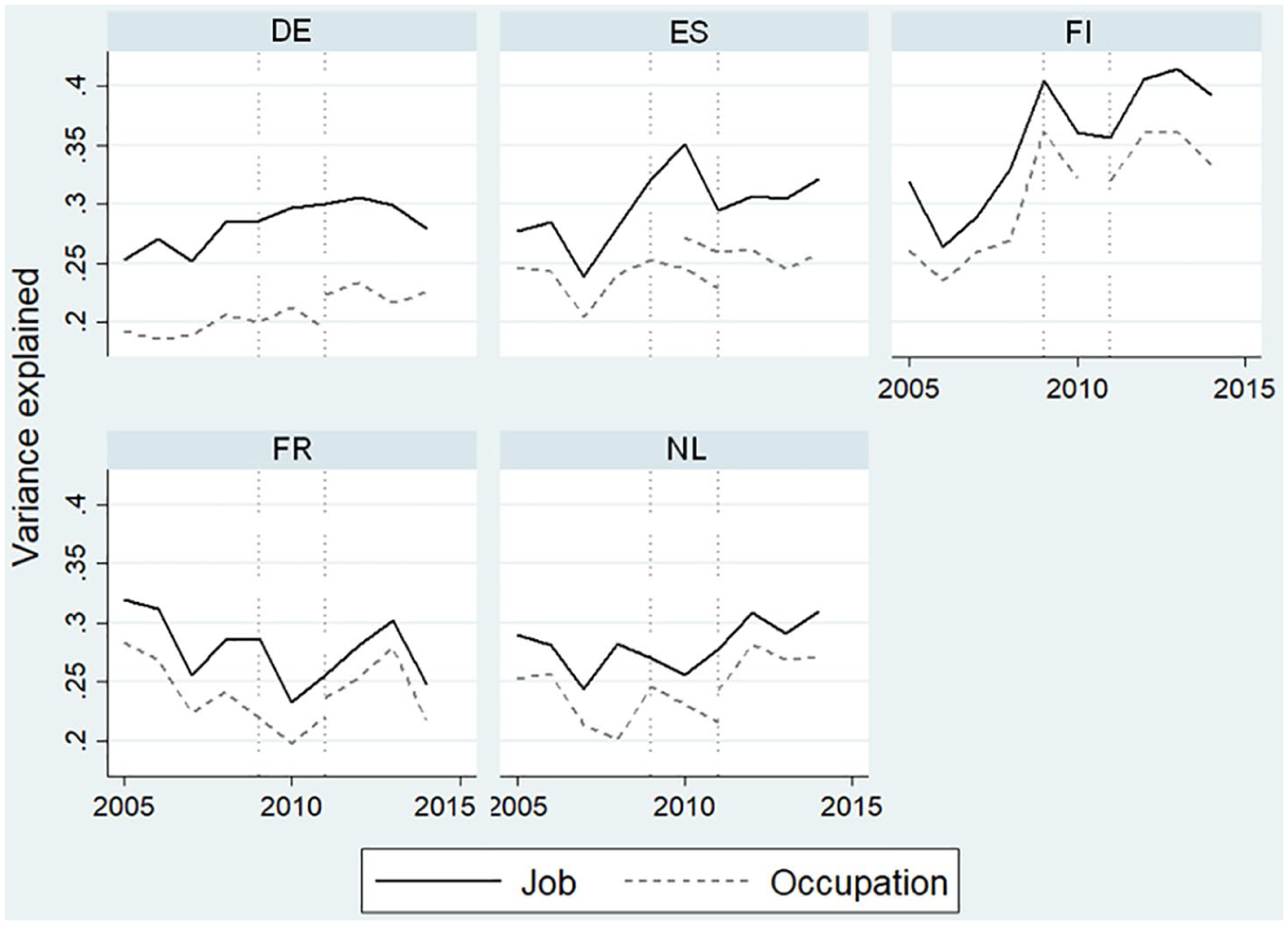
Share of variance explained by job and occupation (dashed line), wages logged.
Figure 1 paints a diverse and somewhat volatile picture of recent changes in the role played by occupations in structuring European wage inequality. However, under the short-term volatility there seems to be either stability or growth, with only one clear case of a decline in the share of wage variance explained by occupations (France). In Finland and Spain, the variance accounted for by occupations clearly and significantly increased over the period. In Germany, the trend also suggests an increase, but much milder (and potentially reversible). In the Netherlands, there is considerable volatility, suggesting statistical noise against a background of no significant change. Finally, as already mentioned, France is the only case of a more or less clear decline (though again with some volatility). Figures 1 and A1 indicate breaks in the classifications with separate dashed lines: the first refers to the change in sector (NACE) and the second that in occupation (ISCO). In some cases, these breaks are associated with discontinuities in the trend that should therefore be ignored in the analysis. The clearest case is Spain, with big jumps around the classification breaks.
With all the limitations previously stated, these initial results suggest a stable or mildly increasing role of occupational wage differentials in structuring wage inequality in Europe during the last decade. This impression is reinforced if we focus on the period after the onset of the crisis (around 2008), when in some cases there is a change in the trend.
However, that does not necessarily mean that occupations are driving changes in wage inequality. Even if the impact of occupations on wage inequality is (mildly) increasing, it may be that wage inequality is growing or declining for entirely different reasons. In other words, we need to go one step further and link the overall trend in wage inequality with occupational changes: for this, we use a Theil index decomposition. The Theil index itself is a measure of the degree of inequality in a distribution, which can be directly compared across countries and over time. However, as with the measure of variance previously discussed, it can also be decomposed by any grouping variable (such as occupation) into a within component (an aggregation of the level of wage inequality that exists within occupations) and a between component (the extent of wage inequality that results from differences between the average wages of different occupations). Figure 2 shows the yearly change in the within and between components of the Theil index for the same five European countries (together, these two components reflect the overall level of inequality in the country, which is not directly shown in the picture but can be inferred), plus the share that the between component represents over the total Theil (‘explained’, an indicator that has a similar interpretation to the variance explained by occupations, and that can be used to evaluate the role occupations play in structuring wage inequality).
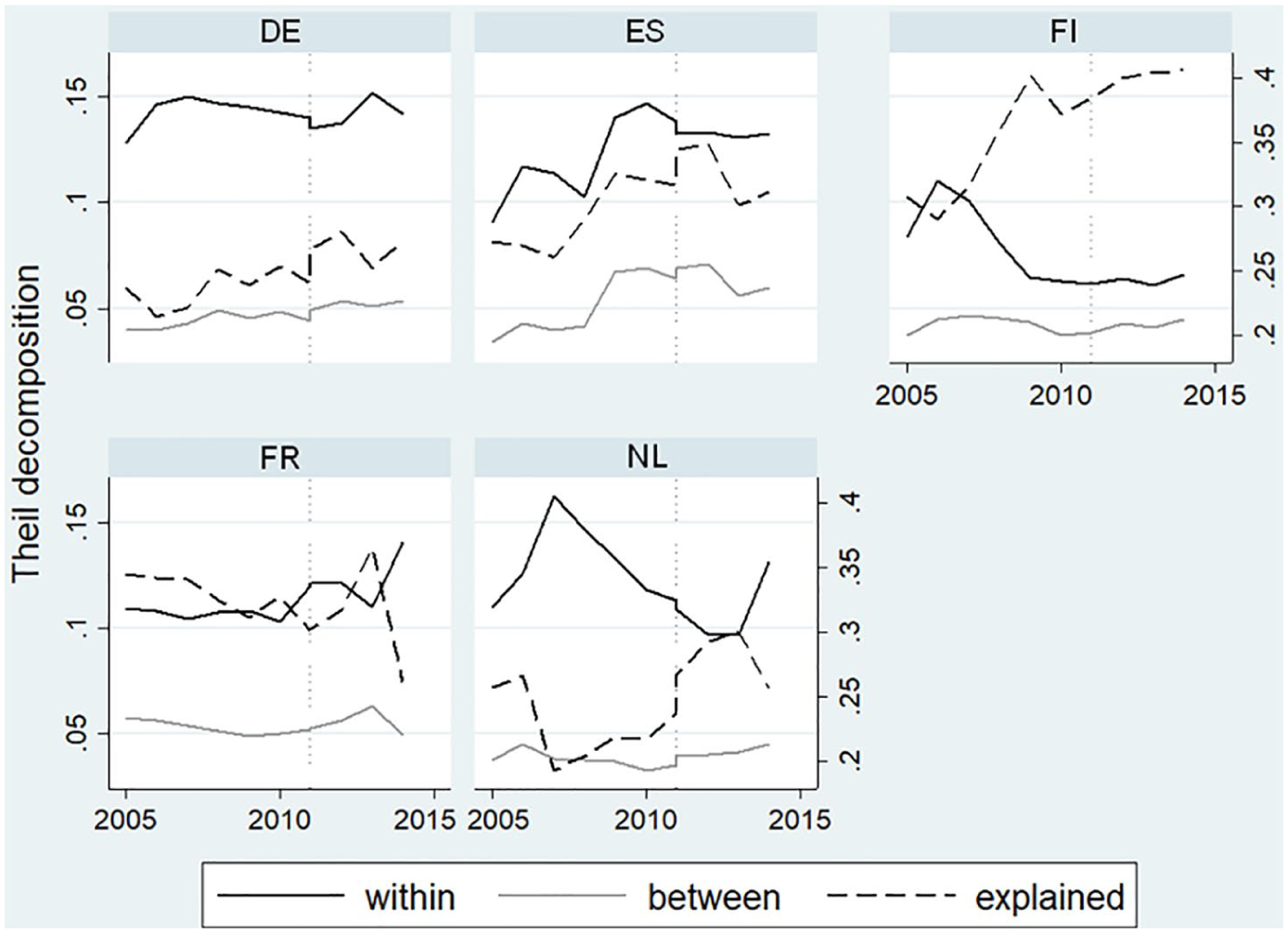
Theil decomposition of wage inequality by detailed occupations (jobs).
The ‘explained’ indicator shown in Figure 2 (the dashed line) paints a very similar picture to the analysis of variance previously discussed. However, we can now look at the evolution of inequality between and within occupations as well, and they suggest a rather different interpretation. It is the within component that drives change in the overall level of inequality in most cases, even when the share of inequality that is directly linked to occupational differentials tends to grow. The reason is, simply, that the between component tends to be more stable; and when it changes, it tends to move in parallel with the evolution of the within component. Let us discuss each country in more detail.
In Finland, where the increased role of occupations in the analysis of variance was very clear (a result confirmed with the Theil approach), we can see that a significant decline in the within component of wage inequality is what makes the explanatory power of occupations grow (a denominator effect). So paradoxically, occupations become more important not because occupational wage differentials grow, but because they remain relatively stable in the face of a generalized decline of wage inequality (which takes place mostly within occupations).
The pattern is similar in Germany, although with much more stability in both the between and within components. In France, the only case where we found a consistent decline in the variance explained by occupations, the within component of Theil actually increased over the period while the between component remained stable or slightly declined. The apparently erratic development in the Netherlands is again driven by much more volatility in within-occupation changes. And even in Spain, where the between component seemed to increase more clearly (between 2008 and 2009 in particular), it runs in parallel with changes in within-occupation inequality, and, therefore, it cannot be said to drive the overall inequality trend.
We can thus conclude that between 2005 and 2015, a period which is short but consequential both in terms of occupational change and inequality trends, because the crisis generalized job polarization and increased inequality (Fernández-Macías and Hurley, 2016; Vacas-Soriano et al., 2019), occupational change did not contribute significantly to wage inequality trends. This is surprising because, with the single exception of France, between-occupation differentials accounted for a growing share of total wage inequality over the same period. But the overall trend in inequality in the five countries was much more driven by within-occupation wage developments than by changes in occupational wages or job polarization. Occupational wage differentials were much more stable than within-occupational inequalities, and thus the latter played a much more significant role in overall wage inequality trends.
But even though 2005–2015 was an eventful period in terms of employment and inequality, it remains a short one. Perhaps in the short run within-occupation inequalities drive changes in overall inequalities, simply because they are more sensitive to cyclical developments or even measurement errors. After all, within-occupation inequality is calculated upon individual observations, whereas between-occupation inequalities are computed on the basis of grouped data, so that the latter is likely to be more robust and stable. In the next section, we complement this short-term analysis with medium-term data on wage inequality by occupations in the same five countries, using a different database.
Occupations and the evolution of wage inequality in Europe in the past three decades
In this section, we use the LIS database to extend the analysis of wage inequality across occupations and countries over the last three decades. This must be taken with more caution because, as mentioned above, the variables of occupation and sector are less detailed and sometimes affected by reclassifications that can break the consistency of the series. However, the broad trends should be reliable enough for a complementary long-term approximation to the analysis carried out in the previous section.
Figure 3 shows the same type of variance decomposition previously discussed with SILC data for the decade 2005–2015, but covering two or three more decades. As in Figure 1, a dashed line shows the variance explained by ISCO codes only (without crossing them with sectors). Table A2 (online Annex) shows the detailed numeric tables of this variance decomposition for reference. We should first assess the consistency of the results for the periods covered by the two sources (the last few years presented in Figure 3). It is reassuring that the results of the two sources are broadly consistent: in general, for the last decade covered in Figure 3, we can observe the same increase in the share of variance explained by between-job wage differentials that we discussed in the previous section using SILC data (the decline observed in France is also consistently found in the two sources). We can, therefore, proceed to discuss the more substantial question of how do these most recent trends compare with the changes over the previous two or three decades.

Share of variance explained by job and occupation (dashed line), wages logged.
The contrast between the most recent and the previous decades is quite clear. Whereas between 2005 and 2015, the variance in wages explained by occupational differentials either expanded or remained stable, between the 1980s and the 2000s, it tended to decline or remain stable. In other words, the longer term data of LIS suggest a change in the trend around the last decade, from a slightly declining role of occupations in explaining wage inequality to a slightly increasing role. In four of the five countries, the long-term decline seems clear and consistent: especially in France and Finland as well as in Germany (to a smaller degree) and Spain (although there is an abrupt and inconsistent increase in the variance explained by occupations in the early 1990s, which may simply reflect data problems). The Netherlands shows a very inconsistent pattern, with an initial sharp increase in the variance explained by occupations, then a sharp decrease and finally another significant increase, which seems implausible as a real trend and is likely to reflect problems in the LIS occupational classifications.
Finally, Figure 4 shows a similar Theil decomposition to the one discussed above, but covering a much longer period with LIS data. The last 10 years covered in the charts are again reasonably consistent with the results shown earlier with SILC data, and thus give support to the analysis of longer term trends. And again, there is some contrast between the short- and long-term results, but in this case, the substantive implications are similar. The results using LIS data in terms of variance explained and Theil explained are somewhat inconsistent, which did not happen with SILC. If the analysis of variance suggests overall a decline in the role played by detailed occupation in structuring wage inequality in the long run, the Theil decomposition suggests an expansion in some cases (most clearly in Spain). The Theil decomposition seems to be more sensitive to the problems of higher aggregation in the definition of jobs and long-term changes in the classifications. However, the analysis of variance approach provides a better and more consistent assessment of the role played by detailed occupations in explaining wage inequality. The Theil analysis is mostly used for comparing the evolution of inequality within and between occupations, a result which is consistent with the previous SILC analysis.

Theil decomposition of paid employment income by detailed jobs.
As discussed previously using SILC data for the past decade, between-occupation trends are significantly more stable than within-occupation changes in wage inequality over the last three decades. And again, it seems that irrespective of the role of occupations in explaining overall inequality, it is the within-occupation dynamics that drive overall inequality trends. Although in this case, changes in the within-occupation component display some abrupt shifts that should be viewed sceptically (because they suggest statistical noise rather than actual tendencies), it seems clear that whenever there is change, it tends to be either concentrated on the within component (as in Spain with declining inequality; France with decline until 1990s and increase afterwards; Finland with an implausible increase until 2000 and decline afterwards) or parallel in between- and within-occupation inequality trends (as in Germany and the Netherlands). As for 2005–2015, there is no country in which we can observe a clear divergence in the between- and within-occupation components of inequality that would suggest that the former drives overall trends.
We can, therefore, conclude this approximation to the longer term using data from LIS by confirming that in the five countries analysed, occupational dynamics did not drive broad trends in wage inequality. A longer term perspective suggests that the role played by occupations in structuring wage inequalities has declined in most cases over three or four decades, although in the most recent decade it seemed to increase slightly.
Conclusion
We have discussed empirically the link between two phenomena widely discussed in contemporary social sciences: job polarization and the increase in wage inequality in European economies. There is separate and convincing evidence on both. At least since the 1990s, some European labour markets have tended to expand employment either on the highest levels of the occupational ladders or on the highest and lowest simultaneously, with some diversity in trends across regime types (Fernández-Macías and Hurley, 2016). Over the same period, there was a moderate increase in wage inequalities in most countries, again with a significant diversity in the magnitude and even direction of these changes (Vacas-Soriano et al., 2019). But despite the obvious possibility of these two phenomena being related, no empirical study has established a link between from a European perspective.
We have tried to fill this gap, using two different data sources to assess to what extent occupational dynamics have driven recent wage inequality trends in five European countries. There are very significant methodological challenges facing this kind of study, mostly not only because of the lack of suitable data at an EU level on wage movements over time but also because of the inconsistencies generated by occupation and sector reclassifications. We managed to construct a reasonably consistent time series of wage inequalities between and within detailed occupations for the period 2005–2015 using SILC data, and a rough approximation (with less detail in the classifications) for a longer time period covering the 1990s onwards using LIS data. For the period covered by the two data sources, the results were broadly consistent despite some implausibly abrupt shifts in the series, especially in the long-term trends derived from LIS data.
In broad terms, the results point in a clear direction. Occupational trends (either in terms of employment shifts across occupational categories or in terms of changes in wage levels across occupations) were not the main driver of trends in wage inequality in the periods studied. On the contrary, changes in the distribution of wages within occupations played a more significant role in determining the overall trends in wage inequality. The contribution of occupational wage differentials and changes in the occupational structure to overall wage inequality tended to be rather stable over time compared with within-occupation wage trends. Although detailed occupations (defined here as occupation-by-sector combinations, to embody the idea of small units within the division of labour in the economy) play a significant role in the structuring of wage inequality in European countries; between one-third and half of all the variance in wages can be explained by occupational differences (Fernández-Macías et al., 2017). But this structuring role may be declining in the medium to long run.
These findings are consistent with some studies in the USA and UK that also found within-occupation inequality to be the most important driver of overall changes in the wage distribution (Kim and Sakamoto, 2008; Mishel et al., 2013), and contrast with other studies that find the opposite (Mouw and Kalleberg, 2010; Weeden et al., 2007; Williams, 2013). But perhaps the most interesting point of reference is the abundant literature on recent changes in the distribution of wages and income, which tends to find inequality to be driven mostly by massive increases in the incomes of a very highly paid minority (the top 1, 0.1 or even 0.01 % OECD, 2011; Piketty, 2014), linked to phenomena such as financial and labour market deregulation (Saez, 2015) or the rise of ‘super-star’ firms (Autor et al., 2017). Although these studies do not explicitly discuss the relevance of occupational trends in these phenomena, it seems almost obvious that those factors would tend to erode the importance of occupational wage differentials as a structuring factor the distribution of wages. These are all factors that would tend to increase within-occupation wage inequalities, because they are either oblique to occupations or directly eroding occupational wage differentials.
Occupations and sectors have always played an important economic and social structuring function, locating people in different socio-economic positions according to patterns of specialization, division of labour and work organization as well as reflecting institutional and political factors such as industrial relations systems and employment regulation. This crucial structuring role of occupations is reflected in the fact that occupations account for a large share of the total variance of wages in advanced market economies, as we have studied in this article. A decline in the role played by occupations in structuring wage inequality, as well as the predominance of wage inequality trends that have little to do with occupational dynamics, can therefore be understood as part of the generalized process of erosion of the regularities, institutions and socio-economic structures of post-war socio-economic systems.
Supplemental Material
Fernandez-Macias_online_supp – Supplemental material for Occupations and the recent trends in wage inequality in Europe
Supplemental material, Fernandez-Macias_online_supp for Occupations and the recent trends in wage inequality in Europe by Enrique Fernández-Macías and José-María Arranz-Muñoz in European Journal of Industrial Relations
Footnotes
Acknowledgements
We thank Andrea Garnero, Stephen Kampelmann, Brian Nolan, Luis Ortiz, François Rycx, Andrea Salvatori, as well as Eurofound colleagues and members of the Advisory Committee for Labour Market Change for their very useful input. We also thank Richard Hyman and the anonymous referees.
Funding
The author(s) disclosed receipt of the following financial support for the research, authorship, and/or publication of this article: This work was supported by funding from the European Foundation for the Improvement of Living and Working Conditions (Eurofound) and was carried out within its European Jobs Monitor. The views expressed are those of the authors and do not necessarily reflect those of the European Foundation or the European Commission.
Supplemental material
Supplemental material for this article is available online.
Author biographies
References
Supplementary Material
Please find the following supplemental material available below.
For Open Access articles published under a Creative Commons License, all supplemental material carries the same license as the article it is associated with.
For non-Open Access articles published, all supplemental material carries a non-exclusive license, and permission requests for re-use of supplemental material or any part of supplemental material shall be sent directly to the copyright owner as specified in the copyright notice associated with the article.
