



Abstract
The vast diversity of present vegetation and environments that occur throughout South America (12°N to 56°S) is the result of diverse processes that have been operating and interacting at different spatial and temporal scales. Global factors, such as the concentration of CO2 in the atmosphere, may have been significant for high altitude vegetation during times of lower abundance, while lower sea levels of glacial stages potentially opened areas of continental shelf for colonisation during a substantial portion of the Quaternary. Latitudinal variation in orbital forcing has operated on a regional scale. The pace of climate change in the tropics is dominated by precessional oscillations of c. 20 kyr, while the high latitudes of the south are dominated by obliquity oscillations of c. 40 kyr. In particular, seasonal insolation changes forced by precessional oscillations must have had important consequences for the distribution limits of species, with potentially different effects depending on the latitude. The availability of taxa, altitude and human impact, among other events, have locally influenced the environments. Disentangling the different forcing factors of environmental change that operate on different timescales, and understanding the underlying mechanisms leads to considerable challenges for palaeoecologists. The papers in this Special Issue present a selection of palaeoecological studies throughout South America on vegetation changes and other aspects of the environment, providing a window on the possible complexity of the nature of transitions and timings that are potentially available.
Background
Environmental reconstructions covering the last 20,000 years are important for understanding the dynamics of natural systems as a reference for recent anthropogenic changes (Intergovernmental Panel on Climate Change, 2007). Climate changes, especially pronounced at the glacial–interglacial transition, volcanic eruptions, earthquakes, fire and human activities, have controlled the pace of recent environmental history. Understanding these changes in different ecosystems as a response to the different driving forces provides insight into general questions of species survival, spread and biodiversity. Although there is a long tradition of palaeoecological investigations in South America, results are often controversial and extensive pieces of the puzzle remain missing.
South America is a vast, diverse, and under-researched continent. Straddling the equator, it includes habitats ranging from the most diverse rain forest in the world, to extreme desert, a chain of high mountains, and species-poor Sub-Antarctic environments of the far south. Nowhere else on Earth can a greater range be found. Naturalists and scientists have long been aware of the riches present, but difficulties of accessing inland regions, especially in the tropics, mean that understanding the full range of these landscapes has lagged behind other regions. This spatial diversity of modern landscape and vegetation is, however, matched by a temporal variation in the forcing factors of climate change on Quaternary timescales. The pace of insolation change in the tropics is dominated by the precessional oscillations of c. 20 kyr, while the high latitudes of the south are dominated by obliquity oscillations of c. 40 kyr, often not in phase with precessional change (Berger, 1978). Over and above that consideration, there are global-scale processes that interact with these, and may dominate either or both. The build up and decline of both polar ice caps may be significant, as Arctic ice sheets potentially influence climatic change of the Caribbean coast of northern South America (Hughen et al., 2004), while the Antarctic ice development influences climates of the southern parts of the continent. The abundance of CO2 in the atmosphere is another global-scale forcing factor (Street-Perrott et al., 1997), which may have been a particularly significant controlling factor for higher altitude vegetation during times of lower abundance, while lower sea levels of glacial stages potentially open areas of continental shelf for colonisation during a substantial portion of the Quaternary. At any given part of the continent, then, the exact sequence of events that have led to the present vegetation and environment is a function of phenomena that are intrinsically global in nature (CO2, sea level), regional (latitudinal variation in orbital forcing), as well as more local (availability of taxa, altitude, human impact, etc.).
For palaeoecologists, these issues provide considerable challenges. It is not easy to disentangle forcing factors that operate on different timescales, especially when they operate continuously and interact in ways that are likely to be complex. The difficulty is further compounded by an apparent paucity of preserved late-Quaternary records over much of the area (except for the formerly glaciated south), as well as difficulties of access to a vast, thinly populated continent, even though the vastness and complexity of the region also offers a superb opportunity for fundamental research of how vegetation is developed and maintained in the face of climate changes on scales of millenia to hundreds of thousands of years.
South America extends from about 12°N (in northern Venezuela) to 56°S (in the southernmost islands of the Chilean Cape Horn archipelago). This range spans the equator, so the seasonal contrast in insolation changes forced by precessional oscillation act in the opposite sense in the northern part of South America relative to the centre and south (Figure 1). The current seasonality of insolation is greater today at 30°S than 30°N, but it was less at 11 ka, giving more evenness to the seasonality of the tropical zone then than now. Further, the consequences of greater insolation are likely to be different depending on latitude. In the south, increasing summer insolation through the Holocene (Figure 2) may have meant that many species, with distributions limited by summer cold, were able to spread further south. In the tropics at low southern latitudes, the same increasing insolation trend may have had a similar effect, but temperatures in this area may already be sufficiently high that further increase caused more restriction of distributions than extension. Precipitation changes in this area are likely to have been more significant than temperature changes. At low northern tropical latitudes, summer insolation decreased through the Holocene (Figure 2), and thus potentially forcing changes in distribution in the opposite sense to low southern tropical latitudes. Finally, all those potential changes as a consequence of changing latitudinal patterns of insolation must have interacted with each other, so that the actual climate consequences on the ground should have been some combination that is very hard to predict.
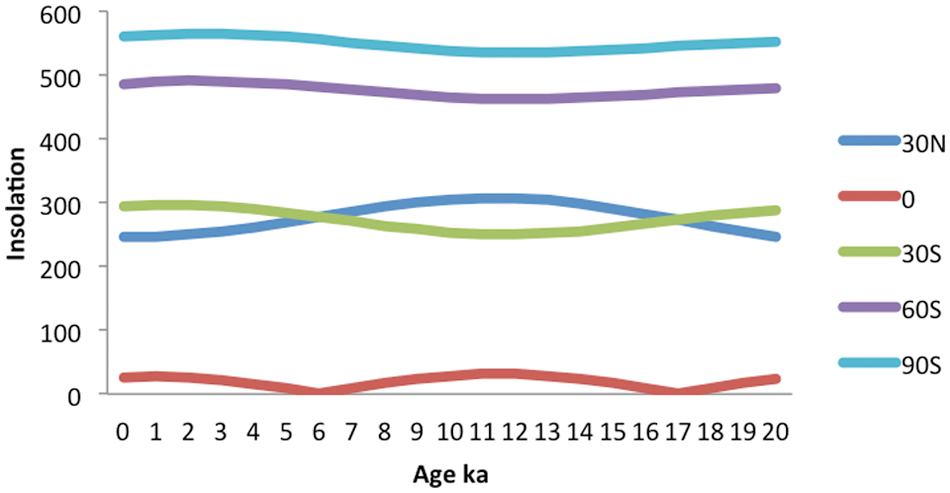
Changes in seasonal contrast since 20 ka, as represented by the difference between the calculated insolation values for June and December. Data from Berger (1992).
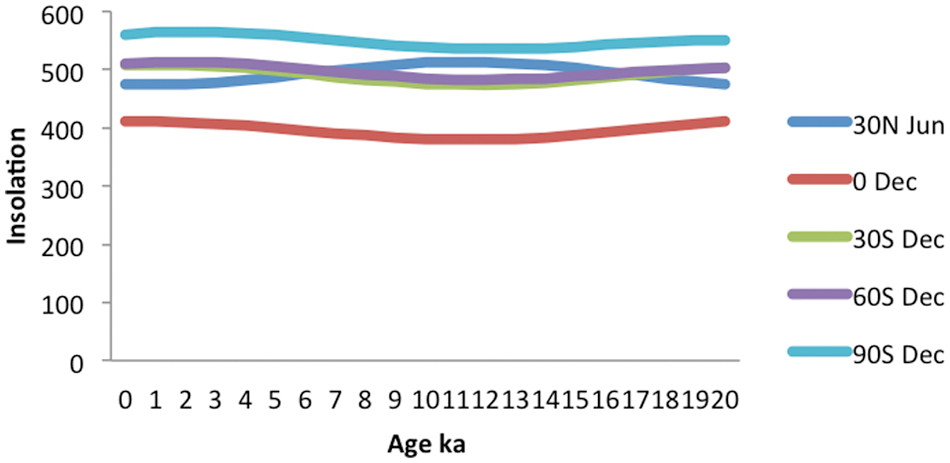
Calculated summer insolation values since 20 ka. Data from Berger (1992).
These considerations provide a background understanding of how climates might have changed. Palaeoecological studies, such as those in this Special Issue, provide data on changes in vegetation and other aspects of the environment through the Holocene. Is the one necessary and sufficient to bring about the other? It is seductively simple to match changing climates with changing vegetation, or even infer changing climate from the observed changes in vegetation. Unfortunately, we normally lack controls. Even if there is a contemporaneous climate change, we cannot tell, in principle, if the vegetation change would have happened without it. And if we lack information on contemporaneous climate change, there may be other factors that may have brought about the vegetation change, with or without the involvement of climate. Not least, climate change may be necessary for some vegetation change, but it may not always be sufficient, other elements being needed before the vegetation change can take place. For example, if a landscape is covered by an open vegetation under a cold climate, and the climate warms to the extent that Nothofagus growth is enabled, occupation of the landscape by Nothofagus cannot take place unless Nothofagus is available, and may still not take place if soil changes are also necessary. Climate change is thus necessary for growth of Nothofagus, but so are other factors, so it alone is not sufficient.
Contributions to this Special Issue
During a symposium convened at the VIth Southern Connection Congress in Bariloche (Argentina, 15–19 February 2010), scientists working with different proxies of environmental change research for the period since the LGM, gathered to present and discuss their latest results and views. A selection of these contributions and invited papers are published in this Special Issue of The Holocene. The goal of the symposium was to contribute to resolving questions concerning (1) the regional to hemispherical environmental history; (2) the palaeo-dynamics of Southern Hemisphere climate systems; and (3) the response of regional environments to global climate change.
The papers in this Special Issue present novel palaeoecological records and palaeoclimatic proxy data from Colombia, Peru, Brazil, Argentina and Chile, providing new perspectives on existing evidence of environmental change. They illustrate well the diversity of possible outcomes through South America as a result of this necessarily complex background (Figure 3). Although they barely scratch the surface of the full range of vegetation and environments in space and time, they provide a valuable introduction to that range, and the literature that is incrementally leading us to a fuller understanding.

Biomes of South America, after Olson et al. (2001) and location of sites for the papers in this special issue. 1: Neotropics, Bennett et al.; 2: Colombian Andes, González-Carranza et al.; 3: Nevado Coropuna, S Peru, Kuentz et al.; 4: Serra do Capara, SE Brazil, Veríssimo et al.; 5: São Francisco de Paula region, S Brazil, Jeske-Pieruschka and Behling; 6: Pampa grassland, E Argentina, Stutz et al.; 7: NE Patagonia, Marcos et al.; 8: WC Argentina 1, Bianchi and Ariztegui; 9: WC Argentina 2, Iglesias et al.; 10: SW Patagonia, Argentina, Sottile et al.; 11: S Patagonia, Argentina; Recasens et al.; 12: Western Tierra del Fuego, S Chile, Fontana and Bennett.
Quaternary climate oscillations, involving several cold and warm stages, have influenced the distribution and abundance of most plant taxa. In South America, extended ice fields during the cold stages were restricted to mountain ranges at higher latitudes, but changes in temperature and precipitation regimes have also influenced the vegetation distribution of unglaciated areas. In response to the cold stages of the Quaternary, moisture-demanding taxa of tropical highland environments retreated downslope to areas such as deep valleys and coasts. The maintenance of the complex and diverse Amazonian forests has been controversial for several decades, but increasing palaeoecological and phylogenetic data from the region may lead to a resolution (Bennett et al.). After the increase in temperature and humidity that followed the last glacial period, populations of these taxa expanded and spread upslope, influenced by different factors. In the Andean region, authors tend to prefer changes in temperature and moisture as explanatory mechanisms, while human impact is significant for at least the last millennium, in particular at the beginning of agriculture (Kuentz et al.). On the other hand, Andean civilizations have adapted and continued their activities despite abrupt climatic changes (Kuentz et al.). In the south Colombian Andes, it is remarkable that some taxa spread so slowly that they reached their highest position only two millennia ago (Gonzàlez-Carranza et al.).
In the southern part of Brazil, similar trends are identified, but with more emphasis on the cooler and wetter portions than drier. Forest expansion across the highlands has occurred at different times during the last four millennia. Forest taxa have responded to local shifts in moisture availability, apparently following altitudinal patterns (Jeske-Pieruschka and Behling). In local circumstances, the extent of plant taxa seems to have been influenced by anthropogenic activities. Intensive grazing and deforestation during the late Holocene in the high-altitude grasslands have favoured the increased extension of Campos even though the prevailing climate conditions would have been adequate for the occurrence of forests (Veríssimo et al.).
In central and south Argentina, warmth and dryness are key factors, along with fire, while in the extreme south, it is the early-Holocene warming (perhaps with increased wetness) that dominates records. At the Atlantic coast of northern Patagonia, Holocene environmental changes have been influenced by the changing strength of westerly and easterly wind-circulation systems, with consequent impact on the space and resources used by hunter-gathers of the region (Marcos et al.). In the Pampa grassland, the major climatic shifts that occurred during the Holocene are likely the main forcing factors responsible for changes in the trophic states of shallow lakes (Stutz et al.). Towards the Andean Cordillera, studies within different plant communities have provided new insights into past climate variations and local vegetation dynamics at the limits of species distributions. Along the eastern Andes, postglacial environmental and vegetational changes have been largely governed by changes in the position and intensity of the westerly winds (Bianchi and Ariztegui; Iglesias et al.; Sottile et al.). Along with climate, fire regimes have played a significant role in influencing vegetation composition and structure, and promoting ecotonal shifts (Iglesias et al.; Sottile et al.). In the southernmost part of South America, in the Patagonian steppe, a unique continuous palaeoclimatic and palaeoecological lacustrine record has provided new insights into the regional environmental history for the last glacial cycle (Recasens et al.). In western Tierra del Fuego, major shifts in plant communities occurred during the Lateglacial–Holocene transition, as climate warmed, while increasing rainfall caused the spreading and expansion of rain-forest taxa through the region. Volcanic disturbance has had a positive influence on the expansion of tree populations, and facilitated changes in woodland structure. Along with these external processes, competitive species interactions have played a significant role in controlling the extent of plant communities (Fontana and Bennett). Figure 4 gives some idea of the possible complexity in the nature of transitions and timings that are potentially available.
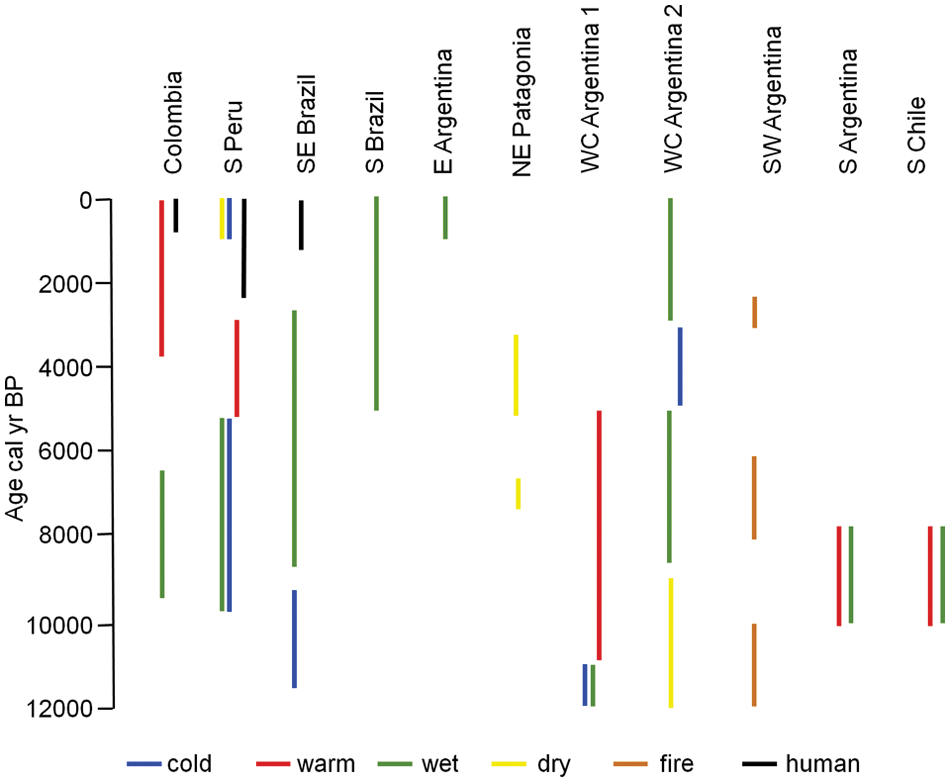
Summary of some of the main directions of variation identified in the papers in this Special Issue. Site details may be found as follows: Colombian Andes, González-Carranza et al.; Nevado Coropuna, S Peru, Kuentz et al.; Serra do Capara, SE Brazil, Veríssimo et al.; São Francisco de Paula region, S Brazil, Jeske-Pieruschka and Behling; Pampa grassland, E Argentina, Stutz et al.; NE Patagonia, Marcos et al.; WC Argentina 1, Bianchi and Ariztegui; WC Argentina 2, Iglesias et al.; SW Patagonia, Argentina, Sottile et al.; S Patagonia, Argentina, Recasens et al.; Western Tierra del Fuego, S Chile, Fontana and Bennett.
Final considerations
Even a series of data sets as small as that in this issue makes plain the difficulty of generalising trends across the continent. Most would probably agree that the dominant climate change of the last 20 kyr was the warming that occurred at the transition from the last glacial to the early Holocene, but the impact of that, and the way it is expressed, varies across the continent. This event transformed landscapes of the far south that had been glaciated or were periglacial into forest ecosystems. Elsewhere, change took place within forest systems through shifting distributions and abundance of forest trees. The degree of aridity (and perhaps also factors such as fuel source) determined whether fire was or was not a significant element, and it probably was at mid latitudes. The consequences of volcanic eruptions and tephra deposition can be seen widely along the Andes. Human impact also comes into the equation, but surprisingly late, given that South America was apparently completely peopled from the early Holocene, with perhaps only the civilisations of the Andes developing to the extent of initiating a dominant and controlling influence on their environment, complete with deforestation and agriculture.
We hope and expect that papers in this issue will attract interest in themselves, and become valuable documents of late-Quaternary events in the regions they represent. But, more than that, we hope that this array of material will stimulate further work to unravel the mysteries of environmental change of this vast and varied continent, truly adding a third dimension to the spatial richness that is already appreciated.
Footnotes
Acknowledgements
We thank many reviewers who provided valuable comments to improve these manuscripts. John Matthews and Gill Oliver carefully guided the review process. Authors of papers not included in this volume made important contributions to the success of the symposium. We are grateful for and appreciate the interest and enthusiasm of the large audience in attendance at this session.
Funding
This research received no specific grant from any funding agency in the public, commercial, or not-for-profit sectors.