




Abstract
We report on a sediment record from a small lake within the subarctic wetland complex Stordalen in northernmost Sweden covering the last 1000 years. Variations in the content of minerogenic material are found to follow reconstructed variations in the activity of the Sun between the 13th and 18th centuries. Periods of low solar activity are associated with minima in minerogenic material and vice versa. A comparison between the sunspot cycle and a long instrumental series of summer precipitation further reveals a link between the 11 yr solar cycle and summer precipitation variability since around 1960. Solar minima are in this period associated with minima in summer precipitation, whereas the amount of summer precipitation increases during periods with higher solar activity. Our results suggest that the climate responds to both the 11 yr solar cycle and to long-term changes in solar activity and in particular solar minima, causing dry conditions with resulting decreased runoff.
Introduction
A large and growing body of evidence suggests that the climate on Earth is intrinsically related to variations in the activity of the Sun. Holocene climate changes on decadal, centennial and millennial timescales have been suggested to be forced by variations in the activity of the Sun (e.g. Bond et al., 2001; Büntgen et al., 2006; Haigh, 2003; Haltia-Hovi et al., 2007; Magny, 2004; van Geel et al., 1996; Wang et al., 2005). Yet, because of the assumed small changes in total solar irradiance, amplifying mechanisms appear to be necessary to explain the amplitude of climate variability suggested by the paleorecords. An important non-linear process could be connected to the solar UV variability that influences the heat budget and circulation in the stratosphere (e.g. Haigh et al., 2005). Mechanisms have been suggested for how this signal is transferred to the troposphere (Matthes et al., 2006). The stratosphere–troposphere link, which has only recently become a focus of research, might provide a clue for the understanding of the solar influence on climate, since the effects of solar variability are much more clearly visible in the stratospheric circulation than in the troposphere (e.g. Labitzke, 2006). Furthermore, a series of papers demonstrates linkages between variability in the Sun’s activity and the North Atlantic Oscillation (NAO) and the Arctic Oscillation (AO) (Gimeno et al., 2003; Kodera, 2002; Lukianova and Alekseev, 2004; Ogi et al., 2003b). In agreement with findings from other studies, this indicates that solar modulation of climate may be locally amplified through changes in atmospheric circulation (Shindell et al., 2001).
Here we present a new record of last millennium variations in the amount of minerogenic material in a sediment sequence from Lake Inre Harrsjön in northern Sweden (Figure 1). Our results show an overall positive correlation between temporal variations in the content of minerogenic material, solar activity and temperatures of Atlantic water masses in the Norwegian Sea. A comparison between sunspot numbers and a record of last century summer precipitation from the nearby Abisko Scientific Research Station (ANS) indicates a periodic relationship between summer precipitation variability, the solar cycle and the NAO, with minima in the 11 yr solar cycle being related to summer precipitation minima and more negative phases of the NAO.

Left: map of Fennoscandia showing the location of the study area (black) and the location of the oxygen isotope record representing temperature variability in Atlantic waters along the Norwegian coast from a sediment sequence in the eastern Norwegian Sea (grey) (Sejrup et al., 2010). Right: aerial photo of Lake Inre Harrsjön (available at Abisko Scientific Research Station). The lighter colored area southeast of the lake represents the Stordalen peatland.
Study site
Lake Inre Harrsjön (68°21′N, 19°03′E) is located c. 10 km east of the small village of Abisko in northern Sweden just south of Lake Torneträsk (Figure 1). The area is characterized by a steep precipitation gradient from the Norwegian coast to the west with an oceanic climate, to a more continental climate further east. Since 1913 weather has been monitored at the Abisko Scientific Research Station (Callaghan et al., 2010). Between 1913 and 2005 the mean annual temperature was −0.6°C, and the mean total annual precipitation was 305 mm, of which on average c. 40% fell in the summer.
The studied lake covers an area of 0.02 km2, with a maximum depth of 5 m and a pH of c. 7. The lake is situated c. 350 m a.s.l. and has a catchment (c. 0.3 km2) that consists of mires and sub-alpine birch forest. The Stordalen mire southeast of the lake is composed of a slightly elevated ombrotrophic area containing permafrost and wet fen areas with no permafrost. The lake has no apparent inlet but is, through a narrow channel, connected to a system of lakes that extend to the west and northwest. A larger lake to the southeast (Lake Villasjön) drains water to the west through fen areas north and south of the central peat plateau. Groundwater recharge occurs from two springs south and northeast of Lake Inre Harrsjön. Organic sedimentation in Lake Inre Harrsjön was initiated 2650 cal. BP, likely in response to permafrost formation and frost heave of the surroundings (Kokfelt et al., 2010).
The initiation of peat deposition in the adjacent Stordalen mire has been dated to the mid Holocene (Kokfelt et al., 2010; Sonesson, 1972). The maximum lateral expansion of poor fen and/or bog communities was by Malmer and Wallén (1996) found to have been reached as late as c. 300 cal. BP, whereas Kokfelt et al. (2010) dated poor fen formation to c. 675 cal. BP and ombrotrophication to c. 120 cal. BP. Both these transitions likely indicate permafrost formation phases. Wet minerotrophic areas expanded during the last decades, leading to significant changes in carbon cycling of the mire (Christensen et al., 2004; Johansson et al., 2006; Malmer et al., 2005).
Material and methods
We studied a sediment sequence from Lake Inre Harsjön with respect to variations in the content of minerogenic material over the last 1000 years. The sediment sequence is a composite of a 26 cm surface gravity core sequence retrieved in 2004 and a 90 cm sequence retrieved in 2005 with a Russian corer (10 cm diameter). The uppermost 26 cm was sampled in 0.5 cm sections whereas the Russian core sequence was sampled in 1 cm sections. Significant variations in water and organic matter content of the sequences allowed the correlation to a parallel sediment sequence that has been dated using 210Pb dating and 14C dating of terrestrial macrofossils combined with Bayesian modeling (Kokfelt et al., 2010). The temporal resolution of each sample was between 3 and 16 years.
The ignition residue (IR) content was calculated as the residue after ignition at 550 and 925°C (Kokfelt et al., 2010) relative to the weight of the total dry sediment sample (Figure 2a). The IR consists mainly of mineral matter, originating partly from allochthonous minerogenic material and partly from biogenic silica (BSi). BSi may in turn originate from both allochthonous sources (Kokfelt et al., 2009b, 2010) and from autochthonous production in the lake. Temporal changes of the BSi content in the sediments of Lake Inre Harrsjön have previously been analysed on a parallel sediment sequence but with a lower resolution (Kokfelt et al., 2010) than the IR record presented here (Figure 2a). In order to reduce uncertainties about allochthonous and autochthonous sources, the BSi record was interpolated and subtracted from the IR record (BSi corrected IR, hereafter IR-BSi in the text) (Figure 2a). This remaining IR-BSi fraction is considered to represent a predominantly minerogenic and allochthonous component of the sediment, brought into the lake either by runoff from the catchment, as a result of shore erosion, in suspension from the connected lakes or by wind.
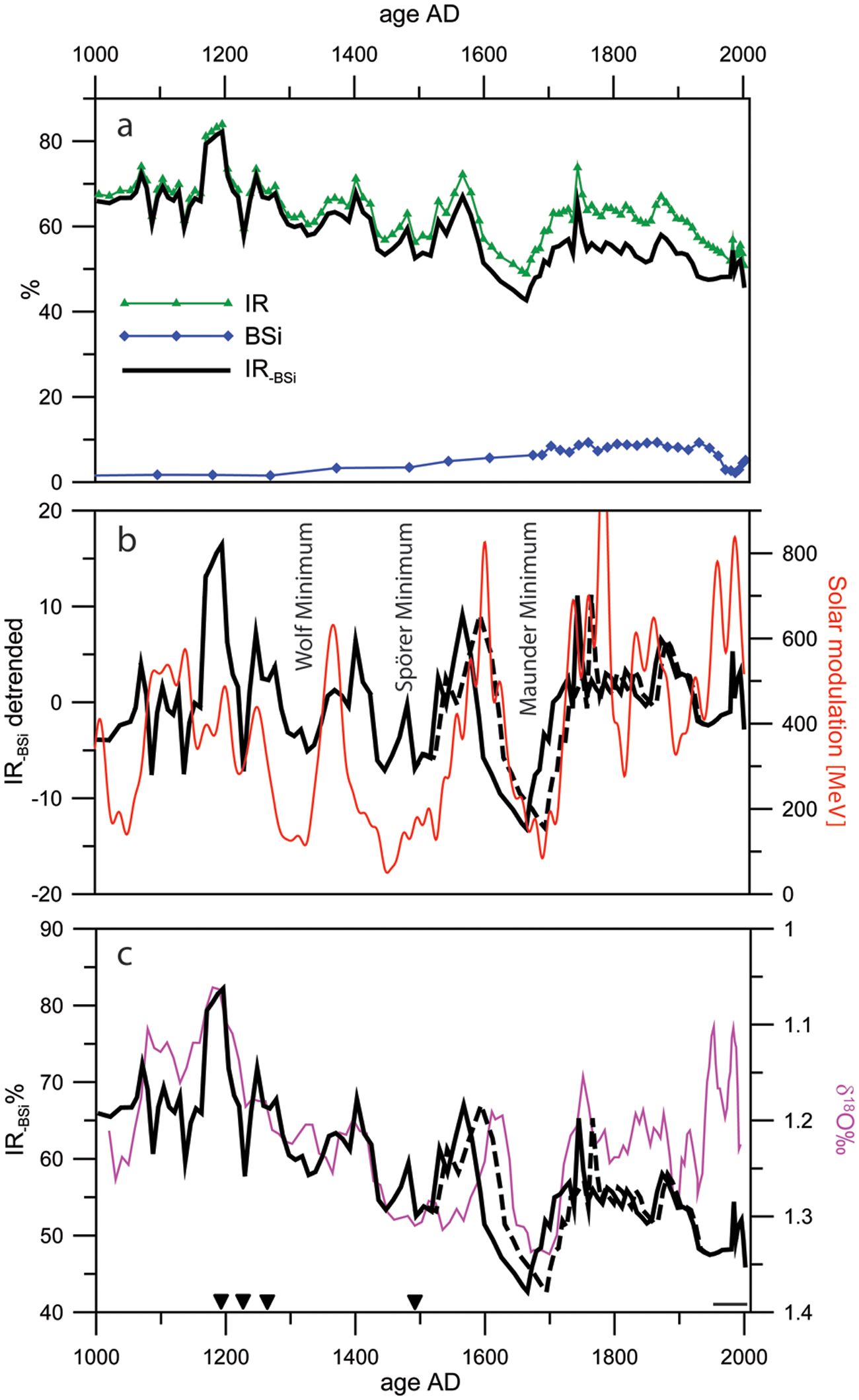
(a) Green: the ignition residue (IR) record from Lake Inre Harrsjön shown against ages based on 210Pb dating and AMS 14C dates obtained on terrestrial macrofossils (Kokfelt et al., 2010). Blue: biogenic silica (BSi) content measured on a parallel sequence (Kokfelt et al., 2010). Black: the BSi corrected IR record; IR-BSi. (b) Black: the IR-BSi record (detrended) from Lake Inre Harrsjön. Dashed: the IR-BSi record shown with the adjusted age model based on tuning with the solar modulation. Red: solar modulation function inferred from 14C production rates and neutron monitor data (Muscheler et al., 2007). (c) Black (solid and dashed): the IR-BSi record from Lake Inre Harrsjön with the original and the adjusted age model, respectively. Black arrows indicate calibrated age control points based on 14C datings on terrestrial macrofossils (Kokfelt et al., 2009a, 2010). The black bar represents the time interval in which age control is based on 17 210Pb dates (Kokfelt et al., 2009a). Pink: a 5 yr running average of δ18O in foraminifera from a sediment record in the eastern Norwegian Sea (Figure 1), representing the temperature and transport of warm Atlantic waters entering the Nordic Basin (Sejrup et al., 2010)
Solar activity for the last 1000 years has been reconstructed based on 14C production rates and neutron monitor data (Muscheler et al., 2007).
Last millennium solar variability signature in a lake sediment record
A comparison of variations in solar activity and detrended IR-BSi in the lake sediment sequence since
A potential link to temperature of Atlantic water masses
A recent study demonstrates that variations in the July–August–September (JAS) temperature of Atlantic water masses entering the Norwegian Sea via the North Atlantic Slope Current (NwASC) have been strongly correlated with changes in solar activity over the last 1000 years (Sejrup et al., 2010). Our lake record shares striking similarities with this reconstruction (Figure 2c), where temperatures of the relatively shallow (~50 m deep) Atlantic water along the Norwegian Coast correlate positively with the amount of IR-BSi in the Lake Inre Harrsjön record. Certain conspicuous features, such as an overall declining trend until the early 18th century, and isolated peaks around 1190 and 1745 can be found in both records. The records diverge after c. 1900. The apparent timing offset between
Solar influence on summer precipitation variability in the second half of the 20th century
In order to gain a better understanding of how the climate in the region could have responded to solar variability, we compare the long instrumental series of summer precipitation from Abisko Scientific Research Station (68°20′N, 19°02′E) since 1913 (Callaghan et al., 2010) with the sunspot number record (downloaded from ftp://ftp.ngdc.noaa.gov/STP/SOLAR_DATA/SUNSPOT_NUMBERS/). We find that minima in summer precipitation occurred during minima in the solar 11 yr cycle since around 1960, while in periods of high solar activity the average summer precipitation amount increased (Figure 3a). An 11 yr running correlation between summer precipitation and sunspot numbers reveals an overall positive correlation after 1960 that, however, is statistically significant at the 95% level only from 1975 to 1977 and from 1997 to 1998 (i.e. bracketing the years 1970–1982 and 1992–2003) (Figure 4). Another important feature of the comparison between the summer precipitation and the solar cycle is a correspondence between a period of generally low solar activity between 1962 and 1977, when the sunspot maximum in the 11 yr cycle around 1969 was low relative to surrounding maxima. During these 15 years the summer precipitation was 17% and 25% lower than during the 15 years before and after. We also note that during this period, solar minima were associated with cold summers. In contrast to the second half of the 20th century, a connection between summer precipitation and solar activity is not apparent during the first half of the 20th century.
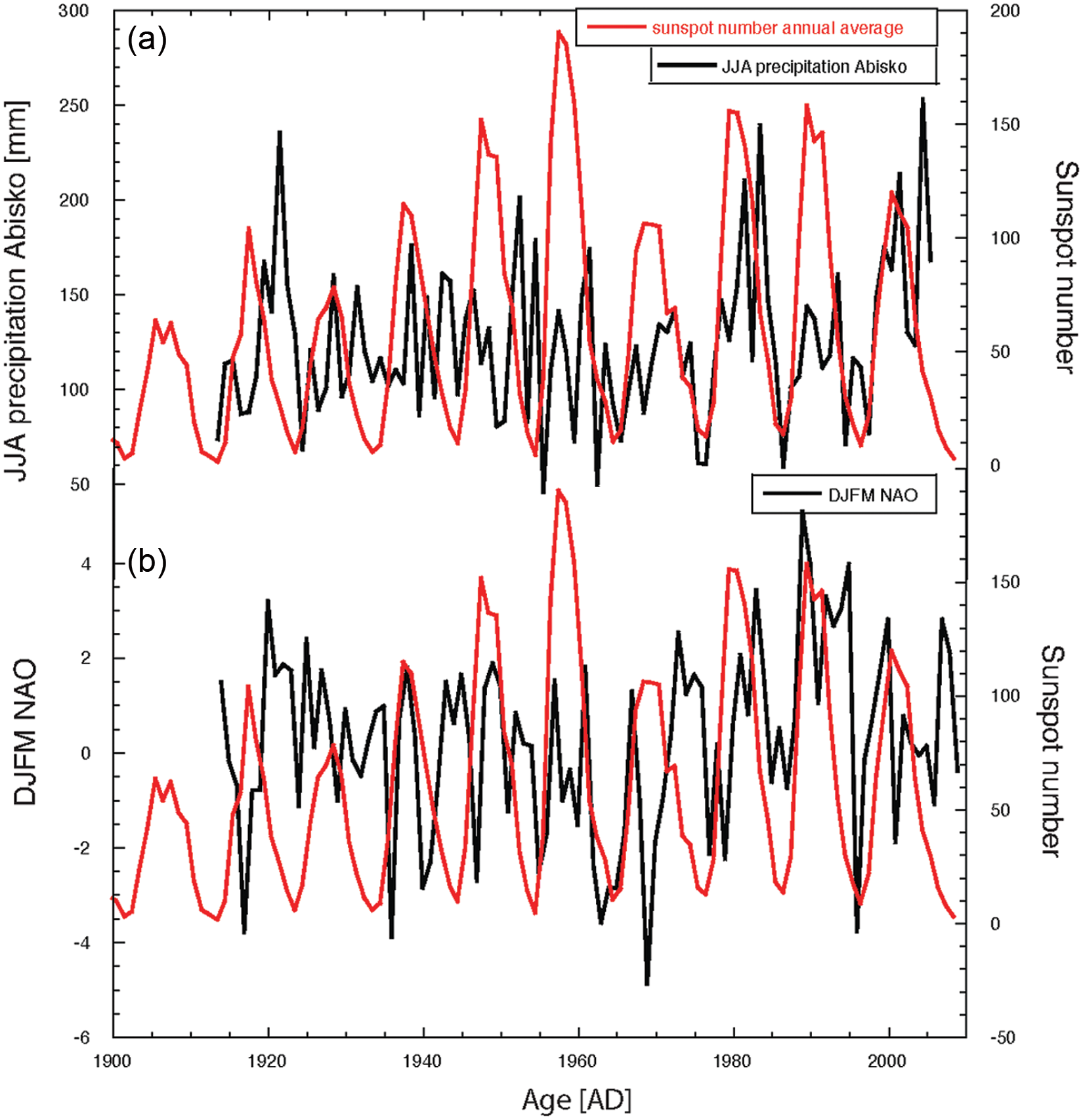
(a) Sunspot record and summer precipitation around Abisko since 1913 (Callaghan et al., 2010; Kokfelt et al., 2009a). (b) Sunspot record and the winter North Atlantic Oscillation (NAO) index (updated after Hurrell, 1995).
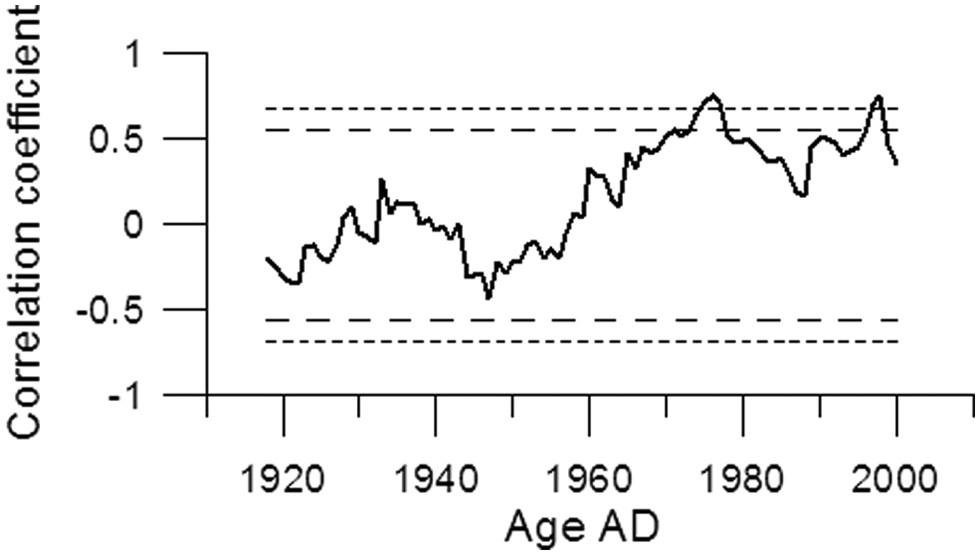
11 yr running correlation between summer (JJA) precipitation and sunspot numbers. Coarsely dashed lines indicate significance at 95% and finely dashed line indicates significance at 99%.
A NAO-mediated link between solar activity and climate in northern Fennoscandia?
An important concept for the description of European precipitation and temperature patterns is the winter NAO, defined as the normalized pressure difference between Iceland and the Azores (Hurrell, 1995). In the positive mode, the pressure difference between Iceland and the Azores is high and causes strong westerlies and efficient transport of Atlantic air and moisture to northern Europe, whereas in the negative mode northern Europe experiences drier and colder winter conditions (Hurrell, 1995). Although the NAO has the largest impact on the winter climate, the winter NAO has also been found to impact on the summertime climate the following year (Ogi et al., 2003a) and a series of papers has linked the winter NAO to variations in solar activity (Gimeno et al., 2003; Kodera, 2002; Lukianova and Alekseev, 2004). The winter NAO further affects the transport of Atlantic water along the Norwegian coast where the stronger southwesterlies that prevail during a positive state of the NAO result in a wider and warmer branch at the surface in the Barents Sea (Ingvaldsen, 2005). The winter NAO index is shown together with the sunspot data in Figure 3b. It can be seen that, although there is no straightforward relationship between sunspot numbers and the winter NAO index, there is a tendency towards a negative state of the winter NAO during solar minima in the second half of the 20th century. Together with the overall positive (although not consistently statistically significant) correlation between summer precipitation and sunspots after 1960 (Figure 3a), our results indicate that summer precipitation may, to some extent, have been affected by solar variability via changes in atmospheric winter circulation (the NAO).
Discussion and conclusions
Many studies have shown effects of variations in solar activity on climate conditions in the Northern Hemisphere. Instrumental data and modeling results suggest that the NAO is a concept that could help to understand the link between solar variations, the dynamical response of the atmosphere and observed climate changes. The spatial extent of the NAO has been found to vary according to the phase of the solar cycle, extending into the stratosphere during solar maxima, whereas the NAO is confined to the eastern Atlantic sector in the troposphere during solar minima (Kodera, 2002). Lukianova and Alekseev (2004) found that the NAO after c. 1940 varied with the same rhythm as the aa index, which is a geomagnetic index linked to the magnetic activity of the Sun. The solar influence on the NAO has further been found to affect Northern Hemisphere temperatures, with a positive correlation between temperature and the winter NAO during solar maxima phases and a zero or negative correlation between temperature and the winter NAO during solar minima phases (Gimeno et al., 2003). Although the NAO is most important for winter climate, the high-latitude summer climate in the Northern Hemisphere is influenced by the NAO of the previous winter through the effect on SST, sea-ice extent and snow cover anomalies memorized from the winter season (Ogi et al., 2003a).
From our study we conclude that solar variability exerted an important control of climate variability in around Abisko between the early 13th and 18th centuries and after 1960. As the IR-BSi component of the sediment is considered a mainly allochthonous component of the sediment, we interpret the variations in the IR-BSi record from Lake Inre Harrsjön as a result of changes in runoff, where low solar activity is related to decreased runoff and vice versa. The comparison between sunspot numbers and local climate data showed that minima in summer precipitation co-occurred with minima in the 11 yr sunspot cycle during the second part of the 20th century, and that a period of relatively dry summer conditions was associated with overall decreased solar activity between 1962 and 1977. The dry period between 1962 and 1977 has previously been highlighted as a period with reconstructed decreased peat surface moisture content in the catchment mire and reduced lake water TOC concentrations in Lake Inre Harrsjön (Kokfelt et al., 2009a).The observation that summer precipitation and sunspot numbers co-vary after 1960 lends support to an interpretation towards lower summer runoff during solar minimum phases in the IR-BSi record.
Other factors may however have influenced the variability in the record. Variation in winter snow/spring flood is likely a further significant contributor that can explain part of the recorded runoff variability. A strong influence of the NAO on the distribution of winter precipitation is, for example, of great importance to European glacier dynamics (Nesje and Dahl, 2003). At Abisko close to the studied lake, winter precipitation and temperature has previously been demonstrated to be weakly, but significantly and positively, correlated with the Arctic Oscillation (Kohler et al., 2006); an index highly correlated with the NAO (Wallace, 2000). The precipitation response to solar variations around Abisko is probably partly dependent on changes in the atmospheric circulation that affect the large-scale distribution of precipitation across Europe (Hurrell, 1995), with a negative state of the winter NAO occurring more frequently during solar minima phases. This is in correspondence with findings from other model and data studies (Shindell et al., 2001; Trouet et al., 2009).
Apart from the correlation with solar activity, the variability in our lake record was found to correlate positively with last millennium July–August–September (JAS) temperature variability of the Atlantic water entering the Norwegian Sea (Figure 2c). The transport of Atlantic water along the Norwegian coast is in turn affected by the stronger southwesterlies that prevail during a positive state of the NAO (Ingvaldsen, 2005 and references therein). Our IR-BSi record from Lake Inre Harrsjön and the Atlantic water temperature reconstruction from the Norwegian Sea both show an overall decrease between c.
External factors other than solar variability may obviously influence precipitation. Contemporaneous periods of explosive volcanism and solar minima have made a clear separation of low frequent temperature responses difficult during some periods over the last 1000 years (Ammann et al., 2007) and recent research has introduced the view that the onset of the ‘Little Ice Age’ (LIA) cold summer conditions can have been triggered by explosive volcanism and maintained by sea-ice/ocean feedbacks (Miller et al., 2012). Strong volcanic forcing may also influence precipitation, but such effects are normally restricted to short-lived events (e.g. Lamoureux et al., 2001), whereas our record seem to mirror more low frequent variability (Figure 2). The possibility of volcanic impacts on precipitation in the region can and should not be excluded, but detection of such a signal would require a higher and preferably annually resolved and/or varved sediment record. Support that the runoff record from Lake Inre Harrsjön is at least partly forced by solar-induced changes in precipitation, is however found not only in the comparison between sunspot number and summer precipitation but also in the sediment record itself. Hence, the best dated of the IR-BSi minima (constrained by three radiocarbon dates) in our lake record that coincide with reduced solar activity occurred c.
We conclude that the Sun has been an important driver of climate in northern Fennoscandia over the last 1000 years and that summer precipitation may be affected by variations in solar activity. The relationship between solar proxies, instrumental data from the last century, NAO, and Atlantic water temperatures off the Norwegian coast from the last millennium highlight links that could shed light on the mechanisms behind the Sun–climate relationship.
Footnotes
Acknowledgements
The authors are grateful to D Hammarlund and M Rundgren for help with collection of the lake sediment sequence, as part of a former project funded by the Swedish Research Council. The authors are further grateful to H Sejrup, SJ Lehman, N Reuss and Abisko Scientific Research Station (ANS) for providing data. I Snowball and two anonymous reviewers are thanked for constructive comments on the manuscript.
Funding
U Kokfelt was supported by RQ08, the Crafoord Foundation and the Carlsberg Foundation. R Muscheler is supported by the Royal Swedish Academy of Sciences through a grant financed by the Knut and Alice Wallenberg Foundation. The Swedish Research Council supported this study through a Linnaeus grant to Lund University (LUCCI). Thanks to the National Danish Research Foundation for funding the activities within the Center for Permafrost (CENPERM).