



Abstract
The human-climate-ecosystem interactions in the past were valuable for today’s human beings who face the challenge of global change. The multi-proxy reconstruction of climate change impacts and social responses and the comparative study between typical periods form an effective tool for elucidating the mechanisms of the interactions. In this paper, with a reconstruction of the proxy series of famine, migration and wars, the most typical social consequences related to climate change and disasters (flood/drought) in North China in 1470–1911 were quantitatively described, and two typical periods of human-climate interaction with similar climate change backgrounds (cold periods of the ‘Little Ice Age’), which were the late Ming dynasty (1560–1644) and late Qing dynasty (1780–1911), were selected and compared. It is determined that the climate deterioration (rapid cooling and increasing extreme disasters) in the late 16th and 18th centuries both resulted in severe social consequences characterized by more famine and popular unrest. The differences were that the climatic impacts in the late Ming were much more serious, and interregional migration, which was an effective responsive measure in the late Qing, was not important in the late Ming; they were primarily influenced by three factors based on the analytical framework of the impacts of historical climate change and social responses: (1) climate deterioration in the late Ming was more severe (more rapid cooling and more extreme disasters), (2) social system were more sensitive to climate change in the late Ming because of its mode of agricultural production (especially cropping system and crop species), and (3) the capacity of social response to climate disaster, especially disaster relief and refugee settlement, was considerably greater in the late Qing.
Keywords
Introduction
Climate change in the past has been an important contributor to the development of human society throughout the Holocene (Balbo et al., 2010; Büntgen et al., 2011; De Monocal, 2001; Ge, 2011; Magny, 2004; Oldfield, 2008; Zhang et al., 2008). Although it is unlikely for climate change today to produce the same impacts as those that happened in the past because of social development, the reconstruction of historical cases can improve our understanding of the nature of human-climate-ecosystem interactions, as well as the vulnerability and sustainability of society in the context of climate change (IHOPE, 2010; PAGES, 2009).
As a civilization with a history of more than 4000 years, there are close relationships between the formation and development of Chinese civilization and climate change (Ge, 2011; Ge et al., 2014; Wei et al., 2014). With most of its farming region in the East Asia monsoon region, China’s socioeconomic system has been severely impacted by the fluctuations in temperature and precipitation, especially extreme floods and droughts throughout the historical period. For example, the establishment of the first dynasty, Xia (ca. 2000–1600 BC), could be related to the social response to an abrupt climate change and consequent extraordinary flood (Liu and Feng, 2012; Wang, 2005; Wu and Ge, 2005).
With rich written records kept in ancient Chinese literature, many time-series of proxy indicators that could be used in describing changes in human dimensions, such as grain harvest (Su et al., 2014), population (Lee et al., 2008; Lee and Zhang, 2010), war (Zhang et al., 2007, 2010), and dynastic cycles (Wang et al., 2010; Zhang et al., 2006), have been quantitatively reconstructed and compared with climate change at large spatial (national) and temporal (centennial to millennial) scales. Based on these achievements, some general characteristics of the human-climate interactions in China’s history have been summarized, for example, the impacts of climate change on society were relatively negative in the cold periods and positive in the warm periods, and the cooling trend on the centurial scale and the socioeconomic decline often ran synchronously (Ge et al., 2014).
Meanwhile, a more detailed empirical study with multi-proxy reconstruction at smaller spatio-temporal scales was also conducted to further explain the interactive processes and mechanisms (Fang et al., 2007; Ye et al., 2012). For example, with the multi-proxy reconstruction of social responses to flood/drought (e.g. reclamation, disaster relief, migration, revolt) on the North China Plain in the Qing dynasty (1644–1911), it could be found that the dominant responsive strategy altered significantly in different periods, which was impacted by various natural and social factors (Xiao et al., 2014). At the turn of the 19th century, the social responses on the North China Plain experienced a shift under the background of climate deterioration, which could be characterized by the increasingly serious climate refugee problem. Using historical information about refugees, social disorder, grain transportation, and disaster relief, Fang et al. (2013) quantitatively analysed the climatic impact on grain production, as well as its feedback and transfer path from food security to social stability. This work could be taken as a Chinese reference for the causality analysis of climate change and large-scale human crisis in Europe in the 17th century (Zhang et al., 2011).
Because of the periodicity of climate change, it is not difficult to identify some similar climate change scenarios on the centennial scale in the high-resolution reconstructions of temperature and precipitation in China over the past 2000 years (Ge et al., 2003, 2006, 2013a, 2013b). During these periods, the similarities and differences of climate change impacts and social responses were often rooted in the operation of the socioeconomic system; thus, the comparative study would be very valuable for better understanding the mechanisms of the human-climate interactions (Ge et al., 2014; Wei et al., 2014). However, the above-mentioned macroscopic studies, which focused on the relationships between long-term changes in human dimensions and climate, usually paid more attention to the similarities among the different periods rather than the differences. In addition, the case studies conducted on decadal to multi-decadal scales in different periods are difficult to compare with social responses because of the different data sources and proxies. The different spatial scales are also a limitation.
In this paper, North China in the ‘Little Ice Age’ (LIA) was selected as the study area. Proxy series of famine, migration and wars (three typical social consequences caused by climate change and extreme disasters) were reconstructed to describe and analyse the change in impacts of climate change and disasters (flood/drought) and social responses in 1470–1911. Meanwhile, two typical periods of human-climate interaction with similar climate change backgrounds (cold periods of the LIA), which were the late Ming (1560–1644) and late Qing (1780–1911) dynasties, were compared for the similarities and differences of impacts and responses. Furthermore, based on the analytical framework of the impacts of historical climate change and social responses, the main influencing factors of the differences were discussed. This work will provide a historical case to elucidate the nature of human-climate-ecosystem interactions and provide a reference for the decision-making on social responses to climate change during the present and in the future.
Data and methods
Study area
In this paper, North China concretely includes five modern provinces (Hebei, Shanxi, Shandong, Henan and Shaanxi) and two municipalities (Beijing and Tianjin). Compared with historical administrative divisions, the territory of study is approximately equal to the five provinces in northern China in the Ming and Qing dynasties (Zhili, Shanxi, Shandong, Henan and Shaanxi), with some specific differences in administrative boundaries among provinces, for example, in the Ming and Qing dynasties, the territory of Shaanxi province was bigger, and the northern border of Shanxi and Zhili (equal to modern Beijing, Tianjin and Hebei province) provinces changed frequently (Niu, 1990, 1997; Tan, 1982, 1987). In this paper, all the historical place names involved were labelled with their corresponding modern locations on the map (Figure 1).

Sketch map of study area.
The reasons why we chose the period of 1470–1911 are described as follows. (1) Benefiting from rich proxy data, the published reconstructions of historical climate change in China have a high level of confidence for the past 500 years (Ge et al., 2013a). (2) As one of the most important historical data sources, ancient chorography was most abundant in this period and was used and integrated in the authoritative reconstruction of the Yearly Charts of Dryness/Wetness in China for the Last 500-Year Period (China Meteorological Administration (CMA), 1981) beginning in 1470, which was thus used in this paper to reflect precipitation and disasters. (3) The mid- and late Ming dynasty (1368–1644) and whole Qing dynasty (1644–1911), which formed a down-up-down cycle in terms of socioeconomic development, were covered in the period. In particular, the two decline periods of the late Ming and late Qing could provide needed materials for the comparative study.
The study area was mostly located in the warm-temperate zone and strongly influenced by the East Asian monsoon. Because of the high variability of annual and inter-annual precipitation, severe floods/droughts occur frequently and become huge threats to local traditional agricultural production (Ding, 2013; Li, 1990). The period of 1470–1911 was in the ‘LIA’ and covered two maximum stages, which were the 17th and 19th centuries. It was overall colder than the present, and the temperature and precipitation fluctuated significantly, which meant more extreme climate events (Wang et al., 1998; Zheng et al., 2006; Zheng and Feng, 1986).
North China is one of the oldest agricultural regions in China. In the Ming and Qing dynasties, dry farming with a limited irrigation system played a dominant role, and the main grain crops were millet and wheat, harvested once a year or three times every 2 years. The crop yield per unit area was very low (Guo, 1995, 2001; Han, 2012) and sensitive to hydrothermal condition changes, especially extreme flood/drought. On the other hand, as the political centre in the Ming and Qing, the social stability of North China could be directly related to the empire’s fate. Thus, the efficiency of social responses to climate change and extreme disasters became a barometer of the prosperity or decline of the dynasty (Li, 2007; Xiao et al., 2012, 2014).
In this paper, the proxy series of famine, migration and war, which were the most typical social consequences, were reconstructed based on historical records and compared with climate change and flood/drought in the corresponding period. The processes and mechanisms of impact and response of climate disasters were analysed, and a comparative study between the late Ming and late Qing was conducted.
Climate change and flood/drought
Climate change in 1470–1911 is described mainly based on previous studies. Specifically, temperature change was based on the temperature anomaly series in North China since the 1380s (Figure 2a, in 10-year resolution; Wang et al., 1998); the precipitation change is mainly based on the annual dry-wet index series on the North China Plain over the past 1500 years (Figure 2b; Zheng et al., 2006).
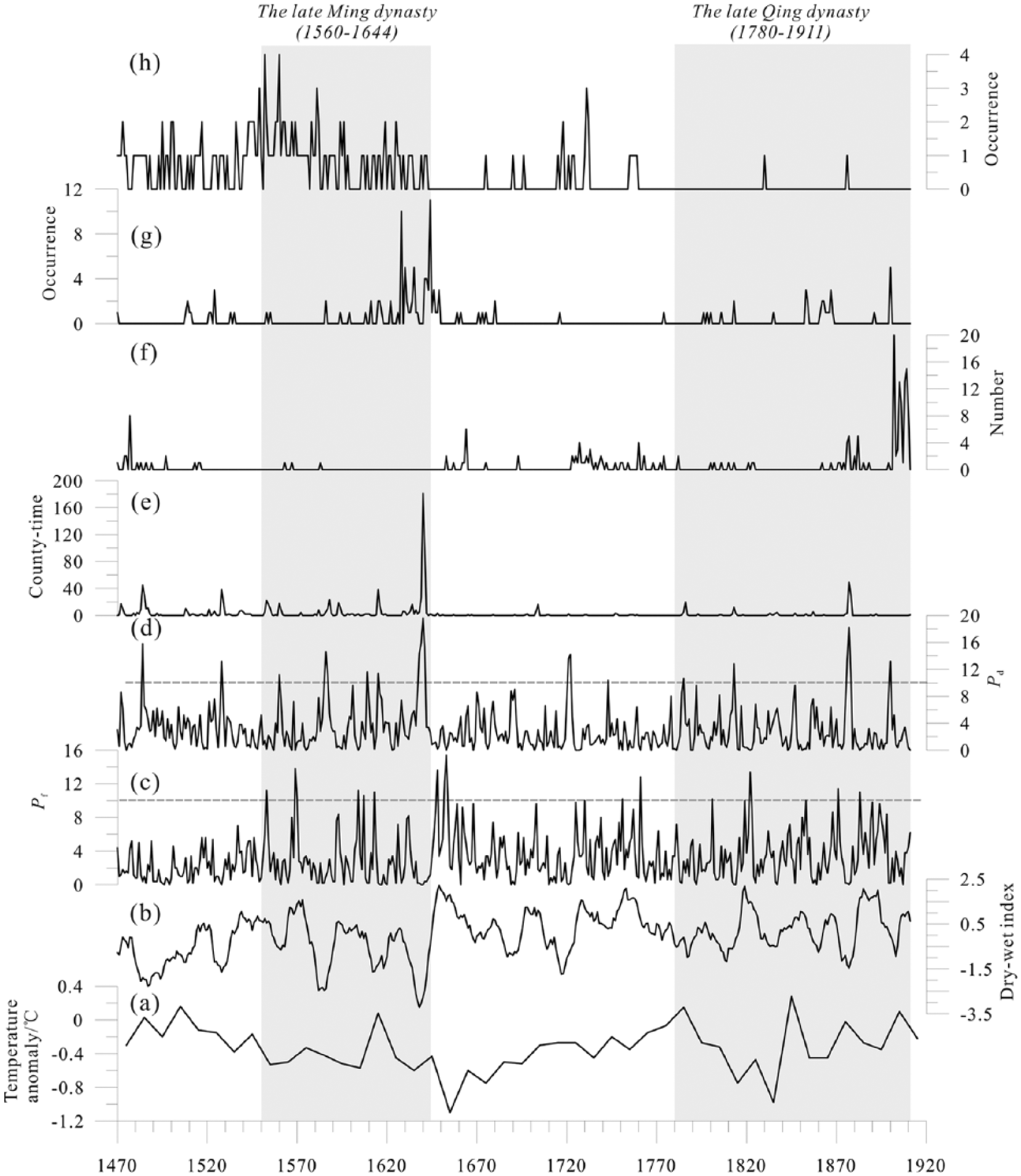
Climate change, natural disasters (flood/drought) and social responses in North China in 1470–1911. (a) Decadal temperature anomalies in North China (Wang et al., 1998), (b) dry-wet index on the North China Plain (Zheng et al., 2006), (c) flood index, (d) drought index, (e) frequency of cannibalism, (f) frequency of administrative units newly set up, (g) frequency of popular unrest in North China and (h) frequency of foreign wars on the northern border.
To indicate the annual intensity of flood/drought in North China, the flood/drought index is calculated using the annual wetness/dryness grade data of 26 stations in North China from the Yearly Charts of Dryness/Wetness in China for the Last 500-Year Period (classified into five grades: 1, very wet; 2, wet; 3, normal; 4, dry; 5, very dry; CMA, 1981). The flood index, Pf (Figure 2c), and drought index, Pd (Figure 2d), are calculated with formula (1; Fang et al., 2013).

where N1 is the number of severely affected stations (dryness/wetness grade is 1 or 5), N2 is the number of minimally affected stations (2 or 4), and W1 and W2 are the weights, which are assigned as 0.8 and 0.2, respectively. Additionally, flood/drought is defined as 1 year with extreme drought/flood disaster when Pf or Pd⩾10.
Climatic impacts and social responses
Famine
In this paper, ‘county-time’ was used to quantify the frequency of ‘cannibalism’ (1 county-time signifies that cannibalism was recorded once in a county), which was an extreme consequence of famine caused by disasters. In China’s traditional society, whenever cannibalism occurred, the rulers and officials are blamed for serious dereliction of duty, and thus, it received much concern from historians. As a type of local history record, the chorography in the Ming and Qing, which nearly covered every county in North China, kept abundant historical information about natural disasters and consequent famine, among which cannibalism was hardly omitted.
The data source was derived from A Compendium of Chinese Meteorological Records of the Last 3000 Years (Zhang, 2004), whose original information was collected from the chorography in the Ming and Qing dynasty and contained the intensity and direct consequences of disasters. Therefore, records on cannibalism were fully preserved in this collection, and the place name of each record has been linked to the corresponding modern county. In total, 1115 pieces of records on cannibalism within the modern territory of five provinces and two municipalities of North China in 1470–1911 were collected on a county-level spatial resolution. An annual time-series of the frequency of cannibalism (county-time) was reconstructed (Figure 2e).
Migration
Some sparsely populated regions in and around North China in the Ming and Qing dynasties became major destinations of refugees mainly caused by disasters from the core area of North China. When the immigrants increased above a certain level, the central government would set up a series of administrative units named Fu (equivalent to prefectures), Ting, Zhou and Xian (equivalent to counties) to manage them. Thus, the frequency of the establishment of administrative units in different periods could reflect the variation on the migration scale, and the spatial distribution of the new units indicated major destinations of refugees (Fang et al., 2013; Xiao et al., 2014; Ye et al., 2012). In this paper, the frequency of newly established administrative units was used as an indicator to describe the scale of migration in a certain period (Figure 2f), which was quantified with the annual number of new administrative units (Fu, Ting, Zhou and Xian) in and around North China.
Considering individual travel distance under pre-industrial transportation conditions and migrating directions of refugees in North China in the Ming and Qing dynasties (Cao, 1997a, 1997b), the territory of the area ‘around North China’ was defined as the whole of Heilongjiang, Jilin, Jilin, Inner Mongolia, Ningxia and Gansu; portions of Hubei, Anhui and Jiangsu provinces located to the north of the Yangtze River; and a portion of Sichuan province located west of the Minjiang River and north of the Yangtze River (Figure 1). These new administrative units are all marked on the modern map based on their geographic coordinates provided by Niu (1990, 1997; Figure 1).
War
In this paper, the war includes two categories:
1. Popular unrest (including armed uprising) occurring in North China.
The great majority of the historical popular unrest was related to a survival crisis for refugees who were suffering from a shortage of food, and the survival crisis was often aggravated and even triggered by a reduction in grain production caused by climate change and disasters. Therefore, historical popular unrest was often taken as an extreme social response to climate deterioration (Zhang et al., 2007). For the North China Plain in the Qing dynasty, the relationship between popular unrest and climate change has been quantitatively identified (Fang et al., 2013; Xiao et al., 2011). In this paper, the annual frequency of popular unrest occurring in or spreading to North China was based on Chinese Military History: Tabulation of Wars (Fu et al., 1986) and General History of China (Fan and Cai, 1994; Figure 2g).
2. Wars between the central regime and nomadic tribes on the northern border (specifically, to the north of the Great Wall).
In the Ming dynasty, the wars were against the Mongols and Manchus, and in the Qing, they were mainly against the Junggar Mongols. War between the central regime based on agriculture and nomadic tribes was an important theme of China’s history and played a crucial role in the rise and fall of many dynasties (Wang, 1996; Wang et al., 2010). The frequency variation could intuitively reflect the military pressure on the northern border, which further impacted the fiscal conditions, military power, migration policy decisions, and finally the social responsive strategy in North China. In this paper, the annual frequency of foreign wars on the northern border was based on Chinese Military History: Tabulation of Wars (Fu et al., 1986; Figure 2h).
Analytical framework of the impacts of climate change and social responses
Agricultural production was the foundation of the socioeconomic system in ancient China. The impact of climate change on the society was made possible fundamentally through its direct impact on food production. According to the theory of vulnerability and risk management, the social impact of climate change is a result of the interaction between climate change as an external perturbation and the vulnerable exposure of the social system, and the vulnerability could be defined as the sensitivity to climate change and the capacity of the social system to respond (Gallopín, 2006; IPCC, 2012, 2014). Accordingly, a food-security-based analytical framework of the impacts of historical climate change and social responses was constructed (Fang et al., 2013; Figure 3).
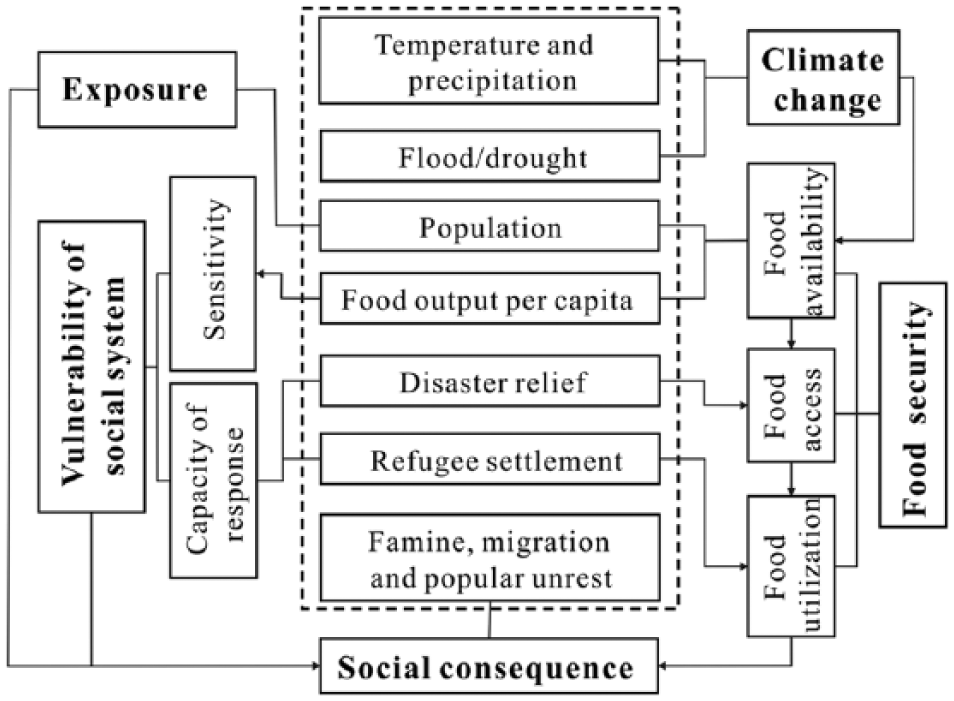
Food-security-based framework of the impacts of historical climate change and social responses in China (cited from Fang et al., 2013, with revision).
In this framework, given a certain physical exposure, the impact of climate change on society was directly proportional to the intensity of climate change and the sensitivity of social system to climate change, whereas it was inversely proportional to the capacity of social response. Based on the framework and relevant proxy indicators, the mechanisms of the social impacts of climatic cooling around the turn of the 19th century on the North China Plain have been analysed (Fang et al., 2013). In this paper, we discuss the different climatic impacts and social responses between the late Ming and late Qing dynasties from three aspects: the intensity of climate change, sensitivity and responsive capacity of the social system.
Results and analysis
Characteristics of climate change
The period of 1470–1911 was in the ‘LIA’, and overall, it was colder than the present. The average temperature anomaly (relative to the average of 1880–1979) in North China was −0.33°C (Wang et al., 1998) and was −0.63°C (relative to the average of 1851–1950) in whole China (Ge et al., 2013b). Against this major climatic background, temperature and precipitation fluctuated periodically.
In North China, there were two significant cooling periods in 1470–1911 (Wang et al., 1998). The first one began in the 1500s with several fluctuations, and the temperature dropped to a trough in the 1650s. The most rapid cooling periods were 1640s–1650s (fell by 0.67°C) and 1610s–1620s (0.53°C), and during 1610s–1650s, the temperature fell by 1.18°C in 40 years. The second one began in the 1780s, and the trough was in the 1830s, which was 1.13°C lower than the 1780s. The most rapid cooling periods were 1840s–1850s (fell by 0.73°C) and 1820s–1830s (0.51°C; Figure 2a).
In the dry-wet index series on the North China Plain (Zheng et al., 2006), it had been relatively drought-rich before the 1640s, when extreme droughts occurred frequently, such as in the 1480s, 1580s and 1630s–1640s. Then, it was relatively wet, and extreme floods increased, such as in 1648–1651, the 1750s and 1880s–1890s (Figure 2b).
In terms of the frequency of extreme disaster (flood/drought), according to the flood/drought index series, there were three extreme disaster years (with Pf or Pd ⩾ 10) in 1470–1559 (3.3%), which sharply increased to 14 in 1560–1644 (16.5%); in 1645–1779 and 1780–1911, it was 9 (6.7%) and 12 (9.1%), respectively. The probability in occurrence of an extreme disaster year increased in both the late Ming and Qing (Figure 2c and d).
We further counted the annual frequency of stations affected by extreme disaster (the sum of stations with dryness/wetness grades of 1 or 5) among the 26 stations in North China and its 30-year running average (Figure 4). The 30-year running average of frequency was relatively low in the early days and rose significantly since the end of the 1560s. Then, it continued to rise with small fluctuations and reached a peak around the 1640s because extreme disasters occurred most frequently in the 30-year period of 1631–1660 (8.63 station-times 1 per year). From the late 17th century to the late 18th century, there were few extreme disasters, except for 1720–1749 (5.53). Since the late 18th century, extreme disasters occurring more and more frequently, and 1871–1900 was the most disaster-concentrated 30-year period in the Qing dynasty (average 6.73).
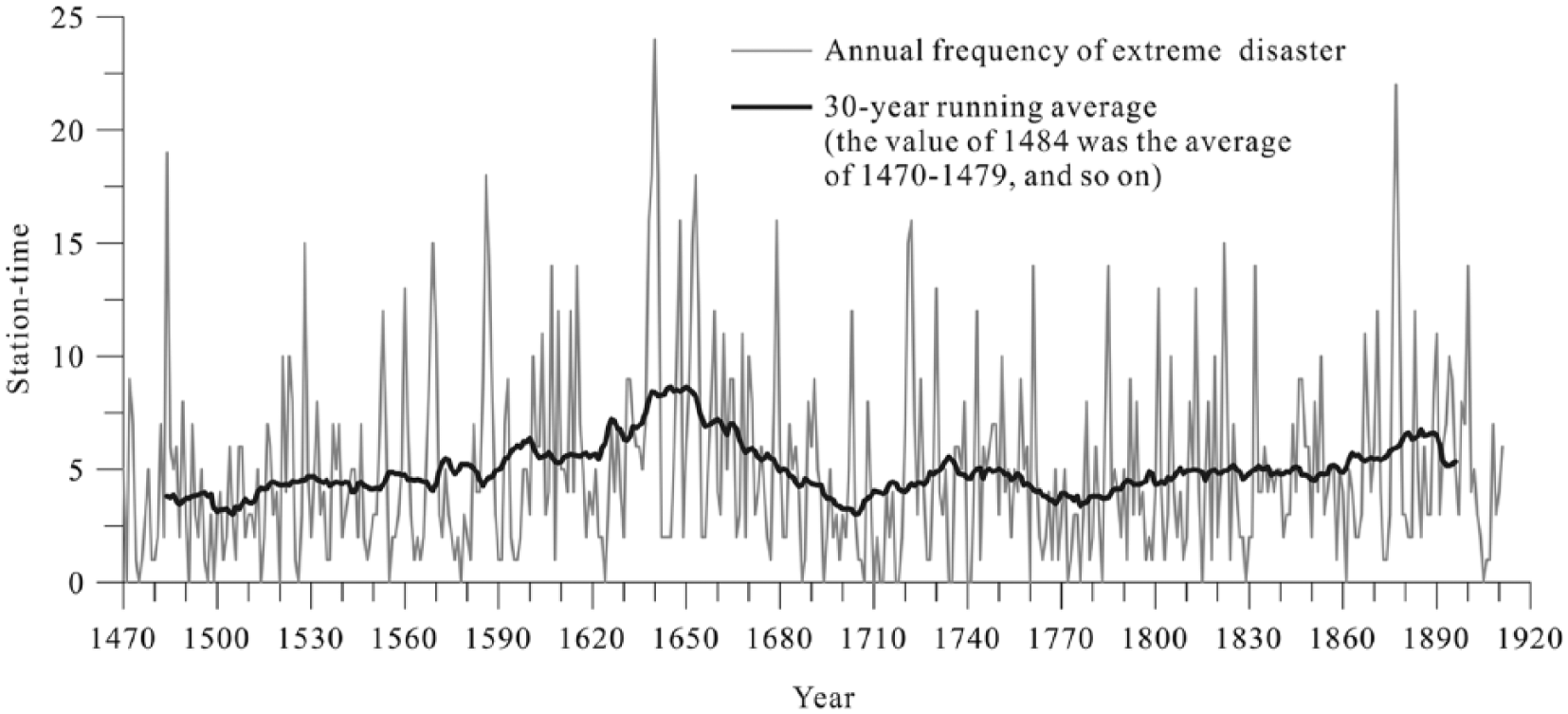
Annual frequency of extreme disaster (flood/drought) in North China in 1470–1911.
Overall, in both the late Ming (1560–1644) and late Qing (1780–1911) dynasties, significant climate deterioration could be observed, which was characterized by rapid cooling and increasing extreme disasters (flood/drought).
Impacts of climate disasters and social responses
Similarities between the late Ming and Qing dynasties
The previous studies on the North China Plain in the Qing dynasty have shown that the dominant responsive strategy of local society to flood/drought altered significantly in different stages (Xiao et al., 2014); among these stages, the most important shift around the turn of the 19th century could be described as the rapidly decreasing governmental efforts on disaster relief, remarkably increasing scale of refugees and more and more violent refugee behaviour. The climate deterioration occurring simultaneously was an important background of the shift. It was estimated that the reduction in crop yield because of climate deterioration had accelerated the intensification of the food insecurity on the North China Plain by approximately 20 years (Fang et al., 2013).
On a larger spatio-temporal scale, namely, the whole North China in 1470–1911, it was also found that the climate deterioration in both the late Ming and Qing enhanced the shift of social responses, which meant that in the two periods, extreme disasters (in particular drought) more and more played the role of accelerator or even the trigger of social crisis, mainly embodied in the increasing occurrence of famine and popular unrest. In 1780–1911 (the late Qing), cannibalism occurred for 163 county-times (1.23 per year), whereas it was only 51 in 1645–1779 (0.38); in the 85 years of the late Ming (1560–1644), cannibalism occurred for 563 county-times (6.62), much more frequently than in 1470–1559 (3.76; Figure 2e). A similar characteristic could be found in the frequency series of popular unrest: in the 1470s–1550s, 1560s–1640s, 1650s–1770s and 1780–1911, popular unrest broke out 15 (0.17 per year), 74 (0.82), 9 (0.07) and 30 (0.23) times, respectively (Figure 2f).
Another similarity was that an extreme drought was much more likely to be a trigger of social crisis than a flood. The Pearson correlation coefficient between the annual drought index and frequency of cannibalism in 1470–1911 was 0.499 (significance level 0.000), while the flood index was −0.124 (significance level 0.009). There were 28 years of severe famine when cannibalism occurred in more than 10 counties, of which 21 were under the background of extreme drought; furthermore, there were 12 of 13 years when cannibalism occurred in more than 20 counties. The majority of large-scale peasant uprisings and the peaks of the frequency series of popular unrest occurred under the background of extreme drought, such as the Liu Liu and Liu Qi uprising in 1510, Li Zicheng and Zhang Xianzhong uprising at the end of the Ming dynasty (1628–1644), Tianli Religion uprising in 1813, Bagua Religion uprising in 1861, Boxer Movement in 1899–1900, and so on.
In most of North China, a semi-arid and semi-humid continental monsoon climate is the dominant type. The annual precipitation is approximately 400–900 mm, which is not abundant for agricultural production; furthermore, because of the high variability of the East Asian monsoon system, the seasonal and annual distribution of precipitation is uneven. Thus, the precipitation became the primary climatic limiting factor for agricultural production in ancient China when the irrigation system was not advanced. Especially when drought lasted for more than 1 year, widespread crop failure would be unavoidable and caused severe famine. By contrast, the disaster-affected area by a flood was smaller (mostly concentrated in the downstream regions of river basin) and the duration shorter (mostly in summer and autumn) than a drought; thus, the threat of flood to agricultural production was less serious. Therefore, social crisis was more frequently triggered by extreme drought.
Differences between the late Ming and Qing dynasties
In addition to the similarities, the differences of climatic impacts and social responses between the late Ming and Qing dynasties were significant as well, as summarized below.
2.Given similar intensity of disaster, famine was more severe in the late Ming.
Famine could be reflected by the frequency of cannibalism; in 1560–1644, cannibalism occurred for 6.62 county-times per year in North China, and in almost every extreme drought year or the next year (1560, 1586, 1587, 1615 and 1638–1641, except for 1609), there was a severe famine (cannibalism occurred for more than 10 county-times; Figure 2d and e). Meanwhile, in 1780–1911, the frequency of cannibalism was much less (1.23 county-times per year), and the famine caused by extreme disasters was less severe. For example, there were 9 years of extreme drought during 1560–1644 (average drought index was 13.9) and 6 years (13.3) during 1780–1911. In these years and the following years, there were 440 (48.9 on average) and 123 (20.5) county-times of cannibalism occurring, respectively. Given similar intensity of disaster (average drought index), famine was more severe (more frequent cannibalism after an extreme drought) in the late Ming, which meant that the civilian livelihood was more vulnerable in the late Ming.
2. As an effective responsive measure, the scale of interregional migration was much larger in the late Qing.
Interregional migration was an important responsive measure to climate change and extreme disasters in North China throughout the Qing dynasty (Xiao et al., 2013, 2014; Ye et al., 2012). According to the frequency series of newly set up administrative units (Figure 2f), there were several periods of concentrated emigration in the Qing dynasty: the late 17th century, mid-18th century, turn of the 19th century and the 1860s–1900s. The largest interregional migration occurred in the last period. The most important destination of emigrants was central and eastern Inner Mongolia and the three provinces of Northeast China located to the north of the Great Wall based on the density of new administrative units in and around North China (Figure 1). While in the Ming dynasty, emigration was mainly concentrated in the late 15th century, and the most important destination was the Qinling-Daba Mountains located southwest of North China. Since the late 16th century, although extreme disasters occurred more frequently, there were no new administrative units established, indicating no more uncultivated land for refugee settlement.
3. The popular unrest triggered by climate disasters was much greater and caused more serious social consequences in the late Ming.
It is embodied in the popular unrest in the end of Ming dynasty represented by Li Zicheng and Zhang Xianzhong uprising, which first broke out in Shaanxi province in 1628 under the background of local drought. The uprising then extended to most of the northern and central provinces in 1634–1635 associated with the expansion of the stricken area of drought and to most parts of China in 1640–1641, when the drought reached its climax. This peasant uprising finally overthrew the Ming dynasty in 1644 (Twitchett and Fairbank, 1998). While in the late Qing, although large-scale peasant uprisings broke out several times in North China, in particular the Nian Army uprising which broke out in the 1850s and once involved all five provinces of North China, no one uprising completely destroyed the social order (Figure 2g).
Taking the most severe droughts in the late Ming and late Qing dynasties as examples, the different climatic impacts and social responses were further compared. The former one was called the ‘Chongzhen Mega-drought’ (Chongzhen was the last emperor of the Ming dynasty, whose reign was 1628–1644) in Chinese history with its peak in 1638–1641, and the latter was the ‘Guangxu Mega-drought’ (Guangxu Emperor’s reign was 1875–1908) with its peak in 1876–1878. Both disasters had caused terrible famines and great loss of population. In 1640 and 1641, cannibalism occurred for 181 and 102 county-times, respectively, in North China, which was the peak of the whole series (Figure 2e). In the end, only approximately 42 million people survived in North China in 1644 after a net decline of 20 million, approximately 32% of the total 1630 population (Cao, 2000). The population decline was mostly because of deaths from famine, plague and war. In 1877 and 1878, cannibalism occurred for 49 and 31 county-times, respectively, in North China, which was the peak of the Qing dynasty. Approximately 15.6% of the total population (22.9 million) was lost in this disaster (Cao, 2001), much of which was contributed by emigration, besides death from famine. It was estimated that more than 3 million refugees emigrated from Shandong province only (He, 1980). In 1876–1882, unprecedentedly, 16 new administrative units were established in the surrounding area of North China (mainly in Northeast China). It could be regarded as the policy response of migration flow caused by the Guangxu Mega-drought. As mentioned above, the Chongzhen Mega-drought directly triggered the peasant uprising and significantly promoted its development, while in the Guangxu Mega-drought, there was only a small amount of popular unrest breaking out and not a single organized peasant uprising (Li and Chen, 2003; Xiao et al., 2012).
Discussion
According to the framework of the impacts of historical climate change and social responses in China (Figure 3), the impact of climate change on society was decided by the intensity of climate change and the vulnerability of social system, which was constituted by the sensitivity and capacity of response. In historical periods, the sensitivity to climate change could be quantified with food output per capita, and the capacity of social response could be measured from three aspects: growth potential of cropland area, governmental efforts on disaster relief and scale of interregional migration (Fang et al., 2013; Xiao et al., 2014). Considering that in both the late Ming and Qing dynasties, the growth potential of cropland area within North China was negligible (Liang, 1980), we discuss the different climatic impacts and social responses between the late Ming and late Qing dynasties from three aspects: intensity of climate change, sensitivity of food production and capacity of social response (including disaster relief and interregional migration).
Intensity of climate change
The intensity of climate change and extreme disaster is directly proportional to their impacts on society. Under the same conditions, the greater the amplitude of climate change, the more severe the social consequences. The differences in climatic impacts and social responses between the late Ming and late Qing dynasties should be first attributed to different intensities of climate change and disaster. In both periods, there was significant climate deterioration; however, the one in the late Ming was much more severe, which could be summarized as the following.
1. The disaster-concentrated period overlapped an extremely cold period in the late Ming.
The late Ming and Qing dynasties were both relatively cold period. In North China, average temperature anomaly in 1560s–1640s (late Ming) was −0.42°C, and in 1780s–1910s (late Qing) was −0.29°C (Wang et al., 1998). The cooling rate in the early 17th century (temperature fell by 1.18°C in 1610s–1650s, about 0.30°C/10a) was also more rapid than the turn of 18th and 19th centuries (temperature fell by 1.18°C in 1780s–1830s, about 0.23°C/10a; Figure 2a).
Moreover, in the late Ming (or more accurately at the turn of Ming and Qing dynasties) and late Qing, there was a disaster-concentrated period, 1631–1660 and 1871–1900, respectively (Figure 4). Compared with the temperature anomaly series in North China (Wang et al., 1998), the temperature anomaly was −0.71°C on average (1630s–1650s) in the former peak stage and 0.1°C (1870s–1890s) in the latter one. The former one was an extremely cold period (just warmer than the 1650s–1670s and 1810s–1830s), while the latter one was a relatively warm period.
The overlap between the disaster-concentrated period and extremely cold period sharply increased the threat of climate deterioration to agricultural production.
2. Extreme disasters occurred more frequently with greater intensity in the late Ming.
In 1560–1644, extreme flood/drought occurred for 498 station-times (5.86 per year), in which extreme drought took a share of 63.1%. There were 14 extreme disaster years (with Pf or Pd⩾10) in a total of 85 years. Meanwhile in 1780–1911, extreme flood/drought occurred for 669 station-times (5.07 per year) with extreme drought of 43.8% and 12 extreme disaster years out of 132 years (Figure 2c and d). In the frequency peak of extreme disasters at the turn of Ming and Qing dynasties (1631–1660), extreme disasters occurred for 8.63 station-times per year and 6.73 station-times per year in the disaster-concentrated period in the late Qing (1871–1900; Figure 4).
The Chongzhen Mega-drought at the end of the Ming dynasty was the most severe drought in the past 500 years in North China, even in the past 1500 years (Zheng et al., 2006). Extreme drought occurred for 76 station-times in the peak stage of 1638–1641, 73% of the total. By contrast, during the Guangxu Mega-drought, the most severe drought in the Qing dynasty, extreme drought occurred for 49 station-times in the peak stage of 1876–1878, 63% of the total. In summary, in the late Ming, the frequency of extreme disaster, especially extreme drought, was higher and the intensity greater.
Sensitivity of social system
The sensitivity of the social system could be measured by the differences in the regional output of grain per capita relative to the critical share of food security (300 kg per capita per year; Fang et al., 2013; Yin et al., 2009). The lesser the output of grain per capita, the more sensitive is the social system to external perturbation. Based on the historical data of population, cropland area and crop yield per unit area, the output of grain per capita in North China in the late Ming and late Qing dynasties was estimated. Two time points were selected: just before the occurrence of serious climate deterioration (1580 in the late Ming and 1776 in the late Qing) and the breaking out of large-scale peasant uprising (1630 and 1851; Table 1).
Output of grain per capita in North China in the late Ming and late Qing dynasties.
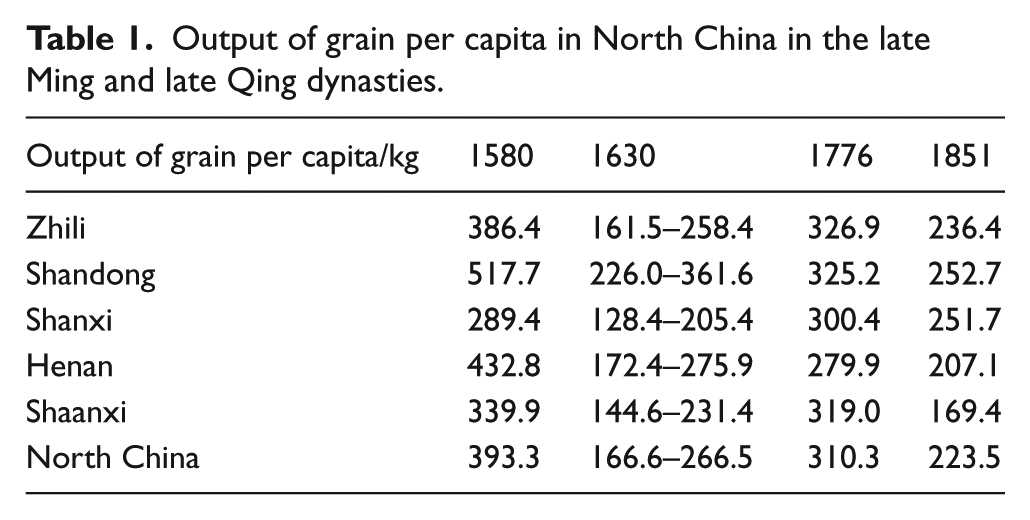
The provincial population in 1580 and 1630 was sourced from Cao (2000), cropland area was sourced from Fan (1984), and crop yield per unit area in 1580 was sourced from Guo (2001). Considering that in the late Ming climate deterioration had caused sharp reductions in grain in most regions of China (Ge, 2011) and the yield per unit area in 1630 was estimated to drop by 20–50% relative to 1580 (Zheng et al., 2014), the output of grain per capita in 1630 in Table 1 was reduced by 20–50%.
The provincial population in 1776 and 1851 was sourced from Cao (2001), cropland area was sourced from Liang (1980), and crop yield per unit area was estimated mainly based on Guo (1993, 1995; Xue, 2008). The estimates of unit crop yield in North China in the Qing dynasty varied among different researchers (Shi and Ma, 2010). In this paper, based on the provincial data of unit crop yield in North China provided by Guo (1995), which were probably lower than the actual values because the case studies in Hebei province (Xue, 2008) and Shandong (Guo, 1993) were 1.27 and 1.22 times higher, respectively, we estimated crop yield per unit area in every province in North China. Specifically, the estimates were the original values of Guo (1995) multiplied by 1.2, which was the correction coefficient with reference to Xue (2008) and Guo (1993). The climate deterioration in the first half of the 19th century also caused a certain drop (less than 10%) in grain output relative to the 18th century (Zhang, 1996), which was much less than the late Ming. Considering that there was not an exact estimation of output drop, the output of grain per capita in 1851 in Table 1 was not amended.
According to Table 1, the grain output per capita in North China was both slightly above the critical share of food security before the climate deterioration (some provinces had been below it) in both the late Ming and late Qing dynasties. However, after several decades, it was far below (the climatic impact was considered in the late Ming but not in the late Qing, which means that the drop of output of grain per capita in 1851 was only caused by population growth). Food insecurity sharply increased the social sensitivity to external perturbation, such as climate change and extreme floods or droughts.
The decline in crop yield (20–50%) caused by climate deterioration in the late Ming was much more significant than in the late Qing. It could be inferred that in 1630s–1640s when Chongzhen Mega-drought broke out, the grain output per capita in North China would drop further. Comparing the intensity of climate change in 1580–1630 with 1776–1851, the difference was not as great as crop yield reduction. Average temperature anomaly in 1580s–1620s was −0.38°C, while in 1780s–1840s was −0.34°C. In 1580–1630, extreme flood/drought occurred for 5.39 station-times per year; while in 1776–1851, it was 4.71.
This fact that food production was more sensitive to climate change in the Ming dynasty than Qing could be associated with different modes of agricultural production. The most significant differences in agriculture between the two periods could be summarized from two respects: cropping system and crop species.
The dominant cropping system in North China in the Ming dynasty was one crop a year and shifted to three crops per 2 years (winter wheat, soybean and millet or sorghum) at the turn of Ming and Qing dynasties, which became the major cropping system in the mid-Qing dynasty (Li, 1995a). The change in the cropping system not only brought increased yield but also made agricultural production more resilient to climate disasters because of the more efficient utilization of the growing season (increasing proportion of over-wintering crop).
The introduction and extension of American crops, especially maize, potato and sweet potato, was another important characteristic of agriculture in North China in the Qing dynasty distinguished from the Ming dynasty. These crop species were first introduced into China in the late Ming; however, they were extended to North China in the 18th and 19th centuries (He, 1979a, 1979b). These crops, with high yield per unit area and a wide range of adaptability to cropland (slope, fertility, hydrothermal conditions, etc.), effectively eased the population pressure and increased resilience of agriculture, which meant the victims could find more food to earn their living after a severe disaster than before because these new crops have more stable yields.
In summary, although output of grain per capita was higher in 1580 than 1776, the reduction in crop yield under adverse climatic conditions in the late Ming was much higher because of extensive cultivation, inefficient cropping system and monotonous crop species, which caused that output of grain per capita in 1630 was even lower than in 1851. High sensitivity of agricultural production led to high sensitivity of social system.
Capacity of social response
Governmental efforts on disaster relief
Governmental efforts on disaster relief in the Qing dynasty should receive the highest evaluation in all the Chinese historical dynasties (Li, 1995b). Among the various relief measures, direct distribution of relief food was the most effective one. The Qing government had established an integrated organization and strict rules and regulations for relief food dispatch, which played an important role in many extreme disasters in North China in the 18th century (Will, 1990). For example, in the drought of 1743 in Hebei, Shandong and Henan provinces, the governmental relief activities were maintained for 8 months, and 2.36 million dan of grain 2 was directly distributed to more than 2 million victims. Both the scale and efficiency of the disaster relief activities were unprecedented in Chinese history (Will, 1990; Xiao et al., 2012).
In the late Qing, although the intensity of disaster relief sharply had decreased since the 1780s because of fiscal crisis, the central government was still trying to dispatch relief food for stricken areas. For example, in the Guangxu Mega-drought, 0.38 million dan of grain was transported to the worst-hit area, Shanxi province; the North China Plain, which was closer to the political centre, received approximately 3.60 million dan of grain in the 1870s–1890s at the peak stage of extreme disasters in the late Qing (Xiao et al., 2012, 2014).
By contrast, the governmental efforts on disaster relief in the late Ming were far less. The relief food was mainly from the Reserve Granaries (Yubei Cang) set up in every county in the Ming dynasty; however, the granary system had declined in the Jiajing emperor’s reign (1522–1566) and no longer played a significant role in disaster relief activities since the late 16th century (Zhou, 2007). Tax reduction, another important measure of disaster relief, also gradually lost its functions since the end of the 16th century. According to the historical records kept in Ming Shilu (Annals of the Ming Dynasty), there were 239 times of famine forwarded to the court, 115 of which received tax reduction in 1573–1599, while for the 200 times in 1600–1620, only 40 received tax reduction (Zhang, 1999). The governmental capacity of disaster relief continued to decrease in the early 17th century, and as a result, facing the unprecedentedly severe drought in the end of the Ming dynasty, the governmental disaster relief activities was almost negligible. Even worse, under military pressure from the peasant uprising and nomadic invasion, the government upgraded the tax ratio thrice in 1618–1620, 1673 and 1639, which made the total tax burden several times more than before and thus further exacerbated the negative impacts of disasters on society (Gu, 1984).
Resettlement of interregional migrants
Interregional migration was an important measure to ease the pressure of disaster relief in North China during the Qing dynasty, which was the most significant feature different from the social responsive mechanisms in the Ming dynasty. No matter the continuity and scale of migration activities or the major destinations of migrants, there were great differences between the two dynasties, which were mainly decided by the different geopolitical environment on the northern border.
The Ming dynasty was established after the Mongolian Yuan dynasty. The war against the Mongols on the northern border was a major theme of the Ming history (Figure 2h). Although the Ming army once had an advantage in the early times, the battle line stabilized over the next 200 years, which was embodied by the Great Wall. In Northeast China, the territory of actual control by the Ming was not more than eastern Liaoning province. Therefore, the refugees from North China could not migrate to the north and northeast, and the only destination was the mountainous area to the west and south of North China, where the population capacity was very limited.
The climate deterioration in late Ming dynasty (cooling, aridification) directly destroyed the agricultural production of the military farms on the northern frontier, which provided food supplies to the northern frontier troops, and caused severe food crisis reflected by the sharp increase in grain price (Quan, 2011b). The military expenditures on the northern frontier accordingly increased since the 1570s and further exacerbated the fiscal deterioration in the late Ming (Quan, 2011a). Meanwhile, for transporting grain to the northern frontier, the tax and labour burden of peasants in North China became much heavier. In this period, the military pressure of nomadic invasion also began to increase as climate deterioration aggravated (Figure 2h). Especially at the turn of the 17th century, the Manchu (Jurchen) rose in Northeast China and destroyed the main force of the Ming army in several decisive battles, which became another direct force of the collapse of the Ming dynasty.
The rulers of the Qing dynasty were the Manchus. Since the beginning of the dynasty, the vast territory of Northeast China had been under their effective administration. The national policy of alliance with the Mongols kept the northern border at peace as a whole. Except for the wars against the Junggar tribe of Mongol which mostly occurred in Northwest China in the early times of the Qing (Figure 2h), the regional society of North China was no longer under the military pressure from the north. On the contrary, the vast uncultivated land outside the Great Wall became the ideal destination of the destitute and homeless refugees from North China in and after a severe flood or drought. Although the quarantine policy for Manchuria and Mongolia had not been officially abolished until the late 19th century, it was not strictly implemented for many years especially under the background of extreme disasters (Xiao et al., 2013; Ye et al., 2012). Thus, interregional migration from North China to Manchuria and Mongolia ran throughout the whole Qing dynasty and reached its climax in the late Qing dynasty. Under the driving forces of population, famine and war, millions of refugees moved north of the Great Wall, especially Northeast China (Zhao, 2004). Thereby, in North China during the late Qing, there was not a large-scale peasant uprising that could completely destroy the social order, as in the late Ming, although the social system in this period was under a social background of domestic unrest and foreign invasion and a natural background of severe climate deterioration.
Conclusion
The Ming and Qing dynasties both occurred in the ‘LIA’. The climatic conditions in North China were overall not conducive to agricultural production and fluctuated greatly. In the late periods of both dynasties, North China experienced significant climate deterioration, which could be characterized by a rapid cooling and increase in extreme disasters and had a negative impact on the local society. Some studies have investigated this issue but lack a detailed comparative study on the climate change impacts and social responses between the two typical periods. In this paper, with the reconstruction of proxy series of famine, migration and wars, the most typical social consequences related to climate change and disasters (flood/drought) in North China in 1470–1911 were quantitatively described, and the similarities and differences between the late Ming dynasty (1560–1644) and late Qing dynasty (1780–1911) were compared.
Climate deterioration (rapid cooling and increasing extreme disasters) in the late Ming and Qing both enhanced the shift of social responses, which meant famine and popular unrest occurred more frequently under the background of extreme disasters (drought, in particular).
The differences between the late Ming and Qing were that the climatic impacts in the late Ming were much more serious, and interregional migration, which was an effective responsive measure in the late Qing, was not important in the late Ming.
Based on the analytical framework of the impacts of historical climate change and social responses, the differences were mainly influenced by three factors: the climate deterioration in the late Ming was more severe (more rapid cooling and more extreme disasters), social system were more sensitive to climate change in the late Ming because of its mode of agricultural production (especially cropping system and crop species), and the capacity of social response to climate disaster, especially disaster relief and refugee settlement, was much greater in the late Qing.
The mechanisms of the impacts of historical climate change on society were not simply linear, which occurs between a single climatic factor and a certain human dimension, but a complex process including a series of positive or negative feedbacks from various social responses (Fang et al., 2013; Wei et al., 2014). In this case, climatic deterioration directly impacted the agricultural ecosystem; then, the negative impacts were accumulated and transmitted in other social subsystems and finally led to social instability. Famine, migration and war were all an intermediate or the last link in a certain interactive process of impacting and responding. Under different spatio-temporal backgrounds, the climate-human interaction would also develop in different directions and made it possible that quite distinct climatic impacts and social responses appeared in similar climate change scenarios, just as the late Ming and late Qing dynasties. In the long Chinese history, more typical cases for comparative study will be explored and discussed in the near future, which could certainly improve our knowledge on the nature of human-climate-ecosystem interactions and the vulnerability and sustainability of society in the context of climate change.
The mechanisms of the impacts of historical climate change on society were not simply linear, which occurs between a single climatic factor and a certain human dimension, but a complex process including a series of positive or negative feedbacks from various social responses (Fang et al., 2013; Wei et al., 2014). In this case, climatic deterioration directly impacted the agricultural ecosystem; then, the negative impacts were accumulated and transmitted in other social subsystems and finally led to social instability. Famine, migration and war were all an intermediate or the last link in a certain interactive process of impacting and responding. Under different spatio-temporal backgrounds, the climate-human interaction would also develop in different directions and made it possible that quite distinct climatic impacts and social responses appeared in similar climate change scenarios, just as the late Ming and late Qing dynasties. In the long Chinese history, more typical cases for comparative study will be explored and discussed in the near future, which could certainly improve our knowledge on the nature of human-climate-ecosystem interactions and the vulnerability and sustainability of society in the context of climate change.
Footnotes
Funding
This study was financially supported by grants from the China Global Change Research Program of the Ministry of Science and Technology (grant no. 2010CB950103) and the National Science Foundation of China (nos. 41371201 and 41071127).