



Abstract
Archaeobotanical analyses conducted on material from the Cueva Blanca rockshelter have provided much-needed data on past landscapes, vegetation change and woodland exploitation by late Mesolithic groups settled in the ‘Campos de Hellín’, a region of SE Spain. Radiocarbon ages indicate occupations in the period between 7610 ± 40 BP (8450–8370 cal. BP) and 6730 ± 40 BP (7660–7560 cal. BP). The seasonal short character of human occupation, major vegetation features and the site chronology relate it to the 8.2 ka cal. BP cooling event and the subsequent aridity responsible for open landscapes and the becoming of human settlement in SE Spain. A Mediterranean open coniferous woodland composed of Pinus and Juniperus has been inferred around the site where Pinus halepensis and Rhamnus lycioides were the main sources of firewood managed by late Mesolithic inhabitants. Steppe and scrub conditions are also identified by the abundance of Ephedra and Asteraceae. Environmental factors, such as an irregular rainfall regime, are also suggested to explain the fluctuations of the main woody taxa identified. Furthermore, pollen and charcoal data were also correlated with the palynological and anthracological information available for the western Mediterranean area. However, human impact is scarce, as indicated by the nature of human occupation. The increase of Poaceae and Amaranthaceae as well as the appearance of Boraginaceae, Cichorioideae, Plantago lanceolata and Cerealia towards the top of the sequence (L1A) are indicative of human activities carried out at the site during later prehistoric periods.
Introduction
Holocene climate instability and the development of the Mesolithic in Mediterranean Spain
The Holocene was marked by an important climatic instability consisting of a series of cooling and dry episodes (Bond et al., 1997) recorded in diverse deposits throughout the northern hemisphere (e.g. Alley et al., 1997; Barber et al., 1999; Colonese et al., 2010; Davis and Stevenson, 2007; Frisia et al., 2006; Yll et al., 1995). These episodes had a decisive effect on vegetation dynamics, human populations and their associated cultural and economic trajectories (Mercuri et al., 2011). The interaction between Holocene climatic changes and the cultural evolution of prehistoric societies is the subject of much heated debate (e.g. Berger and Guilaine, 2009; Brooks, 2006; Cortés et al., 2012; González-Sampériz et al., 2009, 2010; Jalut et al., 2009; López de Pablo and Jochim, 2010; Mercuri et al., 2011; Roberts et al., 2011; Weninger et al., 2006).
For the western Mediterranean and the Iberian Peninsula in particular, there are much palaeoecological data for the 8.2 ka cal. BP event (Burjachs and Riera, 1995; Carrión, 2002; Carrión et al., 2010; Davis and Stevenson, 2007; Jalut et al., 2009; Pantaleón-Cano et al., 1996, 2003; Parra, 1994; Pérez-Obiol et al., 2011; Yll et al., 1995). The increasing aridity following this cooling event had major environmental effects and impacted upon late Mesolithic and early Neolithic cultures, as shown by archaeological data throughout the Mediterranean side of Spain (Cortés et al., 2012; González-Sampériz et al., 2009; López de Pablo and Jochim, 2010), which recorded a general pattern of abandonment of Mesolithic sites as a consequence of these cool-arid oscillations. Similarly, the regional variability observed suggests there was greater complexity in the range of readjustments and adaptations performed by humans to respond to such changing environmental conditions (López de Pablo and Jochim, 2010).
The site of Cueva Blanca is particularly important, as it is the first Mesolithic site to produce reliable stratigraphic data that are supported by two radiocarbon dates (Table 1) in an area placed between the basin of Villena (Alicante) and the Sierra de Cazorla (Jaén), the latter located in the easternmost part of the Baetic Mountains (Figure 1), a region nowadays characterised by substantial aridity. Early research has traditionally considered this area supposedly devoid of human settlement during the Mesolithic period (Juan-Cabanilles and Martí, 2002, 2007-2008). Additionally, new archaeological survey data of the ‘Campos de Hellín’ region show the existence of nearby sites with Neolithic occupation. Finally, the location of this rockshelter is strategic because it lies on a route which has traditionally connected the Mediterranean coast with the Spanish hinterlands, providing possible contacts with the major Neolithic focus in SE Spain (Mingo et al., 2012).
Accelerator mass spectrometry (AMS) radiocarbon dates obtained for Cueva Blanca (Mingo et al., 2012).

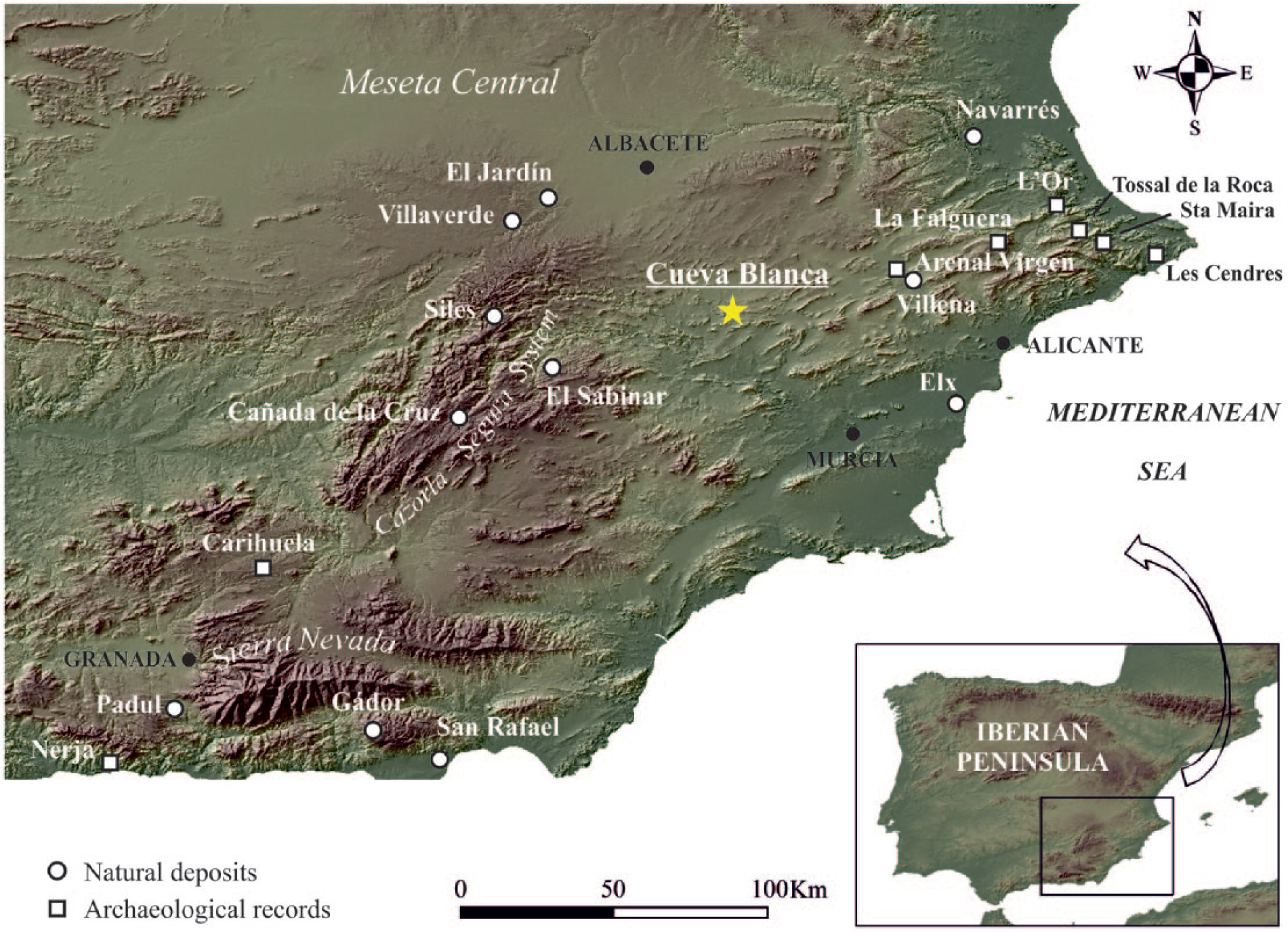
Location of Cueva Blanca rockshelter in the Iberian Peninsula regarding SE Spain Holocene pollen records (circles) and the Mesolithic sites (squares) which have provided archaeobotanical information.
Holocene vegetation dynamics in SE Spain
The record of the Holocene vegetation and environmental change in Mediterranean Iberia is reconstructed from palynological and anthracological records. Most of the pollen data are derived from sites located in mountainous areas above 800 m (e.g. Burjachs et al., 1997; Carrión, 2001, 2002; Carrión and Van Geel, 1999; Carrión et al., 2001b, 2003, 2004; Pantaleón-Cano et al., 2003; Pons and Reille, 1988; Yll et al., 2003; Figure 1). For lower altitudes, pollen information derives from archaeological contexts (Carrión et al., 1995, 1999; Dupré and Renault-Miskovsky, 1990).
Regarding anthracology, the vegetation history in the western Mediterranean region was first compiled by Vernet and Thiébault (1987) from contemporary works focussed on the charcoal records available in south-eastern France and Mediterranean Spain (Vernet, 1997). Since then, integrated anthracological and palynological research has increased our knowledge and understanding of the evolution of the Mediterranean woody plant communities as a result of the interaction between natural and human factors (e.g. Badal, 1990, 2002, 2006; Badal and Carrión-Marco, 2001; Badal and Roiron, 1995; Badal et al., 1994; Burjachs and Riera, 1995; Carrión-Marco, 2002, 2005; Carrión et al., 2010, 2012; González-Sampériz et al., 2010; Uzquiano and Arnanz, 1997; Yll et al., 1995).
When the Holocene vegetation dynamics derived from pollen and charcoal studies of SE Spain are examined in greater detail, we should note the early origin and development of deciduous and evergreen Quercus, according to records from the more northerly western Mediterranean sites (Badal and Roiron, 1995; Burjachs and Riera, 1995; Uzquiano and Arnanz, 1997; Vernet and Thiébault, 1987). Both plant ecosystems were already characteristic of the vegetation managed by early Holocene Mesolithic groups, replacing the previous conifer woods of Pinus nigra and Juniperus phoenicea (Aura et al., 2005; Badal, 1990, 2002, 2006; Carrión et al., 2010, 2012; Rubiales et al., 2010; Uzquiano and Arnanz, 1997). Evergreen oak woods are dominant from ca. 8 Ka BP, prior to the arrival of Neolithic populations. From ca. 7 Ka BP, evergreen oak communities are gradually replaced by the rapid spread of Pinus halepensis, Olea europaea and the Mediterranean scrub leading to a human-modified landscape (Badal, 2006; Badal and Roiron, 1995; Carrión et al., 2010, 2012).
The difficulties of interpretating pollen records from archaeological sites – including shelter and cave infills – such as post-depositional degradation, differential stratigraphic preservation and the possibility of reworking among other biases have been repeatedly highlighted (Bryant and Hall, 1993; Carrión et al., 2008; López-Sáez et al., 2003; Sánchez-Goñi, 1994). Charcoal is also subject to these constraints as it comes from the same sedimentary contexts. However, the radiocarbon dates that were obtained directly from this material help avoid the bad results from potential percolations of charcoal as well as those disturbed areas of excavation (Badal et al., 2003; Vernet, 1997).
Notwithstanding the existence of hiatuses from sedimentary discontinuities and the fact that both pollen and charcoal from archaeological sites are linked to human activities, for their interpretation these archaeobotanical data need to be compared with those obtained from regional pollen records from the area under consideration (Sánchez-Goñi, 1994; Uzquiano 1997).
Cross-disciplinary approaches using data from pollen and charcoal (including seeds, fruits and other plant macroremains) have long been recommended in a great number of works (e.g. Badal et al., 2003; Birks and Birks, 2000; Carrión et al., 2012; Uzquiano, 1997; Vernet, 1997) in order to enhance our knowledge about the landscapes which have resulted from a series of natural and human factors interacting over time.
This paper presents the first integrated archaeobotanical data from the site of Cueva Blanca resulting from an interdisciplinary research programme over the last 4 years (Mingo et al., 2012). One of the main objectives was the reconstruction of the vegetal landscape and woodland exploitation practices carried out in the ‘Campos de Hellín’ (SE Spain), a region so far devoid of archaeobotanical studies. Faunal remains, raw material and lithic industry will be included in order to show the possible human exploitation of the natural environment alongside the site-function of this settlement. On the other hand, the chronology obtained for Cueva Blanca may also contribute to the establishment of the Mesolithic settlement pattern in SE Spain, since this site is for the moment the first stratigraphically well-defined evidence of late Mesolithic occupation in this area. Lastly, archaeobotanical data allow us to investigate the nature of human occupation of the site connected to the record of human readjustments and adaptations in response to the Holocene climate variability.
The site
Geological and geographical setting
Cueva Blanca is located between the south-eastern border of the Meseta central (central plateau) and the eastern and northernmost part of the Baetic System mountain range (38°28′4′ N, 1°33′46″W; Elizaga et al., 1984; García et al., 1984) at 600 m a.s.l. (Figure 1). This area belongs to the Prebaetic mountain system of the External Baetic sector (Vera and Martínez-Algarra, 2004). Throughout this area there are outcrops of diverse materials such as clays, marls, evaporites, dolomite, limestone, conglomerates and sands from the Mesozoic which correspond to the filling of a sedimentary basin which formed during the fragmentation of the supercontinent of Pangea. These are followed by two Neogene sections composed of same materials above-mentioned and biocalcarenites among which those corresponding to the Serravallian-Lower Tortonian should be mentioned as they constitute the rocky support of the Cueva Blanca rockshelter (Elizaga et al., 1984; García et al., 1984; Mingo et al., 2012).
The Sierras de Enmedio, los Donceles, Candil and Cabeza Llana mountain ranges constitute the main orographic features of this area which is otherwise characterised by a gentle topography with isolated mountains lower than 800 m a.s.l. and separated by open valleys with slight slopes. The rivers Segura and Mundo are the major watercourses flowing through this area.
The site is a rockshelter about 35 m high and 5–8.5 m wide that opens to the southwest at the top of a rocky hillside known as ‘Cueva Blanca’, located on the right edge of a ravine (Mingo et al., 2012). The present day climate is continental-Mediterranean because of the transitional position of the site between the continental influences from the central Plateau and the semi-arid conditions of the Murcia-Almeria provinces (Rivas Martínez, 1982). The mean annual temperature reaches 15.2°C, with cold winters characterised by 5–6 months of sporadic frosts and warm summers with major droughts. Precipitation is mainly concentrated in spring and autumn, amounting to a mean annual rainfall of 351 mm; meteorological data were recorded by the weather station of Hellín, located 10 km away from the site (see Figure 2).

Climatogram of Hellín (province of Albacete) for the years 1999–2012 (Source: Spanish Agroclimatic Information System for Irrigation).
Present day vegetation around the site and in the surrounding mountains is dominated by Mediterranean scrub vegetation adapted to dry conditions and/or calcareous soils, such as Artemisia barrelieri Besser, Salsola genistoides Juss. ex Poir., Ephedra fragilis Desf., Retama sphaerocarpa (L.), Rhamnus lycioides L., Pistacia lentiscus and various species of the Thymelaea, Bupleurum and Genista genera. Open pine woodlands (Pinus halepensis Mill.) form the main tree vegetation in the area, extending especially on the northern slopes, although they also appear in valleys and depressions together with scattered individuals of kermes oak (Quercus coccifera L.). A considerable diversity of grasses, including Stipa parviflora Desf., together with the herbs Teucrium, Thymus, Sideritis, Helianthemum, Limonium and other taxa of the Labiatae, Malvaceae and Asteraceae families are also abundant in the area (Blanco Castro et al., 1997).
Stratigraphic record of Cueva Blanca
The stratigraphic record of the cave from bottom to top is defined by two main layers: Layer 2 (L2), some 50 cm deep, consists of detrital deposits of massive appearance and yellowish brown colour. It has been roughly estimated to be Pleistocene in age, according to sedimentological data of the site (Mingo et al., 2012).
The uppermost part, characterised by fine sands with occasional clasts, yielded several archaeological finds similar to those found in the overlying Layer 1. The lower part of this unit is devoid of signs of human occupation and is defined by numerous clasts and blocks.
Layer 1B (L1B) is composed of fine detritus material which occasionally might contain some sharp clasts, with a maximum diameter of 15 cm and 7–20 cm in thickness. Chronological data suggest a time span of about 1 Ka BP (see below) that corresponds to a late Mesolithic human occupation. The bulk of the archaeobotanical data reported in this paper derive from this layer.
Layer 1A (L1A) consisted of dark grey sediment, 3–7 cm thick, mainly composed of sand but also containing small clasts and silts. It was also characterised by a strong compaction of the sediment and, occasionally, by carbonate concretions. In the absence of radiocarbon dates, the estimated age points to continuous occupations ascribed to late Neolithic to Bronze Age, according to the archaeological finds.
Layer 0 (L0) comprised a surface layer about 3–8 cm thick, disturbed materials in which were several archaeological items from late prehistoric and historical periods together with abundant organic remains.
Chronology
Two AMS radiocarbon dates were obtained from different fragments of charcoal identified as Pinus halepensis, one from the lower and the second one from the upper part of layer 1B (Table 1). Conventional ages were calibrated using the IntCal04 curve (Reimer et al., 2004). Although the dated charcoal samples came from a long-lived tree, it must be noted that they were branch fragments and were associated with hearths which were fully within the context of Layer 1B. We also point out the finds of diagnostic artefacts, especially geometric microliths that fit perfectly with the late Mesolithic in Mediterranean Iberia. Therefore, the conditions of synchrony and archaeological association are fulfilled (Mestres, 2008). Consequently, radiocarbon ages derived from these samples showed a high degree of accuracy.
As regards possible hiatuses in the stratigraphic record, they could only be placed between Layers 1A and 1B, according to archaeological finds as mentioned above. Thus, the transition to the Neolithic has not been recorded at Cueva Blanca.
Archaeological setting of Layer 1B
Given the lack of evidence for human occupation in Layer 2 and the much more recent age of Layer 1A, our interest is mainly focussed on Layer 1B which has provided a well-stratified record of Mesolithic human occupation at this site that is well dated by radiocarbon.
Flint and quartzite are the main lithic raw materials recovered at the site. Scarce evidence of quartz and limestone were noticed as well. A number of flint outcrops are located within the ‘Campos de Hellín’ region such as Pedernaloso (Isso), Alcores (Mingogil), Camarillas (Agramón), Aldea del Maeso (Hellín) and Santiago de Mora, which could have served as sources for the raw materials. These localities are all between 5–10 km away, well within the site catchment area of Cueva Blanca which would have had a similar extent. Quartzite appears close by, in the boulders of the valley where the site is located (Mingo et al., 2012).
Signs of lithic industry are scarce and mostly defined by the presence of geometric elements (trapezoids; Mingo et al., 2012). The recovered faunal remains were dominated by Oryctolagus cuniculus (rabbit). However bones of small ungulates have also been recovered, confirming the presence of macrovertebrates. The presence of charred bones may be related to their consumption (Mingo et al., 2012).
Malacofauna (mollusc) remains account for at least 26 individuals, most of them adults, of the Sphincterochila sp. genus, probably S. candidissima (Avezuela, unpublished data). This taxon has a significant bromatologic potential and lives in sunny exposures of limestone outcrops located in arid climates (Moreno, 1994).
The scarce lithic and faunal assemblages suggest sporadic seasonal occupation mainly for the hunting of lagomorphs and small ungulates. The poor preservation of faunal remains does not allow for the determination of patterns of seasonality in the Mesolithic period. However, malacofaunal remains indicate that occupations may have taken place in either spring or autumn, coinciding with their reproductive cycles (Moreno, 1994). Moreover, it is in these same seasons when rainfall is frequent in the area (Figure 2) and snails are commonly collected after rains.
Materials and methods
Pollen
Nine pollen samples were taken from a vertical section 45 cm deep at 3–8 cm intervals (Girard and Renault-Miskovsky, 1969). Extraction of palynomorphs from the sediments followed the standard procedures in palynology (Fægri and Iversen, 1989; Goeury and De Beaulieu, 1979) and identifications were based on Moore et al. (1991) and Reille (1992), together with the reference collection of the Laboratory of Palynology Alicontrol S.A. Pinus nigra type was separated from the rest of the pines by its smaller 50–55 µm equatorial diameter (Carrión et al., 2000). Non pollen palynomorphs (NPPs) were identified sensu Van Geel (1976) and Van Geel and Aptroot (2006); pollen diagram was plotted with Tilia software (Grimm, 1991-2011). In each of 9 pollen samples collected, about 200 pollen grains were counted and percentages of each taxon were obtained from this pollen sum excluding those of the NPPs. The pollen zones were defined following the archaeological stratigraphic units which are consistent with the changes observed in the main vegetation components. Pollen concentration was low (between 195 and 1494 pollen grains per gram of sediment), a common feature of samples from archaeological sites as mentioned above (Bryant and Hall, 1993; Carrión et al., 2008; López-Sáez et al., 2003; Sánchez-Goñi, 1994). However, the pollen sum and diversity obtained show a pollen deposition characteristic of this area of the western Mediterranean region.
Charcoal
The bulk of the charcoal samples were systematically retrieved from the sediments excavated in layer 1B (2500 L) by using a combination of manual flotation, sieving and hand-sorting of the organic material found in the sieves (Badal et al., 2003; Théry et al., 2010; Uzquiano, 1997). No other plant macroremains were found during these processes. Charcoal was fractured by hand along the three anatomical observation planes following the identification keys for both non-charred (Greguss, 1955; Jacquiot, 1955; Jacquiot et al., 1973; Schweingruber, 1990) and charred wood (Vernet et al., 2001).
Nomenclature for both pollen and charcoal analyses follows the guidelines of Flora Europaea (Tutin et al., 1964).
The charcoal recovered clearly represents the remains of firewood from domestic hearths used during the human occupations of Cueva Blanca. These remains appeared dispersed throughout the sediment alongside other archaeological finds resulting from the activities of the Mesolithic inhabitants. Despite the systematic sampling which was carried out, the total number of fragments obtained has been low, which is consistent with the low density of archaeological finds recovered and the short-term character of the occupations.
Given the limitations in interpreting the floristic data from archaeological sites (Sánchez-Goñi, 2006; Uzquiano, 1997), both pollen and charcoal data of Cueva Blanca have been discussed following the major palaeoecological events recorded in lakes and peats sediments of SE Spain (Figure 1).
Results
Pollen
The study allowed the identification of 35 pollen taxa, of which 11 were arboreal, seven shrubs and 17 herbaceous. Some fern spores and NPPs were also recorded, Glomus cf. fasciculata, Pseudoschizaea and fungal spores being the most representative examples (Figure 3). Relative pollen percentages of trees, shrubs and herbs show fairly constant values throughout the sequence, as well as the wetland group which has low percentages and small variations throughout the sequence.

Pollen diagram of Cueva Blanca.
The base of the sequence (L2) is characterised by high percentages of Asteraceae type (Tubuliflorae). Pines, evergreen Quercus, Ephedra, Cistaceae and Fabaceae are the most representative taxa together with low and discontinuous values of Juniperus, Betula, deciduous Quercus, Corylus, Salix, Olea, Ericaceae, Rosaceae and the wetland plants (Figure 3).
Zone L1B (Mesolithic layer) is further divided into L1B and L1Bα. Zone L1B retains some continuity with the previous layer (L2) regarding taxa representation. On the other hand, the discontinuous and fluctuating values recorded by wetland plants are worth mentioning. Zone L1Bα in turn shows some variations involving the simultaneous decrease of Pinus nigra type, Ephedra, Cistaceae and Asteraceae Tubuliflorae and an increase of Amaranthaceae, Poaceae, Lamiaceae, Boraginaceae, Cichorioideae and Plantago lanceolata (Figure 3).
Towards the upper part of zone L1A, Pinus nigra type decreases, Fraxinus and Juglans have a slight presence and the diversity of herbaceous pollen continues to rise comprising Asphodelus, the Cerealia type, Artemisia, Astragalus and Armeria. Olea, evergreen Quercus and the varieties of NPPs also show a sharp increase in percentage (Figure 3).
Charcoal
The most complete charcoal information comes from Layer 1B (Table 2). The charcoal assemblage (Figure 4) shows a significant diversity of shrubby-type vegetation around the site. Rhamnus lycioides is the dominant element, together with lower values of Arbutus unedo, Pistacia lentiscus, Calicotome and Fabaceae (close to broom-type wood anatomy). Pinus halepensis is the main tree species exploited although its percentages are somewhat lower in comparison with those of Rhamnus. Scarce amounts of Quercus ilex-coccifera, Juniperus phoenicea and deciduous oak (Quercus faginea type) were also recorded.
Detailed charcoal data of Cueva Blanca.


Charcoal histogram of Cueva Blanca.
Discussion
Vegetation dynamics
Vegetation types indicated by the archaeobotanical data correspond to a Mediterranean open coniferous woodland, defined by its low density as shown by the high percentages of non arboreal taxa. The main arboreal components are the pines, mostly Pinus halepensis according to the charcoal data from the site, although Pinus pinaster cannot be excluded as it has been also found by pollen analysis at nearby sites with similar biogeographic characteristics (Carrión et al., 2000). Pinus nigra type is also recorded in the pollen diagram. This taxon has been identified in charcoal analyses at a neighbouring site, Pico Tienda III, only 8 km from Cueva Blanca and located in a similar biogeographical context and altitude (Uzquiano, unpublished data). This finding may indicate the persistence of some relicts of black pine that were scattered nearby.
The permanence of Pinus since the late Glacial and during the mid-Holocene has been highlighted by the pollen record of the region (Figure 1; Carrión et al., 2010, 2012; Pérez-Obiol et al., 2011; Rubiales et al., 2010). This is related to the ecologies of these well-established vegetation types and to the existence of dry local conditions (Carrión et al., 2001a).
Charcoal data from other archaeological sites in the western Mediterranean region (Figure 1) reported several species of pines, Pinus nigra, P. halepensis and P. pinea. These plant communities were largely exploited by prehistoric groups throughout the Valencia and Alicante coastal and pre-littoral areas since the late Glacial and even in earlier periods (Badal, 1990; Badal and Carrión-Marco, 2001; Carrión-Marco, 2002, 2005; Uzquiano and Arnanz, 1997; Vernet and Thiébault, 1987). Regarding the pine species, black pinewoods were established since MIS 3 at lower altitudes covering the N–S western Mediterranean sector from Languedoc to Andalusia (Badal and Carrión-Marco, 2001; Carrión et al., 2010; Vernet, 1997). Their percentage values experienced different fluctuations related to late Pleistocene environmental conditions (LGM, late Glacial) and gradually decreased during the early Holocene, whereupon this taxon disappears from lower and middle altitudes (Badal, 2006). The decreasing values of black pine pollen type recorded at Cueva Blanca are therefore consistent with the wider palaeobotanical record for SE Spain, probably reflecting the last moments of these tree clumps at lower altitudes in the area of study.
Pinus halepensis has also been recorded in SE Spain since the upper Pleistocene, especially in the coastal prehistoric sites of Alicante and Málaga provinces. This taxon appears in the Pleistocene at very low values and always in association with Pinus nigra and P. pinea (Badal, 1990, 2002; Badal and Carrión-Marco, 2001; Badal and Roiron, 1995; Badal et al., 1994; Carrión-Marco, 2002, 2005). By contrast, it becomes abundant in the Holocene from 7.2 Ka BP, when this taxon seems to begin its expansion from coastal to inland areas (Badal, 2006). Hence, Aleppo pine charcoal data recorded in Cueva Blanca is also consistent with the charcoal record for SE Spain.
Deciduous and evergreen oaks were undoubtedly part of the natural vegetation. Nevertheless, considering their weak signals in the pollen diagram and the low frequencies recorded in the charcoal analysis, the presence of these plant communities were not as abundant here as they appear to have been in the Mesolithic charcoal record of the Spanish Levant (Badal, 2006). The geographical position of Cueva Blanca played a decisive role in the aforementioned persistence of pine woods in Mediterranean inland areas of Iberia (Rubiales et al., 2010).
The representation of Betula pollen in the first half of the sequence is particularly significant. Currently, the nearest woodland areas with Betula pendula, (Roth) are in the Sierra de Cazorla (Jaén; Blanco Castro et al., 1997). The presence of Betula could be related to the wetland and other mesophilous taxa (deciduous Quercus, Corylus and Salix), all of them indicative of optimal moisture conditions close to the ravine at the time Cueva Blanca was inhabited. However, their frequencies are low and discontinuous throughout the Mesolithic occupation, indicating the extremely fragile balance between water resources and human occupation in the area. These values practically disappear at the top of the sequence diagram at the same time as the subsequent abandonment of the site.
Similarly, the catchment area of Cueva Blanca also incorporated treeless patches shown by a great variety of shrubs: Ephedra, Cistaceae, Rhamnus lycioides, Erica sp. Prunus sp., Pistacia lentiscus, Arbutus unedo, Calicotome and Fabaceae, most of which were exploited by the Mesolithic inhabitants. Scrub has been indicated by charcoal analyses from the late Glacial and the early Holocene at some prehistoric sites located in the western Mediterranean basin (Badal and Roiron, 1995; Uzquiano and Arnanz, 1997; Vernet, 1997; Vernet and Thiébault, 1987). The presence of scrub indicates the open environment character of the local vegetation.
Firewood supply areas, logistical mobility and site-function
When the present day topographic and biogeographic features are considered, most of the woody taxa identified by pollen and charcoal analyses could have been found in the vicinity of Cueva Blanca. Aleppo pines would have grown up in the nearby slopes, together with scattered juniper and shrubby vegetation. Deciduous and evergreen Quercus were also locally present in the area according to substrate type and slope orientation, shaded or sunny. Charcoal data therefore suggest that firewood was collected from an area of about 1–2 km around the site. Similarly, hunting would mainly have been done within this radius and probably slightly beyond it. Finally the search for raw material, particularly flint, would complete the extent of the resource catchment area to 5–10 km around the site.
Woodland exploitation was mainly dominated by shrubs. Their use would have provided enough fuel biomass to supply domestic hearths for the Mesolithic populations living in open environments with very limited tree cover; this vegetation cover would also suggest short seasonal human occupations at Cueva Blanca. The ensemble of scrubby vegetation identified in the charcoal data possesses a high flammability potential and rapid combustion, both traditionally well-known qualities appreciated by shepherds when they make a stop in their itinerant movements with their cattle (Aseguinolaza et al., 1989). The use of shrubs has usually been associated with livestock activities (Badal, 2002; Uzquiano, 2002) although hunter-gatherers have also made an extensive use of these plant communities, especially when there were unfavourable environmental conditions for human occupation such as in northern Iberia during the Upper Pleistocene (Uzquiano, 2014). Rhamnus lycioides stands out among the shrubs which were exploited. This shrub covers much of SE Spain from thermo-Mediterranean to supra-Mediterranean vegetation units (0–1200 m a.s.l.) in sunny areas without severe frosts, under semi-arid to sub-humid ombroclimates. It grows among other scrub and as undergrowth of kermes oak forests and scattered pine woods. It is indifferent to the nature of substrate, growing on both calcareous and siliceous soils and frequently on rocky areas (Blanco Castro et al., 1997). This shrub is present in the scrubland surrounding the site and it is also characteristic of the whole ‘Campos de Hellín’ region. The local rural tradition exemplifies its use to build chicken coop walls and fences, as well as for making clappers for cowbells, highlighting some livestock practices. Its good qualities as fuel make it a favoured firewood and raw material for charcoal. This taxon is well documented in SE Spain (Valencia and Murcia) by anthracology, particularly in later prehistory (Grau, 1990), although possible evidence of this shrub was also noticed in Palaeolithic sites (Soler et al., 1990).
This occupation layer shows evidence for the hunting of lagomorphs and small ungulates in relatively short periods of occupation which were probably restricted to the spring or autumn season according to the rainfall regime (Figure 2). Malacofaunal remains show that snails were probably gathered for consumption after the rains as is still usually done by village people. The nature of these human occupations is well supported by the slight variations experienced in tree, shrub and herb relative pollen percentages which indicate a weak human impact on the vegetation, although the presence of Amaranthaceae, Poaceae, Lamiaceae, Boraginaceae, Cichorioideae and Plantago lanceolata may be linked to some human activities probably connected to grazing in the area.
The presence of Asphodelus, Cerealia, Artemisia, Astragalus and Armeria towards the top of the sequence (L1A) more clearly denotes an intensification of the human influence on the landscape supported by the presence of the NPPs Glomus cf. fasciculata, Pseudoschizaea and fungal spores, all of them indicative of soil erosion and woodland clearance processes. These data may indicate the existence of agricultural activities already established in the region; however, these should occur substantially later according to the chronology of this layer which is based on archaeological finds recovered (see Chronology).
Late Mesolithic adaptations to global environmental changes at Cueva Blanca
The chronology of layer 1B (8450–8370 and 7660–7560 cal. BP) together with the vegetation cover inferred, provides much-needed data on the impact of the 8.2 ka cal. BP cooling event and the later increase in aridity in the environment inhabited by late Mesolithic groups at Cueva Blanca.
The open character of the vegetation indicated by the archaeobotanical studies, as well as the presence of xerophytes, specifically the continuous curve of Ephedra pollen, coincides with the cool-arid conditions prevalent in the area at this time. Simultaneously, the wide variety of shrubs recorded by charcoal analysis indicates a high potential for fuel biomass, together with a large number of plant and animal resources among the various vegetation types growing in the Mediterranean region (Badal, 2006; Vernet, 1997). Shrub abundance facilitated the settlement of human occupation despite the scarce tree cover and highly arid conditions recorded. Furthermore, the scattered and discontinuous presence of mesophilous trees and wetland plants may indicate the existence of some moist conditions related to water resources in the irregular rainfall regime of the ‘Campos de Hellín’ area. These taxa were within the catchment area of the site. Therefore the data clearly suggest that fluctuating water resources determined the nature of the Mesolithic occupation recorded in layer 1B, in the form of short and strongly seasonal settlements as seen in the scarce lithic material and faunal assemblages recovered from this layer.
The trend observed towards the top of the pollen sequence (layer 1A) suggests that once water resources dwindled and disappeared, the site was abandoned (Figure 3). Nonetheless, the archaeological finds recovered here indicate that more recent human occupations occurred at various times after the Mesolithic period. It is likely that the Mesolithic occupation was interrupted at Cueva Blanca by 7.6–7.5 ka cal. BP as a result of environmental factors, which would be in accordance with the aforementioned abandonment pattern of other Mesolithic sites in Mediterranean Iberia (Cortés et al., 2012; López de Pablo and Jochim, 2010). However, cultural factors related to the origin of the Neolithic in this area (Pico Tienda III, Mingo et al., ongoing research) must have also played a crucial role in Mesolithic lifestyle (López de Pablo and Jochim, 2010).
Conclusion
The cross-disciplinary approach used for Cueva Blanca has provided new insights both for archaeobotanical studies and for Mesolithic settlement in an inland location of south-eastern Spain (Campos de Hellín, Albacete), a region which hitherto has been lacking in archaeological evidence for the Mesolithic period. The integrated study presented here draws a regional picture of the natural vegetation and the human activities during the time period covering the global 8.2 ka cal. BP event.
The record of vegetation change inferred by archaeobotanical studies at Cueva Blanca is essentially consistent with the broader scale record of Holocene western Mediterranean vegetation dynamics, although the presence of pines and the predominantly open environment character was a response to the inland geographical location of this site. Similarly, the dry and arid conditions, also inferred from the results of this study, are mostly associated with the increased aridity which occurred after the 8.2 ka cal. BP cooling event.
Although these environmental constraints did not prevent the settlement of human occupations, they did determine their short and strong seasonal character, which is reflected in the lithic and faunal remains recovered, thereby indicating the degree of adaptation by humans living in an extremely changing environment.
The wide variety of shrubs exploited at and around the site ensured on the one hand enough fuel biomass for domestic fires, considering the large potential of this vegetation in the Mediterranean region. However on the other hand, the irregular availability of water resources allowed for the existence of additional firewood taxa and animal resources which were also exploited by Mesolithic populations. Once these water resources decreased, the site was subsequently abandoned in L1A.
However, the lithic industry recovered in the undated layer 1A has shown later human occupations. The Mesolithic settlement was probably interrupted around 7500 cal. BP as a consequence of the persistent aridity. This momentary abandonment coincides with the first evidence of the Neolithic which started to appear near to the site (Mingo et al., ongoing research) and in other locations in south-eastern Spain (López de Pablo and Jochim, 2010). Further investigations are therefore necessary in order to assess how, when and where this transition to the Neolithic in the ‘Campos de Hellín’ region effectively took place.
Footnotes
Acknowledgements
We would like to thank J. Domínguez, Director of ‘La Escarihuela’ rural lodging for his kindness support to this project. The authors also thank the anonymous referees for their compliments, insightful comments and suggestions that significantly improved this work. Last but no least our gratitude to Aixa Vidal for her assistance with the English text in its first submission and to Dr. James Greigg (UK) for the improvement of its final version.
Funding
This work was financed by the project ‘La transición del Epipaleolítico al Neolítico en Campos de Hellín y la cuenca del Río Mundo: modelos de poblamiento, reconstrucción virtual y difusión del patrimonio’, which is part of the programme developed by the Dirección General de Patrimonio Cultural de la Consejería de Cultura, Turismo y Artesanía of the Junta de Comunidades de Castilla-La Mancha to study the historical heritage of this region (Exp: 100925). This research was also supported by the ‘Plan de Promoción de la Investigación de la UNED’ (2010V/PUNED/0007).